INTRODUCTION
Children typically acquire their native language naturally and spontaneously at a very young age. The emergence of early grammar can be predicted from children's vocabulary size and composition (Bates et al., Reference Bates, Marchman, Thal, Fenson, Dale, Reznick, Reilly and Hartung1994; Bates, Bretherton & Snyder, Reference Bates, Bretherton and Snyder1998; Bates & Goodman, Reference Bates and Goodman1997). One central question in language research is understanding what causes the changes in early language acquisition. Some researchers argue that the qualitative and quantitative shifts in word learning simply reflect the changing character of the child's cognitive maturity (for example, Gentner, Reference Gentner and Kuczaj1982), while others argue that the trajectory of early language acquisition is driven by the child's growing familiarity with the language (Gillette, Gleitman, Gleitman & Lederer, Reference Gillette, Gleitman, Gleitman and Lederer1999; Snedeker & Gleitman, Reference Snedeker, Gleitman, Hall and Waxman2004). These hypotheses are difficult to adjudicate because language acquisition in virtually all hearing children begins from birth and occurs simultaneously with cognitive development and brain maturation. The acquisition of sign languages, in contrast, is frequently delayed until older ages. In the USA, over 90% of deaf children are born to hearing parents who do not use sign language (Schein, Reference Schein1989). As a result, deaf children are often exposed to sign language as a first language at a range of ages well beyond infancy (Mayberry, Reference Mayberry2007). In rare cases, some deaf individuals are isolated from all linguistic input until adolescence when they start receiving special services and begin to learn sign language through immersion (Morford, Reference Morford2003). Case studies of language acquisition in such extreme late first-language (L1) learners provide a unique opportunity to investigate first-language learning. The current study investigates three cases of young teens who are in the early stages of acquiring American Sign Language (ASL) as a first language, to determine what first-language acquisition in adolescence looks like.
Although the exact sequence and content of early language development varies somewhat from language to language, some universal principles seem to be followed, such as the existence of a noun bias, and the relationship between vocabulary size and grammatical complexity. These characteristics of early language learning have been documented in normally developing children cross-linguistically, as well as in atypical populations, such as early talkers, children with Williams and Down Syndrome, and children with focal brain injury (Bates & Goodman, Reference Bates and Goodman1997). Furthermore, these principles have been shown to be independent of the modality through which the language is conveyed: spoken or signed.
Like other sign languages, ASL is linguistically equivalent to spoken languages and obeys linguistic rules at the level of phonology, morphology, syntax and semantics (Klima & Bellugi, Reference Klima and Bellugi1979; Sandler & Lillo-Martin, Reference Sandler and Lillo-Martin2006). It is thus not surprising that when begun at birth, the acquisition patterns for ASL parallel those of spoken languages with respect to the timing and content of linguistic milestones (Anderson & Reilly, Reference Anderson and Reilly2002; Mayberry & Squires, Reference Mayberry, Squires and Brown2006; Newport & Meier, Reference Newport, Meier and Slobin1985; Reilly, Reference Reilly, Schick, Marschark and Spencer2006). In a study of five infants, Petitto and Marentette (Reference Petitto and Marentette1991) found that deaf infants who are exposed to sign language from birth produce manual babbling at 6 to 12 months, which corresponds to the age of onset of vocal babbling in hearing infants. First signs, like first words, are typically produced around the age of 10 months and denote objects and people closely related to the child's experience (Mayberry & Squires, Reference Mayberry, Squires and Brown2006). In a longitudinal, combined observational and diary study of eleven children exposed to ASL from birth, Bonvillian, Orlansky and Novack (Reference Bonvillian, Orlansky and Lazin Novack1983) found the number of early signed words acquired increased steadily in a fashion comparable to early spoken word acquisition over the first 30 months of life. They found that early acquired signs are overwhelmingly nouns as compared to predicates. In a normative study using the MacArthur-Bates Communicative Developmental Inventory for ASL on a sample of sixty-nine deaf children of deaf parents, Anderson and Reilly (Reference Anderson and Reilly2002) identified a series of parallels between the acquisition patterns of ASL and English. Although the two languages are distinct, with ASL having significantly more inflectional morphology than English (Sandler & Lillo-Martin, Reference Sandler and Lillo-Martin2006), two-word combinations in both ASL and English begin to appear only after the child can reliably produce 50–100 words. In both ASL and English, grammatical words are acquired after a critical mass of content words has been learned (Anderson & Reilly, Reference Anderson and Reilly2002; Bates & Goodman, Reference Bates and Goodman1997). Although the proportion of predicates in early ASL vocabularies tends to be higher than in English, which may be attributed to its use of pro-drop and highly inflected verbs, children acquiring ASL or English exhibit a clear noun bias which begins to disappear as more predicates enter the lexicon. Further, vocabulary size predicts utterance length in both languages. This indicates that lexical and syntactic development are intertwined regardless of language modality (Bates et al., Reference Bates, Marchman, Thal, Fenson, Dale, Reznick, Reilly and Hartung1994; Anderson & Reilly, Reference Anderson and Reilly2002).
A small percentage (less than 10%) of American deaf children are born to deaf parents and thus acquire sign language from birth (Schein, Reference Schein1989). For the remaining 90% of deaf children who are born to hearing parents, sign language exposure and acquisition begins at a range of older ages determined by several educational, cultural and familial factors, but not biological ones. For example, a school that uses sign language may not be accessible to the family, or the child may not have been enrolled in school at all until an older age. As is the case for hearing children's acquisition of spoken language (Huttenlocher, Vasilyeva, Cymerman & Levine, Reference Huttenlocher, Vasilyeva, Cymerman and Levine2002), the quantity of sign language input deaf children receive in childhood affects their acquisition rate (Lederberg & Everhart, Reference Lederberg and Everhart1998; Spencer, Reference Spencer1993).
In rare cases, deaf individuals are linguistically isolated until adolescence; they cannot hear spoken language and, due to social and other factors, they have not been exposed to any kind of sign language. Unlike most deaf children, these individuals have experienced limited schooling and received very little or no language input of any kind (spoken, written or signed) throughout childhood. After they are ‘identified’, they begin receiving special services and, if resources are available, may become fully immersed in sign language. Such deaf cases are unique because they have been linguistically isolated until adolescence, at which point they become immersed in sign language for the first time. We ask how these adolescent L1 learners begin to acquire language. Do they begin where young hearing children begin, or do they bypass some stages in acquiring their language due to the fact that they are cognitively more mature when first encountering language? If language acquisition in older learners shows a similar pattern as what we see in young children, we can conclude that at least some of the principles driving the language acquisition process are age-independent. The answer to this question is important because it furthers our understanding of the mechanisms underlying language acquisition in general. Previous research has explored the question of language acquisition in older learners using four different approaches, which we discuss below.
The first approach involves experimental studies on language processing in lifelong users of sign language. These studies consider various aspects of language processing in adults whose first-language acquisition began at a variety of ages past infancy, but who have been using sign language for at least twenty years. Results consistently indicate a negative correlation between the age onset of sign language acquisition and ultimate proficiency (Mayberry & Eichen, Reference Mayberry and Eichen1991; Newport Reference Newport1990). For example, Mayberry and Eichen (Reference Mayberry and Eichen1991) used a sentence recall task with forty-nine deaf lifelong signers who began ASL acquisition at a variety of ages, and found that age at onset of acquisition (AoA) had significant effects on performance at all levels of linguistic structure. Importantly, AoA effects on L1 are unlike those documented to exist in second language (L2) learning (Birdsong, Reference Birdsong1992; Flege, Yeni-Komshian & Liu, Reference Flege, Yeni-Komshian and Liu1999). Mayberry and Lock (Reference Mayberry and Lock2003) found in a study with fifty-four participants of varying language backgrounds, that learning an L2 at an older age can result in native-like proficiency, but acquiring an L1 at an older age results in attenuated proficiency and linguistic deficits across all languages subsequently acquired, regardless of modality. It is important to note that these studies, while crucial in demonstrating the severity of the effects of delayed language acquisition, do not directly address the question of how a first language is acquired at an older age.
The second approach to studying whether later language acquisition is similar to early acquisition is to investigate cases of international adoption (Pollock, Price & Fulmer, Reference Pollock, Price and Fulmer2003; Roberts, Pollock, Krakow & Price, Reference Roberts, Pollock, Krakow and Price2005; Snedeker, Geren & Shafto, Reference Snedeker, Geren and Shafto2007). Internationally adopted children typically begin acquiring a first language in their country of origin, but then become monolingual speakers of another language upon adoption in a new country. In a study of two toddlers adopted from China, Pollock et al. (Reference Pollock, Price and Fulmer2003) found that age at adoption was negatively related to the rate of phonological acquisition, vocabulary acquisition and syntactic development during the first two years following adoption. However, Roberts et al. (Reference Roberts, Pollock, Krakow and Price2005) studied fifty-five children adopted from China and found that the majority soon catch up with their monolingual peers, scoring within the normal range on standardized language tests by preschool age. Because the age of onset of language acquisition in internationally adopted children varies, Snedeker et al. (Reference Snedeker, Geren and Shafto2007) conducted a study with twenty-seven children adopted from China and asked whether older adoptees follow the same general pattern of language acquisition as infants who begin to acquire a single language from birth. Interestingly, Chinese adoptees who began to acquire spoken English at a later age (between ages 2 ; 7 and 5 ; 1) followed the same early language acquisition path, with respect to sequence and content, as did monolingual toddlers acquiring English from birth. Based on these results, Snedeker and colleagues (Reference Snedeker, Geren and Shafto2007) concluded that early word acquisition must, at least in part, be driven by an age-independent process. Note, however, that internationally adopted children have already begun to acquire a language from birth, although they switched acquisition to another language following adoption. International adoption has thus been characterized as ‘second first-language acquisition’ (Roberts et al., Reference Roberts, Pollock, Krakow and Price2005), and its outcomes might differ significantly from those arising from very late exposure to linguistic input of any kind.
The third way of studying language acquisition begun at older ages is to consider cases of social isolation and/or abuse. Case studies by Koluchova (Reference Koluchova1972) and Fujinaga, Kasuga, Uchida and Saiga (Reference Fujinaga, Kasuga, Uchida and Saiga1990) suggest that victims of language deprivation who were exposed to linguistic input before the age of seven years eventually overcome their delays to develop a linguistic competence comparable to their peers. Victims of social isolation who have been rescued after puberty, on the other hand, are reported to follow a different course of linguistic development. The case study known as Genie, who was physically isolated from the outside world until she was 13 ; 7, was reportedly able to use limited vocabulary to form basic sentences, but her grammatical structures were inconsistent and atypical even eight years after her rescue (Curtiss, Reference Curtiss1976).
The fourth source of information on language acquisition begun at a later age is provided by case studies of deaf individuals who were born to hearing parents and were linguistically isolated because of their deafness. Due to a variety of factors, these children were not exposed to language input until adolescence or adulthood, when attempts to teach them a spoken or a signed language were undertaken. Case studies of two deaf adolescents acquiring a spoken language have found that they produce variable word order and almost no inflectional morphology (Curtiss, Reference Curtiss and Newmeyer1988; Grimshaw, Adelstein, Bryden & MacKinnon, Reference Grimshaw, Adelstein, Bryden and MacKinnon1998). From these data, researchers have argued that adolescents' lexical development is advanced compared to their syntactic development (Curtiss, Reference Curtiss and Newmeyer1988; Grimshaw et al., Reference Grimshaw, Adelstein, Bryden and MacKinnon1998). It should be noted, however, that the research focus of these studies was on the development of syntactic skills and that the lexicon of these adolescent learners was not investigated. Further, these results should be interpreted with caution because spoken language input may not have been accessible to these deaf learners at a level that would allow normal language acquisition.
Morford (Reference Morford2003) observed the linguistic development of Maria and Marcus, two deaf adolescents who immigrated to North America with their families at ages 13 ; 7 and 12 ; 1, respectively. In their countries of origin Maria did not attend school and Marcus attended a hearing school for a short period of time. Like some other deaf children who acquired little functional language in early childhood, Maria and Marcus developed and used home-sign. Home-sign consists of combinations of points and idiosyncratic gestures generated by the child to communicate with family members (Goldin-Meadow, Reference Goldin-Meadow2003). Morford studied the two adolescents longitudinally on a narrative retell task using the story Frog, Where are You? (Mayer, Reference Mayer1969) and observed significant gains in their grammatical ability over time: their mean utterance length increased from an average of 3·3 signs after two months of ASL exposure to 8·3 signs after 31 months of exposure. Both adolescents had replaced most of their gestures with ASL signs and showed a significant increase in non-verbal IQ scores (Morford, Reference Morford2003). However, comprehension tests after seven years of ASL exposure showed persistent comprehension problems, with performance levels being only slightly above chance. Maria's and Marcus' lexicons were not studied in detail, and it is unknown what kinds of words they acquired in their first years of exposure to ASL, or whether their vocabulary size was related to the length and complexity of their utterances.
Emmorey, Grant and Ewan (Reference Emmorey, Grant and Ewan1994) studied the linguistic abilities of another home-signer who was first exposed to ASL at age sixteen years. At the end of the study, after 9 months of exposure, this individual communicated predominantly through the use of ASL signs. Her vocabulary at that point was estimated to consist of over 500 signs, which is comparable to a three-year-old typically developing deaf child (Anderson & Reilly, Reference Anderson and Reilly2002).
In sum, our understanding of how later exposure to language affects language acquisition in its beginning stages is primarily limited to adoption studies, as studies of other late-learning populations have focused on different aspects of language learning. To date, case studies of linguistic isolation have not systematically investigated how older individuals begin to acquire their first language. Studies of language acquisition in deaf late learners are theoretically important because they provide a unique opportunity to study what language acquisition looks like when it is not confounded by the factors of cognitive immaturity or child abuse. Additionally, understanding beginning language acquisition in late learners can illuminate the origin of the deleterious effects of late L1 acquisition on adult language processing (Mayberry, Reference Mayberry2007; Morford, Reference Morford2003).
The current study is the first known one to systematically investigate early first-language acquisition begun in adolescence. We ask how adolescent first-language learners compare to typically developing deaf children of deaf parents in terms of their vocabulary size and composition, and what kinds of sentences they produce in spontaneous conversation. First, we ask if their initial ASL vocabulary is childlike or atypical compared to normative data for deaf children acquiring ASL from birth. Second, we ask if adolescent L1 learners can take advantage of their cognitive maturity and begin producing complex multiword utterances more quickly than do young children with comparable vocabulary sizes.
METHODS
Cases
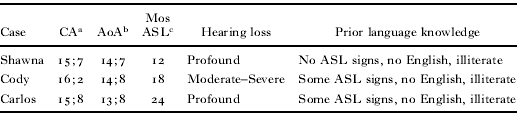
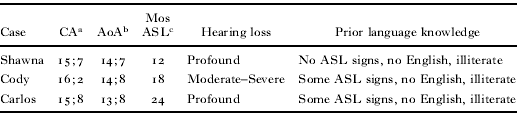
Three deaf adolescent first-language learners were studied. These adolescents had, at age ∼14 years, just begun to acquire ASL, their first language. They were given the pseudonyms Shawna, Cody and Carlos to maintain confidentiality. At the time of testing, the three adolescents resided together at a group home for deaf students with two other deaf adolescents who were not included in the study. The group home was staffed and managed by deaf and hearing professionals, all highly proficient ASL signers, who worked with the adolescents every day exclusively in ASL. The adolescents thus became fully immersed in ASL upon placement in the group home. Background information (Table 1) was collected in the form of a questionnaire filled out by a social worker who knew them well after having worked with them for several hours daily from their initial arrival.
Background characteristics of the cases
a Chronological age.
b Age of onset of ASL acquisition, equivalent to placement to group home.
c Number of months of immersion in ASL.
Background information
The information regarding the cases' schooling and communicative strategies in childhood is sparse. Upon placement in the group home when they began receiving special services in sign language, they knew few if any ASL signs. They had no knowledge of any spoken language, and were illiterate. Due to a number of different circumstances, each had received little or no schooling prior to placement in the group home. Shawna's guardians were hearing and did not use any sign language, and she was reportedly kept at home until age ∼12 years. Prior to first receiving special services at age 14 ; 7, she had attended school for a total of 16 months, during which time she was placed in a number of deaf and hearing schools. Before receiving special services in ASL, she relied on behavior and very limited use of gesture to communicate. Cody lived with his legal guardian who was hearing and did not use any sign language. He first began to attend school at the age of 5 years, but the type of educational program is unknown. It is also unknown how he communicated with his guardian or his teachers. Upon receiving special services at age 14 ; 8, Cody knew only a few basic ASL signs, and relied primarily on pointing and some use of gesture to communicate. Carlos was born in another country and lived there until the age of 11 years with his parents and family who were hearing. In his home country he was enrolled in a deaf school but soon stopped attending because the school was of poor quality, according to parental report. At age 11 years, he immigrated with his family to the United States, and was placed into a classroom for mentally retarded children where the use of sign language was very limited. Upon receiving special services at age 13 ; 8 he knew only a few ASL signs, and relied on some use of pointing and gestures to communicate.
It is unknown whether Shawna, Cody or Carlos had ever developed a home-sign system to communicate with their caregivers. However, the professionals (deaf and hearing native signers) who have worked with them since their initial arrival at the group home believed that this is unlikely because the cases were not observed to use home-sign to communicate with deaf peers or adults. Unlike some home-signers discussed in the literature (for example, Morford, Reference Morford2003; Emmorey et al., Reference Emmorey, Grant and Ewan1994), these cases were not raised in typical nuclear families, and may not have had stable interlocutors for extended periods of time prior to placement in the group home and receipt of special schooling. They can thus be described as linguistic isolates who became fully immersed in ASL in adolescence. At the time of the study, the three cases had been receiving consistent ASL input both in and out of school for a period of 1 to 2 years (see Table 1).
Cognitive testing
A few weeks prior to the initial testing session the participants were administered the Test of Nonverbal Intelligence, Third Edition (TONI-3; Brown, Sherbenou & Johnsen, Reference Brown, Sherbenou and Johnsen1997), and two of them were also given the Wechsler Nonverbal Scale of Ability (NVW: Wechsler & Naglieri, Reference Wechsler and Naglieri2006). Their scores on the TONI-3 were 67 (Shawna), 91 (Cody) and 85 (Carlos). The TONI-3 is typically used with children and adults between ages 6 and 90, and the average score in this population is 100 (SD = 15). A raw score is assigned which is converted into an age-adjusted scaled score. Cody and Carlos were also tested on the NVW. Like the TONI-3, the NVW also uses age-adjusted scaled scores, and the mean score for hearing and deaf individuals between ages 4 and 21 is 100 (SD = 15). Cody and Carlos scored 85 and 74, respectively. Cody scored within one standard deviation from the mean on both tests, and Carlos scored within one standard deviation from the mean on the TONI-3 and below one standard deviation from the mean on the NVW. Shawna was only tested on the TONI-3 and was well below one standard deviation from the mean. These results, however, should be interpreted with caution because of the participants' atypical life and schooling experience. As discussed by Mayberry (Reference Mayberry, Segaolwitz and Rapin2002), the non-verbal IQ scores of late L1 learners who have suffered from educational deprivation tend to be low, but generally show significant increases over time as more education and linguistic input is received (see also Morford, Reference Morford2003).
Language sampling procedures
Language skills were investigated using the MacArthur-Bates Communicative Developmental Inventory for ASL (CDI; Anderson & Reilly, Reference Anderson and Reilly2002), as well as by conducting an analysis of spontaneous language samples collected during group conversation at dinner-time. The research protocol was approved by the Human Research Protections Program at UCSD.
The MacArthur-Bates Communicative Developmental Inventory: Normative data for American Sign Language
The ASL-CDI (Anderson & Reilly, Reference Anderson and Reilly2002) is an adaptation of the CDI, a parent report measure of vocabulary that has been shown to be a reliable resource in estimating the size and composition of early vocabularies in a number of different languages (Fenson, Dale, Reznick, Bates, Thal & Pethick, Reference Fenson, Dale, Reznick, Bates, Thal and Pethick1994). The ASL-CDI has been standardized for use with deaf children between 8 and 36 months of age. The purpose of using the CDI was to compare the vocabulary size and composition of the three cases to deaf children who have been acquiring ASL for a comparable period of time (i.e. 1–2 years), but who began ASL acquisition from birth. The CDI checklists were completed by the social worker who had been working with the adolescents for several hours a day since their initial placement in the group home. Because the social worker had been teaching them ASL signs and conversing with them daily, she was highly familiar with their ASL skills.
For purposes of comparison with young children who have been exposed to ASL for a period of one to two years, we closely followed the procedures of Anderson and Reilly (Reference Anderson and Reilly2002). We counted the total number of signs that each adolescent produced in each semantic category, and then determined the number and proportion of nouns, predicates, closed-class items and other signs. As stated by Anderson and Reilly (Reference Anderson and Reilly2002), nouns include the following CDI categories: Animal Names, Clothing, Furniture and Rooms, People, Food and Drinks, Places to Go, Outside Items, Small Household Items, Toys, and Vehicles. The total number of nouns on the CDI is 277, which is 52% of the list. The category of predicates includes Action Signs, Helping Verbs, and Descriptive Signs. The total number of predicates is 163, which is 30·5% of the list. The category of Closed Class includes Connectors, Prepositions, Pronouns, Quantitative Signs, and Question Signs. The total number of items in this category was 53 (10% of the checklist). The category Other consists of Games and Routines, and Signs about Time, which together consist of 42 items (7·5% of the list).
It should be noted that the classification of ASL signs into syntactic categories is not always straightforward; in particular, certain verbs and nouns may look very similar to each other. For example, the signs for SITFootnote 1 and CHAIR share the same location, handshape and path of movement; they only differ in that the movement for CHAIR is a nominal inflection consisting of a repeated movement on the verb stem SIT. When adapting the English CDI for ASL, these noun/verb pairs were modified to include only the verb form, which was always included in the Action Sign category. This decision was based on pilot data where parents consistently endorsed the verb form when presented with both options (Anderson & Reilly, Reference Anderson and Reilly2002). Although there are other ways to address the issue of categorizing nouns and verbs, for purposes of comparison we followed the procedures outlined by Anderson and Reilly.
Although the CDI checklist is intended for use with young children and thus limited in the number and type of lexical items that it measures, its reliability has been confirmed in studies of children who are older than the age range of the CDI norming population (Thal, O'Hanlon, Clemmons & Frailin, Reference Thal, O'Hanlon, Clemmons and Frailin1999), in studies of children with delays in language development (Heilman, Weismer, Evans & Hollar, Reference Heilman, Weismer, Evans and Hollar2005; Thal & Bates, Reference Thal and Bates1988) and in studies of some atypical populations, such as preterm children and early talkers (Dale, Bates, Reznick & Morisset, Reference Dale, Bates, Reznick and Morisset1989). However, the current study is evidently the first to use the CDI with adolescent L1 learners. It was thus important to cross-validate the vocabulary results by also analyzing the cases' vocabulary during spontaneous signing.
Spontaneous language samples
Spontaneous language samples were collected by videotaping the three adolescents as they conversed freely at meal-time with each other and with several deaf peers and deaf adults they knew well. The entire session was approximately 50 minutes long and included the language samples of all three adolescents talking about a variety of different topics (food, school, everyday life) with several different interlocutors. Each adolescent produced a minimum of 100 utterances. If the sample was longer than 100 utterances, the first 100 utterances were used for analysis. The original videotapes were transferred to a computer and then imported into the annotation system ELAN (Crasborn, Sloetjes, Auer & Wittenburg, Reference Crasborn, Sloetjes, Auer, Wittenburg and Vetoori2006). All video segments were viewed and transcribed by a highly skilled ASL signer and double-checked by a deaf native signer who had many years of research experience.
Transcription and coding
All sign and non-sign communicative units that could be segmented were glossed into English. Utterance boundaries were determined by considering temporal and prosodic cues, including breaks, pauses or lowering of the hands. In rare instances where the adolescents used streams of signing without any obvious temporal breaks, utterance boundaries were determined using structural and semantic cues such that each utterance contained one propositional unit corresponding to one semantically coherent idea.
ASL lexical signs
ASL lexical signs were categorized into the same syntactic categories as those used on the CDI: noun, predicate, closed-class signs and other signs. For the ASL noun–verb pairs that look alike (for example SIT and CHAIR), we followed the classifications as outlined by Anderson and Reilly (Reference Anderson and Reilly2002), which allowed us to compare the results from spontaneous language samples to those from the CDI. The noun category included common and proper nouns. Predicates included verbs and modifiers (adverbs and adjectives). Closed-class items included pronouns, connectors, prepositions, question words, quantifiers and signs indicating tense. Greetings (bye), comments (thank-you, ok) and numbers were classified as Other signs.
To obtain an estimate of the adolescents' minimum productive vocabulary, we calculated their total number of different ASL signs across both language analyses (CDI and spontaneous language samples). We also determined the number of signs produced in spontaneous samples that overlapped with the signs on the CDI, as well as the number of signs that were produced in the spontaneous samples and were part of the CDI, but were reported as unknown by the social worker who filled out the CDI questionnaires.
Classifiers and fingerspelling
In addition to ASL lexical signs, the adolescents' spontaneous samples contained some instances of fingerspelling and classifiers, neither of which are part of the CDI questionnaire, as they are typically acquired relatively late by young children (Anderson & Reilly, Reference Anderson and Reilly2002; Schick, Reference Schick1990). Fingerspelling and classifiers are important in conversations among ASL signers, but differ from the core lexicon in important ways. Fingerspelling is the use of manual alphabet to spell a word in English, for example to introduce proper names for individuals or places (Emmorey, Reference Emmorey2002). Classifiers in ASL are used to encode spatial relations and to show movement along a path (Schick, Reference Schick1990). Unlike other lexical signs, classifiers are multimorphemic units, and their use in discourse obeys different phonotactic constraints than those governing the core ASL lexicon (Supalla, Reference Supalla1982). For the purposes of this study, classifiers included units that had one of the ASL classifier handshapes combined with a classifier movement morpheme (Schick, Reference Schick1990).
Non-sign units
Given their backgrounds, we expected that the three adolescents might use gesture (in addition to ASL) to communicate. Communicative units that did not pattern according to ASL phonology and were not divisible into separate meaningful parts were called Gestured Descriptions. They were considered as one unit when they occurred within an utterance and were used as a lexical item or as a whole proposition when expressed alone. These included enactments (pantomimes which involved a whole-body enactment of a situation), function descriptions (gestural description of how an object is used), shape outlines, and pragmatic gestures (waving goodbye, nodding head, etc.). Self-body actions (for example, scratching a body part) were not included in this category.
Instances of pointing were divided into linguistic and non-linguistic points. Note that points in ASL can be used as pronouns to refer to people or objects, in which case they have a linguistic status; however, pointing gestures can also be used in an effort to describe the environment (Petitto, Reference Petitto1987). To separate linguistic and non-linguistic points, we adopted the definitions of deictic gestures and deictic signs developed by Pizzuto (Reference Pizzuto, Volterra and Ertings1990). Points were classified as linguistic and were counted in the Closed Class category if they occurred together with other ASL signs. If they occurred in isolation, together with other non-ASL units, or together with other points, they were regarded as non-linguistic points.
Utterance length and complexity
Analyses at the utterance level included a calculation of mean length of utterance (MLU) and an analysis of utterance types for each adolescent. MLU is one of the most robust indices of young children's language acquisition (Brown, Reference Brown1973). Because the adolescents' morphological productions were limited, making it difficult to determine which grammatical morphemes were being used productively, MLU was measured in words (signs) rather than morphemes, which is also sensitive to syntactic development and widely used (Hurtado, Marchman & Fernald, Reference Hurtado, Marchman and Fernald2008; Huttenlocher et al., Reference Huttenlocher, Vasilyeva, Cymerman and Levine2002). All sign and non-sign units in each utterance were considered in the MLU computation, including inflected and uninflected signs, classifiers, gestured descriptions, linguistic and non-linguistic points, and fingerspelled words. Excluded from the computation were within-utterance back-to-back repetitions of lexical signs. Utterances were also classified by type and were either declarative, wh-questions or yes/no questions. As another estimate of the adolescents' utterance complexity, we counted the number of lexical items used to indicate coordination, subordination, conditionals and all instances of inflected verbs produced in the sample. These lexical items are typically acquired relatively late by young children in English and ASL (Mayberry & Squires, Reference Mayberry, Squires and Brown2006; Reilly, McIntire & Bellugi, Reference Reilly, McIntire, Bellugi, Siple and Fischer1991; Vasilyeva, Waterfall & Huttenlocher, Reference Vasilyeva, Waterfall and Huttenlocher2008), and can thus be regarded as markers of relatively complex sentence structure.
RESULTS
The results are presented in two sections. The findings pertaining to lexical acquisition are presented first, followed by the results from the analyses of utterance complexity.
Vocabulary acquisition
Figure 1 shows the adolescents' vocabulary size as measured by the CDI plotted with the normative data for young deaf children. Shawna used 250 signs on the CDI checklist, which is 47% of the list total. Cody and Carlos, on the other hand, used 419 and 401 CDI signs, respectively, which is 78% and 75% of the list total. Importantly, the adolescents' CDI vocabulary sizes were larger than those of young deaf children with comparable lengths of exposure to ASL (Figure 1). This is particularly true for Shawna and Cody, and less so for Carlos, suggesting that adolescent L1 learners may have an advantage over children by learning vocabulary more quickly at the first stages of word learning.
Vocabulary size measured by the ASL-CDI.a

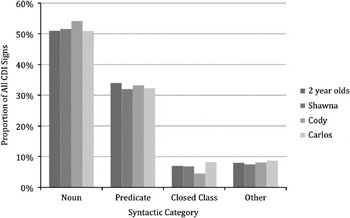
Next we analyzed the composition of the adolescents' vocabulary. Their vocabularies showed a preponderance of nouns (between 51% and 54% of total CDI vocabulary), followed by predicates (between 32% and 33% of total CDI vocabulary), and relatively few closed-class signs (between 5% and 8% of total CDI vocabulary). A direct comparison between the vocabulary composition of the adolescents and that of young deaf children is shown in Figure 2. The average vocabulary of a two-year-old deaf child acquiring ASL from birth exhibits a strong noun bias (51% of total vocabulary). Nouns are followed by predicates (34%), words classified as ‘other’ (8%) with closed-class words representing only 7% of the total CDI vocabulary. As shown in Figure 2, the three adolescents exhibited remarkably similar composition patterns to one another and in comparison to typical deaf two-year-olds. This composition trend is also a characteristic of the CDI list itself, so it is possible that these results arose at least partially as a consequence of the checklist structure.
Vocabulary composition (measured by the ASL-CDI) of the cases and typically developing two-year-old deaf children.a

Spontaneous language samples
The CDI is limited in size and range of vocabulary that it tests so it was important to cross-validate our results using a different method. To explore the adolescents' linguistic abilities beyond the scope of the CDI we analyzed their spontaneous signing.
Proportion of ASL
Our first aim was to determine what proportion of the adolescents' communicative units were ASL signs, and what proportion were non-ASL (gestural) units. Counted as ASL units were nouns, predicates, grammatical signs, greetings, comments (OK, thank you), numbers, ASL classifiers and all instances of fingerspelling. Gestured descriptions and non-linguistic points were counted as non-ASL units. Shawna's sample consisted of a total of 306 unit tokens, and Cody and Carlos had 308 and 324 unit tokens, respectively.
The proportions of ASL signs in the samples were 87% (Shawna), 89% (Cody) and 95% (Carlos). Non-sign units (gestured description and points) thus represented between 13% and 5% of all tokens. Thus after one to two years of language exposure, the adolescents predominantly used ASL to communicate.
ASL sign types
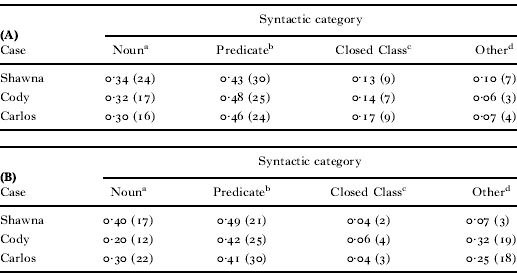
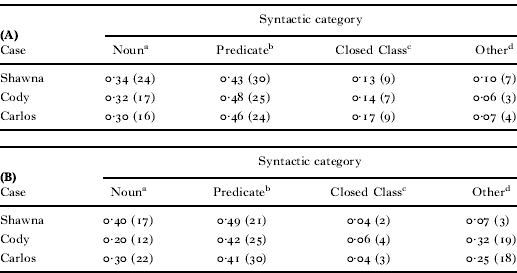
Next we considered the adolescents' use of ASL lexical signs as a function of syntactic category. Table 2A shows the words that were produced in the language samples that were also part of the CDI checklist; Table 2B shows the words that were produced in the language sample that were not part of the CDI. Shawna used 113 different ASL signs in her spontaneous sample, of which 70 (62%) were also part of the CDI, yielding an estimated vocabulary size of 292 signs. Cody's and Carlos' samples consisted of 112 and 126 different ASL signs, respectively, of which only 46% and 42% overlapped with those on the CDI. Their total vocabulary sizes were thus estimated at 477 and 471 signs, respectively. It is noteworthy that almost all of the signs that were produced in the sample and noted to be part of the CDI checklist were, in fact, correctly reported as ‘known signs’ by the social worker. More specifically, the social worker ‘missed’ (i.e. reported as unknown) only 4 predicates (2 verbs for Shawna, 1 adjective for Cody and 1 verb for Carlos). This indicates that the social worker's CDI report of the adolescents' ASL vocabulary was highly reliable.
Proportion (number) of ASL types by syntactic category in spontaneous language samples: (A) words produced in the sample that overlapped with those on the CDI checklist; (B) words produced in the sample that are not part of the CDI checklist
a Nouns include common and proper nouns.
b Predicates include verbs, adverbs and adjectives.
c Closed-class items include pronouns, connectors, prepositions, question words, quantifiers and signs indicating tense.
d Other signs include greetings, numbers and comments.
Another observation arising from this analysis is that the number and proportion of ASL signs in each syntactic category is remarkably consistent across the three adolescents, especially when considering the signs that are also part of the CDI checklist (Table 2A). One of the few notable differences among the adolescents is that Cody and Carlos produced a higher proportion of signs classified as ‘other’ and a lower proportion of nouns than Shawna (Table 2B). This can most likely be attributed to their extensive use of numbers in spontaneous conversation, which Shawna did not use at all; nor did she use an alternative to indicate number. It is also important to note that all three adolescents used a relatively low proportion of closed-class signs, especially when considering those words that are not part of the CDI questionnaire (Table 2B). Combining all closed-class words in the case samples (Table 2A and B), we find that they represent approximately 10% of the participants' lexicon. All three adolescents used a higher proportion of predicates than nouns (Table 2A and B), which does not accord with the findings from the CDI analysis and will be further addressed in the ‘Discussion’.
Non-CDI vocabulary
Analysis of the non-CDI signs used by the adolescents revealed that they were mostly signs that are semantically irrelevant for toddlers, but are highly relevant for adolescents, such as EMAIL, INTERNET and MATH, as well as an extensive use of numbers by Cody and Carlos. These results show that adolescents do indeed use some vocabulary outside the CDI checklist.
Classifiers and fingerspelling
The adolescents occasionally used ASL classifiers and fingerspelling, which are important features of (adult) ASL use (Emmorey, Reference Emmorey2002), but are not part of the CDI checklist. In the 100-utterance sample, each of the adolescents produced a total of 10 different classifiers, and fingerspelled two different English words. All instances of fingerspelling were extremely slow and laborious, despite the fact that the target words were predominantly short proper or common names (such as JIM or BUS). In order to maintain consistency between the syntactic categories on the CDI and those on the spontaneous language samples, we did not include classifiers and fingerspelling in the final word classification computation. However, additional analyses indicated that the total proportion of classifier tokens in the language samples was between 4% and 5%, while fingerspelled words represented less than 1% of the samples.
Utterance length and complexity
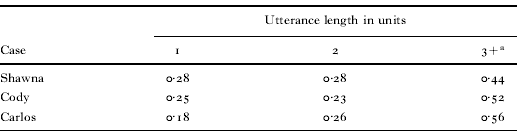
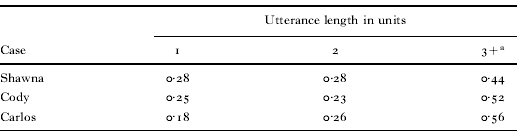
The final analysis was of the adolescents' language at the utterance level. Computation of Mean Length of Utterance (MLU) revealed that their utterances were relatively short. Shawna's MLU was 2·4, Cody's was 2·7 and Carlos' was 2·8. Note that these averages were obtained by considering all sign and non-sign units in each utterance (including inflected and uninflected signs, classifiers, gestured descriptions, linguistic and non-linguistic points, and fingerspelled words). If non-signs (gestured descriptions and non-linguistic points) are excluded from the analysis, the MLU results are 2·3 for Shawna, 2·5 for Cody and 2·8 for Carlos. Table 3 shows the proportion of 1 unit, 2 unit and 3 or more unit utterances used by each of the adolescents. More than half of Shawna's spontaneous ASL productions consisted of 1 and 2 unit utterances, while slightly over half of Cody and Carlos's utterances were longer than 2 units. Together these results indicate that these adolescent L1 learners used relatively short utterances.
Proportion of 1, 2 and 3 or more unit utterances in spontaneous language samples
a 3 or more unit utterances.
Examples of the adolescents' utterance are given below as English glosses (cases' names are given in square brackets at utterance ends).
Two-unit utterances:
(1) FOOD BRING. [Shawna]
(2) BROTHER SMOKE. [Cody]
(3) NAME J_I_M(fs)a. [Carlos]
a fs = fingerspelling
Three-unit utterances:
(1) CAT WATER LICK(desc)b. [Cody]
(2) SCHOOL FOOD LIKE. [Shawna]
(3) MY DOG GONE. [Cody]
b desc = gestured description
Four-unit utterances:
(1) YES THERE(ling-point)c MY ROOM. [Cody]
(2) NEXT PAY MONEY COACH. [Carlos]
(3) WE EAT VEGETABLES CHICKEN. [Shawna]
c ling-point = linguistic point, counted in the closed-class category.
Analysis of the adolescents' utterance types reveals that they used predominantly declarative utterances (between 92% and 97% of all utterances). Yes/no questions and wh-questions were used only rarely, accounting for 2–5% and 0–3% of all utterances, respectively. When language is acquired from birth, declarative utterances are typically acquired before yes/no questions, which are acquired before wh-questions in English and ASL (Anderson & Reilly, Reference Anderson and Reilly2002; Lillo-Martin, Reference Lillo-Martin, Emmorey and Lane2000; Mayberry & Squires, Reference Mayberry, Squires and Brown2006; Vasilyeva et al., Reference Vasilyeva, Waterfall and Huttenlocher2008). The adolescents thus exhibited the same acquisition pattern for sentence type as young children. After one to two years of ASL input, they rarely used syntactic question forms.
The results at the utterance level indicate that adolescent L1 learners, despite their age, used neither long nor complex sentences in spontaneous conversations. This result parallels the results for their acquisition of closed-class ASL signs. Lexical items indicating subordination or conditionals were never used (nor was non-manual use of these grammatical markers ever observed). The use of coordination was limited to a few instances of the signs AND and BUT that were frequently used by Cody, albeit incorrectly. In addition, as one would expect of a young child with comparable vocabulary size and utterance length, the majority of the verbs that the three adolescents used were bare forms, that is, uninflected. Shawna and Cody produced a total of two inflected verbs, and Carlos produced four inflected verbs. These results indicate that the adolescents' utterances, like their lexicons, were child-like in their composition.
DISCUSSION
The main objective of the current study was to describe the initial stages of language acquisition begun in adolescence; specifically, we asked whether adolescent first-language acquisition is similar to child language acquisition. In order to do this, we systematically analyzed the language skills of three deaf adolescents with one to two years of experience with ASL as their first language. In the first part of the study we used the ASL-CDI (Anderson & Reilly, Reference Anderson and Reilly2002) to gain insights into their vocabulary acquisition. After one to two years of ASL exposure, they knew and used between 47% and 78% of the words on the CDI checklist. The most noteworthy finding was that the adolescents, despite the differences in their vocabulary size, exhibited highly consistent vocabulary compositions with a preponderance of concrete vocabulary items, and few closed-class words. Further, the adolescents, like young children, produced simple utterances that were generally 3 units or less in length. Newport and Meier (Reference Newport, Meier and Slobin1985) state that deaf children acquiring ASL from birth produce two sign utterances by the middle of their second year. Petitto (Reference Petitto1987) suggests that an MLU of 2·4 is comparable to deaf children between ages 1 ; 3 and 1 ; 6, and an MLU of 2·7 or 2·8 is comparable to deaf children between ages 1 ; 8 and 2 ; 0. These results suggest that early language acquisition in adolescence is a highly structured process with many characteristics resembling childhood language acquisition.
Another key finding of the current study was that the adolescents used a higher proportion of predicates than nouns in spontaneous signing. There are several potential explanations for this finding. The use of the CDI is limiting since the items are predetermined and are based on what is expected from children. As shown in the study of spontaneous language, the adolescents used words that are not listed on the inventory but are relevant to their age. At the same time, the CDI represented most of the signs that the adolescents were observed to use during spontaneous conversation, suggesting that it is a useful guide for studying the lexicon of early-stage, late language learners. It has previously been shown that in some languages the proportion of nouns in relation to verbs is sensitive to the type of measure used (Tardif, Reference Tardif1996). For example, Tardif, Gelman and Xu (Reference Tardif, Gelman and Xu1999) directly compared spontaneous language samples and CDIs for English- and Mandarin-speaking children and found that a verb advantage was present in spontaneous samples, but not in the CDI results. These discrepancies may arise as a result of limits on maternal memory, or due to the fact that mothers tend to remember words produced in certain contexts better than others (Tardif et al., Reference Tardif, Gelman and Xu1999). It may also be the case, as argued by Caselli and colleagues (Reference Caselli, Bates, Casadio, Fenson, Fenson, Sanderl and Weir1995), that verbs are oversampled when vocabularies are measured using spontaneous language samples because of their low type–token frequencies. The lower proportion of nouns in spontaneous conversations may be partly due to subject omission. In ASL, like in Mandarin and Italian, subject omission can and does occur in perfectly grammatical sentences (Sandler & Lillo-Martin, Reference Sandler and Lillo-Martin2006), and we observed it frequently in our data. In sum, cross-linguistic studies on lexical acquisition in normally developing children suggest that the proportions of nouns in relation to verbs are highly dependent on the method used. It is likely that, in spontaneous samples of young deaf children acquiring ASL, words are used that are not listed on the inventory and possibly the percentage of nouns to predicates would vary. A higher proportion of predicates in adolescents' spontaneous signing could indicate an advanced stage of language knowledge, perhaps suggesting that the three adolescents are shifting towards grammar more quickly than young children. However, the results from the adolescents' spontaneous language are consistent with the data from the CDI (total lexical types, number of closed-class words, MLU, and sentence type), suggesting that this is not the case.
In addition to the commonalities between the three adolescents and children, we also observed some important differences between them. Most notably, the rate of vocabulary acquisition in adolescent L1 learners appears to be initially faster than in children, which was indicated by the fact that the their vocabulary sizes were consistently above those of young children with comparable amounts of ASL exposure. Interestingly, Snedeker et al. (Reference Snedeker, Geren and Shafto2007) report that internationally adopted preschoolers initially acquire words at a faster rate than toddlers acquiring English from birth. Our results suggest that older language learners have an advantage over young children in acquiring initial word–world pairings, even when they begin to do so without the benefit of a previously acquired language.
Another potential difference between the three cases and typically developing deaf children of deaf parents was the amount of classifier use. As much research on ASL vocabulary development comes from the administration of the ASL-CDI, which does not include classifiers, our understanding of ASL classifier acquisition and use under typical learning circumstances is fairly limited (Kuntze, Reference Kuntze2011). However, we do know that deaf children of deaf parents, as well as deaf children of hearing parents, do produce productive classifier forms between ages two and tree (Schick, Reference Schick, Schick, Marschark and Spencer2006; Slobin et al., Reference Slobin, Hoiting, Kuntze, Lindert, Weinberg, Pyers, Anthony, Biederman, Thumann and Emmorey2003). Kuntze (Reference Kuntze2011) studied a group of five deaf children between ages 3 ; 9 and 4 ; 3 and observed that their use of classifiers tends to hover between 3% and 4% of lexical items, although it can be as high as 9·6% or as low as 1·6%. Our analyses showed that classifiers comprised between 4% and 5% of all vocabulary items in the adolescents' language samples. Since the adolescents have only been exposed to ASL for a period of one to two years, it may be the case that their proportion of classifier use is somewhat higher than in typically developing deaf children with a comparable length of ASL exposure. However, classifier use has been shown to be highly context dependent in typically developing deaf children and adults (Kuntze, Reference Kuntze2011; Morford & MacFarlane, Reference Morford and MacFarlane2003), which makes it difficult to draw any firm conclusions about the comparability of the adolescents' classifier usage to that of young children.
Other differences between children and adolescents that emerged in our data may be more or less directly related to the adolescents' backgrounds and previous communicative experience. Although the adolescents occasionally used gesture to communicate, this was surprisingly limited. In fact, the proportion of ASL was remarkably high considering their relatively short amount of ASL exposure. Emmorey and colleagues (Reference Emmorey, Grant and Ewan1994) report the case of Anna, another deaf adolescent L1 learner of ASL, who used ASL 80–90% of the time after only 9 months of exposure. Maria and Marcus, the two adolescent L1 learners studied by Morford (Reference Morford2003), were also reported to have replaced most of their gestures with signs after less than three years of exposure to ASL. The results of these studies in conjunction with our results indicate that adolescent L1 learners retain the capacity of zeroing in on, and using, linguistic input remarkably quickly, suggesting that the ability to distinguish between linguistic and non-linguistic input is not lost after early childhood (see Krentz & Corina, Reference Krentz and Corina2008).
Another noteworthy characteristic of the adolescents' spontaneous signing is that they occasionally used language to discuss concepts that may be irrelevant for young children, such as computers or movie characters. They occasionally conversed about things that were not in their immediate environment, such as volcano eruptions in Hawaii that they learned about at school, or football games that they watched on TV. This ability to talk about non-immediate, and unexperienced, events shows that adolescent L1 learners are able to use their newly acquired ASL skills to represent concepts more typical of advanced and older language users, and is a skill also reported in home-signers who have not yet learned a full language (Morford & Goldin-Meadow, Reference Morford and Goldin-Meadow2006).
Having acquired the initial set of base vocabulary items and beginning sentences, the question is whether the adolescent L1 learners we studied here will continue to develop ASL in a child-like manner and eventually develop linguistic competence close to that of native ASL signers. Given that previous studies have shown that significant delays in the onset of language acquisition leads to processing deficits across all domains of linguistic structure, this outcome is unlikely. We hypothesize that subsequent language learning stages that require inducing a system of complex relations are age-sensitive. That is, it may be that adolescent L1 learners are slower then children when it comes to further expanding their lexicon and grammatical system by means of learning its internal contingencies.
The implications of the current study are limited by the small sample size (3 participants), as well as by the differences among the cases, such as the differences in their backgrounds and length of exposure to ASL. In addition, the cases' non-verbal IQ scores were not equivalent, which could potentially affect their language learning ability. However, it is unclear whether their non-verbal IQ is driving their language learning, or whether their level of language ability and lack of schooling is driving their non-verbal IQ performance. Other late L1 learners who have suffered from educational deprivation have shown increases in their non-verbal IQ scores as they received more education and linguistic input (Morford, Reference Morford2003), suggesting that the relationship between non-verbal IQ and language acquisition may be reciprocal in these circumstances. Despite these limitations, our results provide compelling evidence to suggest that first language acquired in adolescence is remarkably consistent and noticeably similar to child language acquisition for vocabulary size, vocabulary composition, and utterance length and complexity. The current study investigated productive language only. Future studies should consider whether similar conclusions can be drawn with regard to language comprehension. Subsequent longitudinal studies will also reveal how adolescent first-language acquisition develops over time; we suspect that delays will eventually be evident across all domains of linguistic structure.