Introduction
Tropical signalgrass (TSG) is a perennial grass species capable of reproducing by seed and stolons and is commonly found in lawns, cultivated fields, and disturbed areas (Murphy et al. Reference Murphy, Colvin, Dickens, Everest, Hall and McCarty1992). Its dense, aggressive growth habit allows for quick colonization of any bare patches or areas where turfgrass density is low. This species gets its common name from the seedhead branching angle, which resembles a “signal flag” (Murphy et al. Reference Murphy, Colvin, Dickens, Everest, Hall and McCarty1992). Other common names include smallflowered alexandergrass, green summergrass, two-spiked panic, and two fingergrass (Speedy Reference Speedy2002). It is native to Asia and Australia (Murphy et al. Reference Murphy, Colvin, Dickens, Everest, Hall and McCarty1992) and now occurs in Florida, Maryland, Hawaii, and Puerto Rico.
TSG has become one of the most troublesome weeds on golf courses in south Florida. This weed thrives in tropical conditions, with seed germination (Teuton et al. Reference Teuton, Brecke, Unruh, Macdonald, Miller and Ducar2004a) and vegetative growth being optimal around 25 C and in moist soil conditions. Frost and killing freezes are uncommon in south Florida, thus TSG has the potential to grow year-round. Monosodium methane-arsonate (MSMA), the standard for chemical control of this weed, was banned for urban uses including turfgrass in 2012, and any existing stock after this time could be applied until December 31, 2013 (Brosnan et al. Reference Brosnan, Steckel and Armel2009). This has created a need to find alternatives for developing an integrated approach for managing this weed.
Prior studies have looked at herbicide use as the sole method for TSG control. For example, Teuton et al. (Reference Teuton, Unruh, Brecke, MacDonald, Miller and Ducar2004b) reported unacceptable (≤50%) control of mature TSG plants at 8 wk after initial treatment (WAIT) for all summer-applied POST herbicides and herbicide combinations that were tested, including asulam, ethofumesate, and quinclorac. Better results were observed with bare-ground PRE herbicide applications to prevent TSG seedling establishment, although efficacy decreased by 5 WAIT.
Integrated herbicide management uses PRE herbicides, POST herbicides, tank mixes, and differing modes of action. This alone does not constitute an integrated weed management (IWM) program. Mixing herbicides with different modes of action can be effective, but to implement an IWM approach, an element of nonchemical control must also be included (Harker and O’Donovan Reference Harker and O’Donovan2013). Danyal et al. (Reference Danyal, Bhowmik, Anderson and Shrestha2008) cited the importance of accounting for cropping system design to allow for easier integration of IWM strategies into farming operations. Common cultural practices that could easily be implemented by turfgrass managers into IWM strategies include mowing, irrigation, fertilization, and cultivation.
Bergkvist et al. (Reference Bergkvist, Ringselle, Magnuski, Mangerud and Brandsaeter2017) showed that rhizome fragmentation of quackgrass [Elymus repens (L.) Gould] in early summer reduced rhizome biomass by up to 60%. In turfgrass management, verticutting is a cultural practice that uses vertical mower blades to cut down into the turf, removing excess thatch and fragmenting stolons, which promotes new growth and healthy turfgrass. We hypothesized that verticutting a few days before herbicide applications would increase TSG control. This would be the result of apical dominance elimination in TSG stolons and increased number of actively growing meristems directly affected by POST herbicides (especially those with systemic activity). Also, smaller TSG stolon fragments would result in shoots with fewer underground reserves limiting their growth and recovery from herbicide injury.
There are several POST herbicides available that injure TSG; however, they require high rates and multiple sequential applications to provide acceptable control (McCarty and Estes Reference McCarty and Estes2014). Amicarbazone (AMI) is a photosystem II (PSII) inhibitor that is active in the soil and can be absorbed by roots, so it can increase TSG control when complementing the action of herbicides that only have foliar uptake and activity. Symptoms include chlorosis, stunting, and eventual necrosis of leaf tissue (Dayan et al. Reference Dayan, Trindale and Velini2009). This herbicide is safe on multiple cool- and warm-season turfgrasses and is labeled for control of various broadleaf and grassy weeds such as annual bluegrass (Poa annua L.) (Anonymous 2014). Mesotrione (MESO) is a 4-hydroxyphenylpyruvate dioxygenase (HPPD) inhibitor that causes bleaching of the leaf tissue, and subsequent necrosis, resulting from insufficient carotenoid production (Armel et al. Reference Armel, Rardon, McComrick and Ferry2007). Trifloxysulfuron (TSS) and thiencarbazone+foramsulfuron+halosulfuron (TFH) are all acetolactate synthase (ALS) inhibitors that can be extensively translocated to growing regions and result in chlorosis and stunting of leaf tissue (Shaner Reference Shaner2014). We hypothesized that a POST herbicide program using a three-tier approach of (1) aboveground bleaching and necrosis of leaf tissue by MESO, (2) belowground root uptake of AMI to inhibit any new growth, and (3) systemic activity of an ALS-inhibiting herbicide to target meristematic growth, could increase TSG control while allowing the use of lower rates and fewer applications.
Although managers predominantly focus their efforts on controlling established TSG plants, we hypothesized that a PRE herbicide with long residual properties might be necessary to effectively reduce TSG populations from one season to the next. This is true of many weed management approaches; however, little research has been done identifying the role of seedling recruitment in TSG regrowth after POST herbicide applications.
Implementing IWM strategies and avoiding sole reliance on POST herbicides has become a priority for turfgrass managers to control TSG infestations. There is a need to further explore the role that cultural practices can play as part of an integrated management program. Recent research has shown acceptable levels of TSG control using POST herbicides such as AMI and TFH (Cross et al. Reference Cross, McCarty and Estes2016; McCarty and Estes Reference McCarty and Estes2014). However, as was the case with MSMA, if a chemical is banned or becomes ineffective, turfgrass managers are left without any effective tools at their disposal. Therefore, the objectives of this research were to: (1) determine whether verticutting before herbicide applications increases TSG control and (2) identify herbicide programs that effectively control TSG.
Materials and Methods
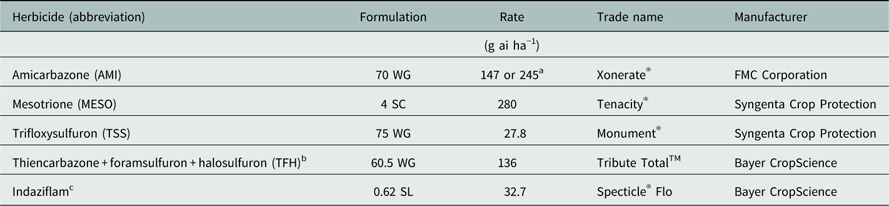
Field experiments were conducted in 2015 and 2016 in Vero Beach, FL, at Sandridge Golf Club (27.72°N, 80.44°W) and Pointe West Country Club (27.63°N, 80.48°W) to determine the effects of verticutting, PRE herbicides, and POST herbicides (Table 1) on TSG control. An IWM study was conducted at both sites in 2015 and one site (Sandridge) in 2016 for a total of 3 site-years. A POST study was conducted at both sites in 2016. Soil type was a Myakka fine sand (sandy, siliceous, hyperthermic Aeric Alaquods) with pH 7 and <1% organic matter at both locations. Experiments were conducted in areas with rough-height (3 cm) ‘Tifway 419’ bermudagrass infested with TSG (52±5% ground cover; mean±SEM).
Herbicides, formulations, and rates used in the experiments.

a For the integrated weed management study, AMI was applied at 147 g ai ha−1 when combined with other herbicides or at 245 g ai ha−1 when applied alone.
b All treatments containing TFH received methylated seed oil at 1% v/v and ammonium sulfate at 1.68 kg ha−1. All other treatments received a nonionic surfactant at 0.25% v/v.
c All POST herbicides were applied with two sequential applications with a 21-d interval. Indaziflam (PRE treatment) was applied as a single application when the second POST application was made.
For both studies, experimental units were 2.25 m2 (1.5 by 1.5 m), herbicide treatments were applied in a water carrier volume of 374 L ha−1, and all applications were made with a CO2-pressurized boom sprayer equipped with three 8002VS flat-fan nozzles (TeeJet Spraying Systems, Wheaton, IL) spaced at 45 cm.
The IWM study was conducted to evaluate the benefits of integrating different tools for TSG control. A split-plot factorial arrangement in a randomized complete block design with four replications was used to evaluate the integration of three factors: verticutting (with and without), PRE (with indaziflam and without; Table 1), and POST herbicides (AMI, MESO, TSS, TFH, and nontreated control; Table 1). The main plot was verticutting, and PRE and POST herbicide combinations were the subplots. Verticutting was performed on May 15, at 14 d before initial herbicide treatment, using a Toro triplex greens mower (Greensmaster Triflex Hybrid 3320, Toro, Bloomington, MN) with verticutting blade attachments. Two passes at a 2.5-cm depth were made in opposite directions to increase the amount of stolon fragmentation. Two POST herbicide applications were made with a 21-d interval (June 1 and 21, respectively), and a PRE herbicide application was made with the second POST herbicide application.
The POST study was conducted to identify the most effective POST herbicide combinations comparing single, two-, three- and four-way combinations of AMI, MESO, TSS, and TFH. Two POST herbicide applications were made with a 21-d interval. This study was conducted in a randomized complete block design with four replications.
Visual evaluations were recorded weekly beginning 3 d before initial treatment and ending at 52 WAIT. TSG cover was evaluated visually on a 0% to 100% scale and also by using a quadrat (1 by 1 m) with a grid to record the total number of units out of 36 that contained TSG. Weed control was evaluated visually on a 0% to 100% scale (0%=no reduction in weed population and no symptoms of injury; 100%=complete elimination of TSG populations or only dead tissue present). Regression analysis was conducted with PROC NLIN in SAS (SAS Institute, Cary, NC) to describe the relationship between grid count and visual estimates of TSG cover. Bermudagrass density was visually estimated on a 0% to 100% scale, and turf color and quality were evaluated visually on a 1 to 9 index scale (1=dead turf; 6=acceptable turf quality/color; 9=excellent turf quality/color) (McCarty et al. Reference McCarty, Miller and Colvin1991). Bermudagrass injury (phytotoxicity) was visually estimated on a 0% to 100% scale (0%=no injury; 100%=complete elimination of turfgrass or only dead tissue present).
For the IWM study, nontransformed data were subjected to ANOVA using PROC GLIMMIX in SAS after confirming data normality and homoscedasticity. An ANOVA was performed for each parameter by assessment date, because an interaction was present between assessment date and other factors (P<0.01). Site by POST treatment interactions were significant (P<0.0001), but data were pooled due to the absence of crossover interactions. For the POST herbicide study, square root–transformed grid data, arcsine-transformed visual cover data, and nontransformed control data were all subjected to ANOVA by PROC GLIMMIX in SAS. To identify the presence of synergism, the Colby (Reference Colby1967) equation was used to calculate expected means for the herbicide combinations. Expected means were then compared with the observed means to determine whether the combinations were synergistic, antagonistic, or additive. For both studies, means were separated using Tukey’s honestly significant difference test (α=0.05).
Results and Discussion
Regression analysis (R2=0.83; P<0.0001) indicated that percent visual estimates of TSG cover (V) agreed with percent cover estimates based on grid counts (G), and the relationship between these two variables was explained with the exponential model G=96.19 (1 − 0.94 V ). This exponential relationship was explained by the tendency of the grid count system to reach maximum cover (i.e., 100%) when evenly distributed TSG plants were present in plots at higher TSG cover levels (>65%). To simplify the presentation of the results, only visual estimates of TSG cover are discussed.
IWM Study
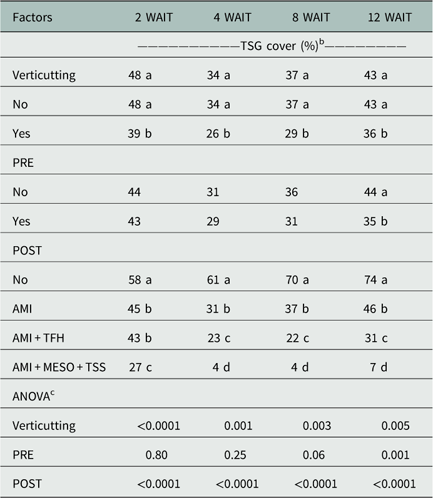
Verticutting did not increase the efficacy of POST herbicide applications, and interactions between these two factors were not significant (P>0.16). Verticutting did provide a small (7% to 9%) but consistent (P ≤ 0.005) reduction in TSG visual cover through 12 WAIT averaged across herbicide treatments (Table 2); however, long-term control with verticutting alone is expected to be minimal. In the absence of herbicides, verticutting provided 20%, 22%, and 19% TSG control at 2, 12, and 52 WAIT, respectively. Busey and Johnston (Reference Busey and Johnston2006) also demonstrated that cultural practices alone (e.g., mowing, fertilization, irrigation) may not provide acceptable, long-term weed control in turfgrass. They found that after a 3-yr period without herbicide use, most plots exhibited poor turf quality and dense weed populations. The removal of photosynthetic tissue and fragmentation of stolons resulting from verticutting might reduce the amount of carbohydrate reserves each individual TSG plant can access for regrowth and recovery. In all evaluation dates, plots that were verticut had on average 8% less TSG cover than plots without verticutting (Table 2).
Effects of verticutting, PRE herbicide, and POST herbicide on tropical signalgrass cover at 2, 4, 8, and 12 wk after initial treatment.Footnote a

a Abbreviations: AMI, amicarbazone; MESO, mesotrione; TFH, thiencarbazone+foramsulfuron+halosulfuron; TSG, tropical signalgrass; TSS, trifloxysulfuron; WAIT, weeks after initial treatment.
b Values within columns and main factors with the same letter were not statistically different based on Tukey’s honestly significant difference test (α=0.05).
c There were no interactions between main factors (P>0.16).
IWM uses multiple tactics, some of which may provide very little control on their own, in a complementary manner. Most importantly, these tactics must be easily integrated into a manager’s existing program (Swanton et al. Reference Swanton, Mahoney, Chandler and Gulden2008). Verticutting results in more active growing points, potentially increasing the number of vegetative buds that are potentially killed by herbicides with systemic activity. Although verticutting did not provide an increase in POST herbicide efficacy, future research examining this cultural practice with reduced rates of the effective POST herbicides tested in this study may prove beneficial in scenarios where verticutting is normally used.
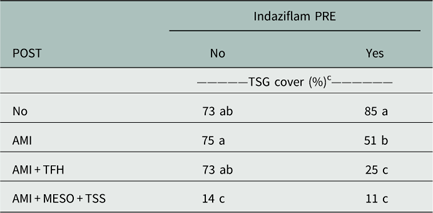
At 52 WAIT, there was an interaction between PRE and POST herbicide (P<0.0001; Table 3). Specific combinations of PRE and POST herbicides increased long-term control considerably. For example, without indaziflam, AMI+TFH application resulted in 73% TSG, whereas application of indaziflam tank mixed with those POST herbicides resulted in 25% TSG cover. TSG seeds exhibit a dormancy mechanism that is still not well understood (Teuton et al. Reference Teuton, Brecke, Unruh, Macdonald, Miller and Ducar2004a), but our results indicate that germination can occur during the summer and fall. Therefore, PRE herbicides should complement POST applications to prevent new seedling recruitment. Indaziflam, a cellulose biosynthesis inhibitor, is an effective PRE herbicide used in turfgrass (Henry et al. Reference Henry, Brosnan, Breeden, Cooper, Beck and Straw2012) and has shown the ability to enhance POST activity of some herbicides such as 2,4-D, fluroxypyr, and simazine (McCullough et al. Reference McCullough, Johnston, Reed and Yu2015) as well as provide PRE and early POST activity when applied alone to annual bluegrass (Brosnan et al. Reference Brosnan, Breeden, McCullough and Henry2012). Although vegetative propagation of TSG seems to be the primary method of encroachment, this research confirms the need for PRE herbicides in a management plan for persistent TSG population reductions.
Interaction (P<0.0001) between PRE and POST herbicides on tropical signalgrass cover at 52 wk after initial treatment.Footnote a , Footnote b

a Abbreviations: AMI, amicarbazone; MESO, mesotrione; TFH, thiencarbazone+foramsulfuron+halosulfuron; TSG, tropical signalgrass; TSS, trifloxysulfuron; WAIT, weeks after initial treatment.
b Data were collected from only 1 site-year due to renovations at one of the golf courses in 2017 that resulted in loss of the trial site.
c Means with the same letter were not statistically different based on Tukey’s honestly significant difference test (α=0.005).
POST herbicide treatments reduced TSG populations at all assessment timings (P<0.0001; Table 2). AMI+MESO+TSS provided the greatest reduction in TSG cover at 4, 8, and 12 WAIT, resulting in 4%, 4%, and 7% TSG cover, respectively (nontreated check had 61%, 70%, and 74% TSG cover at those timings). Other POST herbicide treatments provided varying levels of control. The combination of AMI+MESO+TSS includes three different modes of action, two of which (PSII and HPPD inhibitors) have been shown to produce synergistic responses in certain situations, primarily against broadleaf weeds (Abendroth et al. Reference Abendroth, Martin and Roeth2006; Hugie et al. Reference Hugie, Bollero, Tranel and Riechers2008). The other mode of action, ALS inhibition, has been shown to increase efficacy when tank mixed with AMI (Cross et al. Reference Cross, McCarty and Estes2016).
All POST herbicide treatments resulted in acceptable levels of phytotoxicity to the bermudagrass turf (<20%) at all assessment timings with the highest level of injury (18%) occurring in the AMI+MESO+TSS treatments at 4 WAIT (unpublished data). Because these studies were performed on rough-height turf of lesser quality, further studies should be done to determine safety levels of these POST herbicides on well-maintained, fairway-height bermudagrass.
POST Study
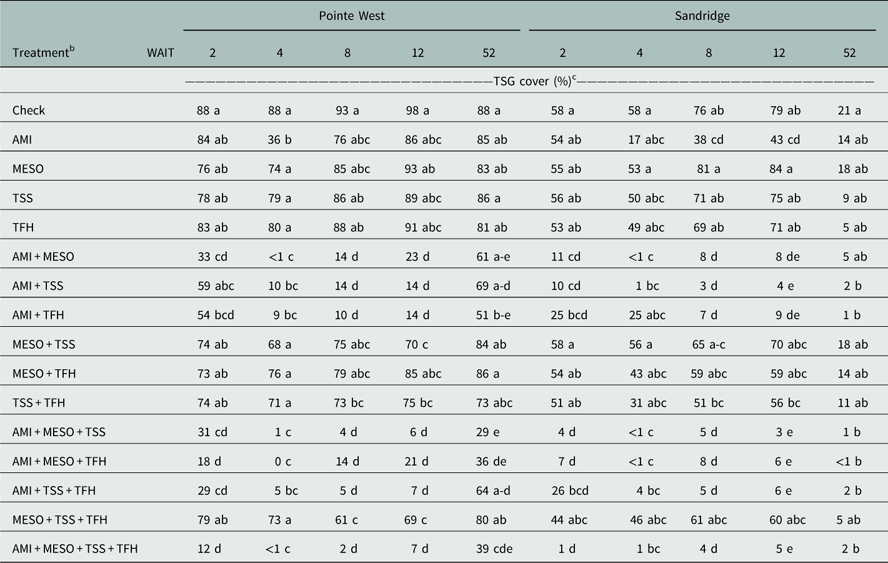
POST herbicides were assessed individually and in all possible combinations to determine the most effective treatments. There was a significant (P<0.0001) interaction between site and treatment effects, so data were analyzed separately. At Pointe West, all treatments containing only one herbicide resulted in >70% TSG cover at all assessment timings, with the exception of AMI at 4 WAIT, which had 36% TSG cover (Table 4). Of the two-way combinations, only those containing AMI resulted in <26% TSG cover at 4, 8, and 12 WAIT for both locations. The two-way combinations without AMI resulted in >65% TSG cover at all assessment timings at Pointe West and >50% at 8 and 12 WAIT at Sandridge. Similarly, all three-way combinations containing AMI greatly outperformed the treatment that did not contain AMI at 4, 8, and 12 WAIT (<22% vs. >60% TSG cover, respectively, at Pointe West; and <10% vs. >45% TSG cover, respectively, at Sandridge). TSG cover for most herbicide treatments had recovered to levels similar to the nontreated check at Pointe West at 52 WAIT, but the recovery of TSG cover was not as high at Sandridge (Table 4). TSG populations were denser at Pointe West than at Sandridge. Also, turf density was lower at the former than the latter. We think that having more turf cover and density in Sandridge favored TSG suppression, limiting its growth and population recovery after herbicide applications (Busey Reference Busey2003; Busey and Johnston Reference Busey and Johnston2006).
POST tropical signalgrass cover at 2, 4, 8, and 12 wk after initial treatment.Footnote a

a Abbreviations: AMI, amicarbazone; MESO, mesotrione; TFH, thiencarbazone+foramsulfuron+halosulfuron; TSG, tropical signalgrass; TSS, trifloxysulfuron; WAIT, weeks after initial treatment.
b All treatments containing TFH received methylated seed oil at 1% v/v and ammonium sulfate at 1.5 kg ha−1. All other treatments received a nonionic surfactant at 0.25% v/v.
c Values within columns with the same letter were not statistically different based on Tukey’s honestly significant difference test (α=0.05).
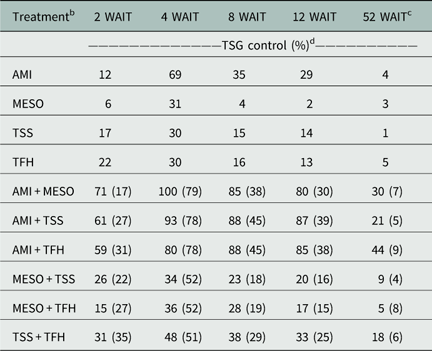
PSII inhibitors, such as AMI, have shown synergistic responses when combined with HPPD inhibitors (Abendroth et al. Reference Abendroth, Martin and Roeth2006) and complementary responses when combined with ALS-inhibiting herbicides (Cross et al. Reference Cross, McCarty and Estes2016). In this study, AMI displayed potential synergistic responses for TSG control when combined with HPPD or ALS inhibitors. Using the Colby (Reference Colby1967) equation, we calculated the expected two-way herbicide combination means for percent TSG control using the single and two-way combination treatments from the POST study. Expected means were compared with the observed combination means to determine whether there was a synergistic response (Table 5). There was no interaction between site and treatment effect (P>0.05), so data from both sites were pooled for the analysis. At 2 WAIT, AMI and MESO provided 12% and 6% TSG control, respectively, resulting in an expected value of 17% TSG control. The observed value of the AMI+MESO treatment was 71% TSG control, indicating a strong likelihood of synergy. A similar trend was observed at multiple assessment dates and with various tank-mix partners. It is also worth noting that at 4 WAIT, the expected control of MESO+TSS and MESO+TFH was higher (52%) than the observed control (34% to 36%). This might indicate a potential antagonism. However, in the rest of the evaluation timings, expected and observed control levels were similar.
Synergism between amicarbazone and multiple mix partners at 2, 4, 8, and 12 wk after initial treatment.Footnote a

a Abbreviations: AMI, amicarbazone; MESO, mesotrione; TFH, thiencarbazone+foramsulfuron+halosulfuron; TSG, tropical signalgrass; TSS, trifloxysulfuron; WAIT, weeks after initial treatment.
b Treatments containing TFH received methylated seed oil at 1% v/v and ammonium sulfate at 1.68 kg ha−1. All other treatments received a nonionic surfactant at 0.25% v/v.
c All evaluations were done in two locations and data were pooled, with the exception of 52 WAIT, in which TSG control was collected at only one site because the second site was undergoing turfgrass renovation at that time.
d Numbers in parentheses represent the expected means generated using the Colby (Reference Colby1967) equation. If the expected is less than the actual, then the combinations resulted in a synergistic response.
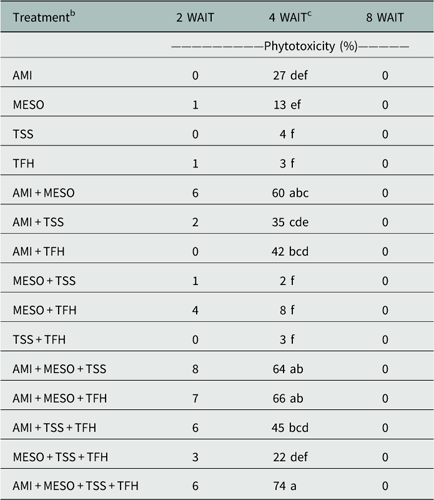
All treatments containing AMI resulted in unacceptable (>20%) levels of phytotoxicity at 4 WAIT, with the four-way herbicide combination causing >70% injury to the bermudagrass turf (Table 6), but all treatments showed full recovery by 8 WAIT. Further studies are needed to confirm these levels of injury and investigate possible mitigation methods.
Turfgrass injury observed in POST herbicide study at 2, 4, and 8 wk after initial treatment.Footnote a

a Abbreviations: AMI, amicarbazone; MESO, mesotrione; TFH, thiencarbazone+foramsulfuron+halosulfuron; TSG, tropical signalgrass; TSS, trifloxysulfuron; WAIT, weeks after initial treatment.
b Treatments containing TFH received methylated seed oil at 1% v/v and ammonium sulfate at 1.68 kg ha−1. All other treatments received a nonionic surfactant at 0.25% v/v.
c Values within this column with the same letter were not statistically different based on Tukey’s honestly significant difference test (α=0.05).
Our results demonstrated that the contribution of verticutting to an IWM strategy was considerably minimal when compared with herbicide treatments. Verticutting may still provide a benefit to turfgrass managers if implemented into existing practices so as to not incur additional costs. Future research should look at reduced rates of these combinations in conjunction with verticutting to see whether the minor effect of this cultural practice could be increased while reducing weed control cost and environmental impact. A valuable finding was the herbicide synergy exhibited by AMI in combination with several herbicides on TSG. If this synergism also affects other weed species, AMI could be a useful tool for managing difficult to control weeds and herbicide resistance in turfgrass systems. The present research focused on summer applications when conditions are more favorable for TSG growth and recovery from herbicide injury. Previous research has shown that fall applications were more effective than spring applications (McCarty and Estes Reference McCarty and Estes2014). Therefore, application timing during the year might be a critical factor to find more efficient herbicide application programs and integration with cultural practices.
As with many weed management strategies, a PRE herbicide (indaziflam) was shown to be a necessary component by providing longevity of control of TSG, indicating that seedling recruitment is an important source of TSG population growth after POST applications. Finally, our original hypothesis that a POST herbicide program using three complementary components targeting simultaneously quick leaf tissue elimination (e.g., HPPD inhibitor), systemic activity (ALS inhibitors), and elimination of new regrowth (root-absorbed PSII inhibitor) was very effective for TSG control. This approach might prove useful for the control of TSG and other turf weed species. There are multiple herbicides with the same mechanisms of action that can play similar complementary roles while providing options in broad spectrum, turf safety, and cost.
Acknowledgments
We would like to thank Sandridge Golf Club and Pointe West Country Club for technical support. D.G. Pearsaul received financial support from Syngenta Crop Protection to support his graduate studies. The other authors declare no conflict of interests.