INTRODUCTION
The relationships among cognitive, affective, and motor processes as drivers of action have recently become increasingly apparent, leading to calls for conceptualizations that unify these three domains (Lewthwaite & Wulf, Reference Lewthwaite and Wulf2010). The present study draws upon two specific aspects of these relationships. First, there is a growing literature demonstrating functional and neuroanatomic overlap between executive functioning (EF) and certain aspects of motor output (e.g., action planning, action learning, and motor control) (Koziol, Reference Koziol2014; Mirelman et al., Reference Mirelman, Herman, Brozgol, Dorfman, Sprecher, Schweiger and Hausdorff2012; Ridler et al., Reference Ridler, Veijola, Tanskanen, Miettunen, Chitnis, Suckling and Bullmore2006; Rigoli, Piek, Kane, & Oosterlaan, Reference Rigoli, Piek, Kane and Oosterlaan2012; Suchy & Kraybill, Reference Suchy and Kraybill2007; Suchy, Kraybill, & Larson, Reference Suchy, Kraybill and Larson2010). Second, there is a growing literature showing that engagement in the emotion regulation strategy known as expressive suppression (ES) deleteriously impacts subsequent availability of EF resources, including both cognitive and behavioral control (Baumeister & Alquist, Reference Baumeister and Alquist2009; Franchow & Suchy, Reference Franchow and Suchy2015; Hofmann, Schmeichel, & Baddeley, Reference Hofmann, Schmeichel and Baddeley2012; Schmeichel, Reference Schmeichel2007). Together, these findings suggest that expressive suppression in daily life might also deleteriously impact subsequent motor output, and that associations between motor deficits and ES might be mediated by EF. However, these two literatures have largely developed in parallel, and the impact of ES on motor output remains relatively unexplored.
The aim of this study is to integrate these two literatures by investigating the relationship between self-reported naturally occurring ES and executively demanding aspects of motor output. This study marks an important step toward the overarching goal of understanding how state-level fluctuations in daily life (e.g., executive decrements resulting from emotion regulation burden) relate to neuropsychological performance.
Relationship between Executive Functioning and Motor Output
Executive functioning is a multifaceted construct that encompasses a variety of higher-order cognitive processes that allow one to successfully engage in goal-directed behavior (Cummings & Miller, Reference Cummings and Miller2007; Lezak, Howieson, Bigler, & Tranel, Reference Lezak, Howieson, Bigler and Tranel2012; Stuss, Reference Stuss2011; Suchy, Reference Suchy2009, Reference Suchy2016). Numerous scholars have proposed that EF, which governs cognitive and behavioral control, is best thought of as an extension of the motor system (Ardila, Reference Ardila2008; Belanger et al., Reference Belanger, Wilder-Willis, Malloy, Salloway, Hamman and Grigsby2005; Koziol, Reference Koziol2014; Suchy & Kraybill, Reference Suchy and Kraybill2007). Ridler and colleagues (Reference Ridler, Veijola, Tanskanen, Miettunen, Chitnis, Suckling and Bullmore2006) argue that EF develops through the integration of additional prefrontal and cerebellar areas to a previously matured cortical-cerebellar system that initially developed to coordinate movement. This idea is supported by evidence that motor coordination and EF abilities develop in tandem (Hartman, Houwen, Scherder, & Visscher, Reference Hartman, Houwen, Scherder and Visscher2010; Rigoli et al., Reference Rigoli, Piek, Kane and Oosterlaan2012) and that infant motor coordination predicts adult EF, but not other cognitive abilities (Murray et al., Reference Murray, Veijola, Moilanen, Miettunen, Glahn, Cannon and Isohanni2006), relying on overlapping sets of neuroanatomical substrates in the prefrontal cortex, premotor area, and medial cerebellum (Ridler et al., Reference Ridler, Veijola, Tanskanen, Miettunen, Chitnis, Suckling and Bullmore2006).
Additionally, in neurologically healthy older adults, EF is uniquely associated with fall risk beyond other cognitive abilities and motor deficits (Herman, Mirelman, Giladi, Schweiger, & Hausdorff, Reference Herman, Mirelman, Giladi, Schweiger and Hausdorff2010; Mirelman et al., Reference Mirelman, Herman, Brozgol, Dorfman, Sprecher, Schweiger and Hausdorff2012). Relatedly, cognitive-motor interference research demonstrates that simultaneous engagement in EF and motor tasks deleteriously affects motor output (Fraser, Li, & Penhune, Reference Fraser, Li and Penhune2010; Nadkarni, Zabjek, Lee, McIlroy, & Black, Reference Nadkarni, Zabjek, Lee, McIlroy and Black2010). Lastly, performance on motor sequencing tasks (e.g., Luria’s [1966] “fist-edge-palm”) is related to the integrity of the substrates that support EF (Lezak et al., Reference Lezak, Howieson, Bigler and Tranel2012), and to performance on EF tests (Fama & Sullivan, Reference Fama and Sullivan2002). For example, action planning during motor sequencing accounts for 12 to 32% of unique variance in design fluency performance beyond component skills (Kraybill & Suchy, Reference Kraybill and Suchy2008; Suchy et al., Reference Suchy, Kraybill and Larson2010).
One way to refine our theoretical understanding of the relationship between EF and motor-sequence learning is to evaluate whether different aspects of motor-sequence learning (action planning, motor-control speed and accuracy, and action learning) are as vulnerable as EF to the deleterious impact of ES. Action planning refers to covert assembly of a mental program (including both the overall movement goal and specific neuromuscular commands) that precedes movement execution (Baldauf, Reference Baldauf2011; Keele, Reference Keele1968). Motor control, which is distinct from action planning, refers to the fluid execution of discrete movements, which includes both speed and accuracy (Buxbaum, Johnson-Frey, & Bartlett-Williams, Reference Buxbaum, Johnson-Frey and Bartlett-Williams2005; Glover, Reference Glover2004). Lastly, action learning refers to improvement in the accuracy of the movement sequence with practice across time (Willingham, Reference Willingham1998; Wolpert, Ghahramani, & Flanagan, Reference Wolpert, Ghahramani and Flanagan2001).
ES and Depletion of EF Resources
ES refers to the intentional inhibition of behavioral expression of emotions, such as crying or laughter (Giuliani, Drabant, Bhatnagar, & Gross, Reference Giuliani, Drabant, Bhatnagar and Gross2011). Engagement in ES is a common occurrence in daily life and can be beneficial for a variety of pro-social behaviors (Gross, Reference Gross2014). However, there are significant short-term costs associated with engaging in ES, such that ES leads to what has been called “depletion” of available EF resources (Baumeister, Vohs, & Tice, Reference Baumeister, Vohs and Tice2007; Suchy, Reference Suchy2011; Vohs et al., Reference Vohs, Baumeister, Schmeichel, Twenge, Nelson and Tice2008). Specifically, experimentally manipulated ES has been shown to result in subsequent decrements in performance on measures of EF, impaired decision making, and greater willingness to engage in shopping sprees, break diets, and drive recklessly (Baumeister & Alquist, Reference Baumeister and Alquist2009; Inzlicht & Gutsell, Reference Inzlicht and Gutsell2007; Muraven, Tice, & Baumeister, Reference Muraven, Tice and Baumeister1998).
Recent research has extended these findings from experimentally induced ES to naturally occurring ES in daily life. Franchow and Suchy (Reference Franchow and Suchy2015) developed a self-report measure that assesses the burden of ES in daily life. Using this measure, they demonstrated that individuals who reported higher than usual ES on the day of testing produced lower scores on a set of traditional EF tasks. This relationship held even after controlling for processing speed and working memory, suggesting a degree of specificity of the depletion effect to EF. Of interest, the usual ES burden (i.e., over the 2 past weeks) was unrelated to EF; instead, it moderated the relationship between EF and ES on the day of testing, such that only those individuals who exhibited low ES burden over the past 2 weeks were affected by high ES burden on the day of testing. This finding is important as the relationship between self-reported higher than usual ES burden and lower EF scores suggests that the depletion effect is externally valid. Further investigations of the relationship between reported ES burden and objective performance measures are warranted to better understand the extent to which this effect occurs in daily life.
Relationship between Motor Output and ES
Although the impact of ES on motor-sequence learning has not been directly investigated, there is indirect evidence that naturally occurring ES may negatively affect motor output. Specifically, priming individuals with negative stereotypes about their motor abilities deleteriously impacts various indices of motor output, including balance ability in older adults, and the speed and accuracy of golf-putting and soccer dribbling in athletes (Lewthwaite & Wulf, Reference Lewthwaite and Wulf2010; Stone, Chalabaev, & Harrison, Reference Stone, Chalabaev and Harrison2012). These findings parallel experiments showing that engagement in ES toward regulation of negative emotions mediates the relationship between stereotype threat and subsequent decrements on executively demanding cognitive tasks (Johns, Inzlicht, & Schmader, Reference Johns, Inzlicht and Schmader2008). Thus, it is likely that this increased ES engagement also mediates the relationship between stereotype threat and motor performance, providing indirect support for the hypothesis that ES burden in daily life relates to performance on executively demanding action tasks.
There are at least two reasons to believe that different aspects of motor output may differentially relate to reported ES burden. First, it appears that two aspects of motor output (i.e., action planning and action learning) relate to EF more strongly than motor control does (Suchy and Kraybill, Reference Suchy and Kraybill2007).Footnote 1 If the deleterious impact of ES on motor output occurs due to the close association between ES and EF, then those aspects of motor output that are most reliant on EF should exhibit the strongest relationship with ES. Second, various aspects of motor output (action planning, action learning, motor-control) appear to be differentially affected by experimental manipulations designed to interfere with performance. Two studies using versions of an electronic analogue to Luria’s Fist-Edge-Palm task (i.e., the “Push-Turn-Taptap” task; PTT) demonstrated that manipulations designed to interfere with verbalization deleteriously affected participants’ action learning and motor-control speed, but did not impact action planning or motor-control accuracy (Larson & Suchy, Reference Larson and Suchy2014, Reference Larson and Suchy2015).
The Current Study
The current study investigated the relationship between naturally occurring ES and motor-sequence learning. The study had two aims: (1) to investigate whether different aspects of motor output (i.e., action planning, action learning, and motor-control speed and accuracy, assessed via the PTT) are associated with naturally occurring fluctuations in ES (assessed via self-report); and (2) to examine whether any identified relationships between ES and motor output are mediated by other neurocognitive processes examined in prior research (i.e., EF, processing speed, and working memory).
We generated two hypotheses for our first aim. First, we hypothesized that individuals with high ES burden on the day of testing would display longer action-planning latencies (action planning), lower accuracy rates (action learning), and slower motor-control speed. Based on the findings that motor-control accuracy showed a weaker relationship with EF than other aspects of PTT performance (Suchy & Kraybill, Reference Suchy and Kraybill2007), and was also unaffected by concurrent verbal WM tasks in two different studies (Larson & Suchy, Reference Larson and Suchy2014, Reference Larson and Suchy2015), we hypothesized that motor-control accuracy would remain unaffected. Second, since Franchow and Suchy (Reference Franchow and Suchy2015) found that the association between ES and EF was only present for individuals with higher-than-usual ES burden on the day of testing, we predicted that usual ES burden (i.e., over 2 weeks preceding testing) would moderate the relationship between motor output and the ES burden on the day of testing. For our second aim, we hypothesized that ES would relate to PTT performance above processing speed and working memory, but not above EF (i.e., EF would mediate the association between ES and PTT).
METHOD
Participants
Participants were 59 undergraduate volunteers from the University of Utah who received course credit for participation.Footnote 2 Participants were screened for self-reported history of severe mental illness and serious neurologic (e.g., seizure disorder, moderate/severe traumatic brain injury, etc.) or medical condition known to affect the central nervous system. Consistent with past work on the deleterious impact of ES (Franchow & Suchy, Reference Franchow and Suchy2015), participants who reported moderate to severe levels of depression (i.e., Beck Depression Inventory>14) were excluded from the study (n=8) to avoid confounding results by the possible effect of depression on cognition (McDermott & Ebmeier, Reference McDermott and Ebmeier2009). The final sample consisted of 51 students (female=70.6%; right handed=88.2%), with the mean age of 23.14 years (SD=5.85; range=18–44 years) and an average education level of 13.63 years (SD=1.47; range=11–17 years).
PROCEDURES AND INSTRUMENTS
Informed consent was obtained from all participants and the University of Utah Institutional Review Board approved all procedures. Participants completed a 3-hr battery that included measures of processing speed, working memory, EF, motor-sequence learning, depressive symptoms, and self-reported ES (in that order).
Aspects of PTT Task Performance (Motor-Sequence Learning)
To assess motor-sequence learning, we used the PTT task introduced as part of the Behavioral Dyscontrol Scale-electronic version (Suchy, Derbidge, & Cope, Reference Suchy, Derbidge and Cope2005) battery. The task requires participants to learn a series of sequences involving three discrete movements (i.e., push, turn, and tap-tap) performed on a special response console. Participants are instructed to perform the sequences as fast as possible while still maintaining accuracy. The sequence length progresses over the course of blocks from two- to five-movement strings. Performance is recorded electronically. In each block, participants complete 3 correct trials while the sequence is displayed on the computer screen and then continue to complete the sequence from memory (i.e., after it disappears from the screen) until additional 5 correct consecutive trials are completed or until 10 trials have been attempted, whichever comes first (for a more detailed description of the task see Suchy & Kraybill, Reference Suchy and Kraybill2007). As was done in prior research (Kraybill & Suchy, Reference Kraybill and Suchy2011; Kraybill, Thorgusen, & Suchy, Reference Kraybill, Thorgusen and Suchy2013), scores for each aspect of performance (see below) were calculated across all blocks of the task.
To assess the relationships between reported ES and individual aspects of motor-sequence learning, we computed four scores from the PTT that align with the constructs of action planning, action learning, motor-control speed, and motor-control accuracy. As done previously (Euler, Niermeyer, & Suchy, Reference Euler, Niermeyer and Suchy2015; Larson & Suchy, Reference Larson and Suchy2015; Marchand et al., Reference Marchand, Lee, Suchy, Garn, Chelune, Johnson and Wood2013, Reference Marchand, Lee, Suchy, Garn, Johnson, Wood and Chelune2011; Suchy, Kraybill, & Franchow, Reference Suchy, Kraybill and Franchow2011; Suchy et al., Reference Suchy, Kraybill and Larson2010), action planning was operationalized as the median time between completion of one sequence and initiation of the next; action learning as total number of errors (excluding double-tap perseverative errors); motor control as the ability to perform a single movement smoothly and correctly, reflected in both the number of perseverative tapping errors (e.g., triple- or quadruple-taps) on the double-tap movement (accuracy) and the time between the two taps (speed).Footnote 3
Executive Functioning
Consistent with prior research (Franchow & Suchy, Reference Franchow and Suchy2015; Kraybill & Suchy, Reference Kraybill and Suchy2011; Kraybill et al., Reference Kraybill, Thorgusen and Suchy2013), the EF composite was based on the following tasks from the Delis-Kaplan Executive Function System (D-KEFS): Trail Making Test (Number Letter Sequencing completion time), Design Fluency (total number of designs generated for the Filled Dot, Empty Dot, and Switching conditions), Verbal Fluency (total words generated for the Letter Fluency, Category Fluency, and Switching conditions), and Color-Word Interference (Inhibition and Inhibition Switching total completion times).Footnote 4 To generate a composite, all raw scores were converted to Z-scores (variables were reversed as needed such that lower scores represented better EF) and the arithmetic mean across all nine Z-scores was computed.
When assessing EF, it is critical to account for lower-order component processes, such as graphomotor speed, visual scanning, sequencing ability, and the speed of color identification (Homack, Lee, & Riccio, Reference Homack, Lee and Riccio2005), which necessarily contribute to performance on EF task performance (Stuss, Picton, & Alexander, Reference Stuss, Picton and Alexander2001). To ensure that our measure truly reflects EF performance, we computed a component-process composite using the conditions from the Trail Making and Color-Word Interference subtests that are designed to control for these lower-order component processes (Visual Scanning, Number Sequencing, Letter Sequencing and Motor Speed completion times and Color Naming completion time).Footnote 5 This composite was also computed by converting raw scores to Z-scores and taking the arithmetic mean of the five scores. As with the EF composite, lower scores represent better performance. To control for component processes, we computed the residuals of the EF composite after accounting for the component-process composite. These residuals were used as the principle EF variable of interest.Footnote 6 In this sample, Cronbach’s alphas for the EF and component-process composites were .77 and .72, respectively. The zero-order correlation between the two composites was .51.
Processing Speed and Working Memory
Working-memory and processing-speed composites were based on well-validated measures from the Wechsler Adult Intelligence Scale III (WAIS-III; Wechsler, Reference Wechsler1997). The processing-speed composite included the Coding and Symbol Search subtests. The working-memory composite included the Digit Span, Arithmetic, and Letter Number Sequencing subtests. These composites were computed by reversing the scores so that lower scores represented better performance (for consistency across all composites), converting raw scores to Z-scores, and taking the arithmetic mean of the respective scores. Cronbach’s alphas for the processing-speed and working-memory composites in this sample were .72 and .80, respectively.
Depression
Depression was assessed using the Beck Depression Inventory, 2nd (BDI-II; Beck, Steer, & Brown, Reference Beck, Steer and Brown1996). Cronbach’s alpha in this sample was .91
Burden of ES
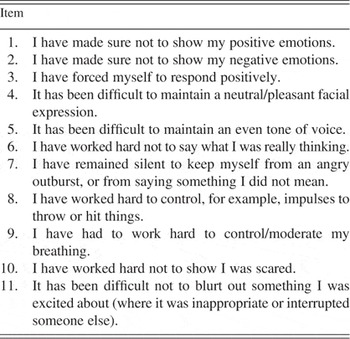
In this study, we assessed ES via-self report, as opposed to inducing ES burden experimentally, so as to allow for examination of the depletion effect as it occurs naturally in daily life. Burden of ES was assessed using a set of 11 items (see Table 1) that ask about how much effort participants exerted to control the expression of their emotions. Participants were asked to rate how much each item applied to them (a) over the course of the past 2 weeks, excluding the day of testing, and (b) on the day of testing. Participants answered on a five-point scale: never (0), once or twice (1), sometimes (2), often (3), or all the time (4). Two composite scores corresponding to ES over the past 2 weeks (ES-2Weeks) and on the day of testing (ES-Today) were computed.Footnote 7 For additional details about the initial validation of the scale, see Franchow and Suchy (Reference Franchow and Suchy2015). For the current sample, Cronbach’s alphas were .78 and .80 for ES-Today and ES-2Weeks, respectively.
Burden of expressive suppression

RESULTS
Preliminary Analyses
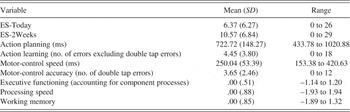
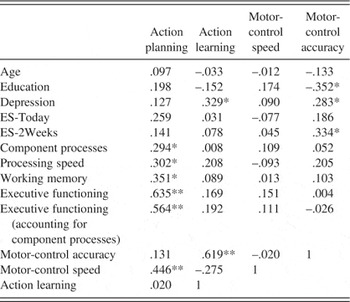
Descriptive statistics are presented in Table 2. Zero-order correlations among demographics and dependent and independent variables are presented in Table 3. As seen, individual aspects of PTT performance were not all significantly related to each other. Additionally, the only aspect of PTT performance that significantly related to the EF composite was action planning. No significant correlations were found between PTT performance and the ES-Today composite. The hypothesis that ES-2Weeks would moderate the relationship between PTT performance and ES-Today was tested in the Principal Analyses.
Descriptive statistics for expressive suppression, PTT performance, and executive functioning composites

Note. N=51. ES-Today=expressive suppression on the day of testing; ES-2Weeks=expressive suppression over the past 2 weeks; Action planning=latencies (in ms) between correct sequences on the PTT task; Action learning=total number of PTT errors excluding double tap errors; Motor-control speed = latencies (in ms) between the double taps in the tap-tap movement; Motor-control accuracy=total number of PTT double tap errors; Executive functioning (accounting for component processes)=residuals after regressing the executive functioning composite onto the component processes composite; Processing speed=processing-speed composite scores; Working memory=working-memory composite scores.
Zero order correlations among independent and dependent variables and demographic data

Note. N=51. Depression=total score on the Beck Depression Inventory-Second Edition; ES-Today=expressive suppression on the day of testing; ES-2Weeks=expressive suppression over the 2 weeks leading up to testing; Component processes=component processes composite scores; Processing speed=processing-speed composite scores; Working memory=working-memory composite scores; Executive functioning=executive functioning composite scores; Executive functioning (accounting for component processes)=residuals after regressing the executive functioning composite onto the component processes composite; Action planning=latencies (in ms) between correct sequences on the PTT task; Action learning= total number of PTT errors excluding double tap errors; Motor-control speed = latencies (in ms) between the double taps in the tap-tap movement; Motor-control accuracy= total number of PTT double tap errors.
*p<.05 (two-tailed).
**p<.01 (two-tailed).
PRINCIPAL ANALYSES: FIRST AIM
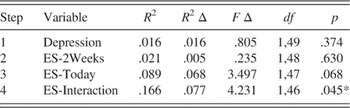
To determine whether self-reported burden of ES related to PTT performance, we conducted a series of hierarchical regressions, using the four aspects of PTT performance as dependent variables. Specifically, we tested whether the relationships between PTT and ES-Today were moderated by ES-2Weeks. As was done previously (Franchow & Suchy, Reference Franchow and Suchy2015), for all models, BDI-II was entered on the first step to control for possible effects of subclinical depression. ES-2Weeks was entered on the second step followed by ES-Today on step 3. On the fourth and final step, we entered an interaction between ES-2Weeks and ES-Today to determine if typical levels of ES burden moderates the relationship between ES burden on the day of testing and PTT performance.
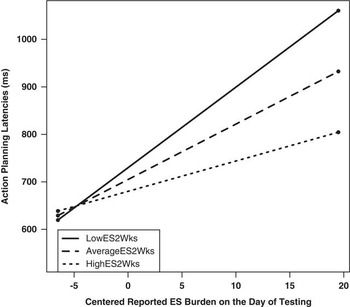
For action-planning latencies, the ES interaction term accounted for significant variance above and beyond BDI-II and the other two ES composite scores. Results from the hierarchical regression predicting action-planning latencies are reported in Table 4. In regression model with all four variables entered simultaneously as predictors, a positive main effect emerged for ES-Today (B=11.67; p=.015), which was qualified by an interaction between ES-Today and ES-2weeks (B=–.78; p=.045). To interpret this moderation effect, the interaction was decomposed by computing simple slopesFootnote 8 at the mean and at 1 SD above and below the mean of ES-2Weeks (Cohen, Cohen, West, & Aiken, 2003). This revealed that the association between ES-Today and action planning is stronger as ES-2Weeks decreases (low ES-2Weeks: B=16.95; p=.007, average ES-2Weeks: B=11.67; p=0.015; high ES-2Weeks: B=6.38; p=.154). Specifically, individuals who reported low ES burden over the past 2 weeks but high ES burden on the day of testing exhibited the longest action-planning latencies (see Fig. 1). In contrast, those with high ES burden over the course of the past 2 weeks did not show a relationship between ES burden on the day of testing and action planning.
This figure illustrates the relationship between self-reported expressive suppression scores on the day of testing and action-planning latencies at different levels of self-reported expressive suppression scores over the 2 weeks leading up to testing. Simple slopes are shown for low (1 SD below the mean), medium (the mean), and high (1 SD above the mean) levels of self-reported expressive suppression over the 2 weeks leading up to testing.

Hierarchical linear regression predicting action-planning latencies by expressive suppression

Note. N=51. Depression=total score on the Beck Depression Inventory-Second Edition; ES-Today=expressive suppression on the day of testing; ES-2Weeks=expressive suppression over the 2 weeks leading up to testing; ES-Interaction=ES-Today×ES-2Weeks.
*p<.05 (two-tailed).
**p<.01 (two-tailed).
Additionally for motor-control accuracy and motor learning, BDI-II scores accounted for a significant amount of variance when entered as the only predictor in the models (B=.198; p=.044; B=.355; p=.018, respectively). This demonstrates a positive relationship between subclinical depression and accuracy during motor-sequence learning. The ES composites did not account for any significant amount of variance in the models predicting motor learning and motor-control accuracy (all R 2 Δ values less than .05, all F Δ values less than 2.64, and all p-values greater than .11). Similarly, none of the predictors entered accounted for a significant amount of variance in the models predicting motor-control speed (all R 2 Δ values less than .02, all F Δ values less than .64, and all p-values greater than .43).
SECOND AIM
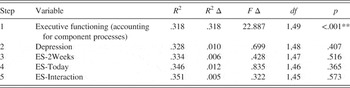
To determine whether any relationships observed between ES burden and action-planning latencies can be explained by EF, processing speed, or working memory, we repeated the hierarchical regression described above, this time with the EF composite entered as a covariate on step 1. As a reminder, the composite represents the residual variance in EF measures after accounting for the component processes. The results of this model demonstrate that none of the ES variables or BDI-II scores accounted for additional variance in action-planning latencies above and beyond EF (see Table 5).
Hierarchical linear regression predicting action-planning latencies by expressive suppression and executive functioning

Note. N=51. Executive functioning (accounting for component processes)=residuals after regressing the executive functioning composite onto the component processes composite; Depression=total score on the Beck Depression Inventory-Second Edition; ES-Today=expressive suppression on the day of testing; ES-2Weeks=expressive suppression over 2 weeks leading up to testing; ES-Interaction=ES-Today×ES-2Weeks.
*p<.05 (two-tailed).
**p<.01 (two-tailed).
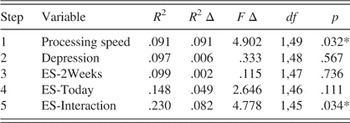
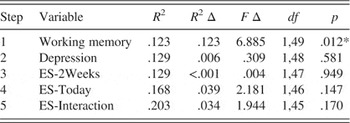
To see if the relationship observed between ES burden and action-planning latencies could be also explained by processing speed and/or working memory, we repeated the hierarchical regressions described above, this time with the processing speed and the working-memory composite each entered in turn as a covariate on step 1. The results showed that ES interaction accounted for additional variance in action planning above and beyond processing speed; when all five variables were entered simultaneously as predictors, a positive main effect again emerged for ES-Today (B=10.56; p=.024), which was again qualified by an interaction between ES-Today and ES-2weeks (B=–.81; p=.034). However, no ES variables contributed to action planning above and beyond working memory (see Tables 6 and 7).
Hierarchical linear regression predicting action-planning latencies by expressive suppression and processing speed

Note. N=51. Processing speed=processing-speed composite scores; Depression=total score on the Beck Depression Inventory-Second Edition; ES-Today=expressive suppression on the day of testing; ES-2Weeks=expressive suppression over 2 weeks leading up to testing; ES-Interaction=ES-Today × ES-2Weeks.
*p<.05 (two-tailed).
**p<.01 (two-tailed).
Hierarchical linear regression predicting action-planning latencies by expressive suppression and working memory

Note. N=51. Working memory=working memory composite scores; Depression=total score on the Beck Depression Inventory-Second Edition; ES-Today=expressive suppression on the day of testing; ES-2Weeks=expressive suppression over 2 weeks leading up to testing; ES-Interaction=ES-Today×ES-2Weeks.
*p<.05 (two-tailed).
**p<.01 (two-tailed).
DISCUSSION
The current study bridged two literatures that have largely been developing in parallel: the literature establishing the functional and neuroanatomical overlap between EF and various aspects of motor output (Koziol, Reference Koziol2014; Kraybill & Suchy, Reference Kraybill and Suchy2011; Mirelman et al., Reference Mirelman, Herman, Brozgol, Dorfman, Sprecher, Schweiger and Hausdorff2012; Ridler et al., Reference Ridler, Veijola, Tanskanen, Miettunen, Chitnis, Suckling and Bullmore2006; Rigoli et al., Reference Rigoli, Piek, Kane and Oosterlaan2012; Suchy & Kraybill, Reference Suchy and Kraybill2007; Suchy et al., Reference Suchy, Kraybill and Larson2010), and the literature demonstrating that recent engagement in ES leads to subsequent decrements in EF (Baumeister & Alquist, Reference Baumeister and Alquist2009; Bray, Martin-Ginis, & Woodgate, Reference Bray, Martin Ginis and Woodgate2011; Fischer Kastenmüller, & Asal, Reference Fischer, Kastenmüller and Asal2012; Franchow & Suchy, Reference Franchow and Suchy2015; Inzlicht & Gutsell, Reference Inzlicht and Gutsell2007; Muraven et al., Reference Muraven, Tice and Baumeister1998). Collectively, this work suggests that higher than usual ES burden is likely to be associated with decreased performance on aspects of motor output that rely on EF.
To test this hypothesis, the current study examined (a) the relationships between different aspects of motor-sequence learning assessed by the PTT task (i.e., action planning, action learning, motor-control speed, and motor-control accuracy) and self-reported ES burden, and (b) whether any identified relationships could be explained by EF and/or processing speed and working memory. Results confirmed our hypothesis that higher than usual self-reported ES burden (increased on the day of testing relative to the 2 weeks preceding testing) would be associated with longer action-planning latencies. However, contrary to expectation, no other assessed aspects of motor output were associated with ES burden on the day of testing. Importantly, self-reported ES burden accounted for variance in action-planning latencies above and beyond processing speed, but not EF or working memory performance. This suggests the relationship between reported ES and action planning is mediated by state level fluctuations in EF [including working memory, which is commonly considered an aspect of EF (Suchy, 2016)]; thus, higher than usual ES burden will likely only impact action processes that are reliant on EF. Future work should determine the role other specific aspects of EF play in this relationship.
Is Action Planning Uniquely Depletable?
One explanation for why action planning was uniquely related to reported increased ES burden is that it is simply “more vulnerable” to cognitive stressors than the other aspects of performance. This is unlikely, however, as two past studies designed to interfere with verbalization documented a consistent negative impact on motor learning and speed of motor control, but no effect on action planning (Larson & Suchy, Reference Larson and Suchy2014, Reference Larson and Suchy2015). Instead this suggests different types of cognitive stressors impair different aspects of motor output.
In the current study, action planning was the only aspect of performance significantly related to EF and working memory. This likely explains why action planning was the only variable associated with increased ES on the day of testing. This finding was somewhat surprising, however, as past work with the PTT task has documented that action planning, action learning, and motor control are all significantly related to EF (Suchy and Kraybill, Reference Suchy and Kraybill2007). One possible explanation for this discrepancy is that which components of motor-sequence learning rely on EF, and thus relate to excessive ES, changes as a function of age. In fact, behavioral and neuroimaging research suggests that motor sequencing increasingly relies on EF with increasing age (Berchicci, Lucci, Pesce, Spinelli, & Di Russo, Reference Berchicci, Lucci, Pesce, Spinelli and Di Russo2012; Fraser et al., Reference Fraser, Li and Penhune2010; Heuninckx, Wenderoth, & Swinnen, Reference Heuninckx, Wenderoth and Swinnen2008). Thus, although Suchy and Kraybill (Reference Suchy and Kraybill2007) found all aspects of motor-sequence learning to relate to EF, their sample was comprised of age groups across the adult lifespan. In contrast, participants in the current study included an undergraduate (i.e., young adult) population.
Additionally, Larson and Suchy (Reference Larson and Suchy2014) used children as participants in their study of the impact of incongruent verbalization on motor output, and once again age differences between that and the present study may have contributed to the discrepant findings. Neuroimaging studies show that higher order cognitive abilities and motor abilities both rely on overlapping neural regions, including frontal, parietal, cerebellar, and basal ganglia structures, which rapidly develop in tandem during childhood (Pangelinan et al., Reference Pangelinan, Zhang, VanMeter, Clark, Hatfield and Haufler2011; Ridler et al., Reference Ridler, Veijola, Tanskanen, Miettunen, Chitnis, Suckling and Bullmore2006). This ongoing development could cause various aspects of motor output to be differentially vulnerable to interference or depletion in children versus adults.
It is unlikely, however, that the differences in the results between the verbalization studies and the current study can be entirely explained by age differences, as Larson and Suchy (Reference Larson and Suchy2015) used a college population in their study of the impact of articulatory suppression on motor output. Another likely factor contributing to the discrepant results across these studies are differences in task demands. The analogues of the PTT task used by Larson and Suchy (Reference Larson and Suchy2014, Reference Larson and Suchy2015) both required participants to perform only one specific sequence of hand movments and included a separate learning and perfomance phases. In the current study, participants performed a series of novel sequences of increasing length across four blocks without an extensive learning period. These specific task demands likely explain why action planning was related to both EF and working memory. This is consistent with our recent work demonstrating that action-planning latencies during performance of a familiar sequence were only significantly related to EF if the sequence was presented in a novel context (Euler et al., Reference Euler, Niermeyer and Suchy2015). This suggests that ES may only be associated with action planning when individuals are planning a novel movement, or a familiar movement in a novel context. Thus, taxing EF and working memory by excessive ES burden or incongruent verbalization may not affect action planning for over-learned tasks. Future studies should investigate this empirically.
Taken together, these results highlight the susceptibility of motor output to depleted cognitive resources and suggest the aspects of motor output that are negatively affected by a cognitive stressor may vary as a function of (a) the type of cognitive stressor, (b) population characteristics, and (c) specific task demands.
Ramifications for Neuropsychological and Functional Assessments
In clinical assessments, accurate measurement of EF, including action planning, has important implications both diagnostically and for predicting future functional outcomes (Lezak et al., Reference Lezak, Howieson, Bigler and Tranel2012; Robinson et al., Reference Robinson, Woerner, Alvir, Bilder, Hinrichsen and Lieberman2002). For example, efficient action planning is thought to facilitate successful navigation around obstacles while walking, as it allows individuals to quickly reprogram new action trajectories when presented with unexpected changes in their environment (Knobl, Kielstra, & Almeida, Reference Knobl, Kielstra and Almeida2012; Uemura, Yamada, Nagai, & Ichihashi, Reference Uemura, Yamada, Nagai and Ichihashi2011). Depletion of action planning resources due to excessive ES burden could then be associated with poor obstacle navigation, which in turn could lead to falls. Future studies should assess this possibility empirically.
Additionally, in a research context, EF assessment is becoming increasingly prominent in many fields (Suchy, Reference Suchy2009). Past research and the current study together suggest that researchers and clinicians should adjust for stressors in daily life that deplete EF, to maximize the accuracy of their assessment. To do this effectively, psychometrically validated tools are needed that can reliably and efficiently capture factors like increased ES burden. Further psychometric development of the measure used to assess ES burden in the current study is, therefore, warranted.
LIMITATIONS
The current study has some limitations that should be noted. First, the current study was conducted on a modest undergraduate student sample that was primarily female (71%); this may limit the generalizability of our findings. Future work using larger samples and more diverse populations is needed. Additionally, self-report measures are necessarily limited by participants’ memory, self-insight, and tendency to present themselves in a socially desirable manner. Future validation work is needed, and should include the development of response validity scales.
Additionally, the goal to investigate self-reported ES burden necessitated the use of a correlational design. Therefore, a causal relationship between ES burden and action-planning latencies cannot be determined. It is also possible participants’ self-perceptions of how they performed on the cognitive tasks may have influenced how much ES they reported. A conceptual replication and extension of the current findings should assess whether experimentally manipulated ES selectively interferes with action-planning latencies rather than other aspects of motor output.
Additionally, the participants who rated themselves as having increased burden of ES over the course of the day of testing may be experiencing more stressful events or other experiences that might coincide with or be driving their increased need for emotion regulation. A complete assessment of the reasons driving the self-reported increased ES burden and other coinciding stressors was beyond the scope of the current study. However, future work that isolates and accounts for potential contributions of other variables, such as decreased sleep and increased stress level, would further clarify current findings. That said the deleterious impact of ES has previously been demonstrated in the experimental literature (Baumeister & Alquist, Reference Baumeister and Alquist2009; Bray et al., Reference Bray, Martin Ginis and Woodgate2011; Fischer et al., Reference Fischer, Kastenmüller and Asal2012; Inzlicht & Gutsell, Reference Inzlicht and Gutsell2007; Muraven et al., Reference Muraven, Tice and Baumeister1998), suggesting it is unlikely that these other variables would fully account for our findings.
The use of the PTT task allowed for precise measurements of discrete aspects of motor output, and the ability to draw on existing literature establishing the task’s reliability, validity, and promising clinical utility (Kraybill & Suchy, Reference Kraybill and Suchy2011; Kraybill et al., Reference Kraybill, Thorgusen and Suchy2013; Suchy et al., Reference Suchy, Derbidge and Cope2005; Suchy & Kraybill, Reference Suchy and Kraybill2007). The lack of population-based norms for the PTT, however, makes it difficult to determine the practical or clinical significance of the prolonged action planning time. Future studies may consider using measures of various aspects of motor output that are normed for healthy and clinical populations to provide further clarification of the significance of the depletion effect on action planning. Finally, sample size in the current study is modest, limiting power. Future studies should replicate these findings with larger samples.