


1. Introduction
Semitic root incompatibilities are characterized mainly by the tendency to avoid two homorganic radicals (*mpd, *dmp, *mdp) and two identical initial and medial radicals (*mmd).Footnote 1 Previously explained by dissimilatory constraints (Cantineau Reference Cantineau1946, Greenberg Reference Greenberg1950), they received formal expression through the Obligatory Contour Principle (see among others McCarthy Reference McCarthy1979, Reference McCarthy and Barlow1983, Reference McCarthy1989, Bohas Reference Bohas1990).
Incompatibilities in Biblical Hebrew are examined in Greenberg (Reference Greenberg1950), Koskinen (Reference Koskinen1964), Kuryłowicz (Reference Kuryłowicz1972) and Weitzman (Reference Weitzman1987).Footnote 2 Since Greenberg (Reference Greenberg1950), it is generally assumed that glides can combine freely with all other root consonants and are thus not subject to homorganic co-occurrence restrictions.Footnote 3 This is indeed at least partly true. As shown below, initial and medial w combine with labials and velars, e.g.:Footnote 4

In the same way, initial, medial, and final y combine with coronals, e.g.:Footnote 5

Unlike the previous cases, the appearance of final radical w is restricted. This limitation is primarily the result of a well-known historical process: almost all III-w verbs have shifted to III-y (as in the other Northwest Semitic languages).Footnote 9 The same process has occurred in nouns, but in a less systematic way. Indeed, alongside original III-w verbs and nouns that have shifted completely to III-y, related nouns that still retain the final w can be found, e.g.:Footnote 10, Footnote 11

In the following sections, a possible incompatibility between medial labial/velar radical and final w will be investigated. For this purpose, a comprehensive examination of all the III-w nouns according to their synchronic pattern will be undertaken in section 2.Footnote 12 In section 3, an attempt will be made to highlight the incompatibility from this complete inventory; to support our claim, additional historical and comparative evidence will be presented.
2. III-w nouns
2.1. III-w segolate nouns
CvCw (segolate) nouns are the most numerous of III-w nouns. In masculine forms, the vocalization of postconsonantal final w as in theoretical /CvCw/ > CvCū is a regular phenomenon:

The feminine forms are:Footnote 14
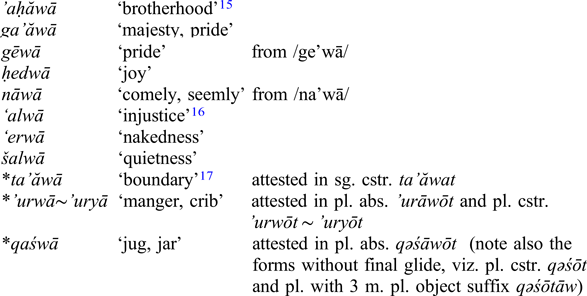
2.2. III-w nouns with suffix -t
On the one hand, some nouns are apparently III-w nouns with feminine ending -t, e.g. ?/‘enw-t/ > ‘ěnūt ‘affliction’. On the other hand, some abstract nouns, and to a lesser extent some action and concrete nouns, are formed with the feminine suffix -ūt, e.g. yədīdūt ‘love, object of love’, hărīsūt ‘destruction’, ḥallāmūt ‘name of a plant, purslane’. These two types of nouns are difficult to distinguish.
Indeed, the adding of the suffix -ūt to III-y nouns is always followed by the syncope of radical y, e.g. /demy–ūt/ > dəmūt ‘likeness, /zeny–ūt/ > zənūt ‘fornication’, leading to homophony with putative III-w nouns with -t such as /‘enw-t/ > ‘ěnūt ‘affliction’. To complicate matters, III-w nouns with -t and defective nouns with -ūt should theoretically differ in their plural, e.g.*‘enwōt vs. *dəmuyyōt respectively. However, not only are their plurals generally not attested, but it also seems that there is some confusion between the two plural suffixes. This is suggested by the case of ‘ēdūt ‘testimony’, a noun (from the root ‘wd) with -ūt. Its plural is ‘ēdwōt,Footnote 18 that is, the plural form of a III-w noun and not *‘ēduyyōt Footnote 19 as expected for a noun with -ūt.
As a result of these complexities, it is not possible to know with certainty if a final sequence -ūt comes from a third radical w followed by -t (as in ?/‘enw-t/ > ‘ěnūt) or from the suffix -ūt (which causes the syncope of the third radical y as in ?/‘eny-ūt/ > ‘ěnūt). This is especially true in the two following cases:Footnote 20
(1) When a defective noun is derived from a root attested elsewhere synchronically as both III-y and III-w:

(2) When a defective noun is derived from a root attested elsewhere synchronically as III-y albeit likely III-w from a comparative point of view:Footnote 23


2.3. Other III-w nouns
More rarely, III-w nouns are found with patterns other than those observed above: CəCāC (sətāw ‘winter’, śəlāw ‘quail’, which are perhaps loanwords since their pattern is, as is well-known, of Aramaic origin), CaCaC (‘ānāw ‘poor, humble’, feminine *‘ănāwā ‘humility’ attested in cstr. state ‘anwā) and CaCeC, the pattern of stative adjectives and participles (šālēw ‘quiet, at ease’ also šəlēw, see below section 2.4. on III-w verbs).
The form *šiqqūw ‘drink’ is only attested in pl. with 1. pl. object suffix šiqquway. The presence of w here is really unexpected. Indeed, the pausal form of šiqquway, viz. šiqqūyāy, and the singular form of the term, viz. šiqqūy, exhibit a final y. Elsewhere, in Biblical Hebrew as well as in other Semitic languages, the root occurs also as III-y only (see Leslau Reference Leslau1987: s.v. saqaya).
Finally, the hapax śekwī is obscure. First, its meaning could be either ‘cock’ (as in Mishnaic Hebrew) or ‘meteor, celestial appearance, phenomenon’. Second, its relationship with the root śky as in maśkīt ‘show-piece, figure, imagination’ (cf. also Mishnaic Hebrew sākā ‘to look out’, Aramaic sakwātā ‘watchman’, Geez maskot ‘window’, masākəw ‘planets’) is not clear. Third, it may also be a loanword.Footnote 33
2.4. III-w verbs
Final w rarely appears in verbs. It occurs alongside final y in the conjugation of šālēw ‘to be quiet’ (e.g. šālaw-tī ‘I was quiet’ vs. yi-šlā́y-ū ‘they will be quiet’) and of rā’ā ‘to see’ where an unexpected form of the infinitive construct, viz. ra’ăwā, coincides with the pattern of the CvCw feminine nouns (cf. above, section 2.1).Footnote 34
3. Co-occurrence restrictions between II-labial/velar and III-w
3.1. Synchronic analysis
The 32 III-w roots, including all the indecisive cases in section 2, are as follows:
’ḥw, ’rw, bhw, g'w, glw, hgw, ḥgw, ḥdw, ḥzw, ḥyw, ḥnw, ḥsw, ksw, mdw, n'w, nṣw, stw, ‘lw, ‘nw, ‘rw, qṣw, qśw, r'w, śḥw, śkw, ślw, šbw, šḥw, šlw, šqw, t'w, thw
It is worth remembering that the III-w roots are remnants that survived the historical shift III-w > III-y, which explains their small number. Some types of roots are relatively over-represented (I-ḥ, I-ś, I-‘) whereas others simply do not occur (e.g. I-d, I-z). It is therefore possible that the absence of certain combinations is not due to incompatibilities between consonants, but rather results from the limited size of the corpus. We will soon return to this problem. Meanwhile, let us proceed to the description of the attested combinations between root consonants and w. Final w appears with initial consonants of any major place of articulation:

On the contrary, combinations between medial radicals and final w are limited. Certainly, w occurs freely with preceding coronals and gutturals:

However, as shown below, only one combination between final w and medial labial is attested; moreover, it is an indecisive case where w/ū (in šbw/šəbūt) might be a suffix (see section 2.2). Regarding medial velar, four roots are attested but, here again, three are indecisive cases: w/ū in hgw/hāgūt might be a suffix, šqw/*šiqqūw stems apparently from an original III-y root and śkw/śekwī might be a loan and is at least a noun with obscure origin (see sections 2.2 and 2.3):

Is it safe to conclude, from the limited data we have, that Biblical Hebrew root structure tends to disfavour homorganic II-labial/velar III-w sequences? The I-labial roots bhw and mdw are almost as rare as the II-labial/velar roots and this could also be interpreted as the manifestation of a dissimilatory constraint (we will return to this point at the end of the article). From what we know about co-occurrence restrictions in Semitic grammar, a root incompatibility involving a glide would be unexpected. However, previous studies on Biblical Hebrew have largely overlooked the glides and the nouns: Greenberg (Reference Greenberg1950) passed over glides and only mentioned substantives occasionally; Koskinen (Reference Koskinen1964) disregarded II- and III-w/y roots but included nominal roots; Kuryłowicz (Reference Kuryłowicz1972) excluded II-w/y roots but admitted some verbal roots of nominal origin; and finally, Weitzman (Reference Weitzman1987) worked on Koskinen's (Reference Koskinen1964) data. As a result, it would not be surprising that some glide co-occurrence restrictions within nominal roots have so far gone unnoticed.Footnote 35 Needless to say, under such conditions, the particular issue of nominal roots with two underlying glides (such as III-y roots that keep the remains of an original w) was not even considered.
3.2. Historical and comparative evidence
We have no synchronic means of confirming whether the preceding distributional gaps are the result of dissimilatory constraints or simply a random result that stems from a limited corpus of data. Fortunately, comparative and historical morphophonology can provide some evidence. First, consider below the other Biblical Hebrew III-y roots that come from Proto-Semitic II-labial/velar III-w roots:

In all the attested realizations of these roots in Biblical Hebrew, the final radical is always y, never w. This clearly shows that at a certain stage in the prehistory of Hebrew, w shifted to y after II-labials and velars. Certainly, the question of whether the change was caused by a genuine dissimilation process or by the broader and phonetically unconditioned change III-w > III-y is open. However, in any case, this is exactly what we expected: not to find a final w preceded by a labial or a velar.
Second, all Northwest Semitic languages have undergone the change III-w > III-y. Have they all retained w in the same contexts (i.e. only after coronals and gutturals) as in Biblical Hebrew? Of course, our goal here is not to examine all the Northwest Semitic languages one after the other. Since Biblical Hebrew data on III-w roots is scarce, we have to turn to a well-attested language to benefit from more data. The related language with the largest corpus is, to the best of our knowledge, Syriac. Syriac has 54 III-w roots (mostly nominal as in Hebrew). Of these, 51 are II-coronal or II-guttural, e.g.:
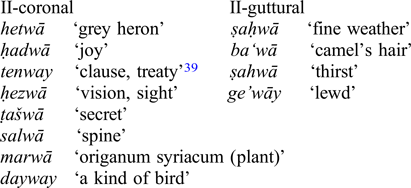
Only three are II-labial or II-velar, and they are not even real exceptions.Footnote 40 Syriac obviously forbids II-labial/velar III-w sequences (for a comprehensive study, see Aïm Reference Aïm2019). Consequently, since the limited data of Biblical Hebrew exhibits identical tendencies and since Biblical Hebrew and Syriac are related, one can legitimately assume that the dissimilatory constraints observed in Syriac are also at work in Hebrew.Footnote 41 Because of more abundant data, Syriac instantiates these constraints more clearly than Biblical Hebrew.Footnote 42
Finally, it is worth noting that Syriac does not exclude I-labial III-w roots, e.g. petwā ‘breadth, ampleness’, /parw-tā/ > prūtā ‘skin, leather garment’, ba‘wā ‘camel's hair’, /baraw-tā/ > brōtā ‘sawdust’, marwā ‘origanum syriacum (plant)’, /masw-tā/ > msūtā ‘cypress’. Thus, the scarcity of the I-labial III-w roots in Biblical Hebrew is probably not representative of a dissimilatory constraint.
4. Conclusion
This article has investigated the distributional limitations of the glide w in a special group of Biblical Hebrew defective roots, viz. the III-w nouns. These limitations have been accounted for by the well-known Semitic root incompatibilities that disfavour sequences of homorganic consonants. The small number of III-w nouns could call into question any generalization on this matter. However, historical and comparative data support our claim. Syriac presents exactly the same phenomenon, even more clearly, because of a greater number of attested III-w roots.


