INTRODUCTION
The members of the family Acanthuridae are commonly known as surgeonfish, one of the most common marine fish families found around coral reefs of tropical and subtropical seas with 7 genera and 81 species (Kamla Devi & Rao, Reference Kamla and Rao2003). Among the seven genera of the family Acanthuridae, Acanthurus is the largest genus with 39 species (Kamla Devi & Rao, Reference Kamla and Rao2003) followed by Naso with 20 species (Froese & Pauly, Reference Froese and Pauly2012). During the collection of ornamental fauna along the east coast of India, one specimen of surgeonfish was collected from the fish landing centre at Mohana, Digha, West Bengal, India (21837.843′N 87832.827′E). It was carefully examined and identified as Naso reticulatus Randall, Reference Randall2001 which forms its first record from Indian waters. Naso reticulatus was first reported from Taiwan and Indonesia (Randall, Reference Randall2001) and known by its type specimens only. The record of Naso reticulatus from Indian waters extends the distributional range of the species to the east coast of India as well as increasing the knowledge about the richness of the Indian ichthyofauna.
MATERIALS AND METHODS
Sample collection
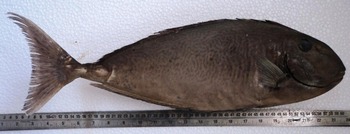
A single specimen was collected from the fish landing centre at Mohana, Digha, West Bengal, India (21837.843′N 87832.827′E). The morphometric characters of the specimen were recorded after photo-documentation of the specimen in fresh condition (Figure 1). The specimen was subsequently preserved in 10% formaldehyde and deposited in the museum of the Marine Aquarium and Regional Centre of the Zoological Survey of India, Digha.
Specimen of Naso reticulatus (standard length 456 mm) in fresh condition collected from Mohana, Digha, fish landing centre: MARC/F2278 on 16 January 2012.

Materials examined
Mohana, Digha, fish landing centre: MARC/F2278, 1 specimen, standard length: 456 mm (date of collection: 16 January 2012).
RESULTS AND DISCUSSION
SYSTEMATICS
Class ACTINOPTERYGII Klein, 1885
Order PERCIFORMES Bleeker, 1859
Family ACANTHURIDAE Bonapatre, 1832
Genus Naso Lacépède, 1801
Species Naso reticulatus Randall, Reference Randall2001
DIAGNOSTIC CHARACTER
Dorsal fin rays V, 29; anal fin rays II, 28; all dorsal and anal rays branched; pectoral fin rays 17, the upper two unbranched; pelvic fin rays I, 3; body depth 3.15 in standard length (SL), head length 4.47 in SL; origin of dorsal fin is above upper end of gill opening and origin of anal fin is just below the base of 5th dorsal spine. 1st dorsal ray is longest, 2.88 in head length. 4th to 8th dorsal soft rays are longest among dorsal soft rays and 2.72 in head length. 1st anal spine 4.59 in head length. 6th anal soft ray longest among anal soft rays and 2.97 in head length. Caudal fin emarginated. Pelvic fins origin behind the lower base of pectoral fins. Body scales very small and closely associated; except opercular membrane head is fully scaled. Membranes of dorsal, anal, pectoral and ventral fins are naked. Caudal fin covered with very small scales; paired fin with very fine scales on rays; lateral lines more or less parallel to dorsal profile of the body but pores are not visible. Anterior lower limb gill rakers are 11 and posterior gill rakers are 12.
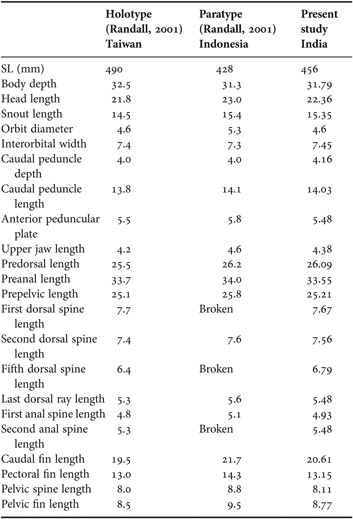
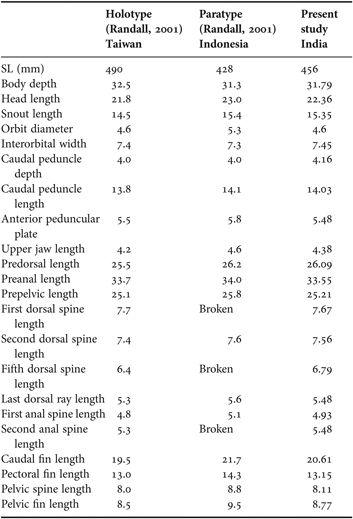
Small, terminal mouth with slightly oblique gape; teeth very small and pointed; middle part of upper lip broad and narrower at corner of mouth; upper jaw length 5.05 in head length; tongue rounded and very short. Circular anterior nostril larger and anteroventral to the small rounded posterior nostril. A sinuous curve formed by an oblique groove which passes from in front of eye to below nostrils. Horn or protuberance of snout or forehead is absent; dorsal part of head convex with angularity before eye. Snout length 1.48 in head length; orbit diameter 4.80 to head length. Caudal peduncle length and depth are 1.6 and 5.31, respectively in head length. Each side of caudal peduncle with two keeled bony plates, the anterior one is larger with rounded edge, its length 3.96 in head length. Proportional measurements of Naso reticulatus are given in Table 1 with comparisons with the type specimens described by Randall (Reference Randall2001).
Comparative proportional measurements of Naso reticulatus collected from India with the holotype and paratype (expressed as percentages of standard length (SL)).
COLOUR
Body brown dorsally and shading to white ventrally, upper part of body with numerous small dark brown spots, sometimes joined together forming short lines; some small dark brown spots below lateral line, but most markings as irregular dark lines; head dark brown except anterior and posterior part of eyes which are pale; cheek and side of snout below groove with dark reticulum; opercular membrane black; a large irregular dark brown blotch below and extending slightly above anterior part of pectoral fin. Dorsal fin spines and rays brown with black membranes; anal fin spines and rays pale brown with distally black membranes. Pectoral fins light grey, distally black and pelvic fin rays white with grey membranes. Caudal fin deep greyish-brown with dark brown spots and lines.
REMARKS
Naso reticulatus Randall (Reference Randall2001) has close resemblance with the dark spotted species, Naso lopezi (Herre, 1927), reported from Indian waters having similar fin ray counts. However, it differs from N. lopezi, with flat interorbital space and more elongated body depth (3.15 in N. reticulatus vs 3.4–4.0 in N. lopezi in SL). Naso reticulatus can easily be differentiated from the other Naso species reported from Indian waters like N. elegans (Ruppell, 1829) by body colour; N. vlamingii (Valenciennes, 1835) by body depth (3.15 in N. reticulatus vs 2.5–2.6 in N. vlamingii in SL); N. unicornis (Forsskål, 1775) and N. annulatus (Quoy & Gaimard, 1825) with the presence of a tapering body horn; N. brachycentron (Valenciennes, 1835) and N. tuberosus Lacépède, 1801 with hump on forehead or snout; N. tonganus (Valenciennes, 1835) with bulbous nose; N. brevirostris with six dorsal spines; and N. hexacanthus (Bleeker, 1855) without small black body spots.
Naso reticulatus is described by Randall (Reference Randall2001) with only two specimens. To date the species is known by its type specimens only from Taiwan and the southern end of Sumatra, Indonesia. This is the first record of the species outside its known geographical area suggesting its range extension to Indian waters.
ACKNOWLEDGEMENT
The authors thank Dr K. Venkataraman, Director, Zoological Survey of India, for guidance and necessary facilities for the work.