INTRODUCTION
Moray eels of the family Muraenidae comprise one of the largest families of eels and are found worldwide in tropical and subtropical seas, from the shoreline down to the edge of the continental shelf. Nearly 200 species are recognized worldwide (Smith, Reference Smith2012) and new species are continually being discovered (e.g. Reece et al., Reference Reece, Smith and Holm2010; Loh et al., Reference Loh, Shao and Chen2011). Morays are easily recognized by their lack of a pectoral fin, their greatly reduced gill opening, the posterior nostril above the eye and the formidable dentition of most species. The lateral line is reduced to a few pores at the anterior end (usually one or two) of the canal. Head pores are similarly reduced, with most having three in the supraorbital canal, four in the infraorbital canal and five or six in the preoperculomandibular canal. Many species of morays are readily recognized by their conspicuous colour patterns, but others are plain brown or grey.
Gymnothorax prolatus Sasaki & Amaoka, Reference Sasaki and Amaoka1991 was described from off Taiwan and, until now, was known only from there. During a recent survey of fishes around the coast of India near Digha, the two authors – A. Mohapatra and D. Ray – collected four specimens of an elongate, unpatterned moray eel that matched the description of G. prolatus. About the same time, D.G. Smith acquired a specimen collected off Pakistan. It was initially surprising to find this species so far from its type location, but the specimens agreed in all their characters with G. prolatus. These records show that the species occurs continuously from Taiwan across the northern Indian Ocean.
MATERIALS AND METHODS
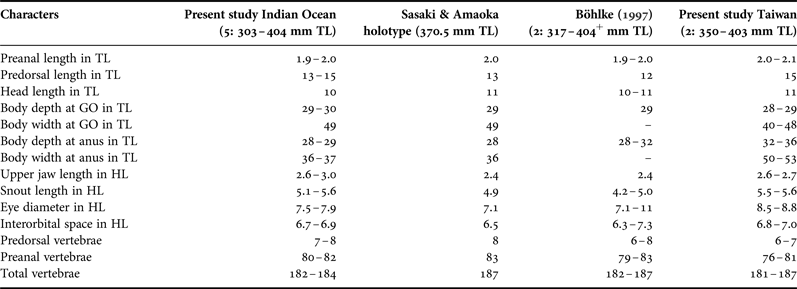
The Indian specimens (303–336 mm) were collected from the Shankarpur fishing harbour, Digha, West Bengal, India. Fishermen here collect fishes by trawl net. The Pakistan specimen (404 mm) was collected off Karachi, also by trawl. The Indian specimens are deposited in the Marine Aquarium and Regional Centre, Zoological Survey of India Museum, MARC/ZSI/F3707. The Pakistan specimen is deposited in the National Museum of Natural History, Washington, DC, USNM 427622. Counts and measurements follow Böhlke (Reference Böhlke and Böhlke1989). All measurements are in mm, made with digital and dial callipers and recorded to the nearest 0.1 mm. Vertebrae were counted by means of digital x-ray. Meristic and morphometric values are presented in Table 1.
Morphometric and meristic characters in Gymnothorax prolatus.

TL, total length; HL, head length; GO, gill opening; +, tail damaged, original length greater than present length.
RESULTS
SYSTEMATICS
Class ACTINOPTERYGII Klein, 1885
Order ANGUILLIFORMES
Family MURAENIDAE Rafinesque, 1815
Genus Gymnothorax Bloch, 1795
Gymnothorax prolatus Sasaki & Amaoka, Reference Sasaki and Amaoka1991
Gymnothorax prolatus Sasaki & Amaoka, Reference Sasaki and Amaoka1991: seven, Figures 1–3 (Suao fish market, north-east Taiwan, bottom trawl, 9 April 1986, coll. by K. Nishida).
MATERIAL EXAMINED
MARC/ZSI/F3707 (four, 303–366 mm total length (TL)), Shankarpur fishing harbour, Digha, West Bengal, India. USNM 427622 (one, 404 mm TL), off Karachi, Pakistan, February 2014.
COMPARATIVE MATERIAL EXAMINED
Gymnothorax prolatus. USNM 396130 (one, 403 mm TL), Taiwan, 2009. USNM 398732 (one, 350 mm TL), Donggang fishing port, south-eastern Taiwan, 12 November 2009.
DIAGNOSIS
Body slender, elongate, brown in colour with black fins. Anus at midbody (Figure 1). Teeth smooth, sharp; intermaxillary teeth in one peripheral series and a median row; maxillary teeth biserial.
Gymnothorax prolatus Sasaki & Amaoka, Reference Sasaki and Amaoka1991 (F3707: 315 mm TL).
DESCRIPTION
Body elongate, compressed posteriorly. Dorsal and anal fins continuous, dorsal fin begins anterior to gill opening, anal fin begins immediately behind anus. Head moderate, snout blunt and rounded. Upper jaw slightly longer than lower, teeth concealed when mouth closed. Eye moderate, located in middle of gape and closer to rictus than to snout tip. Anterior nostril short, tubular, more or less at tip of snout; posterior nostril oval, located above anterior margin of eye. Gill opening vertical, below midlateral area, larger than eye diameter.
Three supraorbital pores: anterior one at tip of snout near edge of lip; middle one above first and just in front of anterior nostril; posterior one between second supraorbital pore and posterior nostril. Four infraorbital pores: anteriormost below anterior nostril; second between anterior nostril and anterior margin of eye; third below anterior margin of eye; and fourth below posterior margin of eye. Seven mandibular pores: anteriormost at tip of lower jaw; posteriormost below posterior margin of eye. Two branchial pores.
Teeth sharp, slender and slightly curved. Intermaxillary teeth in one peripheral row, approximately six on each side, and one median series of 2–3 large, depressible, curved, fang-like teeth. Maxillary teeth biserial, the inner teeth larger and fewer than outer. Vomerine teeth small, uniserial. Dentary with 4–5 large teeth anteriorly, followed by about 15–18 small teeth.
The proportional measurements are provided in Table 1.
Colour: In fresh specimens, body brown, without markings, fins dark with pale margin; head tan, anterior nostril white, posterior nostril and gill membrane areas whitish.
DISTRIBUTION
Known from Taiwan, the east coast of India in the Bay of Bengal and the north-eastern Arabian Sea off Pakistan.
DISCUSSION
This species was previously known only from Taiwan. It was described from a single specimen (Sasaki & Amaoka, Reference Sasaki and Amaoka1991). Böhlke (Reference Böhlke1997: 99) reported two additional specimens and referred to two others that were not examined. D.G. Smith collected two more specimens in Taiwan, bringing the total number to seven. The specimens reported here significantly add to that total and extend the species’ known range into the Indian Ocean. These specimens largely agree in all of their meristic and morphometric characters (Table 1), and there is no clear indication of geographic differentiation. Based on the new records, the species probably occurs continuously across the northern Indian Ocean wherever suitable habitat is found.
ACKNOWLEDGEMENTS
We thank Dr K. Venkataraman, Director of the Zoological Survey of India, for providing the necessary working facilities. The Pakistan specimen was made available through the cooperation of P. Psomidakis of the Food and Agriculture Organization, United Nations and H.B. Osmany, Marine Fisheries Department, Karachi, Pakistan. D. Ray is thankful to the Zoological Survey of India for funding a senior research fellowship.