INTRODUCTION
Litterfall is one of the most important sources of nutrients to lowland tropical forests growing on old and weathered soils (Hobbie & Vitousek Reference HOBBIE and VITOUSEK2000). Experiments show that long-term differences in litter input influence the fertility of tropical forest soils (Sayer & Tanner Reference SAYER and TANNER2010, Vincent et al. Reference VINCENT, TURNER and TANNER2010), as well as the nutrient concentration of canopy tree leaves and litterfall, and forest litterfall production (Sayer & Tanner Reference SAYER and TANNER2010, Wood et al. Reference WOOD, LAWRENCE, CLARK and CHAZDON2009). Litter effects on nutrient availability are potentially important not just for trees but also for understorey seedlings, because although light is generally considered to be the main limiting resource to seedlings growing in shaded understoreys, recent studies show that understorey seedlings in tropical forests respond positively to differences in soil nutrients (Holste et al. Reference HOLSTE, KOBE and VRIESENDORP2011, Santiago et al. Reference SANTIAGO, WRIGHT, HARMS, YAVITT, KORINE, GARCIA and TURNER2012). At present, however, there is a lack of information on the role of the litter layer on the nutrient status and growth of established understorey seedlings. This information would be useful to better understand forest regeneration, given that litter is a vital component of tropical forests.
Recognizing the importance of leaf litter as a source of nutrients, two studies have investigated the effects of litter addition to seedlings in shadehouse experiments. In Borneo, Brearley et al. (Reference BREARLEY, PRESS and SCHOLES2003) found that mixing leaf litter into pots of soil improved the growth of seedlings from three species of dipterocarp tree, and that this positive response was associated with increased nutrient availability to seedlings. In contrast, in French Guiana Coq et al. (Reference COQ, WEIGEL, BONAL and HATTENSCHWILER2012) found neutral and even negative effects of adding litter to pots of soil on the growth of seedlings from four species of tree. The authors proposed toxic effects of litter and enhancement of fungal pathogens amongst possible explanations for the lack of a positive effect of litter on seedling growth.
To investigate the effects of litter input on the growth and nutrient availability to seedlings we used long-term, large-scale, leaf-litter manipulation and fertilization experiments in a lowland semi-deciduous forest in Panama. Firstly, we tested for in situ effects by transplanting seedlings of two shade-tolerant tree species directly into forest plots having received either two continuous years of litter removal (L−), or addition (L+); seven continuous years of fertilization with nitrogen (N), phosphorus (P) and potassium (K) combined (+NPK); and no treatment (control, CT), and measuring seedling growth and foliar nutrients after 6–13 mo. The +NPK treatment provided a reference for the magnitude of potential litter effects on seedling growth. Secondly, we tested for litter effects on soil fertility with a soil nutrient bioassay, by growing a phytometer species (Ochroma pyramidale) on soils collected from the same plots mentioned above. We hypothesized that seedlings transplanted into forest plots would grow and have foliar nutrient concentrations that increase in the order L− < CT < L+ < +NPK, and that this would also be reflected in soil nutrient availability as determined with the soil nutrient bioassay.
METHODS
Study site
The litter manipulation and the fertilization experiments are both located in old-growth semi-deciduous forest in Gigante Peninsula, Barro Colorado Nature Monument (BCNM) (9°06′N, 79°54′W), in the Republic of Panama. This area has a tropical monsoon climate, with an average temperature of 26 °C and a mean annual precipitation of 2620 mm (Windsor Reference WINDSOR1990). Litterfall peaks early in the dry season (January–March), and then falls by 50% to low wet-season levels from May to November (Sayer & Tanner Reference SAYER and TANNER2010). Soils on the northern part of Gigante Peninsula (and under our plots) are moderately acidic Oxisols (pH 4.8–5.4) (Cavelier Reference CAVELIER1992) developed on Miocene basalt (Stewart et al. Reference STEWART, STEWART and WOODRING1980).
Litter manipulation started in January 2003 and consists of three treatments: litter addition (L+), removal (L−) and control (CT), with five replicate plots per treatment for a total of 15 plots. Plots are 45 × 45 m in size and are trenched to a depth of 50 cm to reduce nutrient transport from outside the plots by roots and mycorrhizas. The litter is removed from L− plots about every 30 d by rake and hand which results in almost no litter standing crop. This litter is then evenly distributed over the L+ plots. The fertilization experiment started in 1998 and includes N, P and K additions in a full factorial design (Wright et al. Reference WRIGHT, YAVITT, WURZBURGER, TURNER, TANNER, SAYER, SANTIAGO, KASPARI, HEDIN, HARMS, GARCIA and CORRE2011). In the present study we only use the +NPK treatment, which consists of four replicate plots 40 × 40 m in size separated by a minimum distance of 40 m. The litter addition treatment supplies approximately the same amount of nitrogen (N) and potassium (K) to the plots as the +NPK treatments (respectively, 143 vs. 125 kg N ha−1 y−1 and 39 vs. 50 kg K ha−1 y−1) and approximately 12% of the phosphorus (P) added in the +NPK treatment (5.8 kg ha−1 y−1 vs. 50 kg P ha−1 y−1).
Forest transplants
Mycorrhiza-free seedlings of two species of shade-tolerant tree (‘demographic scores’ <1; Condit et al. Reference CONDIT, HUBBELL and FOSTER1996), Coussarea curvigemmia Dwyer (Rubiaceae) and Licania platypus (Hemsl.) Fritsch (Chrysobalanaceae), were transplanted directly into the litter manipulation and +NPK fertilization plots; 10 seedlings of L. platypus (in November 2004) and 16 seedlings of C. curvigemmia (in July 2005), in four 1 × 1-m subplots per plot. Seedlings were germinated from seeds collected on Gigante Peninsula and on Barro Colorado Island (BCI) nearby, from five to six healthy trees per species. Seeds were surface sterilized and sowed onto trays containing a 1:1 autoclaved mix of local topsoil and acid-washed sand. A mycorrhizal colonization assay shortly before transplantation confirmed that seedlings were non-mycorrhizal, which ensured colonization by mycorrhizas native to the different treatments. Seedling height and number of leaves were measured 2−5 d before transplantation and at harvest, 13 mo later for L. platypus and 6 mo later for C. curvigemmia. At harvest, seedlings were measured and stems cut at ground level; stems and leaves were dried and weighed. Relative growth rates of height (RGRH; mm mm−1 mo−1) of each seedling was calculated as (ln ht2 − ln ht1)/(t2 − t1) where ht1 and ht2 were initial and final heights (mm) respectively, and t2 − t1 was the time period (mo). A similar equation was used to calculate the relative growth rate in leaf count (RGRL). Licania platypus is a tall tree (10–30 m tall) common in old-growth forest, and C. curvigemmia is a small (3–10 m tall) shade-tolerant tree (Croat Reference CROAT1978).
Foliar N concentrations were measured on dried-and-ground leaf tissue composited on a per-plot basis, using dry combustion in a CHN analyser. Foliar P and K concentration were measured on dried-and-ground leaf tissue composited on a per-treatment basis (therefore no measure of plot-to-plot variability is available), using ICP-OES after nitric acid digestion. All analyses were conducted at the Smithsonian Tropical Research Institute (STRI) Soils Laboratory in Panama City, Republic of Panama. Photosynthetically active radiation (PAR) in the litter manipulation plots was logged at 5-min intervals (PAR DataHogs, Skye Instruments, Powys, UK) for at least 1 d and compared with simultaneous reference PAR measurements taken at BCI laboratory clearing ~4 km away. This procedure is adequate to give a comparative index of light in our seedling subplots.
Soil nutrient bioassay
For the soil nutrient bioassay, the very light-demanding, locally occurring Ochroma pyramidale (Cav. ex Lam.) Urban (Bombacaceae) (Dalling et al. Reference DALLING, LOVELOCK and HUBBELL1999) was used as a phytometer species. Seeds were collected from three healthy trees in the BCI laboratory clearing, and germinated in sterile trays containing washed, autoclaved sand. Soils for this experiment were collected from each of the 15 litter manipulation and the four +NPK forest plots in February 2005. Briefly, 10 soil cores per plot (c. 20 kg) were taken with a 10-cm-diameter screw-augur to 0−15 cm depth of the mineral soil, at random locations. Leaf litter and surface organic matter fragments >1 cm2 that were still recognizable as plant material were carefully removed prior to coring. Soils were immediately transported to the laboratory and kept in cool and well-aerated conditions for 2 wk, after which they were mixed by hand on a per plot basis. This composite soil was mixed with acid-washed sand at a 1:1 dry mass ratio to increase drainage.
Ochroma pyramidale seedlings were planted into 2-L pots containing composite soils, for a total of 19 soils × 10 seedlings per soil = 190 pots. Seedlings were watered every day to field capacity. Photosynthetically active radiation (PAR) inside the shadehouse was approximately 40% of that outside, as measured with a Decagon linear ceptometer (Decagon Devices INC, Model PAR-80). After 167 d, leaf area was calculated from leaf length and breadth and seedlings were harvested, dried (60 °C), and weighed. Leaf weight ratio (LWR), stem weight ratio (SWR), root weight ratio (RWR) and specific leaf area (SLA) were calculated. Data from both the transplant and shadehouse experiments were analysed by one-way ANOVA followed by orthogonal treatment contrasts. All analyses were done with R version 3.0.0 (www.r-project.org).
RESULTS
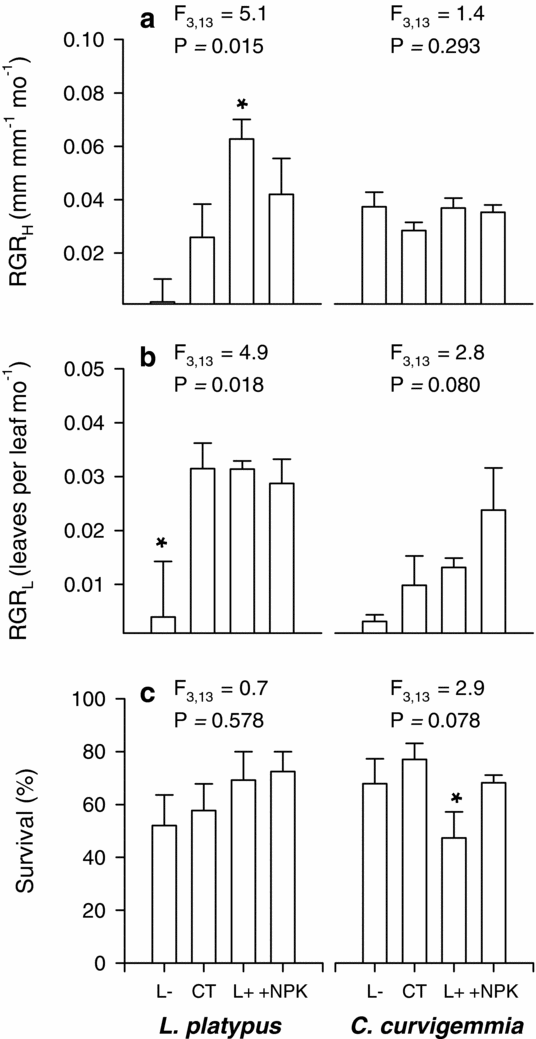
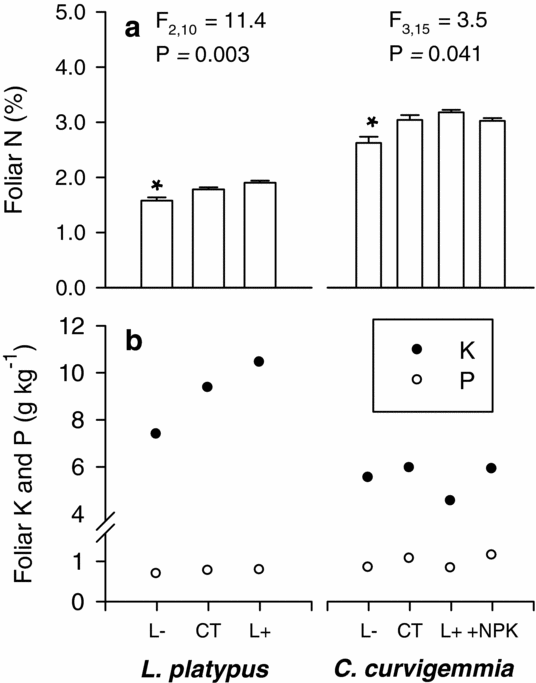
In the forest transplant experiment, L. platypus RGRH was faster in L+ plots (Figure 1a), and RGRL was lower in L− plots (Figure 1b) relative to controls, but survival did not differ across treatments (Figure 1c). No significant differences were seen for C. curvigemmia, except for a lower survival in L+ than in controls (L+ vs. CT contrast, P = 0.013) (Figure 1c). Foliar N concentrations for both species were around 11% lower in L− relative to control plots, but not significantly higher in L+ (or in +NPK plots in the case of C. curvigemmia) than in controls (Figure 2a). Foliar K concentration in L. platypus increased in the order L− < CT < L+ whereas in C. curvigemmia it appeared to be lower in L+ plots relative to all other plots (Figure 2b). Foliar P concentration did not vary greatly with any treatment for either species (Figure 2b). We note that unlike foliar N, foliar K and P concentrations were measured on one composite leaf sample per treatment and no error measure is available, therefore foliar K and P data should be interpreted with caution. Mean PAR in the litter manipulation plots was 1.02% ± 0.17% of the open canopy reference, and did not vary significantly across litter manipulation treatments (ANOVA, F(2,6) = 0.25, P = 0.784).
Growth rate and survival of Licania platypus and Coussarea curvigemmia seedlings transplanted into litter manipulation and fertilization plots in Panama. Panels represent seedling relative growth rate in height (RGRH) (a), relative growth rate in leaf count (RGRL) (b), and per cent survival (c). Treatments are control (CT), litter removal (L−), litter addition (L+) and fertilization (+NPK). Bars represent mean values (±1 SE) for replicate plots. For each plant species, F and P values (with df) are from a one-way ANOVA, bars topped with an asterisk differ from the control at P <0.05.

Foliar nutrient concentration of Licania platypus and Coussarea curvigemmia seedlings transplanted into litter manipulation and fertilization plots in Panama. Panels represent seedling concentrations of foliar nitrogen (N) (a) and foliar potassium (K) and phosphorus (P) (b). Treatments are control (CT), litter removal (L−), litter addition (L+), and fertilization (+NPK). In panel (a) bars represent mean values (±1 SE) for replicate plots; for each plant species, F and P values (with df) are from a one-way ANOVA testing for the effect of litter manipulation (L. platypus) and of litter manipulation and fertilization (C. curvigemmia); bars topped with an asterisk differ from the control at P <0.05. Dots represent nutrient concentrations for one composite leaf sample per treatment, hence the lack of error bars.
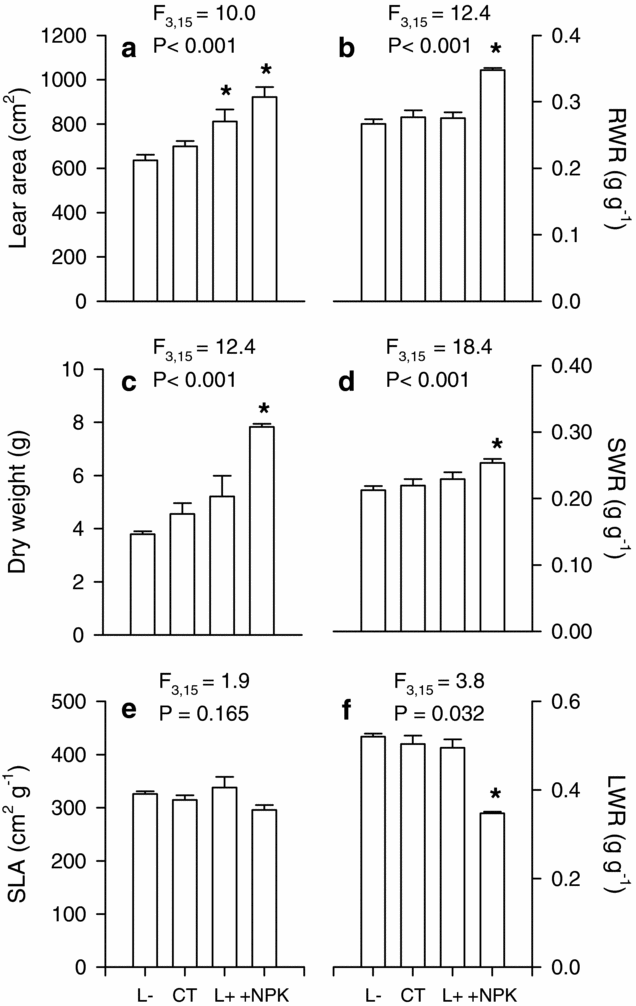
In the soil nutrient bioassay, O. pyramidale leaf area was significantly higher in L+ than in CT soils (Figure 3a), though no other significant differences between litter treatments and controls were observed. The +NPK treatment resulted in significantly higher plant dry weight, leaf area, RWR, and SWR (Figure 3a–d), and significantly lower LWR (Figure 3f) relative to controls.
Growth and biomass allocation of Ochroma pyramidale seedlings grown in the shadehouse. Panels represent leaf area (a), relative growth rate (RGR) (b), plant dry weight (c), stem weight ratio (SWR) (d), specific leaf area (SLA) (e), and leaf weight ratio (LWR) (f). Treatments are control (CT), litter removal (L−), litter addition (L+) and fertilization (+NPK). Bars represent mean values (±1 SE) for plants grown in soils from replicate plots, F and P values (with df) are from a one-way ANOVA, bars topped with an asterisk differ from the control at P ≤0.05.
DISCUSSION
Leaf litter is one of the major pathways for nutrient cycling in tropical forests, yet the importance of leaf litter for soil nutrient availability to seedlings is poorly understood. In this study, leaf area growth of the phytometer species O. pyramidale was faster in soil from the L+ plots than from the controls, showing that 2 y of litter manipulation (2003–2004) had changed soil nutrient availability. This result is consistent with changes in chemically extractable nutrients which were significantly different in the top 2 cm of mineral soil 2 y after litter manipulation started (Vincent et al. Reference VINCENT, TURNER and TANNER2010), and foretell the significantly higher rainy-season litterfall detected in L+ plots relative to controls for the period 2003–2008 (Sayer & Tanner Reference SAYER and TANNER2010). Taken together, these results suggest that litter effects are building up over time. Differences in phytometer growth were probably driven by soil nutrients, given that pots were watered to field capacity every day and that seedlings were not shading each other until about day number 120 in the shadehouse. The lack of significant differences in O. pyramidale biomass across litter manipulation treatments is consistent with findings of no significant changes in tree trunk growth and litterfall rates over the first 2 y of litter manipulation (Sayer & Tanner Reference SAYER and TANNER2010); changes in soil nutrient availability caused by litter manipulation were modest and only significant in the top 2 cm of soil (Vincent et al. Reference VINCENT, TURNER and TANNER2010). That the soil from the L+ treatment was not as fertile as that from the +NPK, as evidenced by leaf-area and biomass-allocation results, could be due to the fact that chemical fertilizers had been added for 7 y whereas litter manipulation was done for only 2 y, plus that fact that 10 times more P was added in the +NPK than in the L+ treatment.
In the shadehouse experiment, the increased leaf area growth of O. pyramidale growing in pots of soil from L+ plots compared with soil from control plots was expected, because light was not limiting in the shadehouse at least for the first 120 d of the experiment when the leaf area index was low and the leaves of seedlings from different pots did not overlap. However, in the deeply shaded forest understorey, we saw a greater growth in L+ plots and slower growth in L− plots for only one of the two species, L. platypus. These results are consistent with recent studies which also find significant effects of fertilization and natural differences in soil nutrients on the growth of seedlings of some but not all species in deeply shaded forest understoreys in Costa Rica and Panama (Holste et al. Reference HOLSTE, KOBE and VRIESENDORP2011, Santiago et al. Reference SANTIAGO, WRIGHT, HARMS, YAVITT, KORINE, GARCIA and TURNER2012). The differences in seedling growth detected here are likely to be driven by differences in nutrient availability, as suggested by significant differences in foliar N and trends in foliar K concentration in the transplanted seedlings, together with leaf area differences in the soil nutrient bioassay. Interestingly, it appears that these growth effects are driven primarily by N and K rather than P, given the lack of difference in foliar P concentrations. This result is consistent with Sayer & Tanner (Reference SAYER and TANNER2010) and Sayer et al. (Reference SAYER, WRIGHT, TANNER, YAVITT, HARMS, POWERS, KASPARI, GARCIA and TURNER2012), who report significant effects of litter manipulation on the N and K concentration of live tree leaves and litterfall during 2003–2010, but not of P. Soil organic P in the litter manipulation plots turns over rapidly and is dominated by labile compounds (Vincent et al. Reference VINCENT, TURNER and TANNER2010) so it is possible that soil P availability is ‘buffered’ against changes in P inputs via litterfall. Our results suggest that seedling RGRH and RGRL in Gigante Peninsula is more strongly limited by N and K than by P; a conclusion that is largely consistent with a study of height growth in naturally occurring seedlings of five species in the fertilizer plots that concluded that K followed by N and P together were limiting (Santiago et al. Reference SANTIAGO, WRIGHT, HARMS, YAVITT, KORINE, GARCIA and TURNER2012).
In contrast to the shadehouse soil nutrient bioassay, the growth of L. platypus seedlings in the forest was significantly affected by leaf-litter manipulation but not by +NPK fertilization. Differences in foliar N and K concentrations in L. platypus in the litter manipulation plots mirrored its growth patterns, indicating that leaf-litter effects on growth were associated with differences in nutrient uptake. The +NPK treatment had no significant effect on understorey seedling RGRH and RGRL relative to the controls. Our RGRL results are consistent with Santiago et al. (Reference SANTIAGO, WRIGHT, HARMS, YAVITT, KORINE, GARCIA and TURNER2012), who found no significant effects of +NPK on seedling RGRL relative to the controls. Our RGRH results appear to be inconsistent with that study, however, which reports a significant and positive effect of +K and +NP fertilization on seedling RGRH. This difference is likely a result of studying different species and because our study was shorter, 6 and 13 mo, compared with 2 y in Santiago et al. (Reference SANTIAGO, WRIGHT, HARMS, YAVITT, KORINE, GARCIA and TURNER2012).
The soils in our plots are of average fertility for N and P as judged by the concentrations and amounts of N and P in litterfall (Sayer & Tanner Reference SAYER and TANNER2010); though chemically extractable ‘instantaneously available’ P is low (as opposed to ‘average’) in the BCNM soils – trees can apparently acquire more P than the soil chemical extracts suggest. The fact that we found differences in understorey seedling growth rates, which we ascribe to differences in fertility caused by differences in litter inputs, and that seedling growth increased in plots fertilized with chemical fertilizers in other experiments in Panama (Santiago et al. Reference SANTIAGO, WRIGHT, HARMS, YAVITT, KORINE, GARCIA and TURNER2012) and in naturally more fertile soils in Costa Rica (Holste et al. Reference HOLSTE, KOBE and VRIESENDORP2011), suggests that seedling growth may be limited by nutrient supplies for many species in a wide range of infertile and moderately fertile soils in tropical moist forests. It also shows that understorey seedling growth and nutrient uptake is influenced by short-term (2 y) differences in litterfall input.
ACKNOWLEDGEMENTS
We thank Joe Wright for access to the Gigante fertilization experiment, Jesús Valdez and Alexander Cheesman for help with field and shadehouse experiments, and Scott Mangan and Lucrezia Tincani for help with light measurements. Two anonymous reviewers greatly helped revisions of the manuscript. Funding was provided by the Wolfson College Alice Evans Fund and the Cambridge European Trust (AGV) and the Mellon Foundation (EVJT). We are grateful to STRI in Panama for logistical support.