


Introduction
Specific information-processing biases are believed to be involved in the formation and maintenance of delusions (Garety and Freeman, Reference Garety and Freeman2013; McLean et al., Reference McLean, Mattiske and Balzan2016). Apart from jumping to conclusions (JTC) and a bias against disconfirmatory evidence (BADE) (Dudley et al., Reference Dudley, Taylor, Wickham and Hutton2016; McLean et al., Reference McLean, Mattiske and Balzan2016), overconfidence in false memories is one of the best replicated cognitive distortions in psychosis (for reviews see Balzan, Reference Balzan2016; Moritz and Woodward, Reference Moritz and Woodward2006); patients with psychosis are more confident in false memory content compared with healthy controls and slightly less confident in correct memories (Balzan, Reference Balzan2016), which generates knowledge corruption (a high proportion of high-confident errors). This memory bias has been recently associated with the liberal acceptance bias: patients with psychosis assign meaning to evidence that is weakly supported (Moritz et al., Reference Moritz, Pfuhl, Lüdtke, Menon and Andreou2016). In support of the notion that memory biases may represent a risk factor or an antecedent to the onset of a psychotic state, patients with a first episode of psychosis and people with a higher risk for psychosis show distortions in metamemory (Eisenacher et al., Reference Eisenacher, Rausch, Ainser, Mier, Veckenstedt and Schirmbeck2015; Eisenacher and Zink, Reference Eisenacher and Zink2017). Biases in metamemory (i.e. self-monitoring and knowledge about memory capabilities; Pannu and Kaszniak, Reference Pannu and Kaszniak2005) are discussed as contributing factors for sustaining delusional conviction (Balzan, Reference Balzan2016).
Common strategies for deconstructing delusions consist of four steps: inducing doubt regarding paranoid beliefs, identifying delusional thoughts, searching for and processing disconfirmatory evidence, and finally considering alternative explanations (Freeman, Reference Freeman2007). The first step is perhaps the most crucial as psychotic delusions are often rigidly held (Coltheart et al., Reference Coltheart, Langdon and McKay2011). Of note, the strategy of inducing doubt or softening the rigid thinking pattern of delusions aims at sharpening critical thinking but should by no means generate anxiety or general mistrust. In some cases, individual functional aspects of delusions should be considered before undermining them without conveying alternative strategies, as some delusions actually foster self-esteem or are considered valuable or even positive by patients (Moritz et al., Reference Moritz, Woodward and Rodriguez-Raecke2006, Reference Moritz, Rietschel, Veckenstedt, Bohn, Schneider, Lincoln and Karow2015). Nonetheless, improving belief flexibility is an important step in ameliorating psychotic symptoms (Freeman, Reference Freeman2007). A new group of interventions focuses on delusion-relevant cognitive biases to ameliorate psychotic symptoms, such as metacognitive training (MCT; Moritz et al., Reference Moritz, Andreou, Schneider, Wittekind, Menon, Balzan and Woodward2014a), reasoning training (Ross et al., Reference Ross, Freeman, Dunn and Garety2011) and social cognition and interaction training (SCIT; Roberts et al., Reference Roberts, Penn and Combs2015). These interventions provide information and correct cognitive distortions by inducing doubt and demonstrating the fallibility of the human mind. Targeting underlying cognitive biases could be considered a gentler approach to ameliorating delusions, especially for people who struggle to distance themselves from their delusions (Moritz et al., Reference Moritz, Andreou, Schneider, Wittekind, Menon, Balzan and Woodward2014a). Among other types of exercises, such approaches often use media such as short film clips or optical illusions to demonstrate cognitive distortions and to teach patients how to counter them. However, these examples are often abstract, and there is little connection to a patient's everyday life and personal experiences.
Adopting virtual reality (VR) environments, in which certain situations can be experienced as if the user is actually there, can enhance these demonstrations. According to Gregg and Tarrier (Reference Gregg and Tarrier2007), VR can be defined as the integration of computer graphics, sound, and other sensory input to create an interactive computer-generated environment. The user can explore the virtual world via conventional input (mouse and keyboard, joysticks, etc.) or modern motion-tracking devices. By using a head-mounted display (HMD; goggles containing television screens), the computer can monitor and align the field of view in real time based on the user's head movements.
In recent years, researchers have begun to target delusions via VR interventions (Freeman, Reference Freeman2008; Freeman et al., Reference Freeman, Bradley, Antley, Bourke, DeWeever and Evans2016, Reference Freeman, Reeve, Robinson, Ehlers, Clark, Spanlang and Slater2017; Moritz et al., Reference Moritz, Voigt, Köther, Leighton, Kjahili and Babur2014b; Suenderhauf et al., Reference Suenderhauf, Walter, Lenz, Lang and Borgwardt2016; Veling et al., Reference Veling, Moritz and van Der Gaag2014b). Studies have shown that VR scenarios are safe and are accepted by people with psychosis (Fornells-Ambrojo et al., Reference Fornells-Ambrojo, Barker, Swapp, Slater, Antley and Freeman2008; Veling et al., Reference Veling, Moritz and van Der Gaag2014b). As of yet, hardly any counter indications – and none exclusively for patients with psychosis – for the application of VR interventions have been reported. Fornells-Ambrojo and colleagues defined the safety of VR for people with psychosis as ‘the absence of an increase in level of anxiety, no triggering of significant levels of simulator sickness and no adverse experiences in the following week’ (Fornells-Ambrojo et al., Reference Fornells-Ambrojo, Barker, Swapp, Slater, Antley and Freeman2008, p. 229). Yet, cybersickness (synonymous with motion sickness or simulator sickness, e.g. dizziness or nausea) is a common possible side effect of HMD use (Davis et al., Reference Davis, Nesbitt and Nalivaiko2015), especially when movements of the body and the virtual avatar do not align well (Palmisano et al., Reference Palmisano, Mursic and Kim2017). However, studies suggest a habituation effect for cybersickness after repeated exposure to VR (Gavgani et al., Reference Gavgani, Nesbitt, Blackmore and Nalivaiko2017). The evidence for cybersickness in psychosis is mixed. Most studies have not found an increase of cybersickness in people with psychosis (e.g. Freeman et al., Reference Freeman, Pugh, Vorontsova, Antley and Slater2010; Veling et al., Reference Veling, Moritz and van Der Gaag2014a). Only one study that we know of explicitly reported a problematic increase of cybersickness in its sample (Hesse et al., Reference Hesse, Schroeder, Scheeff, Klingberg and Plewnia2017). Current research asserts that VR interventions are efficacious forms of psychological treatment and represent a promising addition to existing treatment options; however, research on VR intervention is still at an early stage (it is characterized, for example, by uncontrolled design and small sample sizes), which makes assessing its effectiveness difficult (Freeman et al., Reference Freeman, Reeve, Robinson, Ehlers, Clark, Spanlang and Slater2017; Gregg and Tarrier, Reference Gregg and Tarrier2007; Turner and Casey, Reference Turner and Casey2014; Veling et al., Reference Veling, Moritz and van Der Gaag2014b). VR interventions have demonstrated large effect sizes when compared with non-intervention, and moderate effect sizes when compared with active intervention control groups (Turner and Casey, Reference Turner and Casey2014). VR interventions show good ecological validity as experiences in VR correlate with real symptoms (Veling et al., Reference Veling, Moritz and van Der Gaag2014b) and due to the precise control of perceptual stimuli, which allows consensual interpretations and judgements (Parsons, Reference Parsons2011). The objectivity of delusions is much debated in therapy as false convictions are held despite counter evidence and can seldom be empirically challenged (e.g. ‘You cannot judge that as you were not present when it happened’). Here, VR interventions can bridge the gap because they provide standardized environments that allow consensus about what has happened. VR environments provide the opportunity to reappraise patients’ subjective assessments of personal situations, which in real life cannot be evaluated by therapists because they are generally absent when delusional appraisals occur.
In a pilot study (Moritz et al., Reference Moritz, Voigt, Köther, Leighton, Kjahili and Babur2014b), 33 patients with schizophrenia completed a VR paradigm designed to reduce delusional ideation by inducing doubt and reducing overconfidence in false memories. The participants were instructed to walk through a virtual street environment, in which they passed pedestrians. Afterwards, participants were asked to recollect the previously encountered pedestrians and their facial expressions and to grade their response for confidence, and then they received feedback regarding the correctness of their recall. The Paranoia Checklist was administered twice, both before the virtual reality walk and after the recollection and feedback phase, and the scores decreased significantly at a medium effect size (d = 0.54). Notably, participants who improved made more errors, i.e. they received more corrective (error) feedback. The pilot study left room for improvement as it employed a very short intervention that consisted of only one session and did not use an HMD. The lack of an HMD may have reduced the participants’ immersion in the experience. Consequently, it is important to test the paradigm using an HMD to qualify as a ‘true’ VR [according to Gregg and Tarrier (Reference Gregg and Tarrier2007), who state that VR includes using an HMD]. Also, the exact origin of the observed effect remained unclear, as no control group design was implemented.
We extended the VR intervention of the pilot study and added a second scenario to the social recollection paradigm as well as a new paradigm with two corresponding VR environments based on the Deese-Roediger-McDermott paradigm (DRM; Roediger and McDermott, Reference Roediger and McDermott1995) but with objects as presented stimuli. In addition, to enhance immersion in the VR scenarios we used an HMD instead of a computer monitor. Both the extension of the VR intervention and the increased immersion in a virtual world were implemented to deepen the corrective experience. As in the pilot study, the goal was to decrease overconfidence in false memories by providing corrective experiences and thus to reduce delusions. We present two cases from an ongoing randomized controlled study to investigate feasibility and individual benefit from a VR intervention to ameliorate delusions.
Method
The present case studies were part of a larger randomized controlled trial examining the efficacy of a VR intervention to reduce delusions by inducing doubt about false memories held with overconfidence. All presented data were gathered between February and August 2016. To test the hypothesis that corrective experience reduces delusions, patients were randomized to either an experimental condition in which they received feedback on whether their memory response was correct, or to the control group in which no feedback was given. Participants were tested individually. The study consisted of four sessions: baseline diagnostic assessment, two interventions (with the object or social paradigm, respectively; see below), and finally the post-diagnostic assessment 3 weeks later. The two intervention sessions took about 45 minutes each, including completion of questionnaires. The pre-assessment lasted approximately 1.5 hours; the post-assessment was slightly shorter and took roughly 1 hour. The paradigms were administered in random order and the two corresponding scenes were presented randomly as well (see below). Participants were not told the rationale of the study beforehand, i.e. that they would be asked to memorize faces or objects, but they were told during recruitment that they would be asked to evaluate the VR scenes. After completing the trial, each participant received 50€ as reimbursement. The ethics committee of the Deutsche Gesellschaft für Psychologie (DGPs) approved the study (SM 112015).
Virtual reality intervention
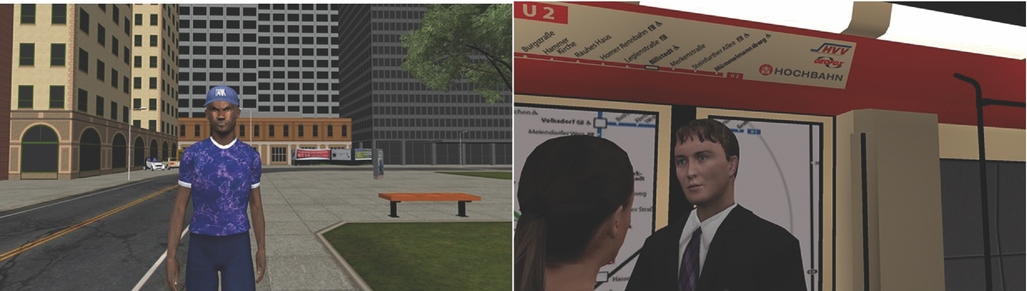
The VR task was programmed using the software Unity. The VR environment was presented using Oculus Rift D2, a virtual reality HMD. The VR scenarios were employed to elicit false memories via a life-like environment showing prototypal scenes that deliberately leave out commonly expected objects (e.g. towels in a beach scene), which leads to confabulatory memories. Two paradigms were employed: the social paradigm tested memory of faces and facial expressions, whereas the object paradigm tested memory of objects. The social paradigm was adapted from the pilot study (Moritz et al., Reference Moritz, Voigt, Köther, Leighton, Kjahili and Babur2014b) but included an additional scene (a metro station). The object paradigm was modelled after the visual DRM or false memory paradigm (Miller and Gazzaniga, Reference Miller and Gazzaniga1998; Moritz et al., Reference Moritz, Woodward and Rodriguez-Raecke2006). We set up two VR scenes (a camp ground and a beach) with appropriate objects (e.g. tents and chairs or towels and sandcastles) and simultaneously deliberately omitted certain key features, so-called ‘strong lure items’ (e.g. a volleyball net but no volleyball). In the recollection phase, three different categories of objects were used. A volleyball net would represent a hit, as it was present in the scene, whereas a volleyball would count as a lure, as it would usually be in the environment but not actually shown. We added a third category, a miss, which was an item not in the scene and also not associated with the environment or objects (e.g. an elephant). Participants were presented with four VR environments in total, two per intervention session. The participants were instructed to follow the respective path until the end and to observe everything that happened very closely. Participants navigated the virtual reality using the mouse and arrow keys on a keyboard. The virtual reality was presented using an HMD, and thus participants could adjust their vision through head movements just as they would in reality. If patients experienced discomfort (e.g. nausea), a regular computer monitor was used. In the social paradigm, participants explored a street and a metro station (see Fig. 1), where twelve different pedestrians were placed. The facial expressions of the pedestrians were happy, neutral or angry. In each scene (street or metro station), each emotional expression was displayed twice by different pedestrians. In the object paradigm, the participants explored a beach and a camp ground. Avatars were present as well, but unlike the social paradigm, all the avatars in the scenes displayed a neutral facial expression. Each area was filled with relevant objects (e.g. a towel on the beach, a tent in the camp ground), while certain lure items, ones that would be expected in the environment, were removed (e.g. a volleyball on the beach).
Screenshots from the social paradigm; street scene (left) and metro scene (right).
Recognition
After exploring two of the scenes, the participants engaged in a recognition task. For the social paradigm, the experiment tested whether participants remembered the identity, location and affect of each of the pedestrians. In addition to the 12 pedestrians that had been present in the two scenes, six novel avatars were also displayed. First, participants indicated whether they had seen the person on the street or at the metro station, or whether the person was new. They also rated their response confidence on a 4-point scale (unsure, somewhat unsure, somewhat sure, sure). Second, if they indicated having seen the person before, participants chose the person's corresponding facial expression (angry, neutral or happy) and again rated their response confidence. Participants in the experimental group received immediate feedback as to whether their decision was correct, plus the correct answer along with the correct facial expression. After completion of the recognition phase, the experimental group read a short text on cognitive distortions and overconfidence in memory to increase the corrective experience. The text summarized how overconfidence in memory can lead to problems in everyday life and explained ways to counter false memories (e.g. asking a friend when in doubt). The object paradigm recognition task was analogous. The recognition phase included 12 previously shown objects and 12 distractors (eight lures and four unrelated new objects). Participants were asked to indicate whether or not they had seen the item and at which location (beach or camp ground) they had seen it and to rate their confidence. Participants in the experimental group again immediately received feedback and read a similar short text on the distortive effect of overconfidence in memory. Finally, in both paradigms (i.e. social and object) and both conditions (i.e. experimental and control), participants were asked whether they were satisfied with their performance, how many of their responses were correct, the subjective difficulty level of the questions, and how they would rate their confidence level overall (too sure, exactly right, too unsure). The two presented cases are from the experimental condition.
Assessment
The MINI International Neuropsychiatric Interview (MINI; Sheehan et al., Reference Sheehan, Lecrubier, Sheehan, Amorim, Janavs and Weiller1998) was administered to verify inclusion criteria (primarily current or past psychotic episode; age 18–65 years, informed consent). The scale is good in terms of acceptance, feasibility, (inter-rater) reliability and validity (Lecrubier et al., Reference Lecrubier, Sheehan, Weiller, Amorim, Bonora and Sheehan1997). One week before the first intervention date and one week after the second, psychotic symptoms were assessed using the Positive and Negative Syndrome Scale (PANSS; Kay et al., Reference Kay, Opler and Lindenmayer1989) and the Psychotic Symptom Scale (PSYRATS; Haddock et al., Reference Haddock, McCarron, Tarrier and Faragher1999). The PANSS measures the symptom severity of patients with schizophrenia on five dimensions (positive symptoms, negative symptoms, disorganization, excitement and distress; van der Gaag et al., Reference van der Gaag, Hoffman, Remijsen, Hijman, de Haan and van Meijel2006), with a total of 30 symptoms each rated on a 7-point scale. The PANSS showed good psychometric properties (Kay et al., Reference Kay, Opler and Lindenmayer1988; van der Gaag et al., Reference van der Gaag, Hoffman, Remijsen, Hijman, de Haan and van Meijel2006). The PSYRATS taps auditory hallucinations and delusions on two separate scales with eleven and six items, respectively. The German version showed very high internal consistency (Cronbach's α = .94; Schneider et al., Reference Schneider, Jelinek, Lincoln and Moritz2011). Both were rated based on a semi-structured interview.
Before and after the VR intervention, the Paranoia Checklist (Freeman et al., Reference Freeman, Garety, Bebbington, Smith, Rollinson, Fowler and Kuipers2005), the Community Assessment of Psychic Experiences (CAPE; Stefanis et al., Reference Stefanis, Hanssen, Smirnis, Avramopoulos, Evdokimidis and Stefanis2002), and the Simulation Sickness Questionnaire (SSQ; Kennedy et al., Reference Kennedy, Lane, Berbaum and Lilienthal1993) were administered to assess immediate effects. Both the CAPE and Paranoia Checklist were slightly adjusted to capture current paranoid thoughts. The CAPE consists of 42 items with three scales (positive symptoms, negative symptoms and depression). The Paranoia Checklist is an 18-item self-report scale; items had to be rated first for their relevance and then for personal conviction. Both the CAPE and Paranoia Checklist showed good psychometric properties (Lincoln et al., Reference Lincoln, Ziegler, Lüllmann and Müller2010; Schlier et al., Reference Schlier, Jaya, Moritz and Lincoln2015). The SSQ was used to determine possible somatic side effects (i.e. cybersickness) from use of the HMD. Discomfort is rated for 16 items on a 4-point scale. The SSQ provides a total score as well as three subscales (nausea, oculomotor dysfunctions and disorientation). We calculated the knowledge corruption index (KCI; Moritz and Woodward, Reference Moritz and Woodward2002) to quantify overconfidence in false memories. The knowledge corruption index indicates the ratio of incorrect answers held with high confidence to all high confident answers. If the ratio of incorrect high confident responses is inflated, knowledge corruption, that is, overconfidence in errors, can be assumed. To assess their acceptance of the VR setting, participants were asked ten questions regarding graphics, enjoyment, discomfort and anxiety on a 5-point Likert scale. Mean scores were calculated with higher scores (up to 5) representing a more favourable rating of the virtual reality setting. Additionally, after the intervention a brief interview was conducted inquiring about the experience in general, any subjective benefit from the intervention, and the possibilities and benefits the participants saw for VR interventions in general.
Participants
‘A.B.’. The first case history presents a 44-year-old male, A.B., who had been admitted to different psychiatric hospitals approximately fifteen times due to a diagnosis of schizophrenia 25 years ago. He was currently unemployed and living in an assisted living facility for people with mental illness. At the time of the first intervention session, he had been taking the same anti-psychotic medication for 11 years in alternating dosages (Amisulpride: 400 mg for 3 weeks, and Melperone: 25 mg since 2005). A.B. had experienced his most recent psychotic episode 4 weeks previously after reducing his anti-psychotic medication. He had been hearing voices since 1991 and suffered from persecutory delusions. He attributed the voices to his neighbours (these are actually unknown to him), who talked badly about him (calling him a murderer, rapist or loser). His delusions circled around a cult that spies on him via bugging devices and could also read his thoughts. The cult was also responsible for an alleged experience of violence during his childhood, which he believed resulted in his psychosis, so he held the cult ultimately responsible for his illness.
‘W.A.’. The second case history presents a 36-year-old female who, according to self-report, had experienced delusions since the age of 16; schizophrenia was diagnosed 6 years ago. W.A. was divorced and in early retirement. She had been in inpatient care four times since 2010. She has been taking the same medication for six years (Venlafaxine: 150 mg/day, Clozapine: 600 mg/day, Aripiprazole: 20 mg/day), as well as Lorazepam (3 mg/day) for 2 months. Prior to her first hospitalization she was hearing voices, but she had never heard voices since. Her persecutory delusions mostly revolved around a ‘good force’ which inhabited her and protected her, but she reported that others spied on her (e.g. neighbours) and wanted to steal the ‘good force’ from her. Furthermore, she saw ‘signs’ meant to guide her behaviour when leaving her home, and she attributed information from watching TV as messages meant for her as well. W.A. also experienced distortions of self-experience and feared others could read her thoughts.
Results
In Table 1, all pre- and post-scores for the two cases are given, and these are discussed in the following text for each case.
Pre- and post-scores for the two cases
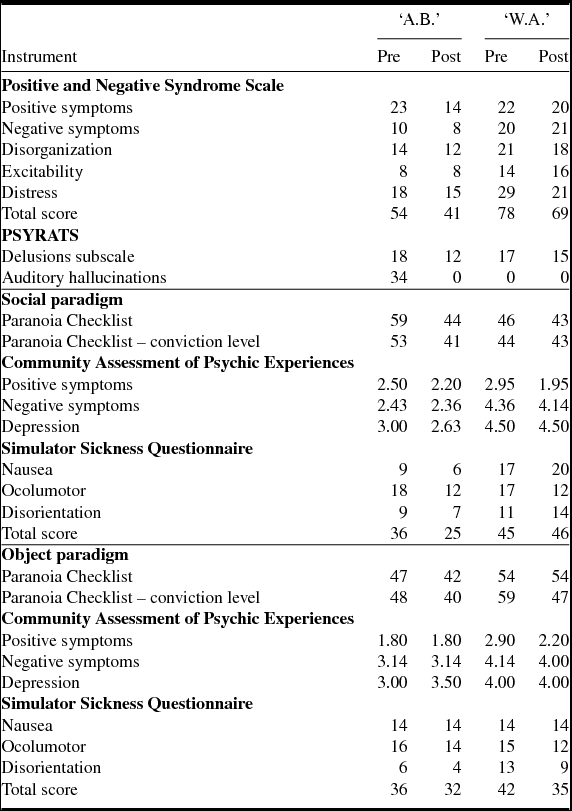
Mean scores are reported for Community Assessment of Psychic Experiences; for the other instruments sum scores are given.
First case: A.B.
This participant completed the social paradigm first, starting with the street scenario. The object paradigm followed in the second session, starting with the camp ground. He completed all four scenarios using the HMD, which posed no problems.
Psychiatric symptoms and global functioning
On the PANSS, symptom improvement occurred on the positive symptom dimension (−9 points), the negative dimension (−2), disorganization (−2) and distress (−3). Excitability remained unchanged. The total score decreased by 13 points. On the PSYRATS delusion scale, symptoms improved by 6 points.
Recognition task
The participant answered 52% of the two recognition tasks correctly. He performed considerably better on the object recognition task (63% correct) compared with the social recollection task (39% correct). He showed no strong tendency for overconfidence in errors. On the social task, he was ‘unsure’ when answering incorrectly (mean = 1.36, with 1 being unsure and 2 being somewhat unsure) and also ‘somewhat unsure’ when answering correctly (mean = 1.7). He identified 17% of the emotional expressions correctly and rated his answers as ‘somewhat unsure’ (mean = 1.5). He was ‘unsure’ about his incorrect answers (83%; mean = 1.38). In contrast, he was more confident in correct answers on the object paradigm (hit: mean = 3.57; lure: mean = 2.0; miss: mean = 2.75). When his answer was incorrect, he was in fact less unsure compared with the social paradigm but still not overconfident (hit: mean = 1.8; lure: mean = 2.5). He showed no signs of knowledge corruption (KCI = 0% in both paradigms).
Psychotic symptoms immediately after the virtual reality intervention
After the social paradigm, the participant's paranoia decreased by 15 points on the Paranoia Checklist and 0.3 points on the positive symptom scale of the CAPE. Negative symptoms (−0.07) and depression (−0.37) also decreased. The conviction level decreased by 12 points on the Paranoia Checklist. After the object paradigm, paranoia decreased by 5 points on the Paranoia Checklist but did not change on the positive symptom scale of the CAPE. Negative symptoms remained unchanged, whereas depression (+0.5) somewhat increased. The level of conviction decreased by 8 points on the Paranoia Checklist.
Evaluation
The participant did not report any signs of discomfort as a result of the VR intervention on the SSQ or verbally to the examiner. Overall, the total SSQ score decreased in both paradigms across time. The participant reported minor delusions of reference during the VR experience, as he was unsure whether the VR pedestrians wanted to attack him. Generally, the participant liked the intervention (object: mean = 4.38; social: mean = 4.0). He rated his memory capacity as ‘poor’ after the second intervention and rated the object recollection task as ‘difficult’ and the social recognition as ‘very difficult’. He stated he was ‘too unsure’ in both tasks but was ‘satisfied’ with his performance on the object task and ‘neither satisfied nor dissatisfied’ with his performance after the social paradigm. Although he suspected he had answered almost everything wrong in the social task, he thought he had answered more than 50% correctly in the object paradigm. After the intervention, A.B. noted that he was wondering if he was imagining things (in his psychosis) that were not actually real.
Second case: W.A.
This participant completed the object paradigm first, starting with the beach scenario. The social paradigm followed in the second session, starting with the metro station. She suffered from nausea after briefly trying to use the Oculus Rift and completed all four scenarios without the HMD.
Psychiatric symptoms and global functioning
On the PANSS, the participant's total score improved by 9 points. Specifically, symptom improvement occurred on the positive symptom dimension (−2 points), disorganization (−3) and distress (−8). Negative symptoms (+1) and excitability (+2) increased. On the PSYRATS delusion scale, symptoms improved by 2 points.
Psychotic symptoms immediately after the virtual reality intervention
For the object paradigm, positive symptoms improved by 0.7 points on the relevant CAPE scale but did not change on the Paranoia Checklist. Negative symptoms (−0.14) improved, while depression remained unchanged. The conviction level decreased by 12 points on the Paranoia Checklist. For the social paradigm, positive symptoms improved by 1 point on the CAPE and by 3 points on the Paranoia Checklist. Negative symptoms (−0.22) decreased, whereas depression did not change. The conviction level decreased by 1 point on the Paranoia Checklist.
Recognition task
The participant answered 62% of the questions correctly. She performed slightly better on the object recollection task (66% correct) compared with the social recognition task (56% correct). On the object recollection task, when answering correctly she was mostly ‘somewhat sure’ (hit: mean = 3.14; miss: mean = 3.25) though ‘somewhat unsure’ regarding lures (mean = 2.2). When answering incorrectly, she was ‘somewhat unsure’ regarding previously presented items (hit: mean = 1.8) and ‘somewhat sure’ regarding lures (mean = 2.65). In contrast, on the social recollection task she was consistently ‘somewhat sure’ (correct answers mean = 3.4; false answers mean = 3.38). She identified 42% of the emotional expressions correctly and rated her confidence as ‘somewhat sure’ (mean = 2.6), and she was similarly confident in her incorrect answers (58%, mean = 3.0). She showed signs of overconfidence in false memory, with a 30% knowledge corruption index (social KCI = 45%; object KCI = 17%).
Evaluation
While exploring the beach scenario using the Oculus Rift, this participant suffered from nausea and opted to continue without the HMD. W.A. had never played any video games in her lifetime. She did not report any distress on the SSQ after the object paradigm, whereas the total score increased by 1 point after the social paradigm, with an increased score on both the nausea and disorientation subscales. She rated the social paradigm less favourably and felt anxious as well as spied on by the examiner, and she did not like the graphics (object mean = 4.75; social mean = 2.75). She was dissatisfied with her performance on both recollection tasks and believed she had answered less than 50% of the questions correctly. After the object paradigm, she stated her confidence level was exactly right compared with the social paradigm, where she was too unsure. While the object paradigm was ‘neither easy nor difficult’ for her, she rated the social task as ‘difficult’. After the intervention, the participant noted that she was bad at recognizing faces and tended to be unobservant. She planned on being more attentive in her everyday life.
Discussion
These two cases present a new approach to improving delusions in patients with schizophrenia. We extended a VR paradigm already used in a pilot study, in which overconfidence in memory was corrected via error feedback, in order to intensify the corrective experience. For the first time, the present study illustrates individual differences regarding the experience of using a VR intervention. Both participants improved in the target dimension. Delusions decreased in both cases, as measured with the PANSS and PSYRATS following the intervention period. Immediate effects are not as obvious, however. After the social paradigm, both cases showed improvement on the Paranoia Checklist and on the positive symptom dimension on the CAPE. After the object paradigm, both cases showed improvement regarding delusions but on different scales (A.B. on the Paranoia Checklist and W.A. on the CAPE) and no improvement on the other scale. Nonetheless, and most importantly, both showed improvement in their level of conviction after each paradigm. The drop in conviction level supports the idea that correcting overconfidence in memory challenges delusional conviction and in turn ameliorates delusions.
Only one case, W.A., demonstrated evidence of overconfidence in false memory, as she was more sure about incorrectly answered questions than correctly answered ones when asked about lures. In addition, she showed the same level of confidence in the social paradigm, irrespective of the correctness of her answers, which can also be seen as a knowledge corruption rate of 45% for this paradigm. In her self-assessment of her confidence level, W.A. thought herself to be ‘exactly right’ after the object paradigm and ‘too unsure’ after the social paradigm, even though she was objectively more sure about her answers in the social recollection task. Both A.B. and W.A. showed more consistent improvement after the social paradigm, in which they made more mistakes compared with the object paradigm (i.e. they received more corrective feedback). This hints at the notion that corrective feedback could ameliorate delusions, as proposed in the pilot study (Moritz et al., Reference Moritz, Voigt, Köther, Leighton, Kjahili and Babur2014b).
A.B., on the other hand, was almost continuously ‘somewhat unsure’. This clearly raises the question of cause and effect, as he also showed improvement regarding delusions after the intervention even though he apparently had no overconfidence in his false memories that could be corrected. Three possible explanations shall be discussed briefly. First, he was continuously ‘somewhat unsure’, even if he answered correctly, and he also rated the intervention as ‘very difficult’ and ‘difficult’, which could suggest overall uncertainty. Whether this might be a trait or effect of the intervention is impossible to ascertain, but one could argue that the intervention revealed this uncertainty to him, which in turn shook his delusions. After all, he showed improvement in his delusional conviction rate after both intervention sessions, as measured with the Paranoia Checklist. Thus, it seems his delusional beliefs were challenged, not just reduced in intensity. Another argument in favour of the improvement in delusional conviction rate is his statement after the intervention that he was wondering if he were imagining things (in his psychosis) that were not actually real. Second, the results could also reflect a measurement problem because we did not quantify baseline overconfidence but calculated overconfidence after the intervention. Therefore, if the intervention was too difficult for this particular participant, it could have created severe uncertainty, which would lead to a lack of measurable overconfidence. Hence, the overconfidence was possibly corrected by the difficult intervention and thus was not measurable. Lastly, as no randomized controlled trial has been conducted yet, we cannot say whether other possible mechanisms not associated with the VR intervention might have led to a symptom reduction (see ‘Limitations’ section below).
Regarding the feasibility of VR as an intervention method, this case study revealed a methodological problem. One participant could not tolerate the use of the HMD and experienced nausea and discomfort. In light of this particular case study, it could be dismissed as a mere selection effect, but it underpins a problem we experienced in the total sample as well. The participants were not able to walk around during the intervention sessions but remained seated while exploring the VR as we did not have the equipment necessary for motion tracking. This created a misalignment between the movement of the virtual avatar and the seated, physical body of the participant, which can lead to cybersickness. Freeman and colleagues (Freeman et al., Reference Freeman, Pugh, Vorontsova, Antley and Slater2010, Reference Freeman, Bradley, Antley, Bourke, DeWeever and Evans2016), for example, have laboratories fitted to provide a more immersive VR experience in which participants are able to walk around, which attenuates cybersickness and other side-effects (Palmisano et al., Reference Palmisano, Mursic and Kim2017). Several studies have reported no significant change on the SSQ after the VR intervention compared with baseline (e.g. Freeman et al., Reference Freeman, Pugh, Vorontsova, Antley and Slater2010; Veling et al., Reference Veling, Moritz and van Der Gaag2014a), but they did not report on participants who were not able to use the HMD. Only Hesse and colleagues (Hesse et al., Reference Hesse, Schroeder, Scheeff, Klingberg and Plewnia2017) reported a similar problem, and the drop-out rate was higher for people with psychosis compared with healthy controls. In the present study, participants were told they could stop and take off the HMD if nausea occurred, which might have encouraged them to opt out too soon after the slightest discomfort. Additionally, to our knowledge, no published study has yet used the Oculus Rift, so it is therefore – albeit publicly available – untested for clinical study purposes. Despite problems with the HMD, the intervention was given at least medium scores in terms of enjoyment, and both participants explicitly said the experience was thought-provoking. Nonetheless, nausea should be considered a relevant obstacle to implementing VR interventions in standard NHS settings as not every facility can provide the necessary space to allow participants to walk around. Another possibility could be to minimize cybersickness via habituation through repeated exposure to VR, but the feasibility of this method for general implementation of VR is questionable (Gavgani et al., Reference Gavgani, Nesbitt, Blackmore and Nalivaiko2017).
Also, following a strict definition of VR, a non-HMD computer game does not qualify as ‘true’ VR, according to Gregg and Tarrier (Reference Gregg and Tarrier2007), as no additional steps are taken to increase the immersion and sense of presence in the virtual world (‘shutting out the real world’; Gregg and Tarrier, Reference Gregg and Tarrier2007). Nonetheless, non-HMD video games are also able to create immersion (Weibel and Wissmath, Reference Weibel and Wissmath2011), and even movies or books are able to immerse a person to some degree in the imaginary world (for more information on immersion, see Lombard and Ditton, Reference Lombard and Ditton2006). For our particular intervention design, the created immersion seemed to be sufficient as it was merely the display format for the fabrication of false memories and subsequent memory test. However, for broader implementation of VR, e.g. therapy sessions that aim to mirror real-life scenarios and the disputation of delusions, future intervention should aspire to provide the highest possible immersive effect. This would be achieved through the use of an HMD, the ability to walk around, and additional sensory interaction possibilities or input (e.g. gloves) with the virtual world.
Limitations
A few limitations need to be discussed. First, when the present study was conducted, the two patients were also simultaneously participating in a study investigating the efficacy of Individualized Metacognitive Therapy (MCT+). A.B. was also participating in outpatient low-threshold group interventions offered by his assisted living facility. Therefore, improvements on the PANSS and PSYRATS have to be interpreted carefully and cannot be attributed to the VR intervention alone. Nevertheless, the short-term effects and the effects of the pilot study (Moritz et al., Reference Moritz, Voigt, Köther, Leighton, Kjahili and Babur2014b) tentatively suggest at least an added effect of the VR intervention. Second, as with all case studies, no solid conclusions can be deduced from the presented data. Also, cause and effect remain unclear. Currently, an ongoing study with a randomized controlled design is investigating whether the corrective experience is the reason for ameliorated delusions.
Conclusions
The present case study provides preliminary evidence that delusions may be ameliorated via a brief VR intervention that tackles overconfidence in memory. VR environments are suitable as standardized environments in reappraising delusional interpretations by providing the opportunity to arrive at consensual judgements that are often not possible in situations in everyday life, where experiences remain subjective and cannot be proven empirically or reproduced. Therefore, VR environments can provide corrective experiences, in this case for overconfidence in memories, and they can also be used in a therapy setting while discussing delusional ideas. For therapy settings, however, VR interventions should aim at creating the highest possible immersion effect to increase the generalizability of the learning experiences. However, the efficacy of the present intervention as well as the causes and effects can only be assessed after the randomized controlled study has been analysed. Additionally, one of the case study participants had problems when using publicly available HMD, in this case the Oculus Rift D2, for the intervention. Nausea and discomfort (cybersickness) need to be assessed thoroughly to assess the general feasibility of VR interventions.
Main points
(1) Because information-processing biases such as overconfidence in memory errors are likely to be involved in the formation and maintenance of delusions, virtual reality (VR) can be used to correct cognitive distortions and in turn ameliorate delusions.
(2) We conducted a new VR intervention to target overconfidence in memory to ameliorate delusions and found that both of the presented cases benefited from the intervention.
(3) VR interventions can provide corrective experiences and are suitable as standardized environments designed to reappraise delusional interpretations.
(4) Although head-mounted displays enhance immersion, they also need to be assessed thoroughly for the general application of VR interventions, as some patients may suffer from cybersickness (nausea and discomfort).
Conflicts of interest
The authors have no conflicts of interest with respect to this publication.
Financial support
This work was supported by Asklepios proresearch (grant number 3140).
Ethical statements
The authors have abided by the Ethical Principles of Psychologists and Code of Conduct as set out by the APA and assert that all procedures contributing to this work comply with the ethical standards of the relevant national and institutional committees on human experimentation and with the Helsinki Declaration of 1975 and its most recent revision. The ethics committee of the German Association of Psychology (Deutsche Gesellschaft für Psychologie) approved the study (SM 112015).
Acknowledgements
The authors would like to thank Sören Schnoor for his suggestions on the manuscript.
(1) To learn about information-processing biases in psychosis (e.g. overconfidence in memory) and their implications for therapy.
(2) To learn about virtual reality (VR) interventions for psychosis and how VR may be used to reduce psychotic symptoms.
(3) To learn how a new VR intervention may reduce delusions by means of correcting experiences (feedback on errors in a memory task) and learn about individual differences in experiencing a VR intervention for the first time.
(4) To learn about the feasibility of head-mounted displays and cybersickness (nausea and discomfort) caused by VR.



Comments
No Comments have been published for this article.