Introduction
Tobacco use is the foremost preventable cause of death and disease worldwide (WHO, 2011). In Canada, an estimated 4.7 million (16.7%) people are current smokers (CTUMS, 2010). Although the majority (60.2%) of Canadian smokers indicate an interest in quitting smoking in the next six months, the success rate (6 to 12 months prolonged abstinence) of unaided stop smoking attempts is low (Hughes, Keely, & Naud, Reference Hughes, Keely and Naud2004). Cravings and tobacco withdrawal symptoms are responsible for continued tobacco use in dependent smokers (Kozlowski & Wilkinson, Reference Kozlowski and Wilkinson1987; USDHHS, 2010). Hence, effective and economical interventions that help to combat the physiological and psychological symptoms associated with smoking cessation are needed.
Recent systematic reviews have concluded that a single session of exercise ameliorates tobacco withdrawal symptoms (Hassova et al., Reference Hassova, Warren, Ussher, Van Rensburg, Faulkner, Cropley, Byron-Daniel, Everson-Hock, Oh and Taylor2012; Roberts et al., Reference Roberts, Maddison, Simpson, Bullen and Prapavessis2012). More specifically, a single session of exercise significantly decreases tobacco withdrawal symptoms and cravings, and enhances mood and affect (Hassova et al., Reference Hassova, Warren, Ussher, Van Rensburg, Faulkner, Cropley, Byron-Daniel, Everson-Hock, Oh and Taylor2012; Roberts et al., Reference Roberts, Maddison, Simpson, Bullen and Prapavessis2012). A solitary session of exercise was also found to delay time to ad libitum smoking (Reeser, Reference Reeser1983; Katomeri & Taylor, Reference Katomeri, Taylor, Hoppeler, Relly, Tsolakidis, Gfeller and Klossner2006; Taylor & Katomeri, Reference Taylor and Katomeri2007; Thayer et al., Reference Thayer, Peters, Takahaski and Birkhead-Flight1993). This evidence is encouraging; however, a delay in ad libitum smoking does not account for the complex nature of cigarette smoking. Research on the acute effect of exercise on objectively measured smoking behaviour has not been thoroughly examined.
The exposure to the elements of cigarette smoke is associated with health consequences (Frederiksen, Martin, & Webster, Reference Frederiksen, Martin and Webster1979). The number of cigarettes per day (i.e., rate of cigarette consumption) is the common gauge of exposure; and, albeit practical, this commonly self-reported assessment is rife with limitations. Smoking topography, or the way a person smokes a cigarette, provides an objective and detailed account of smoking behaviour indices including puff count, volume, velocity, duration, inter-puff interval, and time to first puff. Exposure to carbon monoxide (Zacny, Stizer, Brown, Yingling, & Griffiths, Reference Zacny, Stitzer, Brown, Yingling and Griffiths1987) and carcinogenic elements (Djordjevic, Stellman, & Zang, Reference Djordjevic, Stellman and Zang2000) is influenced by such variables. Thus, the analysis of smoking topographical indices is integral to the comprehensive understanding of this addiction, which ultimately has clinical implications (Perkins, Karelitz, Giedgowd, & Conklin, Reference Perkins, Karelitz, Giedgowd and Conklin2011).
Early work in the domain of smoking topography and exercise relied on direct observation. Even so, two unpublished Master's theses provide encouraging results. Reeser (Reference Reeser1983) found that participants randomised to the stretching and isometric conditions had fewer puffs with the first cigarette than the passive condition. Using a within-subject experimental design, Mikhail (Reference Mikhail1983) demonstrated that the length of time with the first cigarette was greater for the passive condition compared to cycling at a moderate or vigorous intensity. Although some topographical variables can be measured accurately by observation (e.g., puff count, total cigarette duration), it is difficult to measure intricate variables, such as inter-puff interval, puff volume, and puff duration.
A variety of instruments have been used to objectively measure topographical variables. Past research has used pneumotachographs (e.g., Zacny et al., Reference Zacny, Stitzer, Brown, Yingling and Griffiths1987), pressure transducers (e.g., Ossip-Klein et al., Reference Ossip-Klein, Martin, Lomax, Prue and Davis1983), portable recorders (e.g., Hatsukami, Morgan, Pickens, & Champagne, Reference Ossip-Klein, Martin, Lomax, Prue and Davis1990), flow meters (e.g., Ahijevych, Gillespie, Demirci, & Jagadeesh, Reference Ahijevych, Gillespie, Demirci and Jagadeesh1996), and puff analysers (e.g., Sutton, Russell, Iyer, Feyerabend, & Saloojee, Reference Sutton, Russell, Iyer, Feyerabend and Saloojee1982). Recent technological advances have resulted in the development of sophisticated and portable devices (e.g. CReSS Pocket) to capture intricate smoking topography variables.
Faulkner, Arbour-Nicitopoulous, and Hsin (Reference Faulkner, Arbour-Nicitopoulous and Hsin2010) provided the first evidence for the effect of an acute bout of exercise on objective smoking topography. Using a within-subject design, and controlling for the length of smoking abstinence, they reported that average volume per puff was significantly lower following brisk walking compared to a passive condition. A shorter puff duration trend effect favouring walking was also reported. Although the findings from Faulkner et al. are promising, their sample was small and subsequently underpowered to detect statistical significance for at least one of the topography variables that was positively influenced by exercise. Furthermore, their within-subject design prevented conclusions from being drawn with respect to cause and effect. Therefore, the purpose of the current study was to use a larger sample in a randomised control trial to investigate the effect of an acute bout of moderate intensity exercise on smoking topography variables (puff count, puff duration, puff volume, inter-puff interval, and total duration) following a temporary period of smoking abstinence. We hypothesised that participants in the moderate intensity exercise condition would demonstrate positive changes in smoking topography variables compared to those in a passive control condition.
Methods
Randomisation and Design
The research study used a stratified (age, sex, physical activity level, cigarette dependence) two-group randomised controlled trial design. Randomisation was accomplished by a computer-generated numbers table for age (18–30 years, 31–50 years, 51–64 years), sex (male, female), physical activity level (active, inactive), and cigarette dependence (high = ≥5; low = <5 on FTCD). Participants were blinded to group allocation and were unaware of the existence of a second condition.
Participants
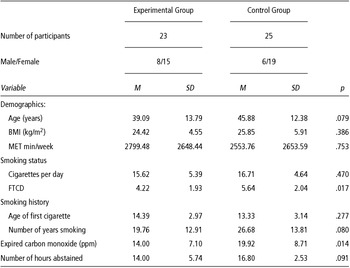
Participants included 48 male and female adult smokers. Participants were recruited via posters, newspaper, and e-mail in London in Ontario, Canada. Participants were eligible for the study if they were 18 to 64 years of age, smoked 10 or more cigarettes per day for at least the past 2 years, and had no contraindications for moderate-intensity exercise. Participants were excluded if they were pregnant, had engaged in a quit attempt in the past 6 months, or were suffering from an illness (e.g., cold) that would compromise normal smoking behaviour. Participant characteristics are provided in Table 1.
Baseline characteristics of study participants in the exercise and passive control conditions

Note: BMI, Body Mass Index; MET, Metabolic Equivalent; FTFD, Fagerstrӧm Test for Cigarette Dependence (Heatherton et al., 1991).
Primary Outcome Measure
Smoking behaviour (topography)
The CReSS Pocket (Clinical Research Support System; Plowshare Technologies®, Borgwalt, KC. Inc., Richmond, Virginia, USA), a portable, battery-operated machine, measured smoking topography. The machine is a hand-held unit that consists of a specialised mouthpiece, which produces a pressure drop that is converted to a flow rate. All variables are derived from the measurement of flow and time (Hammond, Fong, & Cummings, 2005). The topography markers acquired from the CReSS Pocket include: (1) puff count (number of puffs); (2) puff volume (ml); (3) puff duration (seconds); (4) inter-puff interval (IPI; seconds); and (5) time to first puff (seconds). In addition to the values acquired from the CReSS Pocket, total duration (minutes) was calculated. Total duration was derived from the start and end time of smoking a single cigarette. The recommended calibration procedure was performed every day the CReSS Pocket was in use. Data were downloaded from the device immediately upon collection. A serial port computer interface was used to download the data. The CReSS Pocket has excellent test-retest reliability for puff duration (α ≥0.75) (Lee et al., 2003) and fair-to-good reliability for puff volume (0.4 > α < 0.75) (Lee et al., 2003).
Topographical data were inspected for errors of measurement. Erroneous puffs can result from device misuse and/or imprecision. The first puff and any puffs with a volume less than 12 ml were deleted from the data set. The data for all remaining puffs were averaged to obtain one value for each topography marker. Data for the light-up puff was not included as it bears no resemblance to subsequent puffs (in terms of volume and duration), and is often not inhaled by the smoker (Zacny & Stitzer, Reference Zacny, Stitzer, Brown, Yingling and Griffiths1985). The criterion for false puffs has been previously used (Lee et al., 2003).
Manipulation Check Measures
Cravings (Desire to smoke)
The single-item statement ‘I have a desire to smoke’ (Tiffany & Drobes, 1991) assessed cravings. The item was scored on a seven-point Likert scale, from 1 (strongly disagree) to 4 (neither agree nor disagree), and 7 (strongly agree). Desire to smoke was measured at baseline (Session 1), the start of Session 2, and post-condition.
Acceptability of the CReSS Pocket
The investigators constructed an acceptability questionnaire in order to assess participants’ experiences using the CReSS Pocket. The purpose-built questionnaire consisted of 11-items that assessed the degree to which the CReSS Pocket ‘altered smoking behavior’ (i.e. puff volume, time between puffs, puff duration, puff count, and cigarette duration), ‘reduced smoking enjoyment,’ ‘affected the taste of the cigarette,’ ‘made smoking more difficult,’ and ‘increased awareness of how much was smoked.’ Acceptability of puff velocity and likeliness to smoke were not included in the subsequent analysis because they did not represent smoking topography variables. The scale ranged from 0 (strongly disagree) to 100 (strongly agree). Acceptability of the CReSS Pocket was assessed following baseline (Session 1) and follow-up (Session 2; post condition) smoking topography measurements. This questionnaire has not been validated. In the current study, the questionnaire had very good internal consistency at baseline (α = .942) and follow-up (α = .961).
Other Measures
Fagerstrӧm test for cigarette dependence
Behavioural and physiological aspects of dependence were measured by the Fagerstrӧm Test for Cigarette Dependence (FTCD; Heatherton, Kozlowski, Frecker, & Fagerstrӧm, 1991; Fagerstrom, 2012). The FTCD was administered at baseline (Session 1). The FTCD is a six-item, multi-dimensional scale, summarised as a single score. This study used a median split of FTCD scores, with five or higher indicating high dependence and below five indicating low dependence. The FTCD has good internal consistency (α = .64, p <.001) and adequate test-retest reliability (r = .88) (Pomerleau, Carton, Lutzke, Flessland, & Pomerleau, 1994). In the current study, the FTCD had adequate internal consistency (α = .65).
Physical activity
The short-form International Physical Activity Questionnaire (IPAQ; Craig et al., 2003) gauged current physical activity in the previous seven days, including: (1) walking; (2) moderate-intensity; and (3) vigorous-intensity activities. The IPAQ is a self-report recall of physical activity which was administered at baseline (Session 1). Physical activity was defined by metabolic equivalent task (METs) units. A MET-minute was calculated by multiplying the MET unit by the number of minutes. Participants were classified as inactive (< 1500 MET-minutes per week) or active (≥1500 MET-minutes per week).
Smoking and demographic characteristics
Demographic information, including: age, gender, smoking status (e.g., number of cigarettes per day, current other substance use, date and time of last cigarette, and brand and type of cigarette smoked most often), and smoking history (e.g., number of years smoking regularly, age of first cigarette, and past other substance use) were collected. Height (cm) and weight (kg) were recorded and Body Mass Index (BMI) was calculated.
Procedure
Ethics approval was granted by the Research Ethics Board at Western University. Eligibility was determined by an initial telephone or e-mail screen, followed by one screening visit (Session 1). During Session 1, participants provided informed consent and smoking status was verified using the piCO+™ Smokerlyzer® carbon monoxide (CO) monitor (Bedfont Scientific Ltd., Kent, England). A breath carbon monoxide reading of 10 parts per million (ppm) was the threshold for inclusion (as used in previous research; Faulkner et al., Reference Faulkner, Arbour-Nicitopoulous and Hsin2010). Next, resting heart rate was collected using a Polar RS100 heart rate monitor. Participants’ age, sex, smoking status (e.g., number of cigarettes per day, current other substance use, date and time of last cigarette, and brand and type of cigarette smoked most often), and smoking history (e.g., number of years smoking regularly, age of first cigarette, and past other substance use) were also obtained. Height (cm) and weight (kg) were recorded and Body Mass Index (BMI) was calculated. Cigarette dependence and physical activity behaviour were then assessed using the FTCD and International Physical Activity Questionnaire (IPAQ; Craig et al., 2003) instruments, respectively. Participants also rated their desire to smoke (Tiffany & Drobes, 1991).
Next, participants were briefed on the proper use of the Clinical Research Support System (CReSS) Pocket smoking topography device (Plowshare Technologies ®, Borgwaldt KC. Inc., Virginia, USA). Participants were instructed to smoke the cigarette as normal. Subsequently, participants went outside of the laboratory building and smoked a cigarette (their own brand) using the CReSS Pocket. To conclude, participants completed the acceptability questionnaire. Participants were then randomised to one of two conditions: experimental (moderate intensity exercise) or control (passive sitting).
Session 2 was scheduled for one week subsequent to baseline. To control for within subject variation in desire to smoke, Session 2 was scheduled for the same time of day as the baseline (Session 1) assessment. Preceding Session 2, participants were directed to abstain from smoking for a minimum of 18 hours. Temporary smoking abstinence was verified using the piCO+™ Smokerlyzer® carbon monoxide (CO) monitor. A breath carbon monoxide level of less than 10 ppm was taken as evidence of smoking abstinence (as used in previous research; Daniel et al., 2006; Ussher et al., Reference Ussher, Nunziata, Cropley and West2001) (M = 6.03, SD = 6.78). Desire to smoke (Tiffany and Drobes, 1991) was assessed prior to enduring the condition (exercise or passive sitting). Subsequently, all participants completed their allocated ten minute condition. Desire to smoke (Tiffany & Drobes, 1991) was assessed immediately post-condition. Participants then left the laboratory building to smoke a cigarette (preferred own brand) using the CReSS Pocket. The acceptability questionnaire was completed following use of the CReSS Pocket. All participants were debriefed at the end of Session 2.
Intervention
Moderate intensity exercise
The experimental condition involved a single bout of moderate intensity exercise on a Woodway PPS treadmill (Woodway, Waukesha, WI). The activity bout included a warm-up, 10 minutes of exercise (equivalent to moderate intensity) and a cool-down. Moderate intensity was defined as 40–68% of heart rate reserve (HRR) (Karvonen, Kentala, & Mustala, 1957). Heart rate reserve (HRR) was calculated using the formula: maximum heart rate (HRmax) – resting heart rate (HRrest) (CSEP). Maximum heart rate was equivalent to 220 – age (CSEP). Resting heart rate (RHR; beats per minute) was taken at baseline. After 11–15 hours of smoking abstinence, resting heart rate can drop by approximately 8.5 beats per minute (Perkins, Epstein, Stiller, Marks, & Jacob, 1989). Resting heart rate was taken before abstinence because it is an indicator of normal heart rate. The calculation for 40% HRR was: [(HRmax – HRrest) x .4] + HRrest (CSEP). The calculation for 68% HRR was: [(HRmax – HRrest) x .68] + HRrest (CSEP). Heart rate (HR) was monitored using a Polar RS100 heart rate monitor.
Passive sitting
The control condition involved sitting on a chair in the testing facility for 10 minutes. Participants were alone in a room, had minimal contact with the investigator, and were not discouraged from reading.
Power and Data Analyses
Our sample size calculation was based on previous research (Faulkner et al., Reference Faulkner, Arbour-Nicitopoulous and Hsin2010) that showed a difference of approximately 0.5 seconds (SD = 0.5) in puff duration between exercise and passive sitting conditions after an 8-hour period of temporary abstinence. Hence, a sample size of 40 smokers was needed to detect differences in this variable at a power of 0.80 with an alpha of 0.05 (SamplePower 3, IBM-SPSS).
Prior to analysis, data were screened for missing values and outliers. Desire to smoke was the manipulation check; and, a repeated measures ANOVA was conducted to identify condition (exercise vs. passive sitting) by time (pre- and post-condition) interaction effect. For the topography variables, a series of condition (exercise vs. passive sitting) by time (Session 1, and Session 2) repeated measures ANOVAs were conducted. If baseline differences were found for any of the topography variables, they were treated as a covariate in subsequent analyses. The relationship between craving reduction and topography variables at Session 2 was investigated using Pearson product-moment correlation coefficients. The level of significance was accepted at p < 0.05 for all statistical tests (Tabachnick & Fidell, 1996). IBM SPSS Statistics Version 20 was used for all statistical analyses.
Results
Group Equivalency
Baseline characteristics for the exercise and control groups are shown in Table 1. We found no significant differences between the groups at baseline, with the exception of FTCD (t (46) = −2.478, p = 0.02) and expired carbon monoxide (CO) (t (46) = −2.567, p = 0.01). Controlling for these variables for the main analysis was deemed unnecessary as FTCD (r ranged from −0.17 to 0.18, p ranged from 0.23 to 0.80) and expired CO (r ranged from −0.05 to 0.18, p ranged from 0.22 to 0.77) were found to be unrelated to the primary outcome. ANCOVA assumes that the relationship between the dependent variable (i.e., smoking topography) and each covariate (i.e., FTCD and expired CO) is linear (Tabachnick & Fidell, Reference Tabachnick and Fidell2001). The correlations reported here provide evidence that the assumption of linearity is being violated. Hence, FTCD and expired CO were not used as covariates, as to do so would likely reduce the power (sensitivity) of the repeated measure ANOVA tests (Stevens, Reference Stevens1996).
Manipulation Check
Cravings
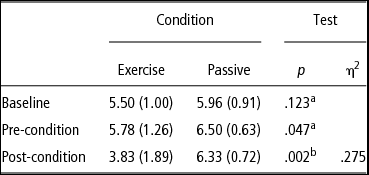
The means and standard deviations for cravings are presented in Table 2. The group by time interaction effect was significant (F [1, 31] = 11.77, p = 0.002, η2 = 0.275). Overall, participants reported lower desire to smoke directly following the exercise condition compared to the passive sitting condition.
Mean desire to smoke (SD) by condition and time
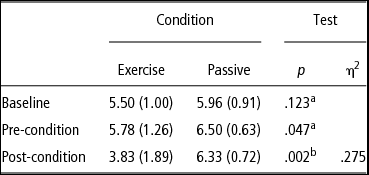
aGroup differences from independent samples t-tests.
bTime by group interactions from repeated-measures ANOVA
Acceptability
Group by time interaction effect for participants’ acceptability of the smoking topography apparatus was not significant (F [1, 29] = 0.411, p = 0.527, η2 = 0.014).
Smoking Topography
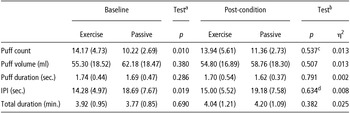
Descriptive statistics for smoking topography variables by condition (exercise, passive) and time (baseline, post-condition) are presented in Table 3. Results from the repeated-measures ANOVA indicated a non-significant group by time interaction effect for puff volume (F [1, 33] = 0.987, p = 0.507, η 2 = 0.013), puff duration (F [1, 33] = 0.071, p = 0.791, η 2 = 0.058), and total duration (F [1, 31] = 0.787, p = 0.382, η 2 = 0.071). After adjusting for baseline values, there was no significant difference between the two groups on post-condition values for puff count (F [1, 29] = 0.389, p = 0.537, η 2 = 0.013) and IPI (F [1, 30] = 0.231, p = 0.634, η 2 = 0.008).
Tests of comparisons for experimental and control groups at baseline and post-condition for smoking topography variables

Note: Mean (SD). IPI, Inter-puff interval.
a Group differences from independent samples t-tests.
b Time by group interactions from repeated-measures ANOVA
c Group effect from one-way ANCOVA (controlling for baseline puff count) due to significant group differences in puff count at baseline.
d Group effect from one-way ANCOVA (controlling for baseline IPI) due to significant group differences in IPI at baseline
Relationships among Variables
There was no association between craving reduction and the smoking topography measures for puff count (r = 0.092, p = 0.616), puff volume (r = −0.115, p = 0.518), puff duration (r = 0.038, p = 0.103), inter-puff interval (r = −0.289, p = 0.103) and total duration (r = 0.031, p = 0.861).
Ancillary Analyses for Craving Reduction
A series of paired-samples t-tests were conducted on the topography variables for those participants in the exercise condition who showed a minimum two point reduction in desire to smoke post-condition. The subsequent analyses were conducted using a sub-sample of participants (n = 12). Results showed a non-significant difference in topography values from baseline to post-condition, with the exception of IPI (t (11) = −2.26, p = 0.045). This indicates that a greater reduction in cravings is associated with a longer time between puffs. Non-significant differences across time for the following smoking topography were found: puff count (t (11) = −0.163, p = 0.873), puff volume (t (11) = −0.054, p = 0.958), puff duration (t (11) = 0.219, p = 0.831), and total duration (t (10) = −0.876, p = 0.402).
Discussion
The present study is the first randomised controlled trial to investigate the effect of an acute bout of exercise on smoking behaviour using the CReSS Pocket. Consistent with previous research (Hassova et al., Reference Hassova, Warren, Ussher, Van Rensburg, Faulkner, Cropley, Byron-Daniel, Everson-Hock, Oh and Taylor2012; Roberts et al., Reference Roberts, Maddison, Simpson, Bullen and Prapavessis2012), our manipulation check demonstrated that an acute bout of moderate intensity exercise reduces cravings in temporarily abstinent smokers. However, the main findings showed a non-significant group by time interaction effect on smoking topography (i.e., puff count, puff volume, puff duration, IPI, and total duration), indicating no differences in these variables across time between exercise and passive sitting.
Our findings are incongruent with previous research which tentatively indicated that brisk walking changes an individual's smoking behaviour (Faulkner et al., Reference Faulkner, Arbour-Nicitopoulous and Hsin2010). Potential explanations for the observed findings are considered below. First, there are differences in sampling. Our sample was older (M age = 42.6 years vs. 24.6 years), smoked more cigarettes per day (M = 16.2 vs. 15.2), and had smoked for a greater number of years (M = 23.4 years vs. unknown). Since these characteristics are attributable to hardened smokers, one can argue that smoking behaviour may be less malleable for our sample compared to the younger cohort in the Faulkner study. Second, the methodology varied between studies. Our study used a bout of moderate intensity exercise determined by each participant's unique pre-abstinence resting heart rate, whereas the Faulkner study used a bout of brisk walking and did not take heart rate into account. The impact of exercise intensity and/or duration (if any) on smoking topography is not known. Third, the mean length of smoking abstinence in our study was 15.3 hours, compared to 8.4 hours reported by Faulkner et al. Although pre-condition cravings are higher in our study, the impact of abstinence length on smoking behaviour is, again, unknown. Finally, the circumstances surrounding smoking topography measurement varied between studies. Participants in the previous study elected when to smoke a cigarette with the CReSS Pocket, in contrast to the current study, where participants were invited to smoke a cigarette immediately following their respective condition. Since participants in the previous study recognised and acted on their readiness to smoke, one would expect that smoking behaviour revert to pre-abstinence norms. On the other hand, if participants had no choice regarding when to return to smoking, one would expect an alteration in smoking behaviour, particularly when coupled with a decline in cravings, as seen in the participants randomised to the exercise group in this study. This further supports the notion that the behaviour of hardened smokers is inflexible.
From our study, there is no evidence to suggest that smoking topography change is more pronounced with a greater craving reduction. We found no significant differences across time for smoking topography variables (with the exception of IPI) for participants in the exercise condition who reported at least a 2-point reduction in cravings. Furthermore, craving reduction was unrelated to any smoking topography variables. There may be a critical level of craving reduction needed to see a change in topography.
Smoking topography measurement is limited, to some degree, by the false act of smoking with a mouthpiece (Williams et al., 2011). Previous research found devices with a mouthpiece make smoking more difficult, reduce smoking enjoyment, and affect cigarette taste (Blank et al., Reference Blank, Disharoon and Eissenberg2009). This is unlikely to be the case in our study given the neutral result for subjective acceptability of the device which was assessed following use of the device.
Overall, our study did not find support for acute exercise having a positive change on smoking topography. Although there is evidence that exercise can delay time to first cigarette (ad libitum), this study demonstrates that the change to smoking topography is negligible when participants are invited to smoke. Therefore, an acute bout of exercise as a harm reduction strategy may only apply to delay ad libitum smoking. Further research examining ad libitum smoking topography following an acute bout of exercise in a natural environment (non-laboratory) is warranted. In addition, the impact of regular exercise on smoking topography prior to a targeted quit attempt may prove to be an efficacious approach to harm reduction.
Role of Funding Sources
This study was not directly supported by any funding source. The Exercise and Health Psychology Laboratory, where this work was conducted, is supported by a Canadian Foundation Innovation infrastructure grant awarded to Dr Harry Prapavessis. The aforementioned funding sponsors did not have any role in study design, collection, analysis, or interpretation of data, writing the manuscript, and the decision to submit the manuscript for publication.
Contributors
TS, SDJ, and HP conceived the study. TS and SDJ recruited participants and conducted the study in London, ON. All authors were involved in the statistical analyses and TS prepared the first draft of the manuscript. All authors contributed to and approved the final version of the manuscript.
Conflict of Interest
My coauthors and I do not have any personal or financial conflicts of interest related to the research, nor do the authors have other relationships with other people or organisations within three years of beginning the submitted work that could inappropriately influence, or be perceived to influence, this work.
Ethical Standards
The authors assert that all procedures contributing to this work comply with the ethical standards of the relevant national and institutional committees on human experimentation and with the Helsinki Declaration of 1975, as revised in 2008.