Historians of premodern Europe agree that Central Europe was financially far less advanced than the Italian city states that were leading in financial innovation at least up to the seventeenth century. It was in Italy where modern commercial loans emerged first and governments first developed a system of municipally funded debts (Day Reference Day1987; Sylla Reference Sylla2002, p. 82; Munro Reference Munro2003, pp. 514–16; Denzel Reference Denzel2008, pp. 51–53). The present article compares the integration of capital markets in this financially sophisticated region with markets in Central Europe. The focus is on one specific type of market for capital, that is, the market for urban annuities which is particularly well documented.
Annuity markets have been studied from a variety of perspectives. One strand of the historiography is concerned with the social background of the buyers of annuities and the role such instruments played in constitutional development and public finance (Gabrielsson Reference Gabrielsson1971; Sprandel Reference Sprandel1971; Rosen Reference Rosen1978; Gilomen Reference Gilomen1982; Alter and Riley Reference Alter and Riley1986; Brown et al. Reference Brown, Mitchell and Poterba2001; Tracy Reference Tracy2003; Poitras Reference Poitras2006; Zuijderduijn Reference Zuijderduijn2009; van der Heijden Reference Van der Heijden2006). This literature explores an issue closely linked to our present concerns: the geographical origin of investors. Several authors stress that in Italy, unlike Northern Europe, most urban bonds were owned by locals (Molho Reference Molho1995, pp. 107–109; Pezzolo Reference Pezzolo2005, pp. 156–58; Zuijderduijn Reference Zuijderduijn2009, pp. 262–64).
Another strand of the literature is primarily concerned with the factors determining the level of interest rates and its change over time. Within this particular historiography one can distinguish two lines of argument: Some authors highlight how political systems like feudalism (Chilosi Reference Chilosi2014) or institutions such as representative assemblies (Stasavage Reference Stasavage2011, pp. 154–55) influenced capital costs; others emphasize the role played by the supply of capital and the development of secondary markets (Epstein Reference Epstein2000, pp. 19–24; Gelderblom and Jonker Reference Gelderblom and Jonker2004, Reference Gelderblom and Jonker2011).
There is a third, and growing, strand of research that speaks directly to the issue of this article, namely capital market integration.Footnote 1 Luciano Pezzolo and Giuseppe Tattara (Reference Pezzolo and Tattara2008), for example, examined how the exchange fairs of Bisenzone around 1600 fostered inter-urban arbitrage and financial market integration. Genoese bankers used the fairs to raise money for the Spanish crown, developing financial techniques and a network that reduced the risk of lending to fund Spanish long-term debts via short-term loans. By contrast, Carlos Álvarez Nogal’s (Reference Álvarez Nogal2009) study of urban public debts in Castile found no evidence of integration across the annuity markets of Burgos, Cadiz, and Murcia between 1540 and 1740. Most recently Wolfgang Keller, Carol Shiue, and Xin Wang (Reference Keller, Shiue and Wang2016), drawing on interest rates imputed from grain storage data, compared Chinese and British capital markets in the late eighteenth and nineteenth centuries. They found not only that the costs of capital in Britain were on average lower than in China, but also that British capital markets were better integrated.
In this article we measure and document the extent, timing, and spatial spread of premodern capital market integration. We employ Maurice Obstfeld and Alan Taylor’s (Reference Obstfeld and Taylor2004) well-tried approach and examine, first, patterns of convergence in interest rates (here: yields of urban annuities) and, second, inter-city capital flows. The study draws on a new, unique dataset of about 29,000 individual interest rate observations from more than 100 cities over a period of almost 500 years. We consider markets from across the Holy Roman Empire north of the Alps and from Italy.Footnote 2 The earliest observations in the sample are from the fourteenth century, with the analysis closing at around 1800. We ask to what extent urban capital markets integrated in the long run and how mobile capital was between cities.
The interest rates used here derive from the prices of life and heritable annuities sold by town councils. In the Empire, these instruments were secured against real estate owned by the town or, more rarely, against its regular revenues. Buyers of such securities paid a sum of money in return for an annual interest payment. If a town defaulted, the courts protected the annuity holders’ right to seize the real estate that served as collateral. Life annuities and heritable annuities differed in that life annuities were typically paid until the purchaser died. By contrast, heritable annuities were—in principle, at least—paid in eternity and could be bequeathed (Baum Reference Baum1985, p. 25).
A few surviving accounts allow gauging the importance of such urban debts. In Nuremberg in the 1430s, for example, newly raised loans reached up to 55 percent of the total annual income of the town. For fifteenth-century Munich values of up to 25 percent, and for sixteenth-century Schwäbisch Hall values up to 62 percent have been calculated (Fuhrmann Reference Fuhrmann2003, pp. 4–12). By the end of the early modern age, most Free Imperial Cities were heavily indebted. Those in South Germany commonly had to earmark more than half of their revenues for servicing their liabilities (Quarthal Reference Quarthal1991, p. 223). Territorial towns, that is, those under the authority of a prince, depended less on deficit finance, as loans had to be increasingly approved by their rulers from about the mid-seventeenth century (Kern, Reference Kern2000; Fuhrmann Reference Fuhrmann2014, pp. 188, 195).
Italian annuities developed in two phases. From the twelfth to the fifteenth centuries, many securities, known as forced loans, were forcibly allocated to the local well-to-do, with Genoa, Florence, and Venice among the cities that issued such securities (Pezzolo Reference Pezzolo2005). From the sixteenth century, urban debts spread across the peninsula and voluntary lending became the norm (Pezzolo Reference Pezzolo1995). Urban authorities typically allocated specific revenues to servicing their debts. While fiscal decentralisation was as common in Italy as in the Empire, estimating the size of debt is possible for capital cities where urban and regional state finances overlapped. For example, in about 1500 the Republic of Genoa’s stock of debt was 35 times the size of its annual revenues. This was an extreme case. In Florence and Venice the corresponding figure was about one-fourth. In the seventeenth century, other cities caught up with the financial pioneers, with their debts rapidly expanding in the face of stagnating revenues. Thus, by 1700, Venice and Papal Rome had accumulated a stock of debt equivalent to, respectively, 15 and 20 times annual revenues. These were very high debts indeed with the stock of per capita debt equivalent to the annual costs of feeding, clothing, and housing around two people. Those of Naples and Milan were not far behind (cf. Chilosi Reference Chilosi2014, pp. 897–98).
Comparing the Empire and Italy is exceptionally fruitful. Italy gave birth to a large number of financial innovations that until the seventeenth century earned it the reputation as the financially most advanced part of Europe. By contrast, the historiography regards Germany as backward (de Vries Reference De Vries1976, p. 221; Denzel Reference Denzel2008, pp. 105–106, 121). Politically, the Empire and Italy give a superficially similar impression of having been fragmented. However, unlike Italy, the Empire had an overarching constitution. This constitution applied neither to the Imperial fiefs in Italy nor to the rest of the peninsula (Schmidt Reference Schmidt2011, p. 46). Moreover, in Italy, alternative supra-urban organizations such as the Lombard League were already defunct by the fourteenth century, whereas the Empire’s constitution continued to be supplemented by urban and other leagues far into the early modern age (Spruyt Reference Spruyt1994, pp. 109–11; Distler Reference Distler2006).
Our results suggest that over the whole period markets were better integrated north of the Alps than in financially more developed Italy. Indeed, in the early modern era, interest rate differentials narrowed only in the Empire. Further, north of the Alps both the distance and volume of investments grew at the same time as yield differentials between distant markets declined. In the Empire, capital markets had a number of centres. The long-term erosion of interest differentials between them was mainly driven by convergence of initially peripheral markets in the Netherlands and Upper Germany with the rest.
Sources and Data
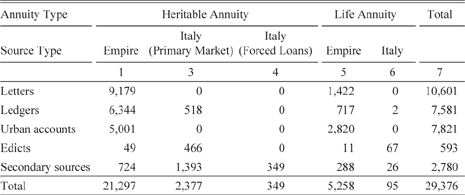
Most data used here were collected from a large number of archives which are listed in detail in Online Appendix A. In Table 1 we delineate the main types of sources. Letters contain the most comprehensive information. They generally give the contract, and margin and dorsal notes sometimes give additional information, for example, on later changes and redemptions. Ledgers, including all books and documents kept to administer urban annuities, are the most heterogeneous type of source. At best, they record all sold annuities, briefly listing the conditions of the contract, as well as transfers, conversions, and redemptions (e.g., the Nuremberg ledgers). However, most ledgers contain only partial information on the contract and its history. Pay-out ledgers, for example, sometimes omit the original interest rate but record a later conversion. In a few cases, we had to infer the date of the conversion by checking whether different types of sources were consistent with each other. Urban accounts record sold annuities as part of the revenues of a town. As several branches of urban administration could sell annuities, the main accounts (that we use predominantly) do not necessarily document all sales in a year. They only summarise the contracts, stating the name of the buyer, the capital, and pay-out or interest rate, sometimes the date, but mostly only the fiscal year. In such cases we assumed that the annuity was sold in the first calendar year (e.g., when the fiscal year was 1525/1526, we assumed the sale to have taken place in 1525). Data from edicts that reported the official rate and, in varying levels of detail, the conditions of purchase were only included from Northern France, the Netherlands, and Italy.
Observations by Source Type and Annuity Type

Sources: Online Appendix A.
For Germany, the data come from actual sales of annuities—that is, we exclude interest rates stipulated in edicts or similar sources. The data refer to primary yields which are much better documented than those on secondary markets. Where evidence on interest rates in secondary markets exists, it shows yields close to those on primary markets.Footnote 3 Note that German urban authorities sold annuities continuously, that is not only in times of fiscal need or when there was particularly strong demand by prospective buyers. For non-German markets in the Empire, for example, Dutch or Flemish, the analysis includes rates determined by law and published in edicts. In Lille and Amsterdam, where it is possible to compare such rates with those paid on the primary market, both match.Footnote 4
The data for Italy come in two forms. First, for the period before 1493 we use secondary market rates on forced loans, which until this point dominated urban debts. As such forced loans were riskier than those purchased voluntarily, differentials between forced loans’ rates and their secondary market rates were far larger than in the case of rents issued on “open” primary markets (Chilosi Reference Chilosi2014, pp. 889–91, 2015, Section 5). Second, from the sixteenth century onwards, that is, after forced loans had fallen out of use and “open” primary markets emerged, our Italian interest rate data mainly refer to official rather than market rates. However, where primary market rates are available the official rates were typically close to them. Since market yields tended to magnify differences in the return between safe and risky securities (Chilosi Reference Chilosi2014, p. 892), using mostly official rates biases the analysis against our finding that Italian markets were relatively weakly integrated.Footnote 5
With few exceptions, which we exclude from the analysis, the prices of urban life and heritable annuities were not related to the age or health or any other biological characteristics of the buyers or those in whose name an annuity was taken out. Hence, the ratio between the yearly pay-out and the purchase price equals the interest rate.Footnote 6 The analysis uses nominal rather than real (i.e., deflated) rates for three reasons. First, the available evidence suggests that differences in long-run inflation rates between markets were small (Allen Reference Allen2001, online database;Footnote 7 Malanima Reference Malanima2002, Appendix). In the given context, it is these long-term rates that matter since the focus here is on securities with long-term maturities. Second, likely small differences between local inflation rates can be estimated only imprecisely because there are few cities where sufficiently detailed price indices are available. Third, and most importantly, the information needed to anticipate price changes over the long term was not readily available to the investors (Gilomen Reference Gilomen1984, p. 195). When deciding where and at what interest to invest their capital, pre-modern investors had little choice but to use nominal rather than real rates (Chilosi Reference Chilosi2014, p. 903).
Sometimes authorities taxed annuities or offered benefits to buyers. Within the Empire, it is only in Nuremberg and Brunswick and in selected periods that the evidence allows estimating what difference this made.Footnote 8 We compare 186 rates on such annuities from between 1396 and 1590 and found that tax-free rates differed on average only by 0.37 percentage points from others. In Italy, some of the forced loans in Venice and annuities sold in Genoa were taxed. Generally, we used the return net of tax when available or else we assume that the pay-out was not affected by taxes or benefits.
The difference between yields on equally risky securities cannot exceed inter-urban transaction costs for long periods of time because arbitrage will trigger adjustment, with capital flowing from where it is relatively cheap to where it is relatively costly. In consequence, differences in yields shrink until they are at the level of or lower than transaction costs. However, these costs are not the only determinant of yield differentials. Similar conditions of supply and demand can produce similar interest rates even in the absence of arbitrage. We therefore also analyse inter-urban capital flows. Such flows highlight that cities within the Empire were linked through fairly dense ties. Thus, the 12 best-covered cities in the sample show a network density (the proportion of actual to potential links) of 42 percent.Footnote 9 This is a much higher value than that for the mid-eighteenth century European money market (12 percent, Flandreau et al. Reference Flandreau2009, p. 160) and roughly matches that existing between nation-states in today’s bond market (57 percent, Schiavo, Reyes, and Fagiolo Reference Schiavo, Reyes and Fagiolo2010, p. 392).
Moreover, inter-urban differences in yields may reflect not only transaction costs between markets but also differences in risk of default (nonpayment or falling into arrears). However, if cities discriminated between domestic and “foreign” investors (in its premodern sense, cf. Schultze Reference Schultze1908, p. 77), exposing them to different risks, as was often the case in Italy, then the differences between their risk premia did indeed become part of inter-urban transaction costs, thus affecting the measured extent of integration.
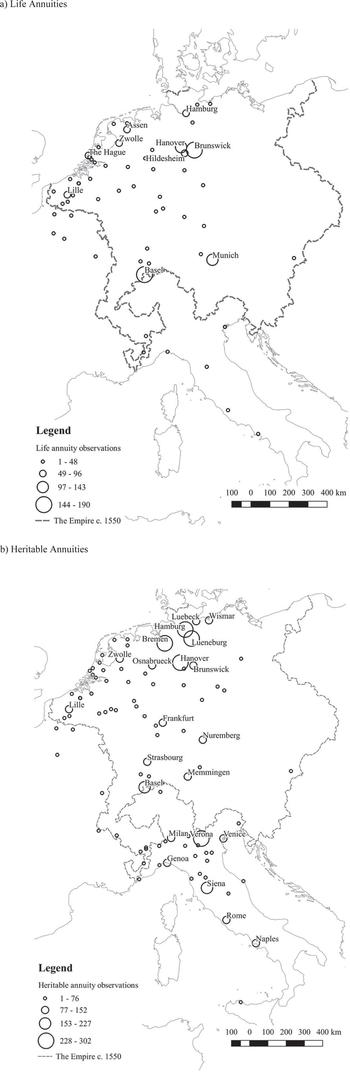
The analysis uses yearly means as there are only few cases where the date of a transaction can be identified with greater than yearly precision. Altogether, there are 5,040 yearly means for heritable and 1,520 for life annuities. While in the very early stages of development life annuities were the more important instrument, over time they became less popular. Possibly this reflected a learning process on the part of the sellers: Heritable annuities did not require the authorities to periodically check that the beneficiary was still alive and, therefore, implied lower administrative costs than life annuities. Further, life annuities were potentially bought on behalf of young children, implying a higher return to the beneficiaries and higher costs to the issuer. The data from the Empire allow analysing differentials between local yields from the mid-fourteenth century. For Italy, where secondary market yields on forced loans are available only for Florence, Genoa, and Venice, the number of pre-sixteenth-century observations is so small that for this period the analysis cannot be more than exploratory. Up to the mid-seventeenth century the number of observations increases. There are fewer surviving data from the Empire thereafter. Following the Peace of Westphalia, many cities lost their fiscal autonomy and ceased raising debts. Figure 1 (a and b) shows the geographical distribution of observations of yearly means.
Interest Rate Observations (Yearly Means), 1240–1809: Geographical Distribution

The interest rates are from 101 cities, 72 of which are located north of the Alps and 30 in Italy.Footnote 10 While the coverage is uneven, our archival research extends far beyond what was available in previous studies of urban annuities or premodern financial integration in Europe. The north of the Empire is particularly well-covered, as are Central and Northern Italy. Figure 1a also shows that life annuities were clearly much less common in Italy than north of the Alps. For this reason, life annuities are examined only for the whole sample and the northern sub-sample.
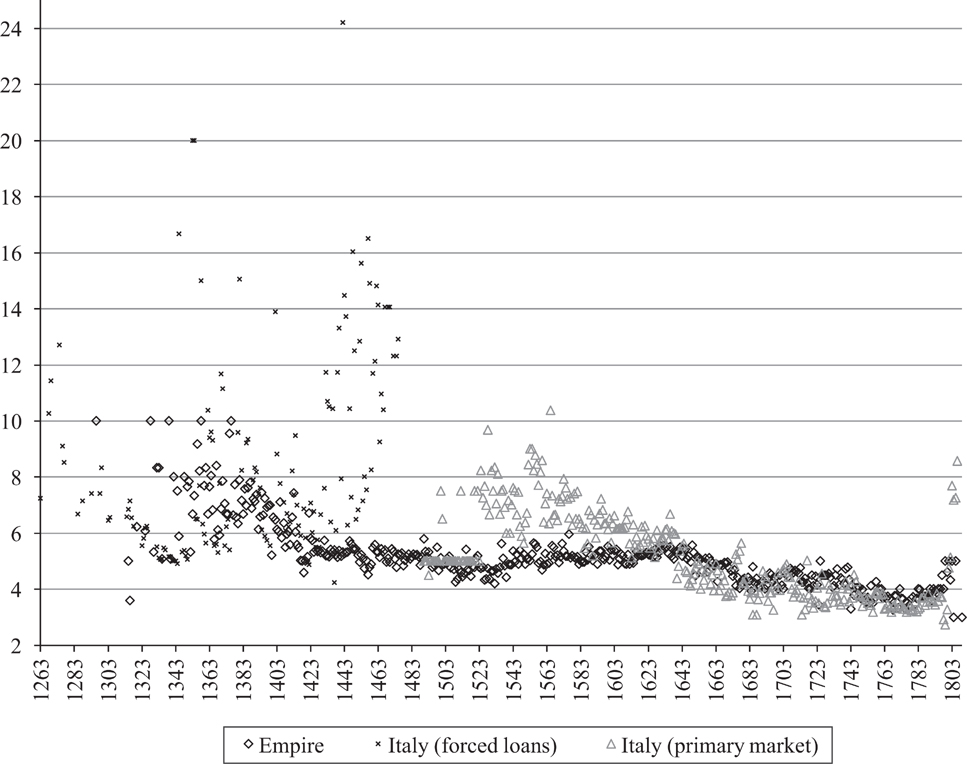
Figure 2 shows how the nominal yield on heritable annuities, including forced loans in Italy before 1493, developed north and south of the Alps.Footnote 11
Nominal Interest Rates on Heritable Annuities in the Holy Roman Empire and Italy, 1263–1809 (Yearly Means, in Percent)

In the long run nominal interest rates in the Empire declined, though in contrast to what prior research implied (Homer and Sylla Reference Homer and Sylla2005, pp. 135, 153, 176), their fall was not steady. Two periods of decline stand out: the early fourteenth to the early fifteenth centuries and the second half of the seventeenth century. In between and after these periods rates stagnated. Italian forced loans, whose yields on the secondary market had often been exceptionally high and volatile, disappeared around 1500. Thereafter, Italian yields on securities sold on the primary market fell continuously to the late eighteenth century. Despite the country’s precocious financial development in the late Middle Ages, yields in Italy were initially much higher than north of the Alps. However, they fell to values lower than those in the Empire in the mid-seventeenth century and from then on stayed slightly lower until the end of the period analysed here.
Integration Trends: North Versus South
The coefficient of variation is a standard measure of price or interest rate dispersion: The smaller it is, the more alike were local interest rates and the greater the level of integration. However, as the coefficient is affected by changes in the sample’s composition of markets, gaps in the interest rate series may introduce a bias. To address this issue, we use city-fixed effects and regress the absolute value of the natural logarithm of the ratio between the interest rate in each market and the average interest rate on a time trend:
 $abs\left[ {ln\left( {{{{i_{it}}} \over {{{\bar \iota }_t}}}} \right)} \right] = {\alpha _i} + \beta year + {u_{it}},$
where abs stands for absolute value, ln is the natural logarithm operator, iit is the interest rate in place i and year t, ${\bar \iota _t}$ is the sample cross-sectional average interest rate in year t, αi is a place-specific fixed effect, β is the yearly rate of change and uit is an error term.
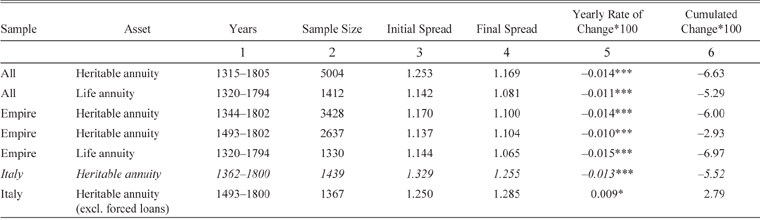
The results (Table 2, columns 3 and 4) show that the differentials were much larger in Italy than in the Empire both at the beginning and at the end of our period. This holds irrespective of whether forced loans traded on the secondary market in late medieval Italy are included. Only if such forced loans are included do Italian markets display a significant trend in long-run interest rate convergence. In other words, from the sixteenth century, when a primary market in annuities developed, interest rates in Italy did not converge any further. By contrast, the results on yearly rates of change and the associated cumulated changes indicate a long-term advance in integration north of the Alps (Table 2, columns 5 and 6).
Long-Term Trends in Capital Market Integration

* = Significant at 10 percent level.
** = Significant at 5 percent level.
*** = Significant at 1 percent level.
Note: City-fixed effects.
Sources: Online Appendix A.
Such long-term trends may obscure non-linear patterns of convergence and divergence. To examine such patterns, we use again fixed effects panel analysis of the dispersion around the mean, but now with ten-year dummies rather than a time trend (cf. Bateman Reference Bateman2011):
 $abs\left[ {ln\left( {{{{i_{it}}} \over {{{\bar \iota }_t}}}} \right)} \right] = {\alpha _i} + \sum\limits_{d = 1350 - 1359}^{1790 - 1799} {{\beta _d}} Decad{e_d} + {u_{it}},$
where βd denotes the rate of change in the gap between the local and the sample average interest rate in decade d, otherwise the notation is as in equation (1).
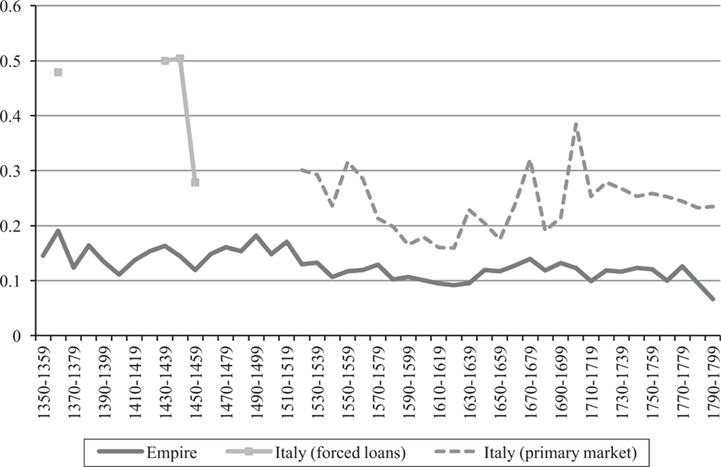
As the analysis requires a large sample, we consider heritable annuities only (Figure 3).Footnote 12
Capital Market Integration in Italy and the Empire: Panel Trends (Logs of Differentials Around the Mean)

Interest rates in Italy were much more dispersed than in the Empire. For the late Middle Ages, this appears to have been due to the dominance of forced loans. Once an open market for annuities had developed, interest differentials moved closer to those in the Empire. However, not only were they still larger than north of the Alps, they also fluctuated far more strongly throughout the whole period under review. In terms of dispersion, northern capital markets were clearly better integrated than those in the supposedly more developed south.
Recent research has shown that in Italy differences between local risk-levels helped keeping differentials large. Apart from forced loans in the late Middle Ages, securities issued in the early modern Spanish territories (Milan, Naples, and Sicily) were particularly risky (Chilosi Reference Chilosi2014, pp. 890, 900). Still, even if observations from the Spanish possessions are excluded, differentials in Italy remain wider than in the Empire. The difference is especially startling considering that the average distance of 286 kilometres between the Italian cities is smaller than that between the sample cities north of the Alps (379 kilometres).
Examining where the owners of the debts lived confirms that the Empire was better integrated than Italy. In the Middle Ages, securities issued by Italian city-states were mostly held locally. Capital flows between Italian cities did intensify in the early modern era, but most bonds still remained in local hands. The Italian city where foreigners owned the greatest share of the debt was probably Venice. By the later seventeenth century, about one-third of its debt was owned by people from outside the Republic, mostly from Genoa (Felloni Reference Felloni1971, passim; Masini Reference Masini2007, pp. 205–207; Stumpo Reference Stumpo2007, pp. 149–51). By contrast, in Flanders, Holland, and Germany a large part of the urban debt, half or more, was owned by non-locals even at the very beginning of the period under review (Fryde and Fryde Reference Fryde and Fryde1963, pp. 528–30, 540, 545, 547, 553; Munro Reference Munro2007, pp. 10, 21–22; Zuijderduijn Reference Zuijderduijn2009, pp. 178–79). In the Empire inter-urban capital flows further intensified over time.
Capital Flows and Distance
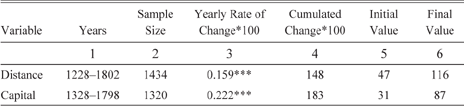
How large were the distances over which investors in the Empire placed their capital, and how did these distances and the invested sums change over time? For 52 markets north of the Alps, the sources contain information on the origin of investors from other places. After excluding trivial links with markets within their hinterland,Footnote 13 we retain 4,541 observations of inter-city investments across 915 city pairs. Comparing investments from different periods requires converting the invested sums into a constant measure. We use the cost of a yearly “respectable” consumption basket.Footnote 14 Excluding those cases where missing capital or coinage data prevented conversion, the analysis builds on 4,095 investment observations. As a first step to assess how capital flows evolved, we investigate trends in the distance and volume of investments. As before, to control for changes in the composition of the sample over time we run fixed-effect panel regressions of the natural logarithm of the yearly means against a time-trend:
 $ln\left( {{y_{it}}} \right) = {\alpha _i} + \beta year + {u_{it}},$
where yit is the yearly mean of the dependent variable of interest (capital invested or distance between places) in place i in year t, αi is an importer-specific fixed effect, and β is the yearly rate of change; uit is an error term.
In the long run the distance and volume of investments grew significantly: With distance increasing from 47 to 116 kilometres and capital invested rising from 31 to 87 consumption baskets (Table 3, columns 5 and 6), the average values are more than twice as large at the end of the period as at its beginning. This supports the finding that the Empire’s capital markets became increasingly integrated. While most investors placed their capital relatively close to home, the sums in question were large. On average and at the prevailing interest rates (see Figure 2), the yearly return on the sums invested in heritable annuities was sufficient to feed, clothe, and house about three people, that is, a small family.
Inter-City Investment in the Empire: Trends in Average Distance (In KM) and Average Capital Invested (in Consumption Baskets)

* = Significant at 10 percent level.
** = Significant at 5 percent level.
*** = Significant at 1 percent level.
Note: Importer city-fixed effects.
Sources: Online Appendix A.
To gauge when the distance and volume of inter-city investments grew, we regress their means against 50-years dummies over the period 1350–1699 (there are not enough eighteenth-century observations to produce reliable estimates):Footnote 15
 $ln\left( {{y_{it}}} \right) = {\alpha _i} + \sum\limits_{f = 1350 - 1399}^{1650 - 1699} {{\beta _f}} Fift{y_f} + {u_{it}},$
where βf is the rate of change in the dependent variable of interest (yit: capital invested or distance between places) in the 50-year period f, otherwise the notation is as in equation (3).
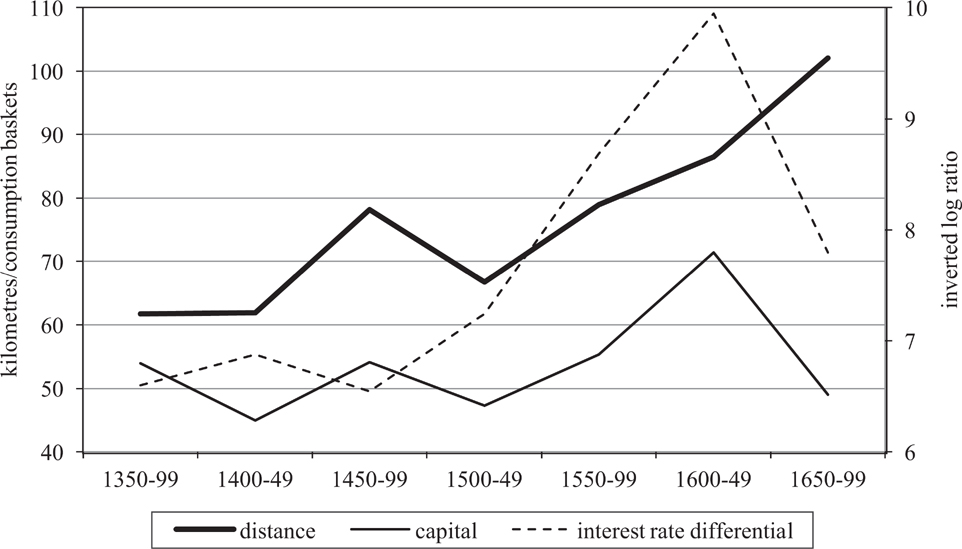
The trends obtained are compared with the inverted trend of the interest-rate differentials (heritable annuities) within the Empire, where a higher value signals increased capital market integration (Figure 4).
Inter-City Investment in the Empire: Trends in Distance (in Kilometres) and Capital (in Consumption Baskets) Compared to Interest Differentials (Inverted Log Ratio)

From the early sixteenth to the mid-seventeenth century, the increase in integration (here shown as a rise in the inverted log interest-rate ratio, right hand axis) was closely associated with growth in both invested sums and distance of investments (left hand axis). In the second half of the seventeenth century, however, the capital figures and the differentials suggest disintegration while the distance measure does not. This is probably an outcome of the spatially uneven effects of the Thirty Years War. The demand for capital grew relative to its supply as the need to finance post-war reconstruction led to a decline in sums invested in the annuity market. At the same time, distances over which capital was placed continued to increase as urban authorities—in the face of diminished local supply—were seeking to attract capital from farther away, that is, areas less affected by the war.Footnote 16
The question is how the reach of the market expanded over the long term. We use 1520 as a suitable cut-off point because it marks the start of the sixteenth-century spurt in interest rate convergence and allows splitting the sample into two similarly-sized sub-samples.Footnote 17 Both before and after 1520, most capital was invested within a radius of 200 kilometres and sums rarely exceeded 200 consumption baskets, which corresponds, for example, to 3,411 Lübeck marks in 1520. However, the reach of the market increased at the high margin: from the sixteenth century, investment gained previously unattained sizes and distances which drove up the average values of investments.Footnote 18
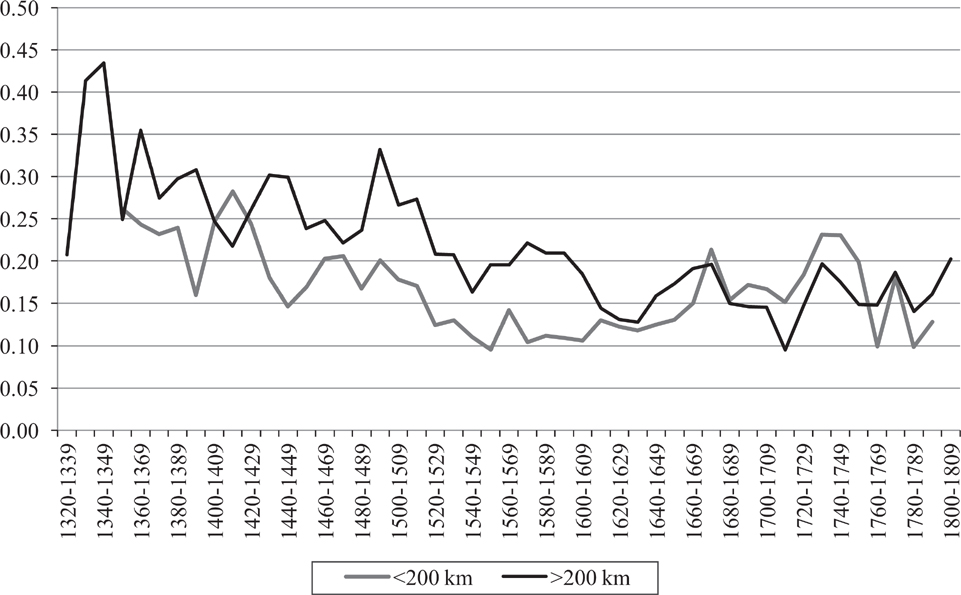
Did long-distance investment also drive interest rate convergence?Footnote 19 Since we find that the frequency of inter-city investments drops sharply beyond c. 200 kilometres, this makes an appropriate cut-off point for comparing long-term trends. We use fixed effects panel regression of pairwise differentials on time:
 $abs\left[ {ln\left( {{{{i_{it}}} \over {{i_{jt}}}}} \right)} \right] = {\alpha _i} + \beta year + {u_{it}},$
where the notation is equivalent to that of equation (1).
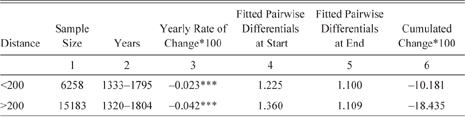
Table 4 shows the results. The highly significant yearly rates of change and associated cumulated changes (Table 4, columns 3 and 6) indicate that long-distance convergence played the key role, advancing almost twice as fast as local convergence. By the end of the period, pairwise differentials between distant places were on average almost as small as those between close markets (Table 4, column 5).
Integration of Capital Markets in the Empire: The Role of Distance (in KM)

* =Significant at 10 percent level.
** =Significant at 5 percent level.
*** =Significant at 1 percent level.
Note: City-pair fixed effects.
Sources: Online Appendix A.
To show when differentials between more distant places shrank, we compare the pairwise differentials across distance groups over consecutive ten-year periods and compute panel trends:
 $abs\left[ {ln\left( {{{{i_{it}}} \over {{i_{jt}}}}} \right)} \right] = {\alpha _i} + \sum\limits_{d = 1320 - 1329}^{1800 - 1809} {{\beta _d}} Decad{e_d} + {u_{it}},$
where the notation is equivalent to that in equation (2).
Figure 5 shows the estimated trend values. The results are fully in line with those of the earlier analysis. Short-distance convergence (<200km) advanced significantly from the early fifteenth to the mid-sixteenth centuries. Long-distance convergence began several decades later: Differentials between places more than 200 kilometres apart declined from about 1500 to 1630. Since the early seventeenth century, interest rates differentials varied little between both distance groups, that is, by about 10 to 15 percent on average. In other words, given costs of capital of about 4 percent, we are looking at interest rate differentials of half a percentage point, which suggests a capital market that was well-integrated by any standard.
Pairwise Differentials by Distance in the Empire: Panel Trends (Logs)

Regional Integration in the Empire
How clustered were capital markets north of the Alps—or which cities were linked by particularly strong capital flows? We investigate these questions first and then use the insights thus gained to divide our sample and study how capital market integration evolved between and within clusters in the Empire.
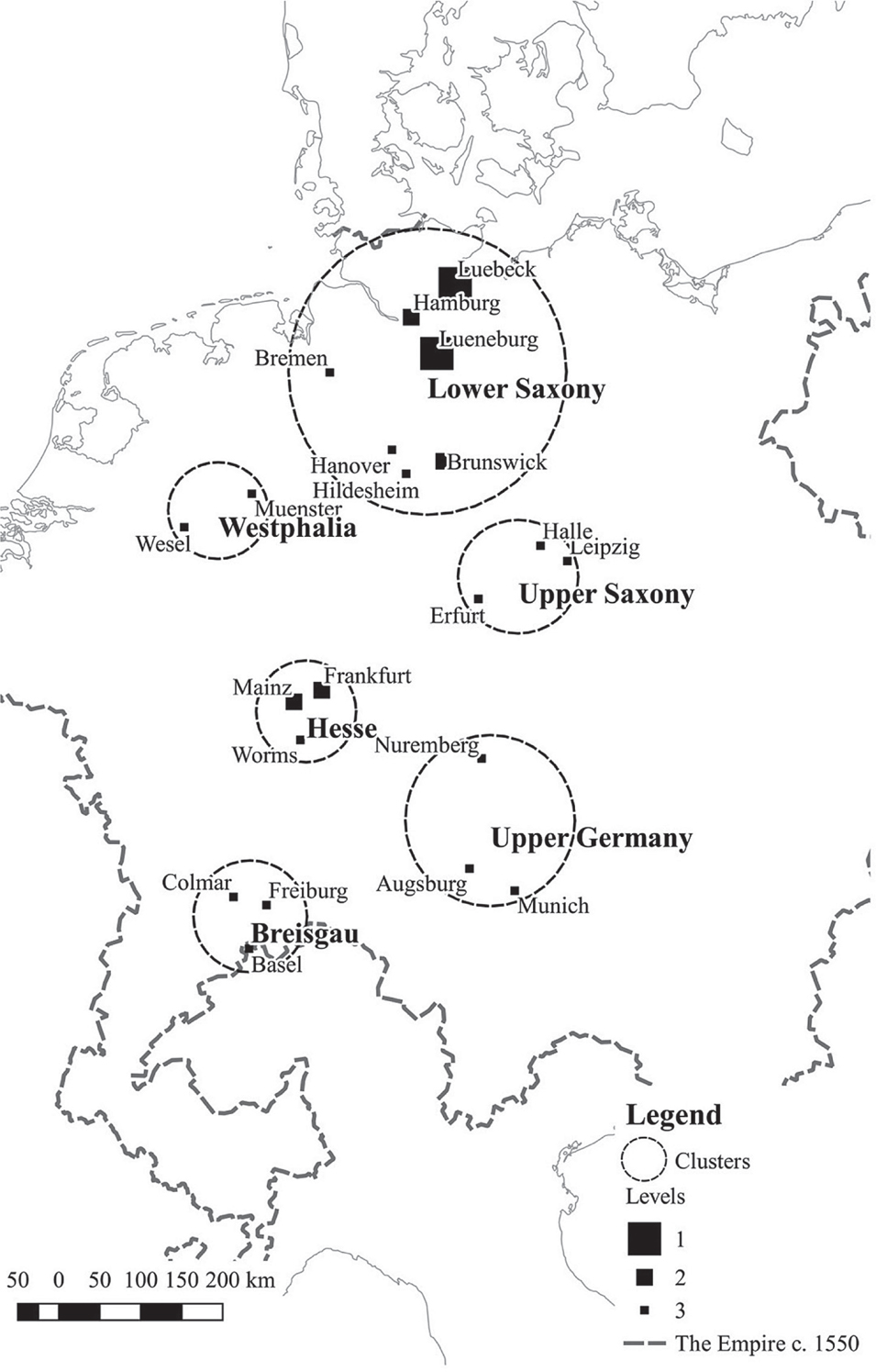
To identify clusters of cities, we rely on the model developed by Michael Schweinberger and Tom Snijders (Reference Schweinberger and Snijders2003). Their technique allows detecting such clusters across various levels of capital flow intensity, defined in a descending order where level 1 is the highest. The likelihood that all the actual links between cities in the sample are recorded does increase with the number of observations from each capital-importing city. However, the fewer well-recorded cities are included, the smaller is the geographical area covered. Concentrating on the 28 cities with at least 10 observations on capital imports is a compromise between the desire to include as many markets and as wide an area as possible and the need to focus on those cities which are sufficiently well-documented. Sample bias is addressed by estimating the capital flows that would be observed if all the linked cities had the same number of observations on capital imports. The measure of capital flow intensity is an index that ranges from 0 to 1 (see Online Appendix B for technical details). Figure 6 shows the clusters.
Capital Market Networks: Clusters of Cities

Capital flows were exceptionally strong between Lübeck and Lüneburg. These are the only cities where we observe the highest level of capital flow intensity. Already at the next lower level, intensity drops by two-thirds (from 1 to 0.364). At this level, we find two clusters: one is an expanded group in Lower Saxony (Hamburg and Brunswick, together with Lübeck and Lüneburg); the other is the Frankfurt–Mainz pair in Hesse. Expected capital flows at the third level remain relatively high (0.15). Here, Bremen, Hanover, and Hildesheim join the cluster in Lower Saxony. Worms becomes part of the Hesse cluster that at Level 2 was formed by Frankfurt and Mainz. Moreover, at the third level a Breisgau cluster (Basel, Colmar, and Freiburg), an Upper Germany cluster (Augsburg, Munich, and Nuremberg), a cluster in Upper Saxony (Erfurt, Leipzig, and Halle) and another in Westphalia (Münster and Wesel) emerge. The fourth level, not shown in Figure 6, contains all 28 cities examined but is characterised by very weak capital flows (0.009).Footnote 20
These findings agree with our results on the role of distance. All cities with strong capital flow links between them were geographically relatively close, with clusters developing around financial or commercial centres such as Frankfurt, Leipzig, Nuremberg, and Lübeck.Footnote 21 Outside these clusters, capital flows tended to be much smaller. One reason for this difference may be information flows that, though not directly related to annuities, made for easier inter-city investment. The relation between Lüneburg—a centre of the production of salt—and Lübeck—from where the salt was distributed across the Baltic—is a case in point: The cluster in Lower Saxony reached particularly high levels of capital flows and was significantly wider than others at the same level of network intensity.Footnote 22
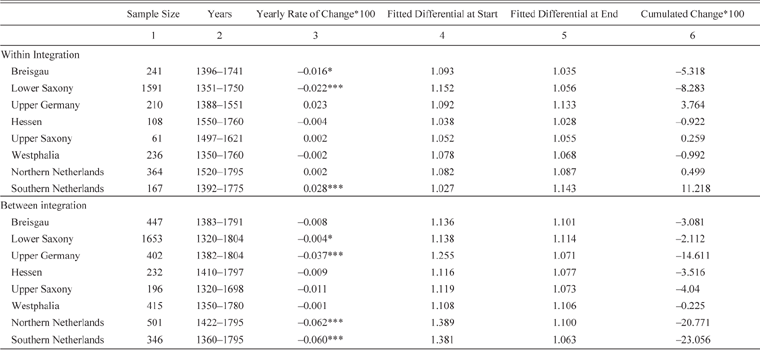
The question now is to what extent interest rates converged within and between clusters. In addition to the cities in the clusters already identified, we draw on interest rate observations from markets that could not be included in the endogenous cluster identification because of insufficient capital flow data. Most of these cities were allocated exogenously to one of the endogenously identified clusters on the grounds of their proximity. The exceptions are cities from the Netherlands and Northern France whose distance from any of the other clusters is significantly larger than the radius of even the largest cluster. We take these cities to form two separate clusters: The Northern and the Southern Netherlands.Footnote 23 Limiting the analysis to the cities identified by endogenous clustering or treating Northern France as a separate group actually strengthens our results. Table 5, columns 3 to 6, shows long-term trends in the dispersion around the mean within each cluster (upper panel) and between cities in each cluster (lower panel); as before, we rely on city-fixed effects estimation (equation (1)).
Integration of Capital Markets in the Empire: Within and Between Clusters

* =Significant at the 10 percent level.
** =Significant at the 5 percent level.
*** =Significant at the 1 percent level.
Note: City-fixed effects.
Sources: Online Appendix A.
Our earlier analysis indicates that market integration was more dynamic over longer than shorter distances. This is supported by the finding that the evidence for increases in integration is stronger between than within clusters. The “within cluster”-analysis detects very low dispersion—with differences mostly within 10 percentage points—both at the beginning and end of the period studied (upper panel Table 5, columns 4 and 5). In other words, the results suggest that by and large clusters were well-integrated already in the late Middle Ages and remained so. The only and partial exceptions are Lower Saxony, where there is evidence of significant progress over time, and the Southern Netherlands, for which we find disintegration. It is possible that interest rate divergence there reflected the commercial decline of Antwerp after the mouth of the river Scheldt was closed in 1585 (Israel Reference Israel1989, p. 30).
Interest rate convergence between clusters (lower panel Table 5) mainly concerned regions where differentials were comparatively high at the beginning (column 4). While Westphalia was fairly well integrated from the start, barriers between initially poorly integrated Upper Germany and especially between the Southern and Northern Netherlands and the rest of the Empire apparently eroded over time. To identify when this progress took place, the “between”-integration panel regression analysis is re-run, using 50-year dummies instead of a time trend. The results suggest that the timing of each cluster’s integration with the rest of the Empire varied. Thus, Upper Germany saw much progress before the mid-fifteenth century. The Southern Netherlands started off from a similarly high level of segmentation from the rest of the Empire in the second half of the fourteenth century, but advanced rapidly between the sixteenth and the first half of the seventeenth centuries. Finally, the main period of convergence of the Northern Netherlands was slightly later, coinciding with the “Dutch Golden Age.”Footnote 24
A Hypothesis: Benefits of Empire
The descriptive analysis of annuity yields suggests a strong contrast between a well-integrated Empire and comparatively poorly-integrated Italy. While the causal analysis of these differences is a task for future research, we hypothesise that the Empire’s constitutional structure and politics helped inter-urban exchange and yield convergence.
Geography clearly did not favour the regions north of the Alps, large parts of which, unlike Italy, had no direct access to the sea. Further, it is uncontroversial that the Italians pioneered the use of sophisticated financial instruments such as the bill of exchange and giro transfers (see, e.g., Day Reference Day1987, passim; Felloni Reference Felloni2008, passim; Denzel Reference Denzel2008, pp. 51–53). Thus, neither geography nor the development of financial techniques can account for the edge in capital market integration that the late medieval and early modern Empire enjoyed. Of course, in the late Middle Ages many Italian communes were much wealthier than the towns north of the Alps and able to draw on more substantial domestic supplies of capital. This probably made them less dependent on loans from outsiders (see Spruyt Reference Spruyt1994, pp. 145–46). At the same time, Italian bankers specialised in lending to European princes such as Edward III, rather than to neighbouring towns. Still yield dispersion in Italy remained comparatively high even after the sixteenth century, when the Italian bankers had lost their international prominence, Italian income was no longer particularly high, and urban debts were rapidly expanding (Braudel Reference Braudel1982, pp. 169–74; Malanima Reference Malanima2011, p. 188; Chilosi Reference Chilosi2014, pp. 897–98).
Financial markets in premodern Europe were often tied to commodity trade. With high information cost and slow communications, trade links and commercial correspondence were highly relevant sources of information on arbitrage opportunities. Also, bonds could sometimes be used as collateral for commercial loans; financial flows triggered by arbitrage counterbalanced trade deficits or surpluses, and secondary markets in public securities gave merchants access to capital in another city when a commercial opportunity arose (de Luca Reference De Luca2007, pp. 140–44; Neal Reference Neal2015, pp. 42–43; Michie Reference Michie1998, pp. 10–11; Schubert Reference Schubert1988, pp. 9–12). However, in the given context it is unlikely that trade accounts for the differences in the level of capital market integration between Italy and the Holy Roman Empire. There is no evidence suggesting that commercial flows south of the Alps were less intense than in the Empire and could thus account for such differences in integration.Footnote 25 While at first sight this apparent mismatch between trade flows and interest rate gaps may seem counter-intuitive, it is consistent with the insight that in equilibrium interest rate gaps are determined by transaction costs rather than by market thickness and thus efficiency (cf. Federico Reference Federico2012, pp. 474–75). Thus, geography, financial techniques, and trade seem insufficient to explain the differences in integration we detect. However, institutions differed markedly between premodern Italy and the Empire, so turning to this factor appears particularly promising.
Italy’s fragmented capital markets can be traced back to the times of forced loans in the late Middle Ages. In this period, outsiders needed specific privileges in order to buy annuities, a restriction that aimed at preventing collective reprisals in cases of default (Sieveking Reference Sieveking1905, p. 29; Molho Reference Molho1995, pp. 107–108; Pezzolo Reference Pezzolo2005, pp. 156–57). In other words, we suggest that because medieval Italian urban governments valued fiscal autonomy (i.e. the right to transform a loan into a tax at will) above access to foreign capital, collective liability (where all merchants from a town were held responsible for the behaviour of each individual) hindered rather than helped the development of inter-city financial links. When securities sold on the primary market replaced forced loans in about 1500, governments relaxed their restrictions. They now often explicitly invited investors from abroad, and interest rate differentials shrank (see Figure 3).Footnote 26 Nevertheless, any gains were short lived. Foreign investment remained more costly than local. “Outsiders” were still discriminated against with partial defaults, taxation, and liquidations (Pugliese Reference Pugliese1924, pp. 339–76; Felloni Reference Felloni1971, pp. 146–47, 214–17, 289, 304–306, 315–17; Calabria Reference Calabria1991, pp. 128–29).
The difference to the regions north of the Alps is stark. There, investors acted in an environment shaped by what was probably the most complex political system of premodern Europe: The Holy Roman Empire, a multi-layered organisation whose influence varied over time and between regions. Expecting to find a catch-all institution that can explain the observed patterns on its own would therefore be misguided; rather, several mechanisms seem to have played a role.
Peter Moraw (Reference Moraw1989, pp. 155–57, 416–18) has coined the term “open constitution” to characterise the Empire’s pre-sixteenth-century structure, which relied on few formal institutions and allowed many towns to develop their own legal systems. If they were not granted the law of an already existing town when they were founded, they often modelled their law codes on that of a neighbouring town. The laws of Aachen, Frankfurt, Nuremberg, Vienna, Brunswick, Magdeburg, and Lübeck played important roles in this context. In effect, “urban law families” emerged (Kroeschell Reference Kroeschell2003, p. 25), making legal fragmentation far less pronounced than a look at the political map of the late medieval Empire would suggest. Moreover, unlike in Italy the widespread use of collective liability in the late Middle Ages may here actually have helped coordinating inter-urban exchange (Fryde and Fryde Reference Fryde and Fryde1963, pp. 528–29, 533; Zuijderduijn Reference Zuijderduijn2009, ch. 3; Boerner and Ritschl Reference Boerner and Ritschl2002, passim). Indeed, Edmund Fryde and Matthew Fryde (Reference Fryde and Fryde1963, pp. 528, 533) argue that as a result of collective liability foreign investment in the Empire was less risky than domestic investment.
Legal congruence and collective liability functioned within a political system characterised by the cooperation of groups of towns. Urban leagues formed, for example, to negotiate commercial treaties with rulers—this applies to the Hansa (Dollinger Reference Dollinger1981, pp. 41–43)—or to provide military security—such as the Rhenish League of 1257 (Distler Reference Distler2006, pp. 180–81). Regardless of how cooperation was motivated, it reduced transaction costs, for example by facilitating information flows, and so helped inter-urban investment. This reasoning agrees well with our finding that the markets characterised by the strongest inter-city capital flows, the Lower-Saxon cluster centred on Lübeck and Lüneburg, formed the core of the Hanseatic League.
From the late fifteenth century onwards, when the Empire was fundamentally reformed (Angermeier Reference Angermeier1984), urban leagues began to decline and urban law was assimilated into the legal codes that princes published within the framework of the Empire’s legislation (Wüst Reference Wüst2003, pp. 17–19). The Empire itself, that is, its Diet and the Supreme Courts, consistently favoured the rights of creditors. The threat that a Free Imperial city which failed to service its debts might be put under forced administration by an Imperial Debit Commission provided incentives for punctual repayment (Kleinehagenbrock Reference Kleinehagenbrock2011, p. 71, Westphal Reference Westphal2002, pp. 265–67). This implied a fall in monitoring costs. To the extent that such costs typically increased with distance (Stasavage Reference Stasavage2011, passim), their reduction is expected to affect long-distance investment, in particular.
How this played out in the case of territorial towns (not represented at the Imperial Diet, but at least nominally under the rule of a prince) is a question that research has so far failed to address. However, any prince would have jumped at the chance to restrict urban autonomy, and when a town’s creditors accused it of failing to service its debts this gave him a perfect excuse to bring such towns under his authority (cf. Kern Reference Kern2000). In consequence, as long as territorial towns were able to sell their own securities, they faced strong incentives to pay their creditors reliably as otherwise they would risk losing their autonomy.
Within the Empire, competition between authorities appears to have encouraged governments to improve the quality of their institutions. The Imperial constitution channeled political rivalries into forms that ultimately proved economically beneficial: Rather than degenerating into the Macchiavellian type of violence that characterised relations between the Italian states, rivalries between members of the Empire generally played out as peaceful competition for scarce mobile resources such as capital (Volckart Reference Volckart1999, passim, Reference Volckart2002, pp. 184–86; see also Mokyr, Reference Mokyr2017, pp. 170–72).Footnote 27 For example, from the early fifteenth century onwards urban officials and private agents acted as intermediaries, attracting capital from abroad.Footnote 28 Sometimes cities even arranged the pay-out to be delivered at the place of residence of the buyer, apparently at no extra cost.Footnote 29 Moreover, some contracts stipulated that the annual interest payment or, in cases of redemption, the repayment of the principal should occur in a place convenient for both parties. Occasionally fairs such as those in Frankfurt and Leipzig, and specialised markets like Hildesheim, were used for this purpose.Footnote 30 By contrast, early modern Genoese capitalists investing in other Italian cities had to pay a fee to a private agent to have the payments delivered to them at financial fairs or at the local public bank (Felloni Reference Felloni1971, pp. 96–97).
While the Thirty Years War marked a temporary break down of the Imperial constitution and was a cataclysm of unparalleled proportions, Sheilagh Ogilvie’s (Reference Ogilvie1992, pp. 437–39) negative assessment of the effects of the “seventeenth-century crisis” needs to be qualified. Promoting peace between its members remained the Empire’s core function, and its institutions, including those relevant for capital markets, proved resilient after the Peace of Westphalia (Press Reference Press1991, pp. 379–84). Thus, Imperial Debit Commissions that administered states in danger of default remained in place into the early years of the nineteenth century (Westphal Reference Westphal2002, pp. 370–71). In sum, within the Empire inter-urban investment was far better protected than in Italy, where rivalries between polities increased transactions costs.
Factors other than creditor rights protection and competition between political authorities likely played some role, too. After all, it was not just regions such as Upper Germany, where Imperial institutional reach was deep, that integrated rapidly with the rest of the Empire from initially low levels, but also the Netherlands, where Imperial institutions had never been strong and weakened further from the sixteenth century (Press Reference Press1986). The Habsburg Netherlands attained a special constitutional status in 1548 but remained part of the Empire. Maximilian I (1459–1519) established the first regular postal route between the Netherlands and Upper Germany in the 1490s (Behringer Reference Behringer2011, pp. 348–49), and Charles V (1500–1558) chose Antwerp to remit American silver across Germany and to raise loans from the Fuggers of Augsburg (Braudel Reference Braudel1982, pp. 150–51). The links so established coincided with the use of newly negotiable bills of exchange (Munro Reference Munro2003, pp. 553–55) and aided inter-urban communications with the rest of the Empire. While not directly concerning annuity markets, such connections made for easier information flows and, all else being equal, reduced risk and so helped long-distance investment in long-term urban debts. Hence, in this instance, Imperial politics–if not Imperial institutions–likely fostered the development of inter-regional capital flows.
Conclusion
Our analysis draws on a new dataset that extends the quantitative evidence available up to now. The findings demonstrate that Central European annuity markets were better integrated in terms of interest rate dispersion than their Italian counterparts. Comparing both regions reveals that in the early modern period integration advanced in the long run only in the Empire. While there was progress in Italy in the sixteenth century, the gains made there were short lived. Within the Empire, cities in close proximity were well integrated from the start; the advances in integration that took place from the sixteenth century onwards concerned primarily markets more than 200 kilometres apart. The size and depth of the market reached particularly high levels around Lübeck and Hamburg, and it was in the main initially poorly integrated clusters of cities in the Netherlands and Upper Germany that improved their integration with the rest of the Empire.
Italian merchants and financiers had an undisputed edge in financial techniques. Yet Italian annuity markets were far less well integrated with each other than those in the Empire. The hypothesis emerging from the analysis of the data is that this difference was primarily due to institutions. Foreign investors north of the Alps were throughout far better protected than in Italy as urban authorities in the Empire improved the quality of their institutions in order to attract foreign capital. The Imperial constitution, which excluded the fiefs in Italy, appears as a credible deep cause of this contrast. Our findings challenge the argument that transaction costs are necessarily lower within territorial states than between cities in different polities (cf. Epstein Reference Epstein2000, p. 159). Given a constitutional framework that fostered cooperation between polities and induced them to compete by improving their protection of property rights, political fragmentation and constitutional decentralisation do not per se and by necessity have adverse effects on the development and integration of capital markets (cf. Epstein Reference Epstein2000, p. 167; Volckart Reference Volckart2002, pp. 213, 217; Stasavage Reference Stasavage2011, pp. 162–64). Testing these hypotheses formally remains the task for future research.