When the French Foreign Minister Aristide Briand went before the Assembly of the League of Nations in September 1929 and proposed a ‘federal bond’ among ‘people who are a geographical group’, he was referring, with the exception of the Soviet Union and Turkey, to his European neighbours.Footnote 1 Yet at the same time other French elites promoted the idea of a different community, that of Greater France: ‘our colonies are indispensable to us, and without them, France would no longer be France’.Footnote 2 In the late 1920s and early 1930s metropolitan intellectuals, businessmen and politicians engaged in a debate about the place of the colonies and the European continent in French economic expansion. To my knowledge, no scholar has pointed to the paradox that Briand called for European economic cooperation at the same moment that other elites invested more than ever before in developing colonial markets.
This article is but a sketch – the beginning of a larger effort to think about the relationship between France's colonial and continental strategies and how each was envisioned to serve metropolitan interests at a critical juncture in the history of twentieth-century French political economy. In the backdrop of these debates were imperial rivalries, rising US economic power, increasingly competitive world markets, growing anti-colonial sentiment and expectations for national self-determination created by the existence of the League of Nations.Footnote 3 In the wake of a catastrophic war, Europe faced powerful ‘continental blocs’ – the United States, the Soviet Union, some writers included Great Britain – with access to cheaper resources and bigger markets.Footnote 4 In response, imperial lobbyists asserted that ‘our future is enclosed in our colonial wealth. The immense treasure of commodities and raw materials that our colonial domains possess will alone be able to free us from the foreign markets that fleece us.’Footnote 5 Against this imperial vision, Europeanists argued that France had to follow the trend of creating continental blocs or risk becoming a colony itself: ‘Europe should not be Americanised, Britainised, or Russified. Europe must remain Europe’,Footnote 6 even if ‘Europe’ was often defined in French terms. The debate centred on whether France should organise colonial markets, European markets or both in order to increase France's economic power and preserve its political independence.
The First World War may have laid the foundations for a world of nation states, but only in retrospect.Footnote 7 In the 1920s numerous French intellectuals, businessmen and politicians posited that nation states were not viable in an increasingly interdependent world economy; as a result, they took seriously the idea of expanding French economic power through larger political structures, both within France's existing empire and within a federal Europe. I chart these ideas in the period between 1925 and 1932, a period that corresponds to Briand's last stay at the Ministry of Foreign Affairs and that witnessed a heightened interest in overseas imperialism and continental cooperation. During this time, neither imperial France nor European France were taken as a given, nor were they necessarily compatible, in the economic realm. One jurist summarised France's contradictory position: ‘France is European; but it is also global . . . it will become absolutely intolerable if the European Conference knocks down its customs borders among continental states. This reform will have repercussions for France's relations with its extra-continental territories. Yet it's France that has taken the initiative to organise Europe.’Footnote 8
An ‘empire-state’ more accurately describes France in the late 1920s than an ‘imperial nation-state’.Footnote 9 The French empire state contained multilevel political structures and diverse populations, insofar as a French nation existed alongside other nationalities such as Moroccan and Tunisian.Footnote 10 The empire state's aim was to enhance the metropole's economic power and security. Layering a European political structure over the empire state would further complicate matters. Yet this was precisely what Briand sought to do, namely to develop a European political entity whose continental boundaries would overlap with but remain distinct from those of the colonies. His federal Europe would require European states to cooperate in administrating the continent's diverse populations and resources in the interests of economic growth and security. Henry de Jouvenel, a former colonial administrator, one of Briand's collaborators and an advocate of fusing France's colonial and continental strategies, noticed the challenge of developing conflicting yet overlapping imperial and European political structures: ‘who can take seriously the French proposition to federate Europe until we have federated the diverse parts of our empire?’Footnote 11 For, as de Jouvenel suggested, France already struggled to govern its empire.
Classic surveys on the twentieth-century French economy either ignore its imperial dimensions,Footnote 12 give them short shriftFootnote 13 or leave the impression that imperialism was backward and Europeanism was progressive.Footnote 14 This retrospective view, where France lost its empire and became committed to European integration, obscures other possibilities that were prominent at the time. More work needs to be done on the producers and investors who supported overseas empire, European unity or both, how these economic actors changed their orientation and struck different kinds of alliances over time and how effective they were at influencing state policy.Footnote 15 Colonial markets may have sustained uncompetitive economic interests such as the cotton industry.Footnote 16 Dynamic economic sectors such as the automobile, chemical and electricity industries depended on already developed markets, but they were not adverse to developing colonial markets.Footnote 17 It would be unfair to characterise the colonies as nothing more than a safety valve. In a context where ‘continental blocs’ controlled large supplies of resources and where the future of the world economy looked uncertain, colonial markets – if developed – showed promise in creating metropolitan prosperity.
Similarly, historians of interwar pan-Europeanism have largely treated France as a nation state instead of as an empire state.Footnote 18 This tendency also reflects a common assumption that France had to retreat into the metropole before it could commit to European unification.Footnote 19 Consequently, scholars often neglect the tension between the French empire and European integration.Footnote 20 Charles-Robert Ageron first charted interwar ideas of Eurafrica, a concept that envisioned European cooperation in developing France's African territories.Footnote 21 More recently Peo Hansen and Stefan Jonsson have revealed the intimate connections between Africa and European integration between the 1920s and the 1960s.Footnote 22 Yet all of these authors neglect the contested nature of the idea. Hansen and Jonsson claim that ‘from the interwar period up until the late 1950s practically all of the visions, movements and concrete institutional arrangements working towards European integration placed Africa's incorporation into the European enterprise as a central objective’.Footnote 23 They build their case, however, on the ideas of ardent Eurafricanists such as the Austrian Richard Coudenhove-Kalergi and show less interest in examining the wider French context, the most important environment for understanding the idea's emergence. Official French interests in colonial development and continental cooperation were often conflicting and only occasionally complementary.
Briand's movement to organise Europe must be placed in its tense and overlapping relationship with other elites’ efforts to organise the overseas empire. In the international context of the 1920s, in a world that had become war-weary and critical of European imperialism, some French elites pushed for greater European cooperation, even if in practice this did not lead to a repudiation of French imperialism. Briand called for European unity in order to preserve the liberal peace and a post-war settlement that had dismantled all the continental empires.Footnote 24 On the foundations of old empires were built new nation states in Central and Eastern Europe, many of which partially depended on French economic and military aid, as well as a promise of protection against possible German aggression. Germany had lost a significant portion of its continental territory and all of its overseas colonies. Throughout the 1920s German diplomats looked to revise the settlement and repossess these lost territories. Enforcing the settlement would contain Germany's territorial demands on these new nation states and maintain a French-led European order and a right to possess a global empire. Although differences certainly existed between France's colonial and continental strategies, more so than in the German case,Footnote 25 both strategies sought to maintain security and create favourable economic conditions for metropolitan France and to that end drew on different ruling strategies over multiethnic populations: political imposition and exploitation in the overseas colonies and economic cooperation and incentives on the continent. Whether French elites wished to dominate the continent or achieve genuine European cooperation, we arrive at the same conclusion: European unification was conceived within and in tension with, but not outside of, an imperial frame of mind.
French Empire
The support that the French colonies gave the metropole in men and materials during the First World War raised awareness among some metropolitan elites about the need to maximise colonial productivity in order to restore French economic power. As international protectionism grew across the 1920sFootnote 26 and as inter-empire competition persisted, imperial lobbyists hoped to stir the public's and the government's enthusiasm for empire. In addition, in the earlier twentieth century French foreign investors had largely concentrated their money in Russia. The communist revolution that broke out there in 1917 forced investors to look to other places such as the colonies or to the new nation states of Central and Eastern Europe.Footnote 27 Imperial lobbyists, hoping to interest government, business and investors in the colonies, called for ‘a new entity where the continental homeland and the overseas colonies, if not merged, at least tightly interlocked, would compose the real power of a Greater France resting its security no longer on 40 million, but on 100 million human beings’.Footnote 28 A report on France's economic expansion after the war declared that ‘the essential basis of our return to normal economic conditions’ is the ‘development (mise en valeur) of our colonies’.Footnote 29 The colonies were to become ‘centres of production and no longer museums of specimens’, the empire a factory with a highly specialised division of labour. Footnote 30
The 1920s saw the publication of numerous works that called attention to France's colonial economic potential. Charles Régismanset, a bureaucrat in the Ministry of Colonies, Armand Megglé, an economist and diplomat, Albert Sarraut, a Minister of the Colonies, Octave Homberg, a businessman and diplomat, and Léon Archimbaud, a reporter on the colonial budget and president of the colonial group in the Chamber of Deputies, all published works in the first decade after the First World War that made the case for the economic importance of empire and thus championed colonial development. Collectively, the writings of these imperial lobbyists argued that imperial economic strategies would help to develop the colonies, increase the colonies' role in supplying the metropole with raw materials, secure an outlet for metropolitan goods, and keep out the Germans and Italians.Footnote 31
These lobbyists were critical of how imperial economic policy had developed over the centuries. This policy, known as the ‘colonial pact’, had created a situation where the ‘colonies are made to serve the metropole’.Footnote 32 Colonial producers were to trade only with the metropole. In the late nineteenth century various tariff regimes slowly undermined the colonial pact, even if imperial economic policy became more byzantine and even if the metropole maintained a privileged trade relationship with the colonies. The Méline tariff of 1892 distinguished between assimilated and non-assimilated colonies. With exceptions, products from the assimilated territories – Algeria (metropolitan officials had created a customs union with Algeria in 1867), the Antilles, Guiana, Indochina (officials had established a customs union with Indochina in 1887), Mayotte, Réunion, Tunisia and, in 1897, Madagascar – entered duty-free into metropolitan France just as metropolitan goods entered freely into these colonies. The assimilated colonies had to impose tariffs on foreign goods at the metropolitan rate, which limited the ability of the colonies to trade with other countries. Any trade agreement that metropolitan officials signed with other countries did not apply to the colonies unless it was ‘explicitly stipulated’.Footnote 33 The tariff regimes of the non-assimilated colonies – French West Africa (AOF) except for the Ivory Coast and Dahomey, Gabon (a law of 1928 changed its status from an ‘assimilated’ into a ‘non-assimilated’ colony), New Caledonia (a law of 1928 changed its status from an ‘assimilated’ to a ‘non-assimilated’ colony), Saint-Pierre and Miquelon (a law of 1912 changed its status from an ‘assimilated’ to a ‘non-assimilated’ colony) and the French Settlements in Oceania (EFO) – were characterised by their diversity. Each of these colonies developed its own tariff system so long as it granted preferential trading rights to the metropole. Usually goods that circulated between metropole and colonies were at least lightly taxed upon entering each. The open-door colonies – Dahomey, Ivory Coast, Morocco, French Equatorial Africa (AEF) except Gabon and other outposts – were bound to international trade agreements and therefore generally had low levels of tariffs on all imports and exports.Footnote 34
This complex imperial trade network often prevented colonial producers from selling in the dearest markets and colonial consumers from buying in the cheapest; it also created numerous conflicts between metropolitan and colonial producers on the one hand, and among colonial producers on the other, all of whom competed for the same markets. For example, wheat production held economic importance for metropolitan France, Algeria and Morocco; producers in each wanted to limit imports from the others. In the early twentieth century some colonial producers began to protest against the metropole's privileged position and lobby for greater freedom of commerce for the colonies.Footnote 35 In the 1920s Sarraut and other imperial lobbyists responded to this discontent by calling for a more complementary, if still unequal, relationship between metropole and colonies.Footnote 36
If the imperial economy lacked complementarity, the imperial administration lacked unity.Footnote 37 Imperial authorities – policy makers in Paris, officials in the colonies, European settlers, tribal leaders and various ethnic communities – maintained rule through complex, asymmetrical power relations. The empire consisted of colonies, protectorates, dominions, spheres of influence and, after the First World War, mandates. The state – especially in an era when officials trumpeted rule through ‘association’ – was reluctant to centralise the colonial administration. Algeria fell under the Interior Ministry, Morocco and Tunisia under the Foreign Affairs Ministry and the other territories under the Ministry of the Colonies. Some imperial lobbyists in the 1920s blamed this lack of coordination for the inability of business and the state to exploit the empire's economic potential.Footnote 38
Although France possessed the world's second largest empire and created an imperial trade policy that served metropolitan interests, the colonies did not make the metropole self-sufficient in raw materials, nor did they generate revenue. In 1913 the metropole took in 53 per cent of colonial exports and provided 54 per cent of the colonies’ imports;Footnote 39 only 9.3 per cent of French capital was exported to the colonies.Footnote 40 In terms of commerce, the empire as a whole came in third after trade with Britain and Germany.Footnote 41 Nine-tenths of colonial goods entering the metropole came from foreign colonies.Footnote 42 In 1920 only 21 per cent of the metropole's imports came from the colonies and 48 per cent of its exports went to the colonies.Footnote 43 France bought the bulk of its raw materials from elsewhere. In 1926 France purchased 1,000 tonnes of bananas from its own colonies but another 45,000 to 50,000 from ‘Anglo-Saxon’ firms.Footnote 44 Nor did the future look promising. The colonies lacked capital for development projects. In 1918, given France's large war debt, metropolitan capital exports had been forbidden. Not until the end of the 1920s did the metropole provide the colonies with more capital.Footnote 45
If France still profited little from its colonies in the 1920s then why did imperial lobbyists think that empire would lead to world power? Collectively these lobbyists believed that empire was necessary for future economic and security reasons. They tried to persuade the French public that France's long-term economic interests depended on French investment in the empire's raw materials and markets, further integrating its colonial subjects into the market economy and creating a more complementary relationship between the metropole and its colonies. Imperial lobbyists also claimed that without colonies French security was at stake. The colonies not only provided France with a sense of grandeur as it lost some of its power on the continent, but after 1870 colonies also boosted France's demographic strength. French elites acknowledged the important role of colonial subjects in the First World War. Moreover, European powers were imperial powers; colonies therefore gave France great power status. Finally, France faced the rising continental powers of the United States and the Soviet Union. Imperial lobbyists believed that French power depended on the development of Greater France.
Imperial lobbyists complained about the government's unwillingness to fund colonial development schemes. In 1921 Sarraut introduced an ambitious bill in the Chamber of Deputies to carry out colonial economic development, but the majority of parliamentarians showed little interest in funding his project. The success of Sarraut's project depended on German reparations, which the Germans failed to meet, and the financial generosity of Parliament, which was rare.Footnote 46 Imperial lobbyists faced parliamentary scepticism. In 1918 only fifteen senators had participated in a discussion about boosting colonial production.Footnote 47 Some politicians were sufficiently sceptical of the value of colonies that they suggested selling them in order to pay off war debts.Footnote 48 Yet Archimbaud noted the impossibility of selling colonies: ‘France will never cede the smallest parcel of its colonial domain. Have you ever seen a country sell itself?’Footnote 49 Archimbaud tried to naturalise the link between France and its colonies in order to spark enthusiasm for the empire and frustrate German ambitions for colonial revisionism once Germany entered the League of Nations in 1926. In the face of perceived threats from Germany he was highly critical of this ‘governmental apathy’Footnote 50 and wished to create an ‘imperial mentality’ among the French population in order to get the state to invest more in colonial development.Footnote 51
Some of domestic and international opinion was indifferent to, or critical of, French imperial rule.Footnote 52 The United States opposed closed imperial trading blocs, even if it did not oppose the existence of the European empires. The Soviet Union was critical of colonialism, even if it developed its own federated empire. French communists, like the Soviet Union, opposed imperialism on the grounds that it served capitalist interests, even if they did not always take a solid stand against it.Footnote 53 Finally, some powerful metropolitan interests were threatened by colonial competition. For example, the rice, sugar beet, wheat and wine lobbies called for protection against the colonies. A parliamentarian had to remind the metropolitan wine lobby that Algeria ‘buys from us more than it sells’,Footnote 54 which led to idle threats of an Algerian boycott of French goods.
To win over French and international publics, imperial lobbyists positioned themselves as reformers who took seriously the spiritual development of the colonised, thereby justifying their intervention in the colonies. Sarraut proclaimed the 1920s to be a new era of ‘association’ that would grant colonial elites representative assemblies, preserve indigenous cultures and carry out humane projects of economic development and social welfare.Footnote 55 Colonial development would benefit not only France but also the colonies. Sarraut explained that ‘development will attenuate the cost of living, supply our industries against the dearth of raw materials and our workers against the misery of unemployment, fatal generator of trouble and violence. Colonies are thus for future France a triple guarantee of liberty, wealth, and social peace.’Footnote 56 As this passage indicates, Sarraut underlined the benefits of imperialism to metropolitan France. He also claimed that colonial subjects would profit by guaranteeing outlets for their raw materials and by improving the welfare of the population through schools and public health. Yet Sarraut's brand of colonial development, in turn, put a brake on rapid industrialisation and urbanisation in the colonies, which comforted metropolitan economic interests that feared competition and a political elite that worried about colonial protest. It should be noted, however, that preventing colonial industrialisation could frustrate metropolitan interests such as the automobile industry that wished to find more consumers. According to Sarraut's idealism, creating stronger economic ties between the metropole and the colonies, ones that were complementary and non-competitive, could improve living standards in the colonies and stimulate the economy at home.
Imperial lobbyists also emphasised the brutish behaviour of Germany toward colonial subjects at a time when these lobbyists feared the German propagation of anti-French sentiment in the mandates. Germany's entry into the League in 1926 caused consternation in France because it gave Germans the same rights and privileges in the mandates. Even though local administrators tightened controls and surveillance on its mandate populations,Footnote 57 Homberg worried that the Germans would seek to retake their colonies.Footnote 58 He told his readers to be ‘vigilant in thwarting all their intrigues that seek to obtain a mandate on such and such of their former colonies or even on such a colony that certain powers could be disposed to give them’.Footnote 59 Archimbaud also argued that Germans’ colonial behaviour explained why Germany had lost its colonies after the First World War: ‘Germany practiced an abominable colonial policy of which civilised nations can only be ashamed. . . . It would be to fail in our duties toward the indigenous races to wipe clean the colonial past of Germany.’Footnote 60 Underlining German mistreatment of colonial subjects distracted attention away from French behaviour in the colonies and worked to mobilise readers against concessions to Germany.
In the late 1920s and early 1930s, during a period of rising protectionism among US and European powers, of thwarted colonial development plans and of attempts at Franco-German reconciliation that made some worry about colonial revisionism in Germany, imperial lobbyists intensified their efforts to drum up public support for empire.Footnote 61 In 1927 Sarraut lobbied the Poincaré government to create a ‘national week of colonial propaganda’. The André Tardieu government of 1929–1930, in which Briand was the foreign minister, also actively supported empire. Widely distributed dailies such as Le Petit Parisien and Le Temps paid more attention to the colonies. The specialised colonial press also attracted a wider readership.Footnote 62 All this suggests that imperial lobbyists achieved some success in raising colonial consciousness among the public, even if Tardieu could still say in 1929: ‘the French are unfortunately too little informed about our colonial empire’.Footnote 63
At the same time, a law of 1928, passed just over a year before Briand's federal Europe speech, reinforced the metropole's privileged trade policy with its colonies. Although the law made no major alterations to the 1892 law, it demonstrated the state's interest in rationalising the imperial division of labour by encouraging the colonies to produce goods that the metropole did not already produce. Significantly, after a Franco-German commercial agreement of 1927 caused a small increase in trade between Germany and its former African coloniesFootnote 64 and as pan-European sentiments spread, the 1928 law continued to limit foreign products from entering French colonies.Footnote 65 Yet Imperial lobbyists had difficulty getting the state to finance colonial economic development. Faced with the challenges of consolidating the imperial economy, Homberg tried to persuade the public that, thanks to colonies, France ‘is still a global nation, and not just a little European nation’.Footnote 66
French Europe
In the late 1920s, as imperial lobbyists struggled to drum up support for Sarraut's ambitious plan to organise the empire, some intellectuals, businessmen and diplomats worked to organise Europe. Briand warned fellow Europeans that ‘it's each day more necessary to organise and rationalise production and trade, in presence especially of an increasingly intense global competition that might become irresistible if we don't find a solution to the anarchical state of the European market’.Footnote 67 Briand's federal Europe project emerged at a time of rising protectionism across the world and growing concerns about Germany's territorial ambitions in its former colonies and in Eastern Europe. In calling for peace and continental cooperation, Briand could maintain the post-war settlement, which meant collaborating with and containing Germany, presenting France as the protector of weaker European states and assuming moral leadership in Europe, all the while protecting colonial resources and securing access to continental raw materials and markets. This form of rule, in which continental states would share power and have incentives to maintain the peace, differed from France's harsher policy of exploitation and outright political control in its overseas colonies.
The Locarno Treaty of 1925 ushered in a period of Franco-German diplomatic rapprochement, which caused anxiety about possible German demands to reclaim their lost colonies in Africa and territories in Eastern Europe. At least in his conversations with Gustav Stresemann, Germany's foreign minister, Briand left open the possibility of territorial revisionism in Eastern Europe and in Germany's former colonies. This period inspired a spate of literature on the importance of pan-Europeanism to continental peace and power, much of it in the French language.Footnote 68 Gaston Riou, an influential politician, syndicalist and author of two important books on the Europeanist cause, Europe, ma patrie (1928) and S'unir ou mourir (1929), the second of which Briand prefaced, called on Europeans to federate because ‘it alone can reconcile the legitimate diversity of its parts and the common desire for peace and unity’.Footnote 69 Riou's vision of a federal Europe ignored France's overseas empire. At the same time that France and Germany worked to reconcile their differences, French Europeanists around Briand used the imperative of peace to contain Germany's territorial ambitions.
Neither at the Assembly of the League of Nations in September 1929 nor in his memorandum of May 1930 did Briand challenge state sovereignty or mention the colonies. ‘It's on the basis of absolute sovereignty and of entire political independence that the understanding among European nations must be realised.’Footnote 70 Yet within the federal state, which in fact looked more confederal, France and its Eastern European allies might be able to limit Germany's territorial ambitions. The fact that Briand's federal Europe would not have infringed on state sovereignty was justified in part because Briand became aware, having heard the concerns of the other French statesmen and European diplomats, that his government and the other imperial powers would refuse to lose jurisdiction over their overseas territories.Footnote 71 At the League of Nations in 1925 Briand had claimed that ‘there was nobody who in any way wanted to deny this moral right of Germany [to own colonies]’.Footnote 72 Then, in March 1926, the Belgian, British and French governments declared that ‘as a member of the League of Nations, Germany could be a possible candidate for colonial mandates’.Footnote 73 It should be underscored, however, that such signs of appeasement seemed to have been fleeting. Practice did not match rhetoric. By 1929–1930 Briand's vision for peace and prosperity was continental, not overseas.
While imperial lobbyists contended that the colonies ‘are an integral part of and inseparable from the mother-country’, French Europeanists tended to push for unity without including colonies.Footnote 74 Interestingly, many French Europeanists refused a role for Great Britain in Europe on the grounds that it was an empire, as if France itself had no colonial holdings.Footnote 75 At international conferences in the 1920s Archimbaud complained that France was always treated as a European state instead of as an imperial state: ‘the British empire has six votes in the Assembly of the League of Nations . . . France has but one vote’.Footnote 76 If the French state administered the colonies in various forms, and if the state was to cede some of its power to a larger European political entity, then the corollary would be that an international body, whether a federal Europe or the League of Nations, would govern the French colonies. Yet, in 1927, a member of the French delegation in Geneva declared that France ‘intends to have no obligation . . . as far as the ensemble of its colonies, protectorates, and territories placed under its sovereignty or mandate is concerned’.Footnote 77 For diplomats around Briand, empire and Europe remained separate spheres of influence.
League officials promoted an open world economy and thus disagreed with the distinction that French diplomats made between empire and Europe. France was not to play an imperial game on the one hand and a European game on the other. Just after Briand's September 1929 speech and as the Belgians and British proposed a tariff truce as a counterbid,Footnote 78 one League official, interestingly from Italy, a country looking to carve out a colonial sphere of influence of its own, asserted that ‘the zone of economic solidarity, the free market on which we focus our efforts, should equally include the colonial possessions and protectorates of the said nations’.Footnote 79 At the same time, German jurists and former colonial officials lobbied the League to enforce an open-door policy in the mandates.Footnote 80 Yet French officials were among the staunchest opponents of sharing the mandates. When it came time to implement the tariff truce, the French delegation in Geneva resisted its application to French colonies,Footnote 81 even though one French official warned that the failure of the tariff truce would cause ‘grave inconveniences for Briand's European policy’.Footnote 82 Even the International Labour Office (ILO) admitted that the ‘French colonies are an integral part of the metropole’ and asked ‘from a political and economic point of view, would a strictly European federation take into consideration their resources, their needs?’Footnote 83
If France's colonial territories fell to various degrees under French sovereignty, then why were they often omitted from French visions of European unity? One, French officials feared losing control over the colonies. In the 1920s the German colonial lobby demanded colonial revisionism at the same time that the League of Nations wished to internationalise empire. Two, open markets would allow other European farmers and industrialists to compete with France's metropolitan producers in France's own colonies, and France's colonial producers would have the freedom to find the most lucrative markets. Officials drew a line between empire and Europe so that metropolitan interests could profit from both.
France's modern industries depended on trade with the other Great Powers, especially given the state's reluctance to organise colonial markets. The academic André Siegfried, son of the imperial lobbyist Jules Siegfried, observed that ‘we remain especially European: in our exports, neither foreign countries outside of Europe nor our colonies hold a primordial place’.Footnote 84 The economist and syndicalist Francis Delaisi, who was close to Briand and who would influence the discussions about European unification at the League and the ILO, came to the same conclusion:
We have misled public opinion in making it believe that Europe depended principally on expanding into ‘colonial’ countries . . . the white man has everywhere the same needs, takes an interest in the same products, and works energetically to obtain them. It's why the Romanian peasant, or the farmer from New Zealand, will always be a better customer for London, Paris, or Hamburg than the Negro, the Hindu, or the Chinese. The economic equilibrium of Europe is mainly based on the European race.Footnote 85
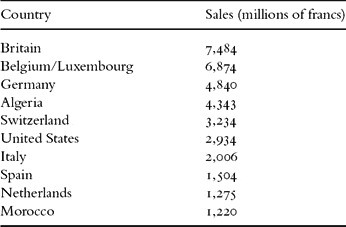
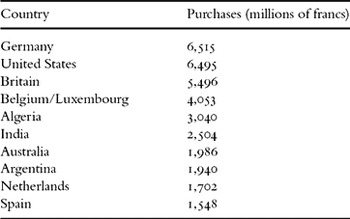
Delaisi, too, refuted the belief that empire would pay and assumed that race determined economic complementarity: ‘the salvation of the European is in the return to Europe’.Footnote 86 Between 1928 and 1930 France's ten main clients included those shown in Table 1. In other words, France sold close to home. Yet, as Table 2 shows, it cast a wider net in its purchases. Based on these tables, it is clear that apart from Algeria the colonies held less economic value than other parts of the world.
Value of French Exports

Source: Alfred Sauvy, Histoire économique de la France entre les deux guerres vol. 2 (Paris: Economica, 1984), 160.
Value of French Imports

Source: Alfred Sauvy, Histoire économique de la France entre les deux guerres vol. 2 (Paris: Economica, 1984), 160.
In the 1920s the structure of French production underwent a transition that made it increasingly reliant on more developed European markets just as those markets closed to French goods. Industry began to adopt mass production to stay competitive with the United States. As the result of economies of scale, and the retaking of Alsace-Lorraine, production soared during the decade. At the same time, French population growth stagnated, which limited demand.Footnote 87 French industrialists therefore searched for new outlets. No country in the period between 1913 and 1928 experienced as rapid an increase in its exports as France.Footnote 88 Yet, as the world economy slowed down in the late 1920s, rising production was met with contracting foreign markets. Not only had the markets of the Soviet Union and China closed, but the United States also raised high trade barriers. The automobile, chemicals and electricity sectors, as well as luxury goods such as silk and wine, depended on securing export markets. Imperial lobbyists argued that colonial markets had potential, but it was clear that they did not yet absorb rising production. In 1927, for example, the AEF had but 384 registered motor vehicles.Footnote 89 As industrial and luxury sectors lost their ability to sell to other industrialised countries, as Latin American countries industrialised and protected their home markets and as colonial markets were not yet sufficiently developed to purchase automobiles and other luxuries, the leaders of these sectors called for European unification as the surest way to sell their goods.
Some businessmen wished to rationalise European markets through cartels or a customs union, but their European orientation does not necessarily mean that they lacked an interest in colonial markets. As production rose, modern economic interests saw a need in developing colonial infrastructure and encouraging public works. The industrialist Louis Loucheur, another of Briand's supporters, lobbied for electrification in Africa. Automobile sales had brighter prospects in industrialised European markets, but with the onset of the Depression André Citroën wished to change that by making a baby's first three words ‘mama, papa, and car’.Footnote 90 Automobile exports to the colonies doubled between 1925 and 1929.Footnote 91 Between 1927 and 1930 the steel industry's exports to Germany diminished, but its colonial exports increased from 207,000 to 282,000 tons.Footnote 92 These industries could profit from separating colonial markets and integrated European markets.
French calls for European unity resembled France's imperial strategy in that politicians tried to convince industrialists and investors to do business in Central and Eastern Europe as a way to deepen France's ties to the region, hem in German resurgence and carve out a continental economic space that would guarantee raw materials and markets for France's industrial and military supplies.Footnote 93 In both his September 1929 speech and his memorandum of May 1930 Briand assured the League that he was working within its universal framework, but given that Europe dominated the League, and France still dominated continental diplomacy, we might conclude that the French had a disproportionate amount of influence in defining the ‘universal’. Market integration served to benefit French and German industrialists by keeping Eastern Europeans on the land as primary producers and consumers of industrial goods. The Belgian electrical engineer Dannie Heineman, who prefaced Delaisi's Les Deux Europes, suggested developing the infrastructure of Eastern and Southern Europe through initiatives such as providing electrification.Footnote 94 He did not, however, wish to industrialise these regions but rather to make their agriculture more productive and profitable so that its farmers could purchase Western Europe's industrial goods.
The core versus periphery relationship that France had with its colonies was also to be found in its relationship with Eastern Europe. Michel Augé-Laribé, a French agricultural expert, rightfully noted that industrialised countries such as France and Germany were also agricultural countries,Footnote 95 which would ultimately work to the disadvantage of other parts of Europe. One Hungarian official feared that with the removal of customs barriers ‘cost prices would be wonderfully low, but the number of unemployed would be very greatly increased and in consequence workers were in many countries strongly in favour of Customs protection’.Footnote 96 Not without reason, Eastern Europeans feared being colonised by the more industrialised Western Europeans.Footnote 97 The Czech foreign minister Edvard Beneš complained that ‘the French were always seeking to attach political conditions to financial transactions’.Footnote 98 Eastern European officials expressed concern that their countries would become a dumping ground for industrial surpluses, thereby hurting their own infant industries.Footnote 99 French Europeanists promoted a similar type of economic relationship in Eastern Europe as imperialists had promoted in other parts of the world.
Through Briand's federal Europe, France might better defend Central and Eastern Europe against Germany's own imperial ambitions. Both security and economic interests motivated France's Eastern policy. After Briand released his memorandum, Loucheur travelled to Central and Eastern Europe to lobby on his government's behalf, combating the idea that Briand's project was a way to assert French hegemony in Europe, or a strategy to exclude American products and influence, suggesting that ‘we must search together for the economic solution that will give Europe status’.Footnote 100 Loucheur was not without personal interest: not only did he promote the electrification of Eastern Europe, but he had also invested in a French chemical company there, and, ironically, this apostle of peace sold arms to Poland and Yugoslavia. Loucheur also had a stake in Romanian oilfields.Footnote 101 Behind the language of peace and security lay powerful economic interests looking to secure markets.
The French government was far from fulfilling the free trade ideal. It was selective about which products it admitted from other European countries. One Polish official noted that ‘exports from Poland are nearly exclusively agricultural, and that if the industrialised countries raise tariff barriers against these products . . . the agricultural countries are forced to defend themselves’.Footnote 102 Interestingly, some Eastern Europeans, like some of France's colonial interests, defended free trade against fortress France.
Briand's call for European unity would preserve the French empire at the same time as it would curb Germany's territorial ambitions, illustrating the way in which European unification could be forged within empires instead of against them. One French politician called the frontier of Poland ‘the frontier of France’.Footnote 103 Some officials in other European empires or aspiring empires suspected, not incorrectly, that Briand's Europeanism was a ploy to maintain France's continental hegemony.Footnote 104 The German foreign minister who succeeded Stresemann claimed that ‘there can be no doubt that France is thinking in the first place of perpetuating existing relations to the east and southeast of Germany’.Footnote 105 Le Figaro observed that ‘European nations are divided into two groups, those who want to maintain the territorial status quo and those who don't. That doesn't make for a favourable beginning to a federation.’Footnote 106
A Eurafrican Synthesis?
Between 1929 and 1932 the European unity movement, like the campaign for colonial economic development, struggled to pick up momentum. One month after Briand announced his federal Europe plan, Stresemann died. Thereafter, fiercer nationalists took charge of the German government.Footnote 107 In addition, the beginning of the Great Depression at the end of October further intensified inter-empire competition, further contracted world markets and slashed government spending on public works projects. For these reasons, a third strategy that fused colonial economic development with European cooperation increased in visibility. A motley group of imperialists, quasi-fascist intellectuals, syndicalists, Germanophiles and pacifists promoted the notion of Eurafrica, first coined by the Austrian pan-Europeanist Richard Coudenhove-Kalergi in 1929.Footnote 108
European cooperation in Africa had existed before the concept of Eurafrica. In the nineteenth century, intellectuals like Saint-Simon and Victor Hugo had called on Europeans to unite and commit themselves to the economic and human development of Africa. European businessmen and statesmen had also periodically collaborated in Africa. At the Berlin Conference of 1884–1885, Europeans came together to end slavery and implement ‘freer’ trade.Footnote 109 During the scramble for African colonies, diplomats in France's Foreign Ministry periodically tried to cooperate with Germany in order to prevent British domination.Footnote 110 In the First World War some socialists in the Allied countries supported the need for supranational control not only of conquered German colonies but also of the other European colonies in Africa. After the war, Woodrow Wilson and his advisers, opposed as they were to the insularity of European empires, called for the internationalisation of Africa. In the 1920s an occasional writer, usually from the Radical or Socialist Party, advocated Franco-German collaboration in Africa, but such appeals failed to gain traction at the official level.
The idea of Eurafrica interested imperial lobbyists who continued to struggle to persuade the government to fund colonial development and Europeanists who wanted to prevent their movement from flagging. 1930 marked the 100th anniversary of the conquest of Algeria. The following year, Paris held a colonial exposition. All the European empires except Great Britain displayed their colonial possessions at the Colonial Exposition. Hubert Lyautey, former governor general of Morocco, hoped that European collaboration at the Exposition would lead to cooperation in the colonies. He promoted a ‘union of all the colonising nations in a policy of association for the greater moral and material profit of all’.Footnote 111 Empire became a way for Europeans collectively to take pride in their scientific achievements in Africa. Moreover, in 1931 French policy makers were reconsidering the Sarraut Plan and needed to find ways to finance it. Although the plan would ultimately be set aside, some intellectuals hoped to convince the Germans to help finance it while it remained on the table.
In 1931 imperial lobbyists such as Sarraut and Archimbaud, earlier hostile toward Germany, became supporters of European unification as a way to promote colonial economic development. Archimbaud lamented Briand's silence on empire, arguing that European imperial powers had ‘a big political and economic interest in envisaging the reorganisation of Europe not only in the framework of Europe, but in the wider framework of Europe and its colonial dependencies’.Footnote 112 Such an assertion was doubtlessly a way to persuade the Ministry of Foreign Affairs to treat access to colonial markets as a bargaining chip at a time when half-hearted discussions proceeded in Geneva about the creation of a federal Europe. Similarly, Sarraut now connected colonial economic development to the creation of a federal Europe.Footnote 113 Sarraut believed in using the League of Nations to spread European influence and contain the United States and the Soviet Union.Footnote 114 In his mind, the common development of Africa could reaffirm European values, which in his view were largely French values: ‘Colonial Europe must think and act like us’.Footnote 115
The promotion of Eurafrica supported efforts to internationalise and therefore re-legitimise the possession of African colonies at a time when colonialism was under attack by some of its subject populations and international opinion. Right-wing intellectual Pierre Drieu La Rochelle predicted that ‘the organisation of Africa, by relaxing the principle of the mandate system, which should no longer be national but international and should directly be a matter of the League of Nations, will be the touchstone of the European Union’.Footnote 116 Sarraut used a similar line of reasoning: ‘Europe, under penalty of death, must remake its broken unity since the war in order to defend, with a European spirit, the influence and structure of this “colonial creation”’.Footnote 117 The language of national self-determination at the League had created new expectations among colonial subjects. Improving living standards in the colonies could make colonial subjects satisfied with French rule. The syndicalist Georges Valois suggested that in Africa Europeans needed to find development sites, not markets.Footnote 118 The choice of language was not innocent. Instead of overtly exploiting the indigenous population and its resources, European banks, investors and businesses would join hands to create new markets that would benefit all involved in Eurafrica, which would become ‘one of the three pieces of the world economy . . . the American system, the Russo-Asian system, and the Eurafrican system’.Footnote 119
Political economist Bertrand de Jouvenel, Henry's son, highlighted the contradiction between France's need for European markets at the same time that it closed its colonial markets to its European competitors. He criticised France's and Great Britain's imperial preference, expressing concern that while, in Africa, France found an outlet for 15 percent of its total exports and Britain 11 percent, Germany exported only 2 percent of its total to Africa. ‘British and French imperial policy. . . thus gravely threatens the economic balance of the industrialised powers of Europe, and particularly Germany’.Footnote 120 De Jouvenel called for European ententes as a way to suppress tariffs, rationalise the European economy and pursue colonial economic development.Footnote 121 By including the Germans in the Eurafrican project, intellectuals like de Jouvenel hoped to ensure peace and prosperity in the colonies and on the continent. The colonies could become, as de Jouvenel put it, ‘an opportunity to rationalise Europe’.Footnote 122
Eurafricanists looked to develop colonial markets, not as the nationalists of the late nineteenth century had done, but through European cooperation and overcoming nationalist barriers. Before he had coined the word Eurafrica, Coudenhove-Kalergi suggested that Europeans transform the Sahara into a cultivable land and eradicate sleeping sickness, work to be done ‘neither by generals nor by politicians, but by engineers and doctors’.Footnote 123 While generals and politicians defended national interests, engineers and doctors served the broader interests of the economy and humanity. Eugène Guernier, who worked in foreign commerce, saw Africa as free of a ‘burdensome past’ and the ‘excessive notion of nationalism’.Footnote 124 He called for the creation of a trans-African railway that would unite economically and culturally all of Europe's colonies in Africa and check the growth of nationalism, an ideology which Africans could use to throw off their chains and which caused European wars.
Eurafrica might also help solidify the peace between France and Germany. If competition for resources led to war, then cooperation in the colonies might keep the peace. Dispossessing Germany of its colonies after the First World War had caused some consternation amongst Germans, as it deprived German industry of markets and an outlet for its overpopulation.Footnote 125 In the Reichstag in 1925 the colonial lobby demanded the return of Germany's colonies.Footnote 126 Germany's entry into the League during the Locarno era allowed Germans access to their former colonies, which caused controversy in France. Although the German colonial lobby was strong, Stresemann seemingly cared less about the colonies than Eastern Europe. All the same, in the interests of peace and colonial development, French socialists called for ‘the internationalisation of the colonies under the control of the League of Nations’.Footnote 127
While Eurafrica could potentially re-legitimise the imperial system in the international community against rising indigenous discontent, it could also remove the threat of social instability from metropolitan Europe. To ease European unemployment during the depression, some members of the ILO proposed to the Commission of Enquiry for European Union (CEEU) to send workers to the colonies.Footnote 128 A draft resolution of the Unemployment Committee of the CEEU noted that ‘the economic equilibrium of Europe would be better re-established if the surplus population which it cannot make use of could be employed for the exploitation of territories which are in a position to absorb it to good purpose’.Footnote 129 By sending Europe's jobless to Africa, European leaders could put them to work, improve their purchasing power and perhaps even uproot radicalism from the metropole.
Between 1929 and 1932 Eurafricanists worked to reinvigorate interest in colonial development and European cooperation by making them one and the same. Eurafrica was presented as a way, however fanciful, for France to maintain the moral high ground as the champions of peace and the territorial status quo all the while securing European and colonial markets. Ultimately, however, the economic depression, the death of Stresemann in 1929 and of Briand in 1932 and the rise of Adolf Hitler in 1933 thwarted hopes that Eurafrica would become a political entity, even if some late Third Republic and Vichy officials would open the colonies to greater German trade as a form of appeasement to Germany's resurgent continental dominance.Footnote 130 In the interwar years imperial rivalry remained a reality and European or Eurafrican unity a dream.
Conclusion
That French policy makers ultimately worked to integrate Europe in the name of peace and prosperity while having their empire discredited in the international community can lead to a simplistic assumption that empire was backward and Europe was progressive. Historian Jacques Marseille argued that the ‘divorce’ between France and its colonies began in 1930,Footnote 131 just as French elites debated colonial and continental strategies. Yet his retrospective view, one in which France and its European partners achieved unity as the process of decolonisation unfolded, ignores the simultaneous but often separate interest in colonial and continental strategies in the late 1920s and again after the Second World War. To frame empire as backward and Europe as progressive is to misinterpret how various French intellectuals, businessmen and politicians viewed these spheres of influence at the time and overlooks certain parallels between colonial and continental strategies.
The 1920s established a framework for post-1945 debates over France's colonial and continental positions, even if each of these periods presented a unique constellation of actors that operated in a historically specific set of circumstances, not least the fact that after 1945 Eastern Europe fell inside the Soviet orbit. In the 1920s French elites identified structural problems facing the metropole that would become more pressing in the 1950s: containing Germany's economic potential, standing up to US and Soviet power, appeasing colonial discontent and adapting to intensely competitive world markets. These changing circumstances forced various elites to rethink their strategies in order to stimulate economic growth and maintain France's independence and global influence. Because the French standard of living stagnated in comparison to some of France's international rivals, the debate over economic expansion also had implications for the state's legitimacy at home. After 1945 French policy makers would commit themselves more fully to developing the overseas colonies on the one hand, and more cautiously to extending French influence through a European framework on the other.
Although scholars go too far in claiming that ‘there was no Europe to begin with, unless it was also Eurafrica’,Footnote 132 it can be argued that French efforts to organise Europe both in the 1920s and in the 1950s were conceived in a tense relationship with French efforts to organise empire. As an idea and a proposition, Eurafrica may have been found at nearly every twist and turn, but policy makers did not necessarily always take it seriously. In fact, Eurafrica was arguably less tenable than separate colonial and continental visions because it would have demanded the most coordination, it would have caused greater competition among European businesses for colonial markets and it would have required a willingness among French officials to relinquish at least some control over their colonies. As had become clear in the 1920s, and as policy makers realised again in the early 1950s, too much was at stake in integrating the French empire into a European political structure. Moreover, as the most powerful continental state in both the 1920s and early 1950s, French leaders did not necessarily have a reason to share their colonial markets, which inconveniently recalled French subservience to Nazi Germany. Distinct colonial and continental strategies would allow France to reinforce its global presence and extend French influence on the continent through a European political structure.
French policy makers thought that they could play both a colonial and a continental game, but the course of events in the 1950s suggested otherwise, as colonial wars forced them to see the merits of the Eurafrican synthesis. As in the Great Depression, certain French elites found Eurafrican visions useful during another world crisis. But unlike during the Great Depression, a growing number of French officials and some African leaders now took seriously the implementation of some form of Eurafrica. For metropolitan officials, Eurafrica became a way to pressure France's European partners to help fund colonial development, appease colonial discontent and give the French empire renewed legitimacy at a time when the empire was coming undone. Some African leaders believed that Eurafrica could provide Africans with social and economic benefits that political independence through the nation state could not provide. Through hard bargaining, French policy makers succeeded in integrating Algeria, still an administrative part of the metropole, and including France's other African colonies as associated territories in the European Economic Community (EEC) in 1957. Yet fusing France's colonial and continental interests did not hand over control of the French empire to a European political structure, nor did it lead to greater political rights for Africans within Europe; instead, it meant maintaining economic ties between the two continents. In fact, calls for a political Eurafrica were not to last. By the late 1950s a new awareness of the social and economic costs of Eurafrican integration, plus a push for political independence in Africa, shelved the idea. Ties of association between the EEC and Africa would have to do.Footnote 133 That an economic form of Eurafrica became official policy in the mid-1950s and a precondition of France's entry into the EEC, despite the difficulty of integrating vastly different economies, demonstrates just how far French officials were willing to go to preserve the empire state.
In the 1920s many French elites worried that the nation state could not manage the international challenges that France faced; instead, they turned to organising larger political structures – empire (which became the French Union in 1946), supranational Europe or Eurafrica – as ways to stimulate economic growth and maintain France's political independence. In the 1950s French elites drew on these interwar concerns and strategies. When France retreated from empire in 1962, French leaders invested ever-greater energy into the construction of the EEC on French terms, as evidenced by the Common Agricultural Policy (CAP) and the Empty Chair crisis. At the same time, France, both on its own and through the EEC, maintained economic and cultural ties to its former colonies. Expansionary strategies, and the language used to describe them, may have changed over time (from ‘imperial rivalry’ to ‘European cooperation’), but the ultimate aim of French policy did not. French elites, in the name of preserving world peace and a Francocentric idea of European civilisation, looked to secure resources and markets abroad in order to maintain a high standard of living at home, the basis on which the civilising narrative depended.