Introduction
Dead, dying, or downed trees, branches, and shrubs are ephemeral habitats for bark and woodboring beetles because most qualities of those habitats degrade quickly over time. Competition for those habitats can be strong, providing a basis for selection favouring those individuals that take advantage of chemical cues as kairomones associated with preferred habitats. Volatile monoterpenes such as α-pinene are abundant in the phloem tissues of pine (Pinaceae) trees (Mirov Reference Mirov1961; Smith Reference Smith2000). Resin containing these monoterpenes is released from trees following events such as fire, physical injury, drought stress, or attacks by pest species such as Ips spp. (Coleoptera: Curculionidae) (Wood Reference Wood1982; Sjödin et al. Reference Sjödin, Schroeder, Eidmann, Norin and Wold1989; Fletchmann et al. Reference Fletchmann, Dalusky and Berisford1999; Fettig et al. Reference Fettig, McMillin, Anhold, Hamud, Borys, Dabney and Seybold2006; Jaakkola et al. Reference Jaakkola, Gärtner, Jönsson, Ljung, Olsson and Holst2022). Ethanol is released from stressed trees or as a fermentation product of dead, damaged, or dying trees (Kelsey Reference Kelsey1994, Reference Kelsey2001; Ranger et al. Reference Ranger, Reding, Schultz, Oliver, Frank and Addesso2016; Kelsey and Westlind Reference Kelsey and Westlind2017).
Monoterpenes and ethanol may also be important as kairomones for predators because bark beetle–infested habitats are ephemeral for predators due to limited opportunities for their larvae to attack and feed on the larvae of bark and woodboring beetles. In Europe, for example, the predator Thanasimus formicarius (Linnaeus) (Coleoptera: Cleridae) and the bark beetles Tomicus piniperda (Linnaeus) and Hylurgops palliatus (Gyllenhal) (Coleoptera: Curculionidae) were all attracted to traps baited with ethanol and α-pinene and have similar flight periods in stands of Pinus sylvestris (Linnaeus) and Picea abies (Linnaeus) Karsten (Pinaceae) (Schroeder and Lindelöw Reference Schroeder and Lindelöw1989; Schroeder Reference Schroeder2003). In eastern Canada, traps baited with a blend of monoterpenes and ethanol were attractive to Thanasimus spp. and the bark beetle Dryocoetes autographus (Ratzeburg) in a mixed conifer stand (Chénier and Philogène Reference Chénier and Philogène1989).
Fungi play a vital role in the breakdown of woody material, with numerous species of insects influencing the role of fungi by their feeding activities and ability to transport spores to new hosts (Ulyshen Reference Ulyshen2016; Marcot Reference Marcot2017). Assessments of forest communities in biodiversity studies often identify fungivores as an important guild in forest health (Vanderwel et al. Reference Vanderwel, Malcolm, Smith and Islam2006; Jacobs and Work Reference Jacobs and Work2012; Schowalter Reference Schowalter2017; Ulyshen and Šobotnik Reference Ulyshen, Šobotnik and Ulyshen2018). Grazing by fungivores can influence fungal growth and community structure, thereby affecting rates of wood decay (Birkemoe et al. Reference Birkemoe, Jacobsen, Sverdrup-Thygeson, Biedermann and Ulyshen2018). Species of Silvanidae and Zopheridae (Coleoptera) are often found under the bark of dead, dying, or decayed trees, although little is known about the biology of most species of fungivores (Gimmel and Ferro Reference Gimmel, Ferro and Ulyshen2018). Therefore, host kairomones may be important to subcortical fungivorous beetles in finding suitable hosts. Volatiles such as ethanol and α-pinene could provide information to fungivores in search of specific fungi that are possibly associated with bark and ambrosia beetles. Fungivores may also be potential prey for predators that respond to the same compounds.
Studying the ecology of bark and woodboring beetles, and their associated species of predators and fungivores, is challenging because much of their lives is spent under the bark and hidden from view. Clarifying the relative roles of semiochemicals, such as those released from host pines, on prey and predators should provide insights into the ecological interactions between bark and woodboring beetles and their associated predators in pine forests. Assessments of behavioural responses of predators to semiochemicals may provide tools in the future for managing pest species. It is possible that lures could be used to direct predators to specific sites early in bark beetle infestations. Monitoring the ratio of predators to their prey in baited traps could provide estimates of infestation progression of pest species, such as the estimates currently used for the southern pine beetle, Dendroctonus frontalis Zimmermann (Coleoptera: Curculionidae), in southern pine forests of the United States of America (Billings Reference Billings2017; Clarke and Hartshorn Reference Clarke and Hartshorn2021).
In 2002–2004, eight trapping experiments were conducted in the southern United States of America to assess the effects of ethanol and α-pinene lures on trap catches of bark and woodboring beetles and their associated predators and fungivores. The responses of bark and woodboring beetles in these experiments have been published in Miller (Reference Miller2006) and Miller and Rabaglia (Reference Miller and Rabaglia2009). Herein, I report on the responses of forest predatory and fungivorous species to traps baited solely with ethanol, α-pinene, or both in those eight studies.
Methods
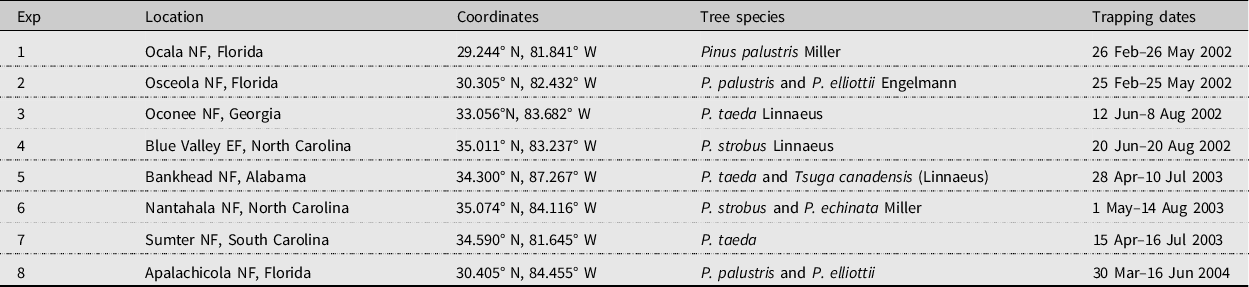
Eight trapping experiments were conducted in mature pine forests in Alabama, Florida, Georgia, South Carolina, and North Carolina in the southern United States of America (Table 1). The methods have been published previously in Miller (Reference Miller2006) and Miller and Rabaglia (Reference Miller and Rabaglia2009). Standard eight-unit black multiple-funnel traps with wet cups were used in all eight experiments. Traps, black ethanol pouch lures, and blue α-pinene pouch lures were obtained from Phero Tech Inc. (Delta, British Columbia, Canada). Release rates (determined by the manufacturer at 20–23 °C) from ethanol and α-pinene lures were approximately 0.5 and 1–5 g/day, respectively.
Locations of national forests (NF) and experimental forest (EF) in the southern United States of America used in experiments 1–8 along with coordinates, primary tree species, and trapping dates.

In each experiment, traps were set in a randomised complete block design, with each of the following four lure treatments applied randomly to traps within each of eight blocks per experiment: (1) blank; (2) ethanol; (3) α-pinene; and (4) ethanol + α-pinene. Lures were replaced once after 7–8 weeks. Traps were spaced 10–15 m apart within each block; blocks were spaced 15–500 m apart. Each trap was hung on twine tied between trees, such that collection cups were 0.2–0.5 m above ground level and all traps were more than two metres from any trees. Collection cups contained approximately 200 mL of a pink aqueous propylene glycol (ethanol-free) solution (Peak RV & Marine Antifreeze, Old World Industries Inc., Northbrook, Illinois, United States of America) to kill and preserve beetles (Miller and Duerr Reference Miller and Duerr2008). Voucher specimens were deposited in the University of Georgia Collection of Arthropods, Athens, Georgia, United States of America.
Statistical analyses were conducted with the SYSTAT, version 13, and SigmaStat, version 3.01, statistical packages (SYSTAT Software Inc., Point Richmond, California, United States of America) for species caught in sufficient numbers (N ≥ 30). As needed, data were transformed by ln (Y + 1) to attain normality and homoscedasticity, verified by the Shapiro–Wilk and equal variance tests, respectively. Treatments with zero total catches in an experiment were omitted from analyses because of the issue of heteroscedasticity (Reeve and Strom Reference Reeve and Strom2004). In all experiments, data were analysed by mixed-model analysis of variance, with treatment as the fixed factor, followed by the Holm–Sidak multiple comparison test for species showing effects of treatments (α = 0.05; Glantz Reference Glantz2005). For species affected by treatments (with no treatments having zero catches), data were further analysed by a mixed-model analysis of variance using the following model factors: (1) ethanol (Et); (2) α-pinene (aP); and (3) ethanol × α-pinene (Et × aP).
Results
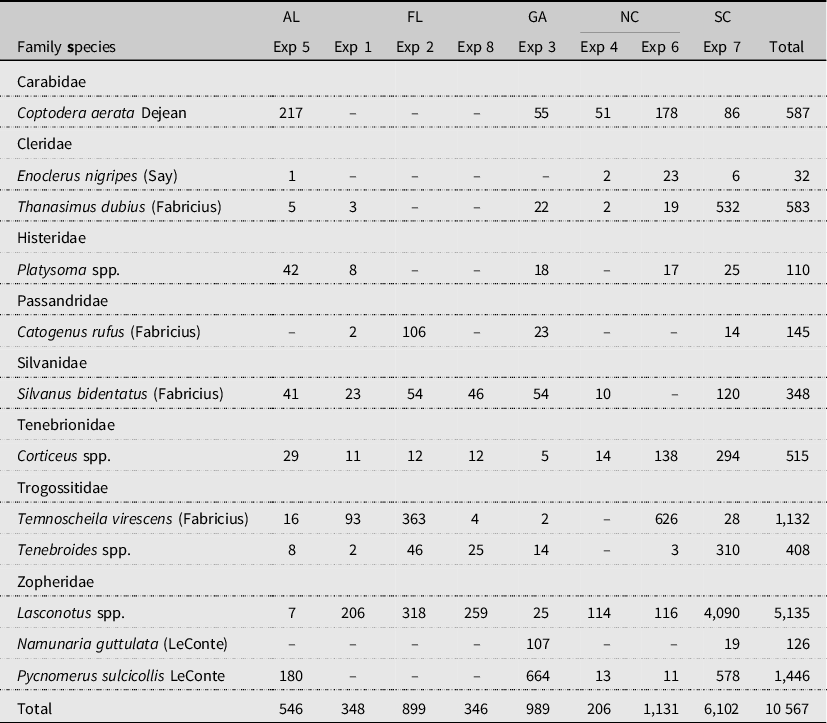
A total of 10 567 predatory and fungivore beetles was captured in the eight experiments, representing at least 12 species across eight families of Coleoptera (Table 2). The most abundant species were Lasconotus spp. (Zopheridae), Pycnomerus sulcicollis LeConte (Zopheridae), Temnoscheila virescens Fabricius (Trogossitidae), Coptodera aerata Dejean (Carabidae), and Thanasimus dubius (Fabricius) (Cleridae), accounting for 49%, 14%, 11%, 6%, and 6% of the total beetle catches, respectively.
Numbers of predatory and fungivore Coleoptera captured in eight trapping experiments conducted in the southern United States of America (2002–2004). AL, Alabama; FL, Florida; GA, Georgia; NC, North Carolina; SC, South Carolina; Exp, experiment.

Predators
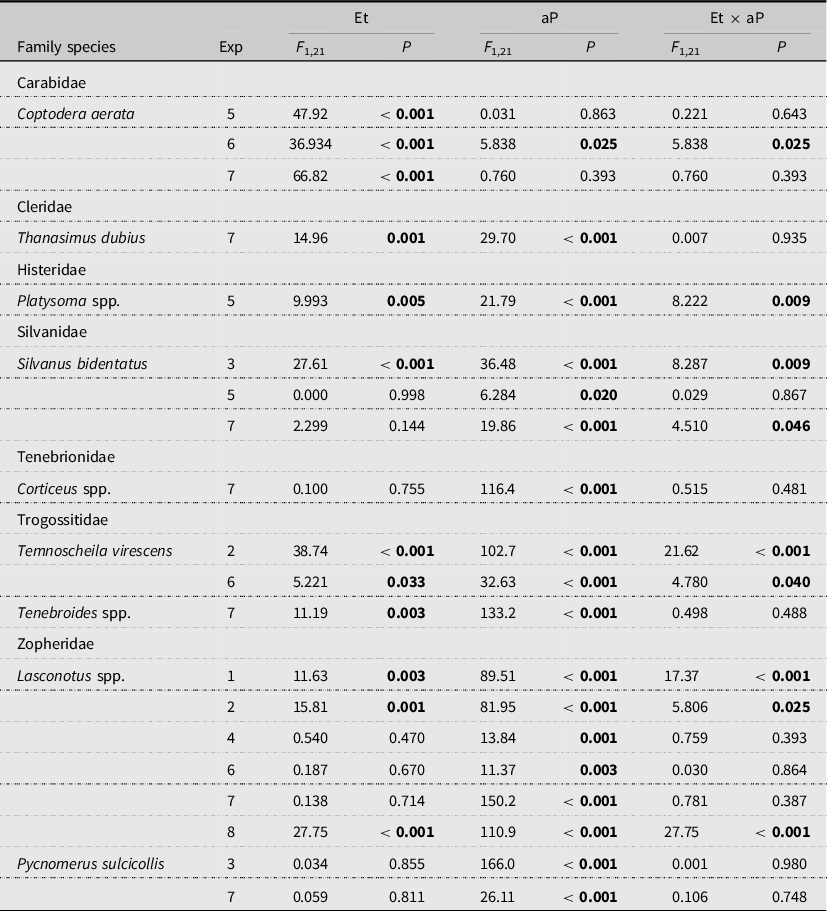
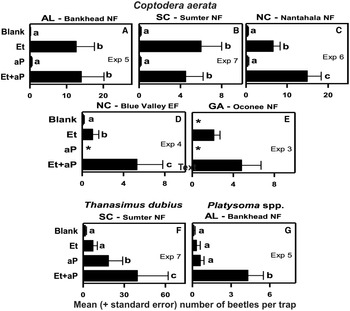
Coptodera aerata were caught in sufficient numbers for analysis at all five locations where they were detected (Table 2). Trap catches of C. aerata were affected by ethanol but not α-pinene in Alabama and South Carolina (Table 3), with catches in traps baited with ethanol (with or without α-pinene) greater than those not baited with ethanol (Fig. 1A, B). In North Carolina (Nantahala National Forest), catches were affected by ethanol, α-pinene, and the interaction between the two treatments (Table 3). Additionally, treatments affected catches of C. aerata at the other location in North Carolina (Blue Valley Experimental Forest; F 2,14 = 9.020, P = 0.002). At both North Carolina locations, catches in traps baited with ethanol were enhanced by the addition of α-pinene, although α-pinene by itself was not attractive to C. aerata (Fig. 1C, D). In Georgia, C. aerata were only caught in traps baited with ethanol or with ethanol + α-pinene (Fig. 1E), with no treatment effect between the two (F 1,7 = 3.512, P = 0.103).
Analysis of variance results for the effects of ethanol (Et), α-pinene (aP), and the interaction of ethanol and α-pinene (Et × aP) on catches of predatory and fungivore beetles in 8-unit multiple-funnel traps, experiments (Exp) 1–8. P-values in bold are significant.

Effects of ethanol (Et) and α-pinene (aP) on mean (± standard error) trap catches of A–E, Coptodera aerata (Carabidae) in experiments 3–7; F, Thanasimus dubius (Cleridae) in experiment 7; and G, Platysoma spp. (Histeridae) in experiment 5. Means within an experiment followed by the same letter are not significantly different at P = 0.05 (Holm–Sidak test). Treatments with an asterisk (*) had zero catches. AL, Alabama; GA, Georgia; NC, North Carolina; SC, South Carolina; NF, National Forest; EF, Experimental Forest.

Thanasimus dubius was caught at six locations, but only one location had sufficient numbers for analyses (Table 2). Both ethanol and α-pinene affected catches of Th. dubius in South Carolina; no interaction was observed between the two treatments (Table 3). Catches were greatest in traps baited with ethanol + α-pinene and lowest in those not baited with α-pinene (Fig. 1F). Enoclerus nigripes (Say) (Cleridae) were detected at four locations, but the numbers were too low for analyses (Table 2). At only one of five locations were Platysoma spp. (Histeridae) caught in sufficient numbers (Table 2). Ethanol, α-pinene, and the interaction between the two had significant effects on catches of Platysoma spp. in Alabama (Table 3), with traps baited with ethanol + α-pinene catching the most Platysoma spp. (Fig. 1G). Catogenus rufus (Fabricius) (Passandridae) was detected at four locations but in sufficient numbers at only one location (Table 2). Lure treatments had no effect on trap catches of C. rufus in Florida (Osceola National Forest; F 3,21 = 0.542, P = 0.659); the mean (± standard error) trap catch was 3.3 ± 0.6.
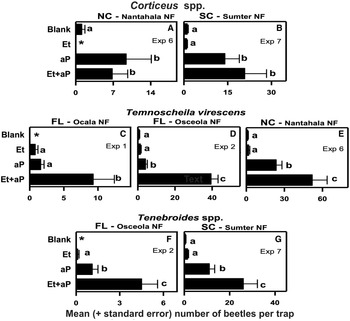
Corticeus spp. (Tenebrionidae) were detected at all eight locations but in sufficient numbers at only two locations (Table 2). Lure treatments affected catches of Corticeus spp. in North Carolina (Nantahala National Forest; F 2,14 = 5.556, P = 0.030) and in South Carolina (Table 3). At both locations, traps baited with α-pinene caught more beetles than those not baited with α-pinene did (regardless of the presence or absence of ethanol; Fig. 2A, B).
Effects of ethanol (Et) and α-pinene (aP) on mean (± standard error) trap catches of A–B, Corticeus spp. (Tenebrionidae) in experiments 6–7; C–E, Temnoscheila virescens (Trogossitidae) in experiments 1, 2, and 6; and F–G, Tenebroides spp. (Trogossitidae) in experiments 2 and 7. Means for a species within an experiment followed by the same letter are not significantly different at P = 0.05 (Holm–Sidak test). Treatments with an asterisk (*) had zero catches. FL, Florida; NC, North Carolina; SC, South Carolina; NF, National Forest; EF, Experimental Forest.

Detected at seven locations, Te. virescens were caught in sufficient numbers for analyses at three locations (Table 2). Treatments affected catches of Te. virescens in Florida (Ocala National Forest; F 2,14 = 9.193, P = 0.003), with catches in traps baited with ethanol + α-pinene greater than those in traps baited with only one compound (Fig. 2C). Catches in Florida (Osceola National Forest) and North Carolina (Nantahala National Forest) were affected by ethanol, α-pinene, and the interaction between the two compounds (Table 3). At both locations, α-pinene by itself was attractive to Te. virescens, whereas ethanol by itself was not; however, the combination of ethanol and alpha-pinene appeared to synergise attraction (Fig. 2D, E). Tenebroides spp. (Trogossitidae) were detected at seven locations and in sufficient numbers at two locations (Table 2). Catches were affected by treatments in Florida (Osceola National Forest; F 2,14 = 21.45, P < 0.001) and South Carolina (Table 3). Catches of Tenebroides spp. were significantly increased by baiting traps with α-pinene alone but were higher still when baited with both alpha-pinene and ethanol; ethanol by itself did not increase catches compared to unbaited traps (Fig. 2F, G).
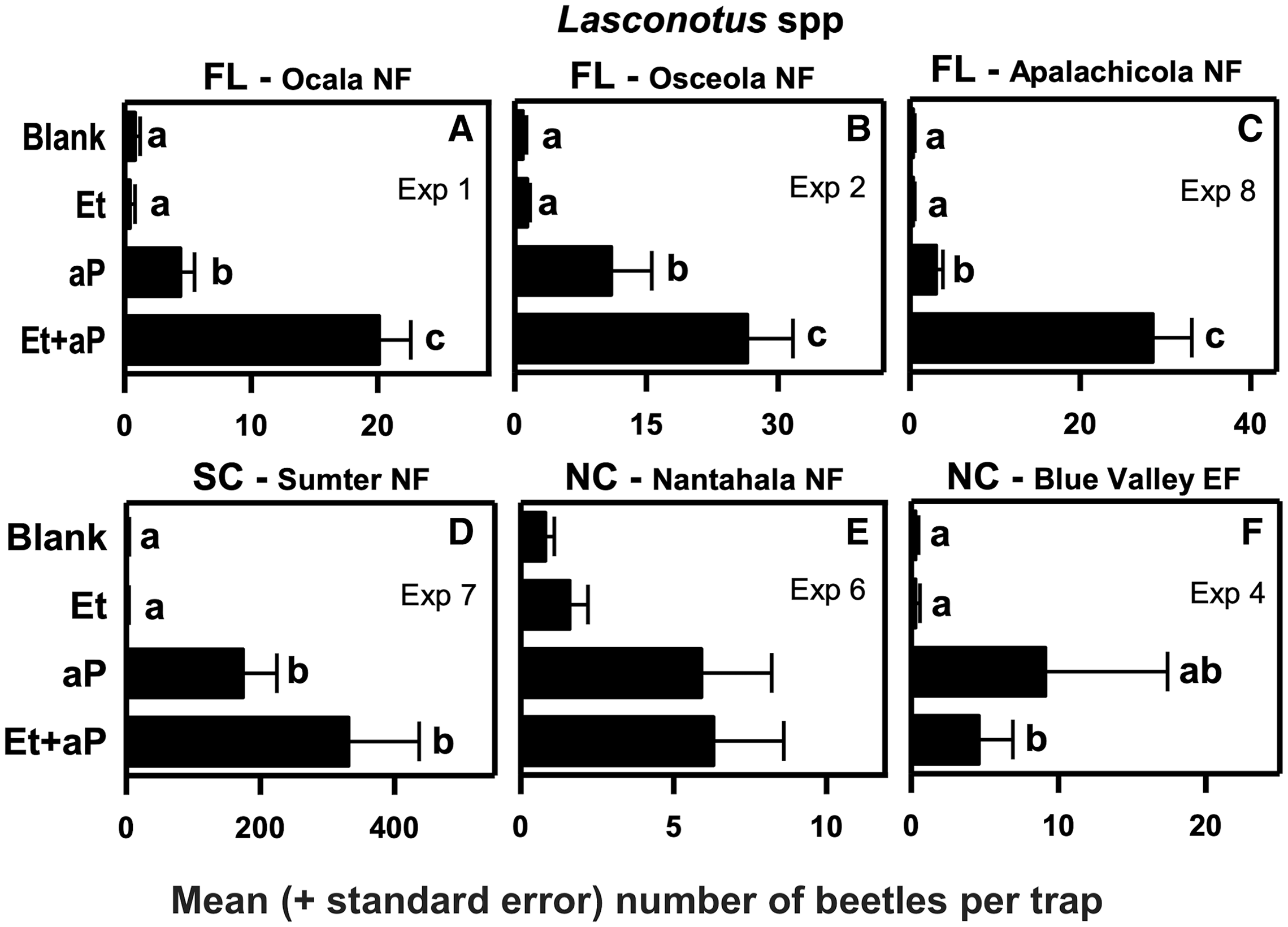
Lasconotus spp. were detected at all eight locations, with sufficient numbers caught at six locations for analyses (Table 2). Ethanol, α-pinene, and the interaction between the two affected catches of Lasconotus spp. at all three Florida locations (Ocala, Osceola, and Apalachicola National Forests; Table 3). Catches were highest in traps baited with ethanol + α-pinene and lowest in traps not baited with ethanol (Fig. 3A–C). Only α-pinene affected catches of Lasconotus spp. in South Carolina and the two locations in North Carolina (Blue Valley Experimental Forest and Nantahala National Forest; Table 3). In South Carolina, catches in traps baited with α-pinene (with or without ethanol) caught more beetles than did those not baited with α-pinene (with or without ethanol; Fig. 3D). The Holm–Sidak test was unable to separate treatment means for beetles caught in North Carolina (Nantahala National Forest; Fig. 3E). In North Carolina (Blue Valley Experimental Forest), catches of Lasconotus spp. were greater in traps baited with ethanol + α-pinene than in those not baited with α-pinene (Fig. 4F).
Effects of ethanol (Et) and α-pinene (aP) on mean (± standard error) trap catches of A–F, Lasconotus spp. (Zopheridae) in experiments 1, 2, 4, and 6–8. Means within an experiment followed by the same letter are not significantly different at P = 0.05 (Holm–Sidak test). FL, Florida; NC, North Carolina; SC, South Carolina; NF, National Forest; EF, Experimental Forest.

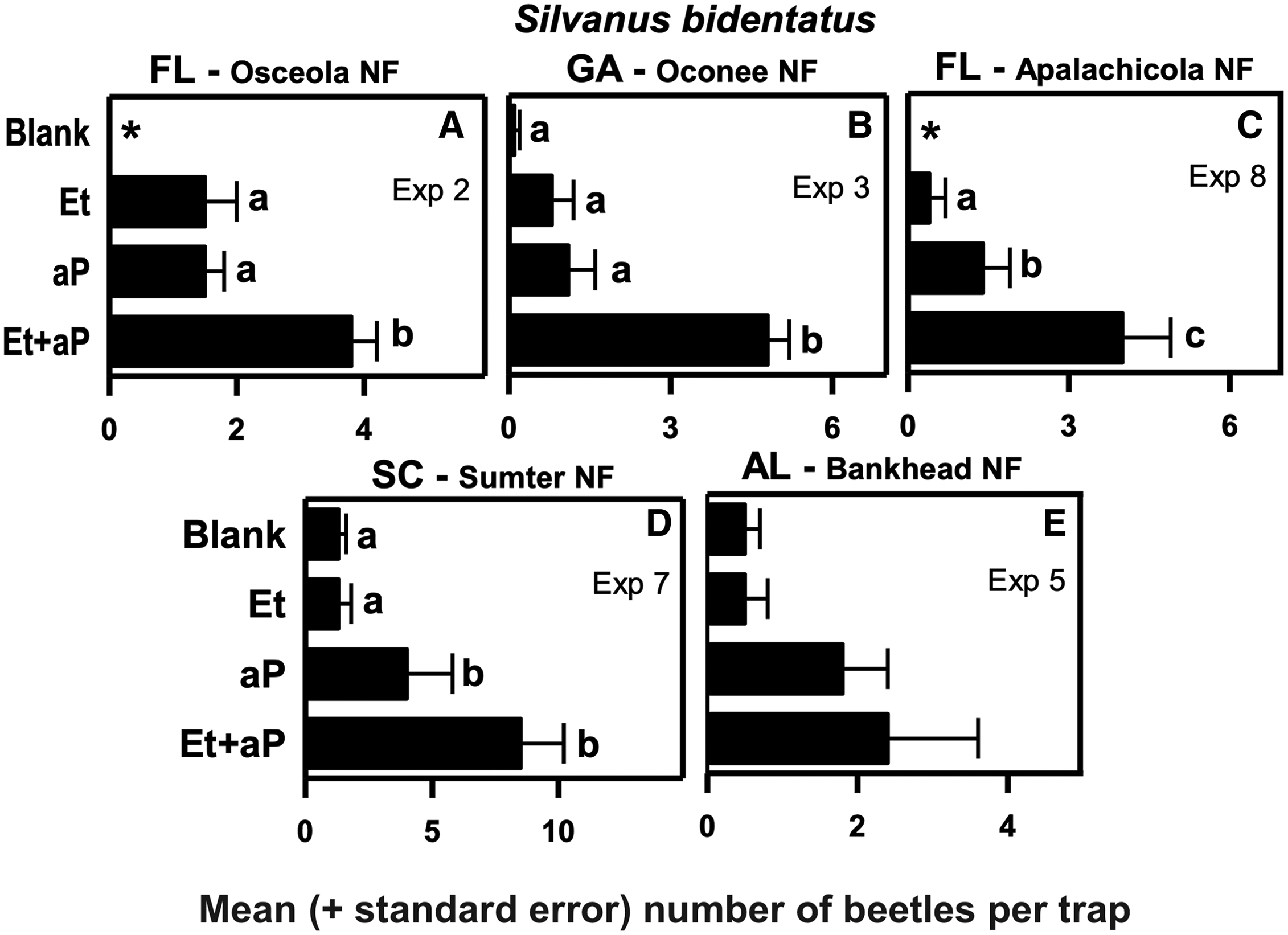
Effects of ethanol (Et) and α-pinene (aP) on mean (± standard error) trap catches of Silvanus bidentatus (Silvanidae) in A–E, experiments 2, 3, 5, 7, and 8. Means for a species within an experiment followed by the same letter are not significantly different at P = 0.05 (Holm–Sidak test). Treatments with an asterisk (*) had zero catches. AL, Alabama; FL, Florida; GA, Georgia; SC, South Carolina; NF, National Forest; EF, Experimental Forest.

Fungivores
Silvanus bidentatus (Fabricius) (Silvanidae) was detected at seven locations, with sufficient numbers obtained at five locations (Table 2). Lure treatments had a significant effect on catches of S. bidentatus in Florida at two locations: Osceola National Forest (F 2,14 = 11.12, P = 0.001) and Apalachicola National Forest (F 2,14 = 20.35, P < 0.001). No S. bidentatus was caught in blank traps at either locations (Fig. 4A, C). Catches in Georgia were affected by both treatments, as well as by the interaction between the two treatments (Table 3). At both Florida locations and in Georgia, catches of S. bidentatus in traps baited with both compounds were greater than were those in traps baited with only one compound (Fig. 4A–C). In South Carolina, catches of S. bidentatus were affected by α-pinene and the interaction between ethanol and α-pinene (Table 3), with catches in traps baited with both compounds greater than those in traps baited with ethanol alone (Fig. 4D). In Florida (Apalachicola National Forest) and South Carolina, catches in traps baited with α-pinene were greater than those in traps baited with ethanol alone (Fig. 4C, D). In Alabama, catches of S. bidentatus were affected by α-pinene (Table 3), but treatment means could not be separated by the Holm–Sidak test (Fig. 4E).
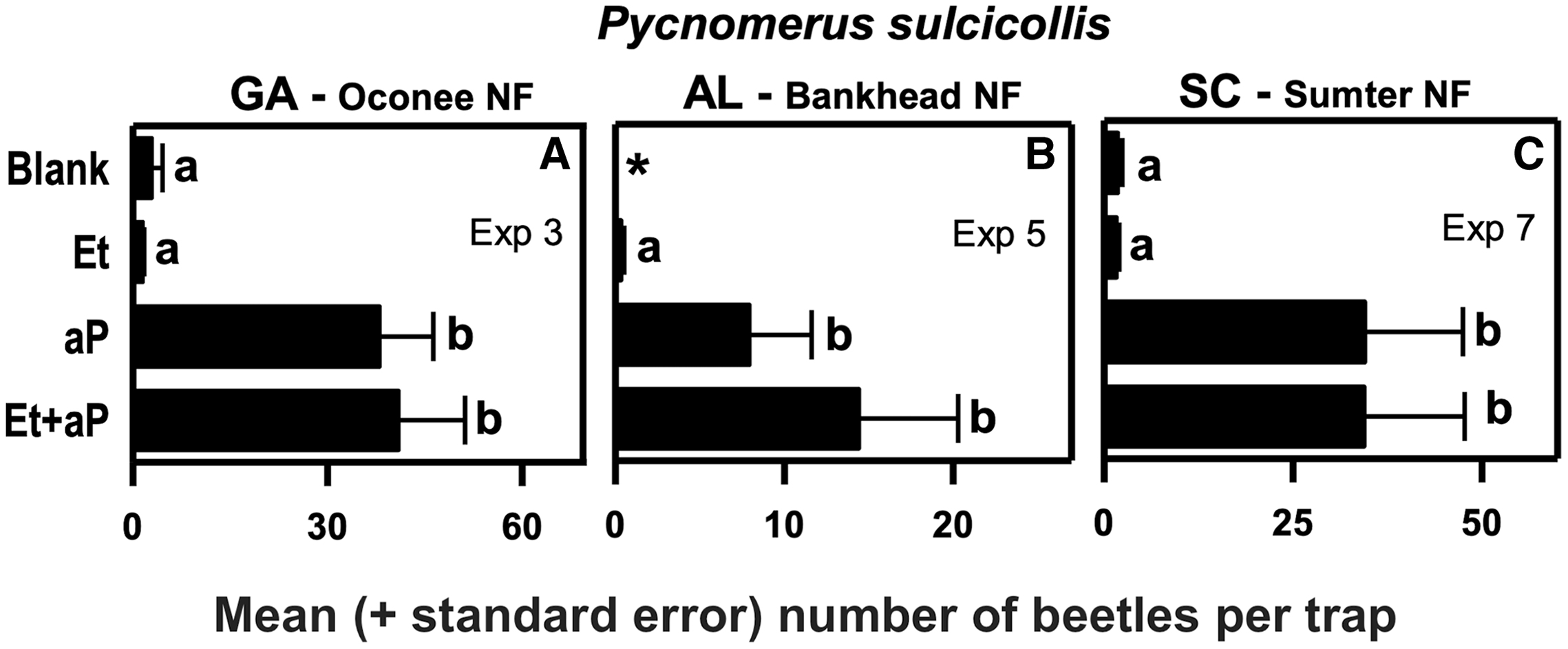
Detected at five locations, P. sulcicollis were caught in sufficient numbers at three locations (Table 2). In Georgia and South Carolina, catches were affected by α-pinene but not ethanol (Table 3). Treatments had a significant effect on catches of P. sulcicollis in Alabama, as well (F 2,14 = 7.994, P = 0.005). At all three locations, traps baited with α-pinene (with or without ethanol) caught more beetles than did those not baited with α-pinene (Fig. 5A–C). Catches of Namunaria guttulata (LeConte) (Zopheridae) in Georgia were unaffected by lure treatments (F 3,21 = 1.504, P = 0.243); the mean (± standard error) trap catch was 3.3 ± 0.6.
Effects of ethanol (Et) and α-pinene (aP) on mean (± standard error) trap catches of Pycnomerus sulcicollis (Zopheridae) in A–C, experiments 3, 5, and 7. Means within an experiment followed by the same letter are not significantly different at P = 0.05 (Holm–Sidak test). Treatments with an asterisk (*) had zero catches. AL, Alabama; GA, Georgia; SC, South Carolina; NF, National Forest; EF, Experimental Forest.

Discussion
Research on species of forest-dwelling beetles has focused largely on species that attack and kill trees. With respect to the biological control of these pest species, parasitoids have been emphasised because of their general capacity to infect many individuals over a short amount of time (Furniss and Carolin Reference Furniss and Carolin1980; Kenis and Hilszcanski Reference Kenis, Hilszcanski, Lieutier, Day, Battisti, Grégoire and Evans2007; Kenis et al. Reference Kenis, Wermelinger, Grégoire, Lieutier, Day, Battisti, Grégoire and Evans2007; Paine Reference Paine and Wang2017). Except for some species of Cleridae, predators have not been significantly studied, particularly with respect to interactions with Buprestidae and Cerambycidae. Understanding the interactions between species and the biodiversity of forest bark and woodboring beetle communities is important because these guilds provide critical roles in the breakdown of woody material, facilitating nutrient cycling and forest regeneration. Activities by bark and woodboring beetles help to minimise the build-up of downed woody material, which impedes movement of wildlife and growth of understorey vegetation, and reduce fire hazards.
Species in four beetle families (Cleridae, Histeridae, Trogossitidae, and Zopheridae) are known to broadly prey on bark and woodboring beetles (Stephen and Dahlsten Reference Stephen and Dahlsten1976; Furniss and Carolin Reference Furniss and Carolin1980; United States Department of Agriculture 1985; Kenis et al. Reference Kenis, Wermelinger, Grégoire, Lieutier, Day, Battisti, Grégoire and Evans2007; Evans Reference Evans2014; Wegensteiner et al. Reference Wegensteiner, Wermelinger, Herrmann, Vega and Hofstetter2015). The combination of ethanol and α-pinene was attractive for the following predator species of bark and woodboring beetles commonly found in the southern United States of America (Goyer et al. Reference Goyer, Lengard, Nebeker and Garrard1980; United States Department of Agriculture 1985; Allison et al. Reference Allison, McKenney, Miller and Gimmel2013): Th. dubius (Fig. 1F), Platysoma spp. (Fig. 1G), Corticeus spp. (Fig. 2A, B), Te. virescens (Fig. 2C–E), and Lasconotus spp. (Fig. 3A–D, F). The response profiles of these predators mirror those of numerous species of bark and woodboring beetles captured in the same study (Miller Reference Miller2006; Miller and Rabaglia Reference Miller and Rabaglia2009). Ten species of ambrosia beetles and two species of bark beetles were attracted to ethanol, five species of bark beetles were attracted to α-pinene, and ethanol enhanced attraction for six species (Miller and Rabaglia Reference Miller and Rabaglia2009). Eight of 10 species of woodborers were attracted to α-pinene, with ethanol enhancing responses of six species (Miller Reference Miller2006).
Little is known about the biology of C. aerata, although it is commonly found on and under bark (Evans Reference Evans2014). Other species of Carabidae are recognised as predators of bark beetles (Wegensteiner et al. Reference Wegensteiner, Wermelinger, Herrmann, Vega and Hofstetter2015). Given its response profiles, C. aerata may prey on bark and woodboring beetles or associated species. Lure treatments had no effect on catches of C. rufus. Similarly, trap catches of C. rufus in Georgia were unaffected by pheromones of southern Ips spp. (Allison et al. Reference Allison, McKenney, Miller and Gimmel2013). These results are not surprising because larval C. rufus are larval ectoparasites of woodboring beetles (United States Department of Agriculture 1985; Thomas Reference Thomas1993; Evans Reference Evans2014). There would be no benefit to adults arriving on habitats before prey larvae have developed to mid- or late-instar stages, generally at times when release of ethanol, α-pinene, and Ips pheromones is likely finished. Further work is needed to determine the cues used by ectoparasites to locate their prey.
The biology of species such as the zopherid P. sulcicollis and the non-native silvanid S. bidentatus is largely unknown (Majka Reference Majka2008; Evans Reference Evans2014; Lord et al. Reference Lord, Nearns and Miller2015). These species are often found in, on, or around bark of downed woody material and are considered fungivorous because they are commonly found with fungal mats, which are often associated with bark and ambrosia beetles. In a study with passive traps, Ulyshen and Hanula (Reference Ulyshen and Hanula2009) found that P. sulcicollis were more common in upland pine stands than in hardwood stands. The attraction of P. sulcicollis to α-pinene but not to ethanol (Fig. 5) suggests attraction of the species to freshly damaged pine boles and branches. In a separate study, trap catches of P. sulcicollis in traps baited with ipsenol and ipsdienol increased with the addition of α-pinene and with no effect from the addition of ethanol, further enhancing the likelihood of the species’ association with bark beetles and possible associated fungi (Miller Reference Miller2020). In contrast, attraction of S. bidentatus to the combination of α-pinene and ethanol suggests a different pine habitat association than that for P. sulcicollis, probably one with some decay, as suggested by the attraction to ethanol, as well as to α-pinene (Fig. 4).
The biology of zopherids and silvanids may be a more complex than simply one feeding activity. For example, some zopherids, such as Lasconotus spp., are predominantly predators, although some feed on fungi as early instar larvae before switching to feed on bark beetle larvae as later instars (Hackwell Reference Hackwell1973). Species of Silvanus are considered to be partly fungivorous (Thomas Reference Thomas1993). Silvanus bidentatus is commonly found under the bark of trees with bark beetles in the southern United States of America (Goyer et al. Reference Goyer, Lengard, Nebeker and Garrard1980). The feeding habits of these species require more research.
Host volatiles are known to interact with bark beetle pheromones in attracting predators, again mirroring the responses of their prey. For example, in the southern United States of America, ipsenol and ipsdienol are pheromones for Ips spp. (Coleoptera: Curculionidae) (Miller et al. Reference Miller, Asaro and Berisford2005; Allison et al. Reference Allison, McKenney, Miller and Gimmel2012). Both compounds also attract numerous species of beetle predators (Allison et al. Reference Allison, McKenney, Miller and Gimmel2013). Adding ethanol + α-pinene to traps baited with ipsenol + ipsdienol increased trap catches of several predatory species, including Th. dubius, Te. virescens, and Lasconotus spp. (Miller Reference Miller2020). Catches of Platysoma spp. increased with the addition of ethanol, with attraction interrupted by the addition of α-pinene, whereas catches of Corticeus spp. increased with the addition of α-pinene but with no effect from the addition of ethanol (Miller Reference Miller2020). Response profiles of these predators to ethanol and α-pinene in the presence of ipsenol and ipsdienol are similar to those in the current study without those pheromones.
Numerous monoterpenes other than α-pinene are commonly found in the resin of pine trees, with composition varying between species and geographic location (Mirov Reference Mirov1961; Gansel and Squillace Reference Gansel and Squillace1976; Squillace and Wells Reference Squillace and Wells1981; Smith Reference Smith2000). Many of these monoterpenes can influence the behaviours of bark beetles and their associated predators. For example, in lodgepole pine (Pinus contorta variant latifolia Engelmann) forests of British Columbia, Canada, catches of the bark beetle Ips pini (Say) and associated predators Lasconotus spp. and Corticeus spp. in traps baited with the pheromone ipsdienol were enhanced by the addition of monoterpenes such as 3-carene, β-pinene, and β-phellandrene (Miller and Borden Reference Miller and Borden1990, Reference Miller and Borden2000, Reference Miller and Borden2003).
Numerous families of Coleoptera are known to have predatory species (Furniss and Carolin Reference Furniss and Carolin1980; United States Department of Agriculture 1985; Evans Reference Evans2014). The presence and diversity of predators may limit the ability of non-native species to establish in our forests. Greater diversity of predators may allow for greater resilience to impacts from pest species in forests that are altered as a result of climate change. As relative abundance of prey species changes over time, predator abundance could respond to these changes, thereby minimising the risk of one species exploding in numbers. Research on the entire community of bark and woodboring beetles and their associated species of commensals and predators is needed to support improved management of our forest resources. This is especially true in addressing the variation exhibited by some species, particularly as the variation in behavioural responses is not the same across the species reported here for predators and fungivores, and for bark and woodboring beetles in Miller (Reference Miller2006) and Miller and Rabaglia (Reference Miller and Rabaglia2009). Although the causes of these variations are unknown, they underscore the need for such studies to be conducted over a broad geographic range so that the reliability of these lures for use in detection and control programmes can be assessed.
Acknowledgements
The author thanks Will Shepherd (United States Department of Agriculture, Forest Service) for a critical review of the manuscript, Chris Crowe (United States Department of Agriculture, Forest Service) for field assistance, and Richard Hoebeke (University of Georgia Collection of Arthropods) for verification of insect identifications. The use of trade names and the identification of firms or corporations do not constitute an official endorsement or approval by the United States government of any product or service to the exclusion of others that may be suitable. The United States Department of Agriculture is an equal opportunity provider, employer, and lender.
Competing interests
The author declares none.