INTRODUCTION
The change in the definition of post-traumatic stress disorder (PTSD) in DSM-IV from earlier DSM editions was in two parts: the broadening of the stressor criterion and coupling it with a subjective element (criterion A), and the addition of the clinical significance criterion (criterion F). The change in the stressor criterion, which defines the etiologic event, has resulted in a considerable increase in the lifetime cumulative exposure to qualifying events and the proportion of victims assessed as PTSD cases (Breslau & Kessler, Reference Breslau and Kessler2001). The impact of the addition of the clinical significance criterion in DSM-IV (i.e. the requirement that the disturbance cause clinically significant distress or impairment) on the probability of PTSD given exposure to trauma has not been evaluated in general population samples. Narrow et al. (Reference Narrow, Rae, Robins and Regier2002) reported that an addition of clinical significance criteria reduces the prevalence estimates in the National Comorbidity Survey (NCS) and the Epidemiologic Catchment Area (ECA) study across most disorders. PTSD was not recalculated by Narrow et al.; it was assessed only in two of the ECA sites, and, although covered in the NCS, the assessment did not incorporate indicators of clinical significance. Slade and Andrews (Reference Slade and Andrews2002) estimated the impact of the DSM-IV clinical significance criterion across five currently active disorders (in the past 4 weeks) in the Australian National Survey of Mental Health and Well-Being (Andrews et al. Reference Andrews, Henderson and Hall2001). The reduction in the current prevalence of PTSD with the inclusion of the clinical significance criterion was by 24%. Zimmerman et al. (Reference Zimmerman, Chelminski and Young2004) evaluated the impact of the clinical significance criterion among psychiatric out-patients (whose disturbance is likely to be more severe than among respondents in general population surveys) and showed little reduction in current PTSD cases.
Dohrenwend et al. (Reference Dohrenwend, Turner, Turse, Adams, Koenen and Marshall2006) presented new estimates of PTSD in the National Vietnam Veterans Readjustment Survey (NVVRS; Kulka et al. Reference Kulka, Schlenger, Fairbank, Hough, Jordan, Marmar and Weiss1990). They adjusted the original estimates by applying archival information to confirm self-reports of combat exposure and data on age of onset and level of functioning, adding information on clinical significance, using the Global Assessment of Functioning (GAF; Spitzer et al. Reference Spitzer, Gibbon, Williams, Endicott, Sederer and Dickey1994), gathered in clinical assessments of a subsample. According to their calculations, both the lifetime and current prevalence proportions of PTSD among Vietnam veterans at the time the NVVRS was conducted were reduced by approximately 40%. However, the reduction attributable to restricting the definition of cases to those with functional impairment, using a liberal threshold on the GAF (i.e. ‘no more than slight impairment’), was small. A far larger reduction in prevalence would have resulted if the threshold were shifted to the next level of the GAF (Dohrenwend et al. Reference Dohrenwend, Turner, Turse, Adams, Koenen and Marshall2006; Table 3). Analysis of the extent to which the clinical significance criterion reduces the probability of PTSD given exposure to traumatic events (rather than the prevalence of current cases), by comparing the total pool of cases before and after applying the clinical significance criterion, has not been published.
Conditional prevalence (%) of post-traumatic stress disorder (PTSD) following exposure to traumatic events in two epidemiological studies before and after including the clinical significance criterion (DSM-IV criterion F): data from two epidemiological samples

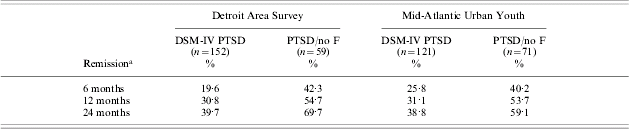
Comparisons of DSM-IV post-traumatic stress disorder (PTSD) versus PTSD without criterion F on remission in the two epidemiological studies

a Examples at selected times from Kaplan–Meier survival curves; the log-rank tests in the Detroit Survey yielded χ2=12·98, p<0·001 and in the Mid-Atlantic Study χ2=6·52; p=0·01.
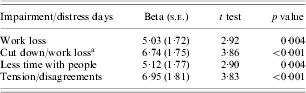
Excess per capita impairment days during the 30-day period of greater trauma-related distress among persons with post-traumatic stress disorder (PTSD) with criterion F

Sex-adjusted difference of number of days in the 30-day period when the respondent was most upset by the traumatic event estimated in ordinary least squares regressions, using PTSD syndrome with no clinical significance as reference.
a ‘Cut down/work loss’ is the sum of two items and signifies the percentage and number of days of either cut down or total work loss.
The addition of the clinical significance criterion to the definition of most disorders in the DSM-IV has been controversial. Objections rely primarily on analogy with medical disease. Wakefield & Spitzer (Reference Wakefield and Spitzer2002) ask: ‘Is asymptomatic but documented cancer not a disease?’ However, unlike cancer, the diagnosis of PTSD, as of most mental disorders, has no laboratory tests for documenting pathology. The defining criteria, including the clinical significance criterion, serve to demarcate deviation from the range of ‘normal’ responses to stress, according to DSM-IV text (APA, 1994, p. xxi, Introduction). Critics have observed a recent rise in the application of the diagnosis of PTSD to a wide range of events and have pointed out the untoward effects of ‘inflating’ and thus ‘devaluing’ the diagnosis by failure to require that symptoms are associated with impairment (McNally, Reference McNally2003; Tyrer, Reference Tyrer2005; Wessely, Reference Wessely2005).
In this study, we use data from two general population samples to evaluate the effect that the addition of the clinical significance criterion to DSM-IV had on the conditional probability of PTSD given exposure to trauma. As reported previously from the two studies, the conditional probability estimates of DSM-IV PTSD given exposure to qualifying stressors were 7·8% and 8·8% respectively (Breslau et al. Reference Breslau, Kessler, Chilcoat, Schultz, Davis and Andreski1998a, Reference Breslau, Kessler and Peterson2004). We estimate the extent to which the clinical significance criterion influenced these percentages, lowering them from what they would have been if it were not required. We define the reduction as the percentage of trauma victims who met all the DSM-IV PTSD symptom criteria (criteria A–E) but reported that the disturbance caused no clinically significant distress or impairment, as measured by the survey instrument. Furthermore, we examine the construct validity of the criterion as measured in our studies. We compare PTSD cases (those ever meeting the syndrome criteria) with and without clinical significance on the following indicators: (1) the total number of PTSD symptoms; (2) time to remission; and (3) number of days of work-loss and personal distress within a 30-day period when the respondent was ‘most upset’ by the trauma.
METHOD
Epidemiologic surveys
The 1996 Detroit Area Survey of Trauma
Participants were 2181 persons 18 to 45 years of age, representative of the Detroit, Michigan, primary metropolitan statistical area, which contains 4 266 654 residents, nearly 2 million in the age range 18–45 years. A random-digit dialing method was used to select the sample. Screening for eligibility was completed in 76·2% of households, and cooperation rate in eligible households was 86·8%. The sample was 51·4% female and 25·3% non-white. A detailed description of the sample and population appears elsewhere (Breslau et al. Reference Breslau, Kessler, Chilcoat, Schultz, Davis and Andreski1998a).
Mid-Atlantic Urban Youth
Participants were young adults from a longitudinal study of first-grade cohorts selected from a public school system of a large mid-Atlantic city in the USA in 1985–1986 as part of the research of The Johns Hopkins University Prevention Research Center, Baltimore, MD (Kellam et al. Reference Kellam, Werthamer-Larsson, Dolan, Brown, Mayer, Rebok, Anthony, Laudolff and Edelsohn1991; Werthamer-Larsson et al. Reference Werthamer-Larsson, Kellam and Wheeler1991; Kellam & Anthony, Reference Kellam and Anthony1998). Children were assessed from the first through the eighth grade. Between 2000 and 2002, nearly 75% (n=1698) of the original sample was interviewed during young adulthood. The sample was 53·2% female and 71·0% non-white. Detailed information on the study appears elsewhere (Breslau et al. Reference Breslau, Wilcox, Storr, Lucia and Anthony2004).
The institutional review board of Henry Ford Health Sciences Center, Detroit, approved the first study and the institutional review board of The Johns Hopkins University approved the second study; the Michigan State University, East Lansing, institutional review board, where analyses were conducted, approved both. Oral informed consent was obtained in the first study, and written consent in the second.
Assessment of PTSD
The interview schedule for assessing exposure to traumatic events and PTSD was developed, used, and evaluated in the 1996 Detroit Area Survey of Trauma (Breslau et al. Reference Breslau, Kessler, Chilcoat, Schultz, Davis and Andreski1998a). A computer-assisted, telephone structured interview was used. The interview began with a complete enumeration of traumatic events, using a list of 19 types of traumatic events, which operationalized the DSM-IV definition as explicated in its accompanying text. An endorsement of an event type was followed by questions on the number of times an event of that type had occurred and the respondent's age at each time. A list of all the traumatic events reported by the respondents was read by the interviewer and the respondent was asked to identify the one event that was most upsetting, the worst trauma. PTSD was evaluated in connection with this event, using the PTSD section of the National Institute of Mental Health Diagnostic Interview Schedule (NIMH-DIS), Version IV, and the World Health Organization Composite International Diagnostic Interview (WHO CIDI), Version 2.1.1 (WHO, 1997). A mental health professional reappraisal study showed good concordance with the structured interview (Breslau et al. Reference Breslau, Kessler and Peterson1998b).
The clinical significance criterion (criterion F) in the CIDI requires an affirmative answer to one or more of the following questions: (1) Did you ever tell a medical doctor about any of your reactions to this experience? [If ‘no’ to 1] (2) Did you tell any other professional such as a minister, priest, rabbi, social worker, psychologist or psychiatrist? (3) Did you take medication more than once because of your reactions? (4) How much did your reactions interfere with your life and activities – a lot, some, a little, or not at all? The reply ‘a lot’ was coded as an affirmative.
Construct validity
To evaluate the validity of the clinical significance measure, we used data from both samples on indicators of the severity of the disturbance other then those used to measure clinical significance: number of PTSD criterion symptoms (above the required threshold) and duration of symptoms. The Detroit Area Survey also included standard questions for measuring the economic and personal impact of disease (Kessler & Frank, Reference Kessler and Frank1997), which we used as indicators of the severity of the disturbance for the purpose of evaluating the validity of the clinical significance measure. The questions focused on the 30-day period when respondents were most upset by the traumatic event. The four questions were preceded by the statement, ‘In answering the next questions, please think of the 30-day period when you were MOST upset by this experience’. The first two questions ask about work-loss and work cut-back days, that is: (1) how many days of those 30 days that the respondents were ‘totally unable to work or carry out your normal work related or daily activities because of your reactions to this experience’, and (2) how many days of the remaining 30-day period that they had to ‘cutdown on your normal work-related or daily activities because of your reactions to this experience’. The next two questions refer to the respondents’ personal/social domain, that is: (1) how many days out of that 30-day period the respondents spent ‘less time with people in your personal life than otherwise because of your reactions to this experience’, and (2) how many days of that 30-day period they had ‘tensions, disagreements, or conflicts with people in your personal life because of your reactions to this experience’. Information on work-loss days (i.e. totally unable to work) was considered on its own. In addition, information on work-loss days was used together with cut-back days (of the remaining 30-day period after subtracting work-loss days) as an index of the impact of the disturbance in terms of number of days the respondents either performed their work or other major activities below their usual level or did not perform them at all. Trauma victims meeting all PTSD criteria, including the clinical significance, were compared on these measures to trauma victims meeting all criteria, except the clinical significance.
Statistical analysis
Separate analyses were performed on each of the two samples. Reductions in lifetime prevalence proportions of PTSD overall and by sex are presented, including tests of sex differences and differences by event category. Persons who experienced PTSD criterion symptoms were asked how many weeks, months or years after the onset of their disturbance they continued to have symptoms. Based on these reports, we evaluated time to remission of symptoms by means of the Kaplan–Meier method for estimating survival curves. Ordinary least squares regressions were applied to estimate sex-adjusted associations of PTSD (versus syndrome but no clinical significance) with variables measuring number of days of work loss and number of days of personal distress as described above. The unstandardized partial regression coefficients can be interpreted as the number of excess days of impairment associated with endorsing the clinical significance criterion among trauma victims experiencing the PTSD syndrome (criteria A–E).
RESULTS
Effect of the clinical significance criterion on the conditional probability of PTSD
Percentages of persons with all PTSD symptom criteria with and without the clinical significance criterion from the two surveys are presented in Table 1, showing the reductions in the conditional probability of PTSD after the clinical significance criterion is applied. The reduction was by 28·0% in the Detroit Area sample and by 37·1% in the mid-Atlantic sample of young adults. In both samples, the reduction in the conditional probability of PTSD associated with exposure to assaultive violence was smaller than the reduction associated with other traumatic events, but the difference was minor and not statistically significant in either sample. In each sample the reduction was larger in males than females, 32·9% v. 24·6% in the first (not significant) and 44·4% v. 30·4% in the second (χ2=4·05, p=0·04). When examined across the four individual items that measured the clinical significance of the PTSD syndrome, sex differences in endorsement were robust for the two questions about ‘seeing a doctor/other professional’, but slight and not significant for questions on ‘use of medicine’ or ‘interference with life’. The last question was endorsed by a similar percentage in both sexes, approximately 50%.
Construct validity of the clinical significance criterion
We compared number of PTSD symptoms between the subset with DSM-IV PTSD (criteria A–F) versus the subset that met all the symptom criteria but endorsed none of the clinical significance indicators. By definition, persons in these two subsets reported the constellation of six symptoms specified in the DSM-IV definition of PTSD. However, in both studies, the mean number of symptoms (from a list of 17) was significantly higher in the subset with DSM-IV PTSD (criteria A–F) than in the subset meeting the syndrome criteria (criteria A–E) but not the clinical significance criterion. In the Detroit Area Survey, the means were 11·9 (s.d.=2·5) v. 10·0 (s.d.=2·5) (t test=5·21, p=0·001); in the Mid-Atlantic Urban Youth Survey, the means were 11·4 (s.d.=2·6) v. 10·2 (s.d.=2·4) (t test=3·28, p=0·001).
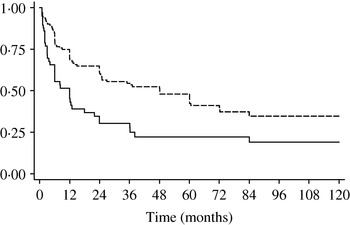
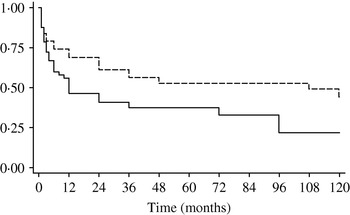
Comparisons of Kaplan–Meier survival curves of time to remission (time from onset of PTSD to time when symptoms were last experienced) between the DSM-IV PTSD subset (criteria A–F) and the subset without clinical significance (criteria A–E) are displayed in Figs 1 and 2. The figures display the survival curves up to 120 months. Analyses and statistical tests are based on all the available data. In both studies, the survival curves declined most steeply in the first 12 months in the two subsets, those with and without clinical significance, and continued to decline at a lower pace in subsequent years. However, the decline was steeper in the subset without (than the subset with) clinically significant disturbance (in both studies the log-rank test χ2 p⩽0·01). To illustrate the results, Table 2 provides percentages of remission at selected time points from the Kaplan–Meier analysis. At 12 months after onset, remission was about 54% and 31% in the first and second subsets respectively.
Survival curves of duration of post-traumatic stress disorder (PTSD) symptoms for DSM-IV PTSD syndrome that did (- - -) and did not (—) meet the clinical significance criterion in the Detroit Area Survey of Trauma. Log-rank test χ2=12·98, p=0·0003.

Survival curves of duration of post-traumatic stress disorder (PTSD) symptoms for DSM-IV PTSD syndrome who did (- - -) and did not (—) meet the clinical significance criterion in the Mid-Atlantic Urban Youth Study. Log-rank test χ2=6·52, p=0·0106.

Data on number of work-loss or distress days in the 30-day period of greatest trauma-related distress, gathered in the Detroit Area Survey, provide another perspective on the clinical significance construct, as measured by the survey instrument. Sex-adjusted regression coefficients of work-loss days or personal distress days in the 30-day period when the respondents were most upset by the traumatic experiences are presented in Table 3. The regression coefficient can be interpreted as an adjusted mean excess number of days associated with DSM-IV PTSD (criteria A–F), compared to DSM-IV PTSD syndrome without clinical significance (criteria A–E). Mean group differences across the work-loss and personal distress variables were statistically significant and ranged from 5·0 to 6·9 days.
DISCUSSION
The inclusion of the clinical significance criterion in DSM-IV reduces substantially the number of PTSD cases among community residents exposed to traumatic events, based on two independent general population studies. If clinical significance were not required, the probability of PTSD following exposure to qualifying traumatic events would be approximately 30% higher. Cases fulfilling the clinical significance criterion showed more pervasive and persistent disturbance and more impaired activity days than trauma victims who have met all the symptom criteria but endorsed none of the items used to measure the clinical significance of the disturbance. The consistency between the findings of the two independent studies strengthens the evidence on the impact of the clinical significance criterion on the conditional probability of PTSD and adds support to the construct validity of its measurement.
The results suggest that the measurement of the clinical significance criterion in the DSM-IV definition of PTSD applied in the leading structured diagnostic interviews, those used in large-scale epidemiological studies, the CIDI and the NIMH-DIS (on which the CIDI is based), might vary between the sexes. The somewhat greater impact of the clinical significance criterion in males than females is largely due to the inclusion of questions about care-seeking behavior. By contrast, we detected no evidence of sex-related variance in endorsing items about ‘taking medicine’ or ‘interference with life or activities’, items used as alternative indicators of clinical significance. The meaning of the sex difference in the care-seeking items merits investigation.
A limitation that this study shares with other community-based studies of PTSD is the absence of verification of respondents’ reports of traumatic experiences, PTSD-related symptoms and the role of traumatic memory in the disorder. The limitation extends to the ascertainment of level of distress and impairment caused by the disturbance. In addition, respondents’ reports of distress or impairment due to traumatic experiences might be influenced by current psychiatric disturbance or level of distress. Although the diagnostic procedure used in our studies was evaluated against independent clinical reinterviews, yielding good agreement (Breslau et al. Reference Breslau, Kessler and Peterson1998b), obtaining reports from independent informants was not feasible.
An important strength of the study is the focus on the impact of the clinical significance criteria on the conditional probability of PTSD (lifetime) given exposure to DSM-IV qualifying traumatic events, rather than on current cases, as in the epidemiologic study by Slade & Andrews (Reference Slade and Andrews2002). The impact of the clinical significance criterion on current cases (a reduction by 24%) in the Slade & Andrew (Reference Slade and Andrews2002) report was lower than the reduction in the conditional probability in our two samples (28% and 37%). Our inquiry about impairment days referred to the 30-day period when the respondent was most distressed by the trauma, which allowed us to link the occurrence of the disorder (rather than current symptoms) to the impairment it caused. It also allowed us to estimate time to remission of symptoms as another criterion of construct validity.
In DSM-IV, the concept of mental disorder is defined as a clinically significant syndrome that is associated with distress or disability (APA, 1994). The importance given to the association with distress or disability is reflected in the inclusion of a clinical significance criterion for most DSM-IV disorders. The intent in adding this criterion was to ‘establish a threshold’ for diagnosing a disorder, a boundary between pathology and normality. The DSM-IV defines clinical significance as distress or impairment in major social roles. However, impairment is a continuum and the threshold on that continuum is unspecified. The implicit assumption is that clinicians’ discretion is the standard. That assumption would be secure when functional impairment is severe, as might be the case in clinical samples. However, for the majority of PTSD cases in the general population, there is a need for an explicit threshold on a reliable measurement procedure. The evidence from Dohrenwend et al. (Reference Dohrenwend, Turner, Turse, Adams, Koenen and Marshall2006) that a shift of the threshold to the adjacent level on the GAF (‘some difficulty in social, occupational or school functioning’) would have resulted in a substantially lower prevalence estimate is a poignant example of the importance of this problem.
In the absence of an explicit threshold for distress or impairment that can be extended from clinical practice to epidemiological surveys, the procedure applied by the major epidemiological instruments, although arbitrary, satisfies an essential scientific principle: it is operationalized by a set of standard questions and an a priori rule. It should be noted that our findings of higher levels of impairment or distress in PTSD cases who met the clinical significance criterion (criterion F) versus those who did not should not be interpreted as signifying a clear-cut dichotomy. Criterion F did not separate PTSD cases with work-loss or distress days from PTSD cases with zero work-loss or distress days. Clearly, the definition and measurement of the clinical significance criterion deserve greater scrutiny.
ACKNOWLEDGMENTS
This work was supported by grants MH-44586, MH-71395 (Dr Breslau) and Fogarty International Center D43TW0581 (Dr Alvarado) from the National Institutes of Health, Bethesda, MD, USA.
DECLARATION OF INTEREST
None.