Progressive but also reversible cognitive impairment was previously noted in idiopathic hypereosinophilic syndrome (IHS) only in a few case reports (Reference Kaplan, Waterbury, Kawas, Bolla-Wilson and Durack1–Reference Kwak, Han, Seo and Roh4). We present a case of IHS, in whom the disease onset is relatively early in comparison with previously reported cases (Reference Kaplan, Waterbury, Kawas, Bolla-Wilson and Durack1–Reference Kwak, Han, Seo and Roh4), but is within characteristic for IHS age range (20–50 years). Despite the characteristic clinical features, diagnosis was delayed. Apart from mini-mental state examination (MMSE) score that was reported once Reference Briani, Baracchini, Zanette, Zanusso, Carollo and Monaco(2), no neuropsychological assessment was performed in published IHS cases. Three types of neurologic dysfunction may emerge in IHS: cerebrovascular, peripheral neuropathy and primary central nervous system dysfunction (as eosinophil-derived neurotoxin, EDN)-induced disorder Reference Moore, Harley and Fauci(5,Reference Yoshikawa6).
The patient was a retired army pilot with 17 years of formal education. Before IHS onset, he used to drink alcohol four to six times a month. At the age of 43, the patient became apathetic. Subsequently visual impairment and unsteady gait emerged. At the age of 47, the patient was admitted to the hospital because of multiple organ symptoms (lung, heart, liver and gastrointestinal), visual impairment and dementia (confirmed by MMSE score of 18). IHS was not diagnosed, despite the abnormal white blood cells (WBC) count of 16.50 and 9290/mm3 eosinophils.
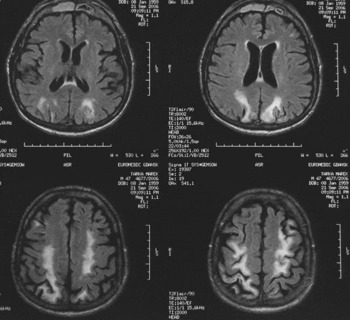
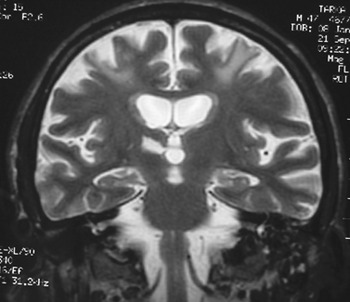
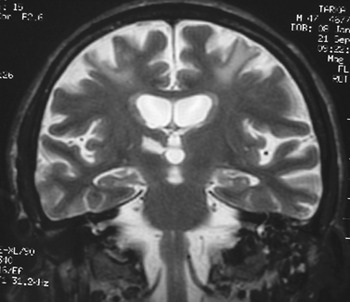
Magnetic resonance imaging (MRI; at the age of 47) showed FLAIR/T2W hyperintensities in the right thalamus and left occipital lobe along with the periventricular white matter and subcortical regions (bilaterally in the occipital and parietal lobes) (Fig. 1; Fig. 2).
MRI (FLAIR/T2W) shows cortical and subcortical hyperintensities of parietal and occipital lobes bilaterally.

MRI (FLAIR/T2W) shows the hyperintensive signal within right thalamus.
He was admitted to the Neurology Department at the age of 48. Neurological examination showed right homonymous hemianopsia, motor apraxia in right upper limb, left parkinsonian symptoms (rigidity mainly in the left upper limb with bradykinesia), cerebellar syndrome (gait disturbances and ataxia, more on the right side). Dementia, defined as significant deterioration of previous cognitive status with the loss of ability to live alone (according to DSM-IV criteria), was also diagnosed. Haemotological investigation showed WBC count of 12.00 and 7200/mm3. At that time, the patient was diagnosed with IHS. Subsequently, steroid treatment was introduced, followed by imatinib (Glivec®, Novartis, Basel, Switzerland) administration at Hematology Department. The patient’s wife noticed significant improvement in cognitive abilities and activities of daily living in the course of treatment.
Detailed neuropsychological examination (8 months after implementation of treatment) showed no progression of dementia (MMSE 19). Detailed neuropsychological assessment showed lowered verbal fluency (semantic – animals 11, plants 14, phonological –‘K’ 9, ‘P’5). Digit Span was within normal range but below expected (forward 5, backward 4). Working memory impairment was evidenced by trail making test (in part B he committed four mistakes). Verbal learning examination showed slowed learning (auditory verbal learning test 4,7,7,7,9, recognition 14, delayed recall 7, delayed recognition 11) with relatively preserved delayed recall (87.5%). In logical memory trials from Wechsler Memory Scale, he managed to recall 55% of previously learned information. Semantic memory was preserved (Wechsler Adult Intelligence Scale-Revised: information SS = 11,vocabulary SS = 12).
Spatial dysfunction was confirmed by means of experimental trials. The patient was unable to report the hands distribution on the clockface with a given time, describe a famous square he was familiar with. No right/left asymmetry was observed. On Neuropsychiatric Inventory only apathy was a prominent finding. Follow-up neuropsychological testing performed 14 months after the previous comprehensive assessment, with the same methods, showed MMSE score of 22 and no significant changes in all tested cognitive domains.
This case confirms that IHS treatment can slow down or stabilise the cognitive decline. The cognitive dysfunction observed in our patient cannot be attributed solely to alcohol-induced brain damage, what may be suspected at the beginning, as delayed recall memory measures were not significantly affected in the context of overall cognitive function and he responded positively to immunological therapy. Neuropsychological examination showed cognitive deficits both characteristic for posterior vascular damage (such as spatial deficits) and rather atypical executive dysfunction, as frontal lobe pathology was not confirmed by MRI (possibly because of EDN and primary central nervous system lesions). It is in concordance with disproportionate to MRI cognitive impairment that was also previously reported Reference Gwen-Li and Tih-Shih(3). MRI findings showed the diffuse process with basal ganglia (right thalamus) involvement which may be responsible for parkinsonian symptoms, not described till now (despite shuffling gait mentioned in one report) Reference Gwen-Li and Tih-Shih(3). In our case, in contrast to previous reports Reference Briani, Baracchini, Zanette, Zanusso, Carollo and Monaco(2,Reference Gwen-Li and Tih-Shih3) no psychiatric symptoms, apart from apathy, were noted. Nevertheless, the process seems to be not regionally specific sharing both vascular and primary neurons toxicity pathology. Therefore, the symptomatology may be variable, depending on the localisation of lesions. On the other hand, the scarce literature does not allow to make generalised conclusions but regional specific MRI and neuropsychological pattern is possible. Diagnosis of dementia and extrapyramidal symptoms should focus not only on the most common neurodegenerative causes, but also on possible reversible aetiologies.