Pāṇḍavalīlās
Pāndavalīlās are dramatic danced renditions of the Mahābhārata that are unique to the Central Himalayan region of Garhwal, in the state of Uttarakhand in North India. Performances incorporate dancing, drumming, singing, narrative recitation, and possession and are enacted as ritual entertainment at various times over the space of two to three weeks. Performances are presented as danced renditions of the different characters and episodes from the epic and are fairly disparate in style, even though Pāndavalīlās are restricted to a limited area of the Indian Himalayas.
William Sax has undertaken the most comprehensive examination of the Pāndavalīlā to date. Sax outlines how, “[t]hrough various performative media, such as dance, music, and drama, a heightened experience is produced in the [Pāndavalīlā], thereby indexing (and often altering) social relations while simultaneously legitimating them via cosmological paradigms” (Reference Sax2002:4). As Sax points out, ritualistic performance—performance that is in many senses also efficacious—serves to construct individual “selves” and legitimise social hierarchies by drawing on overarching cosmologies. In many ways, Sax’s approach draws on scholarly traditions of ritual associated with performance studies. As Schechner and Appel suggest, the study of ritual as performance provides a “precise juncture of time and space [when] the problems of representation, imitation, and transformation converge” (Reference Schechner and Appel1990:4). In possession rituals, such representations, imitations, and transformations are as likely as not to occur within an arena that is shared with musical performance. There is nothing unique about this in the case of a Pāndavalīlā. Thus, an interpretation of possession in Pāndavalīlā performances as dramatic rendition in the context of musical performance is warranted.
In this paper I consider the nexus that exists between drumming, dancing, and possession within the Pāndavalīlā and investigate the relationship between drum repertoire and the progression of various transitions to different states of performed possession. While Rouget cautions against the assumption that aural triggers exist within music for the inducement of possessed states, there is a link between the performative acts within a sonic world and the aural fabric of that sonic world (Reference Rouget1985:65–66). As Briggs suggests, a totality of experience is undoubtedly responsible for bringing on possession (Reference Briggs, Laderman and Roseman1996:187). There is of course theoretical disquiet among more recent ethnomusicological investigations of trance, in which the ontology of the possession act itself is reconsidered, as much as is practicable, from the perspective of the performers themselves. As Jankowsky warns, scholars all too often accept the bias of a rationalist anthropological atheism, in which it is almost obligatory to disbelieve. There is, therefore,
a tension between rationalizing, scientistic and universalizing tendencies, on the one hand, and more culturally contextualized, phenomenological approaches on the other. Despite their sometimes irreconcilable differences, many studies near both ends of this spectrum share an implicit assumption that possession trance poses some sort of “problem” to be solved.
(Jankowsky Reference Jankowsky2007:187)In many ways, Perman’s approach offers a theoretical solution to this dilemma: “Approaching possession as an intersubjective habit of the self” acknowledges the obvious power that possession events have on people, while recognising the “agent-oriented psychology and semiotics” that intersubjectivity affords (Reference Perman2011:59). Here, I would suggest that my investigation of the drumming associated with Pāṇḍavalīlā as a “theatre of transition” acknowledges the performative elements of the event while admitting the agency of individuals and their experiences of possession during the act of performance. Without wishing to reject the reality of any one possession experience, I would suggest that there may well be different possession experiences during lengthy rituals like a Pāṇḍavalīlā, and these may well reveal different states of liminality. In this context, I wish to turn to Becker’s comprehensive theorisation of the phenomenon (Reference Becker2004) to investigate how the processes of music making, dancing, and trancing might be explained as an interactive domain.
Becker draws not only on the descriptions of researchers like Friedson (Reference Friedson1996) who have experienced trance, but also on the neurological work of researchers like Damasio (Reference Damasio1999:132) to propose a model for trance consciousness that integrates the phenomenology of trancing with the neurophysiology of what we know about consciousness. Significant to Becker’s theory is the presumption that dancing and musicking are integral to “trancing,” and that an understanding of the phenomenon of trance rests to a considerable degree on cognizance of how we experience music and dance. Yet, beyond the centrality of music and dance, Becker acknowledges what Friedson describes as the “transformation” of the thinking self:
The habitus of listening [emphasis original] of a trancer and the self who is listening are indivisible: one includes the other. The listening self at a spirit possession ceremony is a self who waits and listens for clear signs of intervening holy spirits, signs that he/she is about to become a different self. The ears become the valorized sense, music the vehicle for transformation.
(Becker Reference Becker2004:106)Ultimately, Becker proposes a uniform theory for understanding trance as a social phenomenon tied not only to the individual but also to the society within which those individuals enact trance.
Emotion, music, and dance become one system of ontogenic coordination of actions. Together, they bring about changes in being and changes in the music event. Although it is the individual who experiences the emotion, it is the group and its domain of coordinations [my emphasis] that triggers the emotion. The changes in the neurophysiology of the listener are not attributable simply to the brain and body of a self-contained individual. They occur through the group processes of recurrent interactions between co-defined individuals in a rhythmic domain of music.
(ibid.:127)Thus, Becker seeks to provide an “integrated embodied analysis of the relationship of music and emotion and trancing,” through which she avoids casting individual trancers as distinct from the community of which they are a part, or as distinct from the histories and beliefs that link individuals to communities.
Elsewhere, I have described the music and dance associated with Pāṇḍavalīlā rituals, presenting the broad outline of repertoire and procedures used for performance, including ethnographic data associated with traditions of dance and performance (Alter Reference Alter2008:93–134). In this paper, I expand on that description to explore the “domain of coordinations” that operate within a Pāṇḍavalīlā performance. Thus, I re-examine my earlier ethnographic work within the frames offered by Becker to explain more comprehensively how drumming in Pāṇḍavalīlā performances integrates community and individuals as “a theatre of transition.”Footnote 1 In addition, I seek to refocus the analysis, not so much on the basic features of the drumming, as to create a more holistic view through identification of a matrix of transitional moments that comprise the ritual. How is the spectacle of the Mahābhārata enacted over two to three weeks while engaging not only the dancers themselves in a performance of lengthy proportions, but also the community of listeners that constitute the village and its surroundings? What is the role of drumming and music in the spectacle of possession within a ritual that regularly moves back and forth between worlds of deities and humans as well as historical figures and stories? Ultimately, I suggest that the drum repertoire of a Pāṇḍavalīlā helps organise the event through the management of transitions—transitions that are essential for the transformation of the drama of Pāṇḍavalīlā performance into a ritual act.
Pāṇḍavalīlā and Possession
Notably, while drumming in a Pāṇḍavalīlā effectively inspires possessed states, these are of different kinds and different orders. Performances like those of the Pāṇḍavalīlā rely not only on altered states of consciousness in some form, but also on the performance of those altered states of being. A broader focus on the transitional stages of possession as outlined through drumming admits a wider acknowledgement of the different forms and purposes of possession. Critically, drumming not only provides the aural backdrop for inducing a variety of possessed states, but drum patterns offer a metaphor for understanding the numerous levels of transition that operate within a Pāṇḍavalīlā. Transition is therefore not simply a leap from one state of consciousness to another. Rather, it is a movement through, and into, different levels of performative being. Drum repertoire in a Pāṇḍavalīlā is organised not only to assist with the creation of states of trance consciousness, but also for the management of ritual space and performative segments. Entrainment within this environment is not only a sense of locking in to rhythms for dancing, but also a sense of locking in to the efficacious spiritual world of the ritual. Over two to three weeks, levels of trance are enacted during specific moments of performance as dancers move in and out of ritual space as well as narrative worlds.
Observations for this paper are made primarily on the basis of field recordings undertaken in the region of Garhwal in 2001 and 2002, as well as 2004. During these periods, I visited and recorded segments of Pāṇḍavalīlās occurring in seven villages in or near the Kedarnath valley system.Footnote 2 I was particularly encouraged in this endeavour by Dr. D. R. Purohit, whose extensive knowledge of Garhwali folkloric practices undoubtedly influenced my own perspectives here.
General Features of Pāṇḍavalīlā Performances
In a Pāṇḍavalīlā, the “story” of the Mahābhārata is not presented through dramatised dialogue with causative action followed by response and reaction. Rather the “epic” emerges as episodic material, with characters dancing their roles in dramatic and spectacular possessed states. In Nautiyal’s description, the Pāṇḍavalīlā is in essence a series of dances that show the personalities of the characters from the Mahābhārata (Reference Nautiyal1989). Consequently, they might easily be referred to as Pāṇḍava Nṛtya (Pāṇḍava Dances). In short, the epic is presented as a series of episodes rendered by dancers who are possessed by the spirits of their characters.
Pāṇḍavalīlās are sponsored by the Kshatriya, or landowning upper-caste members of a village. In some regions only men perform the parts of characters from the epic, although in other valley systems women also participate. Consequently, the parts of female characters from the epic, such as the Pandava’s common wife, Draupadi, and Arjuna’s other wife, Subhadra, are frequently rendered by men. The fieldwork I conducted when first investigating the Pāṇḍavalīlā was undertaken in the Kedarghati valley below the sacred pilgrimage location of Kedarnath, where the Mandakini river emerges as one of the sources of the Ganges. During 2001 and 2004, I visited numerous villages in the region where performances were being enacted, including Bareth, Kyunja, Budna, Maletha, Gandhari, Than and Kandara. I was invited to a performance in Kyunja village by Mr. Nautiyal, who also performed as an additional dancer in the Kyunja village celebrations.Footnote 3
Pāṇḍavalīlās are not performed every year. Rather, a village may choose to perform a Pāṇḍavalīlā every third year, or even after a more lengthy period. This means that the first few days, or even the whole first week of a performance, are spent by people reacquainting themselves with procedures, characters, ideas, and costumes. As the Pāṇḍavalīlā progresses, costumes and dances become more elaborate. Most commonly, a two-hour performance is held during the afternoon of each day, and this performance is repeated again at night. As discussed in more detail below, these distinct ritual sessions follow a common pattern. First, ritual space is prepared, then group dancing is undertaken, through which a possessed state may be performed, and finally individual character dancing is undertaken to show different scenes from the epic in abstract form. A session of this kind might last about two to three hours and is repeated over the days and nights of a Pāṇḍavalīlā. Consequently, there are lengthy times between actual performances when people go about other aspects of their daily lives. Preparing for transitions from quotidian life to ritual space and back are therefore a crucial—and regular—part of the performance atmosphere.
All organised outdoor communal rituals in the state of Uttarakhand, including the Pāṇḍavalīlā, incorporate drumming by two drummers playing the ḍhol and damaun. These drums are of course related to, or resemble, many drums found elsewhere in South Asia. The Uttarakhandi ḍhol has two heads and is barrel shaped, while the damaun is a smaller, single-headed kettle drum. The ḍhol in Uttarakhand is played with a stick in one hand, while the damaun is played with two sticks, which allows for regular rolls that outline the metric design of rhythms. A pairing of drums for outdoor ritual purposes is particularly common throughout the Himalayas, as well as in numerous other locations in North India. In Garhwal, drumming is essential not only to create the right atmosphere for dancing, but also to create a sonic environment auspicious for attracting deities of various kinds to dance on their mediums.Footnote 4 Most such forms of possession, provided they are by deities whose character is benevolent, are viewed positively. Such supernatural appearances further enhance the environment of the space. Ultimately, ritual space in Garhwal, as noted by Dabral (Reference Dabral1989), Anuragi (Reference Anuragi1983–1984), and others is directly shaped by the creative force of drum sounds, which themselves are neatly integrated into cosmogonic stories of creation.
Moving from Daily Life to Ritual Space
To set the correct atmosphere for each afternoon’s and night’s dancing session in a Pāṇḍavalīlā, all drummers play a type of invocation called a Baṙhāī. Each family of drummers from a particular village will have a distinctive Baṙhāī that is part of the repertoire they use for all ritual occasions. Thus, one village’s Baṙhāī is most likely different to another, even though there is general stylistic consistency amongst all Baṙhāīs. They are generally cyclical, with a stroke pattern that is less dense than the stroke pattern of many other repertoire items. The cyclical pattern is asymmetrical and normally fairly long. Individual Baṙhāīs can be of different lengths, and cyclical patterns of more than twenty beats are common. The invocation is not meant for dancing, and therefore does not have a regular metric pattern that inspires repetitive movement. It does, however, introduce sound into the ritual space and serves the secondary purpose of collecting people to come listen to, and watch, the event that is about to take place.
The mode of performance of a Baṙhāī can be sporadic and may seem somewhat secondary to other preparatory activities going on at the same time. Ideally, it is performed to create an ongoing low volume background of sound. Where the Baṙhāī cycle begins or ends is not particularly relevant to other activities. Thus, the transition from quotidian space to ritual space, while directly enacted through organised drum patterns, is not aurally organised into perceptible segments of time through clearly audible patterns of rhythmic repetition. Rather, a more relaxed atmosphere of preparation is created through a “constant sounding” of asymmetrical stroke patterns. The asymmetry and regularity of the sounding foreshadow and build towards the more significant actions that are to follow.
As I have written elsewhere, drums and drumming are ultimately understood to hold power and meaning as explained through a sonic cosmology associated with Shaivite theology (Alter Reference Alter2003, Reference Alter2008, Reference Alter2009; see also Beck Reference Beck1993). Meaning is not so much a system of lexical meaning (though some patterns may hold more direct meaning than others) as it is a symbolic iteration of sacrality. In essence, drums and drumming are heard to be sacred because the instruments and their sounds are physical and aural symbols of Shiva’s primordial drum, through which the universe was created. In the same way that the ultimate reality of the universe may be understood as a vibrational matrix created through the sound of Shiva’s drum, the ultimate reality of the ritual space of a Pāṇḍavalīlā—or indeed of any ritual space—is created through the sounding of the drum. The Baṙhāī is the first stage in this creative transition, and its structures are designed to elide the spaces of quotidian village life and ritual sacred space.
Performing Possession Within Ritual Space
After a Baṙhāī is played to create an auspicious environment and to summon village members to watch and perform at each session, a circle dance called a Chauṅwārā is performed. In a Chauṅwārā, those who are to play characters of the epic, as well as other high-caste men from the village, dance together until the designated dancers become possessed by the spirit of their character. Thus, the Chauṅwārā is an essential mechanism for transition by which deities are invited to join the ritual space of the Pāṇḍavalīlā. The dancers move from being village personalities to becoming the characters of the epic.
A Chauṅwārā’s rhythms are significantly different to those of a Baṙhāī. The cycle of beats is much shorter, they are organised symmetrically, and they have a rhythmic vitality that naturally encourages dancers to move together into a circle or some group formation. The transition of the drums’ sounds, from the quiet undercurrent of a more random rhythm associated with the lengthy asymmetric patterns of the Baṙhāī to the organised Chauṅwārā rhythms, marks a transition from sounds designed to create a sacred atmosphere to the onset of more organised and unified action. In addition, the Chauṅwārā is designed to move dancers into a state of trance. In its most overt organisational design, the Chauṅwārā is made up of a variety of segments of different rhythms played successively, each of which inspires dancers to move in a different way. Even though drum patterns played by drummers in individual villages differ in some ways, they share a general procedure to establish rhythmic elision. Dancing is not carefully choreographed to fit each rhythm exactly. Nonetheless, in general, dance movements comprise an oscillation between alternately placing the right side of the body forward with the right arm upwards, and then moving to hold the left side forward with the left arm upwards. While one arm is forward and up, the other arm is moved behind and downwards behind the body. A dip of the knees frequently marks the moment when either side of the body is fully extended. This dip is often coordinated with the most accented point in the twelve-beat cycle of the rhythms that accompany the dance. Since Pāṇḍavalīlās are presented/enacted with a break of several years between presentations, dance styles develop and coalesce during the first few Chauṅwārās of a Pāṇḍavalīlā. As dancers remember movements and watch each other over the days and weeks of the ritual, they create an ever-increasing sense of coordination.
Drummers in different villages maintain a distinctive series of rhythmic patterns that are either known or become familiar to the whole group as the choreography of a Chauṅwārā becomes executed with more finesse and coordination over the days and weeks of the event. Thus, the village’s individual identity as a community of dancers is reinforced through a unique set of movements and rhythms that are rehearsed, performed, and observed as a communal activity. Dancers become entrained through hearing regular drum patterns and following each other’s movements over successive sessions. In spite of certain differences between the rhythms and movements of different villages, the succession of rhythms in a Chauṅwārā reveals a general approach to rhythmic elision that organises the transition from human personae into a possessed state. The elision of successive rhythms may be subtle. Different contexts and conventions mean that Chauṅwārās in different villages take different lengths of time—anywhere between twenty minutes to an hour.
Two overarching features of a Chauṅwārā, which may at first seem obvious, are critical to the purpose of the dance: these are the tempo and the communal intention of the choreography. Not surprisingly, the overall tempo of each rhythm increases slowly but steadily. Each individual rhythm gradually increases while it is played, and each successive rhythm is slightly faster than the last. This naturally leads to the climactic ending of the Chauṅwārā, when the first onset of possession occurs and/or is displayed. The fact that the Chauṅwārā, when all dancers perform together, occurs at the first moment after most people gather at the performance space is also important. Not only is it a way to demonstrate the communal unity of the characters in the drama, but it is also a way to bring on a state of communal possession.Footnote 5 As a group dance through which dancers remind each other of coordinated dance moves while becoming entrained with a set of drum rhythms, the Chauṅwārā is reminiscent of similar examples of communal rituals elsewhere in the world. Individuals may experience individual emotions and different conscious states, but participation within the group and its “domain of coordinations,” as Becker (Reference Becker2004:127) suggests, is one aspect of a set of triggers for emotional response and trance. Significantly, when the Chauṅwārā finishes, the circle formation of dancers dissipates as individual characters demonstrate the onset of possession through individual uncoordinated movements. These may include vigorous leaping, rigid arms, rapid twirling, violent shaking, and other extraordinary body postures and gestures. Until that moment, however, all dancers remain more or less coordinated in their choreography.
Transitional Features of Chauṅwārā Rhythms
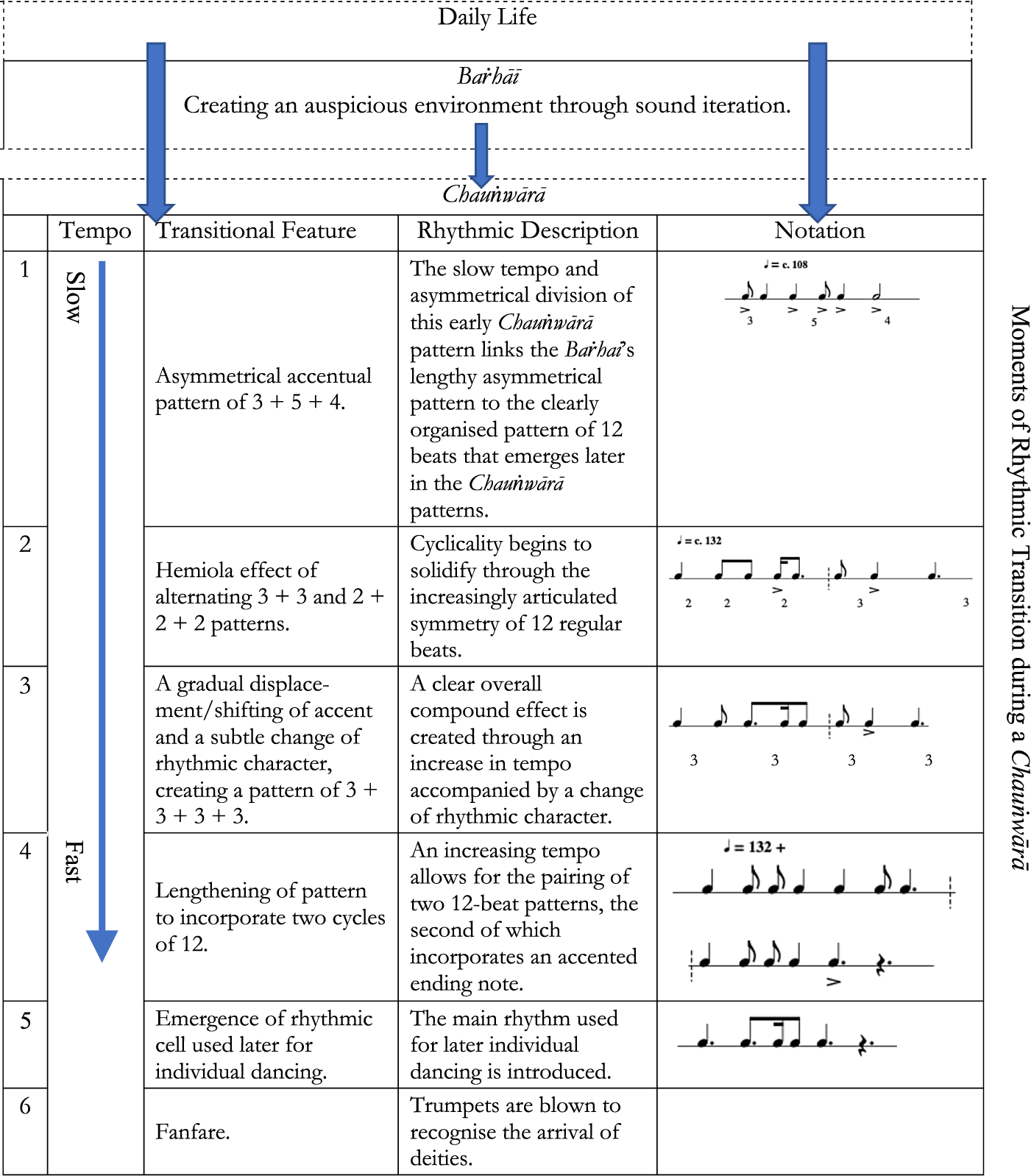
A number of features of the Chauṅwārā rhythms are worth noting to demonstrate the coordinated nature of the onset of possession. Figure 1 illustrates the transitional stages of repertoire items leading to the dances by individual characters. Within the Chauṅwārā itself there are six transitional features of the rhythms that illustrate the way drumming, dancing, and trancing operate within a unified domain of “coordinations.” This domain of coordinations not only operates across musicking, dancing, and trancing, but also serves as a structural feature within the music.
Transitional moments from daily life into possession.
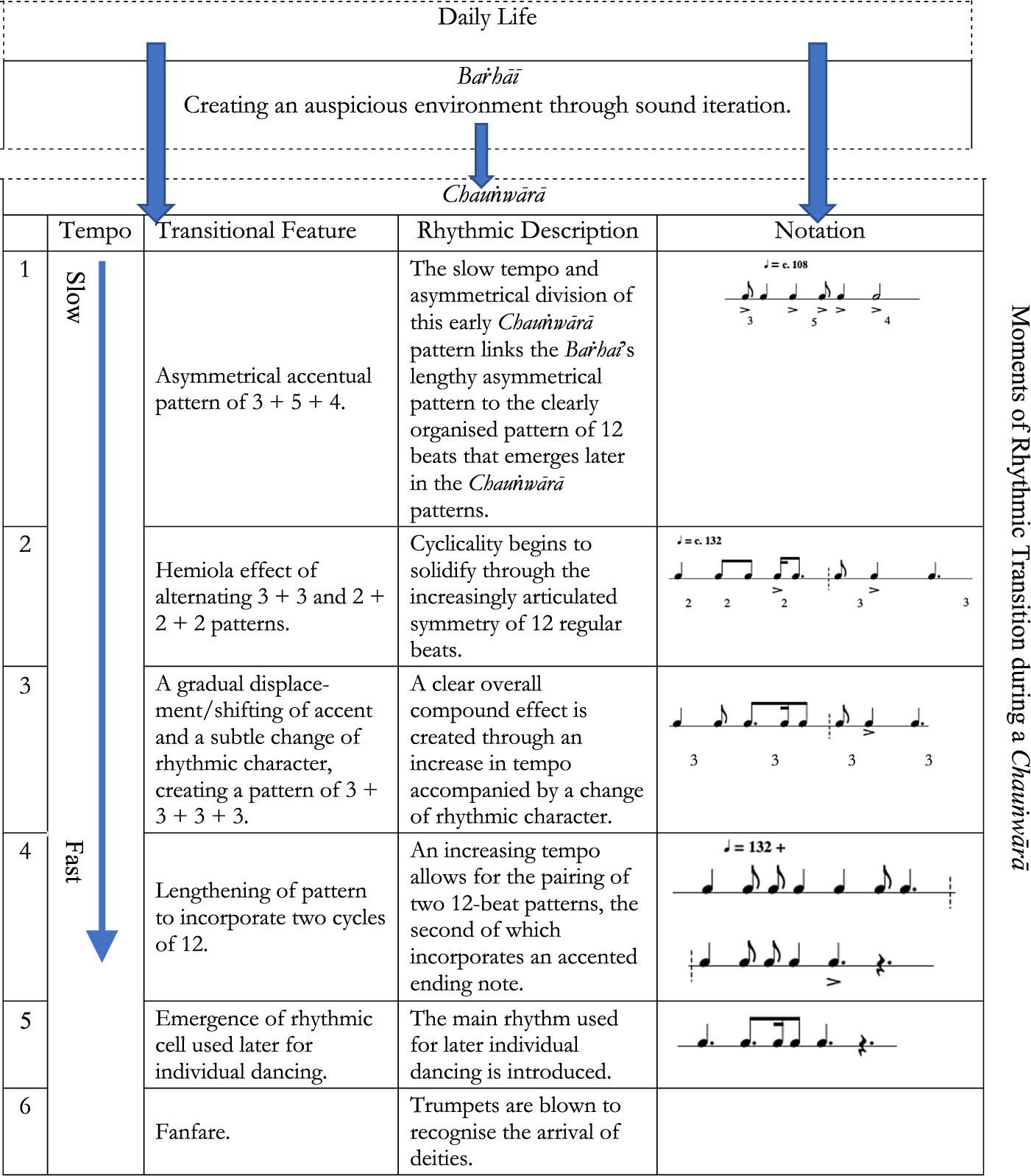
Successful entrainment between choreography and drumming is motivated by the desire to achieve coordination among individuals. Movements are made to fit together—or gradually become more fitted together—in association with the drumming over the span of the Chauṅwārā dance, as well as over the weeks of a Pāṇḍavalīlā. Each segmented rhythmic section is designed to not only move subtly from one to the next, but also to give an overarching perception of changing rhythmic structure associated with the merging of rhythmic patterns. Transitions between rhythms are a series of elisions leading ultimately to the transition into trance. Dancing with these rhythms requires the elision of bodily movements in sync with the rhythms.
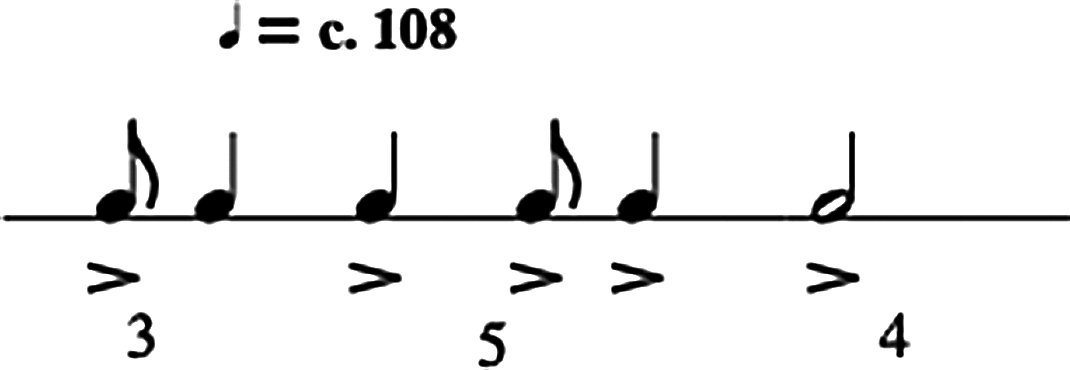
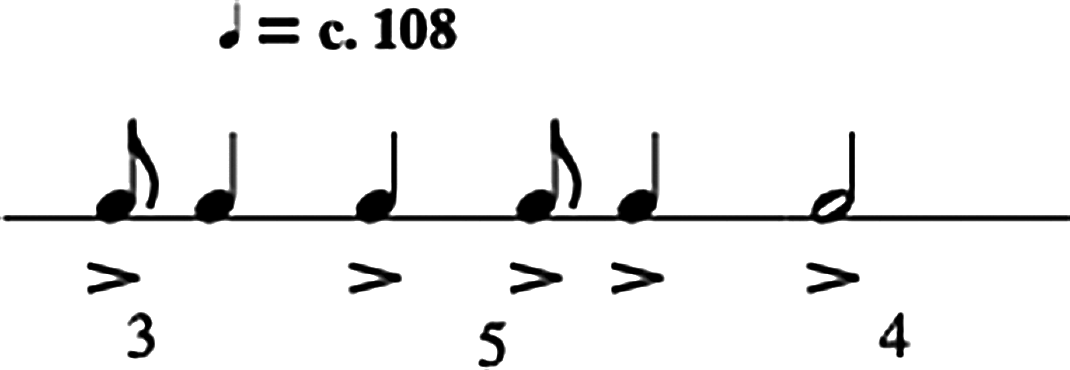
The first transitional feature I wish to highlight here is the asymmetric and slow pace of the first few Chauṅwārā rhythms. This assists with the transition from everyday life into sacred space through a reference to the lengthy and ambiguous cycle of the Baṙhāī. Thus, these rhythms elide the aural space from the asymmetric rhythms of the Baṙhāī to the highly symmetric rhythms featured in the middle and at the end of the Chauṅwārā. For instance, while the overarching cycle length may be identified as containing twelve major beat pulses, accentual patterns and drum strokes of early rhythms may divide the pattern of twelve into a grouping of 3 + 5 + 4, as shown in Figure 2.Footnote 6
Accentual pattern for an early Chauṅwārā rhythm demonstrating ambiguous, or asymmetric, cyclical structures.
The slow tempo of the rhythms of the first few Chauṅwārā segments also allows dancers the time-space to coordinate their movements with each other and with the emerging cycle of the drumming. A dip of the body while bending the knees is often associated with the accented strokes of the drum. While the rhythm remains slow, it is easier for dancers to become entrained with the drum’s pattern. Furthermore, a slow tempo allows for a more emphatic dip of the body, such that all dancers are better able to feel the accent together. Communal feeling is emphasised through a coordinated, more emphatic movement.
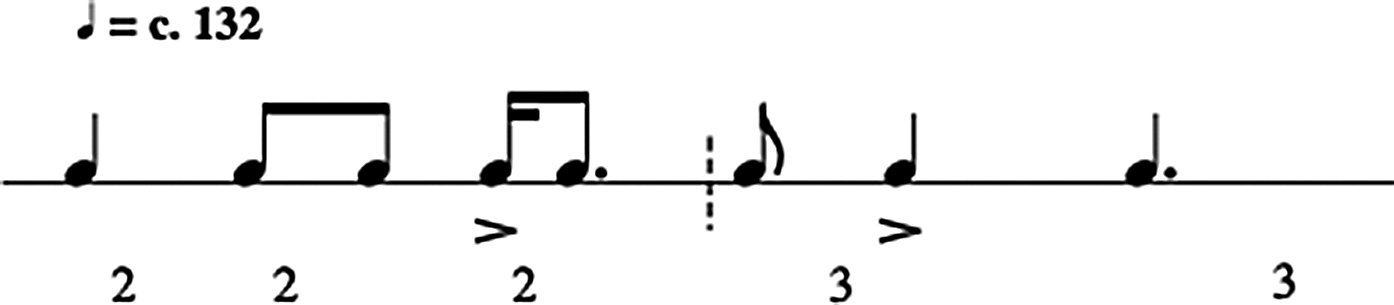
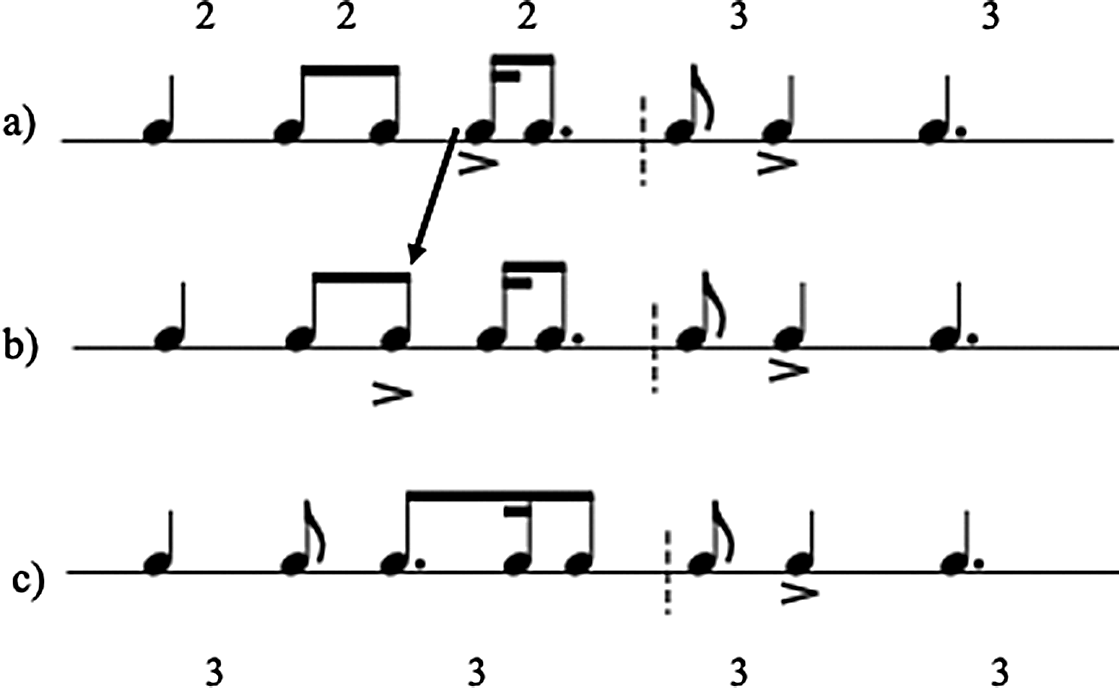
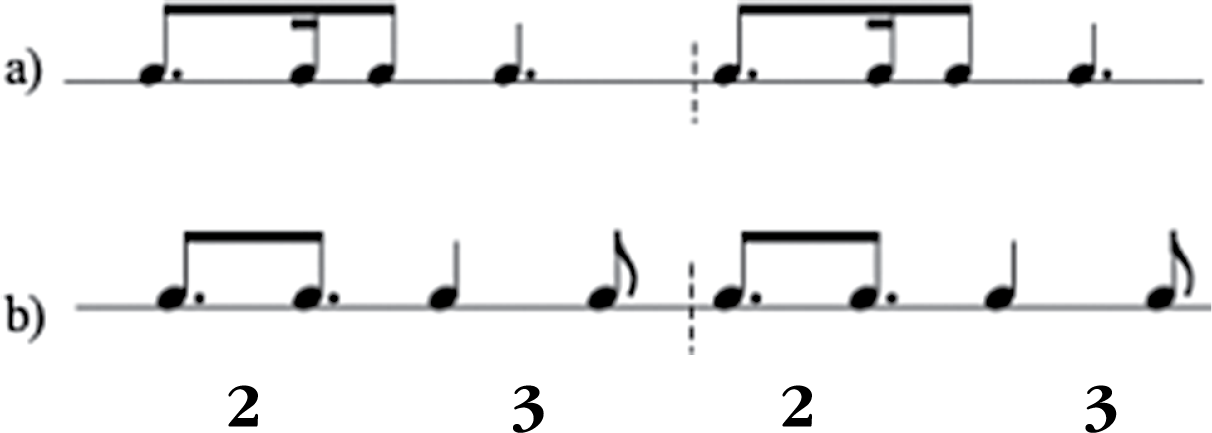
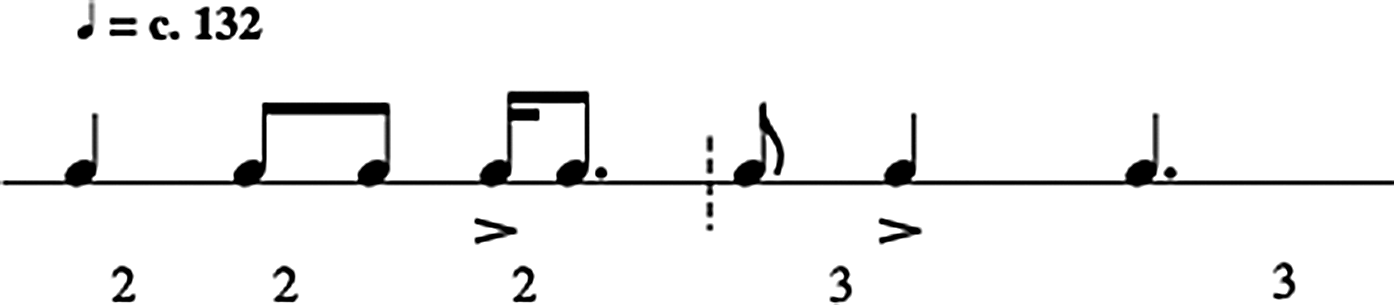
As the Chauṅwārā progresses, the accentual patterns within successive rhythms of the cyclical pattern of twelve move towards symmetrical divisions that inspire faster and smoother forward progression around the circle. All Chauṅwārā rhythms I recorded during fieldwork were based on a twelve-beat—or proportionally equivalent—pulse pattern. Thus, the transition from asymmetric patterns to symmetric patterns could be elided further through rhythms with accentual patterns that create a hemiola effect through alternating patterns of 2 + 2 + 2 and 3 + 3. This is the second transitional feature I suggest here, and is shown in Figure 3. Though each half of the rhythm is divided differently, an overall feeling of twelve pulses is established as the structurally audible length of the pattern becomes clearer. Furthermore, the beginning of the cycle becomes more firmly established. In short, cyclicality begins to solidify through a more articulated symmetry. Nonetheless, the repetitive performance of rhythms frequently obscures any sense of the beginning point of a cycle. As I discuss below, changes in rhythmic structures during performance can obscure the beginning even further through the creation of alternate rhythms that seem to cross over particular points in the cycle. As twelve pulses become the audible overarching length of the cyclical pattern, individual rhythmic cells within the pattern begin to change to emphasise and reinforce the cyclicality of the pattern. This metamorphosis of rhythmic cells occurs through two means: a gradual displacement/shifting of accent and a subtle change of rhythmic character. Figure 4 places three rhythms above each other to demonstrate the features of this third transitional device.
A rhythmic cycle with an accentual pattern alternating between 2+2+2 and 3+3.
Three rhythms illustrating a change of accentual placement and a change of rhythmic character.
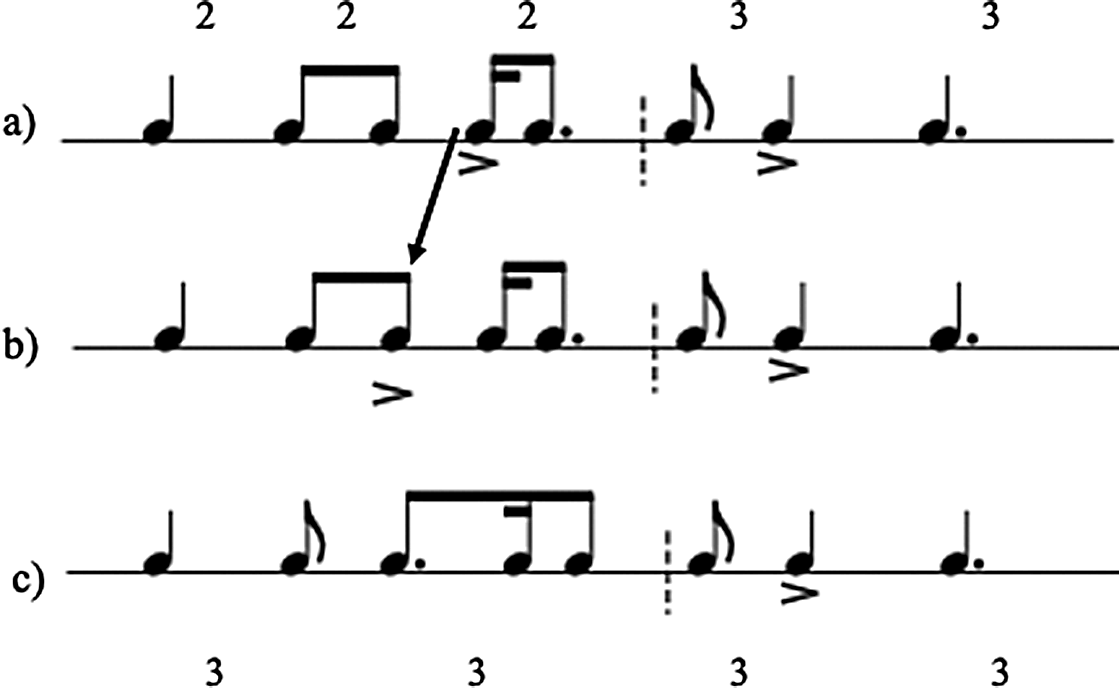
The first accentual pattern (a) shown in Figure 4 is the same as that of Figure 3. Beneath this accentual pattern the same rhythm is shown again (b). However, the second pattern is altered through a shift of accent to a beat earlier in the first half. This changes the underlying division of the whole pattern into a more clearly defined 3 + 3 + 3 + 3. Remembering that while this is occurring the overarching tempo is also increasing, the subtle shift of lilt is enacted through a change of rhythmic cell. With the shift of accent onto the fourth eighth-note of the pattern, this new accented beat becomes the first beat of a rhythmic cell defined by the pattern “dotted eighth note, sixteenth note, eighth note.” To create this new rhythmic character, the effective length of the fourth eighth-note beat in rhythm (c) is lengthened subtly. Overall, the final rhythm (c) in Figure 4 is created.
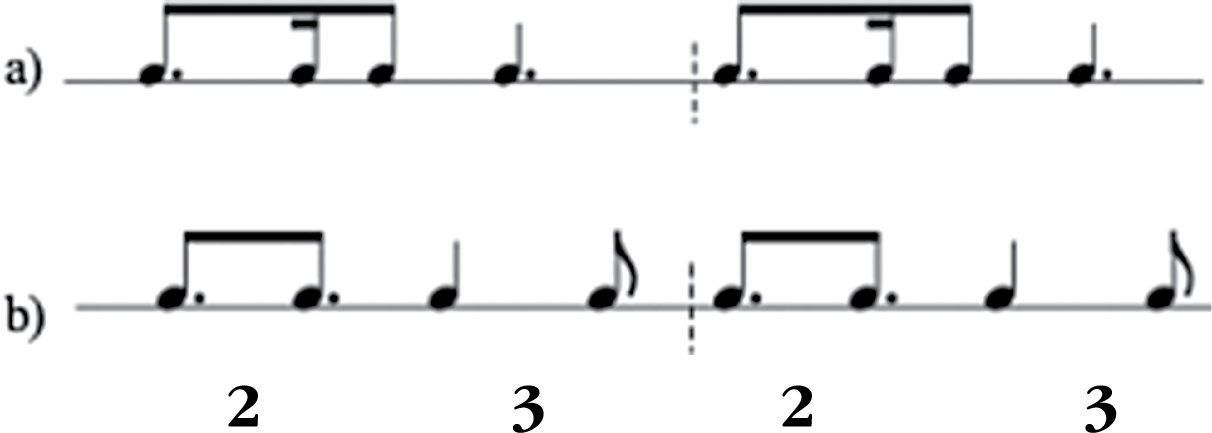
The fourth transitional feature of the Chauṅwārā rhythms to highlight is the lengthening of rhythmic phrase pattern that may occur as the dancing speeds up. As the tempo increases the twelve pulses of the cycle become more and more densely organised as the cycle is effectively shortened. At a certain point, the shortened length means that a pattern over two cycles of twelve pulses may be created. In general, such patterns involve a pairing of rhythmic phrases that create a question and answer relationship between two successive patterns of twelve. Figure 5 illustrates a pair of rhythms that are designed in this way. The two halves are of course very similar, though they operate together to create a balanced effect. Naturally, the accent just before the final rest at the end of the example is a moment when dancers’ movements stop together on a coordinated gesture of some kind. Thus, the more lengthy pattern not only moves the perception of the cycle from one level of cyclical understanding to another, but also serves to create a point of coordination that is easily heard by the dancers. This point of coordination is a further means by which the entrainment of the dancers is reinforced.
A set of paired rhythms that extend the length of the cycle to twice its original length.

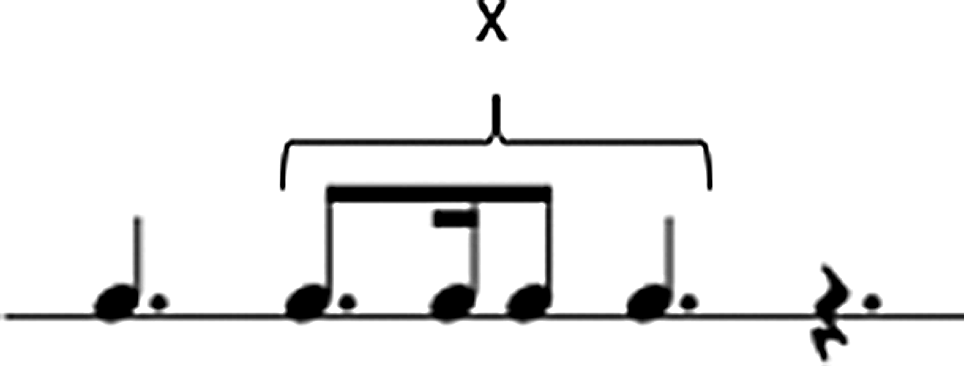
Significantly, rhythms in the Chauṅwārā are also designed so as to prepare the aural space of the Pāṇḍavalīlā for the forthcoming individual dances that comprise the remainder of the event. This is the fifth transitional feature embedded within the music. For instance, in the village of Budna the most audible rhythmic pattern associated with individual character dancing is the accentual pattern shown in Figure 6. The pattern is related to the accentual pattern shown at the end of the paired rhythm of Figure 5. A further feature of the pattern that highlights the similarity between Figures 5 and 6 is the fact that the final stroke that precedes the rest in both patterns is a loud high-pitched left-hand rim stroke. Moreover, the quick sixteenth-note “fill” that visually distinguishes the two notations here is in fact a softer open stroke that is not overtly accented. Thus, in the drum patterns of Budna village the main pattern used for individual character dancing is foreshadowed in this way at the end of the earlier Chauṅwārā rhythm. Similar connectivity between Chauṅwārā rhythms and individual character dancing exists in other villages, too.
Main accentual pattern used for individual character dancing in Budna village.
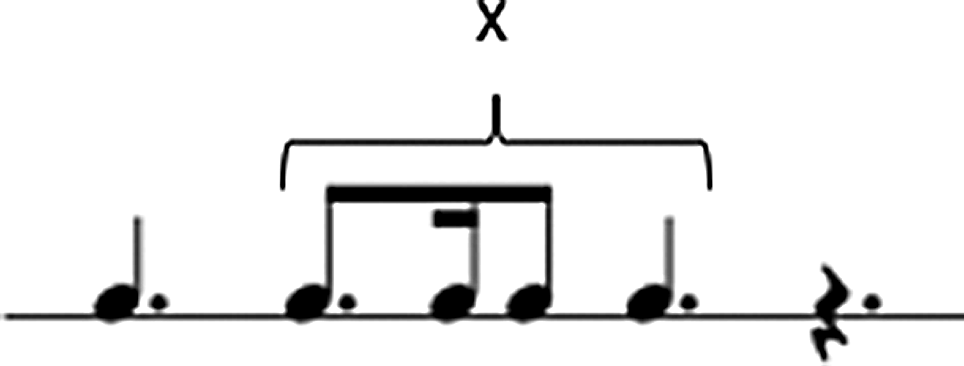
During an individual character’s dance, drummers might at various times also sing the incantation (birad) of that character. In Budna village this is done while softly playing a stroke pattern that shortens the pattern shown in Figure 6 even further. This is illustrated as pattern (b) in Figure 7, wherein the duple division of the triplet—itself iterated as the soft sixteenth filler note in (a)—is picked up by the ḍhol player as a duple rhythm for accompanying the singing. This kind of oscillation between a more emphatic triplet rhythm and a softer duple division of each alternate triplet is audible in many drum strokes used for individual character dancing.
Accentual patterns used for individual character dancing and birad singing.
An overall ambiguity between simple and compound divisions is in fact a feature of the Chauṅwārā rhythms used in various villages, not just in Budna. Coupled with a steady increase in tempo as well as the process of lengthier phrase creation (shown in Figure 5), such an ambiguity of simple and compound subdivisions and groupings is used by drummers as a device to transition between different rhythms. While actual rhythms may introduce variation through the inclusion of extra rolls, flams, and drags, the accentual patterns in the examples demonstrate the levels at which the play between simple and compound divisions functions. As the tempo changes and the rhythms are played repeatedly, the sense for a beginning point within any particular pattern becomes submerged within the repetition. Though the visual nature of notation requires that the rhythms in the examples are shown with a beginning point, in reality, patterns which exist in repetitive form move between the different emphases of simple and compound divisions in a less clear form. The ambiguity of compound or simple subdivisions is therefore further masked within a shifting sense for (or even absence of) a beginning point. Ultimately, I would suggest that drummers and dancers hear (and use) the emergence of variable rhythmic accentuation as a device that symbolises transition and inspires transitional states of consciousness.
Entrainment between drummers and dancers is always a work in progress. As dancers feel the accentual patterns of the drums they naturally move to remain in sync with that accentual pattern. Within each pattern, however, there exists the potential of another interpretation of divisional accent and consequent movement. Furthermore, rhythms shift as drummers and dancers move communally within a domain of coordinations that is constructed through transitions between drum patterns. The gradual alignment of dancers’ movements with drum rhythms fosters the group’s understanding of the conventions of movement and achieves the onset of possession.
A Fanfare
The final transitional feature of the aural space of a Pāṇḍavalīlā to note here is the use of trumpets to signal the arrival of deities at various significant moments. Bhaṅkorās are lengthy (about two-meter) conical-bored copper trumpets used for this purpose. Bhaṅkorās are valveless and are not played melodically. Normally, two are played at the same time by ceremonial assistants who stand at the edge of the performance space. All performances that I have witnessed involved a rapid swinging motion associated with the sounding of the instrument. Thus, the pitches that were used comprised a few of the instrument’s upper partials while the instrument’s end was swung rapidly in an arc of about 90 degrees. The visual display of swinging instruments (in pairs) symbolically matches the idea of “throwing” sound out into the space of the performance. The movement also emphasises the vigorous effect of a fanfare; that is, the force required to blow the instruments is picked up as a visual symbol through the act of a vigorous swinging motion.
Invariably, the Bhaṅkorās are played at the end of a Chauṅwārā, when all dancers demonstrate their possessed state through individualistic and spectacular movements. The fanfare therefore announces the presence of the deities as they arrive on their mediums. The physical power of the deities is matched by the effort required to “throw” the sound forward and by the vigorous and energetic movements of the possessed dancers.
Conclusion: Transitional States, Performative Space, and Individual Character Dancing
The Chauṅwārā as described above is overtly designed to occur at the start of a Pāṇḍavalīlā so that the arrival of the deities/characters may be witnessed and celebrated by the audience each afternoon and evening of the ritual. Bhaṅkorās are used to further signal the arrival of deities within the sacred performance space. Notably, however, the end of the Chauṅwārā is in fact the beginning of a more dramatic series of individual character dances. These may be performed by smaller groups of characters who outline in abstract form the particular episodes of the epic that are most relevant to their characters. Arjuna might dance with his son Nagarjuna in a scene depicting their original meeting and the battle that results from their complicated relationship. Bhima and Hanuman dance together to show their meeting and subsequent contest. Over the weeks of a Pāṇḍavalīlā the procedure is the same: afternoon and evening performances begin with the preparation of a sacred space through the iteration of a Baṙhāī. A Chauṅwārā is danced to bring on the possession of the characters. Individual characters then dance different episodes from the Mahābhārata to illustrate their characters and to present the epic in episodic form.
Transitions between the different worlds of humans and deities is therefore a constant feature of a Pāṇḍavalīlā. In particular, movement between different episodic dances requires different levels of possession. A dancer may wait at the side of the arena while fellow dancers perform their dances. Draupadi’s dual character traits—as wife of the five brothers and in her alternate persona as DurgaFootnote 7—means that female audience members come forward to receive Durga’s special blessings even while it appears that Draupadi is dancing. The time between afternoon and evening performances is a liminal space between different iterations of the same episodes or the presentation of new ones. Over the weeks of a performance, costumes and set designs become more elaborate as the time between displays is used to construct a more elaborate presentation. On the one hand, therefore, the rhythms of the Chauṅwārā are used to move characters into a possessed state. On the other hand, the lengthy period over which a Pāṇḍavalīlā is enacted means that there are moments of preparation, moments of anticipation, time-spaces of intentionally designed progress towards a trance-state, points of repose, and points of dramatic danced rendition. All of these states require transitions between different states of consciousness. As Becker suggests, movement into and out of different states of trance imply a habitus of listening in which the trancer and the self are indivisible. “The listening self…is a self who waits and listens for clear signs of intervening…signs that he/she is about to become a different self” (Becker Reference Becker2004:106).
Key to this habitus of listening is the sonic design of the aural environment within which transitional moments from one self to another are signaled, developed, and/or heralded. Becoming possessed is a process enacted within broader aural contexts across time, and is associated with shared communal traditions of conventional behaviour and cosmological explanation. Transition between states of possession in a Pāṇḍavalīlā is organised through sound—frequently rhythmically iterated sound—and it is processual. Rather than presuming that a trancelike state exists for each individual, it is more valuable to consider how actors/dancers engage with their community in a lengthy ritual through which different trance states are attained and expressed. These are performed as an expression of a possessed state of consciousness and as a danced episodic event. Many states of possession exist through which ritual is enacted, stories are told, and deities are worshipped.
A Pāṇḍavalīlā is a theatre of transition between these different states. The normal aural space of daily life is transformed through the sacred invocation of a Baṙhāī. Group dancing of the Chauṅwārā brings deities to the arena and transforms humans into mediums for the display of supernatural character and power. The rhythms of the Chauṅwārā organise progress towards transition by requiring dancers to engage with shifting rhythmic features and different accentual patterns—patterns that carry within them the ambiguous outline of alternate rhythms, depending on tempo and perception. Entrainment with these rhythms is achieved through the act of communal dancing, which ensures that dancers interact not only with drums but also with each other. Specific rhythms emerge and are rearticulated for the individual character dances that entertain audiences with stories while demonstrating the real value of efficacious ritual action.