Implications
Compared with conventional production systems, outdoor pig production systems are often perceived to be more environmental friendly and better for animal welfare and, moreover, have relatively low capital investment. This study shows that intensive outdoor pigs had less backfat thickness, slightly higher lean percent and a meat with lower fat content than the conventional system. Therefore, alternative pig rearing systems with indoor space and free outdoor access could be an interesting production system for the pig. In addition, the use of diets with or without corn grain silage to pigs is compared.
Introduction
Conventional production systems are generally associated with negative environmental impact (pollution, offensive odors), and poor animal welfare, due to high animal densities and bad housing conditions, and are perceived to result in reduced meat quality (reviewed in Bonneau and Lebret, Reference Bonneau and Lebret2010). Intensive outdoor pig production systems have been put into practice (pigs housed in an open building with outside access) in recent years in some parts of the world (Bonneau and Lebret, Reference Bonneau and Lebret2010). Interest in outdoor pig production is also growing in Poland. These alternatives to traditional indoor systems may also become more common as environmental or animal welfare regulations become more intense. In addition, outdoor pig production systems often have relatively low capital investment, and the ability to be readily expanded.
The effects of pig rearing conditions on production and quality of pork are conflicting. Some studies have determined that pigs finished outdoors had less backfat than pigs finished indoors (Enfält et al., Reference Enfält, Lundström, Hansson, Lundeheim and Nyström1997; Sather et al., Reference Sather, Jones, Schaefer, Colyn and Roberston1997). Other studies (Gentry et al., Reference Gentry, McGlone, Miller and Blanton2002; Lebret et al., Reference Lebret, Meunier-Salaün, Foury, Mormède, Dransfield and Dourmad2006) have reported to the contrary. In addition, Lebret et al. (Reference Lebret, Meunier-Salaün, Foury, Mormède, Dransfield and Dourmad2006) found lower lean meat content in pigs reared outdoors, but other authors (Högberg et al., Reference Högberg, Pickova, Stern, Lundström and Bylund2004) did not report any effect between indoor and outdoor systems on intramuscular fat content and lean percentage. The influence of rearing systems on other quality parameters, such as ultimate pH, tenderness and drip loss of meat, is also controversial (reviewed in Lebret, Reference Lebret2008 and Bonneau and Lebret, Reference Bonneau and Lebret2010). However, outdoor access is likely to increase the level of physical exercise of the animals, which may have an effect on intramuscular collagen (IMC) characteristics (Maiorano et al., Reference Maiorano, Filetti, Gambacorta, Ciarlariello and Cavone2003), responsible for the background toughness of meat (McCormick, Reference McCormick2009), and on yield from a technological point of view (Boutten et al., Reference Boutten, Brazier, Morche, Morel and Vendeuvre2000).
Very often, an outdoor rearing system is associated with the supplementation of commercial diet mixtures along with farm-grown feedstuff, such as different green forage. Climatic conditions in Poland are not conductive to cultivation of corn for dry feed. Therefore, some farmers use wet corn crops as silage for fattener pig feeding. Some authors have reported that limited doses of silaged corn should be used in pig diets during the whole fattening period (Grabowicz et al., Reference Grabowicz, Dorszewski, Kapelański and Obryk2006; Millet et al., Reference Millet, Cox, Van Paemel, Raes, Lobeau, De Saeger, De Smet, Goddeeris and Janssens2006) because inclusion of high rate of corn cob mix in the pig ration may affect immunocompetence (Millet et al., Reference Millet, Cox, Van Paemel, Raes, Lobeau, De Saeger, De Smet, Goddeeris and Janssens2006).
The aim of the present study was to evaluate the effects of rearing system (outdoor v. indoor), diet (with corn grain silage v. without corn grain silage) and gender on growth performance, carcass characteristics, meat quality and IMC properties of Polish Landrace pigs.
Material and methods
Animals
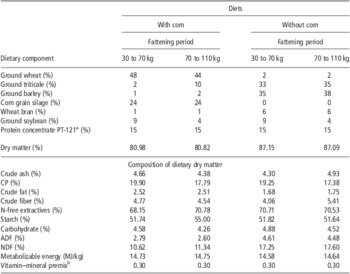
Animal handling followed the recommendations of European Union directive 86/609/EEC. The trial was carried out in a pig farm located in the Kujawy-Pomorze region of Poland. Forty-eight Polish Landrace pigs (an average age of 80 ± 2.1 days old) were individually marked, weighed (initially 32.43 ± 0.70 kg live weight) and randomly distributed into four groups of twelve pigs, each group comprising six barrows and six gilts. The two groups were kept outdoors and the other two indoors. The first two groups were reared outdoors. One of the two groups reared outdoors was fed a diet with corn grain silage, whereas the second did not receive such supplement. In the case of the group kept indoors, as previously, one received diet with corn grain silage, whereas the second did not receive this addition. During the trial period of 14 weeks (from the last week of May to August, with sporadic maximal temperature not passing 26°C to 28°C), pigs were housed in 24 pens of 6 m2 (indoor environmental temperature: 20.6 ± 2.6°C) with two pigs per pen (three pens per treatment), and the outdoor-reared animals had access to a paddock of 24 m2 (average temperatures were: 16°C for June, 19°C to 20°C for July and 17°C for August). During the trial, pigs were fed a diet computed according to the standard requirements and supplied on a basis of 9% of metabolic weight (live weight0.75). The animals were fed twice daily and during the experimental period had free access to water. Composition and chemical components of the diets are given in Table 1. To calculate the food amount to be administered and the average daily weight gain (ADG), pigs were individually weighed (in the morning after an overnight fast) at the beginning of the trial, monthly and at slaughter.
Mean values of composition and chemical components of the diets

aComposition of protein PT-121: metabolizable energy, 9.04 MJ; Net energy, 6.46 MJ; CP, 32.70% to 33.70%; Crude fiber, 8.50%; Crude ash, 22% to 24%; Crude fat, 2.5% to 4.5%; Ca, 5.85%; P-digestible, 1.48%; Na, 1.25%; Lysine, 4.12%; Methionine, 0.70%; Methionine + Cystine 1.27%;
Tryptophan, 0.41%; Threonine, 1.41%.
bThe vitamin–micromineral premix provided the following quantities of vitamins and microminerals per kilogram of complete diet: vitamin A as retinyl acetate, 11 128 IU; vitamin D3 as cholecalciferol, 2204 IU; vitamin E as dl-α tocopheryl acetate, 66 IU; vitamin K as menadione nicotinamide bisulfate, 1.42 mg; thiamine as thiamine mononitrate, 0.24 mg; riboflavin, 6.58 mg; pyridoxine as pyridoxine hydrochloride, 0.24 mg; vitamin B12, 0.03 mg; d-pantothenic acid as d-calcium pantothenate, 23.5 mg; niacin as nicotinamide and nicotinic acid, 44 mg; folic acid, 1.58 mg; biotin, 0.44 mg; Cu, 10 mg as copper sulfate; Fe, 125 mg as iron sulfate; I, 1.26 mg as potassium iodate; Mn, 60 mg as manganese sulfate; Se, 0.3 mg as sodium selenite; and Zn, 100 mg as zinc oxide.
Slaughter surveys
All the animals were slaughtered the same day at 180 ± 2.1 days of age according to standard procedures (Poland PN-86/A-82002-1) in a commercial slaughterhouse located 2 km from the experimental farm. The animals were transported with straight-deck trailers constructed of aluminium punched sides and were gently moved to a small room where they remained overnight with access to water, but not to feed. Pigs were electrically stunned and following exsanguination, the carcasses were scalded, dehaired and eviscerated. Hot and cold carcasses were weighed and dressing percentages were calculated. Dressing and jointing procedures were the same as applied at Slaughter Performance Testing Stations (Różycki, Reference Różycki1996). Meat of primal cuts was calculated according to the equation elaborated by Różycki (Reference Różycki1996) and divided by the half carcass weight to obtain the percentage carcass lean content as follows:
 $$\[<$$>Y\,{\rm{ = }}\,{\rm{1}}{\rm{.745}}{{x}_{\rm{1}}}\,{\rm{ + }}\,{\rm{0}}{\rm{.836}}{{x}_{\rm{2}}}\,{\rm{ + }}\,{\rm{0}}{\rm{.157}}{{x}_{\rm{3}}}\,{\rm{ - }}\,{\rm{1}}{\rm{.884}}\eqno<$$>\]$$
where Y = meat of primal cuts (kg); x 1 = ham without backfat and skin (with shank; kg); x 2 = loin without backfat and skin + tenderloin (kg); x 3 = (2× width + height) of loin eye area (cm2). Carcass lean content (%) = Y/half carcass weight × 100.
Backfat depth was measured with electronic calipers up to 1 mm accuracy. From 5 measurements (above the shoulder in thickest area, between the last thoracic vertebra and the first lumbar vertebra, Sacrum I, Sacrum II, Sacrum III) of backfat thickness the arithmetic mean was calculated (Różycki, Reference Różycki1996). The hot carcass was split into two sides. At 24 h post mortem, the left side was weighed and dissected into the main commercial cuts. Ham, loin, tenderloin, neck and shoulder cuts were weighed and expressed as percentages of the cold carcass weight. The loin was cut behind the last thoracic vertebra, on the frontal surface loin eye area was determined using a computer analysis system LUCIA (System for Image Processing and Analysis, version 4.82.2004). The ham was dissected into the main tissue components (lean, fat, skin and bone).
Meat quality measures
The following determinations were carried out on longissimus lumborum (LL) muscle between the 2nd and 5th lumbar vertebra. The pH45 was recorded 45 min post mortem using a portable pH-meter equipped with a glass electrode (R. Matthaüs, Pöttmes, Germany). At 48 h post mortem, the meat pH was measured in freshly minced and water-suspended meat tissue. At the same time the water holding capacity (WHC) was determined using filter paper (Whatman No. 1) press method (Grau and Hamm, Reference Grau and Hamm1957) and was expressed as free water in meat.
The drip loss was measured (Honikel, Reference Honikel1987) on LL chops (2.0 to 2.5 cm thick). Immediately after cutting off and weighing, the sample with fascia was put into double polythene bags, where the inner bag was perforated to allow the exudate leaks. Meat samples were collected from the carcasses at 24 h post mortem and then stored for 48 h at 4°C. Drip loss was expressed as the percentage sample weight loss during storage.
For the determination of meat tenderness instrumental analysis was performed using an INSTRON 3342 (Norwood, MA, USA), with Warner–Bratzler shear force device (Szalata et al., Reference Szalata, Pospiech, ̡yczyński, Urbaniak, Frankiewicz, Mikołajczak, Medyński, Rzosińska, Bartkowiak and Danyluk1999). The LL chops (2.5 to 3.0 cm thick) were kept in a frozen state at −25°C until analysis. After thawing for 24 h at 4°C, the chops were wrapped with gauze cloth and cooked in 0.85% NaCl at 70°C for 45 min. Then, the samples were cooled overnight at 4°C before Warner–Bratzler shear values were determined. Three cores were cut parallel to the muscle fibers and each core was sheared four times. The average of 12 shears was expressed in N/cm.
Meat chemical characteristics
The LL muscle samples were collected (after 24 h at 2°C to 4°C), between the 2nd and 5th lumbar vertebra, vacuum packaged and stored frozen (−40°C) until chemical composition and IMC analyses.
Proximate analysis
On LL samples, moisture (method no. 950.46), fat (method no. 991.36), protein (method no. 981.10) and ash (method no. 920.153) were assessed according to AOAC procedures (Association of Official Analytical Chemists, 1999, Ch. 39), after 24 h thawing at 4°C.
Collagen analysis
Approximately 100 g of muscle (wet weight) was thawed at room temperature, trimmed of fat and epimysium, lyophilized for 48 h, weighed and hydrolyzed in Duran tubes in 5 ml 6 N HCl at 110°C for 18 to 20 h for determination of hydroxyproline (Woessner, Reference Woessner1961) and cross-linking. All analyses were carried out in duplicate. Collagen content was calculated by multiplying the measured weight of hydroxyproline by 7.25. Hydroxylysylpyridinoline (HLP) concentration, the principal non-reducible cross-link of muscle collagen (McCormick, Reference McCormick2009), was determined using a modified HPLC procedure developed by Eyre et al. (Reference Eyre, Koob and Van Ness1984). The HPLC was equipped with a Kontron 450 MT2 (Kontron Instruments, Milan, Italy) data system and with an Altex (Beckman Instruments, Fullerton, CA, USA) Ultrasphere-ODS (C-18; small pore; 4.6 × 250 mm) column. The HLP was expressed as moles of HLP per mole of collagen and also as μg of HLP per mg of lyophilized tissue.
Statistical analysis
Data were performed using SPSS package (SPSS/PC + Statistics 17.0, SPSS Inc., Chicago, IL, USA, 2008). Data were evaluated by factorial ANOVA where rearing system, diet and gender were the main factors. Pen was the experimental unit for growth performances and each individual pig was considered as the experimental unit for carcass characteristics and meat quality. BW at slaughter was included as a covariant. The interaction between the main factors was not significant and is not reported in the results. Relationships between shear force and IMC variables were evaluated with simple linear correlations using the same statistical package.
Results and discussion
Growth and slaughter performance
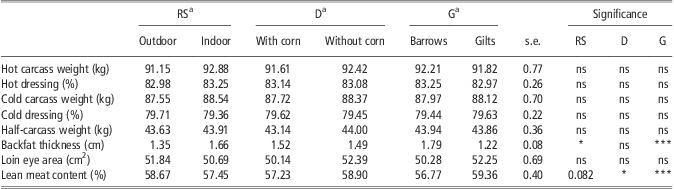
The rearing system, diet and gender did not significantly affect final weight (ranging from 109.82 to 111.56 kg) and ADG (ranging from 779.65 to 806.57 g/day), as well as hot and cold carcass weight, and dressing percentage (Table 2). There has been considerable work comparing the performance of outdoor with indoor finishing pigs in Europe, but such studies are scarce in Poland. The influence of outdoor rearing on pig performances varies according to many factors, such as housing, genetics, climatic conditions, space allowance and feeding regimen (Lebret et al., Reference Lebret, Meunier-Salaün, Foury, Mormède, Dransfield and Dourmad2006). Gentry et al. (Reference Gentry, McGlone, Miller and Blanton2002) did not find any effect on pig growth and carcass weight of rearing environment (indoors on slats or outdoors fed alfalfa pasture). Lebret et al. (Reference Lebret, Meunier-Salaün, Foury, Mormède, Dransfield and Dourmad2006) reported that pigs reared in an outdoor system (sawdust bedding with free access to an outdoor area, 2.4 m2/pig) exhibited better growth rate due to their greater feed intake, especially during the finishing period, and heavier carcasses compared with pigs reared in the conventional system (fully slatted floor, 0.65 m2/pig).
Mean values for carcass traits
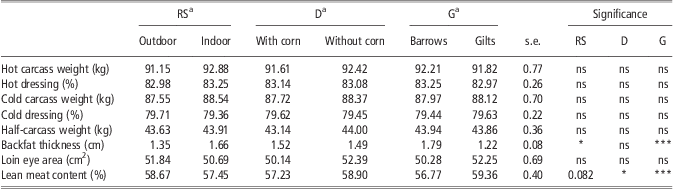
RS = rearing system; D = diet; G = gender.
aTwenty-four pigs for treatment.
*P < 0.05, ***P < 0.001.
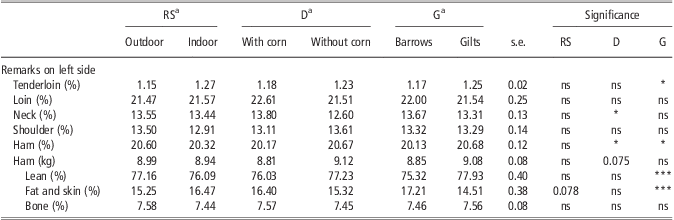
Compared with indoor animals, outdoor animals had less (P < 0.05) backfat thickness, slightly higher but not statistically significant (P = 0.082) lean meat percentage, and similar loin eye area (Table 2) and percentage of tenderloin, loin, neck, shoulder and ham (Table 3). In addition, the weight of the ham was similar between outdoor and indoor pigs. The tissue dissection indicated that pigs reared indoors had only a slightly higher but not statistically significant (P = 0.078) proportion of fat and skin compared with the pigs reared outdoors (Table 3). Previous studies (Enfält et al., Reference Enfält, Lundström, Hansson, Lundeheim and Nyström1997; Sather et al., Reference Sather, Jones, Schaefer, Colyn and Roberston1997) reported that pigs reared outdoors had less backfat than those reared indoors. These findings and those in the current study are not consistent with the findings of Lebret (Reference Lebret2008). Pigs reared in the outdoor system exhibited higher backfat depth. Compared with conventional indoor rearing, Lebret et al. (Reference Lebret, Meunier-Salaün, Foury, Mormède, Dransfield and Dourmad2006) reported that pigs reared with free access to an outdoor area had thicker mean backfat, independent of carcass weight, although the proportions of carcass cuts (except to backfat) were unaffected.
Mean value for cuts and lean, fat and bone content of the ham
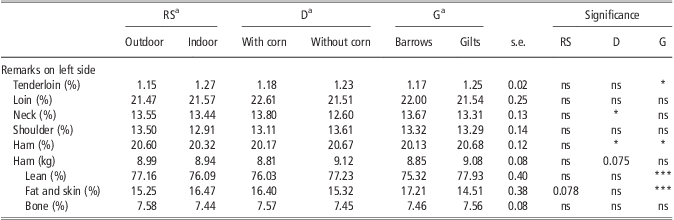
RS = rearing system; D = diet; G = gender.
aTwenty-four pigs for treatment.
*P < 0.05, *** P < 0.001.
Compared with the corn grain silage diet, diet without corn grain silage had a higher percentage of both triticale and barley and also had a higher percentage of dry matter and lower percentage of fat (Table 1). Diet did not affect slaughter performance, except the lean meat percentage that was higher (P < 0.05) in pigs fed without corn than in the pigs fed with corn (Table 2). It should be stressed that carcass lean content in our experiment was relatively high ranging from 58.90% in the control group to 57.23% in the corn group. In a previous study, Różycki (Reference Różycki2003) found an average carcass lean content of 57.6% in the Polish Landrace pigs (n = 625). The lower muscularity of pigs fed the diet with corn grain silage is likely an effect of lower conversion rate of CP from mixture with maize grain as reported by Grabowicz et al. (Reference Grabowicz, Dorszewski, Kapelański and Obryk2006). A tendency towards lower weight gains with large doses of maize silage, especially with low content of or without cobs in pig feeding was observed by several authors (Rajic et al., Reference Rajic, Sevkovic, Maricic and Manojlovic1988; Burgstaller, Reference Burgstaller1995).
Carcass weight, dressing out and loin eye area were not affected by gender. Barrows had fatter carcasses than gilts (P < 0.001), which agrees with the findings of Correa et al. (Reference Correa, Gariépy, Marcoux and Faucitano2008) and Fernández-Dueñas et al. (Reference Fernández-Dueñas, Myers, Scramlin, Parks, Carr, Killefer and McKeith2008). The lean meat content was higher (P < 0.001) in gilts than in barrows (Table 2), in agreement with the earlier study (Fernández-Dueñas et al., Reference Fernández-Dueñas, Myers, Scramlin, Parks, Carr, Killefer and McKeith2008).
Compared with pigs fed diets containing corn grain silage, animals fed diets without corn grain silage had a higher (P < 0.05) percentage of ham and a lower (P < 0.05) percentage of neck, and a slightly heavier but not statistically significant (P = 0.075) ham (Table 3). Compared with barrows, gilts had higher (P < 0.05) percentages of ham and tenderloin; however, loin, neck and shoulder did not differ between the sexes (Table 3), which agrees with previous research (Blasco et al., Reference Blasco, Gou, Gispert, Estany, Soler, Diestre and Tibau1994) indicating that females had similar proportions of shoulder but more ham and loin than castrates. Gender did not significantly affect the weight of ham; however, tissue dissection indicated that gilts had a higher (P < 0.001) proportion of lean and a lower (P < 0.001) adiposity compared with the barrows; the bone percentage was not affected by gender.
Meat quality
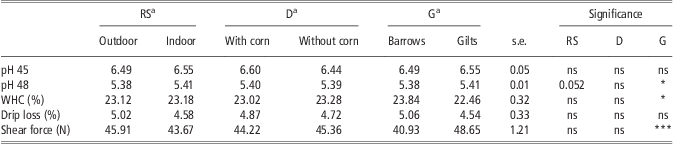
Results on meat quality traits (pH, WHC, drip loss and shear force) in the LL muscle are reported in Table 4. The diet did not significantly affect any meat quality traits. The rearing system also did not affect meat quality traits, except for pH48 value, which was slightly lower in the meat of pigs reared outdoors than in pigs reared indoors (5.38 v. 5.41, respectively; P = 0.052). Differences in pH could be due to the variation in muscle glycogen content: outdoor-reared pigs could have higher glycolytic store, indicating more glycogen in the muscle at slaughter, which then results in more lactate in the post-mortem process (Bonneau and Lebret, Reference Bonneau and Lebret2010). However, ultimate pH value is also dependent on the ante-mortem stress, type of breed and the genetic variation within breeds (Terlouw, Reference Terlouw2005). There is some conflict regarding the differences between pigs raised outdoors and conventionally with respect to pre-slaughter stress and its impact on pork quality (reviewed in Bonneau and Lebret, Reference Bonneau and Lebret2010).
Mean value for pH, WHC, drip loss and shear force of Longissimus lumborum muscle
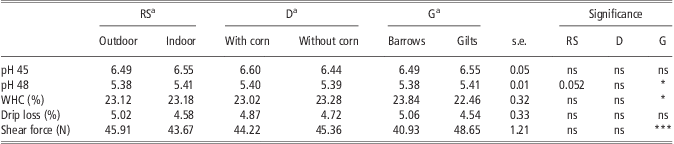
RS = rearing system; D = diet; G = gender; WHC = water holding capacity.
aTwenty-four pigs for treatment.
*P < 0.05, *** P < 0.001.
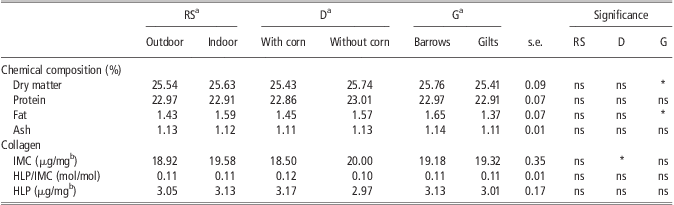
Even though initial pH was not significantly affected by gender, ultimate (48 h) pH of barrows was lower (P < 0.05) than that of gilts. In addition, compared with barrows, gilts had lower (P < 0.05) WHC and their meat was less tender (P < 0.001). Drip loss was not significantly affected by gender (Table 4). Other authors have reported that sex does not influence pH45 and pH24 values (Corino et al., Reference Corino, Musella, Pastorelli, Rossi, Paolone, Costanza, Manchisi and Maiorano2008; Rodríguez-Sánchez et al., Reference Rodríguez-Sánchez, Ripoll, Calvo, Ariño and Latorre2009), WHC and drip loss (Rodríguez-Sánchez et al., Reference Rodríguez-Sánchez, Ripoll, Calvo, Ariño and Latorre2009) in longissimus muscle. Regarding shear force values, similar findings were reported by Fernández-Dueñas et al. (Reference Fernández-Dueñas, Myers, Scramlin, Parks, Carr, Killefer and McKeith2008), who found that meat from gilts had greater shear force values than barrows. Stoller et al. (Reference Stoller, Zerby, Moeller, Baas, Johnson and Watkins2003) reported similar Warner–Bratzler shear force values for the longissimus muscle between barrows and gilts. In addition, these authors observed that the percentage of intramuscular lipid was less in the longissimus muscle from the gilts than barrows (2.27% v. 2.70%, respectively), which concurs with the results of the present study (Table 5). Differences in toughness can be caused by a variety of factors, such as, differences in fiber type proportions, sarcomere length, pH, temperature, fat, connective tissue characteristics and rate of tenderization (Huff-Lonergan et al., Reference Huff-Lonergan, Lonergan and Vaske2000).
Mean value for chemical composition and IMC properties of Longissimus lumborum muscle
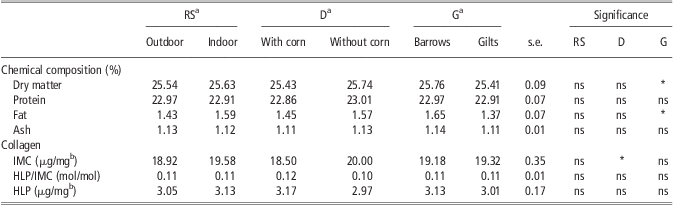
IMC = intramuscular collagen; RS = rearing system; D = diet; G = gender; HLP = hydroxylysylpyridinoline.
aTwenty-four pigs for treatment.
bOf lyophilized muscular tissue.
*P < 0.05.
Chemical composition and IMC properties of LL are shown in Table 5. The rearing system and diet did not significantly affect the chemical composition of the meat. These findings were partially supported by Enfält et al. (Reference Enfält, Lundström, Hansson, Lundeheim and Nyström1997), who observed no effect of the rearing system in intramuscular fat and ash of longissimus dorsi muscle; conversely, these authors reported a higher amount of protein in outdoor pigs than in indoor pigs. Other authors (Lebret, Reference Lebret2008) reported higher intramuscular fat in the m. longissimus in pigs reared outdoors; conversely, Sather et al. (Reference Sather, Jones, Schaefer, Colyn and Roberston1997) found that the longissimus thoracis muscle of pigs reared indoors had higher fat content compared with pigs reared outdoors.
No differences between sexes were detected for protein and ash percentages. However, barrows had more (P < 0.05) intramuscular fat than gilts, which is in line with the higher carcass fat content observed for castrates, and greater (P < 0.05) dry matter, a finding in accord with the literature (Stoller et al., Reference Stoller, Zerby, Moeller, Baas, Johnson and Watkins2003; Fernández-Dueñas et al., Reference Fernández-Dueñas, Myers, Scramlin, Parks, Carr, Killefer and McKeith2008). These findings are not surprising because castration favours intramuscular fattening of meat (Barton-Gade, Reference Barton-Gade1987).
Collagen concentration and degree of collagen maturation, expressed as HLP cross-link concentration, were not influenced by the rearing system. In a previous work, Maiorano et al. (Reference Maiorano, Filetti, Gambacorta, Ciarlariello and Cavone2003) did not find any effect of rearing system on longissimus muscle collagen content, but these authors report an increase of HLP content and HLP/IMC ratio in m. semimembranosus of outdoor pigs than their confinement-reared counterparts. Differences in IMC amount and cross-linking among muscles could be due to functional and structural differences between locomotor and postural muscles (McCormick, Reference McCormick2009).
Diet had a minimal influence on IMC properties. IMC concentration decreased (+7.5%) with corn supplement (P < 0.05), but there was no significant effect of diet on cross-linking (μg/mg of HLP) and collagen maturity, as indicated by the HLP/IMC ratio. In the present study, a positive correlation (r = 0.334; P < 0.05) was found between shear force values of cooked meat and collagen concentration values. Toughness measurements made with a Warner–Bratzler shear are believed to reflect both the myofibrillar and connective tissue components of muscle (Harris and Shorthose, Reference Harris and Shorthose1988). Connective tissue is believed to contribute to the initial toughness of meat as well as the sensation of chewiness (Duizer et al., Reference Duizer, Gullett and Findlay1996).
Comparison of the sexes revealed no differences in IMC characteristics, a finding in accord with literature (Corino et al., Reference Corino, Musella, Pastorelli, Rossi, Paolone, Costanza, Manchisi and Maiorano2008).
Conclusion
The results of the present study indicate similar hot and cold dressing percentages, physico-chemical traits of LL muscle and IMC properties of Polish Landrace pigs for both a conventional rearing system and an alternative pig rearing system, with indoor space and free outdoor access. Outdoor pigs had less backfat thickness and slightly higher lean percent, as well as a meat with lower pH and fat content than from the conventional system. In light of these results, alternative pig rearing systems with indoor space and free outdoor access could be an interesting production system for the Polish Landrace pig. However, additional studies are required to determine the benefits to the commercial producer and to the consumer. Compared with the pigs fed a diet with corn grain silage, those fed a diet without corn grain silage had lower neck percentage, higher lean and ham percentage, as well as higher IMC amount. Diet did not affect the main tissue components (lean, fat, skin and bone) of the ham and physico-chemical characteristics of meat. Compared with the gilts, barrows were fatter and showed a meat with different physico-chemical traits, which was slightly more tender and had similar IMC properties.