




No CrossRef data available.
Foreign Assistance, International Norms, and NGO Development: Lessons from the Russian Campaign
Published online by Cambridge University Press: 17 May 2005
Abstract
Why have Western donors' efforts to encourage development of Russian nongovernmental organizations (NGOs) varied dramatically in two different NGO sectors, despite similar levels of assistance? I forward a norms-based explanation for varying success in bolstering the Russian women's and soldiers' rights movements. Where foreign assistance is employed to promote norms that are universally embraced, it is highly likely to lead to a successful NGO movement. In contrast, when foreign assistance pursues norms that are specific to other societal contexts, it will fail to develop an NGO movement, regardless of the amount of funding foreign donors devote. NGOs and foreign donors have succeeded by articulating a universal norm against physical harm in the cases of soldiers' rights and domestic violence, but have failed by voicing specifically Western norms of gender equality and feminism in the case of women's rights.I wish to thank Kathleen Collins, Elisabeth Friedman, Kathryn Hochstetler, David Holloway, Stephen Krasner, Gail Lapidus, Michael McFaul, and especially Richard Price, Lisa Martin, and two anonymous reviewers for their close readings and comments on versions of this article. Thanks also to Kimberly Swanzey for excellent research assistance and the Social Sciences and Humanities Research Council of Canada for financial support of the research.
Information
- Type
- Research Article
- Information
- Copyright
- © 2005 The IO Foundation and Cambridge University Press
Western efforts to promote democratization and civil society development around the world have grown into a veritable industry since the early 1990s. In international relations literature, constructivist and liberal accounts of networks of nongovernmental organizations (NGOs) have highlighted the role of transnational actors as “norm entrepreneurs” on the global scene, encouraging domestic adherence to norms they wish to promote.1
A separate body of foreign policy literature has examined foreign democracy assistance aimed at developing civil society in democratizing countries.2See Carothers 1999; Mendelson and Glenn 2002; and Van Rooy 1998.
This article attempts to bridge the gap between these two literatures by arguing that there is a relationship between the norms that Western actors promote and the material funding they provide to NGO movements within newly democratizing countries. The transnational actors who provide foreign assistance to NGOs (or “foreign donors” as they are commonly called) are not only “norm entrepreneurs”; they also act as “moral financiers” by providing much-needed funding to local NGOs to build campaigns on various sociopolitical issues.3
I am indebted to Richard Price for suggesting the terms “norm entrepreneur” and “moral financier” to describe the unique position of foreign donors.
In Russia, women's and soldiers' rights NGOs have experienced funding from foreign donors that is similar in kind and intensity, yet the two NGO movements have developed in strikingly different ways. Soldiers' rights organizations, especially the Committees of Soldiers' Mothers, have fought against the Russian military policy of conscription. The soldiers' mothers have done so primarily by framing their opposition as a protest against physical abuse of conscripts, which appeals to a norm against bodily harm that is practically universally accepted around the world. The soldiers' mothers have become extremely well known and respected in Russian society. Each year, they process tens of thousands of appeals for help from conscripts and soldiers' families in Russia. The largest umbrella organization of soldiers' mothers, the Union of Committees of Soldiers' Mothers of Russia (UCSMR) recently formed a political party and plans to compete in the next federal parliamentary election in 2008. Although the success of this new party is yet to be determined, the party's formation has attracted significant media attention. In fact, news concerning the soldiers' mothers' organizations typically attracts considerable media attention. Soldiers' rights groups have also goaded the Russian government into adopting a law allowing Russian conscripts to carry out alternative civilian service in lieu of military service (although the alternative service conditions are not of the sort that soldiers' rights groups advocate), despite harsh resistance from the Russian military and many politicians.
In addition to the soldiers' mothers' groups, there are other foreign-funded soldiers' rights groups in Russia that have protested conscription by using a philosophy of antimilitarism, which conflicts with a strong Russian norm of respect for the military, instead of appealing to the universal norm against bodily harm. These NGOs have not been nearly as successful in terms of creating policy change or public support and awareness as the soldiers' mothers have.
Women's organizations, such as the soldiers' rights groups, began as small, weak groups; unlike the soldiers' mothers' organizations, though, they remain marginal to this day. Few Russian citizens are aware of the work of contemporary women's groups in Russia. Women's organizations receive little media attention, and the attention they do receive is largely negative in tone. “Women of Russia,” a short-lived women's political party in the 1990s, did not attain much electoral success after 1993, and women's NGOs have mostly failed in their attempts to create legislation relating to women's rights. There is one notable area of women's activism that has become much more successful, however, in terms of gaining public support and a constituency, and bringing about some changes in officials' attitudes: this is in the issue of violence against women. Like conscription, this issue is framed by NGOs as a violation of the norm against bodily harm.
Foreign donors have actively supported both women's and soldiers' rights NGOs in Russia. The impact of foreign assistance on NGO development has been hotly disputed in policy analyses.4
Some argue that funding from foreign donors has little effect on NGOs, while others argue that it fundamentally shapes them. I argue that foreign assistance almost always has an impact on the NGO sectors it supports, but whether it is positive or negative in terms of building successful social movements depends on the kinds of NGO issues that foreign assistance supports. Where foreign assistance is employed to promote norms that are universally embraced around the world, it is highly likely to lead to a successful NGO movement. While these movements in most cases can be built gradually by local activists without the help of foreign donors, foreign assistance creates the material opportunities for NGOs to work on a grander scale, and thus to grow a movement more quickly than they would otherwise have done.In contrast, when foreign assistance is employed in pursuit of norms that are not universal and are specific to other societal contexts, it will fail to engender the development of an NGO movement, regardless of the amount of funding foreign donors devote. In fact, in such cases, foreign assistance may succeed in creating a plethora of NGOs purporting to pursue the norms that donors promote; however, those NGOs will lack public outreach efforts and will not attract significant public support. Because foreign donors will almost certainly not promote norms in other societies that contradict their Western societal norms, the result by default is that the norms that combine successfully with foreign assistance will always be universal norms. The norms and outcomes involved in the NGO movements featured in this article are summarized in Table 1.
Summary of cases, norms, and outcomes

Is it not obvious that resources to pursue universal norms will lead to successful NGO mobilization, while pursuit of culturally incongruous norms will fail? Not exactly, if one looks at the literature on Western democracy assistance. Authors often argue that foreign assistance fails because of political barriers, not because of resistance within society itself. Governments that are hostile to democratic reforms will prevent social mobilization by creating bureaucratic obstacles or even openly threatening activists.5
Liberal theorists of international relations have argued that state structures act as a filter of sorts, providing key barriers and access points for transnational actors to promote their norms.6Schmitz and Sikkink 2002, 523.
Accounts that explain the success or failure of social movement campaigns based on the types of normative appeals they choose are hardly new. Social movement theorists have long argued that the “frame resonance” of particular ways in which social movements depict issues is critical to their level of success.7
See McAdam 1996; and Snow and Benford 1999.
See Checkel 1999; Cortell and Davis 2000; Gurowitz 1999; Keck and Sikkink 1998; and Mendelson and Glenn 2002.
In order to make this argument, I first show that major alternative explanations from social movement theory are unsatisfactory in accounting for the outcomes among Russian women's and soldiers' rights NGOs. Next, I detail the widespread nature of the norm against bodily harm, and I use historical and contemporary evidence to demonstrate the existence of Russian societal norms concerning the military, feminism, and gender equality. I then examine the framing strategies that women's and soldiers' rights NGOs have used, and how foreign assistance has supported those strategies. In the case of women's NGOs, I focus on efforts concerning labor discrimination and domestic violence, because these have been areas in which women's NGOs have worked most diligently on changing public policy and social behavior, making these efforts comparable to those of soldiers' rights organizations against conscription. Finally, I demonstrate the consequent levels of success that women's and soldiers' rights have experienced in Russia to provide the empirical support for the theoretical argument made here.
First, it is necessary to articulate some specific hypotheses that derive from this argument regarding universal versus nonuniversal norms and foreign assistance. If my argument is correct, then one should observe distinct patterns in the successes and failures of mobilization efforts by different groups around issues that involve these ideas. First, NGOs that receive a great deal of foreign assistance and pursue goals that are framed in terms of norms that are practically universal should succeed in achieving goals and acquiring public support. Second, NGOs that also receive high levels of foreign assistance but pursue specific goals that are alien to the society in which the NGOs are situated should be largely unsuccessful. Third, when one examines the activities of organizations in the same general issue area, one should find that activists' use of different kinds of normative arguments to battle serious problems in society yields strikingly different degrees of success. Finally, if foreign assistance provides some “added value” for NGOs that pursue universal norms, one should see that these NGO campaigns can grow and garner support more quickly with an influx of foreign funding than they had previously or would otherwise have done.
The “success” of mobilization is measured here in several ways. Clearly any public policy changes or social change that one can link definitively to the efforts of NGOs concerned with a particular issue are an indicator of significant success. Independent NGOs have existed openly for a little more than a decade in Russia, and observers widely acknowledge that the Russian NGO sector as a whole continues to have relatively little impact on public policy.9
Mendelson and Glenn 2002, chap. 1.
In addition to examining the successful alteration of government policies or social behaviors, I assess the extent of public awareness of and support for the two movements. This can be shown through survey data on attitudes toward the organizations, numbers of citizens who turn to the NGOs for assistance, and the volume and nature of media coverage of the movements. Unfortunately, in Russia, growth in numbers of NGOs themselves cannot be considered an accurate indicator of movement success, because foreign donors sometimes encourage growth in numbers of organizations through their grant programs, but those numbers may not indicate high levels of movement activity. Many organizations remain hollow with few members and even one person forming several organizations, largely as a result of donors' preference to grant funds to many different organizations over time.10
Henry 2001, 7–8.
See Henderson 2003, 113; and Henry forthcoming, 5.
Moreover, recent accurate counts of NGOs in existence are not available. Official government records of NGOs include only those that are formally registered, many of which are no longer active. Meanwhile, some of the most active NGOs are not officially registered at all. The best existing count, although dated, comes from a 1998 directory, which counted approximately 500 Committees of Soldiers' Mothers in Russia, and a little more than 400 women's organizations working on the areas explored in this article: women's employment rights (200) and violence against women (220).12
There are also other soldiers' rights groups that are not soldiers' mothers' organizations—perhaps a few dozen in addition to the 500 CSMs.13Caiazza 2002, 150, cites the leader of ARA as claiming in 1996 to have affiliated member organizations in twenty-two Russian locations.
In addition to defining “success,” it is necessary to define the term “norm” as it is used in this analysis. Following Jepperson and colleagues, I use the term “norm” to refer to “collective expectations about proper behavior for a given identity.”14
That is, norms refer to widely shared conceptions of appropriate behavior. Norms are typically difficult to measure; this paper uses a variety of evidence to document their existence worldwide regarding bodily harm, as well as antimilitarism and gender roles in Russia. I use other works that make a case for the universality of the norm against bodily harm, as well as public opinion surveys, observations of Russian scholars, and statements made by interview subjects and public figures that indicate Russian domestic norms concerning antimilitarism, feminism, and gender roles. Interview subjects' statements are taken from the author's field study, which included interviews with seventy-four women's and soldiers' rights NGOs (as well as more than twenty-five NGOs in other issue areas) in seven Russian regions between March 1999 and August 2000.15The seven Russian cities included in the field study were Moscow, St. Petersburg, Ekaterinburg, Izhevsk, Khabarovsk, Vladivostok, and Novgorod-the-Great.
My argument about the importance of foreign donors supporting universal norms in their NGO development strategies is an argument about necessary conditions, rather than sufficient conditions, for successful mobilization by NGOs involved with them. A whole host of problems may prevent NGO success in working on certain issues, even when there is normative support from domestic constituencies. NGOs may not possess enough material resources to succeed, or they may face insurmountable political obstacles in their attempts to change public policy. Conversely, even if NGOs possess abundant material resources, but face a resistant domestic normative context, they will not succeed in producing change, unless they can connect their claims initially with norms that are already widely accepted.
The argument I make in this article should also not be mistaken for a view that norms are static. Indeed, a key characteristic of norms is that they are socially constructed, and thus tend to develop and change over time as new events and information affect the ways in which people understand the world around them. Social movement theorists and constructivists recognize that interpretative cultural frames can be changed through the collective action of social movements and norm entrepreneurs themselves over time.16
In fact, as I show in the empirical discussion below, Russian activists on soldiers' rights and domestic violence have affected the beliefs and behaviors of elites to some extent. But these activists have done so by framing their campaigns as pursuing a universal norm against bodily harm.Alternative Explanations
Of course, there are other standard explanations for social movement success and failure that might be suggested as alternative challenges to my norms-based account. Social movement theorists focus mainly on three additional kinds of factors, aside from the issue framing explanation I adopt, in accounting for the success of movements: (1) the existence of grievances among identifiable groups in society; (2) the ability of a movement to mobilize material and human resources; and (3) the political opportunity structure in which a movement operates.
With regard to the first factor, grievances, the problems that both the women's and soldiers' rights movements in Russia address are undeniably serious and widespread. It is true that soldiers' rights organizations have become incredibly popular in part because of the frequent incidence and acute nature of the problems they address. Virtually every family in Russia must deal with the issue of male conscription, and the Russian mass media have widely publicized the abuse and neglect of conscript soldiers in the armed forces. According to government figures, in 2002, 2,000 members of the armed forces died as a result of “crimes and incidents.”17
The UCSMR estimates that peacetime deaths among conscripts total between four and five thousand each year.18Obraztsova 1999, 2.
Admittedly, with comparable problems of basic physical abuse of women—such as in the area of domestic violence—the problem does not touch every family. Yet by all accounts, violence against women is at least as common in Russia as in Western countries, and official sources state that more than 14,000 Russian women are killed by their partners every year.19
UNICEF 1999, 82.
Moreover, abundant evidence documents that serious labor discrimination is a rampant phenomenon in Russia, affecting millions of women. As in most Western countries, there is a substantial gap between the earnings of men and women in Russia. Rather than improving in Russia, though, the disparity is worsening over time as labor code regulations become less reliably enforced. In the early 1990s, women's salaries were, on average, 60–70 percent of men's, but by 1999 they were only 56 percent of men's.20
See Baskakova 2000, 63; and ICIWF 2001.
See Baskakova 2000, 63; and UNICEF 1999, 36.
Women face discrimination in employers' lay-off decisions. Inspections conducted by the Russian Labor Inspection (Rostrudinspektsii) in 1994–96 showed increasing numbers of labor law violations through illegal dismissals of women during pregnancy and child care leave.22
Baskakova 1998, 52–53.
See ICIWF 2001; and Russian Federation 1994.
See Bridger, Kay, and Pinnick 1996, 80; and Khotkina 1996, 17.
At first glance, it might seem that the problems that soldiers' rights organizations address are more amenable to assigning specific blame than many women's issues that involve structural discrimination, such as female unemployment or role stereotyping (domestic violence being a notable exception). Yet in reality, prosecution of specific employers for illegally dismissing or sexually harassing female employees, for example, should be easier than prosecuting unruly military officers, given the power of Russia's military structures, the autonomy of officers discussed below, and the violent measures that have been used to induce victims' silence. In short, both women's and soldiers' rights NGOs work on problems in society that are serious and affect enormous numbers of people. There is thus no clear disparity between the two issue areas in terms of the existence of grievances to inspire mobilization.
Second, an argument for resource mobilization would posit that groups possessing the most material resources would garner the most success. However, the two sets of organizations have attracted fairly similar types and levels of support from foreign donors. In fact, in terms of their frequency of foreign funding and degree of dependence on such funding, the two groups of organizations from the field study exhibited strikingly similar profiles. It was not possible to obtain exact totals of the amount of funding that each NGO received from various sources, because many NGOs were reluctant to reveal such information. However, it was possible to find out from them what their primary sources of financial support were, and many NGOs were happy to reveal their funding history.
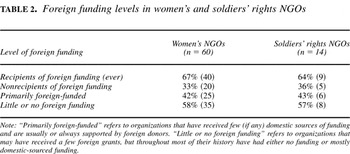
This history suggested that, in total dollar figures, if anything, women's organizations had received more funding than soldiers' rights organizations. For instance, up to the end of the field study period, the UCSMR had received grants totaling approximately $200,000 US from the Swiss government, the Right Livelihood Foundation, and the Ford Foundation. The largest autonomous women's umbrella organization, the Consortium of Women's Nongovernmental Organizations (formerly the NIS-US Women's Consortium) had received far more funding (a total number was not available) from the United States Agency for International Development (USAID), Soros' Open Society Institute, the Ford Foundation, the MacArthur Foundation, the US Information Service, the International Research and Exchanges Board (IREX), and a few other small foreign donors. Similarly, two other major women's organizations, the Information Center of the Independent Women's Forum and the Moscow Center for Gender Studies, had received more foreign funding than either UCSMR or the Soldiers' Mothers of St. Petersburg had received. For both sets of NGOs, though, foreign funding occupied a similar position in terms of its weight in the subsectors' overall funding profiles. Table 2 shows that the organizations interviewed in the two subsectors had virtually identical proportions of NGOs reporting any foreign funding, as well as those reporting primary reliance on foreign funding.25
I interviewed activists from every soldiers' rights NGO that I could find in the cities examined. I interviewed leaders of nearly all of the active women's organizations in each city, except Moscow and St. Petersburg, where there are hundreds of women's NGOs. In those cities, I interviewed leaders of women's NGOs involved in many different kinds of activities.
Foreign funding levels in women's and soldiers' rights NGOs

Moreover, the two subsectors did not differ significantly in terms of the length of time that the organizations have been receiving foreign funding. The median (and also the average) year in which organizations had received their initial foreign grant was 1996 among women's NGOs and 1995 among soldiers' rights NGOs.
NGOs in both the soldiers' rights and women's movements had also received only small amounts of domestic-sourced funding. Approximately one-quarter of both soldiers' rights and women's rights NGOs in the study received funding only from domestic sources (the discrepancy between this proportion and the number for “nonrecipients of foreign funding” in Table 2 is because of the existence of some NGOs with no funding of any kind). However, domestic sources in all cases were very small if in cash form. Usually contributions from domestic sources were in-kind donations, most frequently office space or event facilities, from government agencies or private organizations. In general, as acknowledged by other authors on Russian NGOs, the domestic funding scene was incredibly small.26
See Sperling 1999; and Henderson 2003, 92.
Finally, political opportunity structure explanations are lacking insofar as soldiers' rights organizations have in fact faced a more difficult political opportunity structure than women's NGOs, because their aims concern changes in military institutions, which are notoriously resistant to change, closed to public input, and in Russia have little effective legislative oversight.27
Caiazza 2002, 111–13.
Sperling 1999, 129–43; and also author's interviews with Elena Ershova, NIS-US Women's Consortium, Moscow, 24 March 1999; Elizaveta Bozhkova, Information Center of the Independent Women's Forum, Moscow, 1 April 1999; and Maria Likhacheva, Warm Home Crisis Center, Izhevsk, 14 April 2000.
Because of the implausibility that the above factors can account for the different outcomes in the women's and soldiers' rights movements, in order to explain the greater success of the soldiers' rights movement, one must move to the realm of “issue framing” and normative contexts. The remainder of this article examines NGO activism in several of the issues that soldiers' rights groups and women's groups address: mandatory conscription and physical abuses in the army, employment discrimination against women, and domestic violence. Donors have heavily supported NGOs that work in all of these areas; yet Russian NGO mobilization on these issues has encountered dramatically varying levels of success, because of the different normative contexts that surround each issue. I first turn to these normative contexts and then assess the movements' framing techniques and success.
Universal Norms as Key to Success
The Universal Norm Against Bodily Harm
Keck and Sikkink posit that the norm against violations of human physical dignity is nearly universal: “Not all cultures have beliefs about human rights (as individualistic, universal, and indivisible), but most value human dignity.”31
Keck and Sikkink 1998, 205.
On landmines, see Price 1998. On torture, violence against women and rainforest destruction, see Keck and Sikkink 1998.
In the Russian case, citizens' growing resistance to mandatory military service has been well documented. In their 2002–3 Russia-wide survey of 2,408 respondents, Gerber and Mendelson found that only 30 percent of respondents believed that Russia should maintain a conscript army.33
In addition, during the past few decades, conscription rates have plummeted: in the spring of 2004, only 9.5 percent of those of draftable age were actually conscripted, compared to 54.6 percent in 1988.34See Ministry of Defence of the Russian Federation 2004; and Vremia Novosti, 12 April 2000.
Not many studies have been conducted to pinpoint the reasons for Russian citizens' growing resistance to fulfilling military service. One of the few existing large surveys finds that, among the 72 percent of respondents who would not want one of their relatives to serve in the army, by far the most common reasons are the possibility of death in a conflict (44 percent), dedovshchina (35 percent), and poor physical conditions (23 percent). Pacifism or opposition to militarism did not appear as a reason at all.35
VTsIOM 2002. The survey was multiple-choice without a specific option to choose “opposition to militarism” as an answer. This in itself is revealing of Russian elite views on the military. However, only 5 percent of respondents fell under the residual categories “other reasons” and “cannot name reasons.”
The Economist (UK), 22–28 May 2004.
This norm also extends to other issues that can be framed in terms of bodily harm, including domestic violence. Generally, internationally, NGO mobilization to protest and prevent violence against women has been extraordinarily successful, growing into “the most important international women's issue, and the most dynamic new international human rights concern” by the mid-1990s.37
Keck and Sikkink 1998, 166.
See Bunch 1990; Clark, Friedman, and Hochstetler 1998, 24–25; and Keck and Sikkink 1998, 167.
Zabelina 2002, 42–43.
Rejection of Nonuniversal Norms: Antimilitarism and Gender Equality
As Keck and Sikkink have shown, campaigns often fail when they are framed in terms of norms that are not as universal, or when the norm against bodily harm competes with strong local norms.40
In the cases discussed here, specific norms of antimilitarism and gender equality are weak in Russian society, and thus antimilitarist and feminist campaigns have not succeeded despite foreign donor support.Antimilitarism
A norm of respect for the army and Russia's status as a strong military power complicates popular attitudes toward conscription. Objection to military service for reasons of conscience is a far less accepted action in Russia than objection on the basis of likely physical abuse.
Because of the popular image that the Soviet army held among the population and the reputation it developed as a key element of a young man's education, many Russians continue to view army service as “a necessary instrument for personal development.”41
See Washington Post, 20 May 2001; and Caiazza 2002, 107.
International Institute for Strategic Studies 2002. Population figures from CIA 2002.
See Moscow Times, 5 October 2000; and Ivankovskaia 2001; RFE/RL 2001.
It is difficult to locate surveys that precisely indicate Russians' attitudes toward antimilitarism. However, public opinion on related issues suggests that a large proportion of Russians espouse promilitary ideas. Gerber and Mendelson found that, although confidence in the Russian military has waned significantly in the post-Soviet era, approximately half of their survey respondents continue to have partial or complete confidence in the army.45
Over two-thirds of respondents believed that military spending should be increased in Russia.46Ibid., 6.
Rose 1999, 21.
Gender Equality
Feminism is a concept and a term that is highly disputed worldwide, even within women's networks around the world.49
See Basu 1995; and Sperling, Ferree, and Risman 2001, 1158.
In 1996 Vannoy and colleagues conducted a survey of Muscovites, in which less than 20 percent of the married women respondents and even fewer married men thought that income-earning should be a shared responsibility rather than the sole responsibility of the husband. By comparison, when the same question was asked of Midwestern Americans thirteen years earlier, 47 percent of wives and 31 percent of husbands believed that the responsibility should be shared.51
Ibid., 52–53.
The Independent (London), 21 March 1993.
From the perspective of many Russian women, the Soviet state already granted them legal equality with men and promoted identical images of men and women, particularly in the labor market—yet this “equality” did not improve women's lives. Observers of Russian gender issues widely acknowledge that the Soviet approach to these issues created a backlash against the idea of “equality” between the sexes. As Jurna states, “[T]he hardship that women endured under the Soviet system of ‘equality’ has left a legacy that defines equality with men as an undesirable goal for many Russian women.”54
Jurna 1995, 477.
Voronina 1993, 223.
In the issue of domestic violence, of course, the problem is not completely divorced from beliefs about gender roles, and as a result, discriminatory attitudes toward women emerge in public views on domestic violence. For example, there is a common belief in Russia that women provoke violence.56
Moreover, the traditional problem that has existed for activists against domestic violence everywhere continues to challenge activists in Russia: that of transforming quiet societal disapproval of acts that are basically considered “private affairs” into a belief that the public has a right to interfere in them.57Author's interview with Elena Potapova, ANNA Crisis Center, Moscow, 12 May 1999.
Moscow Times, 20 May 2003.
Framing and Tactics
There are substantial differences between and within the soldiers' rights and women's movements with respect to the ways in which they frame the societal problems that they are trying to solve. Organizations within each of the NGO movements have adopted certain ways of depicting their grievances and have been supported in their efforts by foreign donors who finance them and train activists in how to use certain tactics and approaches.
Soldiers' Rights NGOs
Soldiers' rights NGOs experience great popularity and even some policy successes when they call for military reforms through protesting physical abuses and deprivation of soldiers in the Russian Army. However, when they oppose conscription based on antimilitarist principles, they are much less successful. Both types of campaigns have received significant backing from foreign donors.
Donors have chiefly granted funds for legal defense of conscripts' and soldiers' rights and benefits, education of regional organizations about techniques to defend soldiers' rights, and the conduct of consultations with conscripts and parents to inform them of their rights and advisable courses of action. At various times donors such as the European Commission, the Ford Foundation, and the Open Society Institute have made such organizations a priority in their granting programs. The Ford Foundation has been the largest supporter of soldiers' rights NGOs through its Human Rights and Justice program. As noted earlier, the UCSMR's Moscow headquarters have received a number of grants totaling several hundred thousand dollars. Their grants from the Ford Foundation and the Swiss government have been for communications development and education of their regional offices.59
Author's interview with Ida Kuklina, Union of Committees of Soldiers' Mothers, Moscow, 29 March 1999.
See Ford Foundation 2004; and European Commission 2004.
Ford Foundation 2004; and author's interview with Valeriia Pantiukhina, Mother's Right Foundation, 23 March 1999.
Among antimilitarist soldiers' rights groups, the largest, the Antimilitarist Radical Association (ARA), is part of a transnational political party called the “Transnational Radical Party,” with members across Europe, including in the European parliament. It derives its strategies from that network. ARA receives monthly funding of $5,500 from the transnational party organization and has also received grants from the Open Society Institute and the Dutch government for its Web site maintenance and newsletter production.62
Author's interview with Nikolai Khramov, Antimilitarist Radical Association, Moscow, 9 August 2000.
Author's interview with Gleb Edelev, Movement Against Violence, Ekaterinburg, 18 April 2000.
Here the work of social movement theorists on issue framing is important. While many soldiers' mothers' organizations are in fact opposed to militarization in general, and, for example, oppose the Russian Army's interventions in Chechnya, they pursue their goal of army reform using a more accepted tactic: exposing physical abuse and lawlessness in the army. Their statements and anecdotes in media publications typically focus a great deal on the cruel, abusive practices of Russian army officers and fellow soldiers against young conscripts.64
Many citations in Vallance 2000.
Soldiers' mothers' groups have succeeded by first attracting supporters with images of brutal treatment of soldiers, and only later connecting solutions to soldiers' problems with the language of human rights and the rule of law, and hence the need for political change. The Soldiers' Mothers of St. Petersburg, for example, insist that parents of soldiers who seek the organization's help must receive training and write their legal complaint documents for their sons' cases. By so doing, states Elena Vilenskaia of the Soldiers' Mothers of St. Petersburg, “those who accompany the soldiers to the organization also learn about their rights and how to defend them, so the results are wider.”65
Author's interview with Elena Vilenskaia, Soldiers' Mothers of St. Petersburg, 12 August 1999.
Those soldiers' rights NGOs that pursue a campaign for army reform based on principles of nonviolence and antimilitarism frame their message and their activities much differently. ARA, for example, does not concentrate on “defense of the rights of a concrete person in each concrete situation”; instead, ARA has seen its immediate task as achieving a federal law on alternative service, to facilitate conscientious objection.66
Author's interview with Nikolai Khramov, Moscow, 9 August 2000.
Author's interview with Gleb Edelev, Ekaterinburg, 18 April 2000.
Women's NGOs
Some of the most prominent, heavily foreign-funded women's NGOs in Russia have taken up the issue of labor discrimination, including the Consortium of Women's Nongovernmental Organizations the Moscow Center for Gender Studies (MCGS), and the Information Center of the Independent Women's Forum (ICIWF). The most active foreign donor in this area has been the U.S. government, which has devoted considerable foreign policy resources, especially during Madeleine Albright's tenure as secretary of state, to “promoting human rights and, in particular, combating violence and discrimination against women.”68
See Human Rights Watch 1997; and USAID 2000.
Richter 2002, 40.
Major women's organizations that have worked on these problems explicitly speak in terms of discrimination and gender equality. They refer frequently to United Nations agreements and clauses on women's rights, such as the Convention on Elimination of All Forms of Discrimination Against Women, the Beijing Declaration, the Declaration of Human Rights, and the International Labor Convention in arguing their points of view to the government and the broader public.70
See, for example, the Consortium Web site (www.wcons.org.ru); ICIWF newsletters 〈http://www.owl.ru/win/infolist/index.htm〉; and the Consortium's comments on the new Labor Code (Consortium 2004b).
These efforts have been part of the broader agenda of breaking down gender discrimination that foreign donors have supported among women's NGOs in Russia. According to Kay, the donors' women's programs have “tended to subscribe to and seek to promote Western understandings of gender equality and feminism.”71
Kay 2004, 251.
In contrast, there has been progress in the specific campaign by women's NGOs against domestic violence because domestic violence is a clear issue of bodily harm. Foreign donors have also devoted a great deal of funding to women's organizations to work on the problem of domestic violence. Most programs in this area have USAID as the original source of funds. Legal guidance has been provided constantly since the mid-1990s by the American Bar Association's (ABA-CEELI) Gender Issues Program in Moscow.72
Johnson 2004, 224; author's interview with Dianne Post, ABA/CEELI, Moscow, 25 March 1999.
Author's interview with Elena Potapova, Moscow, 12 May 1999.
For the most part, Russian crisis centers have enthusiastically adopted methods that Western NGOs and shelters use for dealing with gender-based violence. Training sessions with police, lawyers, and medical professionals are largely based on Western techniques, even though Russian experts usually conduct the sessions. Public awareness campaigns use similar techniques as are used in the West, such as role-playing games for children and adolescents, bumper stickers stating “There is no excuse for domestic violence,” and graphic posters showing a woman's bruised face.
While most foreign donors and the leading Moscow organizations (ANNA and Syostri) that deal with domestic violence approach the problem from a feminist perspective that sees domestic violence as part of a larger problem of women's inequality, many other crisis centers and women's organizations wish to stop domestic violence but view it mainly as a problem of protecting women from bodily harm, without perceiving it as a symptom of systemic degradation of women.75
Johnson 2004, 224–25.
Richter 2002, 35.
The widespread view that women provoke domestic violence clearly impedes immediate success in creating better legal mechanisms for battling the problem. However, the fact that Russian activists against domestic violence have managed to frame the problem in terms of the basic human right to be free of physical abuse has led to rapid growth in the movement and increasing public support for the campaign.
Successes and Failures
The women's and soldiers' rights movements have experienced vastly differing levels of success as a result of the different normative contexts they encounter. Soldiers' rights groups, particularly the soldiers' mothers, because of their focus on physical harm, have grown into a movement with a great deal of public support and press coverage. They have also attained some partial victories in legislative change and military conduct. Women's organizations have failed miserably in many areas, including labor discrimination, although they have experienced significant success in the issue of domestic violence. Below I compare the two movements according to specific measures of success.
Changes in Public Policy and Social Behavior
Soldiers' Rights Groups
The soldiers' mothers' early history is peppered with surprising successes, given the minimal material resources the Committee of Soldiers' Mothers possessed at the time. The organization became famous initially in 1989, during the Soviet campaign in Afghanistan, for protesting draft policies and conscripts' service conditions. They persuaded President Mikhail Gorbachev to issue a decree in 1990, called “Measures to Implement Proposals from the Committee of Soldiers' Mothers,” which ordered the disbanding of military construction battalions (notorious for their inhumane service conditions) and called for a review of the procedures for investigating deaths and injuries among service personnel, among other components. They also successfully lobbied for insurance payments to soldiers' next-of-kin upon their deaths (1990) and a legal amnesty for army deserters who had fled because of abuse (1991).77
During the first Chechen War, the soldiers' rights groups attained additional victories. Because of pressure that they placed on the Russian government through letters and demonstrations, the government decided to cease sending draftees to the conflict zone, and instead to only send contracted volunteers.78
Events in Russia Linked with Chechen Conflict, ITAR-TASS, 21 March 1995.
Kommersant-Daily, 24 December 1998.
In more recent years, military draft commissions have begun to recognize medically based refusal cases more frequently, and no longer dare to bend the conscription regulations in cases overseen by soldiers' mothers' organizations such as the Soldiers' Mothers of St. Petersburg. As Vilenskaia states, “Earlier, we got no responses from our applications to the draft commissions. Now, we are getting responses and court cases. We have taught the bureaucrats to read the laws, and this is very important.”80
Author's interview with Elena Vilenskaia, 12 August 1999; and Vallance 2000.
Author's interview with Valeriia Pantiukhina, 23 March 1999; and RFE/RL 1999.
In 2002, Ida Kuklina, a member of the Coordinating Council of the UCSMR, was invited to join the Russian Presidential Commission on Human Rights. This was an important signal of the presidential administration's growing respect for the power of the soldiers' mothers' organizations and also provided the UCSMR with a high-level forum at which to articulate its complaints on soldiers' rights issues.
Soldiers' rights organizations were completely confounded in their attempts to secure passage of an alternative service law until summer 2002, when a law finally passed by a slim margin in the Russian State Duma.82
Moscow Times, 2 June 2003.
Agence France-Presse, 28 June 2002.
Caiazza 2002, 139.
Women's Organizations
Although the soldiers' rights movement has attained some significant public policy victories, the lobbying success of women's NGOs is extremely low, despite significant effort. Women's NGOs have worked with the Duma Committee on Women, Family and Youth and the Committee on Social and Religious Organizations to lobby for legislative change on labor and employment issues as well as tax law, reproductive rights, family policy, and demographic issues.85
Consortium 2004a; and author's interview with Zinaida Suslova, Duma Committee on Women, Family, and Youth, Moscow, 1 April 1999.
Author's interview with Olga Samarina, Deputy Director, Department for Family, Women and Children, Russian Ministry of Labor and Social Development, 26 May 1999; and Sperling 1999, 131.
Russian governmental commitments and institutions to promote the status of women, developed especially following the Beijing World Forum on Women in 1995, have been mostly declaratory, with no significant resources dedicated to them. One example is the federal law “On State Guarantees of Equal Rights and Freedoms of Women and Men and Equal Guarantees of their Fulfillment,” which basically detailed gender equality guarantees already implied by the Constitution, and easily passed in its first reading by the State Duma in April 2003. Formal mechanisms exist, largely to comply with commitments made by the government during the Beijing World Forum on Women in 1995, such as a governmental Commission on Advancing the Status of Women; a Presidential Commission on Women, Family, and Demography; a Duma Committee on Women, Family, and Youth; and the Department for Family, Women's, and Children's Affairs within the Ministry of Labor and Social Development. Yet, as Elena Ershova of the Consortium of Women's Nongovernmental Organizations notes, aside from the formal existence of these official bodies, “[T]here is not a single kopeck in the [state] budget dedicated to improving women's status. That means that everything looks well resolved on paper, but in reality, there are practically no concrete solutions.”87
Author's interview with Elena Ershova, Moscow, 24 March 1999. Similar sentiments were also voiced in author's interviews with Suslova and Samarina.
Indeed, most legislative initiatives promoted by women's organizations that would cost money, challenge power bases, or otherwise require changes to existing institutions have failed miserably. There have been some partial victories in affecting legislation. Notably, as a result of several meetings between women's NGO leaders and the head of the Russian Pension Fund between 2001 and 2003, Russian pension legislation was modified to include women's years of maternity leave in their employment record accumulating state pension funds. In addition, women's NGOs succeeded in amending two clauses of the draft new Russian Labor Code among many for which they had lobbied throughout the 1990s.88
Author's interview with Elena Ershova, Moscow, 21 July 1998.
Ershova, e-mail communication with author, 13 April 2004; and Consortium 2004b.
Ershova, e-mail communication with author, 13 April 2004.
An effort in April 2002 to have a gender-equalizing amendment entered in a new edition of the Russian law on voting rights was short-lived and unsuccessful. The proposed amendment clause, which stipulated that no more than 70 percent of the individuals on a party's list of candidates for seats in the State Duma elections could be of one sex, was voted down in a Duma discussion. Only 167 of the Duma's 450 deputies supported the amendment, while 50 percent support was needed to enter the amendment.92
In the area of domestic violence, there has also been little success in women's organizations' efforts to add mechanisms to the criminal code to prevent and prosecute instances of domestic abuse of women. Several dozen versions of a proposed law on prevention of domestic violence have failed to make substantial progress through the State Duma. Women's organizations and victims of domestic violence have also encountered serious and chronic problems with how Russian law enforcement and judicial organs treat the problem. The view that domestic abuse is not a crime, but a private matter, is widespread within the Russian police force.93
Author's interview with Irina Chernenkaia, “Syostri” Center for Assistance to Victims of Sexual Assault, Moscow, 23 February 2000; and Human Rights Watch 1997.
However, women's NGOs and the foreign donors who work with them have experienced some success in recent years in changing the attitudes of police, prosecutors, and lawyers who deal with domestic violence cases. Whereas prosecutors, for instance, have traditionally treated domestic violence as a private matter outside their scope of responsibility, the project manager for one major foreign donor working in this area, the American Bar Association, claims to have seen a complete change in the actions and views of some prosecutors with whom she has worked. The deputy director of the General Prosecutor's office in St. Petersburg, for example, switched from denying that domestic violence lay within her responsibilities to vowing amongst her peers that the prosecutor's office must work to stop it.94
Author's interview with Dianne Post, Moscow, 25 March 1999.
Author's interview with Irina Chernenkaia, Moscow, 23 February 2000.
Author's interview with Dianne Post, Moscow, 25 March 1999; and author's interview with Irina Chernenkaia, Moscow, 23 February 2000.
Public Support and Awareness
The soldiers' mothers' organizations are extremely well known, respected, and popular in Russia.98
See Malyakin and Konnova 1999; and Obshchaia gazeta, 8 April 1999.
Author's interview with Mikhail Gornyi, “Strategiia” Humanities and Political Science Center of St. Petersburg, 3 August 1999.
It is important to note here, as stated earlier, that soldiers' rights groups that focus on conscientious objection and antimilitarism—the largest being ARA—are not nearly as large or popular as the soldiers' mothers' organizations. Outside the circle of soldiers' and human rights NGOs, and especially beyond Moscow and St. Petersburg, few people know of these other soldiers' rights organizations. Caiazza states in her study of soldiers' rights groups that “ARA had relatively little political capital. Its public membership and support were minimal.”101
Caiazza 2002, 151.
Author's interview with Nikolai Khramov, Moscow, 9 August 2000.
Soldiers' rights organizations receive tens of thousands of requests for help from Russian citizens every year, and most of them conduct regular consultation sessions with draftees, soldiers, and their families. The UCSMR reports that forty thousand soldiers and parents turned to their committees across Russia in 2002.103
It is customary for soldiers' mothers' organizations to have lines of people waiting outside their doors for help during these consultations.The Russian public is far less aware of the work of women's NGOs than they are of soldiers' rights NGOs. Unfortunately, survey data on the exact level of public familiarity of women's NGOs is not available, but there is no doubt that it is lower than that of the soldiers' mothers' organization. To the extent that citizens are aware of women's organizations, they typically express negative attitudes toward them, arguing that women's groups are either useless for helping women, or too radical in their aims.104
Sperling 1999, chap. 3.
Soldiers' mothers' groups appear often on television news discussion programs and constantly provide interviews and information at the request of Russian journalists. Unlike women's rights activists, soldiers' mothers' groups have appeared many times on national television programs with large viewerships, such as the now-defunct popular discussion program Glas Naroda on the channel NTV.105
Representatives of the Moscow-based UCSMR appeared on Glas Naroda during a discussion of conscription and army reform in fall 2000.
By way of comparison between the two movements, a search of a database including newspaper contents and television and radio news summaries for major Russian national publications and stations during the years 2002 and 2003 revealed far more items mentioning “soldiers' mothers” than “women's organization” or “feminism”: 180 newspaper, twenty-one television news and twenty-six radio news items mentioned “soldiers' mothers,” while only sixty-six newspaper and one each of television and radio news items mentioned “women's organization” or “feminism.”107
The search was conducted on the ISI Emerging Markets Web site database (www.securities.com).
There are sporadic serious media treatments of women's issues in the Russian media, such as a biweekly column by the feminist journalist Nadezhda Azhgikhina that appeared for several years in the popular newspaper Nezavisimaia Gazeta, and some positive articles in Segodnia newspaper. Media exposure is more intensive and favorable on the topic of domestic violence. Recently, national television documentary programs have aired on the problem. There is a considerable amount of media interest in the crisis centers' work: for example, Syostri in Moscow reports receiving requests for media interviews at least once a week.109
Author's interview with Irina Chernenkaia, Moscow, 5 April 1999.
Khotkina 1996, 16.
The lack of public awareness about women's organizations generally—particularly feminist ones—can be contrasted with the specific example of mobilization against domestic violence. In every city I visited in Russia, members of women's NGOs, both feminist and traditional, expressed concern about domestic violence and many were trying to locate the resources to develop crisis centers in their communities. There is no question that their work is in high demand and public knowledge of the centers is growing. A crisis center in Izhevsk that established a hotline in 2000 received six hundred calls in the first two months of operation.111
Author's interview with Maria Likhacheva, Izhevsk, 14 April 2000.
Until recently, domestic violence was a “silent problem” in Russia—it simply was not considered to be a problem by law enforcement agencies and most of society.113
See Buckley 1989, 204; and Vannoy et al. 1999, 142–43.
Conclusion: The Differential Effects of Foreign Assistance
Because of the normative contexts discussed above, generally positive toward the goals of soldiers' rights organizations and negative toward women's rights organizations, the efforts of foreign donors to support the development of each of these NGO subsectors have had varying results. In the case of soldiers' rights NGOs, the strength of the universal norm against bodily harm shapes the impact of foreign assistance on NGO mobilization concerning soldiers' rights to humane and lawful treatment. Assistance to build the infrastructural capacity of organizations, support monitoring of rights violations, and train activists in using international human rights conventions has had mainly positive effects. It has made these organizations stronger, more resistant to being co-opted by the state, and more sophisticated in their arguments to the state regarding military reform and human rights observance, without forcing them to change their fundamental goals. By providing funds to develop NGO infrastructure and expand their activities, foreign donors have allowed them to survive and grow in a difficult domestic economic environment where they might otherwise have collapsed.114
Henderson 2003, 105–7.
The same has been true of the movement against domestic violence in Russia: the ability to frame this problem in terms of unacceptable bodily harm has led to fruitful cooperation between foreign donors and Russian NGOs to build public awareness and change the way victims are treated in the legal system. Western funding and expertise has been crucial to building the domestic violence network and information campaigns to publicize crisis centers' work. As another example, there has been an interesting and relatively rapid legislative victory recently in another issue that, like conscription and domestic violence, is framed as a case of bodily harm. In the past few years, foreign donors and women's organizations have become extremely active in trying to prevent trafficking of women out of Russia in the international sex trade. As late as 2002, Russian officials denied that trafficking was even taking place.115
Aleksandr Pochinok, statement to international press, 3 April 2002, quoted on the Angel Coalition Web site: 〈http://www. angelcoalition.org〉 (accessed 18 January 2005).
St. Petersburg Times, 3 February 2004.
Ibid.
However, among women's organizations beyond these issues of bodily harm, foreign assistance has not led to major policy victories and in fact has tended to increase the detachment of women's NGOs from the wider Russian population.118
See Henderson 2003, 153; and Sperling 1999.
See Kay 2000, 193–94; and Sundstrom 2001, 451–54.
The reader may suspect that this discussion can only lead to an argument that donors should not support feminist NGOs in Russia. By no means is this the intended implication. Donors should continue to fund NGOs that have identified problems such as employment discrimination, which are undeniably huge but relatively silent in the Russian public space. Over time, persistent work on these issues may succeed in changing domestic norms related to them. Worldwide experience on violence against women suggests that certain problems that Russian women experience, such as labor discrimination, could inspire successful NGO mobilization if they were framed not in terms of women's right to be treated equally with men, but in terms of their right to be treated as human beings.
Over time, as norms change in Russia with incremental NGO campaign successes, it may be possible to introduce concepts of equality and feminism. Indeed, more and more young women in Russia are learning that feminism can include a quite reasonable set of concepts with which they agree. Likewise with soldiers' rights NGOs; over time, antimilitarist ideas may become more accepted if activists blend them skillfully with opposition to instances of bodily harm. The success of the soldiers' mothers' groups in attracting allies and volunteers shows that it may indeed be possible to attract supporters initially through opposition to bodily harm and then persuade them that the root problem is excessive militarization of Russian society.
In addition to providing lessons for foreign donors, the varying outcomes in these two Russian NGO sectors highlight shortcomings in both materialist and ideational perspectives on international norms socialization. A strict materialist perspective, which would suggest that Western “moral financiers” can prop up NGO movements with funding alone, clearly cannot account for these divergent foreign assistance outcomes. In turn, ideational accounts on international norm diffusion have not generally acknowledged that domestic mobilization in favor of norm adherence can be sped up significantly—provided issues are framed in terms of universal norms—through the provision of material financing from transnational actors. Instead, the analysis here suggests that successful transnational promotion of local movements for social change occurs with a combination of material support and moral support for the right kinds of norms.
References
REFERENCES
Abubikirova, N. I.,
et al.
1998.
Zhenskie nepravitel'stvennye organizatsii Rossii i SNG:
Spravochnik.
Moscow:
Eslan.
Baskakova, Marina.
1998.
Ravnye vozmozhnosti i gendernye stereotypy na rynke truda.
Moscow:
Moscow Center for Gender Studies.
Baskakova, Marina.
2000.
Gender Aspects of Pension Reform in Russia. In
Making the Transition Work for Women in Europe and Central
Asia, edited by
Marina Lazreg,
61–68.
Washington, D.C.:
World Bank.
Basu, Amrita, ed.
1995.
The Challenge of Local Feminisms: Women's Movements in Global
Perspective.
Boulder, Colo.:
Westview Press.
Bridger, Sue,
Rebecca Kay, and
Kathryn Pinnick.
1996.
No More Heroines? Russia, Women, and the Market.
London:
Routledge.
Buckley, Mary.
1989.
Women and Ideology in the Soviet Union.
Toronto:
Harvester Wheatsheaf.
Bunch, Charlotte.
1990.
Women's Rights as Human Rights: Toward a Revision of Human
Rights.
Human Rights Quarterly
12 (4):486–98.Google Scholar
Caiazza, Amy.
2002.
Mothers and Soldiers: Gender, Citizenship, and Civil Society in
Contemporary Russia.
New York:
Routledge.
Carothers, Thomas.
1999.
Aiding Democracy Abroad: The Learning Curve.
Washington, D.C.:
Carnegie Endowment for International Peace.
Central Intelligence Agency (CIA).
2002.
The World Factbook 2002.
Available at
〈http://www.cia.gov/cia/publications/factbook/geos/kn.html〉.
Accessed 24 June 2003.
Checkel, Jeffrey T.
1999.
Norms, Institutions and National Identity in Contemporary
Europe.
International Studies Quarterly
43 (1):83–114.Google Scholar
Clark, Ann Marie,
Elisabeth J. Friedman, and
Kathryn Hochstetler.
1998.
The Sovereign Limits of Global Civil Society: A Comparison of NGO
Participation in UN World Conferences on the Environment, Human Rights,
and Women.
World Politics
51 (1):1–35.Google Scholar
Consortium of Women's Nongovernmental
Organizations.
2004a.
O Konsortsiume.
Available at
〈http://www.wcons.org.ru/ru/page.php?page_id=131&page_up=0〉.
Accessed 18 January 2005.
Consortium of Women's Nongovernmental
Organizations.
2004b.
Zamechaniia zhenskikh nepravitel'stvennykh organizatsii k
trudovomu zakonodatel'stvu.
Photocopy.
Cortell, Andrew P., and
James W. Davis Jr.
2000.
Understanding the Domestic Impact of International Norms: A Research
Agenda.
International Studies Review
2 (1):65–87.Google Scholar
Della Porta, Donatella, and
Mario Diani.
1999.
Social Movements: An Introduction.
Oxford, England:
Blackwell.
European Commission. European Initiative for Democracy and Human
Rights.
2004.
Projects.
Available at
〈http://europa.eu.int/comm/europeaid/projects/eidhr/projects_en.htm〉.
Accessed 18 January 2005.
Finnemore, Martha, and
Kathryn Sikkink.
1998.
International Norm Dynamics and Political Change.
International Organization
52 (4):887–917.Google Scholar
Ford Foundation.
2004.
Grants Database.
Available at
〈http://www.fordfound.org/grants_db/view_
grant_detail1.cfm〉. Accessed 18 January 2005.
Gerber, Theodore P., and
Sarah E. Mendelson.
2003.
Strong Public Support for Military Reform in Russia. Program on New
Approaches to Russian Security Policy Memo 288 (May).
Available at
〈http://www.csis.org/ruseura/ponars/〉.
Accessed 18 January 2005.
Gurowitz, Amy.
1999.
Mobilizing International Norms: Domestic Actors, Immigrants, and the
Japanese State.
World Politics
51 (3):413–45.Google Scholar
Henderson, Sarah L.
2003.
Building Democracy in Contemporary Russia: Western Support for
Grassroots Organizations.
Ithaca, N.Y.:
Cornell University Press.
Henry, Laura A.
2001.
The Greening of Grassroots Democracy? The Russian Environmental
Movement, Foreign Aid, and Democratization.
BPS Working Paper Series.
Berkeley, Calif.:
Berkeley Program in Soviet and Post-Soviet Studies.
Henry, Laura A.
Forthcoming.
Russian Environmentalists and Civil Society. In
Russian Civil Society: A Critical Assessment, edited by
Alfred B. Evans,
Laura A. Henry, and
Lisa McIntosh Sundstrom.
Armonk, N.Y.:
M.E. Sharpe.
Human Rights Watch.
1997.
Russia—Too Little, Too Late: State Response to Violence
Against Women.
New York:
Human Rights Watch.
Available at
〈http://www.hrw.org/reports97/russwmn〉. Accessed
18 January 2005.
Information Center of the Independent Women's Forum
(ICIWF).
2001.
Diskriminatsiia zhenshchin v sfere ekonomiki (po materialam
ofitsial'noi statistiki).
Informatsionnyi listok,
17 April. Available at
〈http://www.owl.ru/win/infolist/2001/index.htm〉.
Accessed 18 January 2005.Google Scholar
Information Center of the Independent Women's Forum
(ICIWF).
2002.
Diskussiia v Gosudarstvennoi Dume po voprosu o
predstavitel'stve zhenshchin v zakonodatel'nykh organakh
vlasti.
Informatsionnyi listok, 3 May 2002.
Available at 〈http://www.
owl.ru/win/infolist/2002/v18_02.htm#duma〉.
Accessed 18 January 2005.
Inglehart, Ronald,
Miguel Basáñez, and
Alejandro Menéndez Moreno.
1998.
Human Values and Beliefs: A Cross-Cultural Sourcebook.
Ann Arbor:
University of Michigan Press.
International Institute for Strategic Studies.
2002.
The Military Balance 2002–2003.
London:
Oxford University Press.
Ivankovskaia, Svetlana.
2001.
Soldaty—zhertvy nasiliia v Rossiiskoi armii.
Available at 〈http://www.
hro.org/docs/reps/spbmoth.htm〉. Accessed 18 January
2005.
Jepperson, Ronald,
Alexander Wendt, and
Peter J. Katzenstein.
1996.
Norms, Identity, and Culture in National Security. In
The Culture of National Security: Norms and Identity in World
Politics, edited by
Peter J. Katzenstein,
33–75.
New York:
Columbia University Press.
Johnson, Janet Elise.
2004.
Sisterhood versus the “Moral” Russian State: The
Postcommunist Politics of Rape. In
Post-Soviet Women Encountering Transition: Nation Building, Economic
Survival, and Civic Activism, edited by
Kathleen Kuehnast and
Carol Nechemias,
217–38.
Baltimore, Md.:
Johns Hopkins University Press.
Jurna, Irina.
1995.
Women in Russia: Building a Movement. In
From Basic Needs to Basic Rights: Women's Claim to Human
Rights, edited by
Margaret Schuler,
477–94.
Washington, D.C.:
Women Law and Development International.
Kay, Rebecca.
2000.
Russian Women and their Organizations: Gender, Discrimination, and
Grassroots Women's Organizations, 1991–1996.
New York:
St. Martin's Press.
Kay, Rebecca.
2004.
Meeting the Challenge Together? Russian Grassroots Women's
Organizations and the Shortcomings of Western Aid. In
Post-Soviet Women Encountering Transition: Nation Building, Economic
Survival, and Civic Activism, edited by
Kathleen Kuehnast and
Carol Nechemias,
241–61.
Baltimore, Md.:
Johns Hopkins University Press.
Keck, Margaret, and
Kathryn Sikkink.
1998.
Activists Beyond Borders: Advocacy Networks in International
Politics.
Ithaca, N.Y.:
Cornell University Press.
Khotkina, Zoya, ed.
1996.
Seksual'nye domogatel'stva na rabote.
Moscow:
ABA-CEELI.
Malyakin, Ilya, and
Marina Konnova.
1999.
Voluntary Organizations in Russia: Three Obstacle Courses.
Jamestown Foundation Prism 8, 23 April.
Available at
〈http://www.jamestown.org/publications_
archives.php?publication_id=7〉. Accessed 18 January 2005.
McAdam, Doug.
1996.
Conceptual Origins, Current Problems, Future Directions. In
Comparative Perspectives on Social Movements, edited by
Doug McAdam,
John D. McCarthy, and
Mayer M. Zald,
23–40.
New York:
Cambridge University Press.
Mendelson, Sarah E.
2001.
Democracy Assistance and Political Transition in Russia: Between
Success and Failure.
International Security
25 (4):
68–106.Google Scholar
Mendelson, Sarah E., and
John K. Glenn, eds.
2002.
The Power and Limits of NGOs: A Critical Look at Building Democracy
in Eastern Europe and Eurasia.
New York:
Columbia University Press.
Ministry of Defence of the Russian Federation.
1993.
Glava 2: Vzaimootnosheniia mezhdu voennosluzhashchimi. Ustav
vnutrennei sluzhby.
Available at
〈http://www.mil.ru/print/articles/article4088.shtml〉.
Accessed 18 January 2005.
Ministry of Defence of the Russian Federation.
2004.
Osobennosti prizyva grazhdan na voennuiu sluzhbu vesnoi 2004
goda.
Available at
〈http://www.mil.ru/articles/article5379.shtml〉.
Accessed 18 January 2005.
Oates, Sarah.
Forthcoming.
Media and Politics: A Comparative Perspective.
London:
Sage Publications.
Obraztsova, Liudmila.
1999.
Stat'ia.
Unpublished manuscript.
Moscow.
Price, Richard.
1998.
Reversing the Gun Sights: Transnational Civil Society Targets Land
Mines.
International Organization
52 (3):613–44.Google Scholar
Radio Free Europe/Radio Liberty (RFE/RL).
1999.
“Illegal Draftees” File Suit Against Military
Commission.
RFE/RL Newsline, 23 August.
Available at
〈http://www.rferl.org/newsline/1999/08/1-rus/rus-230899.asp〉.
Accessed 18 January 2005.
Radio Free Europe/Radio Liberty (RFE/RL).
2001.
5.9 Million Still in Uniform.
RFE/RL (Un)Civil Societies
2 (21),
23 May.
Available at 〈www.rferl.org〉. Accessed 18 January
2005.Google Scholar
Richter, James.
2002.
Promoting Civil Society? Democracy Assistance and Russian
Women's Organizations.
Problems of Post-Communism
48 (1):30–41.Google Scholar
Risse, Thomas, and
Kathryn Sikkink.
1999.
The Socialization of International Human Rights Norms into Domestic
Practices: Introduction. In
The Power of Human Rights: International Norms and Domestic
Change, edited by
Thomas Risse,
Stephen C. Ropp, and
Kathryn Sikkink,
1–38.
Cambridge:
Cambridge University Press.
Rose, Richard.
1999.
New Russia Barometer: Trends Since 1992.
Studies in Public Policy no. 320.
Glasgow, Scotland:
Centre for the Study of Public Policy, University of
Strathclyde.
Rossiiskoe obshchestvennoe mnenie i issledovanie rynka
(ROMIR).
2000.
Otnoshenie Rossiian k voennym vo vlasti.
Available at
〈http://www.nns.ru/analytdoc/romopr210.html〉.
Accessed 18 January 2005.
Russian Federation.
1994.
Concept for the Improvement of the Status of Women in the Russian
Federation.
Moscow:
Government of the Russian Federation.
Available at
〈http://www.un.org/esa/gopher-data/conf/fwcw/natrep/NatActPlans/rusia.txt〉.
Accessed 18 January 2005.
Schmitz, Hans Peter, and
Kathryn Sikkink.
2002.
International Human Rights. In
Handbook of International Relations, edited by
Walter Carlsnaes,
Thomas Risse, and
Beth A. Simmons,
517–37.
London:
Sage.
Snow, David A., and
Robert D. Benford.
1999.
Alternative Types of Cross-national Diffusion in the Social
Movement Arena. In
Social Movements in a Globalizing World, edited by
Donatella Della Porta,
Hanspeter Kriesi, and
Dieter Rucht,
23–39.
New York:
St. Martin's Press.
Sperling, Valerie.
1999.
Organizing Women in Contemporary Russia: Engendering
Transition.
Cambridge:
Cambridge University Press.
Sperling, Valerie.
Forthcoming.
Women's Organizations: Institutionalized Interest Groups or
Vulnerable Dissidents? In
Russian Civil Society: A Critical Assessment, edited by
Alfred B. Evans,
Laura A. Henry, and
Lisa McIntosh Sundstrom.
Armonk, N.Y.:
M.E. Sharpe.
Sperling, Valerie,
Myra Marx Ferree, and
Barbara Risman.
2001.
Constructing Global Feminism: Transnational Advocacy Networks and
Russian Women's Activism.
Signs
26 (4):1155–86.Google Scholar
Sundstrom, Lisa McIntosh.
2001.
Strength from Without? Transnational Actors and NGO Development in
Russia.
Ph.D. diss.,
Stanford University,
Stanford, Calif.
Union of Committees of Soldiers' Mothers
(UCSMR).
2003.
Annual Report 2002.
Available at
〈http://www.ucsmr.ru/english/ucsmr/report/report2002.htm〉.
Accessed 18 January 2005.
United Nations International Children's Emergency Fund
(UNICEF).
1999.
Women in Transition.
MONEE Project Regional Monitoring Report.
Florence, Italy:
UNICEF ICDC.
United States Agency for International Development
(USAID).
2000.
Russia: FY 2001 Program Description and Activity Data Sheets.
Washington, D.C.:
USAID.
Vallance, Brenda J.
2000.
“Russia's Mothers—Voices of Change.” Minerva:
Quarterly Report on Women and the Military
(Fall-Winter).
Available at
〈http://www.findarticles.com/cf_dls/m0EXI/2000_Fall-Winter/73063468/print.jhtml〉.
Accessed 18 January 2005.
Vannoy, Dana,
Natalia Rimashevskaya,
Lisa Cubbins,
Marina Malysheva,
Elena Meshterkina, and
Marina Pisklakova.
1999.
Marriages in Russia: Couples During the Economic Transition.
Westport, Conn.:
Praeger.
Van Rooy, Alison, ed.
1998.
Civil Society and the Aid Industry: The Politics and Promise.
London:
Earthscan Publications.
Voronina, Olga.
1993.
Zhenshchina i sotsializm: opyt feministskogo analiza. In
Feminizm: vostok, zapad, Rossiia (Feminism: East, West,
Russia), edited by
M. T. Stepaniants.
Moscow:
Nauka.
Vserossiiskii tsentr isucheniia obshchestvennogo mneniia
(VTsIOM).
2002.
Press-vypusk No 4,
21 February.
Available at 〈http://www.wciom.ru/〉.
Accessed 18 January 2005.
Zabelina, Tatiana, ed.
2002.
Rossia: nasilie v sem'e—nasilie v obshchestve.
UNIFEM.
Available at
〈http://www.owl.ru/win/books/camp/book_camp.pdf〉.
Accessed 17 August 2004.
Foreign funding levels in women's and soldiers' rights NGOs
 You have
Access
- 58
- Cited by