Politics is about making compromises. There are limits to what individual decision-makers can do on their own, and to what extent they can make other actors follow them. These limits make compromises necessary. Making a compromise is to adapt one's own position to make it compatible with others in order to reach an agreement and to embark on a course of action. Some of these adaptations come relatively easily to the actors involved. Others, however, require sacrifices; they hurt.
It is not that the literature does not recognize the pervasiveness of compromise in politics. The term is widely used across all major subdisciplines of Political Science, including Comparative Politics, International Relations, Political Theory and Public Policy Analysis. Examples include the discussion of the ‘great compromise’ on democratic representation in the US Federal Convention of 1787, the ‘culture of compromise’ in European Union (EU) decision-making, or embedded liberalism as the ‘grand compromise’ of the post-war global order.Footnote 2 Compromise is evoked in scholarly debates as diverse as normative political theory, deliberative democratic thought and models of rationalist bargaining.Footnote 3
However, its frequent mentions in everyday language and scholarly debate notwithstanding, the systematic study of compromise remains surprisingly under-developed. This neglect extends from the very conceptualization of compromise, from analytical attempts to uncover and compare the workings of compromise across political systems and arenas of governance, to normative research on how compromise ought to be reached and how it ought to look. Our special issue fills these lacunae by bringing together scholars from all subdisciplines and some adjacent disciplines of Political Science to conceptualize, theorize and analyse compromise, and to make the concept fruitful for the explanatory, comparative and normative study of domestic, regional and global politics.
To this end, the volume addresses four sets of questions: first, what is compromise? How does compromise differ from other types of agreement? How can we identify and compare compromise in empirical research? Second, what makes compromise possible? Which ideational and institutional conditions facilitate or hinder compromise across societies, political systems and arenas of governance? What strategies for reaching and spoiling compromise are available to actors? Third, what do compromises do? How do they affect political decisions and their legitimacy? What repercussions does the need to compromise have for the process and outcome of domestic, regional and global governance? Fourth, what makes for a good compromise? Should we evaluate compromises according to their substance or according to the process through which they are reached? How does feasibility factor into moral considerations?
The systematic study of compromise offered in this volume has relevance for research on a wide range of phenomena across the Social Sciences. Explanations of compromise and its repercussions in diverse social, political and institutional contexts will be of interest for comparativists concerned with legislative decision-making, the merits of different types of democratic institutions, party systems and coalition government and the governance of divided societies. A better understanding of different types of (negotiated) agreements and their institutional and ideational preconditions will also appeal to those International Relations scholars who investigate strategies of coping with the complexity of global governance, including the genesis, legitimacy and effectiveness of international regimes, European and international negotiations and the resolution of intra- and interstate conflict. Meanwhile, political theorists working on the legitimacy of political institutions, democratic theory and decision-making, as well as liberalism and pluralism, will be interested in the feasibility and legitimacy of compromise. Finally, strategies for reaching, spoiling and evaluating compromise can inform the analysis of public policy and attempts to explain and compare policy solutions found within and across levels of governance, to investigate the link between decision-making and effective policy implementation, and to research the ethical dimension of contested public policies.
In what follows, we discuss the rationale for studying compromise in more detail, review the ‘state of the art’ on compromise in Political Science, present the conceptualization of compromise that has guided this volume and introduce the individual contributions.
WHY STUDY COMPROMISE?
There are three very good reasons for studying compromise. First, compromise is omnipresent in politics. All too often, political scientists think of agreement in terms of consensus. However, such consensus-finding is rare in practice: usually, there are many actors on the political stage, each taking different stances on a given issue. In order to reach a decision, at least some of these actors have to come to agree on what to do. Translating this plurality into an agreement is not an easy task. Given the checks and balances of many modern polities on the domestic and international levels, actors usually have to ‘split their differences’ somewhere in the middle.Footnote 4 The outcome is an agreement that is neither a consensus nor a capitulation but a compromise. Actors find a middle ground by making concessions. These may be more or less far-reaching. At one end of the spectrum, there is merely a discrepancy in the preference ordering between an actor's original political stance and the compromise agreement. At the other end of the spectrum, the concessions impinge on an actor's taken-for-granted beliefs. Needless to say, there are limits to the concessions actors are prepared to make. In other words, compromises do not come easily in politics, but they do come more easily than agreements constituted by consensus.
Second, doing research on compromise pushes us as researchers into generating explanations that overcome the compartmentalization of logics of action into rationalist and constructivist strands. Compromises usually entail a mix of different degrees of concessions. Take, for example, the 1998 Belfast Agreement between the Republic of Ireland and the United Kingdom. The Republic dropped its irredentist claim to Northern Ireland in return for a power-sharing agreement in Northern Ireland and a set of all-Irish institutions. For the Labour government in London, signing this agreement entailed primarily concessions on the level of preferences. Most importantly, the United Kingdom had always been rather sceptical of all-Irish institutions. For the Fianna Fáil government in Dublin, the agreement contained a major concession; ever since its origins in the Irish Civil War, the raison d'être of Fianna Fáil had been to uphold the irredentist claim. It was only through a painful process of inner-party deliberations that the party eventually signed away this important part of its identity for the sake of peace on the island. Northern Irish parties were not signatories of the Belfast Agreement, but, for the most part, endorsed it. Here, too, the concessions that had to be made were of a rather painful nature, especially for Sinn Féin and the Ulster Unionist Party.Footnote 5
Theoretical frameworks on compromise need to be sufficiently inclusive to be able to capture the full range of concessions that actors are prepared to make. The dividing line between rationalism and constructivism is counterproductive for this endeavour.Footnote 6 The former is based on a micro-economic logic of action (logic of consequences). Actors are assumed to weigh costs and benefits in order to figure out what to do. The latter is underpinned by a sociological logic of action. Actors are assumed to act on reasons that are deeply ingrained in their identity. This is conceptualized as rule-following (logic of appropriateness), the outcome of exchanging arguments (logic of argumentation) and the product of common sense (logic of practice). For the analysis of compromise, however, rationalism and preferences alone will not do. Neither will constructivism and identity; compromises are about preferences and identity as well as the many ways in which they are linked together. Compromise, therefore, is a concept that prompts us to engage in a ‘multiperspectival mode of social inquiry’Footnote 7 and ‘eclectic theorizing’.Footnote 8 This is not only important for the analysis of compromise; it is equally important for the study of politics more generally. As long as we over-privilege a certain narrow scholarly lens at the expense of plausible alternatives, our research misses important dimensions of political life.
Third, research on compromise is important from a normative vantage point because it is a kind of agreement that does not deny the plurality of society.Footnote 9 Even if understood merely as a counterfactual, Habermas's focus on deliberative consensus amounts to a strong claim.Footnote 10 In a pluralistic society, reaching such a consensus is – and ought to be – a difficult enterprise. Compromise is a less far-reaching kind of agreement that is more appropriate for a pluralistic and democratic society. Actors do agree on something. But, at the same time, some measure of disagreement persists. Compromise acknowledges that different life experiences, sorts of moral claims, human goods and the limitations of our practical reasoning – what Rawls calls the ‘burdens of judgement’Footnote 11 – can all lead to reasonable disagreements over which collective decisions are the most efficient or just. Compromises, therefore, are an important part of the answer to a puzzle that Rawls formulates very well: how is it possible that ‘over time a just and stable society of free and equal citizens, who remain profoundly divided by reasonable religious, philosophical, and moral doctrines’ exists?Footnote 12 Compromises – at least those that involve reciprocity among actors, accept the good faith and integrity of others, and show equal concern and respect to their points of view – go a long way towards explaining the persistence of such stable societies.Footnote 13
In short, compromise is at the core of politics. All scholars with an interest in politics – no matter whether they focus more on the domestic or the international level, whether they compare political institutions, democratic decision-making or public policies or whether they are more inclined to inquire into what is or what ought to be, or whether they are closer to ontological individualism or holism – have very good reasons for studying compromise.
COMPROMISE: THE STATE OF THE ART
Given its omnipresence in politics, it is very surprising that compromise remains an under-researched phenomenon. This relative lack of attention applies to the explanatory-oriented literature even more so than to normatively oriented research. While the latter has generated a number of frequently discussed works on compromise,Footnote 14 the former merely provides a few scattered clues for how to make sense of the concept.
By and large, the normative literature has fixed on three main topics: the coherence of compromise; the legitimacy, justification and virtues of a ‘good’ compromise; and the limits of compromise. As John Morley first noted, compromise is akin to toleration in being an ambiguous virtue – something that people may accept is often pragmatically necessary because the alternative is an unacceptable degree of oppression or excessive concession by one or more of the parties, but is not of itself necessarily logically coherent or morally admirable.Footnote 15 As a result, many have regarded a compromise agreement as inherently unstable and to a degree wrong. For a just compromise between two apparently conflicting demands would be no compromise – rather, each party would be agreeing on what was right and according each element in the so-called compromise its due weight.
Normative theorists of compromise have divided in their views. Some accept this analysis and regard compromise as normatively justifiable only if the contingent consequences of not compromising would be worse than the benefits of enforcing a just solution on the recalcitrant parties. The issue then is to demarcate when compromise simply is too costly.Footnote 16 Others, though, argue that many compromises result from such cost–benefit analyses being impossible due to the ‘fact of pluralism’ alluded to earlier. In such cases, one should compromise not because one's interlocutor is too strong, selfish or stupid to be convinced of what is right, with coercion onto the true path either not feasible or productive of greater wrong, but because there is no epistemological warrant for imposing one's view on another – there simply are different values and perspectives at play, none of which can be shown to be more valid than the others, and with there being no way of agreeing what the ideal balance between these different concerns should be.Footnote 17 These theorists have tended to look at the process of compromising – the dispositions needed to achieve it, the procedures that facilitate it and render it fair, how far principles as opposed to preferences might be compromised – and whether willingness to compromise itself sets limits to what can be compromised or how.Footnote 18
The explanatory-oriented literature neglects the issue of coherence although it appears to be of key importance for accounting for the implementation of agreements. No matter whether it is the above-mentioned Belfast Agreement, the grand bargain underlying the non-proliferation regime, the Kyoto Protocol or, indeed, any other compromise agreement, the manner in which actors compose the compromise package has major repercussions for its implementation and whether it can serve as a foundation for further agreements.Footnote 19 By contrast to the neglect of the coherence of compromising, the empirical literature does address the legitimacy of compromises. There is contestation on this issue too. On the one hand, some authors conceptualize compromise as ‘foul’, that is, the morally questionable outcome of clandestine deal-making by corrupt elites.Footnote 20 On the other hand, there is the much more positive interpretation of compromise in the conflict-resolution literature. Here, compromise is usually equated with reconciliation. This may be a reconciliation that the parties to the conflict came up with themselves or a reconciliation that is facilitated by mediation.Footnote 21 There is also contestation on the third issue, the limits of compromise. This contestation is predominantly meta-theoretical in nature. Coming from ontological individualism, authors contend that individuals agree to compromises with others if this helps them pursue their interests.Footnote 22 Put more rigorously, a compromise is then a type of Pareto-optimal outcomeFootnote 23 or a Nash equilibrium.Footnote 24 Coming from ontological holism, though, a number of writers conceive of compromise as ‘cultural’.Footnote 25 Actors split taken-for-granted understandings of the world somewhere in the middle, for example more liberal and more regulatory postulates about the world economy.Footnote 26
In order to overcome the neglect of compromise in the scholarly literature, it is of crucial importance to let the scattered insights speak to one another. This is why we have opted for a multi-perspectival research strategy. This special issue reaches across paradigms, bridges subdisciplines in Political Science and engages with approaches from adjacent disciplines. We have cast our net widely in order to do justice to the multifaceted nature of compromise. At the same time, we have provided our contributors with a precise but inclusive working definition of compromise – to distinguish the concept from other types of agreement, lift the term out of its everyday usage and make a hitherto loosely employed concept more fruitful for empirical research and normative evaluation. The following presents our conceptualization.
DEFINING COMPROMISE
Compromise becomes necessary in situations of conflict between at least two individual or collective actors. A situation of conflict arises where ‘incompatible desires, claims, or principles’ clash.Footnote 27 This clash can take the form of an ‘open rupture’ between parties;Footnote 28 alternatively, differences must be resolved to avoid open conflict. The contributions to our volume look at different situations of conflict: conflict between social, religious and ethnic groups; conflict between and within political parties in national democracies; and conflict between states' goals and principles in regional or global arenas of governance. In a situation of conflict, compromise becomes both necessary and desirable when the parties stand to ‘gain more (or lose less) than they would from a failure to reach agreement’Footnote 29 – be this agreement a peace treaty, a coalition agreement, a piece of legislation or an international regime. In short, the need for and the possibility of compromise arises where two or more actors have conflicting individual or collective goals and/or principles, and where these actors stand to benefit more from reaching an agreement or embarking on a course of action than from maintaining the status quo.
As one possible outcome in a situation of conflict, a compromise is situated on a continuum stretching from consensus on the one hand to dissensus on the other. On this continuum, we identify consensus and compromise as outcomes that solve a conflict, and controversy and dissensus as outcomes that maintain the status quo (Figure 1).
Situations of Conflict

Parties to a consensus are persuaded by their agreement, to which they subscribe without regrets. A consensus results from a deliberative process which leads at least one party – but often both – to change its goals or principles through interacting with others and appealing to valid norms.Footnote 30 As a reasoned response to a political or social question, a consensus not only resolves the situation of conflict itself; the reasons for conflict will also have been deliberated away.Footnote 31 Dissensus is at the opposite end of the spectrum and maintains the status quo: parties may have tried to reach agreement, but they failed to do so; or desires, claims and principles are too incompatible to make an attempt to go beyond the status quo possible. In between dissensus and compromise sits controversy. Like dissensus, controversy does not solve the situation of conflict, yet, unlike dissensus, controversy entails the continued attempt to do so. Parties may disagree about the possible path to agreement and about the possible content of agreement, but they recognize each other's competing desires, goals and principles, and are willing to face their disagreement.
Compromise, like consensus, is placed on the ‘solution side’ of the spectrum. Compromises can come in different varieties, but they all share three defining features. First, for an outcome to qualify as a compromise, all parties to an agreement have to make concessions.Footnote 32 Such concessions can be of different kinds, including splitting differences when bargaining, convergence on a ‘second best’, or issue-linkages in a package deal.Footnote 33 Second, concessions made for the sake of a compromise must be voluntary rather than coerced; they cannot be extracted in a condition where, ‘being left with no reasonable alternatives, we do, against our better judgment, what others want us to do.’Footnote 34 Third, compromise will not do away with underlying controversy. Compromise requires a willingness to concede, but the grounds for the conflict (if not the conflict itself) persist.Footnote 35
In spite of sharing these three core features, compromises differ in the mix and quality of these features; as the following sections show, compromises differ, more specifically, in how mutually generous, costly or painful concessions are, in whether all forms of coercion are absent, and in whether the grounds for conflict are transformed.
Concessions
Concessions are a familiar feature in the literature on bargaining, negotiation and conflict resolution. Indeed, if parties attempt to solve a conflict in the absence of a win–win solution, actors must concede something – a claim, a goal, a principle or even a deeply held belief.Footnote 36 Compromises require concessions to be mutual; yet, even mutual concessions can be of different kinds.
In bargaining theory, concessions are made in a context where the structure of the game, the payoff matrix and the players' strategic possibilities are well-defined. Conceding is part of strategic rationality: everyone tries to maximize gains, and all players know that this is what everyone else is trying to do. In such a context, concessions are minimal, strategic moves; they are necessary to strike a deal and will only be reciprocated to reach ‘agreement within a bargaining range’.Footnote 37
The concessions made to reach a compromise can, however, be more demanding on the actors; depending on the type of compromise reached, concessions will need to be generous, costly and social. First, to reach a compromise, all parties need to concede; they need to adjust their claims and positions (if not their underlying preferences and values) so as to facilitate accommodation.Footnote 38 This will also be the case where – given asymmetrical preferences, exit options and bargaining resources – agreement could have been reached on the basis of unilateral concession. Second, the concessions made for a compromise are costly and sometimes painful. Each party gives up a claim or a goal that it would have preferred to retain, with some compromises even requiring parties to sacrifice their deeply held beliefs for the sake of an agreement. In short, to reach a compromise, everyone has to let go of ‘something dear, but not invaluable, in order to gain something truly invaluable’,Footnote 39 or, as Edmund Burke put it, parties have to ‘balance inconveniences’.Footnote 40 Third, such generous and costly concessions do not simply facilitate a deal in a bargaining range but serve a wider social function. Making concessions for a compromise becomes part of constructing a ‘shareable good’,Footnote 41 of re-describing ‘what is in dispute’,Footnote 42 and of accommodating all parties around the table.Footnote 43 Such socially ‘thick’ concessions are possible because the other side's interests and values are considered as ‘matters to be met rather than constraints to be overcome’.Footnote 44
In sum, the concessions made for a compromise require that all parties give something up; yet, compromises differ according to how costly and potentially painful the concession is, and by how much more parties give up than their preferences, strategic possibilities and payoffs would require (Figure 2).
Concessions

Non-Coercion
The concessions made for the sake of compromise are voluntary rather than coerced. Yet, just as the nature of concessions can range from the minimal, pain-free and strategic to the generous, painful and social, so the process through which concessions are extracted can stretch from individual gain maximization to mutual accommodation.
At one end of the spectrum stand bargained concessions. Such concessions are extracted non-coercively, but here ‘more for one means less for the other’.Footnote 45 Actors play a competitive game, attempting to extract concessions and to maximize gains rather than trying to find inclusive solutions.Footnote 46 In this game, success hinges on asymmetrical bargaining power, grounded either in material capabilities,Footnote 47 or in different preference intensities, exit options and alternatives to negotiated agreement.Footnote 48 The difference between positions may be split equally in the ensuing compromise – but only if bargaining resources are distributed equally.Footnote 49
In contrast to consensus, compromises are not built on a ‘synthesis’. But compromises need not be driven by strategic rationality and gain maximization only. They can also be based on a logic of cooperation; this logic is, in turn, grounded in the ‘willingness to confer recognition on one's rival’.Footnote 50 At the other end of the spectrum, therefore, sit concessions whose voluntary and non-coercive nature goes deeper: it is the goal of the compromise agreement to maximize wants in a way that accommodates the preferences of all parties. In defining such a goal, actors are strategic but cooperative; in realizing it, communication is characterized by cooperation, rich information-sharing and openness.Footnote 51 Agreement will thus be built through the furthest possible accommodation of concerns. Underlying the cooperative logic of such a compromise is not just non-coercion but ‘recognition’,Footnote 52 ‘moral acknowledgement’Footnote 53 and ‘respect’Footnote 54 for the ‘opponent’ and for her claims, principles and beliefs.
In sum, the concessions behind a compromise will always be voluntary, but the non-coercive process through which they are reached can stretch from a competitive focus on individual advantage to a cooperative focus on mutual accommodation (Figure 3).
Non-Coercion

Continued Controversy
As argued above, a compromise – like a consensus – offers a solution to a situation of conflict; all parties to a compromise make concessions, and these concessions are extracted in a non-coercive process of accommodation. Yet, in contrast to a reasoned consensus, a compromise cannot do away with the underlying grounds for controversy. Compromises therefore come with regrets. Parties to an agreement prefer the outcome to the status quo, but they are fully aware of the costs they need to bear to reach and uphold the agreement.
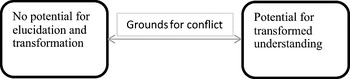
Yet, while continued controversy and perceived costs unite all compromises, compromise agreements differ in whether and how they can transform the grounds for conflict, even if they cannot negotiate them away. A compromise reached through minimal, pain-free and strategic concessions has little potential to elucidate or transform the reasons for a particular conflict. However, where a compromise has to result from mutually generous, costly and social concessions, actors need to exchange, explain and understand their goals, principles and beliefs. They also need to trust each other's willingness to concede reciprocally. The process of cooperation, recognition and communication required to reach such a compromise has the potential to elucidate the grounds underlying the conflict, and such elucidation can, in turn, change actors' perceptions of the conflict itself, even if the reasons for conflict persist.
In sum, while all compromises contain continued controversy – or a ‘splash’ of disagreement – the processes through which different compromises are reached vary according to how the grounds for conflict are transformed, albeit persisting (Figure 4).
Continued Controversy

OVERVIEW
In response to the omnipresence of compromise in politics and the surprising lack of its systematic study, we have invited scholars from all major sub-fields of Political Science as well as from adjacent disciplines such as Social Psychology to contribute to this special issue. The result is a truly multi-perspectival volume that links the study of compromise to core questions of Political Science, including: democracy, justice and political representation; conflict resolution in pluralist societies; European and global governance; international security; and the legitimacy of political decisions. Our contributors focus on different types of compromising actors, reaching from individuals and groups over governments and political parties to states and international organizations, and they look at the preconditions for compromise, the process of reaching compromise and the impact of compromise across arenas of governance. Covering analytical, theoretical and normative perspectives and reaching across sub-disciplines, this volume thus offers a multi-perspectival and comprehensive yet targeted take on the politics of compromise at the national, European and global level.
More specifically, the individual contributions address the following issues: In ‘Predictors of Compromise over Social and Political Issues’, Ananthi Al Ramiah and Miles Hewstone provide a social psychological analysis of the neglected issue of ‘intergroup compromise’. Al Ramiah and Hewstone discuss the factors that promote the willingness to compromise with two very different outgroups: homosexuals and Muslims. They develop a framework in which altruistic motivations (such as empathy) and egoistic motivations (such as trust and symbolic threat) act as proximal predictors of compromise, and intergroup contact acts as a distal predictor. Based on a new dataset, Al Ramiah and Hewstone find that respondents who had more positive contact with homosexuals perceived them to be less threatening, felt more empathy towards them and, in turn, were more likely to compromise with them on group-specific issues. Al Ramiah and Hewstone also find that respondents who had more negative contact with Muslims perceived them to be more threatening and, in turn, were less likely to compromise with them. These results are discussed with reference to recent developments in intergroup relations and the state of public discourse in contemporary Britain. The article is also linked to the wider implications for intergroup relations in pluralistic contexts, and makes suggestions for future research on actors' willingness to compromise with outgroups.
Entitling her contribution ‘The Warden's Dilemma: Self-Sacrifice and Compromise in Asymmetric Interactions’, K. M. Fierke explores how, given a situation where compromise is seen by actors to be inappropriate – either because they understand their opponents to be ‘terrorists’ or themselves to be the victims of injustice – agents would move towards a new game, in which both sides are recognized as political subjects capable of engaging in compromise and negotiation. Fierke argues that compromise requires an autonomous subject and a relational world in which the autonomy of both parties is acknowledged. The possibility of compromise thus rests on a new game in which both sides are recognized as such. In its theoretical approach, Fierke's article reconceptualizes the notion of a ‘game’ by shifting away from the individualist ontology of game theory to a social ontology focused on underlying rules of the game. She turns the common game metaphor, the ‘Prisoner's Dilemma’, on its head, and develops the ‘Warden's Dilemma’, which highlights the hierarchical structure of the prison and the strategic dynamics of asymmetrical conflict in a context of this kind. Empirically, Fierke explores the hunger strikes in Northern Ireland in 1980–81 and the martyrdom of Solidarity's priest, Jerzy Popieluszko, a few years later.
Markus Kornprobst writes about ‘How Rhetorical Strategies Reproduce Compromise Agreements: The Case of the Nuclear Non-Proliferation Regime’. Being rooted in mutual concessions, it can never be taken for granted that compromises, once agreed on, stay in place. Contestation about compliance is something that is very much to be expected and does not inevitably destabilize a compromise. Kornprobst contends that whether such a destabilization occurs or not depends on how actors communicate with one another, more precisely on what offensive and defensive rhetorical strategies they employ to make themselves heard. Probing his framework with an analysis of the foundational compromise on which the nuclear non-proliferation regime is built, Kornprobst finds evidence for his theoretical framework. The parties have tended to stay away from heavy rhetorical artillery and stuck to less robust rhetorical strategies. This played a crucial role in making the compromise – and with it the nuclear non-proliferation regime – persist.
In ‘Grand Compromises in Global Governance’, Steven Bernstein looks at the two ‘grand compromises’ that have underpinned efforts to build a stable global order since the Second World War: ‘embedded liberalism’, a compromise between laissez-faire liberalism and domestic interventionism, and ‘sustainable development’, a compromise between the global North and South. Bernstein compares these two ‘grand compromises’ and the challenges resulting from the twin economic and climate crises of the early twenty-first century; he asks whether ‘embedded liberalism’ and ‘sustainable development’ can be characterized as compromises or rather reflect hegemony; and he assesses whether the two compromises have bolstered or challenged the legitimacy of global governance.
Peter Jones and Ian O'Flynn inquire into the normative dimensions of compromise in divided societies. In ‘Internal Conflict, the International Community and the Promotion of Principled Compromise’, they discuss the conditions under which the international community can promote compromise between parties to internal conflict. To do so effectively, Jones and O'Flynn argue, the international community ought to treat principled rather than pragmatic compromise as its default position. Dictated by considerations of principle rather than by mere strategy, such compromises ought to be preferred for reasons of stability, inclusion and democratic deliberation.
In ‘European Integration as Compromise: Recognition, Concessions and the Limits of Cooperation’, Christine Reh discusses the role of compromise in legitimizing supranational governance and the limits to compromise in the European polity. She argues that the EU – a divided, multilevel and functionally restricted polity – is highly dependent on the legitimizing force of ‘inclusive compromise’, which works through the recognition of difference. This is true for horizontal or micro-level relations between political actors (where compromise works through concessions and perspective-taking in a process of ‘procedural accommodation’), and for vertical or macro-level relations between systems of governance (where compromise works through obtaining ‘constitutional compatibility’). Given the legitimizing force of inclusive compromise, Reh subsequently identifies the limits to such compromise and, thus, to supranational cooperation; these limits are issue specific and depend on who bears the costs of cooperation.
In his contribution on ‘Democracy, Compromise and the Representation Paradox: Coalition Government and Political Integrity', Richard Bellamy explores how far politicians can compromise without compromising either themselves or those they represent. Compromise may be the life blood of politics, yet it is often vilified as undermining democracy. If a politician has been elected on a given mandate, does compromise involve a betrayal of those who have elected them? If a politician holds certain principles, how far can they be compromised before he can be accused of sacrificing integrity for power? It is sometimes argued that the only way for politicians to avoid these dilemmas is to compromise over policy rather than principles, and to do so for pragmatic rather than moral reasons. Bellamy shows that neither of these arguments proves tenable. Policies are defined by principles, and a compromise between principles has to be achieved in a principled way, in which each party to the compromise recognizes the moral standing of the other. However, far from being opposed to democracy, the search for a principled compromise is itself mandated by democratic norms, for the willingness to accept democratic decisions is in many ways the model of a principled compromise. Meanwhile, representatives can have the democratic authority to compromise on their voters' behalf, for their mandate rests not so much on espousing a set of policies per se as on embracing the principled reasons that underlie them. Indeed, their electoral appeal rests on their reasoning as their electors do. So long as their compromises reflect this reasoning, then they can be regarded as legitimate. He illustrates these arguments through an analysis of the Conservative–Liberal Democrat Coalition Agreement following the 2010 British general election.
Finally, Philippe Van Parijs reflects on what distinguishes a ‘good’ from a ‘bad’ compromise. In his article ‘What Makes a Good Compromise?’, he explores the question from two perspectives: first, as a philosopher of justice who considers questions of justice and compromise to be inextricably linked; second, as a Belgian citizen socialized into compromise as a ‘spécialité locale’. In his contribution, Van Parijs explores three distinct definitions of a ‘good compromise’: it is honourable and allows all parties to save face; it is considered fair and equal by all parties; it is a Pareto-optimal improvement on the status quo. Examples from Belgian history and politics illustrate the argument.
CONCLUSION
Compromise comes in different forms and reflects different norms, depending on the views and dispositions of those involved, the circumstances in which they find themselves, and the issue they need to resolve. Compromise is an ineliminable feature of pluralistic and complex societies, in which uncoerced collective agreements are required among individuals and groups with conflicting or incompatible and often incommensurable values, interests and modes of reasoning. Compromise can be easy and difficult, pragmatic or moral, involve mutual satisfaction or the more demanding mutual accommodation, be merely Pareto-optimal or fair and equitable, be strategic or transformative. Compromises of different types can be good, bad, ugly or rotten. All compromise tends to be messy. However, as the individual contributions show, compromise need not be either incoherent or immoral. Politicians no less than citizens can compromise without compromising themselves, coming in the process to a fuller appreciation of each other and of themselves.
From the pork barrel politics of Tammany Hall, to the appeasement of Munich and the disappointments of Kyoto and Copenhagen, compromise is often seen as signalling the shortcomings of politics. Compromise epitomizes a world of shady deals and dirty hands, where promises are made to be broken and everyone and everything has its price. Against this common view, we have suggested that a fuller understanding of the sources, types and modalities of compromise produces a nobler and more edifying picture of the political process. On this account, to meet in the middle need not involve half-measures, a lack of commitment, or even corruption and dishonesty – although all these are possible. At its best, compromise also offers the possibility of a more attractive vision of politics, as enabling citizens to share a collective good that would be unknown and unobtainable on their own.Footnote 55 That it provides the means to do so in a realistic way, without idealizing the motivations of those concerned or minimizing the depth or persistence of the conflicts and disagreements that divide them, strikes us as perhaps the most appealing aspect of the politics of compromise.