Significant outcomes
∙ Shared decision making (SDM) self-reported by psychiatric patients was moderately low.
∙ Although psychiatric patients received some aspects of SDM, they self-reported poorly on some of SDM steps involved, being uncommon that a complete SDM approach was used.
∙ Age, attitudes towards psychiatric treatment, self-efficacy and the diagnoses of schizophrenia predict SDM experienced.
Limitations
∙ The study registered patients’ perceptions of decision-making experience and not studies patient consultations directly.
∙ Cross-sectional study design.
∙ Possible response biases associated to the use of self-report measure.
Background
For a long time, everyday psychiatric clinical practice meant that psychiatrists made decisions for their patients. However, in the last two decades there has been a growing recognition in the Spanish National Health System of the importance of considering patients’ values and preferences in clinical decisions and the model of relationship has moved from a dominant paternalistic one towards a pluralistic model that attempts to democratise decision making, share understanding, and empower patients (Reference Taylor1,Reference De Las Cuevas2).
There are several reasons to enhance psychiatric patients’ active participation in decisions about their treatment: first, a legal imperative, as psychiatric patients have the right to be fully informed on chances and risks of available treatments (Reference Pelto-Piri, Engström and Engström3); second, an ethical imperative, because a considerable number of patients want to be involved more than they are (Reference Moulton and King4); third, a clinical evidence base support, as treatments are presumed to be more successful if patients are involved in decisions (Reference Loh, Leonhart, Wills, Simon and Harter5); finally, an economic reason because it reduces unwanted treatments and allows an appropriate allocation of resources (Reference Coulter and Collins6). One concept to achieve this is SDM. SDM is an interactive process of the clinical decision-making model that ensures that both patient and physician are equally and actively involved and share information in order to come to an agreement, for which they are jointly responsible (Reference Härter7). The essential components of the SDM model include health professional and patient participation at all steps of the decision-making process; these steps include professional disclosure, exchange of information, deliberation about options, patients’ preferences, negotiation, and coming to an agreement on a decision to implement (Reference Elwyn and Charles8). In this sense, SDM is a sequential hierarchic process where each step makes sense by itself and can take place independently of other steps expressing specific communication patterns (Reference Fenton9). Consequently, the patient–professional relationship can vary in SDM as a whole and throughout each step of the process, with each step potentially including distinct forms of SDM (Reference De Las Cuevas, Peñate, Perestelo-Pérez and Serrano-Aguilar10).
Although there is substantial research on SDM, until now there exists little information on the extent to which this apparently accepted model is reflected in the daily practice of mental health professionals. Moreover, little is known about the factors conditioning psychiatric patients’ perceived involvement in their care.
The study of psychological processes as beliefs about having control, self-efficacy, attitudes towards drug treatments, and psychological reactance could be of crucial importance for their possibilities to engage in SDM together with staff in the health care system (Reference Holden11–Reference Mcniel, Gormley and Binder16). Psychological reactance is an aversive affective reaction in response to regulations or impositions that impinge on freedom and autonomy (Reference Brehm17,Reference Brehm and Brehm18), and through limiting and threatening freedom, recommendations to follow a medication have the potential to elicit reactance and, as a result, lead patients to ignore the recommended treatment. Health locus of control refers to the individual’s beliefs regarding the control of health (Reference Wallston19). A patient with an internal locus of control believes that health outcomes are a direct result of his or her own behaviour while a patient with an external locus of control believes that health outcomes are a result of either chance or powerful other people, such as physicians. Finally, sense of self-efficacy reflects the individual’s belief in his/her own skills to plan and perform certain activities to attain particular aims (Reference Holden11,Reference Bandura20) and leads to a greater sense of confidence and control, translating into a greater theoretical likelihood of both intending to perform the behaviour and actually doing so.
The aim of the present study was to measure to what extent psychiatric patients feel they were involved in the process and different steps of decision making about treatment choice in their psychiatric consultations and to analyse the influence of socio-demographic, clinical, and psychological processes on this perception.
Methods
Sample recruitment
From October 2013 to April 2014, 1100 consecutive psychiatric outpatients, belonging to a basic health area of 135 000 inhabitants of the Canary Islands Health Service, seen in the Community Mental Health Services on Tenerife Island (Canary Islands, Spain) were invited to participate in a cross-sectional study. Patients were eligible for inclusion in the study if they were aged 18 and over and were diagnosed by their psychiatrists with psychiatric disorders using the International Classification of Diseases, Tenth Edition (ICD-10) codes as F20 (schizophrenia), F31 (bipolar affective disorder), F32–33 (depressive episode and recurrent depressive disorder), F40–48 (obsessive-compulsive disorder and other neurotic, stress-related and somatoform disorders). Before the consultation with her/his psychiatrist, each participant received a full explanation of the study, after which they signed an informed consent document approved by the clinical research ethics committee of Nuestra Señora de Candelaria Teaching Hospital in Santa Cruz de Tenerife. Each participant then filled out a brief socio-demographic survey and the questionnaires that integrate the study with the exception on the shared decision-making questionnaire (SDM-Q) that was completed after the consultation.
Measures
Socio-demographic characteristics and clinical variables
Age, sex, educational level (no formal education, primary studies, secondary studies, and university degree), history as psychiatric patient (in years), and type of psychoactive drugs currently taken were assessed. For assessment purposes, the drugs were divided into the common groups of psychotropic drugs: antidepressants (tricyclics, selective serotonin reuptake inhibitors and serotonin and norepinephrine selective reuptake inhibitors), benzodiazepines, antipsychotics (conventional and atypical), and mood stabilisers. For statistical analysis purposes, a new variable (number of different drugs) was drawn up as an indirect measure of treatment complexity. We also recorded how long patients had been under psychiatric treatment (in months), the number of different psychiatrists treating them during that time, and the number of psychiatric admissions specifying their voluntary or involuntary character. Patients’ diagnoses and treatments were collected from their therapeutic recommendation sheets.
Instruments
SDM-Q
The nine-item Shared Decision-Making Questionnaire (SDM-Q-9) is a valid, reliable, and brief self-report questionnaire that assesses the patients’ view of the decision-making process in a consultation (Reference Kriston, Scholl, Hölzel, Simon, Loh and Härter21) that has been adapted and validated into Spanish (Reference De Las Cuevas, Perestelo-Perez, Rivero-Santana, Cebolla-Martí, Scholl and Härter22). The questionnaire consists of nine items, each describing one step of the SDM process (Reference Simon, Schorr and Wirtz23). The questionnaire was developed to show the extent to which patients feel they were involved in the process by means of scoring nine items on a six-point Likert scale, ranging from 0 (‘completely disagree’) to 5 (‘completely agree’). Summing up all items leads to a raw total score between 0 and 45. Multiplication of the raw score by 20/9 provides a score forced (transformed) to range from 0 to 100, where 0 indicates the lowest possible level of SDM and 100 indicates the highest extent of SDM. As it is more intuitively interpretable, the original authors encourage use of the transformed score. Patients completed SDM-Q-9 immediately after their clinical consultation with their psychiatrist and not in the presence of the treating health professional.
Hong Psychological Reactance Scale (HPRS)
The HPRS (Reference Hong and Faedda24) is a 14-item self-report questionnaire designed to measure the individual difference in reactance proneness, that is, a person’s trait propensity to experience psychological reactance. Psychological Reactance (Reference Wallston19) assumes that, when an individual’s freedom is threatened, the individual will be motivated to restore the perceived loss of freedom. Participants indicated the extent to which they endorsed each statement on a five-point Likert scale (1=strongly disagree to 5=strongly agree).
Multidimensional Health Locus of Control (MHLC) Form C Scale
Form C of the MHLC scale (Reference Wallston, Stein and Smith25) is an 18-item, general purpose, condition-specific locus of control scale that could easily be adapted for use with any medical or health-related condition. There are four subscales of the form C of the MHLC: (1) internal health locus of control (IHLC), which is the belief that one’s own behaviours affect one’s health status; (2) chance health locus of control (CHLC), which is the belief that one’s health condition is a matter of fate, luck, or chance; (3) doctors (DHCL) health locus of control, which is the belief that are doctors who determine the outcomes of patient health; and (4) other people health locus of control (PHLC), which is the belief that other people, such as family and friends have control over one’s health status. Internal and chance subscales comprised 6 items, while doctors and other people subscales comprised 3 items, totalling 18 items on the questionnaire. Patients are asked to rate, on a six-point Likert scale, the degree to which they agree or disagree with each statement. Higher scores on each subscale indicate a stronger belief in that type of control.
General Perceived Self-Efficacy Scale
The General Perceived Self-Efficacy Scale (Reference Schwarzer and Jerusalem26) is a 10-item self-report scale that measures general self-efficacy as a prospective and operative construct. In contrast to other scales designed to assess optimism, this scale explicitly refers to personal agency, that is, the belief that one’s actions are responsible for successful outcomes. Each item is scored from 1 (not at all true) to 4 (completely true). The summary score ranges from 10 to 40, with the highest score indicating high self-efficacy.
Drug Attitude Inventory
The Drug Attitude Inventory (DAI-10) (Reference Hogan, Awad and Eastwood27) is a 10-item self-report scale developed to assess patient’s belief about the efficacy of drugs. Specifically, the scale measure the subjective responses and attitudes of psychiatric patients towards their treatment by revealing whether the patients are satisfied with their medications and evaluating their understanding of how the treatment is affecting them. Items represent subjective experience presented as self-report statements with which the patient agrees or disagrees. These are based on actual recorded and transcribed accounts of patients, and response options are true/false only. Each response is scored as +1 if correct or −1 if incorrect. The final score is the grand total of the positive and negative points and ranges in value from −10 to 10, with higher scores indicating a more positive attitude towards medication. A positive total score means a positive subjective response; a negative total score means a negative subjective response.
Statistical analyses
Frequencies analyses were carried out for describing the sample. To contrast both general levels of SDM and specific SDM steps, according to different psychiatric diagnoses, ANOVAs were performed. Finally, logistic regression analysis was performed to estimate the best explaining variables of SDM. In this sense an SDM dichotomous variable was computed: low perception of SDM by psychiatric patients (total SDM-Q scores representing percentile 25 or lower), and high perception of SDM (scores representing percentile 75 or higher).
Statistical analyses were only done with participants without missing data. This implies that we can find differences in sample size, according to groups of analyses.
Results
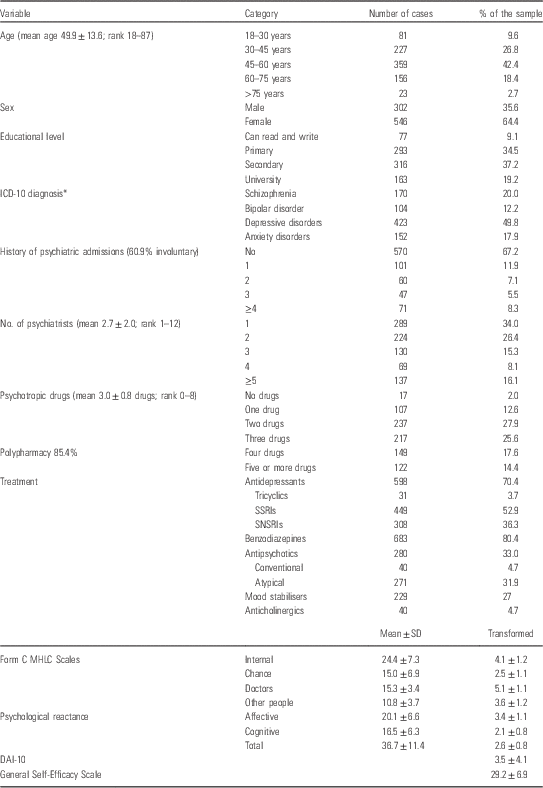
We recorded a high response rate of 77% resulting in a sample of 846 psychiatric outpatients. The 846 patients who agreed to participate in the study had a mean age of 49.9 ±13.6 years (range 18–87), and 64.4% were female. Concerning educational level, 9.1% of patients could only read and write, 34.5% had completed primary studies, 37.2% had completed secondary studies, and 19.2% had a university degree. The primary diagnoses of respondents were schizophrenia (20%); bipolar disorder (12.2%); depressive disorders (49.8%); and anxiety disorders (17.9%). The average duration of treatment was 9.8±8.9 years (range 0.08–40). The mean number of psychotropic drugs used was 3.0±0.8 (range 0–8). Only 12.6% of the patients were under monotherapy treatment, whereas 27.9% received two drugs, 25.6% received three, 17.6% received four, and 14.4% received five or more drugs. Benzodiazepine tranquillizers were the most common medications, used by 80.4% of the patients followed by antidepressants (used by 70.4%), antipsychotics (used by 33%) and mood stabilisers (used by 31.9%). Table 1 shows the sample distribution according to socio-demographic and clinical variables included in the study as well as self-reported questionnaires scores.
Socio-demographic and clinical characteristics of the psychiatric outpatients sample studied (n=846)

DAI-10, Drug Attitude Inventory; ICD, International Classification of Diseases; MHLC, Multidimensional Health Locus of Control; SNRIs, selective noradrenaline reuptake inhibitors; SSRIs, selective serotonin reuptake inhibitors; transformed, mean of items score.
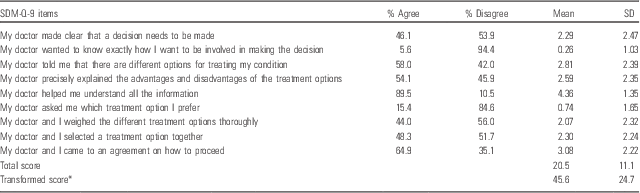
The analysis of SDM-Q-9 results suggests that SDM is currently not widely practiced in psychiatric outpatient care. The average SDM-Q-9 score showed that the mean of the sample was slightly below the midpoint of the scale in their perceptions of the extent to which SDM indicating a moderately low level of participation perceived. As can be observed, very different level of agreement was registered in the different questionnaire items indicating different relevance in the sample of the stages involved in SDM. Five of the nine items of the questionnaire showed a majority of patients disagree. The higher level of disagreement was registered by items 2 and 6, that represent two of the more relevant steps in SDM process, since the great majority of patients informed that their doctors do not want to know their level of involvement desired in decision making, and reported that their doctors did not ask them about their options preferences. Table 2 shows percentages of agreement with SDM-Q items in psychiatric outpatients as well as their descriptive analysis.
Percentage of agreement with shared decision-making questionnaire items in psychiatric outpatients and descriptive analysis
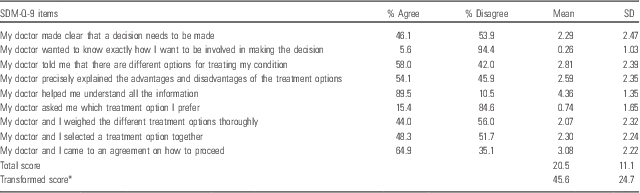
* 0–100 scale; higher scores indicate higher perceived shared decision making.
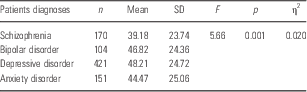
According to the SDM-Q-9 total score, the four diagnostic groups of psychiatric patients differ significantly. Table 3 summarises the main data from the ANOVA analysis performed. Since transformed score (0–100) was used, mean scores registered indicate that all the groups are situated slight below the middle level in how patients feel SDM process in their relationship with their clinicians. Analysing specific differences (Bonferroni test), there is only a significant difference: depressive patients scored higher levels in SDM than patients with schizophrenia (p≤0.001). A similar pattern was found between patients with bipolar disorder and schizophrenic patients, but it does not reach significance (p≤0.07).
Differences in SDM-Q-9 total score among psychiatric outpatients
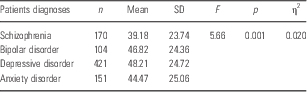
p, probability; SDM-Q-9, shared decision making; SD, standard deviation; η2, squared eta.
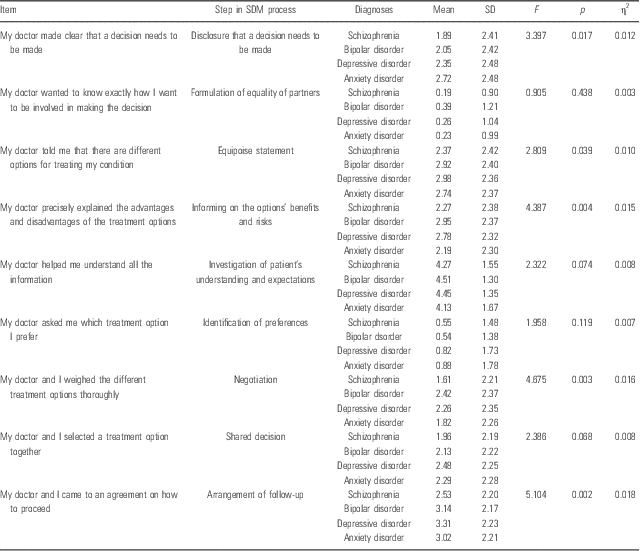
Considering SDM as a process integrated by several steps (from recognition that a decision needs to be made to final agreement on how to proceed), a new ANOVA was performed; now taking into account the different items (representing different contents/steps in SDM). Table 4 summarises the data obtained. As can be observed, there were significant differences in five of the nine questionnaire items/steps: 1 (disclosure that a decision needs to be made), 3 (equipoise statement), 4 (informing on the benefits/risks of the options), 7 (negotiation), and 9 (arrangement of follow-up). The general sense (Bonferroni adjust) points out lower scores in schizophrenia patient subsample comparing with depressive patients (items 3, 4, and 9), comparing with anxiety patients (item 1), and comparing with both depressive and bipolar patients (item 7).
Differences in SDM-Q-9 items scores among psychiatric outpatients according to diagnoses
SDM-Q-9, shared decision making; SD, standard deviation; p, probability; η2, squared eta.
An interpretation of mean scores also reveals interesting data: as low scores point out ‘disagreement’ and high score ‘agreement’, items 2 and 6 clearly indicate ‘disagreement’: patients disagree in considering that clinicians formulate a statement of equality in the relationship, and they consider that clinicians do not ask them much about which treatment they wish. In the opposite are items 5 and 9: in general, patients feel that clinician try that they understand the information, and look for an agreement in treatment procedure.
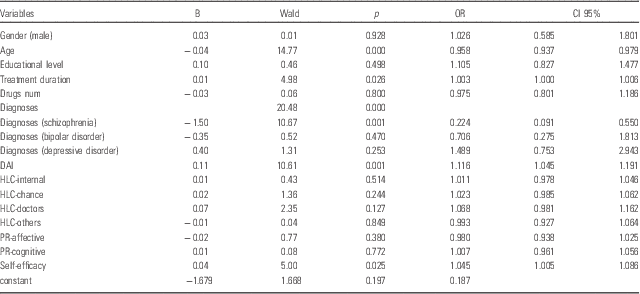
To determine the possible variables explaining SDM’s perceptions by psychiatric patients, a logistic regression analysis was performed. For that, a binary variable was computed attending SDM-Q-9 scores: patients with low perception of SDM (SDM-Q-9≤25), and high perception of SDM (SDM-Q-9≥75). Low-SDM group was composed by 229 patients (59 schizophrenia, 25 bipolar disorder, 102 depressive disorder, and 43 anxiety disorder), and high-SDM group was composed by 131 patients (17 schizophrenia, 16 bipolar disorder, 73 depressive disorder, and 26 anxiety disorder). As predictive variables, both socio-demographic variables (age, gender, educational level, treatment duration, and diagnoses), and psychological processes variables (attitudes to medicines, health locus of control, psychological reactance, and self-efficacy), were taken into account. Table 5 summarises the mean coefficients obtained.
Summary of logistic regression analysis for variables predicting shared decision-making patients’ perceptions, controlling for psychological processes and socio-demographic and clinical variables (n=360)
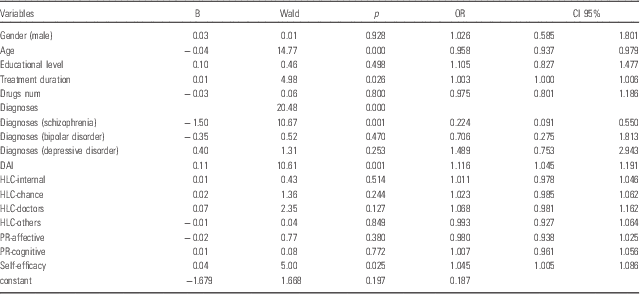
B, β coefficients; CI, confidence interval; DAI, Drug Attitude Inventory; HLC, Health Locus of Control; OR, odds ratio; p, probability; PR, psychological reactance.
As can be observed, five variables were statistically significant in the equation: age, treatment duration, schizophrenia disorder, positive attitude to drugs, and self-efficacy. In the case of treatment duration variable, the value 1.0 is included in confidence interval. Consequently, its role in predicting low/high SDM cannot be established. The final contributions point out that age has a negative contribution (less SDM as age increases) and schizophrenia disorder is a ‘risk’ for low SDM. On the other hand, a positive attitude towards drugs and increases in self-efficacy are associated to high SDM.
Discussion
This is the first large, community psychiatry-based survey exploring the degree to which psychiatric outpatients feel they are involved in the process and steps of decision making about treatment choice analysing the influence of socio-demographic, clinical and psychological variables on this perception. Treatment decision making in psychiatry is often likely to be complex, with additional issues such as comorbidity and chronicity meaning that symptoms and decisions are more likely to fluctuate and change over time and be influenced by a broad range of factors (Reference Simmons, Hetrick and Jorm28).
According to SDM-Q-9 total score, psychiatric patients’ SDM self-reported levels were moderate, tending to be low, which is consistent with previous studies carried out in similar health-care setting but with other methodology, where most patients informed of experiencing a passive role, with their psychiatrists making the final decision after considering the patient’s opinion (Reference Matthias, Salyers, Rollins and Frankel29,Reference De Las Cuevas, Peñate and De Rivera30).
When we pay attention to the different items of the questionnaire, representing the different steps involved in SDM process, it becomes clear that although psychiatric patients received some aspects of SDM (e.g. being involved in making decisions in some way), they self-reported poorly on some of SDM steps involved, being uncommon that a complete SDM approach was used, since most patients feel that an equal relationship is not established (item 2) and that they do not participate in the selection of treatment (item 6). On the other hand, the vast majority of patients reported that their psychiatrist helped them to understand all the information (item 5) and that reached an agreement of follow-up (item 9). When these results are analysed considering the diagnosis of the patient, those with schizophrenia reported less participation in SDM, both taking into account the total score of the questionnaire or the analysis of each questionnaire item or SDM step process involved.
The fact that psychiatric patients self-reported a low participation in SDM may be due to very different situations:
First, it could be an objective reflection of reality. Because SDM requires that patients are able to act as competent decision makers (Reference Hamann, Leucht and Kissling31), it is appropriate that psychiatrists do not use SDM with everyone but first consider the patient’s decisional capacity (Reference Hamann, Mendel and Cohen32). Patients’ psychopathology, as disturbances of thought, depression, mania as well as compulsive doubts, can lead to impaired decisional capacity and result in psychiatrists not engaging in SDM with patients showing any of these characteristics. However, it is necessary to differentiate if psychiatrists prefer a cooperative therapeutic alliance with patients, but they need to consider patient competence as a critical obstacle to participation, or they really prefer to put into practice a paternalistic role with patients giving no opportunity for SDM. Not all psychiatrists agree with or implement SDM in their clinical practice. Some of them perceive medical and legal decisions as inappropriate to share with schizophrenic patients or those who are acutely ill, even though research has found that it is possible and recommendable (Reference Hamann, Mendel and Cohen32,Reference Hamann, Langer and Winkler33).
Previous works had shown a positive attitude towards concordance in the field of psychotropic drugs prescription among psychiatrists working at community setting with broader experience providing a greater conviction of the importance of the patient’s decision about treatment (Reference De Las Cuevas, Rivero-Santana, Perestelo-Pérez and Serrano-Aguilar34). However, studies remark the necessity of further research to address the extent to which this apparently accepted model is reflected in the daily practice of mental health professionals.
The literature has shown that three are the main barriers to implementing shared decision in those patients in whom no clinical contraindications exist that include: overworked physicians with limited time availability, insufficient training of health-care providers about SDM and the use of patient decision aids, and clinical information systems that failed to track patients throughout the decision-making process and that are unable to efficiently integrate the steps of SDM into the daily workflow (Reference Friedberg, Van Busum, Wexler, Bowen and Schneider35). Other potential barriers include a lack of a supportive culture, misperceptions about the desire of patients to be informed and involved, and about the usefulness and quality of decision aids (Reference Barry, Frosch, Shannon and Bowen36).
Although clinicians frequently pointed to time constraints as the primary barrier to SDM, no consistent evidences are available at present time that more time is required to engage in SDM in clinical practice than to offer usual care (Reference Legare and Witteman37). McCabe et al. (Reference Mccabe, Khanom, Bailey and Priebe38) consider that involvement in decision making appears to be influenced by the individual psychiatrist and specific symptoms but not visit length.
In order for patients and professionals to have a more equal role in decisions about care, professionals need a variety of skills. These range from technical communication and interpersonal skills to more fundamental changes in attitudes about the relative roles and expertise of patients and professionals (Reference Légaré, Ratté and Stacey39). Although we have recently seen the incorporation of communication skills training into medical curricula of the medical schools of our country, health-care professionals with limited or no training in SDM characterise our current health care situation. At present time our health care system needs to ensure training at postgraduate level and throughout professional development to enhance clinical skills in supporting people to take decisions about their health and health care.
Another possibility is that patients experienced the role they wanted and they had a psychiatrist who wanted to meet the preferences of their patients. It is necessary to have in mind that a considerable proportion of psychiatric patients preferred a passive decisional control (Reference De Las Cuevas, Peñate and De Rivera30,Reference De Las Cuevas and Peñate40). Finally, it is convenient to consider the possibility that psychiatric patients sometimes may not be a reliable source of information as well as self-report biases of questionnaires used (Reference Fadnes, Taube and Tylleskär41).
Psychological reactance, health locus of control, attitude to drugs, and self-efficacy have demonstrated their relevance in SDM, when SDM is assessed as patients’ preferences of participation (Reference De Las Cuevas, Peñate and De Rivera30). In the present study, SDM has been assessed as patients’ perception of their experience of participation in their last psychiatric consultation that took place minutes before. In this context, only self-efficacy and drug attitudes seem to play a relevant role while neither health locus of control nor psychological reactance registered significant differences. Patients’ preferences can be affected by their wishes and willingness for participating in an SDM procedure. But the facts (how they feel their clinicians behave) seem to be only affected by their self-efficacy level and, especially, their confidence in drugs’ efficacy. This result can have implications about patients’ disposition: they feel they participate more in an SDM procedure, as they rely on their own coping ability, but if they also feel they are being helped by their prescriptions.
As with any research this study has some limitations. However, there are also a number of strengths. Limitations of this study include the fact that we did not study patient consultations directly, but only registered patients’ perceptions of decision-making experience. Since a cross-sectional survey was carried out, the study could only demonstrate associations and not causality. The fact that our sample comprised more women than men reflects the recurrent factor of many population-based studies focused on reporting the determinants of service use for mental health reasons that had evidenced the higher prevalence of female gender (Reference Wang, Lane, Olfson, Pincus, Wells and Kessler42,Reference Smith, Matheson and Moineddin43). The strengths of this study include the large number of psychiatric outpatients who agreed to participate in the study and the large number of socio-demographic, clinical, and personality variables included. Another strength of the current study is that regression analyses performed were controlled for the contribution of these variables. Finally, the results of our study should be interpreted with caution given the explorative nature of the study carried out. Further research is required to replicate and evaluate the relevance of our findings and to clarify if the low level of SDM participation self-reported is justified by psychiatric patients’ decisional capacity or is a consequence of a psychiatrists’ lack of communication skills necessary for proper SDM or a psychiatrist’s preference of paternalism in their relationship with patients.
Clinical implications
Since patients actively involved in their health and health care tend to have better outcomes, and, some evidence suggests, lower costs (Reference Hibbard44,Reference Hibbard and Greene45), the low perception of participation in decision making in psychiatric patients make necessary that mental health professionals need to raise their thoughtfulness regarding patient’s participation in health care decisions each time a relevant treatment decision is about to be made.
Acknowledgments
Carlos De las Cuevas and Wenceslao Peñate conceived, designed and took part in the study. Both authors analysed the data and assisted with results interpretation. All the authors read and approved the final manuscript.
Financial Support
This work was supported by Instituto de Salud Carlos III, FEDER Unión Europea (PI10/00955).
Ethical Standards
The authors assert that all procedures contributing to this work comply with the ethical standards of the relevant national and institutional committees on human experimentation and with the Helsinki Declaration of 1975, as revised in 2008.