Rheumatic fever is an acute, diffuse, and non-suppurative inflammatory disease, which occurs as a late autoimmune response to a group A beta-haemolytic streptococcal pharyngotonsillitis, in a genetically predisposed population. 1 The cardiac involvement occurs in approximately 50–70% of the cases; nevertheless, a significant number of patients develop subclinical rheumatic carditis. In this scenario, echocardiography plays a vital role, as it increases the diagnostic accuracy of the cardiac involvement.Reference Gewitz, Baltmore and Tani 2 Rheumatic heart disease is the most important manifestation of rheumatic fever and remains a significant cause of morbidity and mortality in resource-limited settings, with about 250,000 deaths/year worldwide.Reference Carapetis, Steer and Mulholland 3 Although the disease prevalence has progressively decreased in developed countries since 1950, it is still one of the most prevalent causes of acquired cardiac disease in developing countries.Reference Steer, Carapetis and Nolan 4 Its severity is related to the extent of the lesions after the first episode of rheumatic carditis, although it is mainly due to recurrent attacks. 1 Severe rheumatic carditis treatment is based on the suppression of the inflammatory process and the eradication of the oropharyngeal group A Streptococcus, a micro-organism that remains completely susceptible to penicillin.Reference Czoniczer, Amezcua and Pellargonio 5 – Reference Kumar and Tandon 7 Patients with severe rheumatic carditis associated with heart failure and/or pericarditis respond favourably to the treatment with potent anti-inflammatory agents. In this context, the use of corticosteroids and aspirin (acetylsalicylic acid) are frequent; however, their effectiveness against the development of the rheumatic heart disease has not been well-established yet.Reference Cilliers, Adler and Saloojee 8 We have observed that some patients with severe rheumatic carditis who did not respond to conventional treatment with oral corticosteroid had worst outcomes and died. Experiments with pulse therapy – high dosages of intravenous methylprednisolone – to manage rheumatic carditis was started in 1984 by Couto et al, whose results demonstrated improved cardiac insufficiency outcomes in a shorter period of time and no side effects of the conventional corticoid therapy oral, reducing hospitalisation time and the risks of interruption of the home therapy.Reference Couto, Martins and Mansur 9 Currently there is still no definitive data supporting the use of pulse therapy as a treatment of choice in controlling severe rheumatic carditis, and its management remains a challenge in the clinical practice. This study described the clinical evolution and the complementary follow-up exams of patients diagnosed with severe rheumatic carditis, treated with pulse therapy combined with oral prednisone, admitted to the Hospital Pequeno Principe, Brazil, between 1985 and 2013. It also presented the modifications to the original protocol by Couto et al,Reference Couto, Martins and Mansur 9 such as the infusion volume, dosage, interval between dosages, and the complementary treatment with oral prednisone.
Methods
This retrospective cohort study consisted of patients with a confirmed diagnosis of rheumatic fever, following the criteria by Jones,Reference Gewitz, Baltmore and Tani 2 severe rheumatic carditis, and heart failure in functional class III and IV, according to NYHA. The clinical criteria to define severity of carditis used in this study included shortness of breath during minimal exertion or rest, persistent tachycardia, signs of pulmonary or/and systemic congestion, pericardial friction, muffling of the heart sounds, presence of third heart sound, mitral and/or aortic murmurs with signs of severe valvular impairment. The patients underwent transthoracic echocardiogram, performed by cardiologists specialised in echocardiography, with similar protocol and echocardiographic criteria. At admission all the patients included in this study presented a moderate to severe increase of cardiac chambers, mainly the left atrium and ventricle, as well as pericardial effusion, and mitral and/or aortic regurgitation of moderate to severe intensity. Patients with recurrent carditis presented signs of mitral and/or aortic lesions with morphologic aspect compatible with chronic rheumatic fever – valve and sub-valvular thickening, decreased mobility of the leaflets, and commissural fusion – on transthoracic echocardiogram. In addition, these patients can present cardiomegaly and pulmonary congestion signals on chest X-ray. Electrocardiogram was performed and PR and QTc intervals were measured. The inflammatory activity was determined by haemosedimentation rate.
Exclusion criteria included patients treated with pulse therapy alone, those who received pulse therapy combined with aspirin, as well as those who presented signs and symptoms consistent with mild to moderate carditis. The Human Research Ethics Committee at Hospital Pequeno Príncipe approved this study, CAAE-02153912.2.0000.0097.
All patients included in this study had undergone pulse therapy with intravenous 20 mg/kg methylprednisolone, maximum dosage of 1.000 mg, diluted in 70 ml of 5% glucose solution, in continuous infusion for 2 hours, for three consecutive mornings (1 cycle). The medication was administered three times with an interval of four days between the cycles (3 cycles). After that and interval of 1 day, oral prednisone was used at a dosage of 2 mg/kg, every other morning, with a maximum dosage of 60 mg/day. This was followed by a gradual reduction in increments of 10 mg/week until it reached 30 mg/day. It was further reduced in increments of 5 mg/week, until it was totally discontinued. The pulse therapy was held in the ICU. In patients with haemodynamic compromise, inotropic and vasoactive drugs were prescribed. All patients received treatment for decompensated heart failure, which included diuretics and angiotensin-converting enzyme inhibitors. A total of 35 patients also received 80–100 mg/kg/day aspirin, maximum dosage of 3 g/day, initiated when the administration of oral prednisone reached 5 mg. The aspirin dosage was reduced gradually for 6 weeks, until it was totally interrupted. The patients were divided in two groups: group 1, which received aspirin, and group 2, which was without aspirin.
Before the start of the pulse therapy all patients were meticulously examined in order to exclude foci of infections, hydro-electrolytic alterations, and arrhythmias. Strongyloidiasis was treated with thiabendazole 25 mg/kg, two times a day for 2 days with a maximum of 3 g to avoid hyperinfection syndrome. In addition, the patients received treatment for eradication of streptococci with benzathine penicillin at a dose of 600,000 IU for children up to 25 kg, and 1.2 million international units for patients over 25 kg. The secondary prophylaxis was established with the same dose of antimicrobial every 21 days.
Patients who maintained their home prednisone treatment were clinically evaluated weekly. At the end of the treatment, patients returned after 30, 60, and 90 days for re-evaluations. The patients were followed up by the Department of Paediatric Cardiology, Hospital Pequeno Principe between 1985 and 2013, from the hospital admission until the end of the treatment of the acute phase.
Statistical analysis
Continuous variables were described by mean and standard deviation. Categorical variables were shown as frequencies and percentages. The paired-sample Student’s t-test was considered to compare data collected at the admission and discharge times in relation to the quantitative variables. Regarding the dichotomous qualitative variables, comparisons were performed using McNemar test. The χ2 test was used to evaluate the association between the groups and the qualitative variables. The normality condition of the variables was carried out with the Kolmogorov–Smirnov test. p<0.05 values indicated statistical significance. No systematic random sampling was used. The subjects in both groups were chosen by convenience. The data were analysed with software Statistica v.8.0.
Results
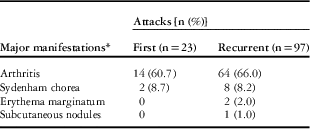
In total, 120 patients were hospitalised for severe heart failure, 50 (41.7%) in functional class III and 70 (58.3%) in functional class IV; of them, 23 (19.2%) at their first episode of rheumatic fever and 97 (80.8%) due to the disease recurrence. Major manifestations of the disease, observed at hospital admission, are shown in Table 1. Of the 120 patients, 112 were Caucasians (94.1%), 62 male (51.6%), their age ranging from 2.8 to 15 years (mean of 10 years).
Major manifestations associated with carditis at admission.

* The presence of any major manifestations is not mutually exclusive
The predominant valvular lesions included 65 (54.1%) cases of mitral and aortic insufficiency, 22 (18.3%) isolated mitral insufficiency, 15 (12.5%) double mitral lesions associated with aortic insufficiency, and 13 (10.8%) with double mitral lesions. Less frequent lesions were mitral stenosis in 2 (1.7%) patients, double mitral and aortic lesions in 2 (1.7%), and 1 (0.8%) patient presented ostium primum interatrial communication with mitral cleft, atrioventricular septal defect.
Heart surgery was performed in eight (6.6%) patients. Four underwent mitral valvuloplasty, one open mitral commissurotomy, one mitral and aortic prosthesis replacement, and one patient with cardiac tamponade underwent pericardiostomy. An functional class III patient, with no clinical evidence of the active disease, underwent mitral and aortic valvuloplasty because of the haemodynamic decompensation, and in the immediate postoperative period presented disease reactivation and was submitted to pulse therapy. At surgery, signs of a recent inflammatory process – pericarditis, fibrous plates – were identified. The endomyocardium biopsy revealed inflammatory infiltrate associated with accumulation of the Aschoff bodies. This patient, 15 months earlier, had been treated with aspirin at anti-inflammatory doses due to the recurrent episode of the disease. Among surgery patients, four evolved into functional class I at hospital discharge: one patient diagnosed, in the first attack, with rupture of the chordae tendineae and three in the recurrent attacks. The remaining patients evolved into functional class II. There were no deaths among these patients and no operated patient developed complications from the pulse therapy.
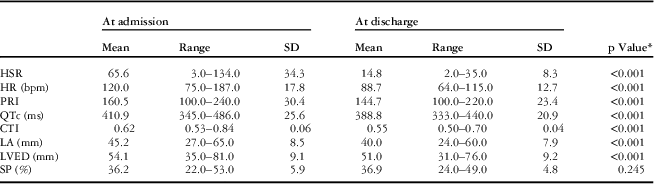
After treatment, all patients showed significant improvement in the laboratory and radiologic parameters (p<0.001). There was a diameter decrease in the left atrium and ventricle, measured at transthoracic echocardiogram, at the hospital admission, and discharge, which was statistically significant (p<0.001), and the percentage of shortening of the left ventricular dimension remained unchanged (p=0.5) (Table 2).
Laboratory and radiologic parameters of the patients at admission and discharge.

CTI=cardiothoracic index; HR=heart rate; HSR=haemosedimentation rate; LA=left atrium; LVED=left ventricle end-diastolic diameter; PRI=PR interval; QTc=QTc interval; SP=shortening percentage
* Student’s t-test for paired samples, p<0.05
The mean hospitalisation time was 69.1 days, ranging from 21 to 176 days, and standard deviation was 25.6. All patients were discharged, 74 (61.7%) in functional class I and 46 (38.3%) in functional class II. Among 23 patients in the first attack, 20 (95.7%) were discharged in functional class I and only 52 (53.6%) of the patients in recurrence presented the same evolution (p<0.001). No patient developed rebound.
A total of 22 (18.3%) patients developed pericardial effusion, which was totally resolved after the treatment: 16 (72.7%) evolved into functional class I and 6 (27.3%) into functional class II at hospital discharge. The presence of pericardial effusion in these patients did not interfere in the functional class at discharge when compared with the patients who did not show this complication (p=0.332). Only one patient with cardiac tamponade required pericardiostomy.
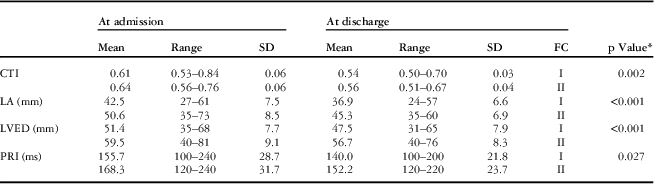
Functional class III patients showed a better clinical evolution than did functional class IV. Among 50 patients in functional class III at admission, 39 (78.0%) were discharged in functional class I and only 35 (50.0%) of the patients in class IV presented the same evolution (p=0.002). The patients that received discharge in functional class II presented, at hospital admission, higher cardiothoracic index during chest X-ray, longer PR interval on electrocardiogram, greater left ventricle and atrium dimensions, observed at transthoracic echocardiogram, in relation to patients discharged in functional class I (Table 3).
Correlation of the cardiac dimensions and PR interval at admission with clinical evaluation at discharge.

CTI=cardiothoracic index; FC=functional class; LA=left atrium; LVED=left ventricle end-diastolic diameter; PRI=PR interval
* Student’s t-test for paired samples, p<0.05
To avoid rebound, 35 (29.2%) patients (group 1) of this study received complementary treatment with aspirin at the end of the oral corticoid therapy. Of them, 24 (68.6%) were discharged in functional class I and 11 (31.4%) in functional class II, representing no statistical significance compared with group 2 which did not receive complementary therapy (p=0.409).
Discussion
This study describes the largest experiment ever published on the use of pulse therapy in managing severe rheumatic carditis patients. All the patients analysed in our series showed significant improvement with the adopted therapy and were discharged without any evidence of rheumatic activity, most of them in functional class I. There was improvement in the electrocardiogram parameters, such as PR and QTc intervals, in the cardiothoracic index at chest X-ray, and in the left atrium and ventricle dimensions, measured at transthoracic echocardiogram. No death was recorded.
The rheumatic carditis inflammatory process may last 12 weeks or longer. Reactivation of the inflammatory process may occur during the treatment or after the interruption of the anti-inflammatory therapy, rebound,Reference Markowitz and Gordis 10 and may extend the length of the active phase of the disease and contribute to the worsening of pre-existing lesions. Thereby, we added oral prednisone at the end of the pulse therapy cycles, aiming to maintain the inflammatory process under control.
We achieved the control of the disease active process and no reactivation signs among the studied patients were observed. We also reduced the interval between pulse therapy cycles to 4 days, rather than the 7 days described previously.Reference Couto, Martins and Mansur 9 This change was based on the observation of the worsening signs of the patients’ condition and of the evidences of the inflammatory activity, which occurred between the pulse therapy cycles in the patients previously treated in our institution. This change was effective and prevented reactivation of the disease during pulse therapy. However, some patients experienced side effects of the steroid therapy in high doses. Additionally, increased appetite, increased weight gain, and mild cushingoid face were reported. Infection related to immunosuppression was not observed.
We observed that the long period of hospitalisation (mean of 69.1 days) was also important for the clinical stabilisation of most of our patients, and reduced the risks for interruption of the home treatment. Our treatment protocol lasted ~75 days. Early discharge occurred because some patients had significant improvement after the end of the third cycle of the pulse therapy and had favourable socio-economic status. This allowed continuity of treatment at home, returning to medical consultation weekly. Patients with disadvantageous socio-economic conditions or patients who had experienced slower clinical response to the treatment required long hospital stays. The control of severe rheumatic carditis by means of pulse therapy has already been reported; however, some patients required a longer treatment time and a higher number of cycles to reach stabilisation of the clinical conditions. Herdy et al,Reference Herdy, Couto and Fernandes 11 in their first series of 36 patients, reported improved signs and symptoms of heart failure, and the patients were discharged presenting no laboratory indications of the active disease. In the 12 subsequent cases, half of the patients required from five to more cycles of pulse therapy to control the acute phase and one patient died due to reactivation during the cycles.Reference Herdy, Pinto and Olivaes 12 Akçoral et alReference Akçoral, Oran and Tavli 13 demonstrated that pulse therapy, when compared with oral corticoid therapy, improved the conditions of the patients with mild carditis, functional class I and II, better and faster. Camara et al,Reference Camara, Braga and Alves-silva 14 on the other hand, in a series of 18 patients, reported improved evolution of the inflammatory clinical and laboratory parameters in the group that was administered only oral therapy.
The intravenous infusion of methylprednisolone in 200 ml of 5% glucose solution, reported by Couto et al, was associated with worsening of heart failure in some patients treated at our institution and probably accounted for the large volume of infused glucose solution in short time. This complication had already been observed in four (11.1%) of the children studied by Herdy in 1993.Reference Herdy, Couto and Fernandes 11 The reduction in the infusion volume to 70 ml of 5% glucose solution prevented this complication among the studied patients in our series.
Aspirin was just prescribed in the first cases. The addition of aspirin at the end of the treatment did not reveal any significant benefit in the control of severe rheumatic carditis and rebounds in our series of patients when compared with patients who did not. This anti-inflammatory drug was removed from the protocol reducing the time of the treatment. In 1954, Illingworth et alReference Ilingworth, Burke and Doxiadis 15 reviewed 170 published manuscripts on the use of aspirin in rheumatic carditis, and found no evidence of the effect of this anti-inflammatory drug on the rheumatic carditis stabilisation. The UK–US Commission has also confirmed these findings. 16 There are no evidences that support the use of salicylates, as these studies do not document the stabilisation of rheumatic carditis or any reduction in the incidence of rheumatic cardiopathy.Reference Cilliers, Adler and Saloojee 8 , Reference Illingworth, Lorber and Holt 17 , Reference Bywaters and Thomas 18
The Sydeham chorea cases analysed in our series (Table 1) also responded quickly to the treatment with pulse therapy combined with oral prednisone. Oral corticosteroids are frequently used in this pathology, showing rapid decrease in intensity and duration of the symptoms.Reference Paz, Silva and Marques-Dias 19 , Reference Walker, Tani and Thompson 20 The literature describes the pulse therapy benefits in severe cases of paralytic Sydenham chorea, with prompt improvement of the symptoms and no side effects of the corticoid therapy.Reference Fusco, Ucchino and Frattini 21
The difficulties encountered to control severe rheumatic carditis are usually attributed to valvular dysfunction. Surgical treatment, replacement or repair of the mitral and/or aortic valves are recommended procedures when the congestive heart failure cardiac cannot be controlled by means of a conventional therapy. Many patients in our series presented significant valvular lesions and decompensated cardiac insufficiency and met the indications for surgical interventions. Nevertheless, pulse therapy combined with oral prednisone stabilised the patients, improved the valvular dysfunction, and reduced the diameter of the cardiac chambers. Other studies in the literature presented higher rates for surgical indications (16.6–30.1%) and mortality rate (12%).Reference Herdy, Pinto and Olivaes 12 , Reference Bitar, Hayek and Obeid 22 We believe that effective clinical treatment stabilises the patients, and hence prevents or postpones the initial surgical approach, decreases the risks for new surgeries, and complications associated with these procedures. Surgeries have restorative potentials; however, they do not ensure stability regarding recurrence or new attacks. What has actually been observed is that these patients return, seek clinical support twice or more times, and present worsening of the first lesions, which maximises the risks for new surgical procedures, increasing the mortality and morbidity rate.Reference Little 23 , Reference Torres, Cunha and Miyague 24
There are limitations in this study, including its retrospective design and single-centre site. The follow-up phase of the patients’ clinical conditions was extended only until the end of the rheumatic carditis acute phase and did not allow performing longer-term evaluation of the treatment.
Conclusions
Our data demonstrated that the use of pulse therapy associated with oral prednisone is an effective and safe approach to treat severe rheumatic carditis. Methylprednisolone in high doses rapidly suppresses the inflammatory process, controls heart failure, and prevents or postpones the initial surgical approach. The patients stabilised clinically, and complications or rebounds were not observed during the treatment or after the clinical 90-day follow-up. The treatment was also effective in the control of Sydenham’s chorea.
Acknowledgements
The authors thank all the patients enrolled in this study.
Financial Support
His research received no specific grant from any funding agency, commercial or not-for-profit sectors.
Conflicts of Interest
None.
Ethical Standards
The authors assert that all the procedures contributing to this work comply with the ethical standards of the relevant national guidelines and with the Helsinki Declaration of 1975, as revised in 2008, and has been approved by the Hospital Pequeno Príncipe ethics committee.