1. Introduction
Research on early child bilingualism generally shows that the language development of simultaneous bilinguals is similar to that of monolingual children and that their end-state grammars are in most respects comparable to monolingual grammars (De Houwer, Reference De Houwer, Kroll and De Groot2005, Genesee & Nicoladis, Reference Genesee, Nicoladis, Hoff and Shatz2007, Meisel, Reference Meisel2011). Nevertheless, factors such as age of onset, input quantity and transparency of the grammatical property to be acquired have been shown to play an important role, especially for certain areas of morphosyntax. This paper provides new evidence on the acquisition of grammatical gender, based on an experimental study of Norwegian–Russian bilingual children living in Norway. Gender is a complex morphosyntactic phenomenon and the timing of its acquisition in various languages depends on the transparency of gender assignment. There is a considerable difference between Norwegian and Russian in this respect: While gender may generally be predicted from the morphophonological shape of the noun in Russian (with some notable exceptions, also tested in this study), gender assignment in Norwegian is virtually always non-transparent. This makes gender a late acquired phenomenon in Norwegian (Rodina & Westergaard, Reference Rodina and Westergaard2015), while gender is acquired relatively early in Russian, especially the transparent noun classes (Gvozdev, Reference Gvozdev1961).
Our study contributes to current research on bilingualism in the following way: While most other studies on bilingual acquisition of gender only report on the acquisition of one of the two languages, this study investigates grammatical gender in both languages, one non-transparent (Norwegian, the majority language of the children) and one generally transparent language (Russian, the minority language). The issue of input is addressed by dividing the bilinguals into two groups depending on the amount of Russian input at home, from one or from two Russian-speaking parents (NR vs. RR children). Our findings show that the bilingual children are somewhat weaker in Norwegian than in Russian, a surprising fact given that Norwegian is the community language. However, this seems to be due to the general lack of transparency of gender assignment in Norwegian, resulting in late acquisition of gender, also for monolingual children. There is no statistical difference between the two bilingual groups (NR and RR), indicating that the home language does not have any (negative) effect on the children's proficiency in the majority language. The amount of Russian input, on the other hand, is found to have a large impact on the acquisition of gender in the minority language: While the performance of the RR children is virtually identical to that of monolinguals in that they make occasional mistakes only with opaque nouns, the NR children are found to have problems both with opaque and transparent nouns. This means that, contrary to what has been argued in previous research (e.g., Hulk & Müller, Reference Hulk and Müller2000), we find not only quantitative differences between bilinguals and monolinguals, but also qualitative differences. Thus, this area of the grammar may be subject to changes and reductions, as has been found in Russian adult heritage speakers (Polinsky, Reference Polinsky2008).
The paper is organized as follows: Section 2 provides an overview of the gender systems of Norwegian and Russian, while section 3 outlines some previous research on the acquisition of gender in Norwegian and Russian monolinguals as well as some bilingual studies on other languages. In section 4, we formulate our research questions and predictions, and in section 5 we describe our participants and methodology. Section 6 provides detailed results and in section 7 these results are discussed in relation to our predictions. Section 8 is a brief summary and conclusion.
2. Gender in Norwegian and Russian
2.1 Gender assignment and gender agreement
In this study, we adopt the traditional definition of grammatical gender as agreement between the noun and other targets (Corbett, Reference Corbett1991, Hockett, Reference Hockett1958). This means that both in Russian and Norwegian, gender is expressed on other words, such as adjectives and determiners. Both languages also have a system of declension classes marked as endings on the noun itself; in Russian these declensional suffixes express number and case, in Norwegian they express number and definiteness (cf. sections 2.2, 2.3).
In many studies on the acquisition of gender, a distinction is made between gender assignment and gender agreement, the latter referring to agreement between different targets and the former to gender assigned to the noun itself, often linked to one specific form, e.g., the definite article; see e.g., Stöhr, Akpinar, Bianchi & Kupisch (Reference Stöhr, Akpinar, Bianchi, Kupisch, Braunmueller and Gabriel2012). In general, these studies find that learners have more problems with gender assignment than agreement, especially in cases where gender is non-transparent. In our study, the focus is on gender assignment, which we consider to be an abstract process. This means that we do not consider gender assignment to be linked to a specific form (there is no definite article in Russian, and the definite article in Norwegian is a suffix, thus a declension class marker). In order to distinguish between assignment and agreement in the acquisition process, we consider gender concord (gender correspondence between different forms, whether target-consistent or not) to be evidence that gender agreement is in place, while gender discord (non-correspondence between different forms) could mean that either assignment or agreement is problematic. Given the nature of the Norwegian gender system (non-transparent assignment and a simple system of agreement), we expect children to have problems with assignment rather than agreement. Similarly, as both gender assignment and gender agreement are generally rule-based in Russian, we expect both to be relatively unproblematic, except gender assignment in non-transparent cases. An exception might be bilingual children with a low proficiency in Russian, as they may not yet have mastered the morphology of the declension system, cf. Russian heritage speakers in the USA (Polinsky, Reference Polinsky2008). We return to this in section 5.2.
2.2 The gender system of Norwegian
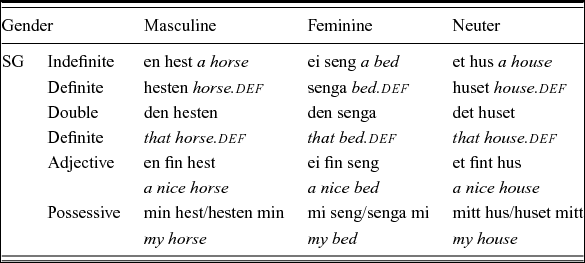
Norwegian has a three-gender system, with distinctions between masculine, feminine, and neuter, where masculine is the default (Trosterud, Reference Trosterud2001). Gender is mainly expressed within the DP itself, on adjectives and determiners (articles, demonstratives, and possessives). Although nouns have different plural suffixes depending on the nominal class they belong to (in some dialects), gender agreement is neutralized in the plural. Table 1 gives an overview of the main aspects of the gender system.
The gender system of Norwegian.

The indefinite article expresses a three-way gender distinction, with the forms en, ei and et for masculine, feminine, and neuter respectively. This also applies to the possessives (which may be both pre- and postnominal), with the forms min, mi and mitt in the 1st person singular. For virtually all adjectives there is syncretism between the masculine and feminine forms. The definite article in Norwegian is a suffix, i.e., -en for masculine, -a for feminine, and -et for neuter (the final -t is silent). Some traditional grammars treat the definite article as an expression of gender (e.g., Faarlund, Lie & Vannebo, Reference Faarlund, Lie and Vannebo1997), but according to the definition given above, the definite suffixes should be considered expressions of declension classes instead (cf. Enger, Reference Enger2004, Lødrup, Reference Lødrup2011, Rodina & Westergaard, Reference Rodina and Westergaard2013a, Reference Rodina, Westergaard, Siemund, Gogolin, Schulz and Davydovab). When a DP is demonstrative or modified, definiteness must be expressed twice, on a prenominal determiner and on the suffix. There is again syncretism between the masculine and feminine forms of the prenominal determiner. In our experiments, we focus on forms expressing gender proper (agreement with the noun) as well as declension forms, more specifically indefinite articles and prenominal determiners in double definite DPs on the one hand, and definite suffixes on the other.
Gender assignment is generally non-transparent in Norwegian, as gender cannot be predicted by the morphophonological shape of the noun. Nevertheless, Trosterud (Reference Trosterud2001) has proposed 43 different assignment rules that may account for 94% of all nouns. Unfortunately, these rules are not very helpful from the perspective of language acquisition, as they typically have a high number of exceptions and also cover many classes of nouns that are infrequent in the input to children.
Trosterud (Reference Trosterud2001) has also carried out a frequency count based on a total of 31,500 nouns in the Nynorsk Dictionary (one of the two written standards of Norwegian): Masculine nouns constitute the majority, 52%, while feminine nouns make up 32%, and neuter nouns only 16%. In Rodina and Westergaard (Reference Rodina and Westergaard2015), a corpus of child language recorded in Tromsø (Anderssen, Reference Anderssen2006) is investigated with respect to the frequency of the three genders in child-directed speech. The findings show that the masculine is even more often attested in children's input than in the dictionary (62.6%) while the feminine and the neuter are equally frequent (18.9% and 18.5%). In Rodina and Westergaard (Reference Rodina and Westergaard2015), it is also shown that the feminine gender seems to be in the process of disappearing from the Tromsø dialect, as children below the age of 12 hardly produce feminine gender forms at all, instead overgeneralizing the masculine. We return to this in section 4.1.
2.3 The gender system of Russian
Russian also has a three-gender system of masculine, feminine, and neuter, where masculine is considered the grammatical default. Corbett (Reference Corbett1991) provides the following distribution, calculated on the basis of a total of 33,952 nouns in dictionaries of modern Russian: masculine 46%, feminine 41%, and neuter 13%. Gender is expressed only in the singular on adjectives, possessives and demonstrative pronouns, as well as verbs in the past tense. In this paper, we only consider adjective-noun agreement in the nominative singular, as in (1)–(3). In the glosses, the gender of the noun is marked in parentheses and the agreeing item is marked after a full stop.
-
(1)

-
(2)
-
(3)


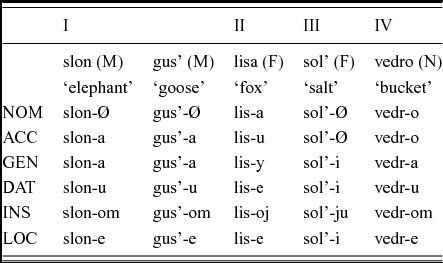
There is a strong correlation between the morphophonological properties of Russian nouns and their gender. The gender of most nouns can be predicted from the ending in the nominative singular, which is considered to be the basic form of a Russian noun (cf. Corbett, Reference Corbett1991): Nouns ending in a consonant (-C) are typically masculine, nouns ending in -a are typically feminine, and nouns ending in -o are neuter. However, there are nouns whose gender cannot be predicted on the basis of one case form, e.g., nouns ending in a palatalized consonant (-C’), such as gus’ ‘goose’ or sol’ ‘salt’, which belong to masculine and feminine gender respectively. Therefore, gender assignment in Russian has been argued to depend on the knowledge of declension classes, i.e., the whole paradigm of inflectional affixes (cf. Corbett, Reference Corbett1982, Reference Corbett1991). The correlation between declensional class and gender is illustrated in Table 2, where nouns in declension I are masculine, nouns in declensions II and III are feminine, and nouns in declension IV are neuter. Masculine gus’ ‘goose’ has the same declension paradigm as the majority of masculine nouns (declension I), while feminine sol’ ‘salt’ has a distinct paradigm (declension III).
Declension-gender correlation in Russian.

The nominative singular of stem-stressed neuter nouns in declension IV presents another source of ambiguity. Unlike neuter nouns such as vedró ‘bucket’, where stress falls on the final syllable, there are nouns that end in an unstressed -o, such as mýlo ‘soap’. The pronunciation of the nominative singular is thus indistinguishable from feminine nouns ending in an unstressed -a, as both have reduced vowels (cf. Iosad, Reference Iosad2012, pp. 524–525). This is illustrated in (4)–(5), where the pronunciation and the corresponding spellings are provided.
-
(4)
-
(5)


Importantly, in examples (4)–(5), the adjectival endings are also opaque, as they are unstressed (Pavel Iosad, p.c.). Thus, only prenominal modifiers with stress on the final syllable can resolve the ambiguity between stem-stressed feminine and neuter nouns:
-
(6)
-
(7)


Russian children and heritage speakers have been shown to overgeneralize feminine agreement with these ambiguous neuter nouns (Gvozdev, Reference Gvozdev1961, Popova, Reference Popova, Ferguson and Slobin1973, Polinsky, Reference Polinsky2008). Furthermore, there is evidence that in some Russian dialects (e.g., to the south-east of Moscow) stem-stressed neuter nouns may take inflectional endings of the second declension, e.g., ubirat’ sén u. acc(f) vs. Standard Russian ubirat’ sén o .acc(n) ‘harvest hay’ (cf. Kasatkin, Reference Kasatkin2005, p. 122). This is an indication that these neuter nouns are vulnerable.
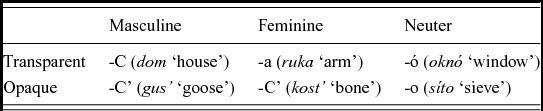
Table 3 summarizes the classes of transparent vs. opaque nouns that we focus on in this study.Footnote 1
The distribution of transparent vs. opaque nouns in Russian based on the nominative singular.

Summarizing, the two languages investigated in this study both have a three-way gender distinction with masculine as the default, but they differ in the degree of predictability of gender assignment. Russian shows a high degree of transparency, since the gender of the majority of nouns is predictable from nominal endings (with smaller groups of nouns showing ambiguity of gender cues). In Norwegian, on the other hand, gender assignment appears to be arbitrary.
3. Previous research
3.1 Norwegian and Russian monolinguals
Transparency of the gender system has been shown to play an important role in monolingual acquisition. Grammatical gender is in place early in languages where gender assignment is rule-based and transparent, while delays typically occur when the system lacks transparency, i.e., when the assignment rules have a small scope and there are numerous exceptions (e.g., Blom, Polisenskà & Unsworth, Reference Blom, Polisenskà and Unsworth2008a, Blom, Polisenskà & Weerman, Reference Blom, Polisenskà and Weerman2008b, Cornips & Hulk, Reference Cornips, Hulk and Lleó2006, Clark, 1985, Kupisch, Müller & Cantone, Reference Kupisch, Müller and Cantone2002, Tsimpli & Hulk, Reference Tsimpli and Hulk2013, Unsworth, Argyri, Cornips, Hulk, Sorace & Tsimpli, Reference Unsworth, Argyri, Cornips, Hulk, Sorace and Tsimpli2014). In Norwegian, gender has been shown to be relatively late acquired. Rodina and Westergaard (Reference Rodina and Westergaard2013a) conducted an analysis of longitudinal data from two monolingual children in the Tromsø corpus (Anderssen, Reference Anderssen2006), age 2;6–3;3. The examination of the children's accuracy reveals that masculine gender forms are massively overgeneralized with feminine and especially with neuter nouns, the indefinite article being the most vulnerable form. These data also reveal a discrepancy between the acquisition of gender agreement and the gender-marked declensional suffixes (e.g., definite articles), the latter being generally target-consistent across all three classes of nouns from early on. More recently, based on experimental data, Rodina and Westergaard (Reference Rodina and Westergaard2015) have shown that neuter gender is not fully mastered (at 90% accuracy) until approximately the age of seven. This study also shows that the feminine is virtually non-existent in the indefinite DPs produced by pre-school and school-aged children. These findings are interpreted as an ongoing change in the Tromsø dialect, involving loss of the feminine indefinite article and possibly feminine gender altogether.
In Russian, children have been shown to be sensitive to morphophonological regularities from an early age (Gvozdev, Reference Gvozdev1961, Popova, Reference Popova, Ferguson and Slobin1973, Kempe, Brooks, Mironova & Fedorova, Reference Kempe, Brooks, Mironova and Fedorova2003, Rodina, Reference Rodina2007, Tarasenkova, Reference Tarasenkova2010, Rodina & Westergaard, Reference Rodina and Westergaard2012, Rodina, Reference Rodina2014). The gender of transparent noun classes is acquired by age three, while opaque cases remain problematic: In Gvozdev's (Reference Gvozdev1961) diary data, masculine agreement occurs with feminine nouns ending in -C’ until approximately age seven, and feminine is used with stem-stressed neuters until age six. In an experimental study, Rodina and Westergaard (Reference Rodina, Westergaard, Siemund, Gogolin, Schulz and Davydova2013b) find that Russian-speaking monolinguals aged 4;5–6;6 overgeneralize stem-stressed neuter nouns to the feminine 15%, while errors with feminines ending in -C’ constitute 5%. Problems with feminine and neuter opaque nouns is also observed in three- to five-year-olds by Tarasenkova (Reference Tarasenkova2010). Her study shows that unambiguous morphophonological forms, such as the instrumental singular (rather than adjectival agreement), have a facilitating effect on the acquisition of gender with opaque feminine and neuter nouns. The facilitating effect of regular morphophonological features has also been demonstrated by Kempe et al. (Reference Kempe, Brooks, Mironova and Fedorova2003). Specifically, they argue that the presence of diminutive forms in child-directed speech (which have regular patterns of metric stress and transparent morphophonological cues) facilitate gender acquisition by Russian two- to four-year-olds. In the study, children produced fewer errors with diminutives, e.g., masculine korablik ‘a small ship’, than they did with the simplex form korabl’ ‘ship’, which shows ambiguity between masculine and feminine due to the palatalized final consonant.
3.2 Bilingual first language acquisition
Bilingual first language acquisition (2L1) is generally very similar to monolingual acquisition (L1), especially for morphosyntax (De Houwer, Reference De Houwer, Kroll and De Groot2005, Genesee & Nicoladis, Reference Genesee, Nicoladis, Hoff and Shatz2007, Meisel, Reference Meisel2011). The differences that are sometimes observed are mainly quantitative (e.g., Hulk & Müller, Reference Hulk and Müller2000, Müller & Hulk, Reference Müller and Hulk2001). This also seems to be true of the acquisition of grammatical gender, which has been studied in several language combinations, e.g., Italian–German and French–German (Kupisch et al., Reference Kupisch, Müller and Cantone2002), Italian–German, French–German, Spanish–German and Italian–French (Eichler, Jansen & Müller, Reference Eichler, Jansen and Müller2012), Spanish–English and Welsh–English (Gathercole, Reference Gathercole, Oller and Eilers2002, Gathercole & Thomas, Reference Gathercole, Thomas, Cohen, McAlister, Rolstad and MacSwan2005), Dutch–English and Greek–English (Unsworth et al., Reference Unsworth, Argyri, Cornips, Hulk, Sorace and Tsimpli2014), and Norwegian–Russian (Rodina & Westergaard, Reference Rodina and Westergaard2013a, Reference Rodina, Westergaard, Siemund, Gogolin, Schulz and Davydovab).
As in L1 acquisition, transparency of the gender system is argued to play an important role. For example, in a corpus study of bilingual Italian–German and French–German acquisition, Kupisch et al. (Reference Kupisch, Müller and Cantone2002) found that transparency of the morphophonological properties of nouns and other gender-marked elements facilitates the acquisition of gender in Italian, while in French, where the gender system is less transparent, gender acquisition is delayed. According to Eichler et al. (Reference Eichler, Jansen and Müller2012), transparency also explains why Spanish and Italian gender systems are acquired with greater ease, compared to French and German. With respect to German, the delay is also attributed to the fact that gender marking is intertwined with case and number.
Crosslinguistic differences related to transparency are also discussed in an experimental study by Unsworth et al. (Reference Unsworth, Argyri, Cornips, Hulk, Sorace and Tsimpli2014), who investigate the acquisition of grammatical gender in Dutch by Dutch–English children in the Netherlands and in Greek by Greek–English bilinguals in Greece. They find that the acquisition of gender by 2L1 children is similar to L1 acquisition both quantitatively and qualitatively, as it reflects the crosslinguistic differences between Dutch and Greek in the following way: The Greek gender system is rather transparent, hence early acquired (before age 3), while the gender system in Dutch is much more opaque, hence acquired after age 4. Similarly, the Greek–English 4-6-year-olds outperform the Dutch–English 4-7-year-olds. Interestingly, the comparison of gender marking in early successive bilinguals (exposure to English from birth and to Dutch/Greek age 1–4) and child second language learners (exposure to Dutch/Greek age 4–10) reveals no age effects. Thus, this study indicates that age of onset is not the primary factor in bilingual gender acquisition.
Unsworth et al. (Reference Unsworth, Argyri, Cornips, Hulk, Sorace and Tsimpli2014) also investigated the amount of input, measured in terms of chronological age, and the percentage of exposure at present vs. cumulative length of exposure. They show that vocabulary score and the amount of input at present are the best predictors for bilingual children's acquisition of grammatical gender in both languages. Additionally, the cumulative length of exposure is a significant predictor for Dutch, which is not unexpected given the lack of transparency of the gender system. It should be noted that Cornips and Hulk (Reference Cornips and Hulk2008) also report a delay for 2L1 acquisition of gender in Dutch by different ethnic minority children, suggesting that this delay in older bilinguals (aged 9–12) indicates a qualitative difference, partly attributed to the sociolinguistic context.
Input effects have been observed in several studies investigating 2L1 acquisition of grammatical gender. For example, Gathercole (Reference Gathercole, Oller and Eilers2002) and Gathercole and Thomas (Reference Gathercole, Thomas, Cohen, McAlister, Rolstad and MacSwan2005) investigate the effect of parental input identified in terms of one or two parents speaking the minority language, on Spanish or Welsh acquired by Spanish–English and Welsh–English bilinguals. For Spanish, Gathercole (Reference Gathercole, Oller and Eilers2002) observes that six-year-olds with the most input at home and at school outperform children with less input. A similar observation is made for the acquisition of gender in Welsh (Gathercole & Thomas, Reference Gathercole, Thomas, Cohen, McAlister, Rolstad and MacSwan2005). Importantly, the two studies illustrate how the amount of input and transparency of the gender system affect the acquisition process at later stages. For Spanish, Gathercole (Reference Gathercole, Oller and Eilers2002) shows that the differences between children with different amounts of exposure disappear at approximately age 10. In Welsh, which is less transparent than Spanish, the complex and opaque gender forms are more problematic, and according to Gathercole and Thomas (Reference Gathercole, Thomas, Cohen, McAlister, Rolstad and MacSwan2005), children with little exposure to Welsh may never converge on the target.
Polinsky's (Reference Polinsky2008) study of grammatical gender in American–Russian heritage language is also related to the issue of the end-state grammar. Based on comprehension data, Polinsky (Reference Polinsky2008) shows that low-proficiency heritage speakers develop a reduced gender system, as they assimilate stem-stressed neuter nouns to the feminine, by analogy with feminine nouns in -a. That is, they develop a two-gender system consisting of masculine and feminine only, distinguishing between nouns ending in a consonant (-C) and nouns ending in a vowel (-a or -o). She proposes that this change is due to the lack of knowledge of the relatively complex declensional system of Russian (cf. Table 2).
Schwartz, Minkov, Dieser, Protassova, Moin and Polinsky (Reference Schwartz, Minkov, Dieser, Protassova, Moin and Polinsky2014) investigate Russian gender in preschool bilingual children with L1 Russian and four different L2 backgrounds, including English, Finnish, German and Hebrew, all in situations where the L2 is the majority language. In these cases no qualitative differences or significant delays are observed. However, although these children grow up outside of Russia, they are in predominantly Russian-speaking environments, and therefore no direct comparison is possible with the Norwegian–Russian children in our study.
To summarize, both transparency and the amount of input are issues that play a crucial role in 2L1 gender acquisition. The present study further explores these issues, as they are highly relevant for bilingual Norwegian–Russian acquisition, given the nature of the two languages. In the next section, we discuss the possible implications that these factors have for our study, as well as the issue of ultimate attainment raised by Polinsky (Reference Polinsky2008).
4. The present study
The study investigates how transparency of the gender system and the amount of input affect gender acquisition in Norwegian–Russian bilingual children.Footnote 2 We raise four main research questions:
-
1. How does amount of (parental) input affect the acquisition of gender?
-
2. Are early age of onset and transparency of the gender system sufficient conditions for successful acquisition in the minority language?
-
3. Will differences between mono- and bilingual children be mainly quantitative?
-
4. Do we find signs of changes/reductions in the gender system of bilinguals?
We study two groups of bilingual children, one with two Russian-speaking parents (RR) and one with only one Russian-speaking parent (NR), comparing them to monolingual controls in both languages. Based on previous studies on 2L1 gender acquisition, our general prediction is that acquisition should be qualitatively similar for bilingual and monolingual children in both languages. Yet, quantitative differences could be expected in the minority language (Russian), where the amount of input could have an effect (cf. Gathercole, Reference Gathercole, Oller and Eilers2002, Gathercole & Thomas, Reference Gathercole, Thomas, Cohen, McAlister, Rolstad and MacSwan2005), especially in the NR group. Given the relatively young age of our participants (4–5-year-olds), we cannot exclude the possibility that also RR bilinguals and even monolinguals could have problems with opaque gender classes (cf. Gvozdev, Reference Gvozdev1961).
In Norwegian, the majority language, we predict that the amount of parental input should not play a role. Despite the fact that RR bilinguals are not exposed to Norwegian in the home, they are born in Norway and attend Norwegian-speaking daycare from age 1. They thus receive considerable amounts of Norwegian input on an everyday basis from early on. For Norwegian we predict that gender acquisition will be late acquired in all three groups of children, since this grammatical phenomenon does not fall into place until approximately age 7 (Rodina & Westergaard, Reference Rodina and Westergaard2015). Furthermore, we predict that neuter and especially feminine will be most vulnerable in all three groups of speakers.
The between-group comparison of the bilingual children is based on the automatically calculated measures in the Utrecht Bilingual Language Exposure Calculator (UBiLEC) (Unsworth, Reference Unsworth2013). This tool documents detailed information about language input and language use both inside and outside the home and estimates language exposure as a percentage of exposure at present as well as cumulative length of exposure in years;months (CLoE). We predict that CLoE will be the strongest predictor of the children's performance not only in Russian, but also in Norwegian, where gender is highly non-transparent.
Finally, we investigate whether the gender system of the children with the least exposure to Russian at home may have characteristics of changes or reductions. If so, we expect the neuter opaque class in Russian to be the most vulnerable, undergoing a change to the feminine, as found in American–Russian heritage language (Polinsky, Reference Polinsky2008).
Our overall predictions are summarized in (8). Language-specific predictions are formulated in (9) for Norwegian and (10) for Russian.
-
(8)
-
a. Quantitative differences between RR and NR bilinguals in Russian.
-
b. Qualitatively similar gender acquisition in bilingual and monolingual children.
-
c. Possible changes/reductions affecting the neuter in Russian.
-
-
(9)
-
a. Late acquisition in bilinguals as well as monolinguals.
-
b. Gender marking on indefinite articles problematic in the neuter and especially in the feminine (overgeneralization of masculine).
-
c. Suffixed definite articles the least problematic forms.
-
-
(10)
-
a. More problems with opaque than transparent nouns.
-
b. Masculine agreement overused with feminine opaque.
-
c. Feminine agreement overused with neuter opaque.
-
5. Method
5.1 Participants
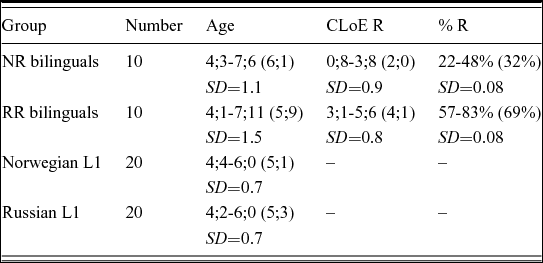
We recruited 20 simultaneous bilingual Norwegian–Russian children, 20 Norwegian-speaking monolinguals, and 20 Russian-speaking monolinguals. The bilingual children were divided into two groups: one group of children exposed to both Norwegian and Russian at home (N=10), henceforth the NR group, and one group exposed to only Russian at home (N=10), henceforth the RR group. In the NR group all ten mothers were recent immigrants from Russia and all fathers were Norwegian with little or no knowledge of Russian. UBiLEC (Unsworth, Reference Unsworth2013) was used to document the linguistic profile of the bilingual children. This tool estimates two exposure measures: Cumulative length of exposure in years;months (CLoE) and percentage of exposure at present.Footnote 3 No statistical age differences were found between the groups, except that Norwegian monolinguals are younger than the NR bilinguals, t = 3.04, p = .003. Details for all groups are provided in Table 4.
Overview of participant groups: Number, age (years;months), cumulative age of exposure to Russian (CLoE R), percentage of exposure to Russian at present (% R).

All the bilingual children were born in Norway and attended Norwegian-speaking daycare from around age one. Ten of the children attended daycare at the time of testing and ten had been enrolled in Norwegian primary school from approximately age six. There were nine first graders and one second grader. All the children were raised in two-parent middle-class households, where the parents had at least a BA. All the Russian mothers had a university degree from Russia and many had an additional degree from Norway. In the NR group, five children were exposed to a consistent one parent–one language situation, while the other five were exposed to both languages from the Russian-speaking mother (roughly 50/50%).Footnote 4 Two children in the NR group had older siblings who used a mixture of Norwegian and Russian.
Fifteen of the bilingual children were recruited and tested at Russian clubs in Tromsø and Alta. These clubs offer classes once a week (45–60 minutes) in Russian language and culture. The four- and five-year-olds had attended these clubs for about one year, the six- and seven-year-olds for two years. Five children were tested in their homes; two of these were from the NR group.
The Norwegian-speaking monolinguals were recruited and tested in two daycare centers in Tromsø. They were all native speakers of the Tromsø dialect. The Russian-speaking monolinguals were recruited and tested at a daycare in Ivanovo, Central Russia.
5.2 Materials and procedure
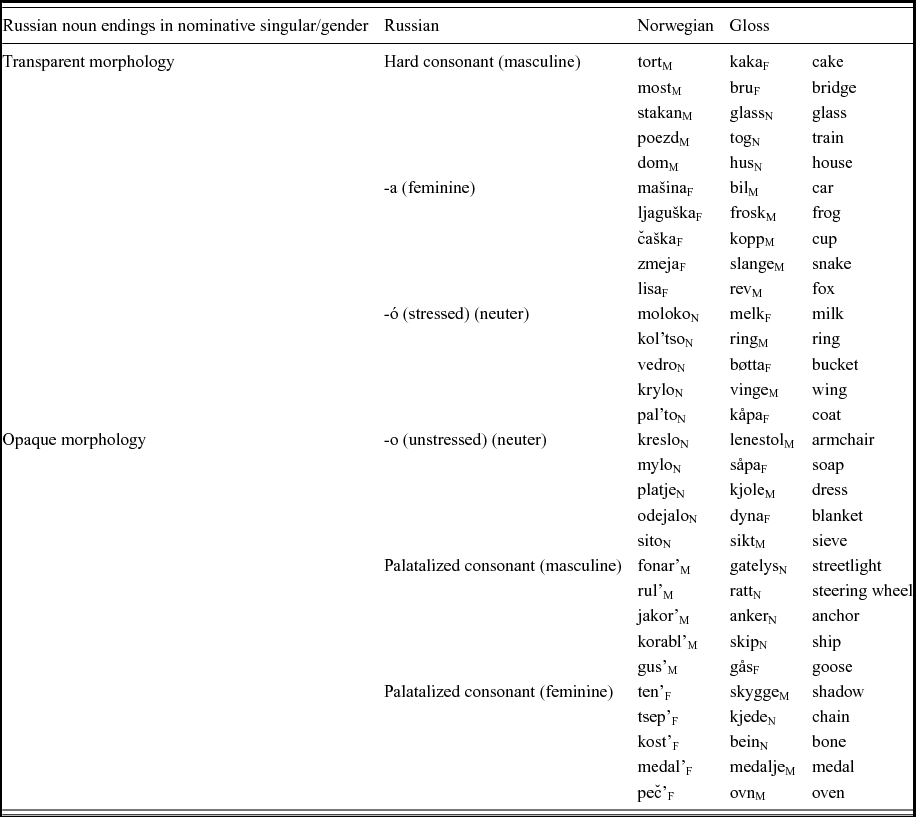
We adopted the elicited production task used in Rodina and Westergaard (Reference Rodina, Westergaard, Siemund, Gogolin, Schulz and Davydova2013b) for this study (originally adapted from Stöhr et al., Reference Stöhr, Akpinar, Bianchi, Kupisch, Braunmueller and Gabriel2012). The materials were a series of colored pictures presented on a laptop computer showing various objects depicting the target nouns. The stimuli consisted of 30 test items in each language. The experiment was based on Russian, where it was important to achieve a balance between the six conditions in Table 3. The same nouns were tested in Norwegian in order to control for frequency effects between the two languages. The test items were selected such that there was no gender overlap in the two languages. Unfortunately, this caused an uneven distribution of test items in Norwegian: 13 masculine, 8 feminine, and 9 neuter nouns. We avoided using cognates (except for medal’/medalje ‘medal’), and it was also important that the test items were easy to depict. Noun familiarity was not taken into account, as our main criterion was morphophonological form and also because all nouns were provided (orally) by the experimenter. A full list of experimental items is given in Appendix A.
The elicitation procedure is shown in (11). Due to the typological differences between the two languages, the target structures were different. In Russian, we elicited adjective-noun agreement forms; in Norwegian the corresponding forms were indefinite and double definite DPs. The lead-in statement was carefully chosen not to reveal the gender of the target noun.
-
(11)

The test items were presented in a randomized order preceded by a training session. In Russian, plural nouns were used in the training session, as they show no gender distinctions. The children were also trained to use the adjective goluboj ‘light blue’, which was crucial in the neuter (cf. section 2.3). In Norwegian, the training session consisted of three nouns in the singular, one from each gender. There were no fillers.
The participants were tested individually by two investigators, a native speaker of Norwegian working as a research assistant and a native speaker of Russian (the first author of this paper). The order of the Russian and Norwegian tests varied for the individual bilingual participants and there was at least a one-week interval between the two. All responses were audio-recorded and later transcribed by two research assistants – native speakers of Norwegian and Russian.
For Norwegian, we counted responses with indefinite articles, prenominal determiners and suffixed definite articles separately. It should be noted that the number of expected responses varied for different agreement targets. A total of 60 responses per child were expected with indefinite articles (26 masculine, 16 feminine, and 18 neuter), as well as 30 responses with double definite forms (prenominal determiners and suffixed definite articles). We excluded responses where a different noun was used. For Russian, we counted responses with adjective noun forms. We excluded all responses where a different noun was used as well as those where the children used a diminutive form of the test item, as in these cases non-transparent nouns have a transparent ending (e.g., kost’ – kostočka ‘a bone – a small bone’). In Russian, a total of 90 responses per child were expected, three per test item. However, in the neuter we only counted the responses with the unambiguous adjective goluboe ‘light blue’ which was used at most twice with each test item. Thus the sample of the neuter nouns was somewhat smaller (20) than the samples of masculine and feminine nouns (30).
In both languages the target noun was occasionally missing in the response. In such cases only the indefinite article or prenominal determiner was used together with an attributive adjective in Norwegian, as shown in (12)–(13). In Russian, sometimes only the attributive adjective occurred, as shown in (14). Since the target noun was introduced in the immediately preceding or following context, such responses were included into the counts, as these are perfectly grammatical responses.
-
(12)
-
(13)
-
(14)


Finally, let us briefly comment on the issue of what we refer to as gender concord vs. discord, i.e., whether there is (correct or erroneous) agreement throughout a single test item (concord), or whether there is a mixture of genders used (discord). In all, there are very few cases of gender discord: In Russian, there were 18 examples in the bilingual children's data and seven in the data of the monolinguals; in Norwegian, there were 12 cases in the bilingual data and 38 in the monolingual data. Some of these examples are presumably simply slips, others we would argue reflect uncertainty with respect to gender assignment. In Norwegian, this is indicated by the fact that the majority of discord cases occur in the neuter (36/50); and most of these (26/36) are found in the monolingual data. In Russian, opaque genders cause some uncertainty for the L1 and RR children; however, the majority of discord cases (15/25) are produced by the NR children with both opaque and transparent nouns. These findings correspond to what has been found for other languages, namely that children typically have problems with gender assignment, not with gender agreement (across several targets). Hence discord cases have been included into the counts.
6. Results
6.1 Quantitative analysis: Bilinguals vs. monolinguals
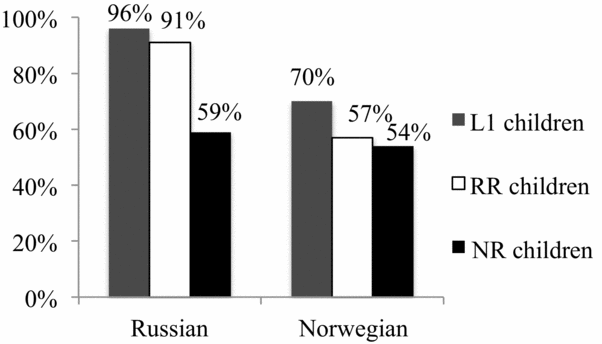
The overall accuracy rates presented in Figure 1 compare gender marking on indefinite articles in Norwegian and attributive adjectives in Russian. As we see, the Russian monolinguals are generally target-like (96%, 1282/1340) and seem to outperform their Norwegian-speaking peers, who use correct gender marking only 70% (587/838). One reason for this is the change that is currently taking place in the dialect, involving the loss of the feminine, as argued in Rodina and Westergaard (Reference Rodina and Westergaard2015), cf. section 3.1 above.Footnote 5 Another important factor is the non-transparent nature of gender assignment in Norwegian, causing a clear acquisition delay in Norwegian compared to other languages, cf. Rodina and Westergaard (Reference Rodina and Westergaard2013a, Reference Rodina, Westergaard, Siemund, Gogolin, Schulz and Davydovab).
Target-consistent gender marking on indefinite articles in Norwegian and attributive adjectives in Russian: L1 Norwegian (4;4-6;0), L1 Russian (4;2-6;0), NR bilinguals (4;3-7;6), RR bilinguals (4;1-7;11).

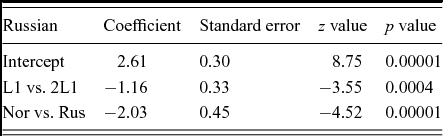
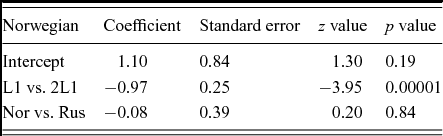
The two groups of 2L1 children behave differently in the two languages as well. The RR children are quantitatively similar to the L1 children in Russian (91% (667/736) accuracy), but this is not the case for the NR children, who only give 59% (426/722) correct responses. Two logistic mixed effects models were fit using the lme4 package in R (Bates, Maechler, Bolker & Walker, Reference Bates, Maechler, Bolker and Walker2014). These models predicted performance based on family structure (monolingual vs. bilingual, Norwegian vs. Russian at home) while allowing varying intercepts for both subjects and items. Separate models were used for each language because the task itself included slightly different materials specific to the two languages (see Appendix B). The results of these models are listed in Tables 5 and 6. The first model shows an effect of bilingual family type in Russian, β = −2.03 (SE = 0.45), z = −4.52, p = .001. In Norwegian, on the other hand, the two groups of 2L1 children perform only slightly lower than the L1 children. The difference between the RR and NR children in Norwegian is very small (57% (208/363) vs. 54% (224/413)) and is not significant, β = -0.08 (SE = 0.39), z = 0.2, p = 0.84. Thus, the bilingual family type has no effect on the majority language.
Effect of family type on performance in Russian.

Effect of family type on performance in Norwegian.

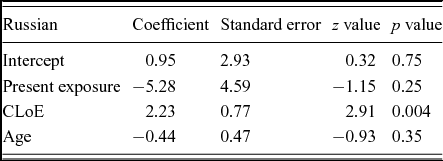
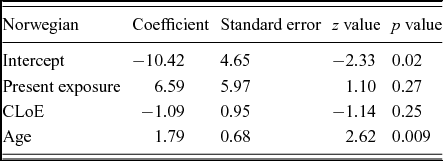
Furthermore, a separate set of multilevel logistic regression models reveal that CLoE is a significant predictor of the children's performance in Russian, β = 2.23 (SE = 0.77), z = 2.91, p = 0.004 (Table 7). These models allow varying intercepts for both subjects and items. When controlling for CLoE, children's chronological age and exposure at present have no significant effect in Russian: p = 0.35 and p = 0.25. In Norwegian, on the other hand, only chronological age is a significant predictor for the children's performance, β = 1.79 (SE = 0.68), z = 2.62, p = 0.009 (Table 8). Neither CLoE nor exposure at present have a significant effect in Norwegian: p = 0.27 and p = 0.25.
Effect of present exposure, cumulative exposure, and chronological age on performance in Russian.

Effect of present exposure, cumulative exposure, and chronological age on performance in Norwegian.

6.2 Qualitative analysis: Norwegian
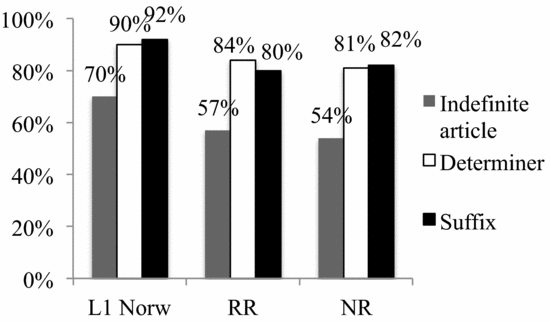
In Figure 1, we saw that even the L1 Norwegian children had an accuracy rate of only 70% (587/838) on indefinite articles. With respect to the other two forms tested, all three groups of children perform considerably better, as shown in Figure 2: The prenominal determiner in double definite DPs (den, den and det in the masculine, feminine and neuter respectively) is produced with a considerably higher accuracy, 90% (464/515) for the Norwegian monolinguals, and 84% (154/184) and 81% (167/205) for the two groups of bilinguals. The definite suffix has similar accuracy rates, 80% (117/146) and 82% (130/158) for the two bilingual groups and almost ceiling performance for the Norwegian monolinguals, 92% (431/466). For all subsequent analyses, we fit mixed-effects models with varying intercepts for participants and items to the relevant subsets of the data. With regard to the data in Figure 2, the analysis shows that indefinite articles are the most problematic for all the children, z = 13.71, p = .001. The performance on determiners and definite suffixes does not vary between monolinguals and bilinguals (z = 0.81, p = .421 and z = 1.92, p = .055, respectively) or between RR and NR children (z = 0.14, p = .892 and z = 0.55, p = .585).
Target-consistent gender marking in Norwegian: L1 Norwegian (4;4-6;0), NR bilinguals (4;3-7;6), RR bilinguals (4;1-7;11).

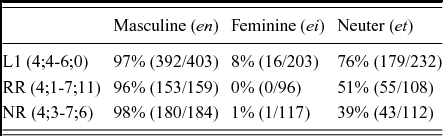
A closer look at the data shows that there is a clear difference between the three genders, especially with respect to the indefinite article. This is illustrated in Table 9: While the masculine is virtually error free, the accuracy rate for the neuter is only 51% and 39% for the RR and the NR groups respectively, z = 0.40, p = .688. The L1 Norwegians do not score much better than the bilingual groups (76% accuracy), z = 1.70, p = .089. And when considering the feminine, we find that the indefinite article ei is hardly produced at all, by any of the three groups. In the majority of cases, the errors are due to overgeneralization of the masculine form en, as illustrated in examples (15)–(16).
-
(15)
-
(16)


Gender marking on indefinite DPs in Norwegian: % correct (N/Total).

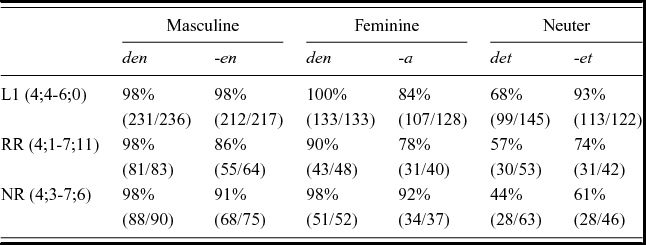
Table 10 provides a detailed overview of the children's accuracy rates with the other two forms tested, the prenominal determiner and the definite suffix. Again we see that the masculine forms are virtually error free, with only slight differences between the three groups. In the feminine, the prenominal determiner is also generally produced target-consistently, which is not surprising given the syncretism between masculine and feminine forms in this case. In the neuter, the children have more problems, overgeneralizing the masculine/feminine form den, as illustrated in (17). The accuracy for the RR and NR groups is only 57% and 44%, z = 0.958, p = .338, and for the L1 Norwegians 68%, z = 2.88, p = .004. The neuter definite suffix is also problematic for the bilingual children with 74% and 61% target-consistent responses for the RR and NR groups respectively, z = 1.33, p = .182, while the monolingual children are at 93% accuracy, z = 2.71, p = .007. The feminine definite suffix is somewhat less error-prone in the bilingual children, z = 1.25, p = .212, and in this case the monolingual children have a similar performance, z = 0.11, p = .914. Most errors involve overgeneralization of the masculine suffix -en, as illustrated in (18)–(19).
-
(17)
-
(18)
-
(19)


Agreement errors in double definite DPs in Norwegian: % correct (N/Total).

6.3 Qualitative analysis: Russian
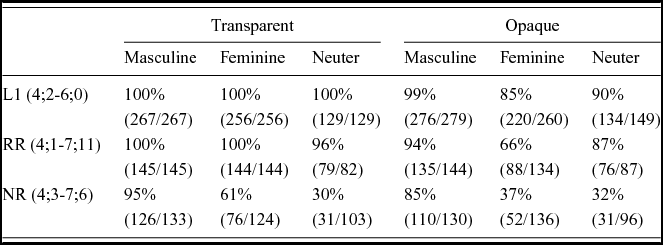
The analysis of gender assignment in opaque vs. transparent contexts in Russian is presented in Table 11. The RR children behave like the monolinguals, in that both groups experience some problems with feminine and neuter opaque nouns, the former producing 66% and 87% target-consistent responses, the latter 85% and 90%. As predicted, the RR and L1 children overgeneralize masculine with feminine opaque and feminine with neuter opaque, as shown in (20a, b). The NR children, on the other hand, produce considerably fewer target-consistent responses than the other two groups, and crucially, not only with opaque nouns, but also with transparent ones: the accuracy rate for feminine transparent is 61% and with neuter transparent only 30%. For opaque nouns, the NR children score lower across all three gender conditions than monolingual and RR children, z = 4.01, p < .0001, and performance is lower across all groups for the feminine as opposed to masculine gender, z = 5.32, p < .0001.
-
(20)

Adjective-noun agreement in Russian: % correct (N/Total).

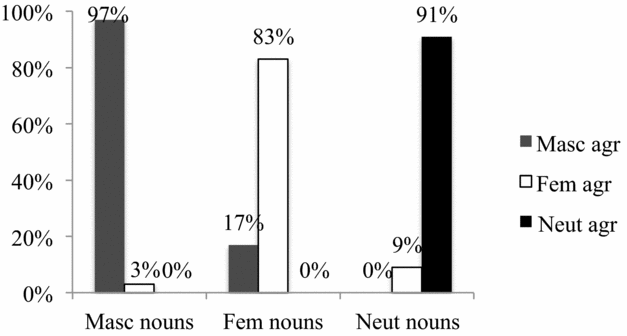
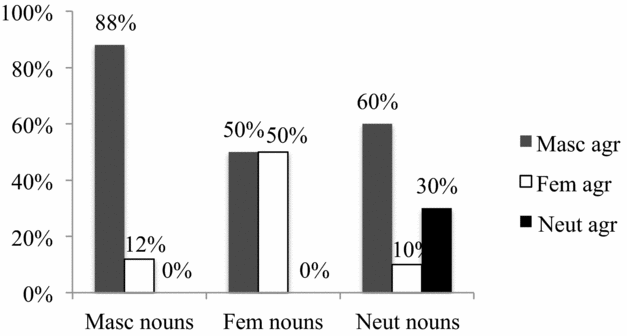
Figures 3 and 4 compare the use of agreement forms with nouns of each gender in the RR and NR data, revealing important differences between the two groups. The RR children use the expected forms, i.e., 97% masculine with the masculines, 83% feminine with the feminines, and 91% neuter with the neuters. In the NR children's data, on the other hand, masculine agreement is used very frequently, not only with the masculines (88%), but also with the feminines (50%) and neuters (60%). In the case of feminine opaque nouns, overgeneralization of masculine was expected. Yet, the NR children overgeneralize masculine also with feminine transparent nouns, as shown in (21). In the neuter, masculine agreement is also predominant, illustrated in (22), which is unexpected, as neuter opaque was predicted to be prone to overgeneralization of feminine. Yet, feminine agreement is used only 10% with neuter nouns, cf. (20b). Target-consistent neuter agreement is used only 30%.
Accuracy of gender agreement in Russian - RR children (N = 10, age range 4;1-7;11).

Accuracy of gender agreement in Russian - NR children (N = 10, age range 4;3-7;6).

-
(21)
-
(22)


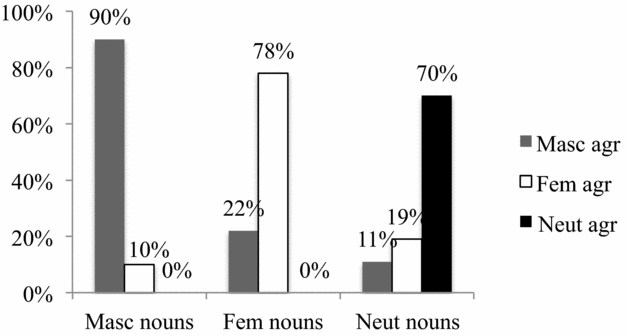
In order to provide an explanation for the observed differences between the RR and NR children, we analyzed the individual parental questionnaires in detail and found that the NR children can be further subdivided into two groups based on the consistency of input in the home. Five of the NR children are exposed to a one parent–one language pattern, where one of the parents always speaks Russian and the other parent Norwegian. These children's use of gender agreement is illustrated in Figure 5, which shows that they are generally like the RR children, clearly distinguishing masculine, feminine, and neuter nouns (cf. Figure 3).
Accuracy of gender agreement in Russian - NR children (N = 5, ages 4;11, 5;4, 6;5, 7;3, 7;6) exposed to one parent–one language.

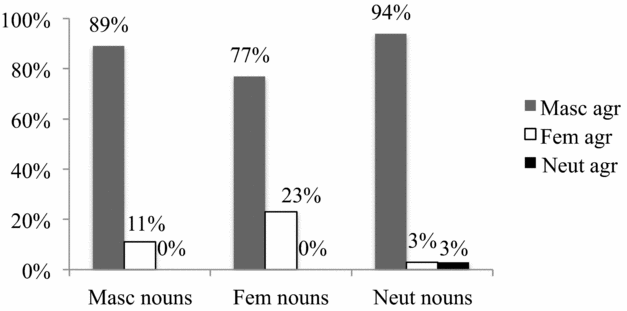
The other five children in the NR group are exposed to input which is less consistent, in that the Russian-speaking mother sometimes uses Russian and sometimes Norwegian. Three of these children also have older siblings who seem to speak almost exclusively Norwegian with them. The use of agreement forms in these five children's data is presented in Figure 6, which reveals that these children are almost solely responsible for the overuse of masculine observed in Figure 4. Masculine agreement is used predominantly across all three genders: 89% with the masculines, 77% with the feminines, and 94% with the neuters. Neuter forms are virtually absent from these children's production. In the opaque neuters, where we expected some overgeneralization of feminine, feminine agreement is used only 3%.
Accuracy of gender agreement in Russian - NR children (N = 5, ages 4;3, 4;6, 6;5, 7;0, 7;1) exposed to both languages from one parent.

7. Discussion
7.1 2L1 gender acquisition: transparency and the amount of input
In section 4, we posited four research questions and three overall predictions for our study:
-
1. How does amount of (parental) input affect the acquisition of gender?
-
2. Are early age of onset and transparency of the gender system sufficient conditions for successful acquisition in the minority language?
-
3. Will differences between mono- and bilingual children be mainly quantitative?
-
4. Do we find signs of changes/reductions in the gender system of bilinguals?
-
(23)
-
a. Quantitative differences between RR and NR bilinguals in Russian.
-
b. Qualitatively similar gender acquisition in bilingual and monolingual children.
-
c. Possible changes/reductions affecting the neuter in Russian.
-
The first two research questions address the effects of transparency of the gender system and the amount of exposure in 2L1 acquisition. The two factors are interrelated in several ways. First, like many other 2L1 studies investigating gender assignment (e.g., Gathercole, Reference Gathercole, Oller and Eilers2002, Gathercole & Thomas, Reference Gathercole, Thomas, Cohen, McAlister, Rolstad and MacSwan2005), we find that the amount of parental input plays a crucial role in the minority language (cf. Figure 1). Children with two Russian-speaking parents (RR) have a clear advantage, as their accuracy rates are very similar to those of Russian monolingual children: 91% vs. 96% respectively. 2L1 children with one Russian-speaking parent (NR) perform significantly lower (59%). Thus, prediction (8a) is borne out.
An initial consideration of the NR children's data in Table 11 reveals that not only opaque, but also transparent nouns are problematic. This means that we find not only quantitative differences between the mono- and bilinguals, but also qualitative differences (cf. research question 3, prediction 8b). A closer analysis shows that not all NR children behave the same (Figures 5, 6). That is, the presence of this qualitative difference is only characteristic of children that hear both languages from the parent speaking the minority language. Only the children in this group are qualitatively different from the Russian monolinguals (and from the other bilingual children exposed to the one parent–one language pattern), as they predominantly use masculine agreement across the board: 89% with masculine, 77% feminine and 94% with neuter nouns (Figures 3, 5, 6). This finding indicates that there may be an ongoing change in the gender system of those Norwegian–Russian children who have the least exposure to Russian at home. Like Polinsky (Reference Polinsky2008), we believe that the nature of this phenomenon is related to the morphological complexity of the nominal paradigm (see discussion in section 7.2). However, unlike Polinsky, we find signs of reduction not only in the neuter, but also in the feminine, as masculine agreement is overgeneralized across all three genders (Figure 6). Thus prediction (8c) is borne out; in fact, we see an even more extensive reduction. The quantitative and qualitative characteristics of bilingual and monolingual children's performance in Russian also suggest that the language-specific predictions for Russian formulated in (10) are borne out for monolinguals and bilinguals from Russian-speaking households and one parent–one language households, but not for bilinguals where the minority language speaker also speaks the majority language to the children. In other words, the majority of the children in our study are sensitive to the -C, -a, -o endings in the nominative singular and perform at ceiling with transparent noun classes. As predicted, they sometimes overuse masculine agreement with feminine opaque and feminine agreement with neuter opaque nouns. The bilinguals from households where both languages are spoken by one of the parents, on the other hand, overgeneralize masculine across the board.Footnote 6 Thus, for the majority of bilinguals in this study it is possible to draw parallels with bilingual preschoolers in Schwartz et al. (Reference Schwartz, Minkov, Dieser, Protassova, Moin and Polinsky2014), who have Russian as their L1 in a minority language situation. This is especially interesting given that the RR children and NR children from one parent–one language households received less input in Russian than the bilinguals in the Schwartz et al. study, who grew up in a predominantly Russian-speaking environment. Interesting further research would be to compare the end-state grammars for bilinguals with different amounts of exposure to the minority language.
While there are significant differences in the bilingual children's accuracy rates in Russian, the parental language strategy does not play a role for the majority language. That is, being exposed to Norwegian at home does not give the NR children an advantage, as they do not perform better than the RR children. This corresponds to what Klassert and Gagarina (Reference Klassert and Gagarina2010) have attested in data from German–Russian bilingual children growing up in Germany: the amount of German spoken at home was found to have no effect on the children's proficiency in the majority language. This indicates that possible concerns parents might have that their children's proficiency in the majority language might be negatively affected by the use of a different language in the home are generally unfounded.
Thus, the factor that seems to play the biggest role in Norwegian is transparency. The lack of reliable gender cues makes gender assignment highly problematic not only for bilingual but also for monolingual children. Both RR and NR children score significantly lower than monolinguals on indefinite articles, 57% and 54% vs. 70% (Figure 1). However, this difference seems to be quantitative only, as the errors made by all groups go in one direction: masculine en is overgeneralized with feminine and neuter nouns. Figure 2 and Table 10 also show that bilingual and monolingual children are similar with respect to prenominal determiners and the definite suffixes, which are less problematic than indefinite articles. This means that all our language-specific predictions for Norwegian in (9) are borne out for all groups of children.
According to Rodina and Westergaard (Reference Rodina and Westergaard2015), the overuse of masculine en with feminine nouns reflects a change in progress rather than a gender assignment error (Table 9), and from the results of the present study we may therefore claim that what is most problematic for 4–7-year-old bilingual (and monolingual) children is the neuter. In the neuter indefinite forms the RR and NR children have low accuracy rates (51% and 39%) compared to 76% in the monolingual data. Given the relatively similar accuracy rates in the two bilingual groups and the one-way directionality of the overgeneralization, this is an indication that bilinguals are simply slower in their development than the monolinguals, who have not reached target-like usage of et either. As pointed out by an anonymous reviewer, it is also possible that bilinguals develop at the same speed as monolinguals proportional to the amount of input they have received. In any case, it may be necessary to study older children to completely exclude the presence of a qualitative change in this bilingual population (cf. the discussion of gender acquisition in Dutch in section 3.2).
Further analysis of the data in terms of cumulative length of exposure (CLoE) and the percentage of exposure at present reveals a pattern which was not fully predicted, but which supports our other findings. Like Unsworth et al. (Reference Unsworth, Argyri, Cornips, Hulk, Sorace and Tsimpli2014) we predicted that both variables may have an effect in both languages and that CLoE would play a greater role in Norwegian, as it is less transparent. However, while CLoE is a significant predictor of the bilingual children's gender marking in Russian, we find that the children's chronological age is the only significant predictor in Norwegian. At the same time chronological age is not a significant predictor variable in Russian. Thus, regardless of the transparency of the gender system of the language, the amount of exposure is crucial for successful gender acquisition, and early exposure is not a sufficient condition. One should bear in mind that the children in this study are still developing and final conclusions should be drawn from studies of older bilingual speakers.
7.2 Qualitative differences – a change in progress?
Finally, we would like to address the question of why we find these qualitative differences in Russian in the five 2L1children who are exposed to both languages from the parent speaking the minority language. As discussed in section 3.2, qualitative differences are typically not found in either of the two languages of 2L1 children. However, as pointed out in Eichler et al. (Reference Eichler, Jansen and Müller2012), the grammatical representation of the gender category is also an important factor. In section 2.3, the Russian gender system was presented as relatively transparent, but at the same time complex, as gender is expressed not only on a single form, but on the full declensional paradigm, i.e., the system of six case forms organized in four different declension classes. In fact, Tarasenkova (Reference Tarasenkova2010) has shown that the knowledge of other case forms, such as the instrumental, plays a crucial role in gender acquisition, especially for opaque noun classes whose phonological representation in the nominative singular is misleading. Occasional errors with these opaque nouns are present in those of our bilingual children who are raised in Russian-speaking and one parent–one language households, indicating that these children are clearly sensitive to morphophonological gender cues in Russian. As the cues in the nominative singular are not sufficient for target-consistent gender assignment to opaque nouns, learners must also have knowledge of the declensional system.
The five children who are raised in the households where both languages are spoken by one of the parents, on the other hand, seem to be insensitive to the gender cues, as they are using masculine adjectival agreement predominantly across all noun classes (Figure 6). We would like to suggest that the reason for this is that these bilingual children have problems with noun categorization as a result of lack of knowledge of the declension system of Russian. This has previously been argued by Polinsky (Reference Polinsky2008) for American Russian heritage speakers, more specifically the speakers with the lowest proficiency in Russian. Thus, they categorize all nouns ending in a consonant as masculine and nouns ending in a vowel as feminine. This results in a two-gender system of masculine and feminine with neuter being virtually absent. In the data of our five bilingual children with the least exposure to Russian, neuter is also the most vulnerable; there are only three cases of neuter agreement (3%), produced by three different children. Feminine agreement occurs somewhat more – 11%, 23%, and 3% with masculine, feminine, and neuter nouns respectively, and feminine thus appears to be somewhat less vulnerable. A possible analysis could be that these children are developing a two-gender system of masculine and feminine like some of the Russian heritage speakers in the United States. However, looking at these children's individual data, we find that one of them does not produce any feminine or neuter forms at all, and two other children produce only two feminine and one neuter form each. The majority of the feminine forms in Figure 6 occur in the data of two children, who produce 35 and 24 feminine forms each. One of them does not use neuter agreement at all, while the other uses it only once. These individual results suggest that the latter two children have a gender system of masculine and feminine, while in the grammar of the other three children gender is not represented as a category, since they generally use masculine gender forms across the board. Further research focusing on bilingual adolescents is necessary to investigate whether they will conform to the target in their minority language at a later stage of development.
8. Summary and conclusion
This paper has presented an experimental study on the acquisition of gender by bilingual Norwegian–Russian children, and compared their performance in both languages to that of monolingual controls. The children's knowledge of grammatical gender was found to be dependent on the transparency of the gender system in the target language and the amount of exposure in the home. In the case of Norwegian, the majority language, a similar acquisition pattern was observed for mono- and bilingual speakers. With respect to transparency, Norwegian gender was shown to be later acquired than Russian, despite the fact that this is the majority language for the bilinguals. Transparency also turned out to be important in Russian, since gender of opaque noun classes was more problematic for the bilinguals (as well as the monolinguals) than gender of transparent noun classes. In Russian, the amount of parental input turned out to be the most important factor in gender acquisition: While children with two Russian-speaking parents performed like monolinguals, the children with one Russian-speaking and one Norwegian-speaking parent made considerably more mistakes, crucially also with transparent nouns. A further analysis of this group showed that this qualitative difference was mainly due to the performance of the children with the least input (i.e., children hearing both languages from the parent speaking the minority language). We suggest that this is due to these children not having mastered the relatively complex declension system of Russian, thus being insensitive to the gender cues. The result is a reduction in the gender system, confirming previous findings from Russian heritage speakers (Polinsky, Reference Polinsky2008). Our findings contribute to ongoing debates in research on bilingual acquisition relating to factors such as transparency, input, age of onset, and quantitative vs. qualitative differences. We conclude that the amount of exposure especially in the minority language is crucial and that early exposure is not a sufficient condition for successful acquisition of a complex and often non-transparent phenomenon such as grammatical gender.
List of stimuli

Appendix B. Statistical models: performance based on family structure (monolingual vs. bilingual, Norwegian vs. Russian at home)
yi = α jk [i] + β1 (Monolingual/Bilingual) + β2(HomeLanguage) + ei
 $$\begin{equation*}
\alpha jk\ = \gamma j\ + \delta k
\end{equation*}$$
 $$\begin{equation*}
\gamma j\ = {\rm{ }}\bar \alpha {\rm{ }} + \eta j
\end{equation*}$$
 $$\begin{equation*}
\delta k\ = {\rm{ }}\bar \alpha + \kappa k
\end{equation*}$$
Where yi is the logit of accuracy for a given response predicted by an intercept adjusted for subjects and items, and fixed coefficients corresponding to an orthogonally-coded design matrix in which monolinguals are compared to bilinguals for the first predictor and the language used at home is compared within bilinguals for a second predictor. The following table illustrates factor coding:

The intercept term includes independent random effects for both subjects and items, encoded as γj and δk. In this context, ηj and κk represent subject- and item-wise errors.