INTRODUCTION
Since independence in 1962, Burundi has held elections on four occasions. Both the 1965 and the 1993 electoral processes were followed by the violent overthrow and breakdown of the emerging political regime. One year after the multiparty elections of 1965, a one-party system was established through a military coup. Mirroring a wider trend on the African continent, a process of political liberalisation paved the way for multiparty elections in June 1993. While these elections were widely applauded as an example of seemingly successful instant democratisation (Reyntjens Reference Reyntjens1993), four months later part of the incumbent (Tutsi-dominated) regime imposed its veto in an attempt to protect its vested interests (Sullivan Reference Sullivan2005). During a military coup attempt in October 1993, the democratically elected (Hutu) president Melchior Ndadaye (Frodebu party) and several other dignitaries were assassinated. This left the country in an institutional imbroglio and rendered the 1993 founding elections nearly meaningless. It also paved the way for large-scale, very often inter-ethnic, massacres, and a civil war between the predominantly Tutsi government army and predominantly Hutu rebel forces. Under South African mediation, an initial peace accord was signed in August 2000 in Arusha (Tanzania) between the former single party Uprona (and a number of small, predominantly Tutsi, parties) and Frodebu (and a number of small, predominantly Hutu, parties), the government and the national assembly. Together with the November 2003 peace agreement between the transitional government and the main Hutu rebel movement (CNDD-FDD), this accord paved the way for the general elections of 2005, which were by and large considered to be free and fair, and were won by the former rebel movement, with some observers calling Burundi a beacon for Central Africa (Peterson Reference Peterson2006). The newly elected government of President Pierre Nkurunziza (Hutu, CNDD-FDD) engaged in lengthy and eventually successful peace talks with the last remaining Hutu rebel movement (Palipehutu-FNL), which laid down arms in 2009, announcing its participation (and even its victory) in the 2010 elections. Five years after the 2005 founding elections and fully in accordance with the constitutionally determined term of office, Burundians were again called to vote, not only in local and parliamentary but also in presidential elections (unlike in 2005, when the president was chosen by the members of parliament).
After nearly five decades marked by authoritarian one-party rule and repeated outbursts of highly murderous ethno-political strife, the 2010 elections were, in more than one way, historical. On the one hand, when viewed against the literature on the self-reinforcing power and the self-improving democratic quality of successive elections (Lindberg Reference Lindberg2006, Reference Lindberg2009), these so-called second elections supposedly signal a politically more liberal position of Burundi in the spectrum of hybrid, i.e. neither fully authoritarian nor fully democratic, political regimes. On the other hand, major costs and risks were associated with the 2010 elections, some of which are not surprising when considering patterns of political transition in sub-Saharan Africa (van de Walle Reference van de Walle2003). In general, electoral observers noted that the elections had been conducted in conformity with international standards, and that irregularities observed during the polls had not been significant enough to bring into question the credibility of the results (UNSC 2010a). After a brief description of the electoral marathon that took place between May and September 2010, this paper analyses the electoral process and how it relates to legitimacy, political liberalisation, pluralism and stability. In order to understand their costs and benefits, Burundi's 2010 elections must necessarily be placed in the context of the complex power-sharing arrangement to which Burundi's peace process has given rise and which is laid down in the post-transition Constitution of 18 March 2005 (Lemarchand Reference Lemarchand2007; Vandeginste Reference Vandeginste2009).
FACTS AND FIGURES OF BURUNDI'S 2010 ELECTORAL MARATHON
Between May and September 2010, elections were held in Burundi at four different levels: communal (or municipality) elections on 24 May, presidential elections on 28 June, national assembly elections on 23 July and (indirect) Senate elections on 28 July, and finally hill electionsFootnote 1on 7 September.
Communal elections
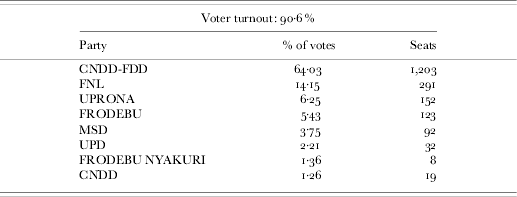
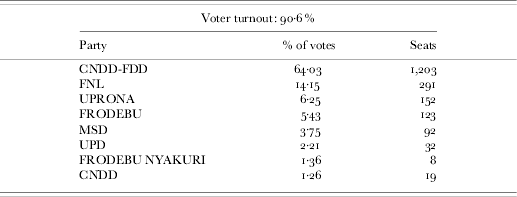
Out of a total of forty-four political parties registered, some twenty-three participated in the communal elections. Quite surprisingly, these resulted in a landslide victory for the ruling CNDD-FDD party. Table 1 shows the scores (percentage of the votes and seats) obtained by the eight parties that presented lists of candidates in more than 100 of Burundi's 129 communes. Apart from the CNDD-FDD, these were Uprona and Frodebu (its partners in the grand coalition government put in place after the 2005 elections, although both of them increasingly positioned themselves as the main opposition parties), FNL (the former rebel movement very recently transformed into a political party led by Agathon Rwasa), MSD (a newly registered party led by the charismatic former journalist Alexis Sinduhije), UPD (a breakaway faction of the CNDD-FDD around former party strongman Hussein Radjabu), Frodebu Nyakuri (a breakaway fraction of Frodebu around former Frodebu chair Jean Minani, considered to be a satellite party of the CNDD-FDD), and the ‘original’ CNDD (which was established in 1994 by dissident Frodebu members and continues to be led by Leonard Nyangoma).
Communal elections, 2010
Source: Author's compilation.
A breakdown of this aggregate score at the national level reveals important regional differences. The CNDD-FDD obtained an absolute majority – with a record of 81% of the votes cast in northern Ngozi, the province of origin of incumbent president Nkurunziza – in all except three of the seventeen provinces. In the capital city Bujumbura, CNDD-FDD obtained 28·2% of the votes, defeating FNL (25·9%), MSD (18·2%) and Uprona (11·9%). In Bujumbura Rural, the province surrounding the capital town and for many years the stronghold of Palipehutu-FNL, CNDD-FDD (26·6%) was defeated by FNL (57·4%), with Uprona (4·2%) and Frodebu (3·5%) left far behind. In southern Bururi, the province of origin of much of the (Tutsi) political and military elite under the Uprona era but also of (Hutu) CNDD leader Leonard Nyangoma, CNDD-FDD obtained 25·6 of the votes cast, defeating Frodebu (23·7%), FNL (15·2%), Uprona (13·3%) and CNDD (9·2%).
While deploring a number of logistical difficulties and some technical lacunae in the electoral legislation, national and international (intergovernmental as well as non-governmental) observer teams applauded the high voter turnout (with a massive participation of women), and the absence of any major violent incidents on election day, as well as the role played by the security forces and the national electoral commission (CENI). As lead agency among the electoral observation teams, the European Union observer mission declared that the elections were generally in accordance with international standards.
The scores obtained by the opposition were far below their own expectations. A group of twelve opposition parties – including FNL, Frodebu, MSD, UPD and CNDD, but not Uprona – immediately set up an alliance called ADC-Ikibiri (Alliance of Democrats for Change in Burundi). They denounced what they considered to be massive election fraud (due to an overall climate of voter intimidation and bribery, a lack of secrecy in the ballot booth, pre-stuffed ballot boxes, orchestrated power cuts, etc.) by the CNDD-FDD. They requested the annulment of the results of the communal elections, the appointment of a new electoral commission (composed of an equal number of members representing the ruling party and the opposition) and the initiation, under international mediation, of a political dialogue in order to prepare for new elections (ADC-Ikibiri 2010). Both in Bujumbura and in the capital towns of Burundi's main international donor countries, opposition leaders and their diaspora representatives lobbied the international community intensely to reconsider its initial position.
Fully aware of the potentially volatile situation and alarmed by a rising number of grenade blasts in several parts of the country, the international community sent in some of its most senior representatives, including UN secretary-general Ban Ki-moon and EU Special Envoy for the African Great Lakes Region Roeland van de Geer, in order to discourage political elites from stirring political violence and instability, and to prevent the electoral process from derailing. After a meeting of the Strategic Committee of the UN Integrated Office in Burundi (BINUB) on 3 June, the country's international partners made a crucial public statement, recalling the generally positive evaluation made of the elections by all observer teams and asking all political parties to continue participating in the electoral process. In a press statement on 23 June, the UN Security Council (2010d) called upon all political stakeholders in Burundi to participate fully in the electoral process, and insisted that electoral disputes should be settled through the existing legal mechanisms. Given the opposition's distrust in the independence of the electoral commission, the latter call was likely to remain unheeded. Only Uprona brought formal complaints – all of which were dismissed – before the provincial departments of the electoral commission.
Insofar as the opposition's withdrawal from the electoral process – probably also based on a genuine conviction that the game had been rigged from the start – was inspired by a strategic speculation that a boycott would encourage the international donor community to call for a rerun of the elections, it turned out to be a grave miscalculation.
Presidential elections
Initially, seven political parties had introduced candidates for the presidential elections. These were, in alphabetical order, Pascaline Kampayano (UPD, Hutu, Ngozi), former interim president Domitien Ndayizeye (Frodebu, Hutu, Kayanza), incumbent president Pierre Nkurunziza (CNDD-FDD, Hutu, Ngozi), Leonard Nyangoma (CNDD, Hutu, Bururi), Agathon Rwasa (FNL, Hutu, Ngozi), incumbent first vice-president Yves Sahinguvu (Uprona, Tutsi, Muramvya) and Alexis Sinduhije (MSD, Tutsi, Bujumbura). In line with the strategy of the ADC-Ikibiri coalition, five parties withdrew their candidate and called on the population to boycott the presidential election. After some hesitation, Uprona also decided not to participate in the presidential election (which, in any case, it had virtually no chance of winning). This seemingly half-hearted strategy – not to join the ADC coalition but to boycott the presidential election – allowed Uprona to increase its price when it came to negotiating its re-entry into the electoral process for the legislative elections.
On 28 June, the presidential election was held, with an average voter turnout of 76·98% and with the only remaining candidate Pierre Nkurunziza obtaining 91·6% of the votes cast. Participation peaked (at about 90%) in the northern provinces of Ngozi and Kirundo. Paradoxically, the popular response to the opposition's call to boycott the election largely confirmed the outcome of the communal elections (which could be interpreted as an indication of their regularity): voter turnout was remarkably below average in the three above-mentioned provinces in which CNDD-FDD failed to obtain an absolute majority: Bujumbura capital town (41·15%), Bujumbura Rural (58·7%) and Bururi (57·52%).
While deploring the lack of political pluralism and competition in this first direct presidential election since 1993, and expressing concern at a worsening political climate marked by infringements of the freedom of expression, international observers made a positive overall evaluation of the presidential ‘referendum’ (as it was commonly called).
Legislative elections
Tremendous efforts were made by representatives of the international community to try to convince as many political parties as possible to participate in the legislative elections. The electoral commission – which, so far, had strictly applied the electoral legislation – was remarkably lenient in extending the deadline in order to allow additional parties to submit lists of candidates. The stakes were high, as a general boycott of the national assembly elections by the opposition would completely negate the pluralistic nature of the elections. Even more important, it would also have badly undermined the functioning of Burundi's constitutional power-sharing system, and would inevitably have left the country in an institutional imbroglio and a situation of serious political instability.
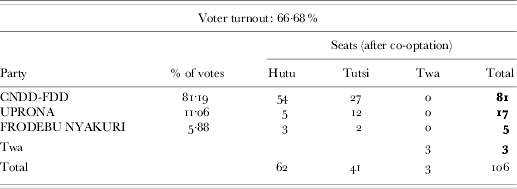
National assembly elections were held on 23 July, with the participation of CNDD-FDD, its satellite party Frodebu Nyakuri (strikingly similar to the kind of so-called opposition parties the ruling RPF party is willing to tolerate in neighbouring Rwanda), Uprona and a number of very small political parties (hardly known to the general public) and independent candidates. It remains unclear at what price Uprona decided to save the electoral process and, revising its earlier position, to participate in the legislative elections. What is clear, however, is that – after the electoral marathon – former president Buyoya (Uprona, Tutsi, Bururi) managed to have loyal followers appointed to several key positions (first vice-president, ministers, members of the bureaus of the national assembly and the Senate).
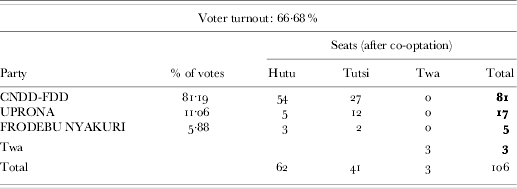
The CNDD-FDD – logically – improved its score, compared with the communal elections. Uprona and Frodebu Nyakuri – both of which took considerable advantage of the boycott by all other parties – obtained a score above the 5% threshold, which guaranteed their participation in the grand coalition government (see Table 4). Voter turnout was considerably lower, in particular in the provinces mentioned above (Bujumbura capital city, Bujumbura Rural and Bururi).
National Assembly elections, 2010
Source: Author's compilation.
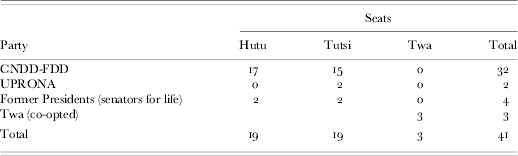
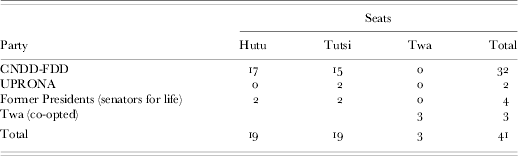
Under Burundi's constitution (art. 164), the National Assembly must be composed of 60% Hutu and 40% Tutsi MPs, with a minimum of 30% women and three representatives of the Twa ethnic group. If the election results do not reflect these constitutional requirements, the electoral commission co-opts (in this case six) additional members. This system of – corrected (with minority over-representation) – proportionality also applies to other public sector areas, including the police, the army and the Senate, where ethnic parity between Hutu and Tutsi is constitutionally required.Footnote 2 On 28 July, senators were indirectly elected by provincial electoral colleges, composed on the basis of the communal elections. It came as no surprise that the CNDD-FDD obtained an overwhelming majority in the Senate (see Table 3).
Composition of the Senate, 2010
Source: Author's compilation.
While not constitutionally required, the composition of the bureaus of both the National Assembly and the Senate reflects the power-sharing spirit of Burundi's constitutional regime. Both are presided over by a Hutu representing the CNDD-FDD, and both Assembly and Senate have a Tutsi second vice-president representing Uprona. As discussed below, it remains to be seen whether this semblance of political pluralism within the institutions is more than symbolic.
The new government
President Nkurunziza was sworn in on 28 August. As constitutionally required, he appointed two vice-presidents of different ethnic groups and different parties (while taking into account the predominant ethnic character of their parties, art. 124). Térence Sinunguruza (Uprona, Tutsi, Mwaro) was appointed first vice-president, while former president of the Senate Gervais Rufyikiri (CNDD-FDD, Hutu, Gitega) was appointed second vice-president. Rufyikiri's appointment was generally seen as a way of silencing him and the Senate (which, during the first legislature, had countered Nkurunziza on a number of occasions).
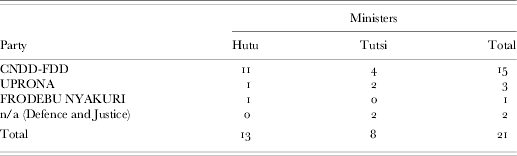
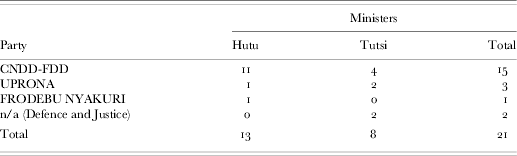
As constitutionally required, the three parties that obtained at least 5% of the votes in the legislative elections are proportionately represented in the grand coalition government (see Table 4). About 60% of ministers are Hutu, about 40% are Tutsi, and over one third are women (art. 129). All provinces are represented, except Bujumbura capital city and Bujumbura Rural as well as Bubanza. The number of ministerial positions has been reduced (from twenty-six to twenty-one) and a number of technocratic newcomers have been appointed. Several – at times highly criticised – CNDD-FDD ministers have been confirmed in crucial positions (internal affairs, external relations, public security and finance).
Composition of the government, 2010
Source: Author's compilation.
A QUEST FOR (PRIMARILY EXTERNAL) LEGITIMACY
The collapse of the 1993 electoral process has been described as a failure to replace the old source of legitimacy (initially the drum, symbolising the monarchy, later taken over by the gun, symbolising the army) by a new one (the ballot box, symbolising the people's will) (Ntibantunganya Reference Ntibantunganya1999). How do the 2010 elections relate to the supposed purpose of enhancing the democratic legitimacy of Burundi's rulers? As far as internal (domestic) legitimacy is concerned, it is hard to speculate – in the absence, to my knowledge, of any scientific research on the issue – what motivated Burundians to vote primarily for the CNDD-FDD. It is nevertheless worth mentioning some hypotheses. As in 2005 (Nimubona Reference Nimubona2005), there is little doubt that for the majority of the population (an estimated 85% of whom are Hutu) legitimacy goes hand in hand with an ethnically representative leader.Footnote 3 Furthermore, more than any other president ever before, Nkurunziza is perceived to be ‘one of them’. He spends a lot of time outside the capital, playing soccer, praying and planting avocado trees together with the average Burundian peasant. Also, people may well have voted for CNDD-FDD as a reward for its social policies of offering free primary education as well as free health care for pregnant women and babies, despite important shortcomings when it came to implementing such policies. On the other hand, people may also have voted for the incumbent dominant party because they realised that, otherwise, peace and security were likely to come under severe pressure. With the civil war still fresh in their minds, people may understandably have voted for short-term stability. In addition, after several months of electoral campaigning by the party and its youth division (the imbonerakure, ‘those who see from far’), marked by the abuse of public goods, the harassment of opposition parties and a general atmosphere of intimidation and corruption (HRW 2010), the electorate's free choice was in practice severely constrained even before the arrival of the election observer missions.
More important for the successful completion of the electoral marathon was the international recognition that the communal elections had been, by and large, sufficiently free and fair. Throughout their dispute, both the opposition and the dominant party were seeking to obtain external adherence to their cause, realising that the voice of Burundi's international donor community was likely to be decisive in order to (de)legitimise the on-going electoral process. What were the stakes involved in these elections for Burundi's donors (who contributed close to 85% of the electoral budget of about US$ 46·5 million)? First and foremost, Burundi's international partners were alarmed by the risk of an outbreak of large-scale electoral violence, as in Kenya and Zimbabwe. Such a scenario, with the associated risks of cross-border refugee flows and sub-regional instability, was to be avoided at all costs. Up to a certain manageable degree of intensity, political violence was seen as acceptable and close to ‘normal’. The regional context, with heavily criticised recent elections held in Kenya and Rwanda (two of Burundi's partners in the East African community), lowered the standards for Burundi. Second, an institutional imbroglio like that experienced in Burundi after the 1993 elections, giving rise to endless rounds of political negotiations, major instability and widespread violence, was to be avoided. Therefore, Burundi's international partners rightly insisted on conducting the 2010 elections in accordance with the constitutional framework. Third, and related to the previous concern, given the results of the communal elections, diplomatic representatives based in Bujumbura spared no effort to try and save a necessary minimum of political pluralism and to avoid a democratically legitimised return to single-party rule. They rightly – though unsuccessfully, except as far as Uprona was concerned – referred to the fact that even parties defeated at the elections but obtaining 5% of the votes are entitled to participate in the grand coalition government and that, together, the opposition might well be able to obtain a blocking one-third minority in the national assembly. Fourth, the elections were seen as a major step towards the consolidation of the peace process. Specifically, the prospect of an electoral victory was the carrot that ultimately convinced the last rebel movement Palipehutu-FNL to lay down arms and to register as a political party. In 2005, CNDD-FDD had transformed itself from a rebel group to the dominant political party, and the FNL, with the expected support of Frodebu, was hoping for the same achievement. Finally, after they had worked with a CNDD-FDD-dominated administration for the past five years, continuity rather than a radical change of political personnel was seen by Burundi's international partners as offering better chances for gradually improving technocratic governance performance. Newly demobilised FNL cadres, lacking both experience and expertise, surely did not offer a promising alternative. In summary, despite the enormous priority awarded to them by the international donor community, the Burundi 2010 elections were rather a matter of avoiding costs than of realising benefits. Seen from that angle, the status quo seemed the safest option. A breakdown of the electoral process – which a negative evaluation by international electoral observers would have placed at risk – would have been a highly unfortunate failure for a flagship case of the UN Peacebuilding Commission. Furthermore, ‘sufficiently successful’ elections were likely to allow for a progressive international disengagement. This was confirmed when, on 16 December 2010, the UN Security Council decided to significantly scale down the UN presence in Burundi, replacing BINUB by a BNUB (UN Office in Burundi) endowed with a more restricted mandate (UNSC 2010c).
FROM COMPETITIVE TO HEGEMONIC ELECTORAL AUTHORITARIANISM?
Have the 2010 elections contributed to a more open, pluralistic, accountable and rule of law friendly Burundi? Although it is obviously too early to draw final conclusions, several indicators suggest that, in the range of hybrid regimes between fully authoritarian and liberal democratic, Burundi has taken a step backwards. While it could be classified as competitive electoral authoritarian before the elections, it may well have become more hegemonic after the electoral marathon, contradicting the literature that suggests the generally self-reinforcing and democratising effect of (in particular second and third successive) elections (Lindberg Reference Lindberg2006).
In the run-up to the elections, the CNDD-FDD repeatedly – but unsuccessfully – tried to arrange the legal and institutional context so as to make sure that it could not lose the elections. A presidential decree of December 2008 on the establishment and functioning of the electoral commission left little if any room for the commission to work independently, and put it largely under the control of the incumbent government. The list of proposed members of the electoral commission, whom President Nkurunziza nominated in January 2009, was another indicator of his desire to fully control the electoral process. However, this blatant attempt to hegemonise the elections failed. This failure was largely due to Burundi's consociational power-sharing regime. CNDD-FDD's coalition partners (but at the same time main opponents in parliament), Frodebu and Uprona, strongly protested and in the Senate, no three-quarters majority (as required under article 90 of the constitution) was reached to appoint the members of the electoral commission. Together with strong pressure exerted by international diplomatic representatives in Bujumbura, the opposition – with a copy of the constitution at hand – managed to twist the ruling party's arm. After some weeks of heated debate and political dialogue, a compromise was found on the composition, powers, functioning and independence of the commission. Another attempt at unilaterally changing the rules of the game failed when the opposition managed to renegotiate the CNDD-FDD's proposed amendments of the electoral code. One contentious issue was the sequencing of the elections. While the CNDD-FDD insisted that the presidential elections should be held first (hoping that, after a re-election of Nkurunziza, his party would also win at all other levels), the opposition requested a bottom-up approach, starting with the communal, then the legislative and finally the presidential elections (hoping that at the local level, many people might vote for the opposition, which would affect the remainder of the electoral marathon). In the end, once again, a compromise was found after several weeks of inter-party dialogue, and in September 2009, a new electoral code was adopted by consensus. (It should be noted that, although the opposition had the impression that it had won this battle, this was not really true. In reality, even the first ‘communal’ elections were very ‘national’: people voted for parties, not for individual candidates, after a campaign that was run by national political leaders, not on the basis of communal development programmes.)
In summary, on the eve of the electoral process, no one was sure who would win, despite the authoritarian practices, the uneven playing field, and the general climate of voter intimidation, referred to above, that had marked the electoral campaign. The opposition remained hopeful that Burundians, dissatisfied with the government's record of corruption, would vote for change. Quite paradoxically, the outcome of the competitive elections – which received the green light from a wide range of observers – may now well enable the CNDD-FDD to consolidate its grip on all spheres of the public sector to such an extent that by 2015 it will be able to organise elections that it cannot lose (a defining characteristic of hegemonic electoral authoritarianism). In particular, the reduction of political pluralism signals a major risk of autocratisation of Burundian politics. This is by no means unique to the situation of Burundi. Authoritarian consolidation through elections has been documented elsewhere (see e.g. Lindberg Reference Lindberg2009; Schedler Reference Schedler2010). What the Burundi 2010 elections seem to teach us is that a carefully designed power-sharing arrangement may offer a temporary protection against this risk, but – in particular if some of the players (bad losers) decide to spoil the power-sharing game and leave the electoral process – no firm guarantees.
WHAT REMAINS OF POLITICAL PLURALISM IN BURUNDI?
Within the institutions, the little political pluralism that remains has been saved by Burundi's power-sharing regime. In an electoral setting based on pure majority rule, CNDD-FDD would surely have obtained full control over the legislative and the executive branch. As a result of Burundi's complex system of (corrected) proportionality and grand coalition, a number of current MPs, senators, ministers and a vice-president of the republic are not CNDD-FDD members. Had it not been for these constitutional power-sharing arrangements, the 2010 elections would have amounted to a democratically legitimised return to single-party rule. However, when taking a closer look, it becomes clear that Uprona, although represented in parliament and in the government, can easily be isolated by the CNDD-FDD and its satellite party Frodebu Nyakuri. For ordinary legislative work, a two-thirds majority is needed, which the CNDD-FDD has in both the National Assembly and the Senate. For specific decisions, such as the appointment of members of the electoral commission, a qualified three-quarters majority is needed, which the CNDD-FDD likewise has in both the National Assembly and the Senate. And, most significantly for its near hegemony, CNDD-FDD and Frodebu Nyakuri together have the qualified four-fifths majority needed to amend the constitution. In summary, Uprona has little leverage over its dominant coalition partner. However, it should be noted that the lack of leverage for Uprona to implement its political programme is not likely to threaten government stability. After all, much more than ideological or other substantive policy considerations, the main incentive for Uprona (as for any other political party in Burundi) to join and support the coalition government is that this strengthens its bargaining position on Burundi's neo-patrimonial political marketplace (De Waal Reference De Waal2009). (Note that, prior to establishing Burundi's coalition government, the parties involved did not even feel the need to identify common ground and to negotiate a substantive programme for government for the next five years.)
Furthermore, while during the first Nkurunziza legislature the Senate on several occasions played an important role in countering his unilateral rule, that is no longer the case today. Former president of the Senate Gervais Rufyikiri (who is generally appreciated by Burundi's international partners, and seen as a representative of the moderate civilian wing of the CNDD-FDD) is now the second vice-president of the republic, a ‘promotion’ which many observers view as a way of silencing him. All but two senators have been replaced by newcomers, most of whom are seen as closer to the military wing within the party. In 2007, CNDD-FDD was considerably weakened by internal dissidence, several of its mandate holders joining former strongman Hussein Radjabu and defecting from the party. The risk of internal dissidence, and associated instability, has now been considerably reduced by a new provision in the electoral code of September 2009. Henceforth, party defectors lose their seats in the National Assembly, the Senate and the communal council.
The dominant position of CNDD-FDD was illustrated, and at the same reinforced, by the appointment of the first Ombudsman of Burundi (an institution agreed on in the Arusha Agreement of 2000 but not yet established). In November 2010, Mohamed Rukara, a member of parliament and leading figure in the dominant party's Council of the Wise (Conseil des Sages, a group of close advisors to President Nkurunziza) was appointed as Ombudsman, despite protests by coalition partner Uprona and civil society.
What remains of political pluralism outside the institutions? It is extremely unclear what political role, if any, will be played by the political parties that are not represented in parliament. In particular, the future of FNL, Frodebu, MSD, UPD and CNDD – as well as of the ADC coalition they formed – is highly uncertain. Several of them have been weakened by internal dissidence, some of which was strongly encouraged if not orchestrated by the CNDD-FDD. Indeed, shortly after the elections, FNL dissidents were rewarded with appointments as provincial governor (Jacques Kenese, Bubanza province), ambassador (Anatole Bacanamwo), or general director of a state-owned company (Emmanuel Miburo, National Peat Office ONATOUR). RADEBU party chairman Jean de Dieu Mutabazi (a former Frodebu spokesperson), who initially joined the opposition but left the ADC coalition in August, was appointed head of the National Palm Oil Office. As of early December 2010, the political leaders of FNL, MSD and CNDD had left Burundi, while the UPD strongman was detained in Mpimba prison. Scores of other opposition party members had also been arrested. There is little that binds the members of the ADC, except their aversion to CNDD-FDD. But a conjunctural alliance that would help them to further their individual interests certainly cannot be ruled out. In order to gain the political power that they failed to obtain through the ballot box, they may decide to change tactics. As recent history, not only in Burundi but also elsewhere on the African continent, has shown (Tull & Mehler Reference Tull and Mehler2005), the use of armed force and political violence may be a rewarding strategy when it comes to negotiating oneself back into power.
Civil society was (and so far remains) vibrant in Burundi. But in the run-up to the elections, the context in which civil society operates became increasingly oppressive. In particular human rights activists and independent media were frequent targets. The expulsion, in May 2010, of the Human Rights Watch representative – an unprecedented decision in Burundi, contrary to the lengthy list of personae non gratae in neighbouring Rwanda – sent a strong signal to local human rights activists. The arrest, in July 2010, of Net Press journalist Jean-Claude Kavumbagu on charges of defamation and treason stands out as a tip of the iceberg of increased intimidation vis-à-vis dissident voices. In the post-electoral context and in the absence of a parliamentary opposition, civil society may increasingly be perceived by the incumbent government as an ally and a voice of the underground opposition. At the same time, political elites have understood the strategic importance – for both public relations and fundraising purposes – of infiltrating civil society.
FRAGILE STABILITY
One of the major risks commonly associated with elections after a period of violent conflict characterised by ethnic strife is that these may enhance ethnic rivalry and therefore destabilise a carefully designed and negotiated power equilibrium (Reilly Reference Reilly, Jarstad and Sisk2008). In particular in consociational power-sharing settings, which have become an important model of ethnic conflict management and resolution (Lijphart Reference Lijphart2008; Taylor Reference Taylor and Taylor2009), concerns have been expressed about a ‘freezing’ of ethnic identity and institutionalisation of ethnic antagonism (Finlay Reference Finlay2010; Jarstad Reference Jarstad, Jarstad and Sisk2008). Burundi, so far, clearly contradicts this alleged conventional wisdom. Sharply contrasting with the 1993 general elections, the 2010 elections have only very minimally been affected by ethnic discourse. Electoral competition is no longer primarily a matter of ethnic competition. FNL dissident Pasteur Habimana, who campaigned calling upon all Hutu to vote for Hutu candidates in order to prevent a Tutsi return to power, was immediately and unanimously condemned by all political parties, including those siding both with the government and with the opposition. It is widely recognised that this de-ethnicisation of electoral competition is largely due to the consociational power-sharing arrangement laid down in the Arusha Agreement of 2000 and in the constitution of 18 March 2005. As detailed above, a complex system of (corrected) proportionality and ethnic quotas guarantees the representation of Hutu, Tutsi and – to a minor extent – Twa societal segments at the national political level. Furthermore – and a decisive feature of Burundi's power-sharing regime – a choice was made for a system of consociational political parties. The constitution and the electoral legislation require that predominantly Hutu parties also include Tutsi candidates on the electoral lists, and vice versa. Furthermore, Tutsi citizens can vote for Hutu candidates, including those running on predominantly Hutu parties, and vice versa. This has, compared with 1993, created a totally new dynamic, with CNDD-FDD – for years perceived, and rightly so, as a Hutu rebel movement – seeking to attract Tutsi candidates and voters.
Do the 2010 elections mark the irreversible end of ethnic electoral competition? It is nothing less than a dramatic paradox that the consociational power-sharing system – which to a large extent saved the electoral process from leading to single-party rule and to Hutu majority rule – may turn out to be the victim of its own success. As a result of the elections, the CNDD-FDD has – strictly legally speaking, as noted above – all it needs to undo the constitutional requirements for a grand coalition, proportionality and ethnic quotas. Provisions which, in the spirit of the constitution, were clearly intended to require close to national consensus for their amendment, can now be unilaterally annulled by the CNDD-FDD. Dominant party leaders, including President Nkurunziza himself, have repeatedly shown a desire to ‘simplify’ the constitution, although no specific proposals have so far been put forward. Two important political questions remain unanswered. Will all Tutsi MPs and senators representing CNDD-FDD also vote in favour of constitutional amendments that threaten their political life-insurance? How will the army – today composed of an equal number of Hutu and Tutsi and operating under dual command (former government army and former rebel forces) – react in case of an imminent constitutional review?
It is impossible to predict how (in)stability and (in)security in Burundi will evolve in the months and years to come. However, developments in the weeks following the elections signal at least a risk of (probably rather low intensity) conflict. Killings of several dozens of people (some opposition members and some security officials, in addition to several ‘ordinary’ civilians) have been reported, in particular in Cibitoke and Bubanza provinces, close to the border with neighbouring DRC, where the absence of state control over the territory has created an excellent playground for insurgent movements (and regional alliances between them). In June 2010, FNL leader Agathon Rwasa went into hiding and has not been seen since. This has led to allegations – confirmed in the final report of the UN Group of Experts on the DRC of November 2010 (UNSC 2010b) – that he may well be reorganising FNL forces who remained loyal to him, calling upon the support of the Rwandan FDLR and also mobilising the MSD leadership to set up a conjunctural alliance between political groups that have little in common but their desire to fight the Nkurunziza regime. As it is no longer possible for Rwasa to play the ethnic card (and to recruit supporters referring to the need to liberate all Hutu, as he did before), it is uncertain whether the rural masses, who are clearly tired of war, will support a renewed insurgency. So far, the reaction by the Burundian government has not been to open political dialogue with the opposition. Rather, it has reacted in a typically authoritarian fashion, by arresting opposition supporters, imposing restrictions on political meetings of the opposition coalition, and intimidating civil society activists and journalists. Shortly before the publication of an Amnesty International (2010) report about the re-emergence of torture, in particular during interrogations by SNR (the National Intelligence Service) officials, President Nkurunziza signed four presidential decrees awarding considerable bonuses and stipends to SNR staff. With a rather opposition-friendly capital city (and its surrounding province), the Burundi government may be tempted to clamp down on any (real or perceived) pocket of resistance in an increasingly authoritarian fashion, finding inspiration, if need be, in the highly effective repression of any nascent opposition by the Rwandan government.
* * *
When viewed against the wider background of post-conflict elections on the African continent, Burundi's 2010 elections were not all that surprising. First, in line with van de Walle's earlier findings (Reference van de Walle2003), Burundi's multiparty competitive elections procedurally satisfied donors, thus enhancing the government's external legitimacy without threatening the interests of the ruling elite. Second, confirming the general trend of an absence of alternation, the party that won the 2005 founding elections also won the second elections. Remarkably, however, the victory of the ruling party was so overwhelming that its authoritarian grip on politics has become more hegemonic as a result of the elections. Third, at whatever level elections are held, political power is strongly personalised around the president. The electoral process has also considerably reinforced the president's position within the dominant party and disciplined (potential) internal dissidents. The elections are logically perceived by Burundi's elite as rewarding (and therefore encouraging) a governance system based on strong presidentialism and big man clientelism. Programmatic and ideological differences or debates about specific policy issues hardly played any role. Fourth, the former single party Uprona, thanks to its strategic negotiating capacity, continues to play – at least for the time being – an active and important role in politics.
Although, in the eyes of the international donor community, elections generally continue to be associated with state-building, democratisation and more accountable governance, Burundi provides a useful reminder that a less ideological and more realistic view of elections is needed. Elections can be potentially advantageous or injurious to post-conflict stability and democratisation (Reilly Reference Reilly, Jarstad and Sisk2008). The political costs of Burundi's 2010 elections indeed by far exceed their benefits. On the positive side, and contradicting the wider continental trend, the 2010 electoral marathon has confirmed that ethnic rivalry no longer drives electoral competition. This is an important achievement of Burundi's sophisticated and typically consociational power-sharing arrangement that, under South African mediation, was agreed upon in Arusha in 2000. The case of Burundi calls for a more thorough examination of the role of consociational political parties as instruments of centripetalism in ethnically divided post-conflict societies (Bogaards Reference Bogaards, Reilly and Nordlund2008).
Burundi also more generally illustrates the potential effectiveness of constitutional and electoral system engineering. Insofar as the elections were not held under a regime of hegemonic electoral authoritarianism, this was partly due to the constitutional and institutional arrangements which the dominant party – at the active request of Burundi's international partners – continued to abide by. Furthermore, the little political pluralism that today subsists inside the political institutions would not have been there without the power-sharing arrangement. However, the prospect of losing the elections but nevertheless obtaining a blocking minority in parliament did not convince the opposition coalition. Also, the deal negotiated at Arusha has little to offer in settling the current political dispute, which is no longer of an ethnic kind, between the dominant party and the opposition. Quite paradoxically, however, Burundi's power-sharing regime may fall victim to the results of the elections it has ‘saved’. Indeed, in its desire to establish more hegemonic control over the instruments of political power, the CNDD-FDD may well be tempted to revise the constitution, a step which it can now, as a result of the ‘democratically’ legitimated quasi-return to single-party rule, unilaterally decide to take.
The case of Burundi suggests that a power-sharing arrangement (even of the most complex and consociational kind) may curb or slow down the risk of autocratisation through elections, but not suppress it. It remains unclear, however, whether the Burundian government envisages an annulment or a significant reduction of the consociational nature of the constitution. In all likelihood, it will be set on formalising the political reality emerging from the elections, by constitutionally entrenching the more presidential and less parliamentary political system. Presidential advisors have already been testing the willingness of international diplomatic representatives to accept an amendment of the constitution that would allow the president to run for a third term in office, in return for a status quo as far as some of the essential ethnic quota requirements are concerned. Another major cost, the 2010 elections are likely to be perceived by the dominant party as a reward for – and an incentive towards – increasingly authoritarian governance practices. The Burundi case has also shown (or, rather, confirmed) that standards of what are considered to be sufficiently free and fair elections are applied with a significant degree of flexibility by international observer missions – an interesting lesson learned for future elections (not only in Burundi, but in the wider region). Pessimists, however, highlight the possible scenario that by 2015, rather than voting, Burundians may again witness how political elites negotiate the end of yet another round of armed conflict (after which, once more, founding elections can be planned). Deceived by an electoral process the outcome of which it had not anticipated, the non-parliamentary opposition may need some time to organise itself, but has probably come to the conclusion that only the use of armed violence can force the government to engage in political dialogue and ‘cake-sharing’ (which, for Burundi's elites, is the decisive element in accepting the kind of short-term political stability that has now been disturbed by the outcome of the 2010 elections).
While the international community supported the elections because they were seen as an important step in the process of democratic state-building, their ‘success’ or ‘failure’ may well be understood first and foremost as a function of their ability to reshuffle the stakes of competing political elites in Burundi's neopatrimonial political marketplace, in a way that these elites are willing to abide by (De Waal Reference De Waal2009). Burundi's international partners face the major challenge of identifying carrots and sticks that may discourage potential last minute spoilers of Burundi's peace process from resorting to large-scale political violence. One theoretically interesting stick and carrot seems to have lost its leverage in the Burundian context. After more than fifteen years of failure to bring to justice those responsible for war crimes (Vandeginste Reference Vandeginste2010), the threat of international criminal prosecution may at the same time fail to discourage new potential warlords (like MSD leader Sinduhije) while inciting rebels whose hands are already bloodstained (like FNL leader Rwasa) to resort to armed violence.