Defects permitting interatrial shunting are most commonly located within the floor of the oval fossa.Reference Ghisla, Hannon, Meyer and Kaplan1 Such defects, when seen in isolation, account for about 3% of patients with congenitally malformed hearts presenting in infancy.Reference Cockerham, Martin, Gutierrez, Hartmann, Goldring and Strauss2 Several studies have reported spontaneous closure of such defects. Besides the age of diagnosis, the diameter of the defect has been reported to be an important factor in spontaneous closure, and the incidence of spontaneous closure is reported to be between 14 and 55%.Reference Mahoney, Truesdell, Krzmarzick and Lauer3, Reference Mody4 More recently, however, the rate of spontaneous closure has been given as between 66% and 92%.Reference Radzik, Davignon, van Doesburg, Fournier, Marchand and Ducharme5 Spontaneous closure does not seem to be affected by symptoms, since it has been reported in infants with cardiac failure.Reference Cockerham, Martin, Gutierrez, Hartmann, Goldring and Strauss2–Reference Mody4, Reference Hoffman, Rudolph and Danilowicz6, Reference Hartmann and Elliott7 The mechanism of closure can be quite varied. Thus far, as far as we can establish, the effects of aneurysmal formation have still to be elucidated. Our aim, therefore, was to investigate the change in size of defects within the oval fossa, and the role of aneurismal formation on the process of closure, in patients who had been diagnosed with isolated defects below the age of 1 year.
Materıals and methods
We analyzed retrospectively the records of the patients diagnosed with defect in the floor of the oval fossa, aiming to investigate the process of closure, if any, using echocardiographic observations. We included 100 patients, 56 female and 44 males, who had been observed for a period of at least 5 years unless closure had taken place earlier. All patients had been diagnosed below the age of 1 year. We excluded patients with other cardiac anomalies apart from mild pulmonary stenosis, as well as those with primum, sinus venosus, and coronary sinus interatrial communications. We have measured the size of the defects in subcostal four-chamber and sagittal views. We also excluded patients having defects of less than 3 mm, following the suggestion of Radzik et al.Reference Radzik, Davignon, van Doesburg, Fournier, Marchand and Ducharme5 that such defects are better described as probe patency of the oval foramen. Patients with defects measuring 5 mm and below were considered to have small holes, whereas those between 5 and 8 mm were designated as medium size, with those of more than 8 mm representing large defects.
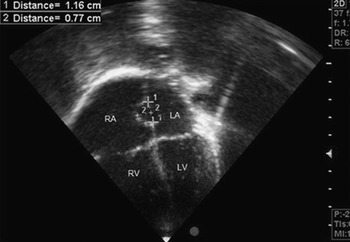
We defined septal aneurysms as protrusions of the floor of the oval fossa, or part of it, into either of the atrial chambers by more than 6 mm beyond the plane of the antero-inferior margin of the septum (Fig. 1).Reference Gallet, Malergue and Adams8
Echocardiographic measurement of the size of an atrial septal aneurysm as seen in apical four chamber view. Distance 1: Diameter of defect base; Distance 2: Protrusion of the aneurysm. LV: left ventricle, RV: right ventricle, LA: left atrium, RA: right atrium.

Results
Of those included in the study, 65 had been referred because of a murmur, 9 with cardiac failure, and 17 with other problems, such as pneumonia, Down’s syndrome and other genetic anomalies, and cardiomegaly. The remaining 9 patients had been diagnosed with atrial septal defects prior to referral. The age at diagnosis was 6.7 ± 3.9 months, with a range from 0 to 12 months. The mean diameter of the defects was 8.1 ± 3.3 mm, with a range from 3 to 16 mm, and the average duration of treatment was 62.5 ± 46.9 months, with a range from 12 to 126 months. The mean period of follow-up for those with persisting defects was 72 ± 27.2 months, with a range from 55.5 to 182.7 months. Of the patients, 20 had small defects. Of these, 16 (80%) either underwent spontaneous closure or showed diminution in the size of the defect. In 4 of them (20%), the defect became larger, and in 1 patient the defect was closed. In the 26 patients with medium-sized defects, 18 (69.5%) showed either complete closure or the hole became smaller. In 1 patient (4%), the size remained unchanged, while in the remaining 7 patients (26.5%) the size increased or had been closed. In the 54 patients with large defects, 16 patients (29.5%) showed spontaneous closure, or else the defect became smaller, in 4 (7.5%) the defect remained unchanged, and in 34 patients (63%) the defect became larger or was closed. The overall closure rate was 27%. In those with large defects, however, only 7.5% closed (4 patients). In 2 of these patients, there was aneurismal formation. Spontaneous closure for those with small and medium defects occurred on average at the age of 40.2 ± 26 months, with a range from 4 to 108.5 months. The change in size of the defects, and periods of observation, are shown in Table 1. In 9 patients with a diagnosis of heart failure, the defect was over 7 mm, and there was no aneurismal formation. Surgery was undertaken in 6 of these patients, while in 1 patient the defect closed spontaneously, and became smaller in the remaining 2. Out of 10 patients who had aneurysmal formation, the defect was larger than 7 mm in 9, with a range from 7 to 15.5 mm. In 3 of these, the defect had closed, while in the others it became smaller. An aneurysm was detected in 5 patients at the initial echocardiographic examination, and in another 5 during a later examination. In one subject, following the closure of defect, the aneurysm was not observed when examined by echocardiography. In the other 2 patients, the aneurysm continued to be present. In 8 subjects with an aneurysm, the right heart was larger than normal. In a more recent examination, only one patient was observed to have a similar problem. The other patients presented with hearts of normal size.
Results of 100 patients with defects of different sizes.

Discussion
Isolated defects in the floor of the oval fossa account for about 3% of all patients with congenitally malformed hearts presenting in infancy. Although such defects may present significant problems in infancy, spontaneous closure can take place, even in symptomatic patients or those with congestive cardiac failure.Reference Cockerham, Martin, Gutierrez, Hartmann, Goldring and Strauss2–Reference Mody4, Reference Hoffman, Rudolph and Danilowicz6, Reference Hartmann and Elliott7 As did others,Reference Porter, Feldt, Edward, Seward, Schaff, Moss and Adams9 we found the defects to be more common in females. Following the precedent of Radzik et al.,Reference Radzik, Davignon, van Doesburg, Fournier, Marchand and Ducharme5 we excluded defects smaller than 3 mm from our analysis, regarding such holes as patency of the oval foramen.Reference Radzik, Davignon, van Doesburg, Fournier, Marchand and Ducharme5 In this study, like others,Reference Helgason and Jonsdottir10, Reference Azhari, Shihata and Al-Fatani11 the reason for a referral in the majority of cases was presence of a heart murmur.
Spontaneous closure of atrial septal defects in patients diagnosed under 1 year of age is reported as between 14% and 55.0% in some studies,Reference Ghisla, Hannon, Meyer and Kaplan1, Reference Cockerham, Martin, Gutierrez, Hartmann, Goldring and Strauss2, Reference Mody4, Reference Cayler12, Reference Timmis, Gordon and Reed13 with similar rates reported for diagnosis after the age of 1.Reference Azhari, Shihata and Al-Fatani11 More recent studies have suggested higher rates of spontaneous closure, with Radzik et al.Reference Radzik, Davignon, van Doesburg, Fournier, Marchand and Ducharme5 reporting 87.0% closure for those diagnosed in the first 3 months of age. Fukazawa et al.Reference Fukazawa, Fukushige and Ueda14 and Senocak et al.,Reference Senocak, Karademir, Cabuk, Onat, Koc and Duman15 reported rates of closure of 92.0% and 99.8% respectively for patients diagnosed during the neonatal period.Reference Fukazawa, Fukushige and Ueda14, Reference Senocak, Karademir, Cabuk, Onat, Koc and Duman15 Ozcelik et al.Reference Ozcelik, Atalay, Tutar, Ekici and Atasay16 also found an overall rate of spontaneous closure of 96% for those diagnosed below 12 months of age.
In our study, just over half of the patients had defects of 8 mm or larger. As found by Azhari et al.,Reference Azhari, Shihata and Al-Fatani11 the overall rate of closure was 27%. They suggested that the size of 8 mm and over was important in determining closure, whereas others reported the critical size to be 5 mm.Reference Ozcelik, Atalay, Tutar, Ekici and Atasay16, Reference Riggs, Sharp, Batton, Hussey and Weinhouse17 Ozcelik et al.Reference Ozcelik, Atalay, Tutar, Ekici and Atasay16 also reported that, for those with defects of 7 mm and above, the rate of spontaneous closure went down to 50%.Reference Ozcelik, Atalay, Tutar, Ekici and Atasay16 Radzic et al.Reference Radzik, Davignon, van Doesburg, Fournier, Marchand and Ducharme5 and Ozcelik et al.,Reference Ozcelik, Atalay, Tutar, Ekici and Atasay16 however, stated that no patients with defects of 8 mm and above underwent closure, whereas we observed 7.5% spontaneous closure in those patients, with 2 of these patients having aneurysms. As with previous studies,Reference Mahoney, Truesdell, Krzmarzick and Lauer3, Reference Azhari, Shihata and Al-Fatani11 we found no influence of heart failure on closure. We also showed that 5% of our patients experienced an increase in the size of the defect.
The mechanisms for closure are reported to be quite varied, including the formation of septal aneuyisms,Reference Awan, Rice and Moodie18, Reference Gondi and Nanda19 extension of the superior interatrial fold,Reference Cayler12 the formation of thrombus or fibrous plaque,Reference Mody4, Reference Timmis, Gordon and Reed13 and stretching of the edge of an ellipsoid defect as a result of growth of the heart bringing the edges closer together.Reference Cockerham, Martin, Gutierrez, Hartmann, Goldring and Strauss2, Reference Edward and Gould20 As far as we can establish, there is no clear definition of the effects on closure of the formation of an aneurysm. Indeed, formation of an atrial septal aneurysm is rather taken as an isolated anomaly.Reference Brand, Keren, Branski, Abrahamov and Stern21–Reference Shiraishi, Hamaoka, Hayashi, Koh, Onouchi and Sawada23 Shiraishi et al.Reference Shiraishi, Hamaoka, Hayashi, Koh, Onouchi and Sawada23 found aneurysms in 11 out of 13 patients below 1 year old, and of these, the defect closed without any surgery, albeit that sizes were not given. In another study,Reference Radzik, Davignon, van Doesburg, Fournier, Marchand and Ducharme5 only two infants, out of a group of 101 infants aged below 3 months, were diagnosed with aneurysm. Brand et al.Reference Brand, Keren, Branski, Abrahamov and Stern21 observed 14 patients diagnosed with an aneurysm for 4 years. Closure occurred in 8, and the aneurysm disappeared in 6 of these 8. The remaining 6 patients had progressive aneurysms. The sizes were not given, although the presence of significant left to right shunting was emphasised. In our study, 9 out of 10 patients with aneurysms had defects larger than 7 mm, and of these, the defect closed in 3 and became smaller in the others. The aneurysm was diagnosed in 5 patients at the first examination, and later in the other 5. In one patient, the aneurysm disappeared after the defect closed. In the other 2 subjects, the aneurysm persisted. Of those diagnosed with an aneurysm, 8 presented right ventricular enlargement. In more recent examinations, only one patient had right ventricular enlargement.
Thus, we conclude that the size of the defect is important in determining whether or not it will close spontaneously. Heart failure, in contrast, has no effect on closure. Aneurysmal formation is seen especially in those with larger defects, and may then be responsible for closure. It may, therefore, be worthwhile to prolong the period of observation in such patients before referring them for surgical or interventional closure.