Introduction
The invasive fruit fly Bactrocera invadens Drew, Tsuruta & White is a tephritid species that has been reported from more than 46 fruit species in 23 families, but its major host plant is mango (Drew et al., Reference Drew, Tsuruta and White2005; Vayssières et al., Reference Vayssières, Goergen, Lokossou, Dossa and Akponon2005; Ekesi et al., Reference Ekesi, Nderitu and Rwomushana2006; Mwatawala et al., Reference Mwatawala, De Meyer, Makundi and Maerere2006; Rwomushana et al., Reference Rwomushana, Ekesi, Gordon and Ogol2008; Goergen et al., Reference Goergen, Vayssières, Gnanvossou and Tindo2011). The pest is believed to be native to Sri Lanka, but invaded Africa in 2003, with the first detection in Kenya from McPhail traps baited with NuLure (Drew et al., Reference Drew, Tsuruta and White2005). At present, it is regarded as a devastating quarantine pest (French, Reference French2005) requiring the application of costly quarantine treatments to any host fruit shipped from countries where it occurs.
Ceratitis fasciventris (Bezzi) belongs to a clade of three species of fruit flies known as the FAR group that also includes Ceratitis rosa Karsch and Ceratitis anonae Graham, and are distinguishable only with difficulty, mainly for females (De Meyer and Freidberg, Reference De Meyer and Freidberg2005/6), but separated C. fasciventris can be separated from males of C. rosa. Ceratitis fasciventris was only recently considered as a separate species from C. rosa sensu stricto (De Meyer, Reference De Meyer2001). All members of the FAR group are polyphagous, attacking 53 species in 24 plant families (Copeland et al., Reference Copeland, Wharton, Luke, De Meyer, Lux, Zenz, Machera and Okumu2006).
Increased awareness of the damage caused to the fruit industry by these fruit flies has increased the demand for effective control measures against them. To conduct the prerequisite studies on insect biology and ecology, and on potential control agents against the target fruit flies, a regular supply of good quality insects of predetermined reproductive stages and ages is needed. In previous studies, Ekesi et al. (Reference Ekesi, Nderitu and Chang2007) demonstrated the adaptation and successful rearing of B. invadens on carrot- and wheat-based solid diet. Ceratitis fasciventris has also been reared in the laboratory for over 100 generations on a carrot-based solid diet (S. Ekesi, unpublished observation). In recent years, a liquid diet has been promoted as an excellent substitute for a solid-based diet (Chang, Reference Chang2009). A liquid larval diet has been reported to have the following advantages over a solid larval diet: (i) total diet consumption by the flies if an accurate proportion of diet volume to egg density is established, thereby leaving a minimal amount of spent diet; (ii) spent diet is water soluble, and can simply be rinsed off with a water gun; (iii) larvae reared on a liquid diet can develop in the same environment-controlled room without the necessity of moving trays around, thus providing more space for rearing; (iv) flies can be reared in smaller and shallower trays than those used currently for a solid diet, but with each tray still producing the same number of pupae; and (v) the liquid diet includes using the most convenient inert bulking agent, the sponge cloth, which is composed mainly of natural cellulose and fibre (Chang, Reference Chang2009). The sponge cloth has a low weight and high water absorbance and is reusable, recyclable, biodegradable and environment-friendly (Chang et al., Reference Chang, Caceres and Jang2004).
We evaluated the performance of B. invadens and C. fasciventris on a liquid diet for five generations. We also tested a local yeast and local oils as substitutes for expensive imported yeast and wheat germ oil, respectively, in the liquid diet of B. invadens.
Materials and methods
Insects
The adults of B. invadens originated from mangoes collected at a local market in Nairobi, Kenya. The insects were maintained on a carrot-based solid diet (Table 1) for 24 generations. One-h-old eggs of B. invadens were collected from the fly stock colonies using a mango dome (pulp and seed removed). Eggs were carefully removed from the underside of the dome with a fine camel-hair brush and placed until required in a 100-mL beaker containing 50 mL of distilled water.
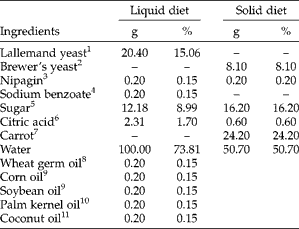
Ingredients of the artificial larval diets
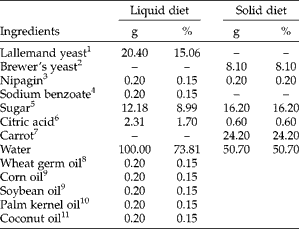
1 Lallemand, Inc. Montreal, Canada. Bio-Ingredients (three parts whole-cell yeast (LB12240) and one part hydrolysed yeast (FNILS65)).
2 East African Breweries Limited, Nairobi, Kenya.
3 Kobian Kenya Limited, Nairobi, Kenya.
4 J. T. Baker Chemical Company, NJ, USA.
5 Mumias Sugar Company Limited, Mumias, Kenya.
6 Chemoquip Limited, Nairobi, Kenya.
7 Obtained fresh from the market, Nairobi, and then crushed, dried and blended into a powder.
8 MP Biomedicals, Aurora, OH, USA.
9 Bidco Oil Refineries Limited, Nairobi, Kenya.
10 Prima Limited, Mombasa, Kenya.
11 Kokocept Plantations Limited, Mombasa, Kenya.
Diet preparation and delivery system
The ingredients of the liquid diet were similar to those described by Chang et al. (Reference Chang, Vargas, Caceres, Jang and Cho2006) for rearing the larvae of Bactrocera dorsalis (Hendel) (Table 1). The ingredients of the solid diet were similar to those described by Ekesi et al. (Reference Ekesi, Nderitu and Chang2007) for rearing B. invadens (Table 1). Each diet mixture was formulated by weighing the ingredients and blending them for 5 min in a 1-L electronic blender with the appropriate amount of water to ensure a homogeneous mix of all constituents. For the liquid diet, after rinsing plastic containers (3.2 × 13.5 × 20.6 cm) with distilled water, a piece of garden net (15 × 10 cm) was placed inside each container. Sponge cloth (4 × 6 cm), the primary support matrix for larval feeding, was rinsed three times with distilled water, squeezed dry and placed on top of the net. Then the liquid diet mixture (150 mL) was poured onto the sponge cloth. For the control solid diet, 500 g of diet were scooped from the blender and transferred to plastic trays of similar dimensions as described above. For both diets, after mixing and transferring, the initial pH was 3.5.
Experimental procedures
Eggs (0.5 mL, ≈ 6000 eggs of B. invadens or 8000 eggs of C. fasciventris), collected within 1 h of oviposition, were seeded with a 1 mL transfer pipette onto a strip (5 × 5 cm) of moist black cloth. In the middle of a tray, the cloth with eggs was placed on top of either the sponge cloth (liquid diet) or 500 g of the carrot-based diet. Upon hatching, larvae fed ad libitum, when mature, were allowed to leave the rearing tray to pupate in larger plastic trays (6 × 20 × 30 cm) that contained 1-cm-deep layer of moist sand (5–8% water). After 7 days in the sand, puparia were separated from the pupation medium by gentle sifting.
Four trays were maintained for each insect species and each type of diet. For every generation tested, data on the following were obtained: (i) pupal recovery, based on the number of eggs seeded onto the diet; (ii) pupal weight, based on four lots of 50 puparia from each tray; (iii) adult emergence, based on four lots of 100 puparia from each tray placed in screened 12-cm-diameter plastic containers and observed for 21 days; (iv) flight ability, based on four lots of 100 puparia tested according to Boller et al. (Reference Boller, Katsoyannos, Remund and Chambers1981) in a 20-cm-high plastic tube coated with talc in a 9-cm-diameter Petri dish; (v) fecundity and (vi) fertility determined for 20 flies over 10 days. Fecundity and fertility were based on daily egg collections from 10 pairs of flies held after a pre-oviposition period of 7 days for C. fasciventris and 10 d for B. invadens. Eggs were collected using a mango dome; the egg hatch was assessed after 72 h. In all the experiments, adults were fed a diet consisting of three parts sugar and one part enzymatic yeast hydrolysate ultrapure (USB Corporation, Cleveland, Ohio, USA) and water on pumice granules. All experiments were conducted in a room maintained at 28 ± 1 °C and 50 ± 8% (RH) with a photoperiod of 12 h light–12 h darkness.
In another experiment using B. invadens, diet types the option of substituting the imported yeast and wheat germ oil in the liquid diet with locally available ingredients was tested. The yeast was replaced with the same quantity of a local waste brewers' yeast, and as alternatives four types of oil (corn or maize, soybean, coconut and palm kernel) were evaluated at the same concentration as the wheat germ oil. The same parameters as in the earlier experiment were measured.
Statistical analysis
Data on pupal weight and fecundity were transformed to natural logarithms before analysis. Pupal recovery and egg hatch were arcsin-transformed. Two-way (SAS Institute, 2001), with diet type and generation as factors, was used to analyse the data for all tested parameters. Data on the effects of types in a liquid diet on quality control parameters of B. invadens were compared using the t test, and data on the effects of the types of oil on the same were analysed using one-way ANOVA (SAS Institute, 2001). If the results of the ANOVAs were significant, means were separated using Tukey's HSD (honestly significant difference) test (P= 0.05).
Results
Rearing Bactrocera invadens for several generations
Flies reared on the liquid diet had a higher pupal recovery (F= 36.21; df = 1, 36; P= 0.0001), heavier pupal weight (F= 42.16; df = 1, 36; P< 0.0001), higher adult emergence (F= 38.34; df = 1, 36; P= 0.0001) and higher fecundity (F= 17.22; df = 1, 36; P< 0.0001) than those reared on the solid carrot diet. However, egg fertility (F= 1.04; df = 1, 36; P= 0.3121) and flight ability (F= 1.58; df = 1, 36; P= 0.4123) were not affected by the diet.
During the five generations, the liquid diet was superior to the solid diet in terms of pupal recovery (F= 12.87; df = 5, 36; P< 0.0001), pupal weight (F= 8.12; df = 5, 36; P= 0.0029), adult emergence (F= 7.56; df = 5, 36; P= 0.0088) and fecundity (F= 10.14; df = 5, 36; P= 0.0012). However, there were no significant differences between the two diet types regarding fertility (F= 0.82; df = 5, 36; P= 0.3234) and flight ability (F= 1.22; df = 5, 36; P= 0.07 632).
Similarly, interaction between diet type and generation was significant for pupal recovery (F= 9.11; df = 5, 36; P= 0.0020), pupal weight (F= 5.14; df = 5, 36; P= 0.0011), adult emergence (F= 7.34; df = 5, 36; P= 0.0004) and fecundity (F= 4.12; df = 5, 36; P= 0.0018), but not significant for fertility (F= 0.34; df = 5, 36; P= 0.4509) and flight ability (F= 0.65; df = 5, 36; P= 0.2131).
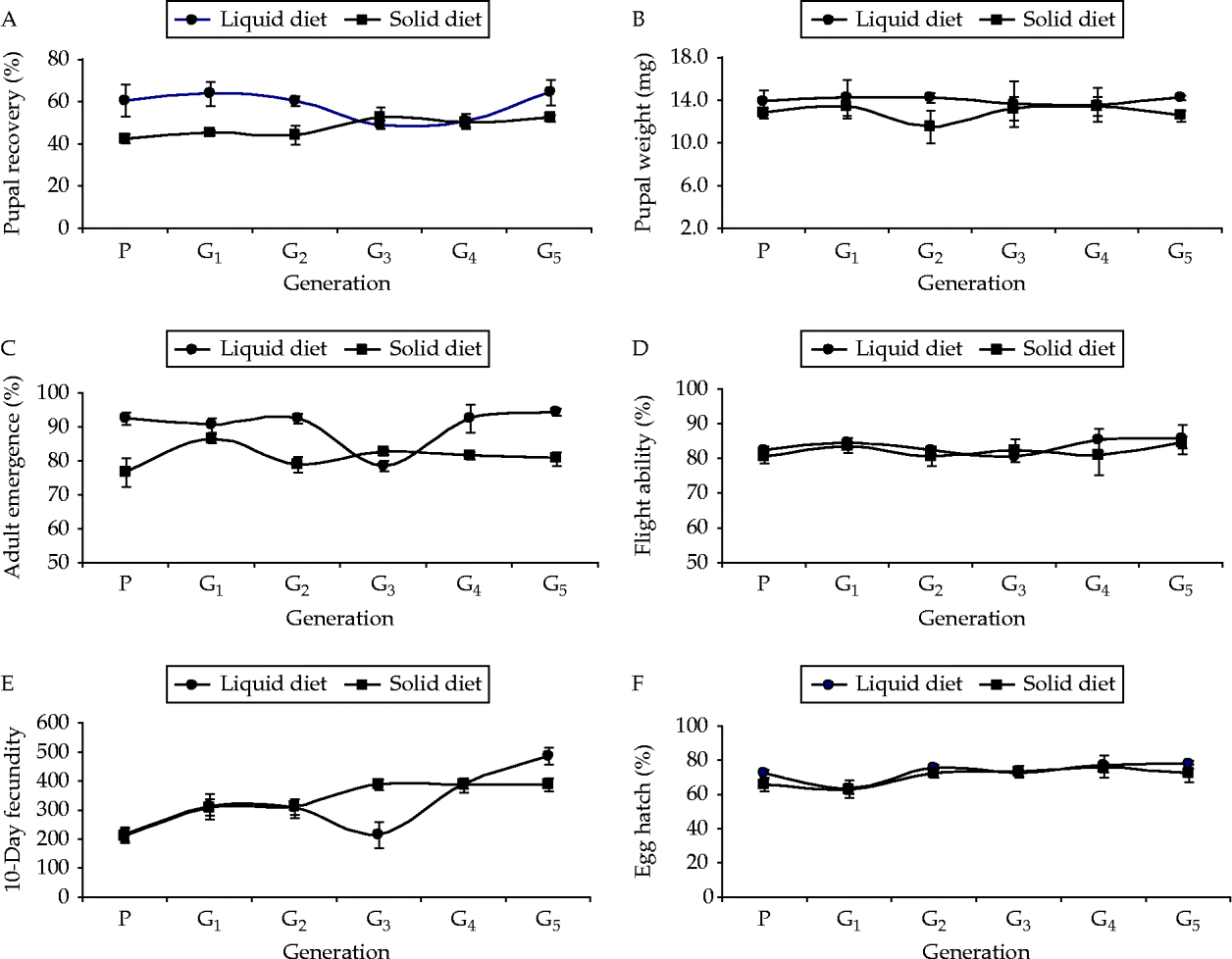
From the parent generation to G2, the number of B. invadens puparia recovered from the liquid diet was consistently higher (60–64%) than that recovered from the solid diet (42–45%) (Fig. 1). There was a slight, but insignificant, decline in recovery in G3 and G4, but recovery increased again in G5 (Fig. 1). The pupal weight on the liquid diet was 13.8–14.2 mg compared with 12.0–13.4 mg on the solid diet (Fig. 1). Apart from G2, adult emergence on the liquid diet was usually above 90% compared with 77–87% on the solid diet in the same generation (Fig. 1). Diet type had no effect on flight ability; values were 80–85% on both diets. On both diets, fecundity was 210 to 311 during the first three generations. However, a substantial decline in fecundity was observed in G3 on the liquid diet; nevertheless, it rebounded to a significantly higher level in G5 with 485 eggs compared with 386 eggs on the solid diet. Egg fertility in flies reared on both diets was largely as expected, ranging from 62 to 78% across generations.
(colour online) Effects of liquid and carrot-based solid diets on pupal recovery (A), pupal weight (B), adult emergence (C), flight ability (D), fecundity (E) and egg hatch (F) of Bactrocera invadens. P, parent generation; G1–G5, first to fifth generations.

Rearing Ceratitis fasciventris for several generations
Ceratitis fasciventris had a lower pupal recovery (F= 52.7; df = 1, 36; P< 0.0001), lighter pupal weight (F= 27.41; df = 1, 36; P= 0.0001) and lower fecundity (F= 26.82; df = 1, 36; P< 0.0001) if reared on liquid diet. However, adult emergence (F= 0.64; df = 1, 36; P= 0.0413), egg fertility (F= 1.12; df = 1, 36; P= 0.3424) and flight ability (F= 1.17; df = 1, 36; P= 0.3031) were not affected by the type of diet.
During five generations, significant differences were also observed for pupal recovery (F= 10.18; df = 5, 36; P< 0.0042), pupal weight (F= 16.12; df = 5, 36; P= 0.0.0001) and fecundity (F= 22.71; df = 5, 36; P= 0.0.0001), but adult emergence (F= 1.01; df = 5, 36; P= 0.0141), fertility (F= 0.43; df = 5, 36; P= 0.2162) and flight ability (F= 0.42; df = 5, 36; P= 0.0614) were not significantly different between diets.
Similarly, interaction between the diet type and generation was significant for pupal recovery (F= 8.41; df = 5, 36; P= 0.0044), pupal weight (F= 9.18; df = 5, 36; P= 0.0002) and fecundity (F= 26.11; df = 5, 36; P= 0.0001), but not significant for adult emergence (F= 1.86; df = 5, 36; P= 0.0218), fertility (F= 1.41; df = 5, 36; P= 0.3210) and flight ability (F= 0.24; df = 5, 36; P= 0.4021).
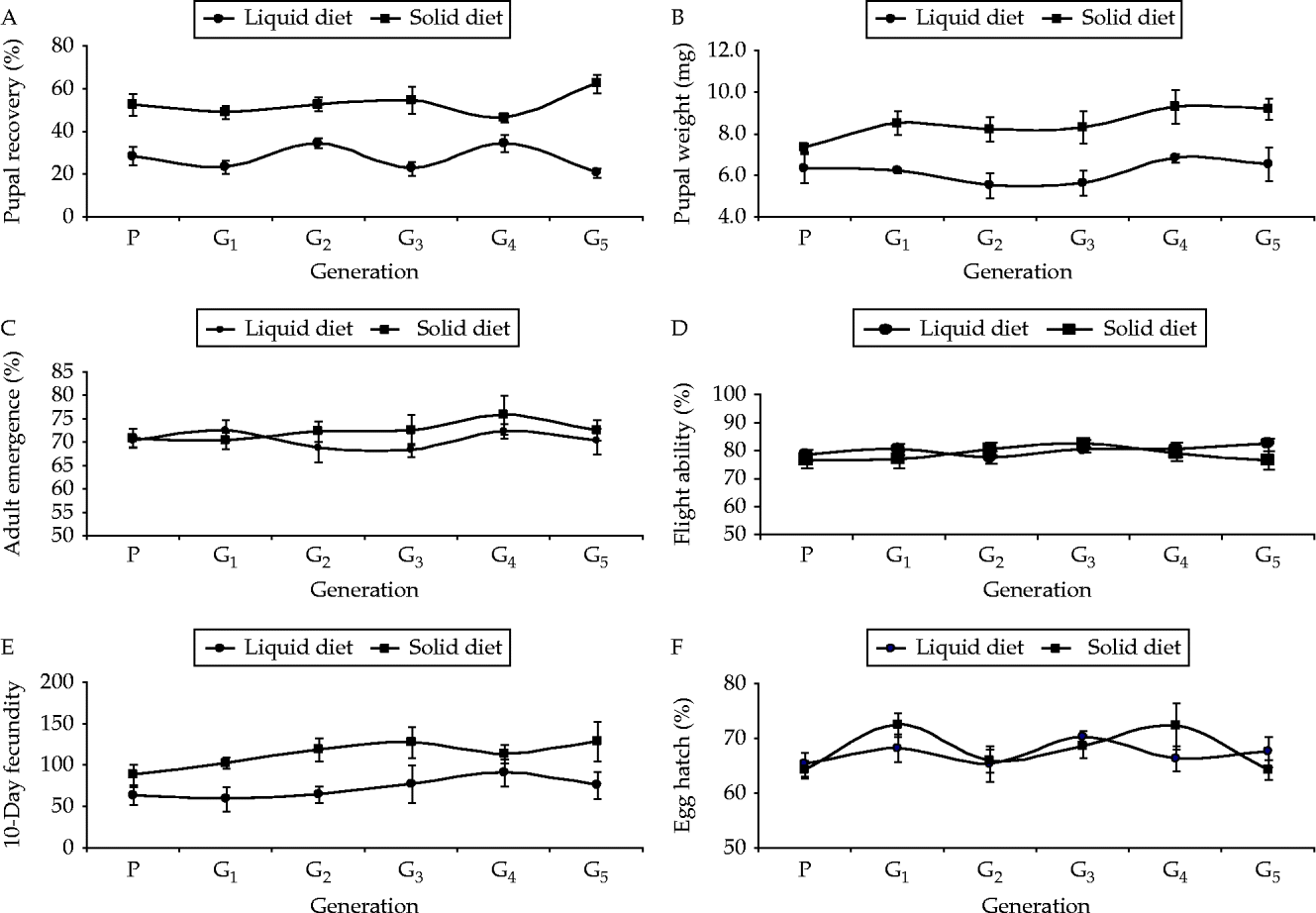
The solid diet outperformed the liquid diet in terms of pupal recovery throughout the six generations tested. Across generations, pupal recovery ranged from 21 to 34% on the liquid diet compared with values of 46–62% on the solid diet (Fig. 2). Similarly, pupal weight was higher (7.3–9.3 mg) on the solid diet compared with the liquid diet (5.5–6.8 mg) across the generations. Adult emergence and flight ability were not affected by the type of larval diet (Fig. 2). However, diet type significantly affected fecundity – the flies reared on the solid diet produced significantly more eggs (88–128 eggs) compared with those reared on the liquid diet (59–91 eggs) across the six generations. Egg hatch was similar across generations for the two types of diets (Fig. 2).
(colour online) Effects of liquid and carrot-based solid diets on pupal recovery (A), pupal weight (B), adult emergence (C), flight ability (D), fecundity (E) and egg hatch (F) of Ceratitis fasciventris. P, parent generation; G1–G5, first to fifth generations.
Local yeast as an alternative to imported yeast
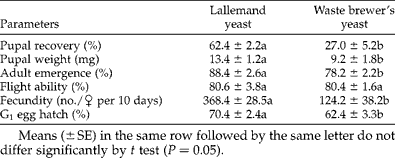
Comparison of yeast types in the liquid diet showed that pupal recovery (t= 9.1213; df = 3; P< 0.0001), pupal weight (t= 5.1076; df = 3; P= 0.0006), adult emergence (t= 4.1102; df = 3; P= 0.0005), fecundity (t= 8.6502; df = 3; P< 0.0001) and egg hatch (t= 3.9645; df = 3; P= 0.0010) of B. invadens reared on the diet containing the imported Lallemand yeast were significantly higher than on the diet with the local waste brewers' yeast, but adults capable of flight (t= 1.0872; df = 3; P= 0.5230) was not affected by the type of yeast (Table 2).
Effects of two types of yeasts in a liquid diet on pupal recovery, pupal weight, adult emergence, flight ability, fecundity and egg hatch of Bactrocera invadens

G1, first generation.
Means ( ± SE) in the same row followed by the same letter do not differ significantly by t test (P= 0.05).
Local oils as alternatives to imported wheat germ oil
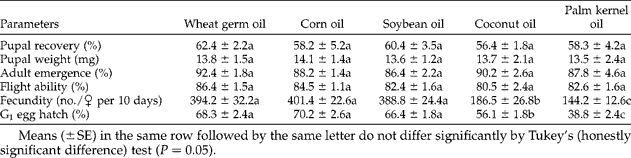
The values of quality control parameters among the five oils tested in the liquid diet were not significantly different for pupal recovery (F= 6.40; df = 4, 15; P= 0.4124), pupal weight (F= 0.54; df = 4, 15; P= 0.9651), adult emergence (F= 1.14; df = 4, 15; P= 0.7013) and adults capable of flight (F= 2.15; df = 3, 15; P= 0.0983). However, significant differences were observed in fecundity (F= 27.18; df = 3, 15; P= 0.001) and egg hatch (F= 18.45; df = 3, 15; P< 0.0001). Among the four types of oil tested as substitutes for wheat germ oil, all quality control parameters from diets containing corn and soybean oils were similar to those obtained from diets with wheat germ oil (Table 3). However, in diets containing coconut and palm kernel oils, fecundity and fertility were significantly lower compared with diets with wheat germ oil, corn oil and soybean oil (Table 3).
Effects of five types of oils in a liquid diet on pupal recovery, pupal weight, adult emergence, flight ability, fecundity and egg hatch of Bactrocera invadens

G1, first generation.
Means ( ± SE) in the same row followed by the same letter do not differ significantly by Tukey's (honestly significant difference) test (P= 0.05).
Discussion
The nutritional content of a larval diet has considerable impact on the quantity and quality of the adult fruit flies produced, affecting the development time, growth and survival of the larvae (Krainacker et al., Reference Krainacker, Carey and Vargas1987; Vargas et al., Reference Vargas, Mitchell, Hsu and Walsh1994; Kaspi et al., Reference Kaspi, Mossinson, Drezner, Kamensky and Yuval2002; Ekesi et al., Reference Ekesi, Nderitu and Chang2007). The two types of diets tested supported the development of the two fruit fly species, but the performance of the flies varied with the type of diet. In B. invadens, the quality control parameters on the liquid diet compared favourably with, and sometimes exceeded, those obtained on the carrot-based solid diet. The most notable parameters were the high pupal recovery and heavier puparia for flies reared on the liquid diet compared with those for insects reared on the liquid compared with solid diet. Pupal recovery was particularly exceptional, ranging from 49–65% on the liquid diet over the six generations compared with 42–52% on the solid diet. Within the first three generations, pupal weight was also relatively higher on the liquid diet (>14 mg) compared with the solid diet, where weights were 12–13 mg. In general, the quality parameters obtained for B. invadens were well within the range reported for B. dorsalis (Chang et al., Reference Chang, Vargas, Caceres, Jang and Cho2006), a close relative of B. invadens (Drew et al., Reference Drew, Tsuruta and White2005).
Pupal mass is viewed as a particularly useful quality control criterion in fruit fly mass-rearing on an artificial diet, and size has been correlated with mating success. Using the pupal weight of the Mediterranean fruit fly Ceratitis capitata (Wiedemann) as an estimate of size, Churchill-Stanland et al. (Reference Churchill-Stanland, Stanland, Wong, Tanaka, McInnis and Dowell1986) found that adults from heavy pupae (8–9 mg) experienced higher mating success than those from lower-weight pupae (4–6 mg). Sharp et al. (Reference Sharp, Boller and Chambers1983) also found that large C. capitata flies had greater flight ability than small flies. Differential performance on various rearing media has been reported for other fruit fly species as well, e.g. B. dorsalis (Chang et al., Reference Chang, Vargas, Caceres, Jang and Cho2006), the melon fly Bactrocera cucurbitae (Coquillett) (Chang et al., Reference Chang, Caceres and Jang2004), the olive fruit fly Bactrocera oleae (Rossi) (Hanife, Reference Hanife2008), C. capitata (Chang et al., Reference Chang, Caceres and Ekesi2007) and Anastrepha species (Celedonio-Hurtado et al., Reference Celedonio-Hurtado, Liedo, Aluja, Guillen, Berrigan and Carey1988).
In a previous study, Ekesi et al. (Reference Ekesi, Nderitu and Chang2007) noted that, when B. invadens was transferred from rearing on host fruit, three to four generations were required for the insect to adapt to an artificial rearing medium based on carrots. However, when B. invadens was moved from a solid-based to a liquid diet, the insect adapted more rapidly than in the previous study, perhaps understandably so since the insect was already accustomed to artificial rearing. The liquid diet is also nutritionally better than the solid diet because in liquid form the nutrients are more easily available to the larvae (Chang et al., Reference Chang, Vargas, Caceres, Jang and Cho2006, Reference Chang, Caceres and Ekesi2007); this may have contributed to the rapid adaptation to the diet.
For C. fasciventris, large differences between the liquid diet and the standard carrot-based solid diet were observed, especially with respect to pupal recovery, pupal weight and fecundity. For these parameters, values were usually higher on the solid diet than on the liquid diet. The results clearly indicated that the liquid diet can support the development of the insect, but to achieve the quality control parameters obtained when on the solid diet, the insect probably requires a longer period of adaptation to the liquid diet. This requires further investigation.
The rate of an insect's adaptation to laboratory rearing depends on both its ability to utilize the nutrients in the diet and the availability of the nutrients defined by the quality of the rearing effort (Ekesi et al., Reference Ekesi, Nderitu and Chang2007). As mentioned earlier, the nutritional quality of the liquid diet is quite high and is suitable for the development of other Ceratitis species, e.g. C. capitata (Chang et al., Reference Chang, Caceres and Ekesi2007). Therefore, it is likely that, when compared with B. invadens, C. fasciventris requires a prolonged period of adaptation to the liquid diet. Insect adaptation to an artificial diet varies with the species; for example, Souza et al. (Reference Souza, de Matioli and de Souza1988) observed that at least 10 generations were required for C. capitata to adapt to an artificial diet. About three or four generations were required for B. oleae to adapt (Tsitsipis, Reference Tsitsipis and Cavalloro1983), and B. cucurbitae required 14 generations to reach a permanent plateau (Kamikado et al., Reference Kamikado, Chisaki, Kamiwada and Tanaka1987).
Bactrocera dorsalis and B. cucurbitae successfully completed their development in a liquid diet containing waste brewers' yeast (Chang et al., Reference Chang, Caceres and Jang2004, Reference Chang, Caceres and Ekesi2007). For B. Dorsalis, up to 43% pupal recovery and pupal weights of 10 mg were achieved on a liquid diet containing 15.1% brewers' yeast. However, in our study, substitution of the Lallemand yeast with local waste brewers' yeast did not support the proper development of B. invadens. Pupal recovery on the diet containing the local yeast was 24% compared with 62% on the liquid diet containing the standard Lallemand yeast. Similarly, pupal weight was significantly lower on the diet containing the local yeast (10.1 mg) compared with the diet with the standard yeast (13.8 mg).
The nutrient composition of the local waste brewers' yeast is about 55.3% protein, 41.6% carbohydrate, 2.1% fat and 1.0% ash (S. Ekesi, unpublished). The standard yeast contains whole-cell yeast (LBI2240) and hydrolysed yeast (FNILS65) at a ratio of 3:1 with 47.8% protein, 31.4% carbohydrate, 2.8% fat and 3.5% ash (Chang et al., Reference Chang, Caceres and Ekesi2007). Although dietary protein and its component amino acids are necessary in all fruit fly diets, an excessive amount of protein in the diet can be detrimental to larval survival. For example, Chang et al. (Reference Chang, Caceres and Ekesi2007) showed that larvae of C. capitata failed to develop in FNILS65 and FNI210 yeasts containing 55 and 68% protein, respectively. Therefore, it is probable that the high protein content in the local waste brewers' yeast was detrimental to the development of B. invadens. Indeed, diets that contain more fat, calories and carbohydrate and less protein are more suitable for fruit fly larval development (Chang et al., Reference Chang, Caceres and Ekesi2007). In future studies, the quantity of local waste brewers' yeast in the liquid diet should be reduced and the impact of this reduction on the production of B. invadens assessed.
Chang and Vargas (Reference Chang and Vargas2007) demonstrated the importance of wheat germ oil in a fruit fly liquid larval diet. The addition of this oil to the standard liquid diet formulation increased the fertility of B. dorsalis to a level comparable with the standard solid mill feed diet. In Africa, wheat germ oil must be imported at an exorbitant price, and therefore it is critically important to identify an alternative product that is locally available. Corn and soybean oils were as effective as wheat germ oil, but coconut and palm kernel oils were rather detrimental to the egg production and fertility of B. invadens; other parameters were about the same as with the wheat germ oil. Chang et al. (Reference Chang, Afuola and Li2011) tested four alternative oils (corn oil, vegetable oil, canola oil with 10% vitamin E, and canola oil with 20% vitamin E) in fruit fly liquid larval diet as a replacement for wheat germ oil in the rearing of C. capitata (TSL strain), B. dorsalis and B. cucurbitae. The results showed that there was no significant difference in performance among the tested oils in B. cucurbitae and B. dorsalis with regard to all standard quality control parameters evaluated. However, lower mating rate was observed in B. cucurbitae from those reared in vegetable oil and canola oil (10% vitamin E) diet. Similarly, lower egg production and egg hatch were observed with B. dorsalis whose larvae were reared on vegetable and canola oils (both 10 and 20% vitamin E), and the vegetable oil diet reduced pupal weight, shortened larval duration, and increased the pupal recovery of C. capitata.
Chang and Vargas (Reference Chang and Vargas2007) speculated that unsaturated fatty acids (oleic, linoleic and linolenic) present at 80%, and the saturated component (myristic, palmitic and stearic) at 20%, in wheat germ oil were responsible for its beneficial effects on reared B. dorsalis. In corn and soybean oils, the three unsaturated and three saturated fatty acids listed above are present at the same ratio of 80 to 20% (Parodi, Reference Parodi1976; O'Brien, Reference O'Brien2004; S. Ekesi, unpublished observation). Therefore, it is likely that these fatty acid chains are responsible for the similar results obtained in our study. In coconut and palm kernel oils, the ratio of unsaturated to saturated fatty acids is 17 and 83%, with lauric acid accounting for 48% of the saturated fatty acids (Parodi, Reference Parodi1976; O'Brien, Reference O'Brien2004). Lauric acid is probably detrimental to egg production and egg hatch in B. dorsalis, but this warrants further investigation.
Conclusion
Bactrocera invadens was reared successfully on a liquid diet; the values of all quality control parameters were comparable to, and sometimes surpassed, those obtained on the standard solid diet. However, the performance of C. fasciventris on a liquid diet was well below the accepted standard. Nevertheless, since this insect successfully completed its development on the liquid diet, probably this species requires a longer period of adaptation to the diet. The local waste brewers' yeast was a poor substitute for the standard Lallemand yeast in the liquid diet, probably because of the high protein content of the local yeast, which was detrimental to larval survival. We also demonstrated that wheat germ oil in the liquid diet can be replaced by locally available corn oil or soybean oil without any adverse effects on quality control parameters. Even though these experiments were based on small-scale rearing, the results are quite remarkable, especially those on B. invadens, and a change to large-scale mass-rearing is likely to be successful.
Acknowledgements
The authors thank John Kiilu, Martin Wanyonyi and Edith Wachira for assistance in the rearing procedures. We are grateful to the International Atomic Energy Agency, Vienna, Austria, for partial grant support for this investigation.