

The 1967 devaluation of sterling has become one of the most charted episodes in the analysis of British external economic policy during the 1960s. The story of sterling, during that decade, is generally told in terms of the Labour government's attempt to hold the parity of the pound for three long years, until devaluation was forced on it in November 1967. The ensuing academic debate has centred on why the decision to devalue was not taken sooner or on the measures that could have been taken to avoid it.Footnote 1 Scholars have largely ignored the late 1960s and have instead turned their attention to the implications for sterling of the break-up of the Bretton Woods system of international monetary management in the early 1970s.
In this paper, I attempt to rectify the deficiencies in the existing literature. Focus will be shifted away from the build-up to the devaluation; instead, this account will begin with the event itself and then attention will turn to its aftermath. Particular emphasis will be placed on the gold crisis of March 1968 and its effects on sterling. Whilst Cairncross has already stressed the importance of the devaluation's fallout – in Managing the British Economy in the 1960s (1996) – this account aims to build on his work.Footnote 2 Although Cairncross argues that the gold crisis was the most ‘palpitating’ sterling debacle of the 1960s, his analysis of it spans a mere five pages. Furthermore, because Managing was written before the recent release of the official state papers, it rests heavily on his diaries and own recollection of events.Footnote 3 Cairncross himself recognised this, and it is therefore arguable that his work should be treated as a memoir rather than as an academic work. This account by contrast, makes use of both primary documents and oral histories. Whilst it does not contradict Cairncross's version of events, it builds on it, providing a detailed analysis not only from the perspective of Treasury officials, but also from the perspective of the Bank of England and of ministers in the Labour government. The aim is to provide an in-depth account of the workings of the core executive under conditions of crisis and to assess the conduct of economic policy in the aftermath of the devaluation.
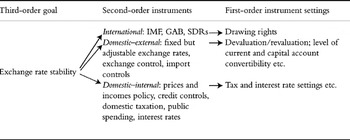
The principal argument is that although sterling was devalued in November 1967, the devaluation was not forced and could have been avoided in the short term. Furthermore, as Table 1 suggests, the fact that sterling was devalued is of little significance in itself. It amounted only to a first-order setting change to the second order fixed but adjustable peg instrument.Footnote 4 It did not constitute the abandonment of that instrument, nor did it represent a withering of the underlying goal of stable exchange rates. In short, there was neither a third-order paradigm shift nor even an instrument shift.

Consequently it is difficult to understand why the build-up to devaluation has attracted so much attention. One supposes that in contrast to interest-rate management, policy makers regarded sterling's parity ‘as a matter of national pride – almost as a national virility symbol – and devaluation or revaluation as a national disaster if not a national disgrace’.Footnote 5 In short, it was a setting change that had emotional and moral connotations, and this explains somewhat the reluctance to use it. However, the real significance of the devaluation rests not in the event itself but in its aftermath and in the way that it altered the context within which economic policymaking was conducted, because, once the setting change was made, it was to have grave repercussions on the management of the pound. First, the resultant J-curve effect was to exacerbate the balance-of-payments difficulties.Footnote 6 Second, because the confidence of the sterling balance holders was greatly reduced, they sought to diversify into dollars and gold.Footnote 7 This meant that the meagre foreign exchange reserves faced pressure from two sources simultaneously. The problem of managing sterling was actually greater in the period after devaluation than it had ever been before. The solution proposed was far more radical and would have amounted to an instrument shift rather than a mere setting change.Footnote 8
By March 1968 the strain on the reserves had become so unbearable that the goal of stable exchange rates became difficult to adhere to. In response to the crisis, the Treasury, with the reluctant acquiescence of the Bank of England, made preparations to block the sterling balances in order to stop the outflow of capital. If this step had been taken, it would have meant that a new second-order instrument had been created to defend the goal of exchange-rate stability, which would have prioritised exchange-rate stability over trade liberalisation. This course was avoided only by timely financial assistance from the United States, the G10 and the International Monetary Fund (IMF). Without this, it is clear that the balances would have been blocked and that in order to conserve the remaining reserves, non-essential imports would have to have been prohibited, food rationing reintroduced and foreign travel banned.Footnote 9 Furthermore, the proposal would also have involved the requisitioning of UK citizens' private portfolio holdings and the abolition of the sterling area.Footnote 10 In short, the British government would have been forced to raise the drawbridge, to implement a siege economy and to descend into becoming a financial ‘little England’. In that sense, the gold crisis is of counterfactual significance. It is, then, ironic that the post-devaluation era should represent one of the greatest gaps in the literature.
In order to discuss these issues, this paper is divided into six sections. In section 1 I examine the 1967 devaluation in order to provide a base point. Section 2 considers the build-up to, and origins of, the gold crisis. The third section analyses the contingency planning of the Treasury and the Bank of England. Sections 4 and 5 assess the strategies of the Labour government, and in section 6 I present my conclusions.
I
Speculative pressure on the pound had been rife from the very beginning of the Labour government's term of office in 1964. This was mainly due to an almost continuous balance-of-payments deficit, which eroded both the foreign exchange reserves and confidence in the currency. Nonetheless, by the first half of 1967 confidence in sterling seemed to have increased. In the last quarter of 1966 there had been a visible trade surplus and ‘calculations made by the Treasury during the summer of 1967 showed that [the] overseas payments had actually been in surplus for the first half of the year and forecast a small surplus for the year as a whole’.Footnote 11 By the end of March 1967, nearly all central bank assistance had been repaid.Footnote 12 However, this tranquil state of affairs was not destined to last for long. Three factors were set to undermine confidence in the currency. The first was the government's decision, at the beginning of May, to announce that the United Kingdom would formally apply to join the European Economic Community (EEC), or the Common Market. It was widely known that the cost of entry to the balance of payments would be substantial and, in view of this, sterling balance holders suspected that entry into the EEC might be accompanied by devaluation.Footnote 13 Therefore the announcement triggered a bout of speculation. Second, at the beginning of June 1967 came the six-day Arab–Israeli War, an oil embargo and the closure of the Suez Canal.Footnote 14 This development was most harmful to Britain. It meant that exports destined for the Commonwealth had to travel via the Cape of Good Hope, and consequently took longer to arrive. This greatly increased the costs of shipping, as did the rise in the price of oil.Footnote 15 Third, by mid-September a series of dock strikes in the United Kingdom ensured that goods destined to make the long journey around the Cape instead lay idly on the docks. Although the goods had left the factories and were destined for overseas, they could not be recorded as exports until they had actually been loaded onto ships.Footnote 16 Consequently the small surplus was to turn into a substantial deficit and the effects on confidence were disastrous.
It was in these events that the seeds of devaluation were sown. At a press conference afterwards James Callaghan, the chancellor of the exchequer, was to state that the decision had been taken two weeks before its implementation. However, this is not strictly true.Footnote 17 Instead, both he and the prime minister, Harold Wilson, prevaricated.Footnote 18 Although contingency planning was brought to a state of readiness in the Treasury, Wilson and his chancellor attempted to negotiate an international whip-round to avoid a shift in parity. There seems to have been a tacit understanding between them that if devaluation were to be averted the funding would have to be large – in the region of US$3 billion – and of long duration – not less than a year.Footnote 19 It is likely that both men felt a sense of defeat after working so hard to bring about a balance-of-payments surplus, only to have the rug pulled from under them.Footnote 20 They concluded that credit would have to be sought, to ‘give some real security to sterling for a long period ahead’; if credit could not be garnesed, only then would they opt for devaluation.Footnote 21
Two strategies were adopted in the quest to gain additional funding, one by Wilson himself and the other by officials in the Treasury and the Bank. Both projects were initiated on 9 November 1967. Wilson believed that the best possible method for securing the credits was for him to make a direct and personal plea to the US president. For maximum impact, he concluded that there would be more chance of success if he met him face to face.Footnote 22 It would have been impossible for Wilson to make the trip without attracting publicity and it was possible that speculators would guess that sterling was on the brink and dispose of their balances at an even quicker rate. Consequently the idea was quickly dropped.Footnote 23
Thus only the second strategy was fully enacted, and on 10 November 1967 Dennis Rickett, from the Treasury, and Jeremy Morse, from the Bank, made their way to the United States to begin the rigours of negotiation. The Americans, who recognised the severe consequences for the dollar of a sterling devaluation, were happy do all that they could to prevent sterling's demise.Footnote 24 However, because their balance of payments was in massive deficit, they conceded that it would be impossible for them to mount a rescue bid alone. A joint operation would be required, with additional credits being supplied by the IMF and the Europeans.Footnote 25 The response from the IMF was not a resounding yes. Schweitzer, its managing director, stated that much would depend on how the Europeans reacted to the scheme.Footnote 26 The Europeans were not even lukewarm; they refused to advance any credit and instead suggested that the IMF should finance the whole operation.Footnote 27 Schweitzer stated that if this were to happen, the standby agreement offered to the United Kingdom would be greater than any extended in the whole of the Fund's history. Consequently it could only be provided with strings attached and these would have included further deflation, a reduction in public expenditure and the introduction of incomes policy.Footnote 28 Callaghan states that the conditions attached, ‘which were not such as I could recommend to Cabinet’, led him to reject the offer.Footnote 29 However, this was simply not true.Footnote 30 The government did not reject the IMF loan; instead Schweitzer reconsidered and concluded that it was not a feasible proposition.Footnote 31 His reasons were that a standby that exceeded the United Kingdom's quota by over 200 per cent would be too great a departure from the policy and practice of the Fund. Furthermore, he felt that it would be wrong for the IMF to take on such an operation alone. If the Europeans had been prepared to involve themselves, it would have been a wholly different matter.Footnote 32 One can only conclude that the Fund actually came to favour the devaluation of sterling, because in the aftermath of the eventual decision, it was more than happy to provide sizeable credits to preserve the new rate. Yet it became increasingly reluctant to help the Labour government defend the rate before the devaluation.
Because of this, Wilson and his chancellor finally conceded that ‘twelve o'clock had struck’,Footnote 33 and on 13 November, with the knowledge that funding was out of the question, ‘the decision subject to ratification by our cabinet colleagues, was to devalue’.Footnote 34 The formal sanctioning did not take place until 16 November, just two days before the event itself.Footnote 35 However, whilst the meeting was taking place it became apparent that Robert Sheldon, a Labour backbencher, had tabled a ministerial question to ask whether it was true that a $1 billion loan was being negotiated with foreign bankers.Footnote 36 The chief whip attempted to persuade the Speaker to disallow the question, but was unsuccessful. Callaghan, whose job it was to reply, was put in a very difficult situation. From his perspective there were only three alternatives open to him: first, to make no statement, second, to say that the rumour was correct, or, third, to say that the government was to devalue. Each of these strategies was, to his mind, equally flawed. To fail to make a statement would be just as damaging to confidence as if he actually admitted that devaluation was to take place.Footnote 37 And he could not very well have commented on the negotiations in Europe, because no further credits were likely to emerge. Consequently Callaghan replied, ‘I did not start the rumours and I do not propose to comment on them.’Footnote 38 Callaghan's dodging of the issue was, overall, damaging. It did not put the markets at rest; in fact, it did quite the opposite. It signalled that sterling was on the brink, and on Friday 17 November £415 million was lost from the Exchange Equalisation Account (EEA).Footnote 39 The loss was greater than during the whole of the crisis-filled month of July 1966.
On Saturday 18 November the devaluation took place (the sterling exchange rate was devalued from $2.80 to $2.40). Existing accounts tend to assume that the move was forced on the Wilson administration because it was impossible to hold out any longer.Footnote 40 In fact, although confidence in the currency had been greatly eroded by the events of the summer and autumn, the reserves at the beginning of November stood in the region of £1,915 million,Footnote 41 although when Britain's short- and medium-term liabilities to the IMF and central banks are factored in, this figure falls to £903m.Footnote 42 Even by 16 November, in spite of the speculative pressure, the till was still far from empty. The remaining resources comprised an IMF standby of £420 million, central bank facilities totalling £280 million, market swaps of £36 million and a Bank for International Settlements (BIS) credit of £90 million.Footnote 43 Furthermore, the Bank of England had managed to raise an additional £175 million by liquidating a portion of the government's dollar portfolio. In short, total assets amounted to £1,001 million. Given that £194 million would be required to service debts at the end of November, £807 million remained. This meant that the reserves were only £226 million lower than at the end of August 1965 and that they were actually £190 million higher than during the forthcoming March 1968 gold crisis.Footnote 44 Thus it is possible that sterling could have weathered the storm. This does not mean, however, that devaluation per se was avoidable. It simply means that in November 1967 Wilson and his chancellor had a choice and that they decided to jump before they were pushed. If the Wilson government had decided to hold out, it would have been necessary to implement a massive deflationary package in order to improve both the balance of payments and confidence in the currency. Although such a package was implemented in the aftermath of the rate change, it may have been politically difficult for the chancellor to gain support for it within the cabinet, among ministers who understood little of economic affairs, without the backdrop of the devaluation crisis to send the message home.Footnote 45
However, until 16 November Wilson and Callaghan could have recanted and opted for either inaction or the deflationary route, although the former would have been extremely unwise and the latter risky without adequate financial underpinning.Footnote 46 In any case, Callaghan's performance in the House of Commons, in response to Robert Sheldon's question, finally closed off both these options and made a November devaluation unavoidable. Indeed, ‘heavy pressure against sterling developed . . . following the Chancellor's statement’,Footnote 47 and in its wake the reserves totalled a meagre £390 million.Footnote 48 If plans had not already been put in motion to devalue the currency the next day, the government would have been forced to develop them rapidly. Given this, it is tempting to argue that devaluation was unavoidable in November 1967 and that the Labour government would have been forced off parity even if it had been decided to hold the rate. However, it is clear that Callaghan's response to Sheldon's question was conditioned by the fact that the decision to devalue had already been taken. If it had been decided to soldier on, then it is likely that Callaghan would have taken a different tone.
What is more interesting is that when the decision was taken, Wilson and Callaghan opted for a fixed-rate move. Had they opted to float, the events of 18 November 1967 would have represented a more significant policy departure, because the second-order fixed, but adjustable, mechanism would have been abandoned. The devaluation, by contrast, was only significant in so much as it altered the structural context within which policy makers operated. Its importance rests in its legacy. However, it seems odd that Callaghan and his prime minister decided on a first-order fixed-rate move when both had previously declared a preference for floating rates.Footnote 49 It is unlikely that the decision to avoid floating rates stemmed from cabinet opposition, because influential ministers such as Barbara Castle and Richard Crossman were also known to favour them.Footnote 50 Instead, it is far more likely that officials from both the Bank and Treasury had done their utmost to dissuade Wilson and Callaghan from taking any action that would undermine either Bretton Woods or sterling's reserve currency role.Footnote 51 Although devaluation was seen as less damaging to the international monetary system (IMS) than floating, Wilson himself recognised that it ‘would not be the end of the affair but the beginning of a long and dangerous process which could lead us not upwards but still further downwards’.Footnote 52 The danger was that the prognosis for sterling would be no better in 1968 and that it might actually be made worse because of the devaluation. This was because the balance of payments would worsen as imports became more expensive.Footnote 53 It was also likely that the sterling balance holders would search for a more stable reserve asset and that this would exacerbate the drain on the reserves.
II
With devaluation came the resignation of Callaghan as chancellor, and his replacement by Roy Jenkins.Footnote 54 Dell has argued that Jenkins should have used the devaluation as a justification to push through quickly a budget package comprising deflationary policies that would ensure that production was diverted to the export market.Footnote 55 This would have meant that the competitive advantage that the devaluation provided was capitalised on and that the balance of payments would quickly improve. It would also have sent a signal to the sterling balance holders that the United Kingdom was prepared to put its economic house in order and it is possible that diversification would have been arrested. However, Jenkins took very few positive steps in this direction during his first two months in office.
Jenkins himself recognised this failing, and argued that the blame rested not with him but with Treasury officials who did not properly advise him.Footnote 56 It is important to note, in the Treasury's defence, that there would have been insufficient time and information with which to prepare a December or January budget and that the budget date was actually brought forward from April to March.Footnote 57 It was not until January 1968 that the government considered the shape that economic policy should take post-devaluation. During a series of meetings held between 4 and 15 January, Jenkins finally presented his strategy to the cabinet.Footnote 58 His prime objective was to bring about a turnaround in the balance of payments, which would be accomplished by reducing home demand. However, the chancellor rejected the possibility of raising taxation as a means of achieving this,Footnote 59 instead arguing that the solution was to enact sizable cuts in the government's public expenditure programme, at home and overseas.
After much debate in cabinet the chancellor's measures were eventually accepted, and were announced in Parliament on 16 January. Footnote 60 The budget, which would herald their implementation, was to be announced on 19 March.Footnote 61 From mid-January the preparations for the budget were to become the prime occupation of the chancellor and his Treasury team, and by Wednesday 13 March they were ‘in nearly final shape’.Footnote 62 However, from this date forward the proposals were relegated to the back burner because an exchange crisis of monumental proportions had erupted, which threatened to undermine the new £1=$2.40 rate. The cause of the crisis was gold.
The March gold crisis was potentially the most severe sterling debacle of the post-war era. Whilst the new $2.40 rate was maintained, the consequences of failure would have been horrific. Although the crisis is usually viewed in terms of its threat to the dollar, its importance for Britain was threefold. First, Britain's foreign exchange reserves were virtually wiped out, prompting the possibility of another devaluation. Second, because policymakers recognised that two devaluations within four months would be catastrophic, the British government had made ready to block the sterling balances.Footnote 63 This step would have heralded the return to a siege economy.Footnote 64 Finally, even after the United States, the G10 and the IMF loaned London a significant sum of money to avert this, Wilson's government authorised, for the first time, full-scale sterling contingency planning.Footnote 65
The origins of the gold crisis can perhaps be traced as far back as 1934, when President Roosevelt declared that the United States was prepared to sell gold to other central banks at the price of $35 per ounce, a decision that became the linchpin of the post-war Bretton Woods agreement.Footnote 66 Whilst this pledge was invaluable in the early post-war years, once Western Europe had recovered from the war and the United States had become embroiled in various Asian conflicts, it came under continual attack. Much of the concern centred on the US financing of the Vietnam War and on large-scale capital exports, which led to high and almost continuous balance-of-payments deficits for the United States throughout the 1960s.Footnote 67 The worry was that these strains would only serve to weaken the US gold stock and ensure that there was not enough gold to back the dollar in its entirety.
In order to stabilise dollar–gold parity the gold pool arrangement was instituted in 1961. Under this agreement the Bank of England acted as controller of an international reserve stock of gold, fed by the central banks of the United States, France, Belgium, West Germany, Italy, Britain, Switzerland and the Netherlands.Footnote 68 The function of this reserve fund was to stabilise the price of gold in the London market. However, by 1966 the ability of the gold pool mechanism to steady the price of gold receded.Footnote 69 Two problems thwarted its management. The first was speculation on the part of private investors. The second was an increasing demand for gold for commercial and industrial purposes.Footnote 70 By July 1966 demand for gold increased rapidly, just as new supplies were drying up.Footnote 71 The following year was worse; the price in the London market came dangerously near the upper limit of $35.20 per ounce and by the middle of 1967 had rarely dropped below that figure. During 1967 as a whole, the countries operating the gold pool had to feed the market with $2,000 million in gold to keep the price down.Footnote 72
Between November and December 1967 alone, the US Federal Reserve sold $1,600 million from its gold reserves in a bid to maintain gold–dollar parity.Footnote 73 Whilst the rush into gold slowed during January and much of February 1968, pressure resumed by March. Much of this was precipitated by the release of the US balance-of-payments figures for 1967, which revealed a glaring deficit of $3.6 billion.Footnote 74 This, coupled with the fact that yet more US troops were to be sent to Vietnam, triggered off a new bout of speculation in the gold market.
For Britain, the side effects of this crisis were terrible. The sterling balance holders, stung by the effects of the devaluation, had already come to the conclusion that diversification was a sensible and desirable policy. The gold crisis added further fuel to the fire, because holders came to believe that a revaluation of gold was inevitable and that gold would provide them with a speculative gain.Footnote 75 Therefore they sought to convert their holdings into gold. During the first two weeks of March, there had been devastating losses for the Bank of England. Calculations made by the Treasury estimated the total spot loss on regular transactions to be in the region of £500 million.Footnote 76 By far the greatest loss occurred on 14 March, when over £100 million were converted into dollars. Apart from the fact that speculators anticipated a rise in the price of gold, the Treasury believed that some of the losses were directly attributable to the impending budget speech and the fear of ‘wide exchange controls’.Footnote 77
On paper, reserves stood at £935 million on 14 March.Footnote 78 This comprised £367 million in gold, £112 million in foreign exchange, a £167 million Federal Reserve swap, an £8 million Bank of France credit and the remaining £281 million of the IMF's devaluation support package. However, because of the immediate requirement to cover £84 million of market forwards and £34 million of central bank orders and to contribute £202 million in gold to the gold pool, the real reserves totalled no more than £615 million. Even this figure is optimistic: the Bank calculated that the EEA would have to honour a further £982 million in market forwards at the end of March. In strict accounting terms, the reserves were –£367 million, although, as these debts had not matured, the real figure was only a technicality. The Bank could still have use of the remaining assets and it might have been possible to defer payment on the outstanding debts. In spite of all this the reserves were at a dangerously low level. When one recognises that the total resources available on the eve of the 1967 devaluation were £190m higher than those available by 14 March 1968, that fact becomes glaringly clear.Footnote 79 It was quite possible that if the pressure did not subside, all the remaining foreign exchange would be exhausted by Monday 18 March, the day before the budget.
III
It seems that the Treasury was unprepared for the crisis, with no contingency plans on the shelf. This apparent lapse was serious and it worried Thomas Balogh, the prime minister's economic advisor.Footnote 80 In January 1968 he had made inquiries and discovered that ‘little in the way of contingency planning has been initiated’.Footnote 81 He informed the prime minister that he regarded it as essential that a committee of economic advisors be established immediately so that plans might be prepared. Consequently, Wilson sent a memo to the Treasury asking them to update him on their current state of readiness.Footnote 82 The reply was that ‘much thought is indeed being given to these questions’ and a short paper on Treasury contingency planning, relating to the blocking of the sterling balances, was enclosed for Wilson's inspection.Footnote 83 Whilst all this seemed to satisfy the prime minister, there is little evidence within the Treasury files that suggests that any planning was taking place. Thus it is tempting to conclude that the memo was designed to stop Wilson and the irksome Balogh poking into Treasury affairs any further – the paper on blocking sent to Wilson was virtually identical to an undeveloped piece produced by the Treasury in 1965.Footnote 84 Another possibility is that the Treasury did in fact engage in systematic planning but that the documents pertaining to it were not preserved. However, given that when Sir Douglas Allen took over as permanent secretary in the aftermath of the gold crisis he set up a specialised planning division, it would suggest that he was unhappy with the previous arrangements,Footnote 85 as would the fact that in the aftermath of the crisis, Treasury officials working in the new division spent over four months honing the proposals devised during the crisis.Footnote 86
Michael Posner, who was economic advisor to the Treasury, accepted that the Treasury could be criticised for its lack of planning,Footnote 87 but he believed that there were two reasons for the omission. The first was that it was still optimistic about the future prospects of sterling and operated on the assumption that the currency's recovery would not be undermined.Footnote 88 Second, officials had become so preoccupied with the preparations for the budget that contingency planning was relegated to the sidelines, and therefore it was not until 14 March, in the very midst of the gold crisis, that any preparations were made. The committee of economic advisors for which Balogh had long argued was finally brought into existence. Its Treasury contingent was made up of William Armstrong (permanent secretary), Samuel Goldman (second secretary: overseas), Alec Cairncross (head of the economic section), Nicky Kaldor (special advisor) and Anthony Rawlinson (assistant secretary: exchange control).Footnote 89 Maurice Parsons (deputy governor) and Kit McMahon (advisor to the governors) represented the Bank.
During the discussions of this hastily convened group, the only course of action that was not advocated by anyone was a second fixed-rate devaluation. In fact, the option was not even discussed and it would seem that there was a tacit understanding that it was to be avoided.Footnote 90 Kit McMahon states that there were three reasons for this.Footnote 91 First, reserves were at such a low level that if the sterling exchange rate were further reduced it would have been very unlikely that any new rate could actually be maintained.Footnote 92 Second, the previous devaluation had taken place only four months before; to shift the rate again so soon would have been little different from moving to a floating rate. Third, the 1967 devaluation had been a great blow to the morale of the Treasury and a second devaluation would have been doubly so.Footnote 93
The group was agreed that the preferred course of action was to attempt to extract further credits from the United States and Europe so that the rate could be supported.Footnote 94 It was clear that if additional support was not forthcoming the consequences would be disastrous. Whilst the Bank was initially against further borrowing, because £2,011 million in aid had already been drawn upon, without it the collapse of the pound would be inevitable and it would be the end for sterling as a major reserve currency.Footnote 95 It would ensure that the sterling area holders would dump their holdings en masse and that the rate could not be held.Footnote 96
However, when the group turned its attention to the options that should be pursued if the United States and Europe could not be counted on to provide further assistance, it became clear that the Bank and the Treasury had gone through ‘much the same analysis’ of the possible courses ‘but ended up rather differently’.Footnote 97 Whilst both institutions were able to agree internally on the course they preferred, agreement between Bank and Treasury could not be reached. Treasury advisors advocated devising a method that would remove the capacity of sterling holders to convert their balances into dollars, so that they had come to favour the wholesale blocking of the sterling balances. This would prevent the drain from the reserves and, in their view, do the least damage to the international monetary system. The net sterling balances stood at £3,893 million, and it was believed that up to £2,000 million could be lost if the balances were not blocked.Footnote 98 By blocking, it might be possible to conserve the remainder of the reserves and to maintain parity with the dollar. To the majority of the Treasury team, this seemed an acceptable price to pay if it reduced the chance that the whole fixed-rate system would collapse.Footnote 99
The Bank, however, was utterly opposed to the suggestion.Footnote 100 Unlike the Treasury, it had a number of client groups that would be directly affected by the policy. First, it would be the accounts of the Bank's customers that would be blocked.Footnote 101 Maurice Parsons, the deputy governor, viewed blocking as a very delicate moral issue and he felt that the Bank could not be seen to be defaulting on its clients' balances.Footnote 102 Second, blocking would undermine the position of the Bank's second client group, the City.Footnote 103 It would obstruct the inflow of foreign capital to London, and undermine the sustainability of its investment banks.Footnote 104 There was also the possibility that it would affect the operation of the Euro-dollar market, operated by banks, who accepted short-term deposits in dollars and then re-lent them for short periods. The British Euro-dollar market was valued at around $17.3 billion during the first quarter of 1968.Footnote 105 It was possible that the blocking of the sterling balances would arouse suspicion that foreign-currency balances would also be blocked, culminating in the withdrawal of the Euro-dollar balances from the United Kingdom.Footnote 106 This would have been problematic for the British banks that operated the market, as they tended to lend out funds for longer periods than they had access to them, in the belief that new deposits would cover the shortfall. If new deposits did not materialise, British banks might have had to default in order to prevent their demise. Furthermore, in blocking, the Bank of England would still have to honour its commitments to the sterling balance holders in the future, and its officials wondered whence the Treasury planned to conjure up the foreign exchange.Footnote 107
Instead, the Bank argued that the solution was to float the pound.Footnote 108 By moving to a flexible exchange rate, the Bank argued that neither it nor the Treasury would have to worry about the level of the reserves any longer. The Bank would no longer face the prospect of having to ride roughshod over the interests of its domestic and international clients and the Treasury would not have to worry about the way in which future drawings on the sterling balances would be funded. It would be the rate and not the reserves that would take the strain. Of course, floating would still have done a considerable amount of damage to the stability of the City.Footnote 109 However, it is arguable that, from the point of view of the Bank, blocking would have been far more hazardous to the City because financial activity would all but cease.Footnote 110 Under floating rates, the City of London would continue to operate, albeit at a greatly reduced level.Footnote 111 However, the Treasury did not agree with the Bank. Goldman in particular argued that, by floating, there would be an ‘immediate sharp fall in the rate due to diversification – possibly to $1.50’.Footnote 112 This would make it very difficult to manage the domestic economy, as there would be a severe inflationary effect due to the increased price of imports. Furthermore, it was obvious that the movement to a flexible rate would have a profound effect on the world monetary system. It was highly probable that pressure on the dollar would intensify, that it too would collapse, and that this would destroy Bretton Woods. It was obvious to Goldman that there was ‘no doubt that we [the Treasury] shall get the blame’.Footnote 113 It was also evident to the Treasury that the United Kingdom would be in breach of its IMF obligations, that it would be debarred from drawing on its IMF standby credits, and would therefore probably have to consider blocking anyway.Footnote 114 To the vast majority of Treasury officials, floating was simply out of the question.
Although the Bank was unanimously opposed to blocking, it appears that it did not have access to enough strategic resources to make the Treasury bend to its will. Recognising that it had in effect been overruled, it argued that if the Treasury were to have its way then only the official sterling area balances should be blocked and that a conference should be quickly convened ‘to negotiate the partial liquidation of the sterling area’.Footnote 115 It is arguable that the Bank pushed for this because it believed that it would do less damage to its overseas clients than a more draconian regime. However, the Treasury was not keen to compromise, because it believed that a partial block would not be effective and that the reserves would continue to diminish.Footnote 116
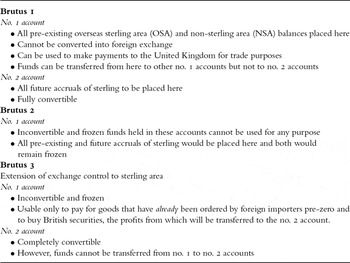
The Treasury pushed ahead. Three schemes for blocking were devised, named Brutus 1, Brutus 2 and Brutus 3 by Anthony Rawlinson,Footnote 117 in honour of the Ides of March.Footnote 118 It was reluctantly agreed that ministers should be advised that if no further funding was forthcoming, Brutus should be implemented. Because of various flaws the Treasury was backing Brutus One, which was the only version sufficiently advanced to be feasible at short notice,Footnote 119 although this version would only make the sterling balances inconvertible. Thus it was recognised that the scheme would have to be tightened ‘post-zero’ and that the official and private balances of both the sterling and non-sterling areas would have to be completely frozen (see Table 2).
The three versions of Operation Brutus

IV
It was in this atmosphere of impending crisis that on the evening of 14 March the chancellor, who had been briefed by his Treasury team, went to the House of Commons to warn the prime minister how close to the edge sterling was.Footnote 120 He also informed Wilson that he had heard that the United States planned to hold an international conference in Washington over the weekend, at which they hoped to deal with the problem of gold. At 10.40 p.m., Henry Fowler, the US treasury secretary, telephoned Jenkins and asked if the London gold market could be prevented from opening the following day.Footnote 121 It emerged that the United States planned to use the Washington conference as a means to push through a proposal to create a two-tier gold market.Footnote 122 The first tier would be operated by central banks; these would trade gold with each other at the official price within a closed market and would not sell gold to private traders. The second tier would be the private market of gold buyers and sellers, and this market would be allowed to reach its own level. The hope was that this tier would provide a useful safety valve that would take the pressure off both the pound and the dollar, as privately held gold would be allowed to increase in value without any impact on the currency markets. However, if the gold markets stayed open after the conference had been officially announced, it was likely that speculation would intensify. For Jenkins, Fowler's news was positive for two reasons. First, it signalled that the United States was not prepared to let the drain continue, but, more importantly, it also presented the administration with a smokescreen under which the foreign exchange markets could be shut down.Footnote 123
Indeed, one method of preventing a currency's collapse is to close the foreign exchange markets in which it is traded, but this sends signals to the international market that the currency is weak. When the markets are reopened, it is likely that speculation will resume vigorously. However, if it can be made to look as though the markets have been closed at the request of a third party, then speculators will be less likely to suspect that there is anything amiss.Footnote 124 The pressure on the home currency will be alleviated for the duration of the closure and valuable planning and bargaining time can be gained before the markets are reopened. Jenkins seized this opportunity as a means of protecting sterling, and Wilson readily agreed to the plan.Footnote 125 However, after consultation with officials it became clear that in order to close both the gold pool and the foreign exchange market, a bank holiday would be necessary. This in turn required an Order of the Council and a Privy Council meeting that night in the presence of the Queen.Footnote 126 Consequently, the prime minister and the chancellor made their way to Buckingham Palace in the early hours of 15 March, in order to implement the proposal.Footnote 127
However, a great political storm blew up. George Brown, the foreign secretary and arguably number two in the cabinet, had not been consulted. When, later that night, he found out about the Privy Council meeting and the ensuing bank holiday, he accused Wilson of
introducing a ‘presidential’ system into the running of the government that is wholly alien to the British constitutional system . . . but was so operating it that decisions were being taken over the heads and without the knowledge of Ministers, and far too often outsiders in his entourage seemed to be almost the only effective ‘Cabinet’.Footnote 128
It is more likely that Brown, who along with Callaghan had been a member of Wilson's inner cabinet of three, was not concerned about decisions being taken without the approval of the whole cabinet, but felt that he was no longer a part of Wilson's inner clique and that his influence was waning. Wilson had unquestionably attempted to contact Brown; the issue was how much effort he had put into it. Wilson claimed that he had sanctioned several attempts to find Brown but that he seemed unobtainable, whilst Brown claimed that Wilson's attempts to locate him were half-hearted and that Wilson wanted to keep him at bay.Footnote 129 When the foreign secretary was finally informed of the decision, he called 10 Downing Street and expressed his deep displeasure. After gathering together all the available cabinet ministers in the House of Commons he descended onto Downing Street and launched into one of his famous tirades, which eventually resulted in his resignation from government.Footnote 130
Whether or not Brown's exclusion from the decision-making process on the night of the 14 March was a calculated move on the part of Wilson is difficult to discern. It is clear that both Wilson and Jenkins were operating under crisis conditions and that the closure of both the gold and foreign exchange markets seemed to be the only viable solution, especially as it could be presented as a benevolent act on the part of the British government in response to a US financial crisis. One can only conclude that the decision taken by Wilson and Jenkins was the correct one, because if it had not been taken sterling would have fallen, but that Wilson's method of running the cabinet was one that caused a great deal of agitation to its members.Footnote 131
In one sense, Brown's departure was a blessing. As Cairncross recalls, ‘fortunately attention was diverted from the gold market by other events: the resignation of George Brown, the appalling [anti-Vietnam war] riot in Grosvenor Square’.Footnote 132 In another sense it was damaging. It meant that Wilson had to be seen to be more inclusive and democratic in his leadership style. These changes began almost immediately. The following day Wilson called a cabinet meeting, when the chancellor explained the chronology of the previous night's events in an attempt to justify the lack of consultation.Footnote 133 During the meeting, Anthony Crossland stated that whilst he agreed with the decision, during his three years as a cabinet minister the subject of sterling had always been something that the cabinet were not allowed to discuss collectively. In fact, it was clear that only the prime minister and chancellor took the important economic decisions.Footnote 134 According to Barbara Castle, he went on to say that ‘The rest of us were merely faced with the results when a crisis came and when the choice of action was invariably limited.’Footnote 135 He felt that the prime minister should establish an inner group of ministers that could discuss these issues. Whilst Wilson was not keen to do this because of the fear of leaks he conceded the point.Footnote 136 It is arguable that this was a concession that the prime minister had to make because Brown's departure, and the circumstances surrounding it, had made his own position more precarious. Tony Benn, the minister for technology, was extra vigilant in completing his diary entries during this episode because ‘if the Labour Government falls, as I now think quite possible, then at any rate I shall have documented the circumstances’.Footnote 137 Of course, whilst Wilson's resignation was not beyond the realms of possibility the collapse of the government was unlikely. Irrespective of how the crisis was resolved, the Labour Party would retain its parliamentary majority.
V
The group of ministers that Wilson called together was labelled the ad hoc cabinet committee MISC 205 and was later described by Barbara Castle as ‘this most secret and powerful of Cabinet groups’.Footnote 138 At its first meeting on Sunday 17 March, it became obvious that there were two overriding and interconnected issues.Footnote 139 First, there was the outcome of the Washington conference: if it were unsuccessful in halting speculation in the gold market, the pound would sink. Second, because the reserves were so low, even if the conference was successful and stopped much of the speculation, a minor flight from sterling, once the markets had been reopened, would still be enough to trigger an insurmountable sterling crisis.
Thus it was imperative that, whatever decision was taken by the United States at the conference in terms of the relationship between gold and the dollar, the outcome would be the restoration of calm to the world's currency markets. If confidence was not restored, not only would sterling remain unstable, but it would be essential that the United Kingdom regain additional credits to plug the gap in the reserves, just as the Bank and the Treasury had advocated. However, the chancellor was not confident that the United States would provide the essential line of credit. During his previous conversations with Fowler, Jenkins had requested a large standby credit. However, ‘He [Fowler] was non-committal, even unforthcoming.’Footnote 140 William Armstrong, permanent secretary to the Treasury, who had been dispatched to Washington, shared this lack of confidence.Footnote 141 He informed Jenkins, via the telephone, that it was most uncertain that Britain would get the necessary financial support from the United States and suggested that the following Monday and Tuesday should be proclaimed bank holidays too.Footnote 142
This greatly worried MISC 205, and it considered the Treasury's contingency plans very carefully. Wilson himself thought that ‘information on the progress of the Washington conference was not yet sufficient to form the basis for firm decisions’, but that it was essential to become acquainted with the alternatives.Footnote 143 However, it was obvious to the assembled ministers that there were clear problems with Brutus. The United Kingdom would accept a major catastrophe and risk being branded as a pariah state in order to avoid chaos, and there was the very real possibility that other countries would retaliate and that Britain's overseas investments would be frozen in return and international economic disorder would ensue. Furthermore, if the balances were frozen, the sterling area countries would have no means with which to pay for their imports and world trade would be disrupted.Footnote 144
The main advantage of the scheme was that it was designed to shield the reserves. It would protect Britain against a further run on the pound and put pressure on the Americans and the Europeans to develop a long-term solution to international monetary problems. However, the ministers were still clear that their favoured option was the provision of a multilateral funding package. After all, this would ensure that international chaos could be avoided, at least for the foreseeable future. If the United States and G10 did not agree to this, Wilson believed that it might be possible to use Brutus as a mechanism to force them to make a U-turn, not through its implementation but as a threat that would make them recognise what the dangers to the international monetary system would be if they failed to protect sterling. Wilson argued that the ‘president would be likely to be more responsive in this respect if it was made clear that the blocking of sterling balances would mean a serious threat to the dollar’.Footnote 145
Indeed, Wilson had already begun the ‘blackmail’.Footnote 146 He had made contact with President Lyndon Johnson three days previously and had stated that ‘if we [the United Kingdom] had to protect ourselves, we should be forced to take action which could have a grave effect on other currencies’.Footnote 147 One wonders then, why he felt the need to seek the agreement of his colleagues to a course of action on which he had already embarked. One can only conclude that, post-Brown, Wilson was ever mindful of the vulnerability of his position, and any attempt on his part at paying lip service to the idea of collective decision making would aid his cause. Before the weekend Wilson's threat to Johnson had been a hollow one, but now that some progress had been made on planning Brutus, the threat was credible.
It is ironic that, at the Washington conference, Leslie O'Brien (governor of the Bank of England) reported that ‘various forms of partial blocking of sterling are being suggested to us but we are resisting these and stressing that blocking would have to be complete and would necessarily cause damage to others as well as ourselves’.Footnote 148 It is possible that O'Brien's rejection of blocking and his elucidation of its horrors at the conference made Wilson's ploy more effective. For the Americans and Europeans finally concluded that if sterling were not to be assisted then the consequences for both the dollar and the IMS would be grave.Footnote 149 Consequently the two-tier gold market was adopted and Britain got its much needed standby credit. The final sum acquired was $3985 million,Footnote 150 not quite the amount requested or publicised, but the prime minister and the chancellor deemed that ‘this was not sufficient grounds to justify immediate action to block, which would lead to the complete dismantling of the sterling area’.Footnote 151
Of course, the March gold crisis was not the end of the affair, because the prognosis for sterling did not improve. Throughout 1968 the balance of payments still tilted heavily towards deficit, and sterling holders continued to diversify. Because of this, the Treasury continued to hone Brutus, and by summer 1968 nine versions of it had been developed.Footnote 152 As planning progressed, officials came to realise the true horrors of the scheme that they had devised. For if the block was to be successful, it would have to be accompanied by severe measures that would wreck the IMS and return Britain to a wartime siege economy under peacetime conditions. Because of the ‘horrors of Brutus’,Footnote 153 the Treasury quickly came to agree with the Bank that floating should no longer be considered a faux pas, and by summer 1968 it became the favoured policy option in the face of an insurmountable sterling crisis.Footnote 154 The Treasury had not come to embrace the possibility of floating exchange rates; it was simply that floating replaced blocking as the last redoubt.
VI
The existing literature on sterling in the 1960s focuses too narrowly on devaluation itself; it fails to recognise that the devaluation amounted only to first-order change and that its aftermath was equally, if not more, significant. In fact, the March gold crisis was the most serious sterling debacle of the 1960s, and it had the potential to have more severe and longer-lasting effects than the devaluation itself. It is ironic that it should go almost unnoticed in the annals of history and that it was completely upstaged by the events of November 1967. The episode is important for five reasons.
First, it occurred during a time when the Treasury, preoccupied with preparations for the budget, had put its contingency-planning operation to bed. This meant that officials had not given as much thought as they could have to the various policy alternatives. Consequently they had to develop proposals from scratch under crisis conditions. The result was that both the Bank and the Treasury were prepared to consider courses of action that they had rejected before the devaluation.Footnote 155
Second, the episode marks a rift between the two organisations, each coming to favour one of two previously rejected policy options, namely blocking and floating. This rift occurred not because the Bank and the Treasury had different ideas about the best means to achieve the public good, but because of the particular vested interests of each body. The Treasury opted for blocking because it feared that its prestige would be dented if the pound floated, although with hindsight it is arguable that its prestige would have been just as damaged by blocking.Footnote 156 The Bank, by contrast, was conscious of the need to protect the interests of its client group, namely its overseas customers and the City of London. That the Treasury was successful in subjugating the Bank and imposing its own preferences on the Labour government suggests that the Bank was the junior partner in the relationship. Kit McMahon, a former deputy governor of the Bank, also supports this interpretation.Footnote 157 However, it is important to stress that the Bank was not totally subservient to the Treasury and that it retained a great deal of autonomy, most notably in its internal management and in its relations with other central bankers and the sterling area.Footnote 158
Third, because the early Brutus scheme was so rudimentary, it is very unlikely that it would have provided an effective block.Footnote 159 If the additional credits had not been provided and ministers had been forced to implement the plan, it would only have been effective for a matter of weeks at the most. Although the Treasury would most likely have attempted to improve the block, if it had been unable to do so quickly enough, it would have been forced to float the pound.
Fourth, the episode was important in shaping the way in which Wilson organised his executive in terms of economic policy making. No longer were the prime minister and the chancellor to conduct economic policy behind closed doors and then bump it through cabinet. MISC 205 became a serious inner group of economic policy makers. Wilson may not have intended this to be so, but after the Brown episode there was little else he could do. The committee was also to take a serious interest in the Treasury's future contingency-planning activities. This too was in marked contrast to the conduct of planning before the devaluation. However, because the Treasury controlled the flow of papers to the committee, it is arguable that officials were still able to shape the context within which ministers operated. Furthermore, it is important to note that during 1969 MISC 205 met only five times.Footnote 160 This suggests that the wounds resulting from Brown's departure had healed and that Wilson could return to bilateralism. It also suggests that under Wilson power relations within the core executive were fluid and dynamic, rather than static.
Finally, the crisis had wider significance in terms of its impact on the IMS. The US decision to split the gold market into two – with one part controlled by the central banks, which continued to trade gold at $35 per ounce, and the other part operated by the markets, where gold was allowed to find its own level – marks the beginning of the end for Bretton Woods.Footnote 161 The Bretton Woods agreement had been established on the principle that the United States would agree to buy or sell gold from anyone, irrespective of their status, at a fixed price of $35 per ounce. With the implementation of the two-tier system, this pledge was to hold good only for monetary authorities. The step also represented the partial devaluation of the dollar, since its values depended on whether it was being used in official or non-official transactions. Furthermore, since the price of gold in the private market was constantly fluctuating, the dollar in effect floated in that market.Footnote 162