Scholars have long recognized the connection between women's representation and parties of the left. Left-wing parties are generally more likely to elect female representatives, to implement gender quotas, and to take on the demands of the feminist movement (Duverger Reference Duverger, North and North1954; Katzenstein and Mueller Reference Katzenstein and Mueller1987; Kittilson Reference Kittilson2006; Lovenduski Reference Lovenduski2005; Trembly Reference Tremblay2012). Yet this connection between women and left-wing parties has historically led to less scholarly interest in investigating women's representation in parties of the right, despite the political importance of these parties. Mainstream parties of the right often play a critical role in policy making, and it is important to learn under what conditions women might have a voice in these parties.
More recently, scholars have shown increased interest in understanding how parties of the right represent women (Childs and Webb Reference Childs and Webb2012; Dalton Reference Dalton2015; Evans Reference Evans2013; Schreiber Reference Schreiber2008; Wiliarty Reference Wiliarty2010). We should not assume that conservative women are operating with “false consciousness.” Conservative women have their own political interests, which are distinct from those of both conservative men and women on the left. These interests should not necessarily be labeled “feminist”; however, sorting out how “women's interests” might be separate from “feminist interests” is not a simple task (Celis and Childs Reference Celis and Childs2012, Reference Celis and Childs2014, Reference Celis and Childs2018). This line of theorizing is concerned with delineating women's substantive representation.
This article is primarily concerned with the descriptive representation of women in two major parties of the right, the German Christian Democratic Union (CDU) and the Japanese Liberal Democratic Party (LDP). The CDU represents women at dramatically higher rates than the LDP. We offer three interrelated reasons for this difference: party organization, the electoral systems, and left party strength.
Moreover, the case studies presented here illustrate the interaction between institutions and critical actors (Childs and Krook Reference Childs and Krook2009). The CDU's internal organization and the German electoral system both offer institutional affordances that make it possible for interested actors to advocate successfully to increase women's representation. The presence of a significant left party threat meant that some actors within the CDU were keen to take advantage of these institutional affordances. The LDP's internal organization, on the other hand, offers fewer institutional affordances for increasing women's representation. These openings are at least partially present in the electoral system, but the absence of a serious left party threat has meant that no actors within the LDP are sufficiently interested in increasing women's representation. Understanding what factors facilitate or hinder right-wing parties’ representation of conservative women can help us understand how their opinions are reflected in the political process.
Comparing the difference in female representation in the CDU and LDP is even more striking given some significant similarities between the two parties. The conservative parties in Germany and Japan oversaw their respective countries’ remarkable transformations following the devastation of World War II. The CDU and the LDP confronted many similar challenges in their efforts to rebuild their countries into stable economically successful democracies. The conservative parties also were instrumental in negotiating the parameters under which gender roles would be redefined. Despite their similarities, the two parties have represented women at very different rates. The German Bundestag is approximately 30.7% female, while the Japanese Diet is approximately 10.1% female (Inter-Parliamentary Union 2018).
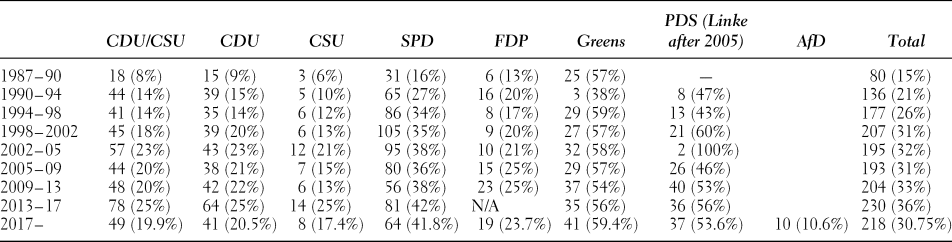
The parliamentary delegation of the German CDU is currently 20.5% female, while the parliamentary delegation of the Japanese LDP is 7.7% female. This article explores the reasons for this significant difference in parliamentary representation and argues that three factors interact to explain the varying levels of success of conservative women in the two countries: (1) right-wing party organization, (2) electoral system rules, (3) left party strength.
Some of the difference in representation in the CDU and LDP is related to the consistent presence of a stronger party of the left in Germany, the Social Democratic Party (SPD). The SPD female delegation has consisted of as many as 95 members, constituting 38% of the party's caucus in 2002, and remained higher than the CDU's delegation even after the CDU implemented a quorum. In contrast, the leftist Japan Socialist Party (JSP) has not had a strong presence in the lower house since electoral reform. The more centrist Democratic Party of Japan (DPJ) has had only a slightly higher percentage of women in its delegation and only elected a significant number of women when it won the government in 2009, electing 40 women, who constituted 13% of the DPJ caucus. While contagion from the left is part of the story in the German case, the ability of the CDU to respond to the left was influenced by its party organization.
Party organization is significant because it affects party behavior. Both the CDU and the LDP are catch-all parties, in that they attempt to appeal to many different kinds of voters (Dittrich Reference Dittrich, Daalder and Mair1983; Kirchheimer Reference Kirchheimer, La Palombara and Weiner1966; Wolinetz Reference Wolinetz1979). Both parties have chosen this strategy in an attempt to maximize “office” (Müller and Strøm Reference Müller and Strøm1999). Although it is advantageous for a party to win support from a broad spectrum of society, if supporters disagree with each other, it can be difficult for a party to present a platform that will appeal to everyone. Various scholars have proposed potential solutions to this problem. Kirchheimer (Reference Kirchheimer, La Palombara and Weiner1966) argues that catch-all parties will dilute their ideology (thereby appealing to everyone) and simultaneously disempower members, making it difficult for members to influence policy formation. Katz and Mair (Reference Katz and Mair1995) note that some parties will seek support from the state itself; such parties are referred to as “cartel” parties.
While either of these approaches might succeed, they are not the only possibilities available to political parties. The following examination of the party organization of the CDU, in contrast to the LDP's more traditional catch-all strategy, illustrates other methods of managing the task of appealing to diverse constituencies and the effects these choices can have on female representation. Specifically, the CDU's ability to represent diverse interests, including women, within the party through its corporatist structure allowed it to respond effectively to challenges on the left (Wiliarty Reference Wiliarty2010). The LDP, in contrast, is a more traditional catch-all party that fails to mobilize interests internally. The LDP's party organization inhibited it from responding to a challenge for female voters from the left and from adopting positive action strategies to support women under the new electoral system.
The repercussions of representing women within the party organization, as in the CDU, can be significant. Women within the German CDU, for example, pushed for and succeeded in having their party adopt and implement a gender quota. The LDP, on the other hand, has not considered a gender quota and did not consider women's interests in any other institutional reforms. As we shall see, the electoral system and a strong left party presence are important parts of the explanation for this outcome. However, these factors alone are not decisive. The CDU had a point of access in the party that could respond to a threat from the left. In Japan, the threat from the left has not been sustained. Even had it been sustained, though, it is not clear that the LDP could have responded effectively given women do not have an organized voice within the party.
In addition, consistent representation of women in the CDU has provided increased opportunities for party and cabinet positions which helped pave the way for Angela Merkel's ascendency to the chancellorship. In contrast, the percentage of women in the LDP in the lower house peaked at 11.9% in 2009. Women vying for office in Japan continue to fall under the gender-stereotyped label “Madonna.” This label emerged during the 1989 upper house election, when Doi Takako, the first female party leader, successfully saw 10 of the 12 JSP female candidates elected, an event the media called the “Madonna Boom.” The term “Madonna” still emerges in elections at times as a label for female politicians in Japan and suggests that women's expertise is limited to the realm of the feminine (Gaunder Reference Gaunder2017).
THE SIGNIFICANCE OF THE GERMANY/JAPAN COMPARISON
This investigation of differences in female representation in parliament in Germany and Japan is particularly intriguing given the large number of similarities found in Germany's and Japan's political and economic systems. Germany and Japan are both successful parliamentary democracies with weak democratic histories. Both countries’ postwar settlements were shaped primarily by their conservative parties. In addition, both countries can be classified as coordinated market economies in which economic interests operate in more structured ways than in liberal market economies (Vogel Reference Vogel2001: Yamamura and Streeck Reference Yamamura and Streeck2003). Finally, both countries have maintained a male breadwinner model of the welfare state for most of the postwar period, which is reflected in female labor force participation statistics (Esping-Anderson Reference Esping-Anderson1990, Reference Esping-Anderson1997, Reference Esping-Anderson1999; Osawa Reference Osawa2007).
The conservative parties in Germany and Japan also have many commonalities. The CDU and LDP are the largest parties in each country, and they are similar in terms of power and ideology. Both have been in government more than any other party in their respective countries. The CDU has been in government for a total of 49 years since 1949 (1949–69, 1982–98, 2005–present). The LDP ruled from its inception in 1955 to 1993 and then in coalition from 1994 to 2009. It reentered government in 2012 and remains in power to date. Through their long tenures in office, both parties have been highly influential in postwar politics.
The CDU and LDP share many key aspects of conservatism. Both parties favor industry and big business and prioritize regulations that favor economic growth. The parties also have conservative notions of family and, until very recently, tended to see women as mothers as opposed to workers. Perhaps most importantly, both parties are highly pragmatic and oriented primarily toward winning office (Bösch Reference Bösch2002; Krauss and Pekkanen Reference Krauss and Pekkanen2011; Pridham Reference Pridham1977).
Two significant differences exist. First, religion informs Christian democracy, while it plays no role in the LDP's party ideology or support base. As is typical for Christian democratic and conservative parties in general, this ideological difference correlates with differences in party organization, which will be discussed later (O'Brien Reference O'Brien2018). Second, the LDP has always contained a contingent of right-wing nationalists who support constitutional revision. The nationalist-oriented wing of the CDU is comparatively much more moderate. Overall, the shared aspects of conservatism outweigh these differences.
Women and the women's movement in Germany and Japan also share many similarities. Women in both countries are highly educated, with 91.3% of German women and 80% of Japanese women receiving at least a secondary education (UN 2015). Furthermore, the women's movements in Germany and Japan have been considered fairly weak from a cross-national perspective and have operated largely outside the political realm (Weldon Reference Weldon2002, 77). In Germany, the feminist movement focused on issues of autonomy (Ferree Reference Ferree, Katzenstein and Mueller1987). Since the 1980s, feminists have sometimes worked with the Greens and the SPD, but the early skepticism of the state remains (Ferree Reference Ferree2012). Even when feminists have worked within the parties of the left in Germany, this has been a sometimes troubled partnership (Kittilson Reference Kittilson2006). The women's movement in Japan is also weak (Eto Reference Eto2010; Mackie Reference Mackie2003). In the postwar era, there have been two varieties of women's movements in Japan. The first and more prominent has focused on women's roles as housewives and mothers (Garon Reference Garon1997). The second strand focuses on women's liberation. These movements have been smaller and focused on reproductive issues, dual surnames, and sexual violence (Mackie Reference Mackie2003; Shin Reference Shin2004).
Given these similarities, why does the level of female representation for conservative women differ? We argue that party organization, electoral system rules, and left party strength interact to influence levels of parliamentary representation.
FEMALE REPRESENTATION AND PARTY ORGANIZATION
The CDU
Women have gained considerable strength within the German CDU. Of course we might expect that outcome, given that Angela Merkel, the German chancellor since 2005, is a female Christian Democrat. If we remember the British Conservative Party under Margaret Thatcher, however, it is clear that a female leader does not necessarily imply that women are empowered at other levels of the party. In the German CDU, though, women are deeply anchored throughout the party (Wiliarty Reference Wiliarty2010).
Turning first to female members of the Bundestag, it is important to sort out female members of the CDU and of the CDU's sister party, the Christian Social Union (CSU). These two Christian Democratic parties do not campaign against each other. The CSU is active in the federal state of Bavaria only, and the CDU is active in the rest of Germany. Women are more powerful within the CDU than within the CSU, though the power of women in the CSU has been growing in recent years (Kürschner Reference Kürschner2009).
The dependent variable we are seeking to explain is the parliamentary representation of conservative women. As Table 1 shows, the CDU's parliamentary delegation was 9% female in the mid-1980s. It increased over the course of the 1990s and has held fairly constant at around 20% to 22% since 1998. With a parliamentary caucus that is 20% female, the CDU still has not achieved the 30% goal put forth by the United Nations, but it is well within the 15% to 40% range that Dahlerup (Reference Dahlerup1988) calls a “tilted group” and within which cultural change is supposed to occur.
Number of female members of the Bundestag (percentage of women in party caucus)

Sources: Ritter and Niehuss (Reference Ritter and Niehuss1991); Frauen-Union der CSU (1997); Schindler (Reference Schindler1999); von Schwartzenberg (Reference von Schwartzenberg2002); McKay (Reference McKay2004); Statitisches Bundesamt (2005, 2009); Bundestag, http://www.bundestag.de (February 24, 2014); http://www.bundeswahlleiter.de (March 16, 2018).
The CDU's party organization has facilitated this relatively high level of female representation in the Bundestag. The CDU is best described as a corporatist catch-all party rather than a classic or standard catch-all party. Corporatist catch-all parties are divided into leaders and members, but also into internal party interest groups. Recognized groups have institutionalized representation on the party's decision-making bodies. Groups represented in a party's decision-making bodies participate in policy making, which happens through a bargaining process in which represented groups negotiate with each other and with party leadership. A corporatist catch-all party's interest associations do more than just lobby the party; they are integrated into the party's decision-making process. Represented groups are not guaranteed that the final outcome will go their way, but they are guaranteed the right to participate in the bargaining process. As discussed later, the Women's Union is one of the CDU's represented groups (Wiliarty Reference Wiliarty2010).
Maintaining an internal balance of these groups is one method of encouraging party cohesion. The CDU did not act rigidly, in terms of following a formula of proportionality or a rule of giving every group a seat on every committee. Party elites observed certain norms, such as maintaining a confessional balance between Protestants and Catholics. In the 1950s and 1960s, a single woman on a committee was often seen as sufficient. Internal committees were not allowed to become dominated by politicians from any particular group. Candidate selection followed similar norms in an effort to appeal to all Germans and also reflect the power of the party's internal organizations (Bösch Reference Bösch2001, Reference Bösch2002).
The Women's Union is the women's organization within the CDU. Although the Women's Union was integrated into the CDU's structure of internal representation at the founding of the party, it did not make many substantial demands on the party until the early 1970s. As the rise of the second-wave feminist movement in (West) Germany contributed to a decrease in CDU support from women at the polls, women within the party responded by demanding more influence and policy adjustments. The CDU largely accommodated their demands, at least in the 1970s and 1980s (Wiliarty Reference Wiliarty2010).
In the 1980s, both the Greens and the SPD adopted gender quotas, which significantly increased the presence of female candidates on the left. In the 1990s, the Women's Union pushed for the CDU to adopt its own gender quota. After significant internal party debate, the CDU implemented a modified gender quota, which it calls a “quorum.” The difference between a “quorum” and a “quota” is purely one of semantics—many CDU members opposed the quota, so party leaders changed the name to make it somewhat easier for internal opponents to swallow. While pressure from left-wing parties was important in getting the CDU to adopt this measure, the female leaders within the party were also critical (Wiliarty Reference Wiliarty2010). The quorum stipulates that one-third of elected and party offices held by the CDU must go to women. Interestingly enough, the sanctions for noncompliance are not serious; if the CDU fails to meet its goal of electing one-third women in an internal party election, the party simply holds a second election, for which there is no target for electing women. Despite the weakness of this mechanism, it has significantly increased women's representation within the Bundestag and at the upper levels of the party hierarchy (Wiliarty Reference Wiliarty2010). Notably, the CDU's sister party, the CSU, did not have such strong internal female leadership, and it only adopted a gender quota in 2010 (Kürschner Reference Kürschner2009). Furthermore, the CSU's quota only covers internal party leadership positions at the regional level and above, not candidates or lower-level party leadership positions.
The results in Table 1 illustrate the effect of the quorum. The first election for which the CDU quorum was in effect was 1998, and women's representation jumped from 14% to 20%. For comparison's sake, with no quorum, the CSU's representation of women increased to 21% in 2002 but then dropped again to previous levels. The CSU's new quorum was in effect for the 2013 election, and women's representation again increased, this time to 25%. For both the CDU and the CSU, the quorum is an instrument to facilitate a sustained push to increase women's parliamentary representation.
Cabinet and leadership positions also are manifestations of female representation. Over time, the CDU has increased the number of women in the cabinet. The first Christian Democratic female cabinet member was appointed in 1961. The number of female ministers in the cabinets of Christian Democratic chancellors has steadily increased. Merkel has had five to six women in each of her three cabinets. Although women have not held high-power positions, such as foreign minister, economics minister, or finance minister, their presence in the cabinet is significant. As for party leadership, the three top leadership positions in the CDU are general secretary, party chair, and chair of the parliamentary caucus. Merkel is the only woman to have held any of these positions, and she has held all three.
The corporatist catch-all party organization of the German CDU leads to female representation throughout the party. The Women's Union is a powerful actor within the party, able to influence policy and personnel decisions, such as the passage of the quorum. The CDU's adjustment to changing demands from female voters was initiated by the loss of female support at the polls and spurred by the way that parties on the left responded to changing gender roles in Germany. The party's internal party organization, however, meant that conservative women within the party had a foothold from which to operate when lobbying their party to change.
The LDP
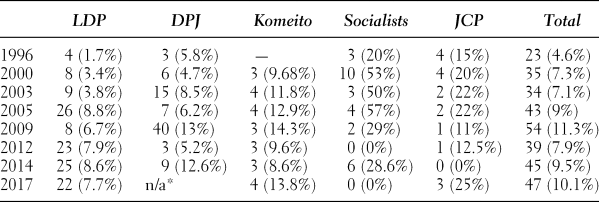
In contrast to the CDU, the level of female representation in the LDP is low, partly because of the LDP's traditional catch-all party structure. While the percentage of women in the Japanese parliament overall has increased gradually since 1996, in the more powerful lower house, it still remains significantly below 30%, the United Nations benchmark. Specifically, the percentage of women in the lower house increased from 4.6% in 1996 to 11.3% in 2009, but it was back down to 10.1% in 2018 (Inter-Parliamentary Union 2018). From 1952 to 1990, the percentage of women in the lower house remained below 2% (Cabinet Office 2005, 20).
The LDP's parliamentary representation of women has remained well below that of the CDU. As illustrated in Table 2, the number of women in the LDP has increased since electoral reform in 1994, but that increase started from a very low base. In 1996, the LDP had four female members of the lower house, constituting 1.7% of its membership. In 2014, 25 LDP women held seats in the lower house, representing 8.6% of its membership. Female representation in the LDP hit its peak in 2005, when 26 LDP women were elected, 8.9% of the LDP's total seats. Overall, women have never even reached a “tilted” group in the LDP (Dahlerup Reference Dahlerup1988, 280).
Number of female members of the Japanese Diet (percentage of women in party caucus)

Notes: The Democratic Party of Japan changed its name to the Democratic Party in 2016. It then split just prior to the October 2017 lower house election. Two new parties emerged: the Constitutional Democratic Party and the New Party of Hope. The Constitutional Democratic Party elected 12 women, constituting 20.8% of the party caucus. The Party of Hope ran 47 female candidates but only two won office, constituting 4% of the party caucus.
Source: Ministry of Internal Affairs and Communications, http://www.soumu.go.jp/senkyo/senkyo_s/data/ (accessed November 8, 2017).
The lower level of LDP female representatives in the Japanese lower house, in comparison to the CDU, is at least partially explained by the LDP's party organization. Unlike the CDU, the LDP is a classic catch-all party rather than a corporatist catch-all party. Since its inception, the LDP has been a large party that reached out to crosscutting interests. The number and types of interest groups that became part of the LDP only increased over time. The core support base of the LDP during its dominant period (1955–93) consisted of farmers, industry, corporations, small business, construction, the postal lobby, and the self-employed. Both the CDU and the LDP represent a range of societal groups, but this internal representation is structured differently in the two parties.
The LDP has three mechanisms that facilitate interest representation: kōenkai (personal support organizations), factions, and the Policy Affairs Research Council (PARC). None of these mechanisms has been used to promote female representation in the party. Instead, in the face of weak party identification and low levels of party membership, individual LDP politicians created kōenkai to provide patronage and pork to constituents in return for votes (Curtis Reference Curtis1971). These kōenkai function as political machines for individuals. Kōenkai require significant financial and organizational resources, something most women candidates do not have access to (Ogai Reference Ogai2001).
The key organizational features of the LDP are factions and the PARC. Since the 1970s, the LDP has contained five to six factions. These factions have not been ideologically based. Instead, LDP factions have focused on raising and distributing funds to support candidates for office in return for the faction member's support in the party presidential election. Factions have also served as an important mechanism for distributing party and Diet positions. In general, factions receive representation within the party and the cabinet in proportion to their numerical strength in parliament (Kohno Reference Kohno1997). Factions have been the main institution for maintaining internal balance. The LDP, like the CDU, fears internal split. Factional balancing in appointments to party and Diet positions promotes cohesion. Each faction, however, has ties to multiple interest groups, making this type of balancing distinct from the corporatism in the CDU. Moreover, no faction has made it a priority to increase its number of women members.
The LDP's PARC allows the party to respond to certain interest groups. It parallels the Diet committee structure and served as the main forum for policy debate and formation under the 1955 system of LDP dominance. The chairs and vice chairs of the PARC divisions served as policy gatekeepers. Participation on the PARC committees provided opportunities for credit claiming and fundraising as politicians could pursue the interests of their district and key interest groups (Krauss and Pekkanen Reference Krauss and Pekkanen2011).
All three of these organizational forms—the kōenkai, the factions, and the PARC—promote a clientelist orientation within the LDP. The LDP's clientelism, however, has not been completely exclusionary. The party's desire to “catch” as many groups as possible has made it more open to considering the interests of groups outside its social coalition. Interest groups with closer ties to the LDP exert greater influence than outsiders, but overall, the LDP was inclusive and flexible during its period of dominance (Muramatsu and Krauss Reference Muramatsu, Krauss and Pempel1990). The LDP has represented many crosscutting interests, including big and small businesses, productive and nonproductive sectors, and rural and urban constituencies. It has favored interests that provide votes and/or money, such as construction.
Women candidates have been supported by the LDP and other parties intermittently as “change” candidates in attempt to appeal to voters desiring reform. For example, Prime Minister Junichiro Koizumi supported 26 women as so-called assassins to run against former LDP members who had been kicked out of the party because of their failure to support postal reform. These female candidates were successful, in part because of the popularity of the party at the time. Most failed to gain reelection because their support had been tied to a particular leader, not to institutional supports for women by the party (Gaunder Reference Gaunder2012).
Kōenkai do recruit both male and female members, but women are being recruited as voters, not as potential political participants. Women tend to be more involved in the social and community aspects of the organization, participating in cooking classes, flower arranging, or travel (Steele Reference Steele2004, 240). This participation cultivates their connection to particular candidates but not to the party as whole or to politics more generally, making kōenkai significantly different from the Women's Union in the CDU. The Women's Union within the CDU provided a point of access for women's demands to reach party decision makers. No such point of access exists at the party level for the LDP.
In contrast to the CDU and its quorum for female candidates, the LDP's party structure has not favored women. Under both the old and new electoral systems, local party branch offices, factions, and kōenkai have played a key role in the recruitment and nomination process. Women faced barriers to entry in all three areas. Candidate nomination is a bottom-up process, with the Electoral Strategy Committee considering recommendations from the local branch offices. Very few women have the type of experience rewarded by the male-dominated local party gatekeepers and/or factions, such as bureaucrat, local or prefectural assembly member, or assistant to a politician (Ogai Reference Ogai2001). These careers cultivate greater connections with business, the bureaucracy, and/or politicians. All these connections are necessary to successfully secure pork for one's district.
Despite Prime Minister Shinzo Abe's recent push to increase female participation in these areas, women's involvement in these careers remains low. In 2016, women made up 12.8% of local politicians and held 4.4% of the division director positions in the national bureaucracy (Cabinet Office 2018a, 2018b). With few qualified women in the political pipeline, the selection of female candidates is hindered. In recent years, the LDP has recruited a larger number of candidates through open recruitment (Smith Reference Smith, Pekkanen, Reed and Scheiner2013). Open recruitment has increased accessibility for candidates including women, but it does not ensure representation or provide an incentive for party gatekeepers to choose female candidates in the same way that quotas would.
Though parliamentary representation of women remains our primary focus, the LDP has lagged behind the CDU in representing women elsewhere as well. The LDP has appointed one to two women to cabinet positions since Prime Minister Toshiki Kaifu first appointed two women in 1989. Prime Minister Koizumi appointed five LDP women in 2001. With few exceptions, such appointments have primarily been symbolic.
In terms of representation within the party, the LDP has lagged behind the CDU. No LDP women had served in a top party leadership role until 2010, when Koike Yoriko was appointed head of the Executive Council. Prime Minister Abe appointed Inada Tomomi to be chair of the LDP's PARC in 2014. Despite recent appointments, the party's overall commitment to increasing the presence of women remains unclear.
While the environment has been more favorable for women in the LDP recently, this trend may not be sustained. More women have been elected as conservatives; however, the nominations are strategic as opposed to structural. The main aim is to gain more votes and sometimes to discipline other sections of the LDP (Christensen Reference Christensen and Tremblay2008). Women would have a greater chance of sustaining their presence in the party if the organizational structure of the party provided for the representation of women's interests. This type of corporatism does not exist in Japan, unlike in Germany. Moreover, appointments of female candidates have been closely tied to the priorities of the party leader (Gaunder Reference Gaunder, Reed, McElwain and Shimizu2009). The lack of institutionalization has resulted in inconsistent female representation and limited progress.
ELECTORAL SYSTEM
The electoral system and left party strength are two factors that have interacted with party organization to influence female representation in the CDU and the LDP.
Extensive scholarship has shown that closed-list proportional representation (PR) systems facilitate women's representation more than majoritarian systems do (Davidson-Schmich Reference Davidson-Schmich2006; Kostadinova Reference Kostadinova2007; Matland Reference Matland, Ballington and Karam2002; Matland and Montgomery Reference Matland and Montgomery2003; Matland and Studlar Reference Matland and Studlar1996; Moser Reference Moser2001; Norris Reference Norris2004). Parties are more likely to nominate women to PR lists, and voters who might be reluctant to support women in a single-member district are less likely to avoid parties that have both women and men on the party list (Norris Reference Norris2004). PR systems also are more amenable to “positive action strategies” to promote female representation, such as quotas and reserved seats (Norris Reference Norris2004, 191). In systems that use a mix of PR and majoritarian systems, the PR component usually elects more women (Davidson-Schmich Reference Davidson-Schmich2006; Kostadinova Reference Kostadinova2007; Matland and Montgomery Reference Matland and Montgomery2003; Moser Reference Moser2001). Germany uses a mixed system with elements of both types, while Japan changed electoral systems in the mid-1990s. The electoral systems in the two countries have different effects and create different incentives for political parties.
Germany's electoral system, called personalized proportional representation, elects some of the members of the Bundestag through proportional representation (PR tier) and some through single-member district contests (SMD tier). The exact allotment of seats from each tier depends on the outcome of the election, but the makeup of the Bundestag as a whole depends on the PR portion of the system. The German system shows that these electoral systems have differential effects on women's representation; more women are elected to the Bundestag through the PR tier (Davidson-Schmich Reference Davidson-Schmich2010).
Japan used the single non-transferable vote (SNTV) system for its lower house from 1955 to 1994. Under SNTV, each district elected two to six representatives. Larger parties (and particularly the LDP) consistently ran more than one candidate per district. Because of this intraparty competition, the SNTV system focused on the personal vote and tended to foster corruption. Candidates needed to have personal control over extensive resources to run successful campaigns. This system imposed constraints on female candidacy. Party nominations were decentralized, and party gatekeepers tended to select candidates in male-dominated professions (Ogai Reference Ogai2001).
In 1994, Japan adopted a new electoral system, which, like Germany's, is a mixed-member electoral system. The electoral systems are marked by two important differences. First, the SMD and PR tiers send equal numbers of representatives to the Bundestag in Germany, while in Japan, the SMD tier sends 289 and the PR tier sends 176 representatives to the lower house. Furthermore, the German system is compensatory, meaning that the results of the PR tier take into account the results from the SMD tier. The PR tier determines the overall distribution of seats in the Bundestag. In Japan, the two tiers operate independently, so the PR tier of the system has less “bite” and the overall results are less proportional. Given these differences, the German system is likely to produce more proportional results than the Japanese system (Reed and Thies Reference Reed, Thies, Shugart and Wattenberg2001).
The Japanese electoral system also has an unusual wrinkle. In most mixed-member systems, it is common for many candidates to run as SMD candidates and to obtain a spot on the PR list as well. The party generally maintains control of the list for the PR tier. In Japan, however, instead of the party elites compiling a list of ranked candidates, some parties list multiple candidates at a single position on the list. The ranking of candidates is then determined by the “best loser” principle. That is, the rank order of candidates on the PR list is determined by how well the losers did in the SMD component of the election. This arrangement means that parties give up the “resource” of being able to distribute better or worse spots on the list, but it also means that parties are not forced to choose among candidates—and parties do not have to adjudicate factional or any other kind of battle. However, parties using this approach also sacrifice their ability to create more balanced or diversified lists (Christensen Reference Christensen and Tremblay2008; McKean and Scheiner Reference McKean and Scheiner2000; Moser and Scheiner Reference Moser and Scheiner2012).
Both the LDP's and voters’ responses to electoral incentives become apparent when looking at the nomination and election trends in recent years. In the 2014 lower house election, the LDP nominated 42 female candidates. Twenty-two candidates were dual listed; the other 20 were PR-only candidates. Sixteen women were elected in single-member districts, and nine won via PR. Six of the nine PR candidates were dual listed. In the 2017 lower house election, 20 LDP female candidates were dual listed, and five were only nominated in PR. Twelve women won in SMDs and eight won in PR (MIC 2014, 2017). Dual-listed candidates tend to be ranked higher than PR-only candidates. Open SMD seats are necessary for new women to run as dual-list candidates since parties prefer nominating incumbents.
Differences in electoral systems can help explain some of why conservative women's representation is so much higher in Germany than in Japan, but it is not the whole story. Despite the differences noted earlier, the current electoral systems in Germany and Japan bear many similarities, yet the LDP continues to have few women in the Diet. In mixed systems, in order for women's representation to increase, political parties need to take advantage of the tool of proportional representation to advance women's representation. That women's representation increased somewhat in the mid-1990s in Japan likely shows that party politicians are aware of the potential of this tool, but they are largely choosing not to use it. In both systems, conservative political parties operated under electoral systems that could be used to promote women's representation. The CDU chose to do so; the LDP did not. To understand why the two conservative parties behaved differently on this issue, we need to look to parties on the left.
LEFT PARTY STRENGTH
Differences in left party strength help explain the different behavior of the CDU and the LDP. In the 1970s, female voters in (West) Germany began to shift their allegiance from the Christian Democrats to parties on the left, both the Social Democrats and later the Greens. The Social Democrats initially picked up the cause of the women's movement, and the Greens followed suit shortly afterward, once the party was established (Kittilson Reference Kittilson2006; Matland Reference Matland, Ballington and Karam2002). This strong left-wing challenge forced the CDU to respond by accommodating the demands of the women's movement in a variety of ways. The Christian Democratic response was successful enough to slow the emergence of the modern gender gap, in which female voters favor parties of the left. Women are better represented in the CDU partly because the CDU did a better job than most conservative parties at responding to changing demands from female voters, including by increasing female representation within the party (Wiliarty Reference Wiliarty2010).
The lack of a challenge from the left in Japan is partially a story of missed opportunity. The most important Japanese party of the left, the JSP, attempted to challenge the LDP by courting the support of women in the late 1980s. While the effort achieved significant short-term success, it was not sustained. The JSP went into the 1989 upper house election highlighting its connection to women and women's issues. Under a female leader, Doi Takako, the JSP put forward several female candidates and the party gained a majority for the first time. The unprecedented nature of the JSP female contingent was reflected in the media label the “Madonna Boom.”
Even though the JSP's “Madonna Boom” opened the door for women to participate on the national stage, the JSP strategy of supporting women was short-lived and ineffective in the long term. While the JSP did well in the 1990 lower house election, it performed poorly in the 1993 lower house election because of its antiquated position on the peace constitution in the wake of the first Iraq War (Stockwin Reference Stockwin1994, Reference Stockwin and Hrebenar2000). The JSP had the potential to provide a challenge from a left-wing party on women's participation, but its ideological inflexibility and weak party organization prevented it from continuing to capitalize on the “Madonna Boom” (Gaunder Reference Gaunder2015). Because the efforts of the JSP to elect more women could not be sustained, the LDP did not feel pressure to respond in a systematic structural way.
The Democratic Party of Japan (renamed the Democratic Party in 2016) was the largest opposition party from 1996 to 2017 when it disbanded. The centrist nature of the DPJ often allowed it to appeal to voters but prevented it from being able to draw distinct differences from its rival, the LDP. The DPJ did have more infrastructure to support female candidates, such as an open recruitment program, modest financial support, and an upper house policy to support women in three member constituencies in 2005 and 2007 (Gaunder Reference Gaunder, Reed, McElwain and Shimizu2009). In the 2009 lower house election, 40 of the 46 female DPJ candidates were elected. The DPJ cast these candidates as symbolizing change, a strategy similar to one used by the JSP in 1989 and the LDP in 2005. The increase in women did not come from the party's commitment to gender issues. In the end, weak party organization and leadership led to the party's decline, a similar path followed by the JSP. Unlike the SPD, neither the JSP nor the DPJ has been able to sustain a clear message about or commitment to women's involvement in politics, thereby preventing them from becoming true threats from the left.
Overall, the CDU experienced a greater threat from parties of the left than the LDP did. This context helps explain the CDU's motivation for increasing women's representation in the Bundestag both by selecting female candidates and also eventually by supporting a quorum. Women had a voice within the CDU when the party was being threatened. These women were in a position to advocate for a quorum through the Women's Union. Female representation increased in the CDU following this policy change. Women did not have an organized voice within the LDP (or in the Diet) during the “Madonna Boom” and the 1994 electoral reform debate that followed (Iwamoto Reference Iwamoto, Haussman and Sauer2007). As a result, the type of electoral system adopted and the party's organizational response to it were not focused on increasing female representation.
CONCLUSION
This article has argued that party organization, electoral system rules, and left party strength interact to influence female representation in the CDU and LDP. This finding has broader implications for future investigations of party organization, parties of the right, and female representation in parliament. It also sheds light on the role of actors in institutional change.
The CDU and the LDP faced the same dilemma. As broad-based catch-all parties, both wanted to appeal to a wide range of societal interests, but both parties also faced centrifugal forces pulling the various interest groups apart when they conflicted with each other. To prevent party fissure, both the CDU and the LDP created mechanisms for internal balance. The CDU mobilized its membership and created internal representation for its various constituencies, including women. The LDP achieved internal balance through factions. The factions were based on patron-client ties, not interest group representation. Party organization can be used to ameliorate party fissure, but the choices parties make have repercussions. Specifically, which groups obtain influence over the internal life of a political party influences that party's choices in terms of policies and personnel.
The mechanisms for internal party balance in the CDU and the LDP have had significant implications for the representation of women. Women were not part of the balancing equation in Japan. Moreover, very few women served in the LDP prior to electoral reform in the mid-1990s. As a result, the LDP did not contain a constituency to respond to the women's movement. In contrast, representing the interests of women through party organization has provided the CDU with a way to respond to conservative women and win votes. The CDU was able to create and respond to a positive feedback loop for female representation that is lacking in the LDP.
The importance of the internal party organization for parties of the right is especially clear when these parties face challenges from parties of the left. The presence of a strong party of the left in Germany is particularly significant. The SPD challenged the CDU on women's political participation and put the party under pressure to respond. In Japan, the weaker JSP missed its opportunity to challenge the LDP on women's representation in the early 1990s when other issues were more pressing.
The potential impact of female representation in conservative parties is complicated and requires further investigation. The CDU and the LDP clearly differ in terms of descriptive representation—there are significantly more women in parliament in the CDU than in the LDP, and this has been true throughout the postwar period. This article, however, takes seriously the contention that we must separate “women's interests” and representation from “feminist interests” and representation (Schreiber Reference Schreiber2014). Conservative women may share some interests with women on the left, but they have their own distinct interests as well (Celis and Childs Reference Celis and Childs2012). Because conservative women will only gain parliamentary representation through conservative parties, it is important to investigate what those parties do in order to facilitate the election of more women. If conservative women share a set of interests distinct from women on the left, but also from conservative men, they rely upon their political parties to ensure that these interests are raised in parliament.
Finally, this article has highlighted the importance of both actors and institutions. Both Germany and Japan underwent institutional changes that had the potential to influence levels of female representation. The German CDU adopted a gender quota, and Japan changed its electoral system. These changes remind us that though institutions might be sticky, they are not necessarily static. Intentions matter, just like organizations. Several countries and parties have adopted some form of a gender quota in an obligatory fashion with no real commitment to compliance, and these quotas are not always effective. Even with remarkably weak sanctions, however, the CDU's quorum has actually increased female representation (though not all the way up to its target). The effects of electoral system change are harder to predict, but certainly introducing elements of proportional representation can give parties a tool to increase the number of women in parliament, if that is the intention. In the Japanese case, the ability to boost female representation was not part of the discussion with electoral reform (Iwamoto Reference Iwamoto, Haussman and Sauer2007, 206). In fact, parties have not used the new system to increase women's representation or the representation of any other societal group. Instead, parties gave up their ability to rank candidates on the list, thereby relieving themselves of the dilemma of balancing the various internal factions.
The broader implications here are that institutions are not necessarily fixed for all time, but also that not all actors will take advantage of the affordances of a particular institution in the same way. Unless the LDP chooses to change its party organization or the Diet implements different electoral rules, the differences in female representation in Germany and Japan are likely to persist.