1. Introduction
Primary information on processes leading to the differentiation of natural silicate magmas comes mostly from unique natural laboratories: mafic–ultramafic sills and layered intrusions (e.g. Wager & Brown, Reference Wager and Brown1968; Parsons, Reference Parsons1987; Cawthorn, Reference Cawthorn1996). However, a large number of natural processes that are commonly simultaneously operative in large magmatic chambers may hamper efforts to decipher the role of individual processes and our understanding of their contribution to the final compositional profile of a magmatic body. To overcome this obstacle, we have undertaken a geochemical study of small mafic dykes (<30 cm thick), as relatively simple geological objects that allow us to narrow significantly the list of processes responsible for their internal magmatic differentiation. For instance, processes such as crystal settling, magma stratification and infiltration metasomatism are extremely unlikely to be significant in such small dykes. Also, depending on the presence or absence of intratelluric phenocrysts, the role of flow differentiation during intrusion can be easily assessed. Detailed compositional profiles across dykes and their adjacent rocks may also give a clear answer as to the role of in situ contamination by country rocks. There is then a chance to end up with one or two processes that could be responsible for the observed differentiation trends in the dykes. The intrinsic simplicity of small dykes may thus significantly assist in understanding the chemical characteristics of these processes and their role in the derivation of compositional profiles in dykes. As primary objects for this study we have taken dolerite dykes of the Åland–Åboland dyke swarm, SW Finland (Ehlers & Ehlers, Reference Ehlers and Ehlers1977; Lindberg, Eklund, & Suominen, Reference Lindberg, Eklund and Suominen1991; Suominen, Reference Suominen1991). This swarm was chosen because it contains a high proportion of relatively fresh and phenocryst-poor dykes that are well exposed on coastal outcrops of numerous islands of the Åland–Åboland Archipelago of the Baltic Sea.
2. Sampling and analytical methods
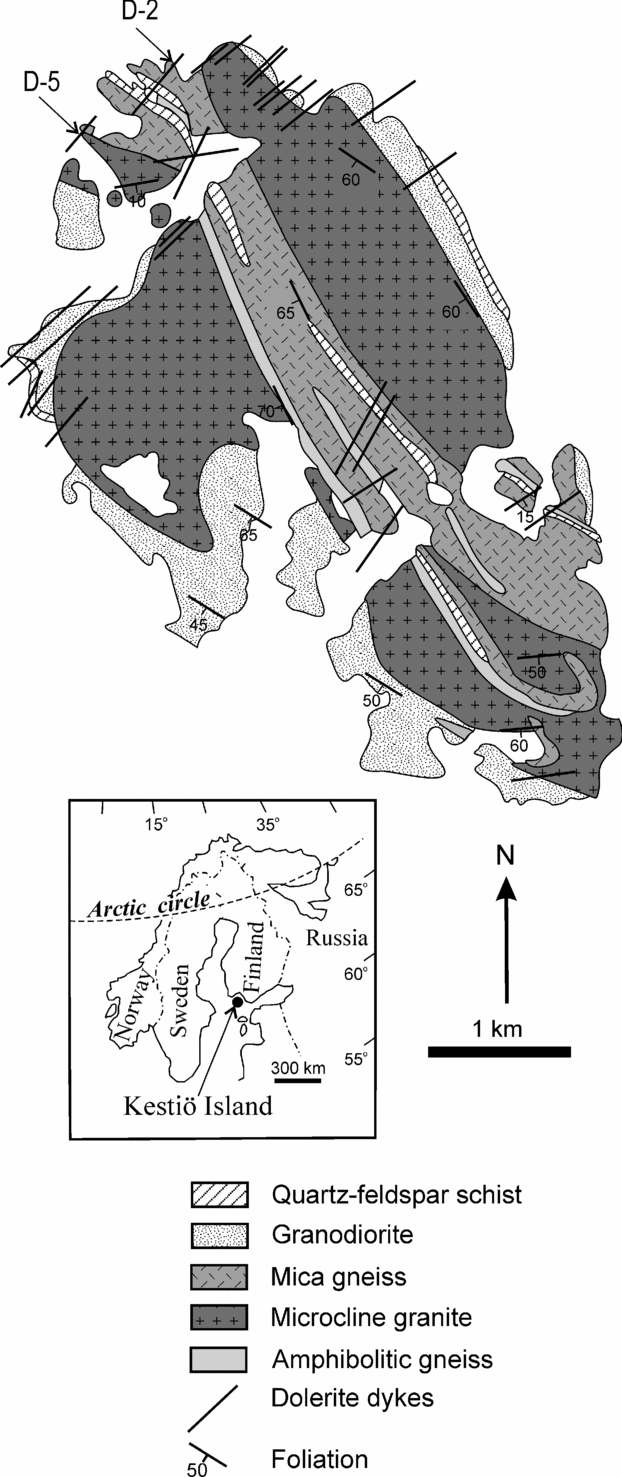
We have studied bulk chemical variations and plagioclase compositions across seven dolerite dykes of the Åland–Åboland dyke swarm, SW Finland, that crop out on Kestiö Island (Fig. 1). The two most representative small dykes D-2 and D-5 are presented here. A specific sampling technique was adopted for the study of these dolerite dykes. By trial and error we found that their internal compositional structure can be best revealed by saw machine sampling on a 1–2 cm scale at the laboratory. The major and trace elements were determined by X-ray fluorescence (XRF) using a Siemens SRS-303AS spectrometer with Rh tube at the University of Oulu, Finland. Working curves were determined by analysing the geochemical rock standards NIM-N, NIM-P, NIM-D, BE-N, BIR-1, W-2 and MRG-1, data for each having been compiled by Govindaraju (Reference Govindaraju1994). Precision and accuracy for all major elements were better than 5% and for most trace element analyses within 15 %. Detection limits are 61.3 ppm (F), 10.0 ppm (S), 12.1 ppm (Cl), 3.6 ppm (Sc), 2.6 ppm (Cr), 7.1 ppm (V), 3.7 ppm (Ni), 0.8 ppm (Cu), 1.5 ppm (Zn), 2.2 ppm (Ga), 1.6 ppm (Rb), 1.1 ppm (Sr), 1.5 ppm (Y), 1.5 ppm (Zr), 1.5 ppm (Nb), 5.8 ppm (Cs), 9.8 ppm (Ba), 18 ppm (La), 5.9 ppm (Ce), 2.7 ppm (Pr), 3.3 (Nd) and 1.9 ppm (Pb). FeO in these samples was determined by titration, and Fe2O3 by difference between total FeO+Fe2O3 and FeO, at the University of Oulu, Finland. CO2 was determined by titration at the Geological Institute of the Karelian Scientific Centre, Russia. Plagioclase compositions were determined at the University of Oulu using electron microprobe JEOL JXA-8200. Operating conditions were 15 kV acceleration voltage, 10 nA cup current, 10–40 s counting times and 10 μm beam diameter.
Simplified geological map showing the distribution of major dolerite dykes of the Åland–Åboland dyke swarm on Kestiö Island, SW Finland. The two main objects of this study, small dolerite dykes D-2 and D-5, are indicated on the map. The location of Kestiö Island in the Fennoscandian Shield is indicated in the inset. The map has been modified after Karhunen (Reference Karhunen2004).

3. Geological background
Mafic dykes of the Åland–Åboland dyke swarm, SW Finland, form a NNE-trending zone, 40 km wide and 120 km long, that extends from the Kökar rapakivi intrusion in the south towards the Vehmaa rapakivi batholith in the north (Ehlers & Ehlers, Reference Ehlers and Ehlers1977; Lindberg, Eklund, & Suominen, Reference Lindberg, Eklund and Suominen1991). The total number of individual dykes in the region is about 500. They range in width from a few millimetres to 400 metres, although most of these dykes are about 1 m or less wide. Individual dykes are seldom more than a few hundred metres in length and usually much shorter. Often dykes are found to lie en échelon and can be traced for much longer distances. The individual dykes are shaped like elongated lenses that become narrower and finally pinch out. Chemically the dolerites are classified as subalkaline continental tholeiites transitional to alkali basalts (Lindberg, Eklund & Suominen, Reference Lindberg, Eklund and Suominen1991; Eklund, Fröjdö & Lindberg, Reference Eklund, Fröjdö and Lindberg1994). Most of the dykes strike at about 30–40°, dip vertically and lie parallel to the dominant fracture set in the country rocks. A wide range in chemical composition of dykes, occurrence of multiple dykes and those with normal and reversed polarity, as well as shearing along some dykes, suggest that they were intruded in pulses of slightly different age. The majority of the dykes appear to have been intruded a little earlier than the rapakivi granites (1590 to 1540 Ma: Suominen, Reference Suominen, Aro and Laitakari1987, Reference Suominen1991; Rämö & Haapala, Reference Rämö, Haapala, Lehtinen, Nurmi and Rämö2005), thus the most probable age of the dykes is considered to be about 1600 Ma (Suominen, Reference Suominen1991). There are close spatial, temporal and genetic relationships between mafic dykes of the Åland–Åboland dyke swarm and the rapakivi granites in SW Finland (Lindberg & Eklund, Reference Lindberg and Eklund1990). It is believed that mafic magmas feeding dolerite dykes of the swarm caused heating and melting of the crust, generating melts of rapakivi granites (Eklund, Fröjdö & Lindberg, Reference Eklund, Fröjdö and Lindberg1994). More detailed descriptions of the geology, petrography and geochemistry of mafic dykes of the Åland–Åboland dyke swarm and related rocks can be found in Ehlers & Ehlers (Reference Ehlers and Ehlers1977), Bergman (Reference Bergman1986), N. Branigan (unpub. Ph.D. thesis, Univ. Dundee, 1987), Lindberg & Eklund (Reference Lindberg and Eklund1990), Lindberg, Eklund & Suominen (Reference Lindberg, Eklund and Suominen1991), Eklund, Fröjdö & Lindberg (Reference Eklund, Fröjdö and Lindberg1994) and Rämö & Haapala (Reference Rämö, Haapala, Lehtinen, Nurmi and Rämö2005).
4. Field relations and petrography
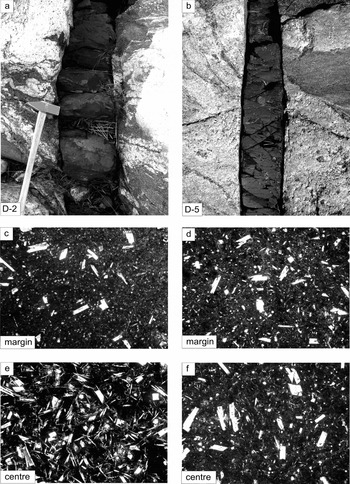
Small dolerite dykes D-2 and D-5 are exposed at a distance of about 500 m from each other along the northwestern shore of Kestiö Island (Fig. 1). They strike at 35°, cut mica gneisses of the Archaean basement and have a thickness across sampling profiles of about 7 and 21 cm, respectively (Fig. 2a, b). The dykes have sharp contacts with host mica gneisses and show no apparent field or petrographical evidence of in situ contamination by host rocks. The dykes appear to be simple bodies, since both field and laboratory petrographical studies revealed no internal boundaries such as chilling zones or comb layers (e.g. Platten & Watterson, Reference Platten, Watterson, Halls and Fahrig1987; Platten, Reference Platten2000).
Field photographs of two small dolerite dykes D-2 (a, 21 cm thick) and D-5 (b, 7 cm thick) of the Åland–Åboland dyke swarm, which cuts Archaean basement mica gneisses (Kestiö Island, SW Finland). Also shown are photomicrographs of a margin (c) and an interior (e) of dyke D-2 and a margin (d) and an interior (f) of dyke D-5. Both dykes are characterized by the glassy to fine-grained groundmass with uniform distribution of plagioclase microphenocrysts, forming elongated tabular crystals and small round amygdales. Note that the larger abundance of plagioclase crystals in the centre of dyke D-2 compared to its margin results from the higher amount of in situ-grown acicular, skeletal and radial plagioclase grains, not from inward accumulation of plagioclase microphenocrysts. Long dimension of field of view is about 3.5 mm.

Macroscopically, both dykes are composed of aphanitic gabbroic rocks that do not contain any visible intratelluric phenocrystic phases (Fig. 2a, b). Microscopically, the small dykes are characterized by non-crystalline microporphyritic texture across their entire cross-section (Fig. 2c–f). Plagioclase is the only microphenocryst mineral set in groundmass glass which has fully devitrified. The plagioclase microphenocrysts occur as elongated tabular crystals (0.2–1.0 mm long), or more rarely as glomeroporphyritic clusters ranging in size from 0.5 to 1.5 mm. They are uniformly distributed across the small dykes (~7 vol.%) and reveal no preferred alignment with respect to their contacts. The larger dyke D-2 becomes somewhat more crystalline towards its centre, where tabular plagioclase microphenocrysts are joined by 5 to 10 vol.% of acicular, skeletal and radial plagioclase grains of smaller size (0.1–0.2 mm) that apparently grew in situ (Fig. 2e). This new generation of plagioclase crystals is not developed in the interior of dyke D-5 (Fig. 2f). Microprobe compositions of the cores of the plagioclase microphenocrysts across the dykes vary unsystematically between An50 and An60, although it is possible that some systematic internal variations may be present but are masked by large variations in the composition of plagioclase grains within a single thin-section. Clear reverse zoning, confined to the narrow outer margins (~20 μm) of the plagioclase grains, is common for the entire cross-section of the small dykes. The observed range in composition of plagioclase microphenocrysts is close to that of the bulk normative An contents (~48 to 62%).
Small round amygdales filled with quartz and/or calcite and often surrounded by a rim of biotite and amphibole are common (Fig. 2c–f). The amygdales are about 0.1–0.2 mm in diameter and show some increase in size towards the centre of dykes. They tend to be evenly distributed across the dyke sections (~8–10 vol.%) although locally may increase up to 15 vol.%. About 1 vol.% of sub- to anhedral magnetite grains (0.1–0.2 mm) invariably occur in the groundmass. Wedge-shaped crystals of sphene, <0.1 mm in size, are also present in the groundmass, especially near the margins of dykes. The cores of sphene crystals are commonly altered into leucoxene. Although very fine-grained aggregates of biotite, amphibole and chlorite occur as alteration products after devitrified glass in most samples, these minerals are almost never in contact with plagioclase phenocrysts. The margins of plagioclase crystals are locally sericitized.
5. Compositional variations across dykes
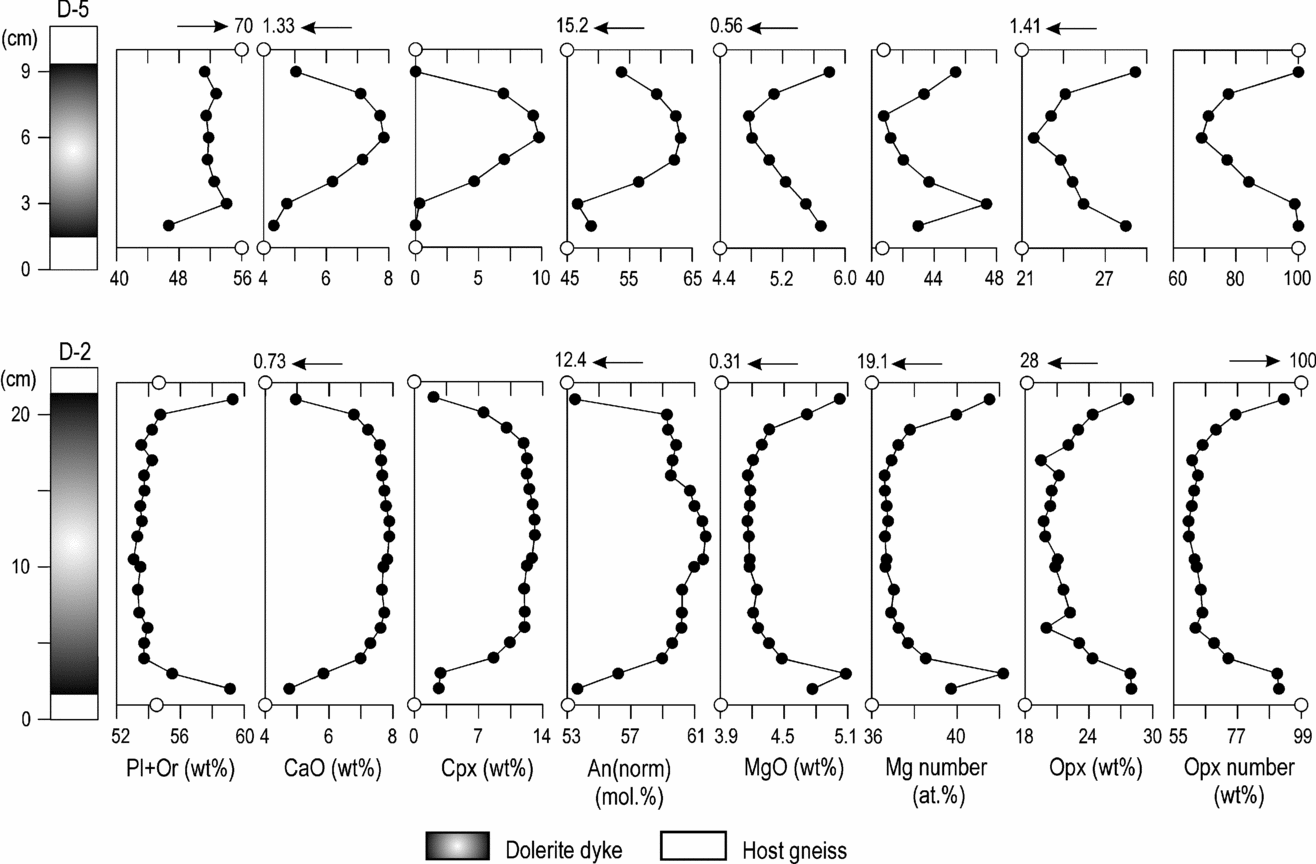
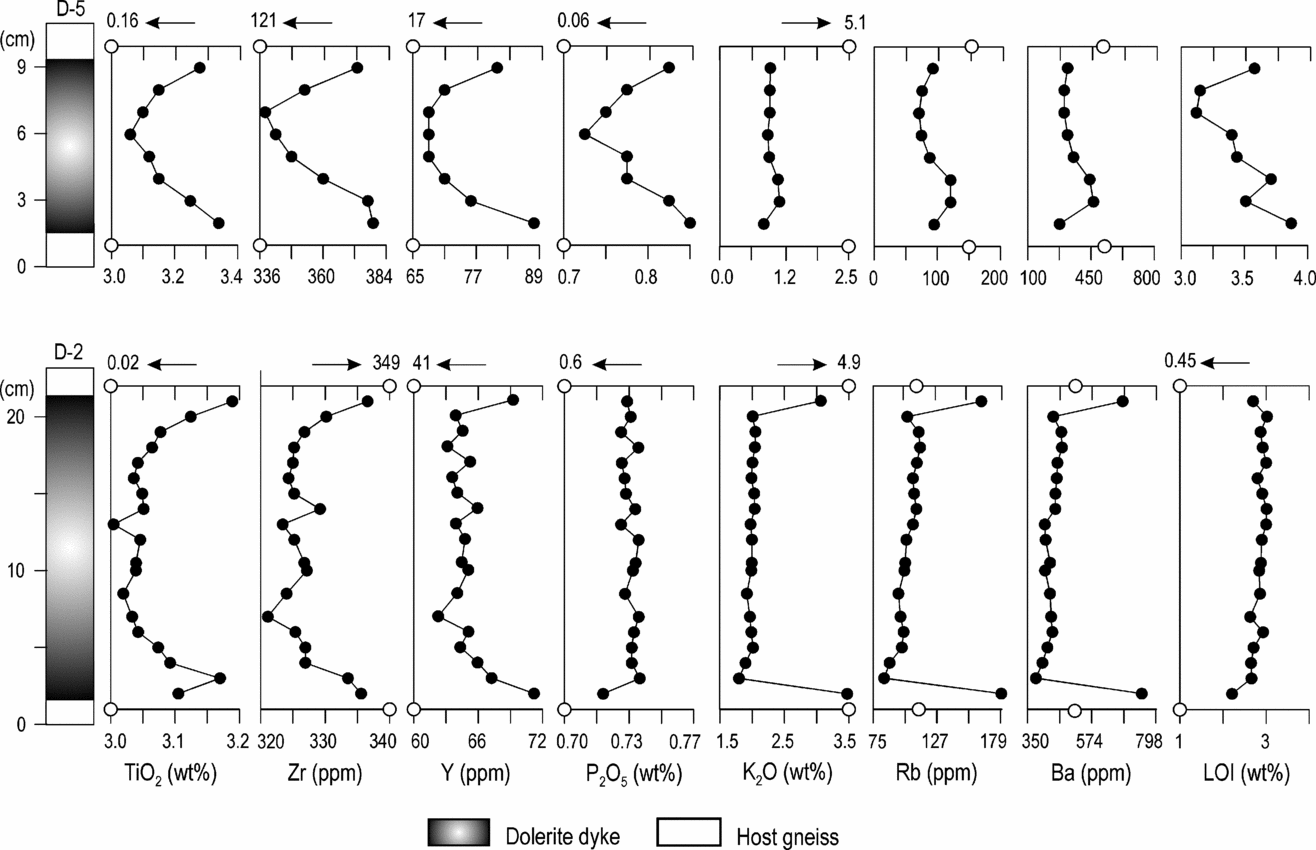
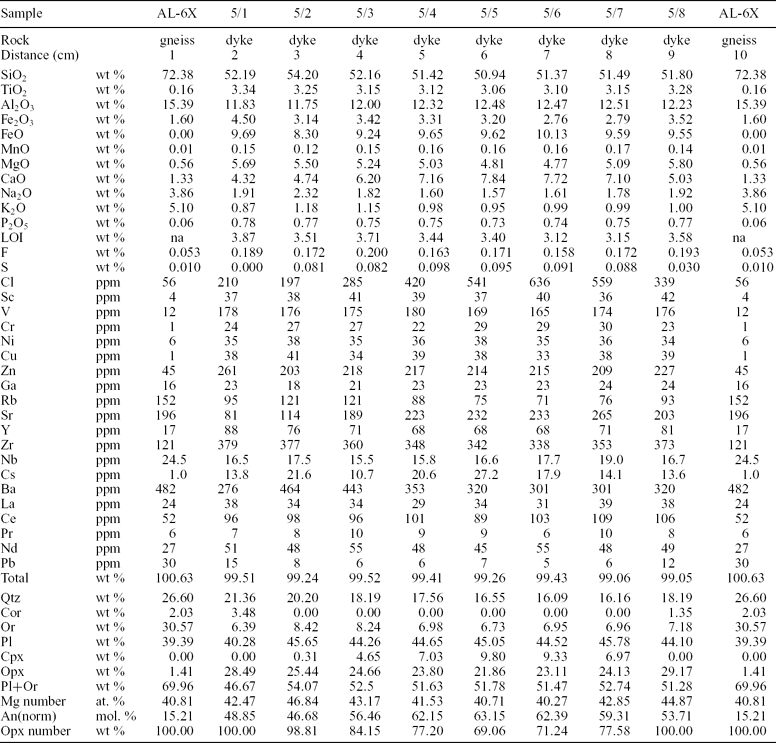
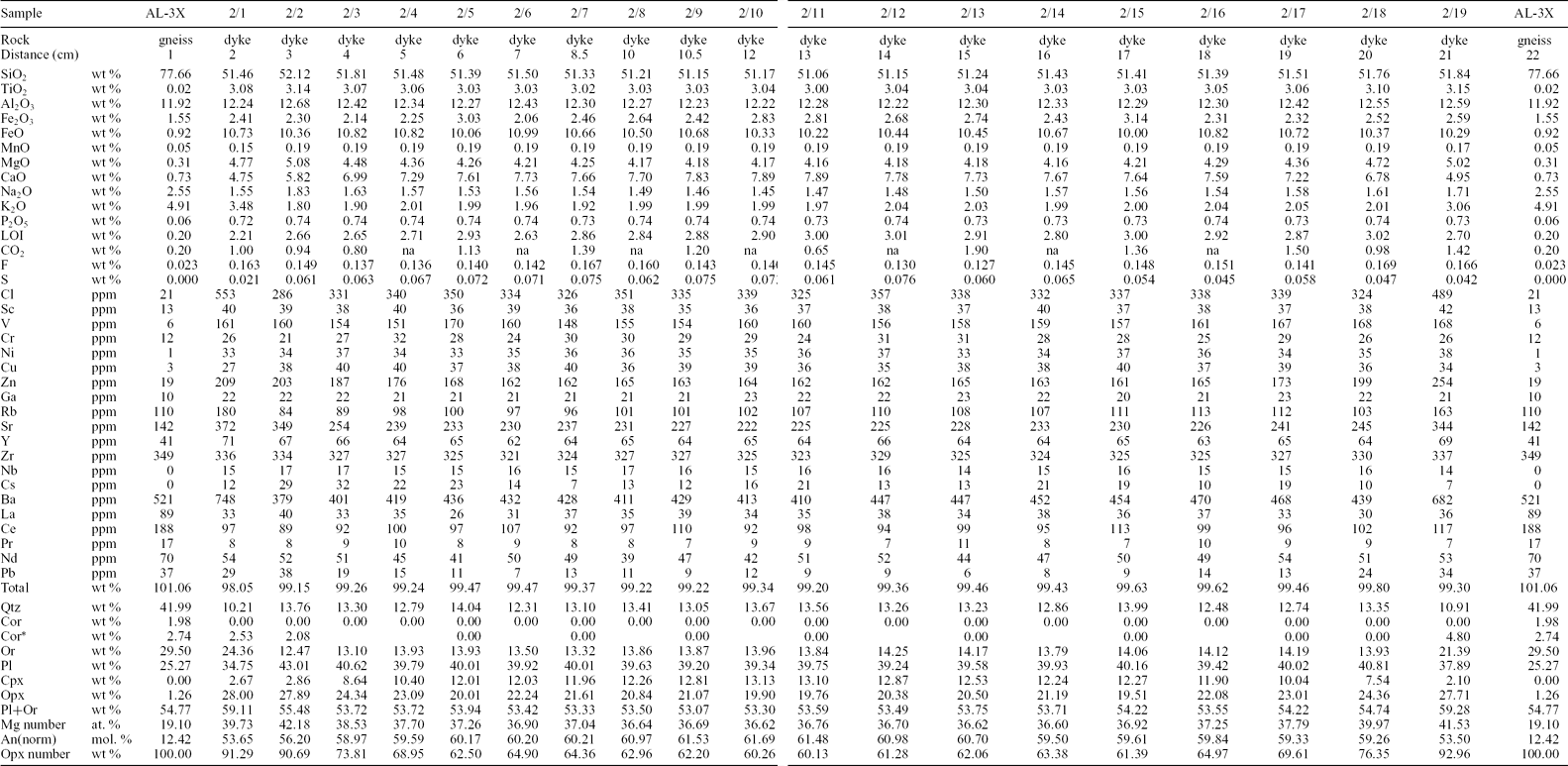
Contrary to common expectations, given the relatively rapid cooling rates assumed for such narrow dykes, systematic whole-rock variations in major and trace elements, as well as in some petrochemical parameters, are found across both dolerite dykes (Figs 3, 4). The dykes exhibit a steady inward decrease in whole-rock MgO, Mg number (100Mg/(Mg+Fetotal)), normative Opx and the pyroxene ratio Opx number (100Opx/(Opx+Cpx)), an increase in CaO, normative Cpx and An (100An/(An+Ab)) and a decrease in such components as Zr, Y, TiO2 and P2O5 (apart from dyke D-2). It is also notable that the extent of internal differentiation is much more pronounced in dyke D-5, despite it being about three times smaller than dyke D-2. Dyke D-5, for instance, reveals two to three times larger centre-to-margin differences in Zr and TiO2 than dyke D-2 (Fig. 4). In addition, despite being so different in thickness, both dykes show comparable centre-to-margin compositional variations in terms of MgO, Mg number and normative An (Fig. 3). It should be noted that the extent of the observed internal differentiation is quite high for such small dykes. For instance, in dyke D-5 the centre-to-margin difference in CaO, MgO, Zr, Mg number and An(norm), is about 4 wt%, 1 wt%, 40 ppm, 7 at.% and 15 mol.%, respectively, for only a 3.5 cm thick interval (Fig. 3). One more notable feature is the appearance of normative corundum in the marginal zones of the dykes (Tables 1, 2).
Compositional variations across two small dolerite dykes (D-2 and D-5) of the Åland–Åboland dyke swarm (Kestiö Island, SW Finland). Note that in terms of some geochemical indices (e.g. whole-rock MgO, Mg number, Opx and Opx number), the dykes are normally zoned, whereas in terms of others (e.g. An(norm)) they are reversely zoned. It is also important that the sum of normative plagioclase and orthoclase shows little variation across both dykes (apart from marginal samples), confirming the petrographical observations that plagioclase microphenocrysts (see Fig. 2) are uniformly distributed across the dykes. Distance is shown from northwestern contact of dykes. Compositional points of host gneisses are indicated by open circles on horizontal axes. Mg number=100Mg/(Mg+Fetotal); An(norm)=100An/(An+Ab); Opx number=100Opx/(Opx+Cpx). See text for further discussion.

Compositional variations across two small dolerite dykes (D-2 and D-5) of the Åland–Åboland dyke swarm (Kestiö Island, SW Finland). Note that in terms of incompatible Zr, Y, TiO2 and P2O5 (apart from dyke D-2), the dykes are reversely zoned. Only two marginal samples in direct contact with country rocks of dyke D-2 reveal in situ contamination in terms of K2O, Rb and Ba. In contrast, marginal rocks of dyke D-5 are lacking any signs of in situ contamination in terms of these components. The extent of post-magmatic alteration, as implied by variations in loss on ignition (LOI), does not correlate with the observed compositional trends, suggesting that the internal zonation is of primary magmatic origin. Distance is shown from northwestern contact of dykes. Compositional points for host gneisses are indicated by open circles on horizontal axes. See text for further discussion.

Major, trace and CIPW normative compositions for rocks from dyke D-5 (7 cm thick)

Distance is shown from northwestern contact. Mg number = 100Mg/(Mg+Fetotal), An(norm) = 100An/(An+Ab), Opx number = 100Opx/(Opx+Cpx). Pl – plagioclase, Or – orthoclase, Qtz – quartz, Cor – corundum, Cpx – clinopyroxene, Opx – orthopyroxene, LOI – loss on ignition, na – not analysed.
Major, trace and CIPW normative compositions for rocks from dyke D-2 (21 cm thick)

Distance is shown from northwestern contact. Mg number = 100Mg/(Mg+Fetotal), An(norm) = 100An/(An+Ab), Opx number = 100Opx/(Opx+Cpx), Pl – plagioclase, Or – orthoclase, Qtz – quartz, Cpx – clinopyroxene, Opx – orthopyroxene, Cor – normative corundum calculated without CO2,*Cor – normative corundum calculated with involvement of CO2, LOI – loss on ignition, na – not analysed.
Three other points related to the compositional zonation of dykes are noteworthy. Firstly, cross-sectional distribution of major and trace elements in dyke D-2 reveals in situ contamination of only the two marginal samples in direct contact with country rocks. Even for these two samples the contamination is selective, since it is only evident from enrichment in K2O, Rb and Ba, apparently indicating an involvement of an orthoclase-rich re-melted material of host gneisses. In contrast, marginal rocks of dyke D-5 are notably lacking any signs of in situ contamination in terms of the mentioned components. In terms of all other elements, both dykes, including the two mentioned samples, appear not to be contaminated in situ. This is clear, for instance, in the way that MgO (Fig. 3) and TiO2 (Fig. 4) exhibit a steady increase towards the dyke margins, despite the fact that the country rocks are depleted in these components. Thus, in situ contamination of dykes by host gneisses, if present at all, is very selective and spatially limited to thin marginal portions, less than ~0.5–1 cm thick, of the small dykes; it therefore cannot be a factor responsi-ble for the origin of internal zonation of the dykes.
Secondly, apart from the marginal contaminated samples in dyke D-2, and one other anomalous sample in dyke D-5, the sum of normative plagioclase and orthoclase shows little variation across both dykes, confirming the petrographical observations that plagioclase microphenocrysts are uniformly distributed across the dykes. Closer inspection indicates that the sum of normative plagioclase and orthoclase in both dykes actually tends to decrease slightly inwards. In dyke D-2, this tendency is additionally emphasized by a slight inward decrease in Sr (Table 2) that is commonly taken as a proxy of plagioclase. These observations indicate that plagioclase microphenocrysts did not accumulate towards the centre of the dykes upon magma emplacement (flow differentiation). The reader should not be misled by the fact that the centre of dyke D-2 (Fig. 2e) visually contains a higher amount of plagioclase crystals compared to its margins (Fig. 2c). This apparently results from an in situ growth of acicular and skeletal plagioclase grains in the interior of this dyke, rather than from flow-induced redistribution of plagioclase microphenocrysts towards the centre. Also, quartz–calcite amygdales do not reveal any preferred concentrations within the dykes, as follows from petrographical observations and unsystematic variations in CO2 in the dyke D-2 (Table 2), taken as rough proxy of amygdale abundances. Taken together, this indicates that distribution of both plagioclase phenocrysts and amygdales also plays no role in the origin of systematic compositional trends within the dykes (Figs 3, 4).
Thirdly, the extent of post-magmatic alteration, as implied by variations in loss on ignition (LOI), does not correlate with the observed compositional trends. Both dykes show well-developed compositional profiles directed from the margins inwards. In contrast, loss on ignition in dyke D-5 tends to decrease fairly systematically from one margin to another (apart from one marginal point), and in dyke D-2 it is almost constant throughout the entire section (Fig. 4). One can still speculate that a compositional zonation may be somehow related to post-magmatic alteration of rocks in the view of their rather high LOI (up to 3–4 wt%). The key argument against this speculation is our preliminary data on dolerite dykes of the Åland–Åboland dyke swarm from Torsholma Island, located about 13 km NW of the study area. These dykes are characterized by quite low LOI (0.5–1.0 wt%), but reveal an internal zonation with similar compositional features (Chistyakova & Latypov, unpub. data). Together with the uncontaminated nature of dykes and their surprisingly systematic compositional trends, this implies that the observed internal zonation can be safely regarded as of primary magmatic origin, not related to post-magmatic modification of rocks.
6. Discussion
One of the key findings of this study is that small dolerite dykes that appear to be macro- and microscopically homogeneous may possess a conspicuous compositional zonation. In this study the smallest zoned dyke was about 7 cm thick, but this does not represent a lower limit. Preliminary data on dolerite dykes of the Åland–Åboland dyke swarm from Torsholma Island show similar compositional zonation in dykes as narrow as 2–3 cm (Chistyakova & Latypov, unpub. data). It appears that mafic dykes can be well differentiated irrespective of their thickness. Another unexpected observation is that the smaller dyke (D-5; 7 cm thick) reveals more significant and conspicuous compositional zonation than the larger dyke (D-2; 21 cm thick). The increased zoning in the thinnest dykes is also characteristic of small dolerite dykes from Torsholma Island. Of even greater surprise is the character of the compositional zonation. On the one hand, it exhibits a steady inward decrease in whole-rock MgO, Mg number (100Mg/(Mg+Fetotal)) and normative Opx, which are commonly considered to indicate fractionation of basaltic magma along a normal trend, as predicted by liquidus phase equilibria. On the other hand, it displays a pronounced increase in normative An (100An/(An+Ab)), which is commonly taken as evidence for fractionation of basaltic magma along a reverse trend, opposite to that expected from liquidus phase equilibria.
Interpretation of components such as Zr, Y, TiO2 and P2O5 in terms of fractionation trends is not very straightforward. These components may increase or decrease during fractional crystallization of basaltic magma, depending on whether the magma is saturated in primary liquidus phases such as ilmenite (fractionating TiO2 and Zr) and apatite (fractionating P2O5 and Y). Considering the rather evolved composition of the parental magma of the dykes (Mg no. ~ 40 at.%, TiO2 ~ 3.0 wt% and P2O5 ~ 0.75 wt%), the possibility of having ilmenite and apatite on the liquidus should therefore be considered. Both natural observations (Delong & Chatelain, Reference Delong and Chatelain1990; Helz, Reference Helz and Mysen1987) and experimental studies (Tolpis & Carroll, Reference Toplis and Carroll1995; Vander Auwera & Longhi, Reference Vander Auwera and Longhi1994; Vander Auwera, Longhi & Duchesne, Reference Vander Auwera, Longhi and Duchesne1998) indicate that ilmenite saturation occurs at 3.5–5 wt% TiO2 in evolved basaltic liquids. Similarly, natural observations (Wager, Reference Wager1960; McBirney & Nakamura, Reference McBirney and Nakamura1973; McBirney & Naslund, Reference McBirney and Naslund1990) and experimental studies (Toplis, Libourel & Carroll, Reference Toplis, Libourel and Carroll1994) show that such evolved liquids become saturated in apatite at about 1.30–1.75 wt% P2O5. Both of these values are substantially higher than the amounts of TiO2 and P2O5 in the dolerite dykes, suggesting that their parental magmas are unlikely to have been saturated in these phases. In addition, modelling of equilibrium crystallization of the bulk compositions of dykes using COMAGMAT (Ariskin et al. Reference Ariskin, Barmina, Frenkel and Nielsen1993) confirms that the liquids were not saturated in ilmenite (and magnetite). This indicates that Zr, Y, TiO2 and P2O5 must have behaved incompatibly in the parental magma of the dykes, and their inward compositional trends can therefore be interpreted as reverse fractionations trends.
Of special interest is a dramatic margin-to-centre increase in whole-rock CaO that provides an essential inward increase in normative An and Cpx. Following interpretation of normative An, it seems logical to attribute the inward increases in CaO and Cpx to reverse fractionation trends. Closely related to this issue is the appearance of normative corundum in marginal rocks. This is interesting since corundum-normative rocks are commonly attributed to contamination of basaltic magma by crustal rocks. Such an explanation is not applicable here, however, because the thinner dyke (D-5) shows no signs of in situ contamination. Close inspection of the rock geochemistry indicates that normative corundum appears in the marginal rocks because of their significant depletion in whole-rock CaO, a component that is responsible for internal zonation of the dykes in several important normative parameters (e.g. An, Cpx, Opx number). It follows that the appearance of normative corundum in the marginal rocks of dykes must be a primary magmatic feature. We are, however, not certain if such behaviour of normative corundum should be assigned to normal or reverse differentiation trends of basaltic magma.
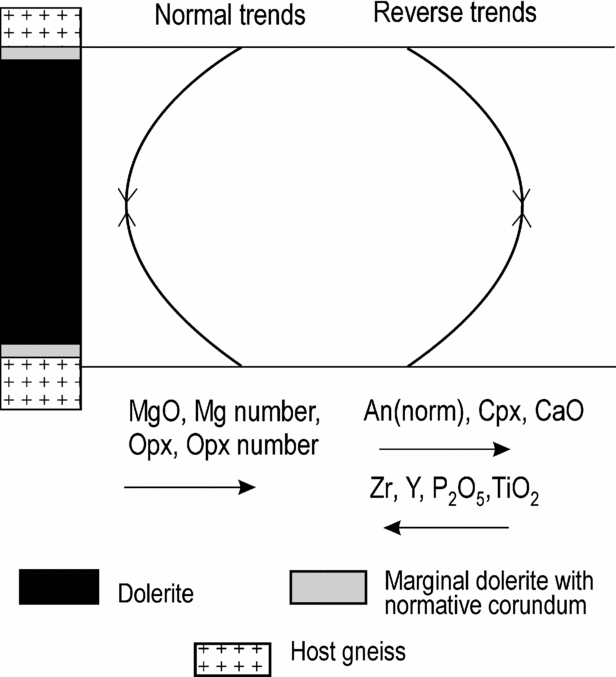
Thus, the compositional zonation of dolerite dykes appears to be anomalous, in that it is normal for some geochemical indices (e.g. whole-rock MgO, Mg number, normative Opx, Opx number) but reverse in terms of others (e.g. An(norm), CaO, normative Cpx, Zr, Y, TiO2, P2O5) (Figs 3, 4). To the best of our knowledge, compositional zonation with such anomalous fractionation trends (Fig. 5) has not been reported previously from mafic dykes or larger mafic–ultramafic intrusions.
Generalized compositional profiles across small dolerite dykes of the Åland–Åboland dyke swarm (Kestiö Island, SW Finland), highlighting the main features of their internal zonation: normal fractionation trends in terms of whole-rock MgO, Mg number, normative Opx, Opx number and reverse fractionation trends in terms of normative An and Cpx and whole-rock CaO, Zr, Y, P2O5 and TiO2. Also indicated is the occurrence of normative corundum in marginal rocks of dykes. Mg number =100Mg/(Mg+Fetotal); An(norm) = 100An/(An+Ab); Opx number=100Opx/(Opx +Cpx).

What primary magmatic process(es) were responsible for the origin of internal differentiation in these narrow dolerite dykes? Magmatic differentiation processes can be roughly subdivided into two major groups: liquid or crystal–liquid processes. The almost glassy nature of the small dykes precludes the origin of their compositional trends by any in situ liquid–crystal processes involving separation of liquid from solid or solid from liquid. These processes include fractional crystallization involving classical crystal settling (e.g. Wager & Brown, Reference Wager and Brown1968) or in situ crystallization (e.g. Campbell, Reference Campbell1978; McBirney & Noyes, Reference McBirney and Noyes1979), infiltration metasomatism (e.g. Irvine, Reference Irvine and Hargraves1980), magma supercooling (e.g. Miller & Ripley, Reference Miller, Ripley and Cawthorn1996), reaction of cumulus minerals with a varying amount of intercumulus melt (e.g. Raedeke & McCallum, Reference Raedeke and McCallum1984) and shrinkage-induced redistribution of intercumulus melt (e.g. Cherepanov, Sharapov & Krivenko, Reference Cherepanov, Sharapov and Krivenko1982, Reference Cherepanov, Sharapov and Krivenko1983; Petersen, Reference Petersen and Parsons1987). The uniform distribution of plagioclase microphenocrysts across the small dykes suggests that mechanical redistribution of phenocrysts in the intruding magma, or flow differentiation (e.g. Gibb, Reference Gibb1968), was also not operative.
Among liquid-state mechanisms we can readily dismiss such processes as crystallization from compositionally stratified magma (e.g. Wilson & Engell-Sørensen, Reference Wilson and Engell-Sørensen1986) and in situ contamination of intruding magma by host gneisses (e.g. Philpotts & Asher, Reference Philpotts and Asher1993). This is because the former process can only be physically operative in large intrusions and the latter is not consistent with the nature of zoning trends of most major and trace elements across the dykes, as discussed above. We are thus left with two alternative options to produce the observed zonation: (a) some liquid state differentiation process, such as the Soret effect, directly at the present location of the dykes, or (b) filling of the dykes with magma that was continuously changing its composition upon emplacement. Each variant has its own merits and demerits.
The first variant is attractive simply because it seems much easier to form compositional zonation in situ rather than to produce it somewhere in a deeper magmatic reservoir and then transfer it intact (without mixing) upwards into subsurface dykes. There are, however, two serious obstacles. The Soret effect, or thermal diffusion, implies diffusive redistribution of chemical species in a liquid subjected to a temperature gradient. However, thermal diffusion has long been known to be a rather slow process (e.g. Bowen, Reference Bowen1928), and the rapid solidification of 7–21 cm thick dykes (less than one hour: Delaney, Reference Delaney, Halls and Fahrig1987) will therefore make liquid differentiation by this process unlikely. An even more serious obstacle is that chemical patterns produced in laboratory experiments with silicate liquids (Walker & Delong, Reference Walker and Delong1982; Lesher & Walker, Reference Lesher, Walker and Ganguly1991) are not compatible with the compositional features of the dykes. In particular, for the liquid differentiation in dykes, experiments predict a compositional profile with increasing whole-rock Mg number and decreasing An(norm) from the margins inwards; the opposite is observed in the dykes (Fig. 3). The recent theoretical suggestion that thermal diffusion may work differently in near-liquidus magmas (Latypov, Reference Latypov2003) is also not consistent with the chemical pattern of the dykes, since it predicts an increase, from the margins inwards, of both Mg number and An(norm).
The major advantage of the second variant is that it gives a straightforward answer as to how compositional zonation may have originated directly at the present position of dykes. This variant is also problematical, however, for two reasons. There are several mechanisms that can result in the filling of a dyke with magma that progressively changes its composition with time, but all these processes (e.g. fractionation in feeder channels, changes in degree of contamination, tapping of zoned magma chamber) would appear to produce magma that becomes increasingly primitive with time. The compositional trends of the small dykes do not fit into any one simple model because of the decoupling between variations in MgO, Mg number and Opx and those in the An(norm) and incompatible elements. The suggestion that compositional zonation of the dykes results from changes in composition of inflowing magma is only a partial solution to the problem. This is because we are still unable to infer what specific process in a feeder channel/staging chamber could have been responsible for the observed changes in magma composition. Another problem is the remote likelihood of filling small dykes with magma that is changing its composition in such a remarkably systematic way. It is difficult to imagine how magma may have travelled hundreds of metres or so from a deep crustal reservoir towards subsurface dykes of several centimetres thickness without complete mixing of compositionally distinct portions of liquid. During this study we did come across one small dolerite dyke which is undifferentiated, despite being texturally and mineralogically similar to those described here. It is tempting to speculate that, unlike its differentiated counterparts, this dyke may have formed from a homogeneous portion of magma that resulted from complete magma mixing on its way to the present position of the dyke.
To sum up, despite the shortcomings mentioned above, we make a choice in favour of the last idea, namely that the compositional zonation in the dykes records temporal changes in magma compositions derived from a deep magma reservoir. A process responsible for the anomalous changes in magma composition (notable by decoupling between variations in MgO, Mg number and Opx and those in the An(norm) and incompatible elements) remains unresolved, however. This is primarily because all known physico-chemical processes cause magma to follow either normal or reverse fractionation trends, but never both simultaneously. It should be mentioned in conclusion that that we do not completely close the door to an alternative option of forming this zonation by some in situ liquid-state process, such as thermal diffusion. This idea must await experimental evaluation. All available experiments on thermal diffusion have so far been conducted in highly superheated and anhydrous liquids under closed system conditions that are far from those under which natural magmas commonly crystallize in crustal chambers (Latypov, Reference Latypov2003). It is therefore not inconceivable that, under natural conditions, thermal diffusion in silicate melts may behave differently. It is possible that further experiments on thermal diffusion may open a new way to interpret compositional profiles by in situ liquid-state processes (Latypov, Reference Latypov2003).
7. Conclusions
Major results of this study can be summarized as follows:
(1) Several dolerite dykes of a few centimetres thickness from the Åland–Åboland dyke swarm (Kestiö Island) display remarkable compositional zonation that is not expected for superficially homogeneous dykes of such small thickness. It is conceivable that such zonation may be a quite common feature for small mafic dykes worldwide. It would be interesting to explore if such zonation also occurs in small dykes of other compositions (e.g. granitic, alkaline).
(2) Contrary to common expectations, the extent of internal differentiation of the thinner dyke (7 cm) is more significant than that of the thicker dyke (21 cm). In particular, in terms of incompatible Zr and TiO2, the extent of centre-to-margin differentiation of the thinner dyke is two to three times greater than that of the thicker dyke. The same tendency appears to be characteristic of small dolerite dykes from other parts of the Åland–Åboland dyke swarm (e.g. Torsholma Island). The extent of internal differentiation of the thinner dyke in terms of some petrochemical parameters is very high (e.g. 15 mol.% of An(norm)).
(3) The compositional zonation is anomalous since it is normal in terms of some geochemical indices (e.g. whole-rock MgO, Mg number, normative Opx and Opx number) but reverse in terms of others (e.g. An(norm), CaO, normative Cpx, Zr, Y, TiO2 and P2O5). In addition, marginal rocks of dykes contain normative corundum that is apparently associated with significant depletion of these rocks in whole-rock CaO. Compositional zonation with such anomalous fractionation trends does not appear to have been previously reported from dykes or other mafic–ultramafic intrusions.
(4) The almost glassy nature of the small dykes strongly suggests that a liquid-state process must be responsible for the origin of the compositional zonation. The most likely mechanism appears to be the filling of dykes with magma that was continuously changing its composition with time. The small dykes thus record temporal changes in composition of magma supplied into the dykes from some deep magma reservoir.
(5) It remains, however, unresolved as to what process in this reservoir is responsible for the changes in magma composition in such an anomalous way, since all known physico-chemical processes cause magma to follow either normal or reverse fractionation trends, but never both simultaneously. The compositional zonation in these small dykes is thus clear evidence for some effective, but not yet specified process of magma differentiation operating in crustal magma chambers.
The data obtained for the small dolerite dykes of the Åland–Åboland dyke swarm thus present a strong challenge for experimentalists/igneous petrologists to decipher the nature of some not yet specified process of magma differentiation. Our failure to identify this magmatic process can be taken as one more piece of evidence that something fundamentally important is currently missing in our understanding of magma differentiation processes (Latypov, Chistyakova & Alapieti, Reference Latypov, Chistyakova and Alapieti2007). Clearly, if we do not understand what is happening in mafic dykes that are a few centimetres thick, we can hardly make progress in the study of much larger intrusive bodies that are up to several kilometres in thickness.
Acknowledgements
We are particularly grateful to Richard Wilson and Steve Prevec for useful suggestions and encouraging comments on the paper as well as editing that led to significant improvement in the wording of earlier versions of the text. The work essentially benefited from discussion of its various aspects with Alexey Ariskin, Evgenii Pushkarev, Michail Dubrovskii, Arto Luttinen, Olav Eklund, Alan Boudreau and Tony Morse. We thank Alexey Shebanov and Olav Eklund for the good advice to choose the Kestiö Island of the Åland–Åboland dyke swarm as the study area. We are indebted to J. C. Duchesne and an anonymous reviewer for their helpful comments and suggestions, which contributed to improving the manuscript. Editorial input by David Pyle is highly acknowledged. Vitali Reif and Zdravka Veleva are greatly thanked for assistance with fieldwork. The research was supported by grants from the Finnish Academy of Science and the Renlund Foundation, Finland.