Introduction
In the U.S.A. social services for older adults who reside in the community are provided by thousands of agencies to millions of elderly clients and many of their informal caregivers annually. Referred to here as the Aging Services Provider Network (ASPN), this mix of agencies aims to deliver non-medical services to community-dwelling older adults for the purpose of maintaining or enhancing their independence, well-being, and quality of life. Non-medical services include those traditionally funded through the Older Americans Act (OAA) (O'Shaughnessy, Reference O'Shaughnessy2008), the Area Agencies on Aging and their affiliated providers, as well as local departments of human services. Older adults can access aging services through self-referral or be referred by informal (e.g. family members, caregivers) or formal providers (e.g. primary care physicians) to receive assistance. Available services include – but are not limited to – information and referral, advocacy, transportation, congregate or home-delivered meals, and care management.
ASPN clients can be complex as many suffer from a combination of social, psychiatric, and medical issues. Functional impairment and medical illness are highly prevalent among older adults receiving case management, with 47% and 79% of them having at least one activity of daily living and instrumental activity of daily living impairment, respectively (Quijano et al., Reference Quijano2007); social services (e.g. transportation, meals assistance) frequently strive to ameliorate such impairments. Furthermore, due to the association of late-life anxiety and depression with many psychosocial and medical stressors (Vink et al., Reference Vink, Aartsen and Schoevers2008), we would expect clients to have elevated levels of emotional distress as well. Indeed, evidence indicates that prevalence of mental illness among ASPN clients is high. In a sample of homebound older adults receiving home-based aging services, 11.7% and 11.9% met criteria for an anxiety or depressive disorder, respectively (Gum et al., Reference Gum, Petkus, McDougal, Present, King-Kallimanis and Schonfeld2009), and 52% of older adults receiving case management services in the U.S.A. screened positive for depression symptoms (Quijano et al., Reference Quijano2007). The Kent Community Care Project, a U.K. social services demonstration program that included case management for elderly persons receiving home care, reported that 49% of their community care (intervention) group had depressed mood. Depressed mood was defined as having moderate or severe mood disturbance using Hamilton's 1960 criteria or having a depressive disorder under treatment. Nearly all (87%) of these depressed people exhibited “an evident degree of anxiety” (Davies and Challis, Reference Davies and Challis1986).
Prospective studies have shown that the majority of community-dwelling older adults with depression or an anxiety disorder at baseline continued to suffer from depression or anxiety symptoms up to six years later (Beekman et al., Reference Beekman2002; Schuurmans et al., Reference Schuurmans2005), the consequences of which can be severe. Late-life depression is also associated with increased healthcare utilization and expenditures (Luppa et al., Reference Luppa, Heinrich, Angermeyer, Konig and Riedel-Heller2008), and anxiety and depression result in large financial burdens to the individual as well as to society (Greenberg et al., Reference Greenberg1999; Reference Greenberg2003). Only a minority of depressed patients, however, receive adequate depression treatment (Unützer et al., Reference Unützer, Simon, Belin, Datt, Katon and Patrick2000; Wang et al., Reference Wang, Lane, Olfson, Pincus, Wells and Kessler2005), and anxiety is also inadequately identified (Kessler et al., Reference Kessler, Lloyd, Lewis and Gray1999) and insufficiently treated (Wang et al., Reference Wang, Lane, Olfson, Pincus, Wells and Kessler2005) in primary care settings.
Anxiety and depression are likely to be under-recognized and poorly treated among clients of aging services providers as well. While there has been movement towards integrating primary care and social services providers in the U.K. (Rummery and Coleman, Reference Rummery and Coleman2003), social and health services are poorly integrated in the U.S.A. Yet social service providers have the expertise to address social and environmental stressors that may partly underlie healthcare utilization and outcomes. Therefore, understanding the contribution that the aging services sector makes to the health and well-being of older adults who seek its services is important. For example, characterizing how community-dwelling older adults seeking help from ASPN agencies engage the healthcare system may aid in identifying targets for future partnerships and interventions. The health services utilization patterns of clients with and without mental distress receiving in-home social work care management assessments have yet to be examined.
Our analytic objectives are to: (1) characterize healthcare and human services utilization among community-dwelling older adults receiving an in-home care management assessment; (2) examine the association between anxiety and/or depression (referred to here as “distress”) and frequency of service utilization and, among those who used services, the amount of utilization; and (3) estimate the proportion of distressed elders who have received mental health treatment, discussed mental health issues with healthcare professionals in the past year, and/or were currently taking a prescribed psychotropic medication. More specifically, we hypothesize that: (1) most of this help-seeking older adult population is utilizing healthcare and human services; (2) being distressed is associated with greater likelihood of using healthcare and human services than being not distressed, as well as with greater amount of use among those who utilize services; and (3) the majority of distressed ASPN clients has not received mental healthcare from a medical professional or mental health specialist for their mental illness.
Methods
Setting and participants
Eldersource is an aging services agency that provides assistance to older adults and their informal care providers in Monroe County (Rochester and environs), New York. In addition to serving as the single point of access for aging services in the county, its staff address a wide range of needs, from providing information and referral for aging-related issues to ongoing care management for homebound seniors. The majority of clients has issues related to functional disability, finances, housing, and/or legal problems. The agency does not provide home healthcare, although referral to a home healthcare agency may be one outcome of the care management assessment. Clients need not be disabled to access Eldersource services, although functional impairments are the norm. Eldersource is supported by OAA funds administered through government contracts, the United Way, and, to a smaller extent, other philanthropies, grants, and contracts. The care management service is without cost to clients, although donations are encouraged in accordance with OAA guidelines.
From September 2005 to August 2007 Eldersource clients who received an in-home care management assessment were invited to participate in the study presented here. For study inclusion, clients had to be aged 60 years or older, English-speaking, and have capacity to provide informed consent. During the initial assessment Eldersource care managers introduced the study and referred interested clients to study personnel for an in-home research interview. The University of Rochester Human Subjects Review Board approved the study.
During the study period care managers conducted intake assessments on 1,090 clients, of which 643 (59.0%) were referred to study personnel. Some clients were not referred because during their initial in-home assessments they indicated no further interest in Eldersource services and care managers chose not to pursue the research option. Others were not referred to the research team due to fluctuations in agency resources during the course of the study thereby causing variable referral rates. For example, turnover in care management staff resulted in larger caseloads for remaining staffers and a lag in the rate of referrals. At other times, when staffing was full and agency leadership encouraged active participation of care managers in the research agenda, referrals surged. Of the 643 referred clients, study personnel did not attempt to call 63 clients because study resources could not keep pace with care management referrals. We were unable to reach 47 clients and 24 had moved, died, or were ineligible based on language or age criteria. Of the remaining 509 eligible subjects, 131 (25.7%) declined participation and 378 provided written informed consent and enrolled in the study. One participant did not have information on anxiety or depression and was not included in the following analyses, yielding a final sample of 377. Analyses of Eldersource administrative data did not show any statistically significant differences in age, gender, income, marital status, and race between study participants and non-participants.
Measures
Anxiety
We used a nine-item, yes/no instrument, the Goldberg Anxiety Scale (GS-A) (Goldberg et al., Reference Goldberg, Bridges, Duncan-Jones and Grayson1988), to determine the presence of clinically relevant levels of anxiety in ASPN clients. Participants answered the first four questions; if two or more of these were positively endorsed, the remaining five questions were administered. Subjects responding “yes” to six or more of the nine questions were considered to have clinically significant anxiety. The GS-A has adequate psychometric properties with a sensitivity of 82% and specificity of 91% for detecting generalized anxiety disorder when applying a threshold score of 6 (Goldberg et al., Reference Goldberg, Bridges, Duncan-Jones and Grayson1988).
Depression
The Patient Health Questionnaire (PHQ-9) assessed depressive symptoms. The PHQ-9 is a nine-item scale with items scored from 0 (“not at all”) to 3 (“nearly everyday”); total scores range from 0 to 27, with a score of 10 or more considered to represent at least a moderate degree of depression severity (Kroenke et al., Reference Kroenke, Spitzer and Williams2001). A PHQ-9 score of 10 or more has a sensitivity and specificity of 88% for detecting major depression (Kroenke et al., Reference Kroenke, Spitzer and Williams2001).
Utilization
To examine healthcare and human services utilization we combined items from the Cornell Services Index (CSI), which evaluates the quantity and characteristics of health services use (Sirey et al., Reference Sirey2005), and a list of human and healthcare services used previously by Toseland and colleagues (e.g. senior center, legal services) (Toseland et al., Reference Toseland, McCallion, Gerber, Dawson, Gieryic and Guilamo-Ramos1999). Specifically, participants were asked if and/or how much they used each service listed in the modified CSI in the 90 days prior to the care manager's visit. The modified CSI characterized the utilization of 12 healthcare and 11 human services. Overall healthcare and human services scores represent the number of service types used and range from 0 to 12 and 0 to 11, respectively. We divided healthcare services into two broad categories. Mental health services consists of outpatient mental health visits, alcohol or substance abuse treatment, and inpatient mental health services. Medical services consists of outpatient (office visits, laboratory tests, X-rays, other tests), intensive medical (emergency room visits, visiting nurse, hospitalization, emergency response, nursing home use), and other health services (home health aide and physical, occupational, or speech therapy). Human services has four categories: in-home (homemaker, home meal delivery), community-based (senior center, adult day care), cognitive/supportive (church pastoral care, Alzheimer's Association), and other services (home energy assistance, financial assistance, transportation, legal assistance, other human services).
Mental health treatment
All participants were asked whether they: (1) had talked with a doctor or healthcare professional about depression, anxiety, or stress in the previous year; (2) were currently under the treatment of a mental health professional (i.e. psychiatrist, psychologist, therapist, mental health social worker) or had seen a mental health professional in the previous year; and (3) were currently taking a prescription medication for mental health problems such as depression, anxiety, or stress (i.e. psychotropic medication).
Other variables
Self-report data on age, gender, race, education, marital status, living arrangement, household income, number of chronic conditions, referral source, whether the subject had a primary care provider, and enrollment in Medicare or Medicaid (public insurance programs) were collected. The Six-Item Screener (SIS) is derived from the Mini-mental State Examination (Callahan et al., Reference Callahan, Unverzagt, Hui, Perkins and Hendrie2002) and was administered in the second half of this study to 236 participants (235 of whom had information on anxiety and depression). The SIS score ranges from 0 to 6 and a cutoff of 2 or more errors for a positive screen of cognitive impairment has a sensitivity and specificity of 74.2% and 80.2% in community samples (Callahan et al., Reference Callahan, Unverzagt, Hui, Perkins and Hendrie2002).
Data analysis
Subjects were dichotomized into mentally “distressed” (either a GS-A score of at least 6 or PHQ-9 score of at least 10 or both) and “non-distressed” (GS-A score less than 6 and PHQ-9 score less than 10) groups. Bivariate analyses characterized the sociodemographic and other characteristics of the two mental health groupings; differences between the two groups were examined using the Pearson χ2 test. Basic descriptive statistics characterized the overall level of healthcare and human services utilization in our sample. In addition to means, median values and interquartiles were reported due to non-normal data distribution. To test for differences between the distressed and non-distressed groups, we used the Wilcoxon Rank Sum test for non-normal data. With regard to the clients’ reported use of primary care physicians, mental health professionals, and prescription medication, we compared groups with Pearson χ2 statistics for each health characteristic variable. Poisson regressions were performed with the dependent variable being the total number of healthcare or human services used during the past 90 days for residents with healthcare or human services use, respectively; sample characteristics that varied by distress grouping with a p < 0.20 were included in the regression analyses. In all analyses a p-value of 0.05 or less indicated statistical significance. Data analyses were conducted with SAS statistical software version 9.2 (SAS Institute, Inc., Cary, NC).
Results
Sample characteristics
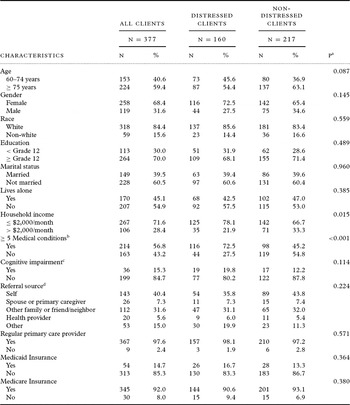
Table 1 lists the characteristics of the entire sample (n = 377) and the distressed (n = 160; 42.4%) and non-distressed (n = 217; 57.6%) subgroups. Participants had a mean age of 77.0 years (standard deviation = 9.1; range = 60–102), one-third were male, and about 15% were nonwhite. Nearly one-third had not graduated from high school, about 60% were unmarried, 45% lived alone, and about 70% had a household income less than or equal to $2,000 per month. Distressed and non-distressed subjects were similar with regard to age, gender, race, education, marital status, living arrangement, cognitive impairment status, referral source, having a regular primary care physician, and health insurance status. However, distressed clients were significantly more likely to have household income less than or equal to $2,000/month and had more medical illnesses.
Characteristics of mentally distressed and non-distressed aging services clients

Notes: Mentally distressed clients have either a Goldberg Anxiety score of at least 6 or a PHQ-9 score of at least 10; non-mentally distressed clients have a Goldberg Anxiety score less than 6 and a PHQ-9 score less than 10.
aP-value determined by Pearson χ2 test and compares the distressed and non-distressed groups.
bMedical conditions use the median value as the cut-point.
cWe have complete cognitive impairment information on 235 participants.
dTotal percentage for all clients does not sum to 100 because of rounding.
Healthcare and human services utilization
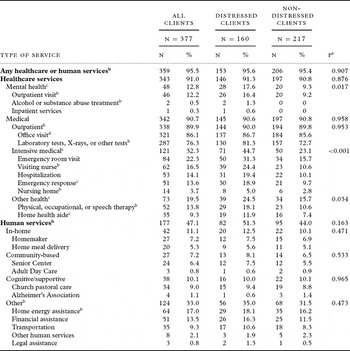
As depicted in Table 2, over 90% of Eldersource clients had utilized at least one healthcare service within the 90 days prior to care management assessment, most commonly outpatient clinic visits and diagnostic tests. More than 1 in 5 clients had made an emergency room visit, and 12.2–16.5% of agency clients were hospitalized or had used visiting nurses, emergency response services, outpatient mental health services, or physical, occupational, or speech therapy. However, while almost 98% of clients reported having a regular primary care provider, less than 6% of the sample was referred to Eldersource by their primary care provider; 80% either sought out services themselves or were referred by a family caregiver, friend, or neighbor (Table 1). Substance abuse treatment and inpatient mental health hospitalizations were uncommon.
Any healthcare and human services utilization in the 90 days prior to the in-home care management visit

Notes: Mentally distressed clients have either a Goldberg Anxiety score of at least 6 or a PHQ-9 score of at least 10; non-mentally distressed clients have a Goldberg Anxiety score less than 6 and a PHQ-9 score less than 10.
aP-value determined by Pearson χ2 test and compares the distressed and non-distressed groups.
Some clients have missing information. The number of missing clients is: b 1. c 2. d 4.
In contrast to their use of healthcare services, Eldersource clients accessed relatively few human services in the 90 days prior to their intake assessment by the agency; slightly over half had utilized none. Of the human services, clients most often used home energy and financial assistance (17.0% and 13.5%, respectively) in the previous 90 days (Table 2).
There were no differences between distressed and non-distressed clients in the proportion using any healthcare, medical, outpatient medical, human services, or sub-type of human services (Table 2). However, distressed clients were significantly more likely to utilize mental health (17.6% versus 9.3%; p = 0.017), intensive medical (44.7% versus 23.1%; p < 0.001), and other health (24.5% versus 15.7%; p = 0.034) services.
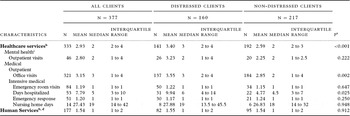
The amount of utilization by those who reported using a service in the preceding 90 days is described in Table 3. There were no significant differences between the distressed and non-distressed groups in mean number of outpatient mental health visits, emergency room visits, emergency responses, nursing home days, and types of human services accessed. However, distressed clients who did access healthcare services utilized more types of services than did non-distressed clients (3.40 versus 2.59; p < 0.001). Similarly, distressed subjects who utilized outpatient medical office visits made more visits (3.55 versus 2.85; p = 0.002), and those who were hospitalized for medical reasons had more than twice as many inpatient days than non-distressed group members who utilized those services (9.94 versus 4.47; p = 0.025) (Table 3).
Amount of utilization by mentally distressed and non-mentally distressed groupings for users of the respective services

Notes: Mentally distressed clients have either a Goldberg Anxiety score of at least 6 or a PHQ-9 score of at least 10; non-mentally distressed clients have a Goldberg Anxiety score less than 6 and a PHQ-9 score less than 10.
aThe Wilcoxon Rank Sum test calculated the two-sided p-values and compares the distressed and non-distressed groups.
bHealthcare and human services are summary scores of all types of healthcare and human services, respectively, used in the 90 days prior to the care manager visit.
cInpatient mental health and alcohol or substance abuse treatment were not included because they were endorsed by only 1 and 2 subjects, respectively.
dNo human services subcategories were reported because no service use intensity information was recorded for such services.
A Poisson regression model for which the total number of healthcare services during the past 90 days served as the dependent variable showed that being distressed was associated with more healthcare services (regression coefficient = 0.212; χ2 = 9.68; p = 0.002) after accounting for age, gender, household income, and number of medical conditions. On the other hand, being distressed was not a statistically significant predictor (regression coefficient = −0.040; χ2 = 0.10; p = 0.754) in a Poisson model for which number of human services was the dependent variable. Adding cognitive impairment to the model did not change the association of healthcare and human service with distress status (healthcare regression coefficient = 0.220 [χ2 = 6.20; p = 0.013]; human services regression coefficient = −0.035 [χ2 = 0.04; p = 0.845]).
Mental healthcare
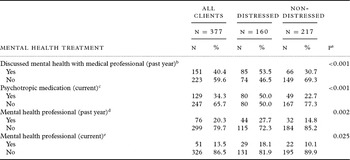
As shown in Table 4, substantial proportions in both groups reported having discussed their mental health with a medical professional in the past year (53.5% of distressed and 30.7% of non-distressed clients), and half of distressed subjects and almost a quarter of the non-distressed group were currently prescribed a psychotropic medication. In both instances the proportions were significantly greater for distressed than non-distressed clients (p < 0.001 for both differences).
Mental health treatment characteristics by mental health grouping

Notes: Mentally distressed clients have either a Goldberg Anxiety score of at least 6 or a PHQ-9 score of at least 10; non-mentally distressed clients have a Goldberg Anxiety score less than 6 and a PHQ-9 score less than 10.
aP-value determined by Pearson χ2 test and compares the distressed and non-distressed groups.
bHad talked with a doctor or healthcare professional about depression, anxiety, or stress in the past year.
cCurrently taking prescription medication for depression, anxiety, or stress.
dHad seen a mental health professional in the past year (includes clients currently receiving mental health professional treatment); mental health professional consists of psychiatrists, psychologists, therapists, and mental health social workers.
eWere currently under the treatment of a mental health professional; mental health professional includes psychiatrists, psychologists, therapists, and mental health social workers.
In contrast, a small proportion of subjects in each group endorsed seeing a mental health professional either currently or in the past year (18.1% and 27.7% respectively for distressed clients; 10.1% and 14.8% respectively for the non-distressed group). The likelihood of distressed clients receiving care from a mental health professional in either time frame was significantly greater than among the non-distressed subgroup (p = 0.002 for past year and p = 0.025 for the current year).
Discussion
Our first hypothesis – namely, most older adult social services clients receiving in-home care management assessments are utilizing healthcare and human services – was partially confirmed. As expected in older adults with high levels of physical illness and functional impairment, nearly all (91%) Eldersource clients reported using healthcare services in the 90 days prior to care management assessment. However, only about half (47%) indicated human services utilization. Furthermore, the average user of healthcare services reported using almost three services while the average user of human services indicated using only about half as many. Although fewer clients accessed human services, utilization would likely increase following agency intervention as care managers initiate supportive services for their clients.
Our second hypothesis – being distressed is associated with greater likelihood of using healthcare and human services than being non-distressed, as well as with greater amount of use among service users – was also partially verified. The proportion of clients with any healthcare use was virtually the same for the distressed and the non-distressed (91.3% versus 90.8%). The percentage of clients who had used human services was higher for the distressed in comparison to the non-distressed subjects (51.3% versus 44.0%), but this difference was not statistically significant. Consistent with our hypothesis and with prior research on older adults in primary care (Luber et al., Reference Luber2001), distressed social service agency clients utilized more types of healthcare services (e.g. mental health, intensive medical, and other health services) than did the non-distressed clients. Among clients with any healthcare use, those who were distressed reported using an average of about 30% more healthcare services than the non-distressed, while among those with any human service use there was no difference in the intensity of human services utilization. Although distressed clients did not utilize more formal human services, it is possible that distressed clients may have relied more heavily on informal sources of support (e.g. spouses, caregivers) than non-distressed clients. The high rates of healthcare service use among the mentally distressed ASPN clients suggest that interventions to reduce clients’ psychological distress could help contain healthcare costs.
Our third hypothesis – that the majority of distressed ASPN clients have not received mental healthcare from a medical professional or mental health specialist for their mental illness – was partially confirmed as well. Relatively few distressed clients reported accessing mental health services, but over half reported discussing their mental health with a medical professional in the past year. These findings are congruent with research suggesting that older adults infrequently access specialty mental healthcare and are more willing to address their mental health concerns to a primary care doctor (Crabb and Hunsley, Reference Crabb and Hunsley2006). Consistent with the high levels of distress among agency clients (42% had clinically significant anxiety and/or depression), a third of all clients and half of those classified as distressed were prescribed a psychotropic medication, presumably by their primary care providers in most cases. Yet clients remained symptomatic, suggesting, consistent with research conducted in primary care (Unützer et al., Reference Unützer, Simon, Belin, Datt, Katon and Patrick2000; Licht-Strunk et al., Reference Licht-Strunk, Beekman, de Haan and van Marwijk2009), that the intensity or type of treatment received prior to agency intake may have been inadequate. The ASPN, therefore, seems well situated to detect and facilitate more effective treatment for those depressed seniors who fall through the cracks of the primary care system.
In the U.S.A. close collaboration between the ASPN and primary care sectors in the care of their mutual patients should be possible, to the added benefit of the client. However, a very small proportion of clients (both distressed and non-distressed) were referred by a primary care provider to the social services agency. Exploration of how to integrate healthcare and human service delivery for these older adults in whom combined physical and social morbidities are the rule is indicated. Furthermore, to improve mental healthcare outcomes, some have advocated the development of collaborative care models that, in addition to linking primary and mental healthcare providers, incorporate community-based social services agencies as well (Alexopoulos and Bruce, Reference Alexopoulos and Bruce2009).
Collaborative care approaches to the treatment of depression (Unützer et al., Reference Unützer2002) and anxiety (Roy-Byrne et al., Reference Roy-Byrne, Katon, Cowley and Russo2001) that incorporate mental health expertise into primary care clinics have shown promise in improving mental illness treatment in a relatively cost-effective manner (Katon et al., Reference Katon2005; Unützer et al., Reference Unützer2008). Less work has been done in home health and community-based social service settings, however, and it is unclear what services in these settings would be most cost effective. There was enough evidence, however, for a national panel of community practitioners and mental health experts to strongly recommend in-home depression care management of older adults suffering from low levels of depression; social services programs could provide such care (Steinman et al., Reference Steinman2007). Bruce and colleagues have shown that training of visiting nurses in assessment of depression increased referrals for diagnosis and treatment, leading to improved patient outcomes (Bruce et al., Reference Bruce2007). Others have reduced depression severity among community-based social service agency clients with a multi-modal intervention that included screening, patient education, and psychotherapy delivered by social services case managers (Quijano et al., Reference Quijano2007).
Because they routinely deliver care in the home, social work care managers are well positioned to detect possible mental illness in their elderly clients, facilitate communications, contribute to the diagnostic assessment, and actively collaborate with primary care and mental health partners by supporting the clients’ adherence to prescribed care, delivering psychosocial components of care, and monitoring side effects and response to treatment. Their expertise and access to resources to address comorbid social factors may well boost response rates beyond those seen in more traditional collaborations between primary and mental healthcare sectors only (Unützer et al., Reference Unützer2002; Bruce et al., Reference Bruce2004). One such example is the Program to Encourage Active, Rewarding Lives for Seniors (PEARLS) in which community agency social workers were trained in behavioral activation and problem-solving therapy to treat minor depression and dysthymia in older adults, resulting in a significant reduction in depressive symptom severity relative to care as usual (Ciechanowski et al., Reference Ciechanowski2004).
Our findings have a number of limitations to consider. First, this study's measure of service utilization is by self-report, unverified by clinical or administrative records. Second, we did not examine use of psychotherapy specifically or prescription medication class and dosage, thereby limiting our discussion of psychiatric treatment received; we also do not know what proportion of clients who reported using services received evidence-based treatment. Third, we examined associations rather than cause-and-effect relationships. Fourth, we did not adjust for multiple comparisons because such adjustments can be overly conservative, inflate the risk of type II errors, and have a number of other limitations (Perneger, Reference Perneger1998). Consequently, we risk spurious findings and the results should be cautiously interpreted in that light. Last, our research was conducted within a single aging services agency. Access to both healthcare and human services varies considerably by location, and there is a wide diversity of services and settings present in the ASPN. The patterns and correlates of service utilization by ASPN clients would likely differ in other regions and agencies. Our findings best generalize to social service agencies that have a gatekeeper function – i.e. they first evaluate and then refer community-dwelling older adults to a set of services and programs suited to the clients’ unique circumstances and needs.
In summary, our findings suggest: (1) clients entering the ASPN have used multiple healthcare but few human services; (2) a large proportion of older adults receiving in-home care manager assessments are mentally distressed (i.e. anxious and/or depressed); (3) the distressed aging service clients utilize more healthcare services than the non-distressed group; and (4) the majority of the distressed clients have discussed their mental health with a medical provider, with half receiving prescription medication for it, although few have seen a mental health professional. Innovative approaches that link the delivery of social services to primary and mental healthcare are needed to reduce the burden of mental illness among aging services agency clients. Further research is warranted to understand the longitudinal course of anxiety and depression in these seniors, the impact that ASPN services have on anxiety and depression, and the most effective and sustainable means by which the social service providers may act as partners with primary and mental health sector providers in the coordinated care of their older adult clients with mental illnesses.
Conflict of interest
None.
Description of authors’ roles
A. Simning conducted the data analyses and wrote the paper. T. Richardson participated in the design of the study, collected data, and assisted with writing the paper. B. Friedman, C. Podgorski and L. Boyle assisted with the research questions and helped write the paper. Y. Conwell designed the study, supervised data collection, and helped write the paper.
Acknowledgments
The authors thank the staff of Eldersource and PeerPlace for making this work possible and acknowledge Connie Bowen and Judy Woodhams for project coordination and data collection and Arthur Watts for data management. This research was supported in part by grants from the Agency for Healthcare Research and Quality (T32HS000044 to Dr. Richardson; Dr. Friedman, PI); National Institute for Mental Health (R24MH071604; Dr. Conwell, PI); the American Foundation for Suicide Prevention (Dr. Conwell, PI); and the National Center for Research Resources (TL1RR024135 to A. Simning; Dr. David Guzick, PI), a component of the National Institutes of Health (NIH), and NIH Roadmap for Medical Research. Some of this paper's findings were presented at the Annual Meeting of the American Association for Geriatric Psychiatry in Orlando, FL, 14–17 March 2008.