When people consider their futures and those of others, they may comparatively display either optimism or pessimism. Comparative optimism (CO) refers to considering one’s own future in a better light than others’ futures (Weinstein, Reference Weinstein1980). Conversely, comparative pessimism (CP) is a tendency that consists of considering one’s own future in a worse light than those of others.
A number of studies have shown that expressing CO or CP has important consequences for social acceptance; most often, people are valued when they display CO but socially rejected when they display CP (Carver, Kus, & Scheier, Reference Carver, Kus and Scheier1994; Helweg-Larsen, Sadeghian, & Webb, Reference Helweg-Larsen, Sadeghian and Webb2002; Vollmann, Renner, & Weber, Reference Vollmann, Renner and Weber2007).
However, most of these studies compared the social acceptance of comparative optimism and comparative pessimism. The social acceptance of a comparatively optimistic outlook has not been found to differ from that of a neutral outlook; and there was no obvious evidence of greater social acceptance of comparative optimism but there was rather a tendency for social rejection of comparative pessimism per se. Moreover, the examination of the social acceptance of CO compared to CP was conducted in a kind of social vacuum. However, we know that the valuation of an object is often affected by the context in which it appears (Helson, Reference Helson1964; Mussweiler, Reference Mussweiler2003). Then, the main objective of the present paper was to examine the social acceptance or rejection of both CO and CP per se in different dimensions of social judgment to better understand the consequences of exhibiting CO or CP, as well as the causes of rejection and acceptance.
Outlook on the future, social acceptance and social judgment dimensions
Many studies have demonstrated that there are two dimensions of social judgment. These dimensions have been given a variety of names but it is worth noting that no major empirical differences have been demonstrated between these various conceptualizations (Wojciszke & Abele, Reference Wojciszke and Abele2008). In this study, we have used the distinction between social desirability and social utility (Dubois & Beauvois, Reference Dubois and Beauvois2005): (a) for purposes of comparison with previous results about social acceptance of comparative optimism obtained in the literature (Le Barbenchon & Milhabet, Reference Le Barbenchon and Milhabet2005; Le Barbenchon, Milhabet, Steiner, & Priolo, Reference Le Barbenchon, Milhabet, Steiner and Priolo2008; Milhabet, Le Barbenchon, Molina, Cambon, & Steiner, Reference Milhabet, Le Barbenchon, Molina, Cambon and Steiner2012); (b) because this conceptualization is explicitly linked to evaluative judgment which is the focus of our attention in this paper. Indeed, in the literature, the analogs to social desirability and social utility such as communion and agency or warmth and competence are based on a psychological realism assumption. Thus, in this conception, the two dimensions are assumed to be two realities existing in a descriptive (quasi-scientific) psychology, and psychological descriptions are considered as real descriptions of peoples’ personalities. For the evaluative approach (Dubois & Beauvois, Reference Dubois and Beauvois2011), the two dimensions are seen as two aspects of the social value of people and the psychological descriptions are considered as direct expressions of persons’ social value. This last assumption is supported by generally strong correlations between descriptions with personality traits on the two dimensions and evaluative statements related to these two dimensions (Cambon, Djouary, & Beauvois, Reference Cambon, Djouary and Beauvois2006).
“Social desirability” refers to the types of affects that individuals elicit from others, or the manners in which individuals satisfy other people’s principal motivations. Accordingly, social desirability informs us of the “likeableness” we can attribute to others in their relationships with others. The social acceptance measured in the friendship domain is obviously related to the social desirability dimension. By contrast, “social utility” refers to an individual’s chance of success or failure in her/his social life and is based on how well she/he meets the requirements of the society in which she/he live. In this approach, social utility has a quasi-economic connotation, rather than a functional one. In other words, an individual’s social utility refers to her/his “market” value and not to the services that she/he might perform for a particular individual or group in a specific context. For example, the value of leadership behaviors relates to the social utility dimension; a leader is an individual who is successful in her/his social life and useful for an organization.
Based on this distinction, Le Barbenchon and Milhabet (Reference Le Barbenchon and Milhabet2005) have shown that displays of CO may be simultaneously socially accepted in one of these dimensions and socially rejected in the other. Le Barbenchon et al. (Reference Le Barbenchon, Milhabet, Steiner and Priolo2008) showed that displays of CO are more socially accepted in the social utility dimension than in the social desirability dimension. In the latter dimension, CO targets are poorly accepted and occasionally rejected. These conclusions are supported by the results of other studies; results have shown, for example, that (1) displays of CO may be perceived as signs of overconfidence and pretentiousness in the friendship domain (Taylor, Lerner, Sherman, Sage, & McDowell, Reference Taylor, Lerner, Sherman, Sage and McDowell2003); and (2) there may be a correlation between displays of CO and advantageous self-description for leaders (Dolbier, Soderstron, & Steinhardt, Reference Dolbier, Soderstron and Steinhardt2001; Hickman, Watson, & Morris, Reference Hickman, Watson and Morris1996; House & Shamir, Reference House, Shamir, Chemers and Ayman1998). These results indicate that the social acceptance of CO is not unanimous. Furthermore, CO was expected to be more socially accepted in the social utility dimension and less socially accepted in the social desirability dimension compared with a neutral outlook on the future (Hypothesis 1a).
The above distinction between the two social judgment dimensions demonstrates that examining the social acceptance of different outlooks on the future within the two dimensions is particularly relevant. Presently, these dimensions have only been used to explore the social acceptance of CO and not the social rejection of CP. Helweg-Larsen et al. (Reference Helweg-Larsen, Sadeghian and Webb2002) observed that displays of CP are generally socially rejected (compared with neutral or optimistic outlooks), regardless of the judgment dimension. CP is then expected to be rejected in both social judgment dimensions, compared to a neutral outlook (Hypothesis 1b).
If these authors show interesting new results which give a social dimension to the judgments of the perception of the future, they do not present their reasons. Then, the second aim was to understand the major process that underlies social judgments concerning CP and CO. In the literature, two major processes are proposed to explain these social judgments: (1) comparatively pessimistic individuals are rejected because they are associated with stigmatized traits, such as displaying nonclinical depressed mood (or dysphoria); and (2) comparatively optimistic individuals are accepted because they display risk-taking potential (Helweg-Larsen et al., Reference Helweg-Larsen, Sadeghian and Webb2002).
Outlook on the future, social rejection and mood
In experiment 2, Helweg-Larsen et al. (Reference Helweg-Larsen, Sadeghian and Webb2002) demonstrated that the depressed mood attributed to the CP targets explained their social rejection. The authors manipulated the information regarding the targets’ outlooks on the future (CP, neutral, or CO). In addition, they either presented the targets as being in excellent mental health (i.e., “not depressed or hopeless, and […] in a good mood most of the times”, p. 99) or withheld this information (i.e., standard condition). When the targets were presented without any information, the displays of CP were considered less socially acceptable than the neutral outlooks, which were no less socially accepted than the displays of CO. The targets were all socially accepted when presented as being in good mental health. In other words, the CP targets may have been socially rejected because they were perceived as being in a depressed mood. Such an assumption raises three concerns.
First, the role of depressed mood has been reported regardless of the social judgment dimension. Social rejection based on excessive reassurance seeking (which is associated with depression) has been observed by roommates, best friends and dating partners (Starr & Davila, Reference Starr and Davila2008). In other words, depressed (Starr & Davila, Reference Starr and Davila2008) and dysphoric individuals (Siegel & Alloy, Reference Siegel and Alloy1990) are rejected, but these results apply only in the social desirability dimension. The hypothesis of the social rejection of depressed and CP individuals in the social utility dimension has not been examined.
Second, the mood attributed to the target does not impact the social judgments about CO targets (Helweg-Larsen et al., Reference Helweg-Larsen, Sadeghian and Webb2002). The social rejection of CO that has been observed in the social desirability dimension may have different causes than the social rejection of CP.
Third, outlook on the future and depression may or may not co-occur (Alloy & Ahrens, Reference Alloy and Ahrens1987; Pietromonaco & Markus, Reference Pietromonaco and Markus1985; Pyszczynski & Greenberg, Reference Pyszczynski and Greenberg1986, Reference Pyszczynski and Greenberg1987). One can intuitively suppose that people display CP when they are depressed, and this is often observed (Alloy & Ahrens, Reference Alloy and Ahrens1987). In such cases, seeking excessive reassurance targets are socially rejected on both dimensions of social judgment (Helweg-Larsen & al., 2002; Starr & Davila, Reference Starr and Davila2008). Some authors have shown that some depressed individuals display CO (Pietromonaco & Markus, Reference Pietromonaco and Markus1985; Pyszczynski & Greenberg, Reference Pyszczynski and Greenberg1985). This intuitive incongruence, manipulated by Helweg-Larsen et al. (Reference Helweg-Larsen, Sadeghian and Webb2002), is possible because one can exhibit one’s outlook on the future as a manner of coping or as a strategy of self-presentation (Taylor & Brown, Reference Taylor and Brown1988; Tyler & Rosier, Reference Tyler and Rosier2009). Many authors have argued that comparative optimism refers to positive illusions that have positive psychological benefits for depressed individuals (Armor & Taylor, Reference Armor, Taylor and Zanna1998; Shepperd, Grace, Cole, & Klein, Reference Shepperd, Grace, Cole and Klein2005). These benefits could also concern the social acceptance of CO in depressed individuals (Chambers & Windschitl, Reference Chambers and Windschitl2004; Tyler & Rosier, Reference Tyler and Rosier2009). Conversely, a non-depressed individual could display CP as a modest self-presentation strategy or as a self-handicap (i.e., modest target). Modesty as a self-presentation strategy is particularly effective for social acceptance in friendship relations and in the social desirability dimension (Tice, Butler, Muraven, & Stillwell, Reference Tice, Butler, Muraven and Stillwell1995). It is then possible to conceive that someone can be non-depressed but display CP. Finally, more frequently, non-depressed individuals display CO. These “narcissistic targets” are socially accepted on the dimension of social utility but rejected on the dimension of social desirability (Le Barbenchon & Milhabet, Reference Le Barbenchon and Milhabet2005; Le Barbenchon et al., Reference Le Barbenchon, Milhabet, Steiner and Priolo2008; Milhabet et al., Reference Milhabet, Le Barbenchon, Molina, Cambon and Steiner2012).
Based on these concerns, the hypothesis addresses only the dimension of social desirability because no results are available concerning the social judgment of dysphoria in the social utility dimension. It is hypothesized that dysphoria attributed to the CO targets reduces their social rejection (Hypothesis 2a); positive illusion targets (i.e., depressed CO targets) are expected to be less socially rejected in the social desirability dimension than narcissistic targets (i.e., non-depressed CO targets). Concerning CP displays, it is expected that dysphoria attributed to the CP targets increases their social rejection (Hypothesis 2b); excessive reassurance seeking (i.e., in depressed CP targets) is expected to be more socially rejected in the social desirability dimension than a modest target (i.e., non-depressed CP targets).
Outlook on the future, social acceptance and risk-taking potential
The role of risk-taking potential in the target is used to explain the social acceptance of CO (Helweg-Larsen et al., Reference Helweg-Larsen, Sadeghian and Webb2002). The link between risk and optimism has often been studied in economics (Bougheas, Reference Bougheas2002; Ucbasaran, Westhead, Wright, & Flores, Reference Ucbasaran, Westhead, Wright and Flores2010), sociology (Peretti-Watel, Reference Peretti-Watel2005; Spire & Peretti-Watel, Reference Spire and Peretti-Watel2008) and psychology (Quadrel, Fischhoff, & Davis, Reference Quadrel, Fischhoff and Davis1993; van der Velde, van der Pligt, & Hooykaas, Reference van der Velde, van der Pligt and Hooykaas1994; Weinstein, Marcus, & Moser, Reference Weinstein, Marcus and Moser2005). However, few studies have examined the relationship between risk-taking and the acceptance of comparative optimism. Helweg-Larsen et al. (Reference Helweg-Larsen, Sadeghian and Webb2002) observed that optimistic targets are the most socially accepted and are perceived as taking the most risks. The authors concluded that perceived risk-taking is not regarded as a negative attribute (Zuckerman, Reference Zuckerman1979, Reference Zuckerman1990). This conclusion is consistent with other studies. For example, Anderson and Galinsky (Reference Anderson and Galinsky2006) assumed that optimism is associated with risky choices in professional domains, which may lead to superior performance. This explanation fits particularly well with the social acceptance of CO in the social utility dimension (Le Barbenchon & Milhabet, Reference Le Barbenchon and Milhabet2005; Le Barbenchon et al., Reference Le Barbenchon, Milhabet, Steiner and Priolo2008; Milhabet et al., Reference Milhabet, Le Barbenchon, Molina, Cambon and Steiner2012). CO may be beneficial in the professional domain because it is perceived as leading to firm value maximization (Anderson & Galinsky, Reference Anderson and Galinsky2006) and investment in new economic markets (Bougheas, Reference Bougheas2002). It is predicted that regardless of the experimental condition (depressed or non-depressed), the CO targets are perceived as taking appropriate risks which may explain that CO targets are thus socially accepted in the social utility dimension; while the CP targets are perceived as taking less risks (Hypothesis 3). This hypothesis was tested in studies 2 and 3.
STUDY 1
Method
Participants and experimental design
Two hundred and three participants ranging from 18 to 67 years old (M = 31.59; SD = 13.35) were recruited from the street and at a train station to participate in this experiment (109 women and 94 men). The participants agreed to participate in the study Footnote 1 , which they were told concerned personality and perception of the future. A 3x3 (Target’s Depressive Status: depressed, non-depressed, or control vs. Targets’ Outlooks on the Future: CP, neutral, or CO) between-participants experimental design was used, with 21 to 25 participants in each group. In all studies, the participants were each randomly assigned to one the experimental conditions. They read the information and answered the questions concerning the target. After the experiment, the participants were debriefed and thanked for their participation.
Dependent variables
Three dependent variables were tested: (1) the social acceptance of the target on the desirability and utility dimensions; (2) the target’s ratings of the personality trait adjectives; and (3) the dysphoria attributed to the target (on specific adjectives).
Materials
First, the mental health presentation of the target was manipulated (depressed or not). In experimental conditions (depressed or not), the target’s depressive character was specified three times: once, verbally, by experimenter, at the beginning of the instructions (“After reading description about an individual not depressed, not sad, not dysphoric and in good psychological health, and…” versus “After reading description about an individual depressed, sad, dysphoric and in bad psychological health, and…”); a second time, it was written, on the first page of the booklet used to in the study (see details below); and a third time it was underlined on the second page of the booklet where there was the entire target-portrait. In the control condition, no information about depressed or not was provided.
Second, the target’s outlook on the future was manipulated as either CP, neutral or CO. The participants were informed that the target had answered a questionnaire concerning their outlook on their own future and that of another average individual of similar age and sex. The participants were told (and they also read) that the target’s scores on the questionnaire were comparatively optimistic, comparatively pessimistic or neither. In addition, to be more concrete, the participants were given two examples. For example, a comparatively optimistic target said that they were more likely to “attend a happy event” and “get a good job soon after graduating” than another person of similar age and sex. This classic manipulation of the targets’ outlooks on the future (CP, neutral, or CO) was enhanced by a quantitative score that was given to participants. The participants were informed that the target had answered a questionnaire on a percentage scale. An average fictitious percentage for the target was indicated to the participants. In the neutral condition, the target’s and other individual’s percentages were similar, with no difference in outlooks. The neutral target had a percentage of 0%, whereas the CP and CO targets had percentages of -34% and +34%, respectively. A score of -34% meant that, on average, the target expressed 34% more pessimism than the other individual. The converse was true for the optimistic comparative target (+ 34%). These percentages were the same as those of the study Milhabet et al. (Reference Milhabet, Le Barbenchon, Molina, Cambon and Steiner2012). Beyond 62%, the targets were seen as less credible.
There were nine target profiles: 3x3 (Target’s Depressive Status: not depressed, depressed, or none vs. Target’s Outlook: CP, Neutral, or CO). All of the conditions were crossed. However, some profiles might seem less possible than others. For this reason, at the end of the questionnaire, two questions related to the plausibility (i.e., “to what extent do you think this person’s answers regarding their future are plausible?”) and consistency (i.e., “to what extent do you think this person’s answers regarding their future seem consistent?”) of the targets (on a 7-point scale) were included. All of the targets were observed to be similarly plausible and consistent (M = 4.38; SD = 1.51), F(4, 194) = 1.68, ns. However, one target, the depressed and comparatively optimistic one, was judged to be less plausible than the others (M = 3.96; SD = 1.42). Despite this low mean, we kept these targets in the final experimental material.
Judgment of social acceptance
Each participant answered ten questions regarding one of nine different targets (see Appendix 1). Five questions corresponded to social acceptance in the social desirability dimension (α > .78 in studies 1 and 3), and five corresponded to social acceptance in the social utility dimension (α > .87 in studies 1 and 3). The answers were provided on scales ranging from 1 (not at all) to 7 (entirely). The participants’ mean responses were calculated for each dimension of social judgment. The judgments of social desirability were correlated with the judgments of social utility (r = .58, p < .01 in study 1; r = .67, p < .01 in study 3). When the correlation between X and Y is equal to, or approaching the reliability of X or Y, then X and Y are considered the same construct (Nunnally & Bernstein, Reference Nunnally and Bernstein1994). So, we also set up the 95% confidence intervals (CIs) around the correlation of .58 (study 1) and .67 (study 3). The 95% CIs ranged from .51 to .65 in study 1, and from .59 to .75 in study 3, and thus clearly excluded the Crombach’s alphas (in study 1, the two α were .78 and .87, in study 3, they were .85 and .92). This led us to regard the two constructs as psychometrically distinct but the two dimensions are not necessarily orthogonal.
Target ratings on the personality traits (desirability and utility).
The participants rated the targets using 12 personality traits (see appendix 2) ranging from 1 (not at all) to 7 (entirely) (Cambon, Reference Cambon2006) obtained from the crossing of the two dimensions of social desirability and social utility and of positive and negative valence (.70 ≥ αs ≤ .81).
The participants’ mean target ratings were calculated for each dimension of the personality trait adjectives (the mean ratings of the positive desirability traits minus the mean ratings of the negative desirability traits, and the mean ratings of the positive utility traits minus the mean ratings of the negative utility traits). This is how each target’s ratings were obtained, including one of desirability traits and one of social utility traits; each ranged from -6 (not at all) to +6 (entirely). The ratings of the desirability traits were correlated with the ratings of the utility traits (r = .32, p < .01 in study 1; r = .27, p < .01 in study 2). The ratings of the traits were also correlated with means of social acceptance (r = .40, p < .01 for desirability; r = .55, p < .01 for utility).
Dysphoria attributed to the targets
The participants rated the targets in terms of four mood adjectives on a scale ranging from 1 to 7: very happy - very sad, definitely not depressed - definitely depressed, definitely not hopeless - definitely hopeless, and definitely funny - definitely not funny. These four questions, all of which were based on the same construct (target’s dysphoria), were computed in a single index (α > .85 in all studies). The greater the score, the more dysphoric the target was perceived to be.
Targets’ outlooks for the future
We asked the participants to rate the targets’ outlooks for the future (i.e., “how do you think this individual sees his/her future?”) on a scale ranging from 1 (pessimistic) to 7 (optimistic). The CP targets (M = 2.55; SD = 1.32) were judged as more pessimistic than the targets in the control condition (M = 4.09; SD = 1.10); these targets were judged as less optimistic than the CO targets (M = 4.92; SD = 1.64), F(2, 194) = 51.04, p < .0001, η 2 = .05). In all of the studies, the results confirmed that our experimental manipulations were successful.
Results Footnote 2
Dysphoria attributed to the targets
The expected main effect of target’s depressive status, F(2, 194) = 14.87, p < .001; η 2 = .01, showed that targets were judged more dysphoric when presented as being depressed (M = 4.52; SD = 1.07) than in the control condition (M = 3.78; SD = 1.21) or as non-depressed (M = 3.68; SD = 1.01). Furthermore, a main effect of target’s outlook on the future, F(2, 194) = 30.94, p < .0001, η 2 = .02, indicated that the CP targets (M = 4.74; SD = .88) were judged to be more dysphoric than both the neutral targets (M = 3.81; SD = .89), F(1, 194) = 29.60, p < .0001), and the CO targets (M = 3.49; SD = 1.27), F(1, 194) = 4.30, p < .05. Thus, the CP targets were presumed to have high levels of dysphoria.
Mean social judgments of the targets’ social acceptance
Only the significant effects and the effects related to the hypotheses are described in this section. The CP targets (M = 3.16; SD = 0.92) were judged less favorably than the neutral (M = 3.89; SD = 1.24) and CO targets (M = 4.04; SD = 1.08), F(2, 194) = 742.14, p < .0001; however, the neutral and CO targets did not significantly differ, F(1, 194) = .82, ns. Overall, the targets were judged more favorably in the desirability dimension (M = 3.83; SD = 1.09) than in the utility dimension (M = 3.56; SD = 1.16), F(1, 194) = 15.80, p < .0001, η 2 = .01.
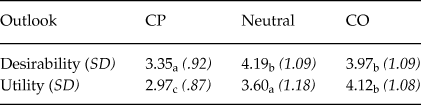
The interaction between outlook and the dimensions of social judgment was significant, F(2, 194) = 11.39, p < .0001, η 2 = .01 (Table 1). Hypothesis 1a expected that the CO targets are more accepted than the neutral targets in the social utility dimension; however, this effect was not observed in the social desirability dimension. Compared to the neutral targets, the CP targets were generally rejected in both dimensions, as predicted in Hypothesis 1b; however, they were less rejected in the desirability dimension than in the social utility dimension.
Mean Judgments of Targets’ Social Acceptance on the Social Utility and Desirability Dimensions According to their Outlook in Study 1

Note: A common letter indicates a lack of significant difference (line by line and column by column), p < .05.
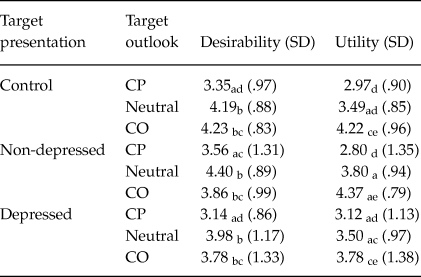
There was a significant interaction between target presentation, target outlook and the social judgment dimensions, F(4, 194) = 2.51, p < .05, η 2 = .0002 (Hypothesis 2; Table 2). However, the depressed CP target (i.e., the excessively reassurance-seeking target) was not observed to be less rejected than the non-depressed CP target (i.e., the modest target; Hypothesis 2b), and the depressed CO target (i.e., the positive illusion target) was less rejected than the non-depressed CO target (i.e., the narcissistic target; Hypothesis 2a).
Mean Judgments of Targets’ Social Acceptance on the Social Utility and Desirability Dimensions According to Their Presentation and Their Outlook on the Future in Study 1

Note: A common letter indicates a lack of significant difference (line by line and column by column), p < .05. Standard deviations shown in parentheses.
An ANCOVA was conducted to examine the control condition and the influence of dysphoria attributed to the targets on social acceptance (i.e., dependent variable). To test perceived dysphoria’s effect on social judgments and to avoid results that could be explained by the experimental manipulation, this analysis only examined the control condition. Target outlook (CP, Neutral, or CO) was the between-participants factor (i.e., independent variable), the social judgment dimension (social desirability vs. social utility) was the within-participants factor (i.e., independent variable), and the dysphoria attributed to the target was the covariate. When the dysphoria attributed to the target was constant, the CP targets were no more socially rejected than the neutral targets in either the social desirability or the social utility dimensions, F(1, 66) < 1, ns. Similarly, when the perceived dysphoria was constant, the CO targets were no more socially rejected than the neutral targets in the social desirability dimension, F(1, 66) < 1, ns; however, the CO targets tended to be more accepted in the social utility dimension than the neutral targets, F(1, 66) = 3.26, p = .074.
Mean ratings on the personality trait adjectives
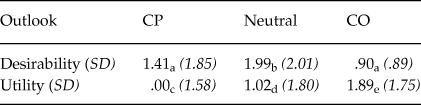
The ANOVA revealed significant main effects from target outlook, F(2, 194) = 5.23, p < .01, η 2 = .02, and personality trait dimension, F(1, 194) = 10.73, p < .01, η 2 = .01. However, the most notable result was the significant effect of the interaction between target outlook and personality trait dimension, F(2, 194) = 27.97, p < .0001, η 2 = .05 (Table 3). The CO targets were given higher ratings for the social utility traits and lower ratings for the social desirability traits than the neutral targets, F(1, 194) = 8.72, p < .01 and F(1, 194) = 11.04, p < .01 (respectively), which was expected (Hypothesis 1a). Consistent with Hypothesis 1b, the CP targets were rejected in the social utility dimension (M = 2.27; SD = .99) compared to the neutral targets, F(1, 194) = 11.29, p < .01, and they also tended to be rejected in the social desirability dimension (M = 4.24; SD = 1.05), F(1, 194) = 2.97, p = .08. Altogether, these results supported Hypothesis 1b, although the social rejection of the CP targets was more salient in the social utility dimension than in the social desirability dimension.
Mean ratings of Targets on the Social Utility and Desirability Traits According to their Outlook in Study 1

Note: A common letter indicates a lack of significant difference (line by line and column by column), p < .05.
None of these effects interacted with the targets’ presentations in terms of depression, F(4, 194) < 1, ns, which indicated that compared to the neutral targets, social judgments concerning the CP and CO targets were similar, regardless of whether they were presented as depressed or non-depressed (Hypothesis 2).
To investigate the effect of the perceived depressive status of the target on the personality trait ratings of that target, a second ANCOVA was conducted in the control condition, using the dysphoria attributed to the target as a covariate (for the same reasons mentioned above). The results showed that when the perceived dysphoria was constant, the CP targets were no more socially rejected based on personality traits than the neutral targets in either dimension, F(1, 66) < 1, ns. However, the CO targets remained more positively rated in social utility, F(1, 66) = 4.84, p < .05, and more negatively rated in social desirability than the neutral targets, F(1, 66) = 4.43, p < .05.
Discussion
First, the results showed that CO is socially accepted in the social utility dimension but socially rejected in the social desirability dimension, in comparison to a neutral outlook on the future (Hypothesis 1a), as observed by Le Barbenchon and Milhabet (Reference Le Barbenchon and Milhabet2005). Moreover, these results showed, for the first time that CP is socially rejected, compared with a neutral outlook, in the two social judgment dimensions (Hypothesis 1b). The social judgments of targets displaying CP or CO were here compared with the social judgment of targets displaying neutral comparative outlook on the future. It is interesting to note that the neutral targets were manipulated to be neither optimistic nor pessimistic. They are neutral for their expression of the future. Yet, these neutral outlooks on the future are more socially accepted on the dimension of desirability than on the dimension of utility. Milhabet et al. (2012; experiments 1–3) showed the same results because to be perceived useful and more useful than desirable, the CO must be expressed unambiguously. Thus, unsurprisingly, the neutral target is perceived as more desirable and useful. Moreover, the positivity of the neutral target on social desirability probably relates to the person positivity bias which refers to a behavioral approach tendency in the participants (Peeters, Reference Peeters1971). The fact that this bias appeared only on the desirability scales is also consistent with the fact that these scales, more than the social utility ones, are more related to the approach-avoidance tendency (Peeters, Reference Peeters2002). Otherwise, these neutral targets may generate affects because they did not display explicit social comparison (Mussweiler, Reference Mussweiler2003). We mentioned above that the neutral target did not displayed comparative outlook on the future. The social judgment of CP and CO could then result from the social comparison displayed by CP and CO. A way to deal with this issue is to compare the social judgments of targets with different levels of CO or CP. For this reason, we added several degrees of comparative pessimism and optimism in the second study. The expected differences in the first study between neutral and CP or CO targets are now expected between the different degrees of comparative outlooks on the future (Hypotheses 1).
More specifically, concerning the social rejection of CP targets, it can be explained by the dysphoria perceived in CP individuals. Two results support this assumption: (1) the CP targets were spontaneously perceived to be more dysphoric than the neutral and CO targets, and (2) the CP targets were no longer socially rejected when the dysphoria attributed to the targets was constant. Therefore, these results extend those of Helweg-Larsen et al.’s (Reference Helweg-Larsen, Sadeghian and Webb2002) study considering the two dimensions of social judgment. However, unlike hypothesis 2b, the CP targets were not more socially rejected when they were presented as depressed (i.e., excessively reassurance-seeking) than when they were presented as non-depressed (i.e., modest). Although the manipulation of the target presentation was effective (the depressed targets were judged to be more dysphoric than the neutral and non-depressed targets), the expected effect did not occur. In a second study, re-examination of these results was proposed, this time maintaining the most problematic and radical conditions (i.e., depressed or non-depressed).
This first study also showed other new results. The social rejection of perceived dysphoria in two social dimensions was tested, and it was observed that a depressed mood is socially rejected in the dimensions of both social desirability (Starr & Davila, Reference Starr and Davila2008) and, for the first time, social utility. The results of this study show that perceived dysphoria explains the social rejection of CP and the partial rejection of CO. However, we are aware of the fact that the results of the ANCOVA should be interpreted with caution, because the inclusion of covariates which were measured after the manipulation of the independent variable can lead to problematic interpretations. For this reason, we conducted a second study with an experimental design giving us the possibility to directly test the influence of perceived dysphoria for social judgments.
The present study shows that depressed targets are socially rejected when they are perceived as excessively reassurance–seeking but not when they display CO as a positive illusion. These results confirm that displaying CO as a positive illusion has positive social consequences for depressed individuals (Chambers & Windchitl, Reference Chambers and Windschitl2004; Taylor & Brown Reference Taylor and Brown1988). It also seems that CP is no more rejected than CO in the social desirability dimension when the target displays CP as a modest self-presentation strategy (among non-depressed targets). We replicated Study 1 by considering the main limitations of this study.
STUDY 2
Method
Participants and experimental design
The participants were 171 students (145 women and 26 men) ranging from 18 to 39 years old (M = 19.65; SD = 3.12). The participants agreed to participate in an experiment investigating personality and perceptions of the future. A 2x5 (Target’s Depressive Status: non-depressed or depressed vs. Target’s Outlook on the Future: high CP, CP, neutral, CO, or high CO) experimental design was used. The first independent variable was a between-participants factor, while the second was a within-participants factor. Five profiles were presented in five random orders. The experimental procedure was the same than in the first study.
Dependent variables
Three dependent variables were tested: (1) ratings of the targets on the personality trait adjectives, (2) the dysphoria attributed to the targets; and (3) the risk-taking potential attributed to the targets.
Materials
The material used was a 15-page booklet. Three pages were assigned to each target. The first half-page contained a description of the target. The target’s description presented the target in terms of both independent variables: their level of depression and their outlook on the future. This description was intended to allow a target to be, for example, simultaneously depressed and comparatively optimistic. Each target was explicitly described as either depressive or non-depressive: half of the participants were informed that the targets were sad, were depressed, and had specific problems, whereas the remaining participants were informed that the targets were not sad, were not depressed, and had no particular problems (i.e., non-depressed). After this information was provided, it was explicitly stated that the target was either very strongly CP, CP, neutral, CO, or very strongly CO. This half-page was followed by a series of questions organized into blocks (or tables). Each block of questions corresponded to one of the dependent variables and additional measures. The items were identical to those in the first study. Four items were created (α > .85 in studies 2 and 3) to assess the risk-taking potential attributed to the target (i.e., “do you think that this person could take risks to get a job with a high social status?”).
The preliminary results showed the effectiveness of the manipulation. A significant effect from target presentation (non-depressed vs. depressed) on the judgment of depression was observed, F(1, 672) = 9.05, p < .0001, η 2 = .01. The CP targets were judged as pessimistic, and the CO targets were judged as optimistic, F(4, 672) = 552.28, p < .0001, η 2 = .16. The credibility of the targets was also examined. All of the targets were observed to be similarly plausible, F(4, 194) = 1.68, ns. However, two of the targets were judged to be weaker than the rest: the depressive target and optimistic (M = 3.68; SD = 1.83) and highly optimistic targets (M = 3.64; SD = 1.84), F(4, 672) = 10.90, p < .0001. All targets were retained.
Results
Dysphoria attributed to the targets
Consistent with the manipulation, it was observed that the perceived dysphoria was influenced by the target presentation, F(1, 169) = 104.27, p < .0001, η 2 = .01: when participants were informed that the target was depressed, they judged that the target was highly dysphoric (M = 3.56; SD = 1.65), but not when they were informed that the target was non-depressed (M = 4.40; SD = 1.40), as expected. We observed a main effect of target outlook, F(4, 676) = 364.70, p < .0001, η 2 = .08; the most comparative optimistic targets were judged as the least dysphoric, F(1, 169) = 808.19, p < .01 (linear contrast).
Mean ratings of risk-taking potential
An ANOVA revealed a significant interaction between the two independent variables, F(4, 676) = 6.00, p < .001, η 2 = .0005, which indicated that the CO targets were perceived to have greater risk-taking potential than the neutral targets, whether the targets were portrayed as depressed or non-depressed (Table 4). However, the CP targets were perceived as potentially taking fewer risks than the neutral targets, and this effect was stronger when the CP targets were depicted as depressed.
Mean Risk-Taking Potential Ratings According to the Targets’ Outlook on the Future in Study 2

Note: A common letter indicates a lack of significant difference (line by line and column by column), p < .05. *p = .058.
Mean ratings of personality trait adjectives
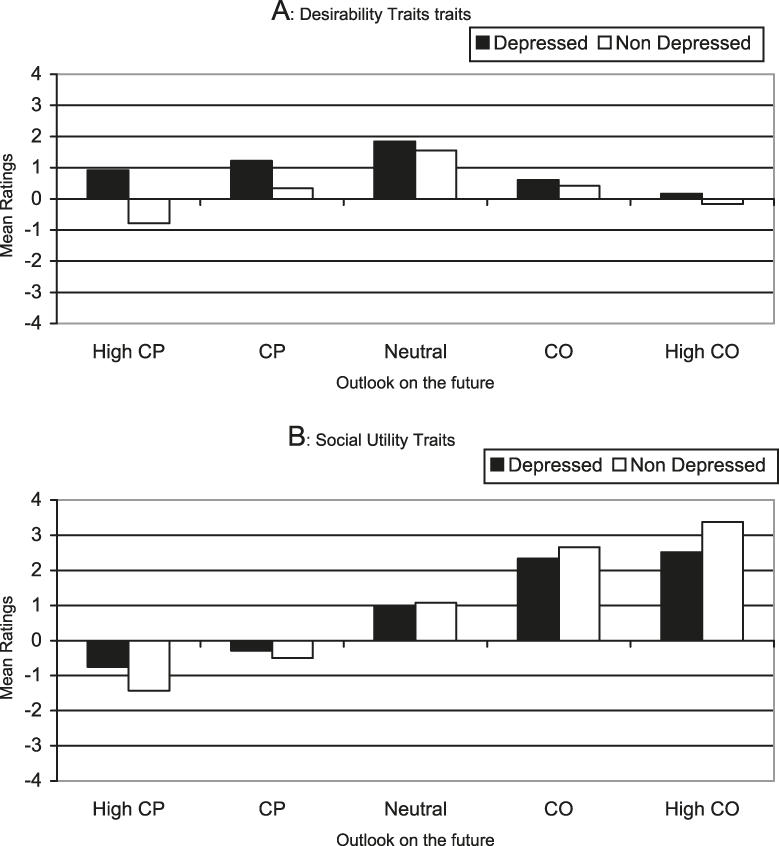
The statistical design of this dependent variable was a 2 (Target’s Depressive Status: non-depressed vs. depressed) x 5 (Target’s Outlook on the Future: highly CP, CP, neutral, CO, or highly CO) x 2 (Valence Adjective: positive vs. negative) x 2 (Adjectives’ Social Dimension: desirable vs. useful) design. The first independent variable was a between-participants factor, and the other independent variable a within-participants factors. To make these results easier to follow, the meaningful significant interaction between the four independent variables is described in some detail, F(4, 676) = 3.76, p < .005, η 2 = .00009 (Figure 1). Highly CO targets were rated as more useful, F(1, 169) = 11.01, p < .01, and more undesirable, F(1, 169) = 23.34, p < .001, than the CO targets, as expected (Hypothesis 1a). In accordance with hypothesis 1b, the highly CP targets were rated as less desirable, F(1, 169) = 10.54, p < .01, and less useful, F(1, 169) = 28.37, p < .001, than the CP targets. In all cases, the targets were regarded as less useful than desirable in the trait adjectives, F(1, 169) = 24.89, p < .001, η 2 = .0004.

The CO targets were less rejected in the social desirability dimension when they were depressed (positive illusion targets) than when they were non-depressed (narcissistic targets), F(1, 169) = 4.55, p < .05, as expected (Hypothesis 2a). Contrary to hypothesis 2b, the depressed CP targets (excessively reassurance-seeking targets) were rated as more desirable than the non-depressed CP targets (modest targets), F(1, 169) = 9.73, p < .01.
The influences of dysphoria and risk-taking potential on mean ratings of personality traits (useful and desirable)
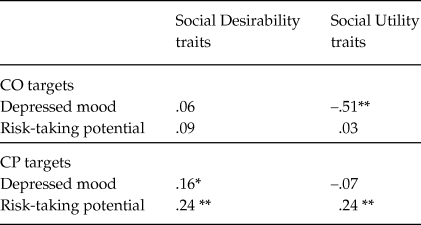
Finally, to understand the influences of perceived risk-taking potential and dysphoria on each dimension, multiple regressions were conducted for the CP and CO targets (non-neutral targets). Dysphoria and risk-taking potential perceived in the target were used as predictors of the mean ratings of personality traits (Table 5).
Beta Coefficients of Multiple Regression Analyses for Comparatively Pessimistic or Optimistic Targets (not Neutral Targets) in Study 2

Note: *p < .05. **p < .001.
It was observed that the role of dysphoria perceived in the target differed as a function of the target’s outlook on the future and as a function of the social judgment dimension. In the dimension of social desirability, depressed mood reduced the social rejection of the CP targets. In the dimension of social utility, perceived dysphoria increased the social rejection of the CO targets. Finally, it was observed that the risk-taking potential attributed to the CO targets was unrelated with their personality trait ratings which did not support our hypothesis 3.
Discussion
In this second study, the results supported those previously noted (i.e., the first study). In short, CO was socially accepted in the social utility dimension but not in terms of social desirability and CP was generally rejected.
Moreover, study 2 investigated the reasons behind the social acceptance of the CO targets and the social rejection of the CP targets. The results revealed that a target who was judged to be dysphoric was actually socially rejected in the social utility dimension. Concerning hypothesis 2, it was observed that the CO target was less rejected in the social desirability dimension when it was presented as having a depressed mood (i.e., the positive illusion targets), compared to the non-depressed CO target (i.e., the narcissistic target). Thus, the depressed mood of the CO target reduced its social rejection in the social desirability dimension, as hypothesized (2a). Similar effects were observed for the CP targets; the CP targets were less rejected when they were depressed (i.e., the excessively reassurance-seeking targets) than when they were non-depressed (i.e., the modest targets). This effect was not expected, but it is consistent with the notable results: dysphoric targets who disconfirmed the expectations of the participant (i.e., the target was non-depressed, whereas the participant expected a depressed target) were socially rejected (Alloy, Fedderly, Kennedy-Moore, & Cohan, Reference Alloy, Fedderly, Kennedy-Moore and Cohan1998). However, experimental manipulation may have stimulated the participants from a confirmation perspective. Another explanation for this unexpected effect could be that the participants counterbalanced the social rejections of CP and depressed mood in the social utility dimension and moderated the social rejection of CP and depressed mood in the social desirability dimension. Furthermore this effect may have been an experimental artifact; in fact, the participants who socially rejected the CP targets could justify their social judgment with the unique information that was provided to them concerning the depressed status of the target. Thus, it was important to test, in a third study, whether participants would reject the CP targets because they spontaneously attributed a depressed mood to CP.
Finally, we tested the hypothesis that individuals were judged as socially useful when they were considered likely to take appropriate risks (Hypothesis 3). The results showed that the useful targets were also judged to have a risk-taking potential. However, their risk-taking potential seemed unrelated to their social value when the effect of dysphoria was controlled for (see multiple regressions). The experimental manipulation (i.e., the induction of the target’s mood) may have artificially enhanced the role of depressed mood and increased its salience beyond the role of risk-taking potential in social judgments. A third study was conducted to examine these different aspects.
STUDY 3
In study 3, a single control condition and a single non-depressed condition were implemented, as in the study of Helweg-Larsen et al. (Reference Helweg-Larsen, Sadeghian and Webb2002). The control condition would allow investigation of the influences of spontaneous attributions of depressed mood and risk-taking potential on social acceptance and rejection. This third study provides new analyses to better understand the influences of mood and risk-taking in the rejection and acceptance of pessimism and optimism. The aim was to investigate the social acceptance of CP and CO in the two dimensions of social judgment while considering dysphoria and risk-taking as mediating variables.
Method
Participants and experimental design
Forty psychology students (33 women and 7 men; M age = 19.2; SD = 2.1) volunteered to participate in an experiment about judgment of individuals. A 2 (Target’s Depressive Status: control vs. non-depressed) x 9 (Target’s Outlook: CP4, CP3, CP2, CP1, N, CO1, CO2, CO3, or CO4) experimental design was implemented. The first independent variable was a between-participants factor, and the second was a within-participants factor. There were 20 participants in the control group and 20 in the non-depressed group, as in study 1. The experimental procedure was the same than the one used in the previous studies.
Materials and Dependent variables
The material used was a 20-page booklet. The initial two pages of the booklet contained the instructions. The participants were presented with nine targets and their responses to a questionnaire concerning outlook on the future, as in study 1. The nine targets were introduced simultaneously on page 3, followed by detailed descriptions of the individual targets. In the following pages, three sets of questions were provided, addressing: (1) the targets’ social acceptance in the social desirability and utility dimensions; (2) the dysphoria attributed to the targets; and (3) the ratings of risk-taking potential (three items, α = .75). These three sets of questions were tested as three dependent variables.
The presentation of the targets
First, the presentations of the targets were manipulated. Half of the participants were informed that the targets were not sad or depressed and had no particular problems (like in previous studies). The remaining participants were not informed about the targets’ depressive statuses (the control condition). Second, the targets’ levels of CO and CP were manipulated using percentage scales (for details, see study 1). The levels of CP were indicated by negative percentages (CP4 = -68%, CP3 = -51%, CP2 = -34%, CP1 = -17%), whereas the levels of CO were indicated by positive percentages (CO1 = +17%, CO2 = +34%, CO3 = +51%, CO4 = +68%). There was also a neutral level (+/–0%). Additionally, the participants received explanations about CO, CP, neutrality, and the percentages of each. These preliminary results confirmed the effectiveness of the manipulation, F(8, 304) = 108.65, p < .0001, η 2 = .15.
Results
Dysphoria attributed to the targets
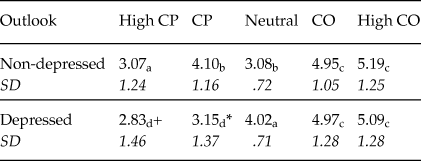
The target presentation (control vs. non-depressed) had no effect on perceived dysphoria, F(1, 38) = 0.62, ns, indicating that the manipulation was not effective. An ANOVA revealed a main effect from target outlook, F(8, 304) = 70.09, p < .001, η 2 = .06 (Table 6). In accordance with the previous results, the CP targets were judged to be dysphoric (i.e., sad, depressed, not hopeless and not funny), and the CO targets were perceived to be non-dysphoric.
Mean judgments of depressed mood attributed to the target according to Target’s outlook on the future in Study 3

Note: A common letter indicates a lack of significant difference, p < .05.
Mean target ratings of risk-taking potential
The results showed that the higher the targets’ levels of CP, the lower the ratings of their risk-taking potential, F(1, 38) = 19.31, p < .001 (linear contrast). Additionally, the higher the targets’ CO levels, the higher the ratings of their risk-taking potential, F(1, 38) = 10.58, p < .001, as expected (Hypothesis 3) (Table 7).
Mean risk-taking potential attributed to the target according to Target’s outlook on the future in Study 3

Note: A common letter indicates a lack of significant difference, p < .05.
Mean judgments of the targets’ social acceptance
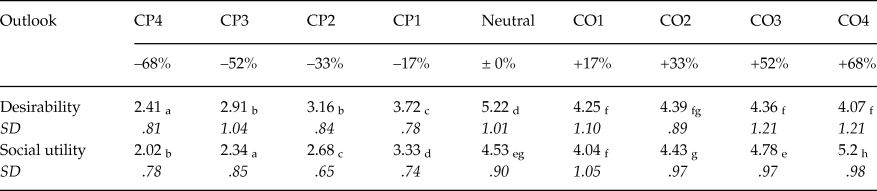
The CO targets were socially accepted in the social utility dimension, F(1, 38) = 36.81, p < .001 (linear contrast), but not in the social desirability dimension, F(1, 38) = .79, ns (linear contrast). Additionally, the CP targets were socially rejected; the higher their CP levels, the greater their rejection in the social desirability, F(1, 38) = 53.36, p < .001, and social utility dimensions, F(1, 38) = 84.54, p < .001 (linear contrast). It is noteworthy that the CP targets were less rejected in terms of desirability than in terms of social utility; these results supported Hypothesis 1b (Table 8).
Mean Judgments of social acceptance on Social Utility and Desirability Dimensions Attributed to Target in accordance with Target’s outlook on the future in Study 3

Note: A common letter indicates a lack of a significant difference (line by line and column by column), p < .05.
The influences of perceived dysphoria and risk-taking potential on social acceptance
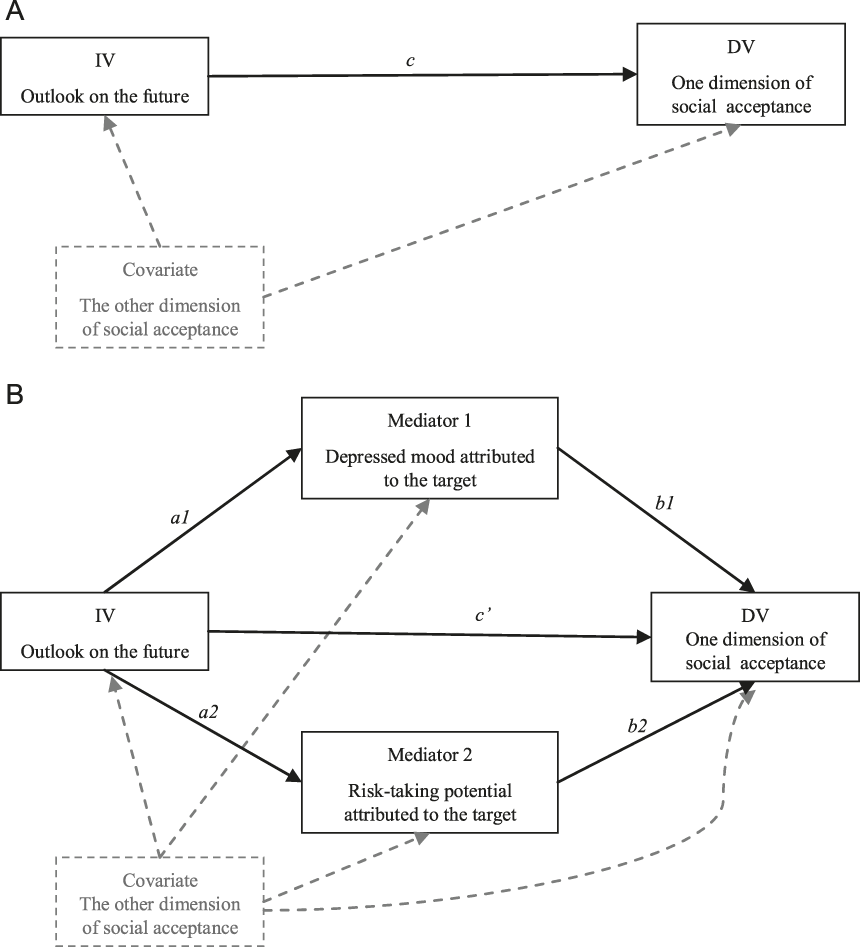
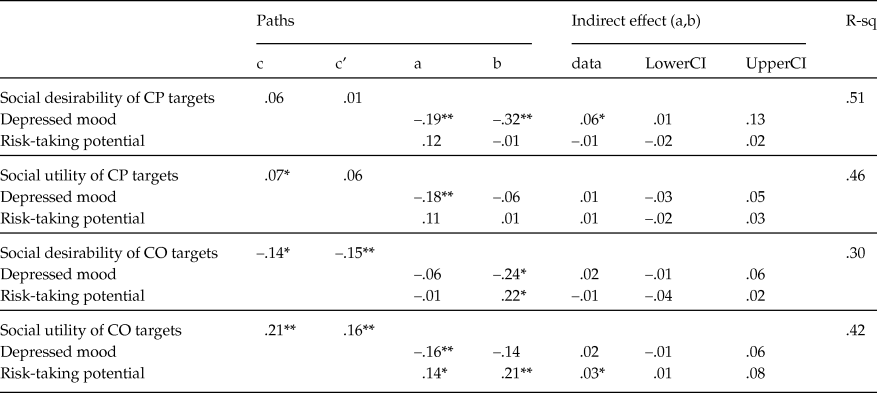
Given that the experimental manipulation (i.e., target’s depressive status) did not have any effect on the dysphoria attributed to the targets, a multiple mediation analysis was conducted to investigate the influences of perceived dysphoria and risk-taking potential in the targets on the mean social judgments (for details of the method, see Preacher & Hayes, Reference Preacher and Hayes2008). Only data from the control condition were used; the data did not include the neutral targets. Four multiple mediation analyses were performed for the CP and CO targets in the social desirability and social utility dimensions. For each analysis, the independent variable was the target’s outlook, the mediators were the mean ratings of perceived dysphoria and risk-taking potential, and the dependent variable was the mean judgment of social desirability (or social utility). The mean judgment in the social utility (or in the social desirability) dimension was a covariate (Figure 2). All variables were standardized. The bootstrap results were interpreted (with a sample of 5000), as recommended by Preacher and Hayes (Reference Preacher and Hayes2008) (Table 9).
Schematic diagram of multiple mediation analyses in Study 3.

Multiple Mediation Results for Comparatively Pessimistic or Optimistic Targets (not Neutral Targets) in Study 3

Note: *p < .05. **p < .001. 95% confidence intervals were used. We used a bootstrap sample of 5000, as recommended by Preacher and Hayes (Reference Preacher and Hayes2008).
The rejection of the CO targets in the social desirability dimension was explained neither by perceived dysphoria (Hypothesis 2a) nor by perceived risk-taking potential. However, their acceptance in the social utility dimension was partially mediated by their risk-taking potential. In other words, the higher the CO levels of the participants, the higher the ratings of their risk-taking potential and the greater their acceptance in the social utility dimension. Their non-depressed moods did not account for their acceptance in the social utility dimension (Hypothesis 3).
For the CP targets, the results showed that the dysphoria spontaneously attributed to them by the participants entirely mediated their social rejection in the social desirability dimension. In other words, the higher the targets’ CP levels, the more dysphoric they were perceived to be, which then caused them to be rejected in the social desirability dimension (Hypothesis 2b). When the effect of perceived dysphoria was controlled for, the targets ceased to be socially rejected because of their CP. An identical analysis showed that the risk-taking potential attributed to the CP targets was not related to their rejection in the social desirability dimension. In the social utility dimension, the results showed that neither perceived dysphoria nor perceived risk-taking potential was implicated in the rejection of the targets. In other words, the social rejection of the CP targets in the social utility dimension was not explained by perceptions of dysphoria or weak risk-taking potential.
Discussion
First, in this third study, the results supported those obtained in studies 1 and 2; the social judgments of CP and CO differed as a function of dimension (social desirability vs. social utility). Second, the results confirmed that when the participants had no information regarding the target’s depressive status, the CP targets were rejected in the social desirability dimension because they were perceived to be dysphoric. In other words, the stigma of depression biased the judgments. Being comparatively pessimistic is harmful enough that individuals are socially rejected for the purposes of future friendships (but not necessarily for the sake of future professional relations). Third, the results confirmed that one of the reasons for the social acceptance of CO in the social utility dimension is high levels of perceived risk-taking potential. The stereotype of a CO individual as a risk-taker helps CO individuals to be socially accepted for future professional relations (but not for future friendships). These findings emphasize the importance of considering both dimensions when investigating social judgments of CO and CP.
General Conclusions
The initial step in the present paper was to investigate and to explain the social judgments of different outlooks on the future. The literature previously showed that displays of CP are socially detrimental, whereas displays of CO are socially beneficial (Helweg-Larsen et al., Reference Helweg-Larsen, Sadeghian and Webb2002; Shepperd et al., Reference Shepperd, Grace, Cole and Klein2005). These experiments have provided in-depth explanations of these results, taking the research one step further by demonstrating the importance of social dimension for judgments. CP is less socially rejected in the social desirability dimension than in the social utility dimension; therefore, a pessimistic bias may occasionally be less detrimental than expected (Helweg-Larsen et al., Reference Helweg-Larsen, Sadeghian and Webb2002), as it has a more negative effect in the professional than in the interpersonal domain. These conclusions are consistent with those of Furr and Funder (Reference Furr and Funder1998), who reported that unhappiness and non-clinical depression are considered contributing factors to maladaptive social interactions. Moreover, their results showed that social rejection of negative personalities is only observed in a few items from the NEO-PI relating to social utility; non-clinically depressed personalities are associated with low conscientiousness, low action and low openness. Additionally, both social judgment dimensions should be used to investigate the social drawbacks of CO, as the dimensions are even more important when investigating the social benefits of CO. It was previously shown that the social benefits of CO concern the social utility dimension, but not social desirability (Le Barbenchon & Milhabet, Reference Le Barbenchon and Milhabet2005; Le Barbenchon et al., Reference Le Barbenchon, Milhabet, Steiner and Priolo2008). The current studies’ results are consistent with previous results and clearly show that the benefits of CO for interpersonal relations only occur when CO is perceived as a positive illusion or as a manner of coping with a depressed mood. Thus, the social benefits of being optimistically biased may be fewer than expected (Shepperd et al., Reference Shepperd, Grace, Cole and Klein2005; Taylor & Brown, Reference Taylor and Brown1988) and mainly occur in the professional domain. These results are consistent with studies that report correlations between displays of optimism and advantageous self-descriptions by leaders (Dolbier et al., Reference Dolbier, Soderstron and Steinhardt2001; Hickman et al., Reference Hickman, Watson and Morris1996; House & Shamir, Reference House, Shamir, Chemers and Ayman1998) and indicate that CO may be perceived as a sign of overconfidence and pretentiousness in interpersonal relationships (Taylor et al., Reference Taylor, Lerner, Sherman, Sage and McDowell2003) or perhaps as self-absorption or insensitivity to social feedback (Colvin et al., Reference Colvin, Block and Funder1995; John & Robins, Reference John and Robins1994).
The second step in the present paper was to investigate several possible reasons for the social judgments of outlooks on the future. The main factor taken into account in previous studies was the mood associated with particular outlooks (Carver et al., Reference Carver, Kus and Scheier1994; Helweg-Larsen et al., Reference Helweg-Larsen, Sadeghian and Webb2002). For this reason, the present study experimentally manipulated the presentations of the targets to convey “depressed” versus “non-depressed” moods. The results confirmed that our experimental manipulation was efficient. The results also showed that dysphoria mood is always attributed to individuals who display CP, compared to individuals who display a neutral outlook or CO, whatever the experimental condition. This stigma is so great that none of the three studies were able to overcome it.
Despite this stigma, the social rejection of depressed mood in the social desirability dimension was replicated; this effect is well established in the literature (Starr & Davila, Reference Starr and Davila2008). Indeed, as quoted by Helweg-Larsen “We might want to avoid associating with people who are sad, depressed and hopeless either because contact with such individuals is unpleasant or because they create a generally negative environment that most people prefer to avoid” (Helweg-Larsen et al., Reference Helweg-Larsen, Sadeghian and Webb2002, p. 104). Moreover, notable results were obtained concerning the role of depressed mood: (1) depressed mood is also rejected in the social utility dimension; and (2) the role of depressed mood in social rejection differs as a function of outlook on the future. This research showed that the social rejection of CP could be explained by the depressed mood that is attributed to it, as was observed by Helweg-Larsen et al. (Reference Helweg-Larsen, Sadeghian and Webb2002). The current results show that this finding was mainly true for the social rejection of CP in the social desirability dimension. It is notable that the depressed mood attributed to the CP targets did not mediate their social rejection in the social utility dimension. In other words, the main social damage of CP (i.e., in the social utility dimension) cannot be explained by the depressed mood that is attributed to CP. Therefore, further studies are necessary to investigate the reasons behind the detrimental effects of CP in the social desirability dimension. In regards to CO, if a depressed mood is associated with CO, it might damage one’s social perception in the professional domain, but depressed mood might also protect the individual from social rejection in the friendship domain. However, no obvious evidence was observed that the mood attributed to the CO targets explained how they were judged in the social desirability dimension when the participant had no additional information about the target (Study 3). Additionally, the non-depressed mood associated with CO did not explain its social acceptance in the social utility dimension.
Another explanation for the social judgments of CO individuals is that they are perceived as having the ability to take risks in social organizations. The highest levels of CO in the present study were associated with the greatest risk-taking potential, as was observed by Helweg-Larsen et al. (Reference Helweg-Larsen, Sadeghian and Webb2002). Being a potential risk-taker would refer to having the potential to be innovative and the ability to forge ahead, regardless of the objective risks. In other words, the risk-taking potential attributed to the CO individuals may refer to their positive illusions, which assist them in forging ahead and taking initiative (Armor & Taylor, Reference Armor, Taylor and Zanna1998). This explanation is particularly suitable for the social acceptance of CO in the social utility dimension. This finding is in accordance with studies reporting that optimism enhances firm performance because it is associated with risky choices in professional domains (Anderson & Galinsky, Reference Anderson and Galinsky2006). It is notable that perceived risk-taking potential does not influence social judgments regarding CP individuals; CP and CO may, therefore, be two different dimensions, rather than two extremes of a single “outlook on the future” continuum, as reported by Peeters, Czapinski, and Hoorens (Reference Peeters, Czapinski and Hoorens2001).
In these studies, the profiles represented fictitious individuals, which is often the case for this type of paradigm. Helweg-Larsen et al. (Reference Helweg-Larsen, Sadeghian and Webb2002) used hypothetical or recorded interviews. In future studies, it would be worthwhile to use such materials to reduce the artificiality of these profiles. An additional limitation concerns the plausibility of the targets. Do such targets really exist? Is it plausible to be pessimistic and not depressed? It is true that people who are in bad moods (Abele & Hermer, Reference Abele and Hermer1993; Salovey & Birmaum, Reference Salovey and Birmaum1989) or are anxious (Dewberry & Richardson, Reference Dewberry and Richardson1990) or depressed (Alloy & Ahrens, Reference Alloy and Ahrens1987; Pietromonaco & Markus, Reference Pietromonaco and Markus1985; Pyszczynski, Holt, & Greenberg, Reference Pyszczynski, Holt and Greenberg1987) display often lower comparative optimism than non-anxious, non-depressed, and happy people, but are not necessarily realistic or pessimistic (Helweg-Larsen & Shepperd, Reference Helweg-Larsen and Shepperd2001). Additionally, anxiety, bad mood and depression are not systematically congruent with pessimism. In this context, the plausibility of being pessimistic but not depressed appeared in study 2 by Helweg-Larsen et al. (Reference Helweg-Larsen, Sadeghian and Webb2002), as well as in the current studies. In addition, is it plausible to be optimistic and depressed? In the same way, congruence between outlook on the future and mood is expected. Such targets were not tested in previous studies about social acceptance. However, all of these types of targets were perceived as credible in all studies. In this context, behavioral measures could be used to test acceptance and rejection. For example, a realistic encounter or a simulation of recruitment could be organized to increase the credibility of the situation.
Despite these limitations, the results support the idea that investigations of the social acceptance of CP or CO require consideration of both dimensions of social judgment because the depressed mood attributed to CP targets was not sufficient to justify their social rejection (which was mainly observed in the social utility dimension). The perceived potential for risk-taking appears to be a promising avenue for exploring the social benefits of CO (which are only observed in the social utility dimension).
Appendix 1
Questions about targets’ social acceptance (Studies 1–3)

Appendix 2
Traits used for measuring social desirability and social utility