Introduction
The ability to navigate the increasingly complex social landscape of childhood and adolescence is likely reliant on a range of complex cognitive-affective behaviours, in particular, Theory of Mind (ToM); a multidimensional construct that allows individuals to ascribe a variety of psychological states, such as intentions or emotions, to understand and subsequently predict behaviours (Blakemore, Reference Blakemore2008; Herbet, Lafargue, Bonnetblanc, Moritz-Gasser, & Duffau, Reference Herbet, Lafargue, Bonnetblanc, Moritz-Gasser and Duffau2013; Walz, Yeates, Wade, & Mark, Reference Walz, Yeates, Wade and Mark2009).
Recent neuroimaging and behavioural evidence supports a tripartite model that distinguishes three types of ToM: cognitive, affective, and conative (Dennis et al., Reference Dennis, Simic, Bigler, Abildskov, Agostino, Taylor and Stancin2013b). Cognitive ToM is concerned with understanding others’ beliefs, traditionally assessed using paradigmatic false-belief tasks (Wellman et al., Reference Wellman, Cross and Watson2001). In contrast, more complex aspects of ToM can be partitioned into conative ToM, defined as the ability to understand how indirect speech acts involving irony and empathy are used to influence the mental or affective state of the listener; and affective ToM, concerned with understanding that facial expressions are often used for social purposes to convey emotions that we want people to think we feel (Dennis et al., Reference Dennis, Simic, Bigler, Abildskov, Agostino, Taylor and Stancin2013b; Hein and Singer, Reference Hein and Singer2007).
Although cognitive ToM matures rapidly during infancy and early childhood (Sodian et al., Reference Sodian, Thoermer and Metz2007; Surian et al., Reference Surian, Caldi and Sperber2007; Wellman et al., Reference Wellman, Cross and Watson2001), affective and conative ToM show protracted maturation through late childhood and adolescence (Dumontheil, Apperly, & Blakemore, Reference Dumontheil, Apperly and Blakemore2010; Sebastian et al., Reference Sebastian, Fontaine, Bird, Blakemore, De Brito, McCrory and Viding2011; Wang, Lee, Sigman, & Dapretto, Reference Wang, Lee, Sigman and Dapretto2006), coinciding with the extended structural maturation of a distributed ‘social brain network’ (Adolphs, Reference Adolphs2009; Burnett, Sebastian, Kadosh, & Blakemore, Reference Burnett, Sebastian, Kadosh and Blakemore2011; Choudhury, Blakemore, & Charman, Reference Choudhury, Blakemore and Charman2006; Dumontheil et al., Reference Dumontheil, Apperly and Blakemore2010; Johnson et al., Reference Johnson, Griffin, Csibra, Halit, Farroni, De Haan and Richards2005). Structural brain maturation throughout late childhood and adolescence is associated with increasing functional specialisation of higher order fronto-temporal association regions that underlie affective and conative ToM (Blakemore, den Ouden, Choudhury, & Frith, Reference Blakemore, den Ouden, Choudhury and Frith2007; Gogtay et al., Reference Gogtay, Giedd, Lusk, Hayashi, Greenstein, Vaituzis and Toga2004; Johnson et al., Reference Johnson, Griffin, Csibra, Halit, Farroni, De Haan and Richards2005). Despite this, little is known about the long-term impact of paediatric traumatic brain injury (TBI) on the acquisition and establishment of these higher order social-cognitive skills.
Recent behavioural evidence supports the vulnerability of complex ToM to disruption from paediatric TBI. In a large cross-sectional retrospective study, Dennis et al. (Reference Dennis, Simic, Bigler, Abildskov, Agostino, Taylor and Stancin2013b) found that, relative to orthopaedic injury controls, children with mild-moderate and severe TBI showed significantly poorer performance on experimental measures of conative and affective ToM; a pattern of impairment that was not fully explained by difficulty with the domain-general demands of the task (Dennis et al., Reference Dennis, Agostino, Taylor, Bigler, Rubin, Vannatta and Yeates2013a; Dennis et al., Reference Dennis, Simic, Bigler, Abildskov, Agostino, Taylor and Stancin2013b). Though evidence for group differences on these tasks supports the vulnerability of complex ToM to paediatric TBI, there likely exists substantial variability in ToM outcomes that is not accounted for by early clinical indicators of injury severity. This possibility has been addressed in a conceptual model of social outcomes proposed by Yeates et al. (Reference Yeates, Bigler, Dennis, Gerhardt, Rubin, Stancin and Vannatta2007), which argues that injury- and non-injury-related risk and resilience factors interact dynamically to contribute to substantial heterogeneity in social outcomes after paediatric TBI. More specifically, injury factors (e.g., injury severity and location of injury) interact with proximal (within the family) and distal (outside the family, e.g., socio-economic status) environmental factors to contribute to substantial individual variability in outcome and recovery of social function after paediatric TBI (Gerring & Wade, Reference Gerring and Wade2012; Yeates et al., Reference Yeates, Swift, Taylor, Wade, Drotar, Stancin and Minich2004; Yeates et al., Reference Yeates, Bigler, Dennis, Gerhardt, Rubin, Stancin and Vannatta2007).
Previous reports show that distal factors such as lower socio-economic status (SES) may confer increased risk for social and behavioural difficulties after paediatric TBI (Chapman et al., Reference Chapman, Wade, Walz, Taylor, Stancin and Yeates2010b; Lalonde, Bernier, Beaudoin, Gravel, & Beauchamp, Reference Lalonde, Bernier, Beaudoin, Gravel and Beauchamp2016; Schwartz et al., Reference Schwartz, Taylor, Drotar, Yeates, Wade and Stancin2003; Taylor et al., Reference Taylor, Yeates, Wade, Drotar, Stancin and Minich2002); however, there is evidence that the quality of the family environment may be an equally important determinant of post-injury recovery and outcome (Anderson, Spencer-Smith, & Wood, Reference Anderson, Spencer-Smith and Wood2011; Rosema, Crowe, & Anderson, Reference Rosema, Crowe and Anderson2012). For instance, studies of young children with TBI show that maladaptive parenting styles and greater family dysfunction are associated with poorer social and behavioural outcomes (Chapman et al., Reference Chapman, Wade, Walz, Taylor, Stancin and Yeates2010b; Kurowski et al., Reference Kurowski, Taylor, Yeates, Walz, Stancin and Wade2011; Wade et al., Reference Wade, Cassedy, Walz, Taylor, Stancin and Yeates2011; Yeates, Taylor, Walz, Stancin, & Wade, Reference Yeates, Taylor, Walz, Stancin and Wade2010). Despite this, the potential contribution of these factors to social outcomes in older children and adolescents has received relatively limited attention.
Theoretical models of ‘social brain’ maturation posit that late childhood and adolescence represent ‘critical periods’ of maximal sensitivity to peer and family influences (Blakemore, Reference Blakemore2008; Blakemore, Reference Blakemore2011; Blakemore & Mills, Reference Blakemore and Mills2014; Burnett & Blakemore, Reference Burnett and Blakemore2009). In line with this account, reports show that despite the increased salience of peer relationships during adolescence, the emotional quality of parenting behaviours wields a strong influence on aspects of adolescent socio-emotional development (Robinson, Reference Robinson2007; Steinberg & Morris, Reference Steinberg and Morris2001). For instance, in a large longitudinal study of typically developing (TD) adolescents, the affective quality of parent–child interactions at age 13 years was found to prospectively predict aspects of socio-emotional adjustment, including depression and anxiety symptoms at age 15 years (Schwartz et al., Reference Schwartz, Dudgeon, Sheeber, Yap, Simmons and Allen2012).
Given that family environmental factors may wield a potent influence on the development of the traumatically injured brain (Anderson et al., Reference Anderson, Spencer-Smith and Wood2011), one might predict that increased family affective responsiveness represents one potential buffer against the negative social cognitive sequelae of paediatric TBI. More specifically, it is conceivable that within a family affective climate characterised by increased opportunities to observe, model, and reference how parents and family members express and use emotion for various social purposes, children with TBI are more likely to acquire more complex forms of social knowledge. This, in turn, may influence how these children develop understandings of the emotions and intentions of others.
The aims of this study were to (1) evaluate the impact of paediatric TBI on long-term conative and affective ToM outcomes assessed at 24-months post injury; (2) explore the relative contributions of (i) clinical indicators of injury severity, (ii) lesion location, and (iii) post-acute family affective responsiveness to long-term ToM outcomes. In keeping with previous research (Dennis et al., Reference Dennis, Agostino, Taylor, Bigler, Rubin, Vannatta and Yeates2013a, Reference Dennis, Simic, Bigler, Abildskov, Agostino, Taylor and Stancin2013b), we predicted a dose-response relationship between injury severity and ToM performance; with the poorest outcomes likely associated with more severe injury. We also predicted that poorer conative and affective ToM would be associated with (i) lesions to the frontal and temporal cortices, (ii) lower SES, and (iii) poorer family affective responsiveness at 6-months post injury.
Method
Participants
This study comprised 124 children, 84 survivors of mild-severe TBI (58 males), and 40 TD children (22 males) group-matched on age and gender. All participants were ascertained between 2007 and 2010, and were aged between 5.5 and 15.11 years at time of recruitment. As part of the larger longitudinal prospective study which aimed to investigate the psychosocial consequences of paediatric TBI (Anderson et al., Reference Anderson, Beauchamp, Yeates, Crossley, Hearps and Catroppa2013), children were recruited at time of injury, and represented consecutive admissions to The Royal Children's Hospital (RCH), Melbourne, Australia. TD children were recruited through local schools chosen to ensure a range of socio-economic backgrounds.
Inclusion criteria for the TBI group were (i) aged 5.0 – 16.0 years at recruitment; (ii) documented evidence of closed head injury, including a period of altered consciousness or presence of at least two post-concussive symptoms; (iii) medical records sufficiently detailed to determine injury severity, including the Glasgow Coma Scale (GCS; Teasdale & Jennett, Reference Teasdale and Jennett1974), and neurological and radiological findings; (iv) no history of pre-injury neurological or developmental disorder (including learning or attention disability, or autistic spectrum disorder), non-accidental injury, or previous TBI; (v) no prior intervention for social impairment; (vi) English speaking. The TD control group were required to meet inclusion criteria (i), (iv), (v), and (vi).
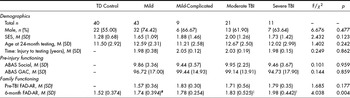
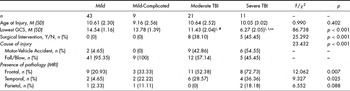
As shown in Tables 1 and 2, participants with TBI were classified as follows: (i) mild TBI (n = 43): Glasgow Coma Score (GCS) 13–15, no evidence of mass lesion on CT or clinical MRI and no neurologic deficits; (ii) mild complicated TBI (n = 9): GCS 13–15, evidence of mass lesion on CT or clinical MRI; (iii) moderate TBI (n = 21): GCS 9–12, and/or mass lesion or other evidence of specific injury on CT/MRI, and/or neurological impairment; (iv) severe TBI (n =11): GCS 3–8, and/or mass lesion or other evidence of specific injury on CT/MRI, and/or neurological impairment. Despite the small cell size for the mild complicated TBI group (n = 9), we adopted this severity classification system to ensure consistency and comparability of results with ToM data collected from this sample at 6-months post-injury, and reported elsewhere (Ryan et al., Reference Ryan, Catroppa, Beare, Silk, Crossley, Beauchamp and Anderson2016).
Demographic and Family Characteristics of the Sample

Note: Significant (p < .05) post-hoc analyses comparing #TD-Control vs. TBI-Mild, ‡TD-Control vs. TBI-Moderate, †TD-Control vs. TBI-Severe.
ABAS =Adaptive Behaviour Assessment System; GAC = Global Adaptive Composite; FAD-AR= Family Assessment Device- Affective Responsiveness Subscale.
TBI Injury Characteristics of the TBI sample

Note: Significant (p < .05) post-hoc analysis comparing ‡TBI-Mild vs. TBI-Moderate, †TBI-Mild versus TBI Severe, # TBI-Mild Complicated versus Moderate, ⱡTBI- Mild complicated versus TBI Severe, **TBI Moderate versus TBI Severe.
GCS = Glasgow Coma Scale.
Injury Measures
Injury characteristics
For participants with TBI, the following details were collected via standard clinical report forms: GCS, duration of coma, surgical intervention, and cause of injury.
Structural MRI
All participants underwent structural MRI including a susceptibility weighted imaging (SWI) sequence as part of the research protocol. MR images were acquired as soon as possible after recruitment on a three Tesla Siemens Trio scanner (Siemens Medical Systems, Erlangen, Germany) using a 32-Channel matrix head coil, and using a standard acquisition sequence as follows; Transverse Turbo Spin-Echo (TSE) aligned parallel to the anterior commissure – posterior commissure line [repetition time (TR) = 6380 ms; echo time (TE) = 93 ms; ETl = 17; band-width (BW) 189 Hz/Px; resolution .6 × .6 × 3.5 mm], sagittal three-dimensional (3D) MPRAGE [TR = 1900 ms; TE = 2.15 ms; IR prep = 900 ms; parallel imaging factor (GRAPPA) 2; flip angle 9 degrees; BW 200 Hz/Px; 176 slices; resolution 1 × 1 × 1 mm], sagittal 3D T2 Weighted non-selective inversion preparation SPACE (Sampling Perfection with Application-optimised Contrast using different flip-angle Evolution) [TR = 6000 ms; TE = 405 ms; inversion time (TI) = 2100 ms; water excitation; GRAPPA Pat2; 176 slices; 1 × 1 × 1 mm resolution matched in alignment to the 3D T1-weighted sequence].
The location of neuroanatomical lesions was identified through visual inspection of MRI by a paediatric neuroradiologist and neuropsychologist with neuroimaging experience blind to injury severity. Lesions were identified and coded based on location (frontal, temporal, parietal, occipital) using a modification of the Coffey classification system (Beauchamp et al., Reference Beauchamp, Ditchfield, Babl, Kean, Catroppa, Yeates and Anderson2011; Coffey & Figiel, Reference Coffey and Figiel1991). Since frontal–temporal regions are commonly vulnerable to the effects of paediatric TBI (Bigler, Reference Bigler2013; Bigler et al., Reference Bigler, Abildskov, Petrie, Farrer, Dennis, Simic and Owen Yeates2013) and are also considered putative hub regions of brain networks that underlie ToM (Molenberghs, Johnson, Henry, & Mattingley, Reference Molenberghs, Johnson, Henry and Mattingley2016), the presence or absence of frontal and temporal brain lesions (on any of the research MRI sequences) were employed in outcome prediction analyses.
Environmental Measures
Socioeconomic status
SES was determined using the Australian Socioeconomic Index 2006 (Trewin, Trewin, Pink, & Zealand, Reference Trewin, Trewin, Pink and Zealand2006). Scores were assigned to each of the child's primary caregivers and the highest of these scores (highest SES skill level) was taken to index family SES for each participant.
Post-acute Family Affective Responsiveness (6-months post-injury) was evaluated using the 12-item Family Affective Responsiveness subscale of the Family Assessment Device (Epstein, Baldwin, & Bishop, Reference Epstein, Baldwin and Bishop1983). Scores were rated along a 4-point Likert scale, ranging from 1 = Strongly Disagree to 4 = Strongly Agree (e.g., ‘some of us just don't respond emotionally’, ‘we do not show our love for each other’.) Higher scores indicate poorer quality family affective responsiveness. Cronbach's alpha indicates an internal reliability of .83–.86 for this subscale (Epstein et al., Reference Epstein, Baldwin and Bishop1983).
Baseline Child Measures (At Recruitment)
Upon recruitment into the study, parents provided retrospective ratings of their child's behaviour and adaptive skills in the weeks preceding injury to provide an estimate of baseline social functioning. Estimates of pre-injury functioning were compared with ratings provided by TD control parents who also completed these questionnaires about their child at the time of initial recruitment.
Pre-injury adaptive and social functioning
Parents provided retrospective ratings of pre-injury adaptive and social behaviour using the Adaptive Behavior Assessment System-II (ABAS-II) (Harrison & Oakland, Reference Harrison and Oakland2003), a parent questionnaire that examines functional skills necessary for daily living. The ABAS-II Global Adaptive Composite (M = 100, SD = 15) and ABAS-II Social Composite are reported. The Social Composite evaluates children's ability to interact socially, engage in play, initiate and maintain friendships, and express and recognise emotions.
Theory of Mind (24-Months Post-Injury)
The Emotional and Emotive Faces Task (EEFT) (Dennis et al., 2013a) was used to assess affective ToM, or the child's understanding of the difference between emotional expression (how a character actually feels) and emotive communication (the emotion a character expresses socially, which may be different from the emotion actually felt). Children were presented with short narratives that described a character in situations that were meant to evoke one of five basic emotions: happiness, sadness, disgust, fear, and anger. In each vignette, a discrepancy existed between the emotion felt ‘inside’ and the character's facial expression. In line with the interpretative guidelines provided by the test developers (Dennis et al., Reference Dennis, Simic, Bigler, Abildskov, Agostino, Taylor and Stancin2013b) each vignette involves (1) affective ToM trials, which ask the child how the character looked on his/her face (‘look on face’ condition) and (2) otherwise identical control trials, which merely require the child to select the facial emotion display that matches the in-text description of how the protagonist was feeling (‘feel inside’ condition). ‘Feel inside’ control items are considered distinct from affective ToM trials since they measure the emotion on the face as a transparent read-out of the emotion experienced (Dennis et al., Reference Dennis, Simic, Bigler, Abildskov, Agostino, Taylor and Stancin2013b). Sample items for both conditions are described in Appendix 1. Percentage of correct responses for emotive communication trials (i.e., ‘Look on Face’) was the primary measure of affective ToM.
The Ironic Criticism and Empathic Praise task (ICEPT) (Dennis et al., 2013b) assesses conative ToM, or the child's understanding of how indirect speech acts are used to influence the mental or emotional state of the listener. Children were presented with six vignettes involving pictures of two children, one of whom was engaged in an activity and another who commented on their performance of the activity. The pictures were presented alongside a narrative, and an audio recording of the speaker's utterances with neutral, ironic, or empathic intonation. Children were told (1) the goal of the child engaged in the activity (e.g., to build a tower); (2) the outcome (e.g., ‘the tower was. . . ’); (3) the speaker's character (e.g., ‘she liked to cheer people up’); and (4) what the speaker said (e.g., ‘You made a great tower’). In keeping with the interpretative guidelines provided by the test developers (Dennis et al., Reference Dennis, Simic, Bigler, Abildskov, Agostino, Taylor and Stancin2013b), each vignette involves (1) conative ToM trials, which require the child to identify the beliefs and intentions underlying referentially opaque communications involving irony and empathy, and (2) otherwise identical control items that have comparable domain-general cognitive demands but do not require conative ToM processing (Dennis et al., Reference Dennis, Simic, Bigler, Abildskov, Agostino, Taylor and Stancin2013b). Control items are considered distinct from conative ToM since they probe beliefs and intentions in literally true statements, and thus do not require the child to infer how indirect speech acts (i.e., irony and empathy) are used to influence the mental and emotional state of the listener. Sample items for both conditions are described in Appendix 1. Percentage of correct responses for indirect speech acts, which reflected the understanding of belief and intent for empathic praise and ironic criticism conditions, was the primary measure of conative ToM.
Procedure
This study was approved by the Human Research Ethics Committee and the Department of Education Research Ethics Committee. All families were initially contacted to ascertain their willingness to participate in the study and mailed details of the study and requests for written consent. Questionnaires assessing pre-injury child and family function were completed by parents upon recruitment to the study. Research MRI scans were conducted between 2 and 8 weeks post-injury. At 24-months post injury, children participated in a comprehensive face-to-face assessment, which included the experimental ToM measures.
Statistical Analysis
All data were entered into SPSS Version 20.00 and screened for missing data and violations of normality. Normality plots indicated that affective and conative ToM measures were normally distributed, and preliminary analysis indicated no violation of assumptions across analyses unless otherwise stated. Multicollinearity was explored, with injury age and age at testing being highly correlated, consistent with the longitudinal design of the project. Age at testing was entered as a covariate in all subsequent analyses.
Group comparisons (TBI severity groups versus TD controls) were conducted via ANOVAs for the following descriptive variables: age at testing, SES, pre-injury adaptive behaviour (ABAS), and pre- and post-injury family functioning (FAD). A chi-square analysis was conducted to determine whether there were sex differences across the groups. Percentages and frequencies are reported for the following injury characteristics: cause of accident, presence of surgical intervention (yes or no), and pathology location, with chi-square analyses to determine whether there were differences between injury severity groups.
Analyses of covariance (ANCOVAs) controlling for age and baseline ABAS-II GAC scores were conducted to examine the effect of injury severity group membership on conative and affective ToM, with post-hoc testing using pairwise comparisons (p < .05, uncorrected). For group comparisons, injury severity group classification was based on severity categories adopted in previous publications from the larger longitudinal study (see Section 2.1). This approach was used to ensure consistency and comparability of results with ToM data collected from this sample at 6-months post injury, and reported elsewhere (Ryan et al., Reference Ryan, Catroppa, Beare, Silk, Crossley, Beauchamp and Anderson2016). However, we acknowledge that sample attrition at 24-months post injury reduces our statistical power to detect group differences using this original group classification. To explore this possibility, we also examined potential group differences by collapsing the original severity group membership categories into a three-level severity variable (i.e., TD control vs. mild uncomplicated TBI vs. Mild complicated-Severe TBI).
Hierarchical regression models were used to examine the contribution of injury-related variables (Step 1: GCS, lesion location, and age at testing) and family environmental factors (Step 2: SES, FAD Affective Responsiveness) to conative and affective ToM outcomes in the TBI group.
Results
Sample Descriptives
As shown in Table 1, groups did not significantly differ in terms of demographic or pre-injury child/family characteristics. For injury variables, comparisons of the severity groups showed expected differences for lowest GCS and for surgical involvement, such that the moderate and severe TBI groups were significantly more likely to require these interventions. Cause of injury was predominately falls/blows in the Mild (95%) and mild-complicated TBI group (100%). For the moderate and severe TBI groups, falls/blows (57% and 45%, respectively) and motor vehicle accidents (43% and 55%, respectively) were equally common (see Table 2).
Theory of Mind Performance
Affective ToM
As shown in Table 3, ANCOVA covarying for age and baseline ABAS scores revealed a significant main effect of injury severity group membership on Affective ToM. Pairwise comparisons indicated that the moderate TBI group performed significantly worse than the TD control group (M diff = −9.04; p = .017; d = −.45). Moreover, the mild-complicated TBI group showed significantly poorer performance than the TD control (mean difference [M diff] = −12.72, p = .014; d = −.86), mild TBI (M diff = −10.37; p = .038; d = −.75), and severe TBI group (M diff = −13.23; p = .032; d = −.95). There was no significant main effect of injury severity on EEFT control task performance (see Table 3).
Performance on Theory of Mind Tasks According to Group

Note: Significant (p < .05) post-hoc analyses comparing †TD vs. TBI-Moderate; #TD vs. TBI-Mild complicated; ‡TBI-Mild vs. TBI-Mild complicated; *TBI Moderate vs. TBI-Mild complicated; **TBI-Severe vs. TBI-Mild complicated.
EEFT, Emotional and Emotive Faces Task; ICEPT, Ironic Criticism & Empathic Praise Task; TBI, traumatic brain injury; TD; typically developing control; M, mean; SD; standard deviation.
When injury severity group membership was collapsed into a three-level variable (TD control vs. Mild vs. Mild complicated-Severe), there was no significant main effect of group on affective ToM, F(2, 124) = 1.661, p = .194.
Conative ToM
As shown in Table 3, ANCOVA covarying for age and baseline ABAS scores revealed a significant main effect of injury severity group membership on Conative ToM. Pairwise comparisons indicated that the mild-complicated TBI group showed significantly poorer performance than the TD control group (M diff = −12.08, p = .004; d = −1.09), mild TBI group (M diff = −13.68; p = .001; d = −1.29) and moderate TBI group (M diff = −10.90; p = .012; d = −.97). There was no significant main effect of injury severity on ICEPT control task performance (see Table 3).
When injury severity group membership was collapsed into a three-level variable (TD control vs. Mild vs. Mild Complicated-Severe), there was no significant main effect of group on conative ToM, F(2, 124) = 1.953, p = .146.
Contribution of Injury and Environmental Factors to ToM Performance
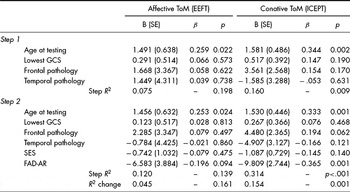
Within the TBI group, hierarchical regression analyses explored injury-related and family environmental predictors of conative and affective ToM (see Table 4). Each regression model instituted two blocks, with the first including injury related variables, and the second block including distal (SES) and proximal (FAD affective responsiveness) environmental factors.
Hierarchical Regression Analysis Predicting Affective and Conative ToM from Injury and Environmental Variables

EEFT = Emotive and Emotive Faces Task; I & E= Irony and Empathy Task; SES = Socio-economic Status; FAD-AR = Family Assessment Device, Affective Responsiveness Sub-scale.
Affective ToM
Block 1 of the hierarchical regression model was not statistically significant for injury variables, F(4,80) = 1.543, p = .198, or after addition of environmental factors in Block 2, F(6,80) = 1.677, p = .139 (see Table 4).
Conative ToM
Block 1 of the hierarchical regression was statistically significant, F(4,80) = 3.626, p = .009, and explained 16% of the variance in conative ToM performance (see Table 4). In Block 1, age at testing was the sole predictor of outcome (see Table 4). The introduction of environmental factors into the model, after controlling for injury-related factors, explained an additional 15.4% of variance (R 2 change = .154, F(2, 74) = 8.289, p = .001), with the overall model now explaining 31.4% of variance, F(6,80) = 5.644, p < .001. In the final model, family affective responsiveness was the strongest individual predictor of outcome, followed by age at testing (see Table 4).
Discussion
The purpose of this prospective study was to evaluate the respective contributions of injury-related factors and non-injury-related environmental variables to long-term ToM outcomes in children and adolescents with TBI. Contrary to expectations of a dose-response relationship between injury severity and chronic ToM outcomes, the poorest ToM outcomes were documented in association with mild-complicated and moderate TBI, rather than severe TBI. Whilst the neuroanatomical location of lesions and SES were not significantly associated with ToM outcomes, post-acute family affective responsiveness was the strongest and most significant predictor of conative ToM, even after covarying for relevant injury-related variables.
Our findings showed that children with moderate and mild-complicated TBI performed significantly worse than TD controls on measures of ToM. These group differences were documented alongside relatively preserved performance on non-social cognitive control trials. These results extend previous findings from this sample at 6-months post injury (Ryan et al., Reference Ryan, Catroppa, Beare, Silk, Crossley, Beauchamp and Anderson2016) and suggest that with the exception of the severe TBI group, difficulties that appear specific to the ToM domain persist until at least 24-months post injury.
Limited evidence for ToM difficulties in the severe TBI group is perhaps surprising, and contrasts with previous evidence for a dose-response relationship between injury severity and performance on these measures in a retrospective study of chronic ToM outcomes in children with TBI (Dennis et al., Reference Dennis, Simic, Bigler, Abildskov, Agostino, Taylor and Stancin2013b). Several potential factors may account for this unexpected pattern of findings. First, chronic ToM difficulties may be more apparent amongst children with mild-complicated and moderate injuries because, unlike children with severe TBI, they are less likely to have adequate access to rehabilitation and support for school reintegration. Second, the unexpected findings might reflect substantial heterogeneity in the extent of injury to higher cortical regions in children classified with severe TBI based on initial clinical and neuroimaging indicators, including lowest GCS, duration of loss of consciousness (LOC), and the presence of mass lesions detected on computed tomography (CT). More specifically, these initial clinical indicators lack sensitivity to structural abnormalities in frontal–temporal–limbic brain circuits, which are commonly vulnerable to the acceleration–deceleration forces of paediatric TBI (Bigler et al., Reference Bigler, Abildskov, Petrie, Farrer, Dennis, Simic and Owen Yeates2013), and have prognostic significance for post-acute ToM outcomes (Ryan et al., Reference Ryan, Catroppa, Beare, Silk, Crossley, Beauchamp and Anderson2016). Overall, weak evidence for a dose response relationship between severity and chronic ToM suggests that clinicians should exercise caution when prognosticating based on early clinical indicators of injury severity, and that individual and group- level outcome prediction should incorporate assessment of a broad range of injury- and non-injury-related risk and resilience factors.
Despite recent meta-analytic support for the contribution of frontal and temporal brain regions to ToM (Molenberghs et al., Reference Molenberghs, Johnson, Henry and Mattingley2016), the presence of lesions in the frontal and temporal cortices did not significantly contribute to ToM outcomes. This surprising pattern of findings contrasts with recent evidence that lesions to these brain regions are associated with increased risk for impairments in false belief understanding and other early emerging aspects of pragmatic communication (Ryan et al., Reference Ryan, Catroppa, Beare, Coleman, Ditchfield, Crossley and Anderson2015a; Ryan et al., Reference Ryan, Catroppa, Cooper, Beare, Ditchfield, Coleman and Anderson2015c). Given recent support for the protracted maturation of affective and conative ToM (Blakemore et al., Reference Blakemore, den Ouden, Choudhury and Frith2007; Dumontheil et al., Reference Dumontheil, Apperly and Blakemore2010; Sebastian et al., Reference Sebastian, Fontaine, Bird, Blakemore, De Brito, McCrory and Viding2011), it is conceivable that the hypothesised pattern of brain–behaviour relationships may not become apparent in younger children until later in the course of development (i.e., adolescence), when brain regions critically involved in these functions are undergoing rapid structural and functional maturation (Blakemore, Reference Blakemore2008; Blakemore, Reference Blakemore2011; Blakemore & Mills, Reference Blakemore and Mills2014; Burnett & Blakemore, Reference Burnett and Blakemore2009; Ryan et al., Reference Ryan, Catroppa, Cooper, Beare, Ditchfield, Coleman and Anderson2015b).
Extending on previous reports of robust links between long-term behavioural outcomes and the quality of the post-injury family environment in young children (Chapman et al., Reference Chapman, Wade, Walz, Taylor, Stancin and Yeates2010a; Kurowski et al., Reference Kurowski, Taylor, Yeates, Walz, Stancin and Wade2011; Wade et al., Reference Wade, Cassedy, Walz, Taylor, Stancin and Yeates2011; Yeates et al., Reference Yeates, Taylor, Walz, Stancin and Wade2010), family affective responsiveness was the strongest individual predictor of conative ToM, after covarying for relevant injury-related variables. Of particular interest, and contrary to a recent report linking poorer post-injury social perception to distal environmental factors (Schmidt, Hanten, Li, Orsten, & Levin, Reference Schmidt, Hanten, Li, Orsten and Levin2010; Schmidt, Orsten, Hanten, Li, & Levin, Reference Schmidt, Orsten, Hanten, Li and Levin2010), family SES did not contribute significantly to affective or conative ToM. Nevertheless, our findings suggest that the proximal family environment may wield a potent influence on conative ToM outcomes.
Results from this study have both theoretical and clinical relevance. In keeping with recent evidence that late childhood and adolescence represent a ‘sensitive period’ for ‘social brain’ development (Blakemore & Mills, Reference Blakemore and Mills2014; Burnett & Blakemore, Reference Burnett and Blakemore2009), our findings suggest that increased opportunities to observe, model, and reference parental expressions of different emotions and mental states may buffer against the negative social cognitive sequelae of paediatric TBI. From a clinical perspective, our findings underscore the importance of long-term follow-up of children and families presenting with both injury- and non-injury-related risk factors (Gerring & Wade, Reference Gerring and Wade2012). In particular, this study suggests that the post-acute family affective climate represents a potentially modifiable risk factor that may form a useful target for evidence-based, context-sensitive interventions designed to optimise long-term social cognitive outcomes.
Limitations
The strength of the current findings is weakened by sole reliance on parent-report measures of family affective dynamics. Further studies using larger samples are required to replicate these findings using observational assessment methods to complement parental report of early family dynamics (Lalonde et al., Reference Lalonde, Bernier, Beaudoin, Gravel and Beauchamp2016). Another potential caveat of the study is the limited neuroanatomical specificity of our lesion detection protocol, which may help explain the non-significant relationships between ToM and lesion location. Further research is needed to investigate the prognostic utility of volumetric changes in specific neurocognitive networks, which are shown to predict post-acute and chronic social outcomes in the child TBI population (Levan, Baxter, Kirwan, Black, & Gale, Reference Levan, Baxter, Kirwan, Black and Gale2015; Ryan et al., Reference Ryan, Catroppa, Beare, Silk, Crossley, Beauchamp and Anderson2016).
A further limitation of the study concerns the use of experimental measures of ToM across a large age-range of children. We acknowledge that these experimental tests are sensitive to the influence of developmental age; an effect that has been statistically controlled for, and examined in previous studies of this sample (Ryan et al., Reference Ryan, Catroppa, Cooper, Beare, Ditchfield, Coleman and Anderson2015b). Nevertheless, previous studies of paediatric samples in the United States show that these experimental measures are sensitive to social ability level in children of the same age or younger than our study participants (Dennis et al., Reference Dennis, Agostino, Taylor, Bigler, Rubin, Vannatta and Yeates2013a, Reference Dennis, Simic, Bigler, Abildskov, Agostino, Taylor and Stancin2013b).
Moreover, though our results suggest that the affective quality of post-acute family interactions represents a useful marker to identify children at risk for persisting difficulties, the wide age range of children in our sample limited the strength of these findings. For instance, recent theoretical accounts of ‘social brain’ development suggest that adolescence represents a period of heightened sensitivity to peer and family influences (Blakemore & Mills, Reference Blakemore and Mills2014). As such, further studies are needed to compare the strength of these influences across distinct developmental stages, to determine whether family and peer influences may wield a particularly potent influence on recovery of social cognitive skills in adolescents with TBI.
Conclusions
In line with previous reports (Dennis et al., Reference Dennis, Agostino, Taylor, Bigler, Rubin, Vannatta and Yeates2013a, Reference Dennis, Simic, Bigler, Abildskov, Agostino, Taylor and Stancin2013b), results from the current study show that relative to TD controls, children with moderate and mild-complicated TBI demonstrate significantly poorer ToM against a background of relatively preserved performance on non-social cognitive control trials. Despite evidence for injury-severity group differences in ToM outcomes, findings suggest that group- and individual-level outcome prediction should incorporate assessment of a range of injury- and non-injury-related risk and resilience factors that may contribute to substantial variability in chronic social outcomes. In particular, this study suggests that the affective quality of the post-injury family environment represents a potentially modifiable risk factor that may be a useful target for family-centred interventions designed to optimise social cognitive outcomes after TBI.
Supplementary Material
To view supplementary material for this article, please visit http://dx.doi.org/10.1017/BrImp.2016.20.
Acknowledgements
This work was supported by a grant from the Victorian Neurotrauma Initiative (No. CO6E1); the Victorian Government Operational Infrastructure Support Program; a NHMRC Practitioner Fellowship (V.A.); and a NHMRC Centre for Research Excellence in Brain Injury Seed Grant (N.R.).
Conflict of Interest
None.
Ethical Standards
The authors assert that all procedures contributing to this work comply with the ethical standards of the relevant national and institutional committees on human experimentation and with the Helsinki Declaration of 1975, as revised in 2008.
Appendix 1.
A. The Emotional and Emotive Faces Task
Sample Item
Children are read the following scenario; “Terry is watching a scary movie with her friends and feels really afraid (Dennis et al., Reference Dennis, Simic, Bigler, Abildskov, Agostino, Taylor and Stancin2013b). Terry doesn't want to show how she feels because her friends will think she's a baby. Participants were asked how Terry felt inside (Emotion Identification) and how she looked on her face (Emotive Communication) by selecting a face from the display. The ToM condition is the Emotive Communication score (“Look on Face” questions), which measures the emotion on the face as a deceptive representation of what is felt inside. The control condition is the Emotion Identification score (“Feel Inside” questions), which measures the emotion on the face as a transparent read-out of the emotion experienced.
B. Ironic Criticism and Empathic Praise Task
Sample Item
Two social dyads are shown in each vignette that involves simultaneous presentation of a picture, a narrative, and an audiotape of the speaker's utterances recorded with neutral, ironic, or empathic intonation (Dennis et al., Reference Dennis, Simic, Bigler, Abildskov, Agostino, Taylor and Stancin2013b). In one of the vignettes, Sally tells John he has done a good job fixing the bicycle. In the Literal Truth scenario, this matches the actual job. In the Ironic Criticism scenario, Sally believes John has done a poor job and her intent is to convey a negative evaluation. In the Empathic Praise scenario, Sally believes John has done a poor job but her intent is to convey a positive, comforting evaluation. Participants were told the task goal (e.g., to repair a bicycle), shown the outcome (e.g., ‘the bicycle was. . .’), and informed about the speaker's character (e.g., ‘she liked to chat and talk to people’; ‘she liked to bug and annoy people’; ‘she liked to cheer people up’) and what the speaker said to the hearer (e.g., ‘You did a great job’). Questions probed beliefs (what the speaker thought about the event, what the speaker thought about the hearer) and intentions (what the speaker wanted the hearer to think about the event, what the speaker wanted the hearer to think about him- or herself). The key measures are Literal Truth (control task), Ironic Criticism (conative ToM task, with an opaque relation between words and meaning, and a negative second-order intention towards the hearer), and Empathic Praise (conative ToM task, with an opaque relation between words and meaning, and a positive second-order intention towards the hearer).