

1. Introduction
Of perennial interest in the study of the Greek New Testament (GNT) – at both popular and scholarly levels – is the question of the total number of textual variants in the extant witnesses. The most recent study (NTS 62 (2016)) pegged the number at ~ 500,000 across all continuous Greek witnesses. There is a certain ‘shock value’ to this number, but it is challenging to know what to do with it even when we have it. I intend not to replace this estimate, but to advance the discussion by refining its method, applying it to the data made available in the Editio Critica Maior (ECM) volumes for Acts and the Catholic Letters (CL),Footnote 1 and constraining the field of inquiry to a smaller set of manuscripts so that we can be more precise in how we use the results. In short, I aim to quantify the total textual variants in Acts/CL for sixteen specific manuscripts that are generally recognized to be of highest importance for this portion of the GNT.
From there this study further attempts to answer significant corollary questions regarding the development or ‘growth’ of the text during its transmission. Among the manuscripts that matter most – not the mass of thousands that are relatively less valuable – what is the nature of their textual variation? Which witnesses contribute the most variants to the pool? Is there an explosion of variants at the earliest stages of transmission, or is it more gradual? Answering such questions empirically is now possible with the extant data, thus making the top-level ~ 500,000 estimate more useful – though requiring a trade-off in limiting ourselves to one fifth of the GNT (Acts/CL). The method developed and employed here is itself a useful contribution to text-critical scholarship, in that it could be applied to any desired sub-set of witnesses for Acts/CL as well as extended across the Gospels, Paul/Hebrews and Revelation once future ECM volumes are available.
The study will proceed by summarising the most recent effort, defining the method to be used here and presenting the results for Acts/CL. Acknowledging that future ECM volumes are still quite a way off, I will conclude by outlining a tentative thought experiment on how we might extrapolate from the known Acts/CL data to the rest of the GNT.
2. Summary of Gurry's Approach
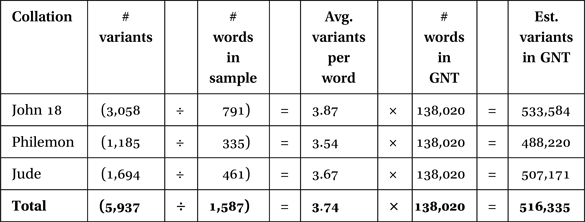
The most recent and, to some extent, only rigorously computed estimate of the variants of the GNT is that of Peter Gurry.Footnote 2 After surveying the use of ‘bad statistics’ (p. 103) and the wild range of estimates from 30,000 to 750,000, Gurry sets to the task of developing a more robust way to approximate the number. In contrast to prior attempts that often lacked any underlying data whatsoever, he works from three efforts that have done full collations of all (or essentially all) continuous-text manuscripts for a subset of passages in the GNT: John 18 (Michael B. Morrill), Philemon (S. Michael Solomon) and Jude (Tommy Wasserman).Footnote 3 For each of these three collations, Gurry identifies the number of distinct textual variants (more on this definition below) and divides that by the number of words in the passage to estimate the key metric: ‘avg. variants per word’. From there, he extrapolates across the entire word count of the NT to produce a range of estimates for the total variants found in all continuous-text Greek manuscripts (~ 5,600). The resulting computations are as shown in Table 1.
Peter Gurry's Estimated Total Variants Based on Prior Complete Collations.

Gurry then checks these estimates of the rate of variation (‘avg. variants per word’) against the selective collations in Text und Textwert, discovering that the rate is slightly higher in most of those samples, probably due to the selective nature of the Teststellen used in those efforts.Footnote 4 Gurry's main conclusion is as follows:
We suggest that a reasonable estimate for the number of textual variants in the Greek New Testament (not including spelling differences) is about 500,000. This estimate – and we emphasise that it is still an estimate – is based on a sample size of about 3 per cent of the entire Greek New Testament.Footnote 5
This proposal is a significant step forward in that it is based on actual data and a sound method.
However, one of the potential limitations of the macro ~ 500,000 number is that, while it is interesting as a data-point, it is challenging to frame in a helpful way because, in principle, it encompasses over 5,000 Greek witnesses. Due to this vast coverage of witnesses, attempts to draw conclusions about, say, how many variants each scribe or manuscript contributes, or how many variants emerge per page of the GNT, or how many variants there are per verse in the GNT, and so on, are of limited value or even misleading.Footnote 6 Moreover, the sheer quantity of witnesses is difficult to get one's head around, and many of them contribute very little to the core tasks of reconstructing the ‘initial’ text,Footnote 7 studying textual flow and genealogical relationships, understanding the main stages of reception and transmission-history, and so on.Footnote 8
In light of such factors, this study does not seek to replace Gurry's top-level estimate but rather to complement it in a way that will offer some key advantages. I will narrow the analysis to a small set of witnesses that are of tremendous text-critical value, as distinct from the nebulous cloud of hundreds/thousands of witnesses that are, on the whole, less valuable (see section 3.2 below). These witnesses are tangible and well known, thus making it easier to get our heads around the numbers. They also cover the waterfront of the textual traditions of highest significance; the exception is the D-tradition (or ‘Western text’), which I have excluded due to its idiosyncrasies and disputed status in Acts,Footnote 9 as well as the general paucity of ‘Western’ data for CL.Footnote 10 By limiting ourselves to Acts/CL, which represents about one fifth of the GNT (versus Gurry's sampling from ~ 3%), we are able to make use of the more robust set of collation data available through the ECM. This will allow greater detail in studying the quantity of known textual variants, the development or growth of the textual tradition, and the variant profile for each individual writing within Acts/CL.
3. Method for This Revised Estimate
Three aspects of the method will be outlined before presenting the results for Acts/CL. The value of this proposed method is that, like Gurry's, it aims to be well defined and thereby repeatable or modifiable in future iterations.
3.1 Defining Terms
For any estimate to be meaningful, one must be clear in defining terms. As Gurry aptly surveys, defining ‘variant’, ‘variant reading’, ‘reading’, and so forth, is itself a vexing task in the scholarship, the details of which do not need repeating.Footnote 11 His study necessarily relies upon the work of independent scholars, with each operating under separate definitions (Morrill, Solomon, Wasserman). In this analysis, however, the task is somewhat simpler given that it builds on the cohesive efforts of the Münster team and its partners. I will define the important terms as follows.
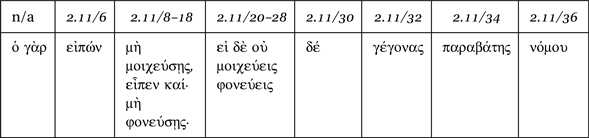
Variant unit (hereafter, VU): a segment of zero (since the reading can be ‘omit’) or more contiguous words that the editors of the ECM deem to be the most logical and granular unit of comparison among witnesses, for which there are at least two readings in the collated witnesses.Footnote 12 If there are no alternate readings for a given segment of text (that is, all witnesses agree), then it is not tabulated as a VU. To use a simple example, James 2.11 in ECM–CL contains eighteen words; the first two words feature no extant variants (and are, thus, not accounted a VU), and the remainder have been segmented into seven VUs of varying length, each with its own ‘address’ (see Table 2).
VUs for James 2.11 in ECM–CL.

Those familiar with the ECM will observe that many verses in ECM–Acts and ECM–CL are more complex than this example; namely, a VU may have sub-units that allow more detailed comparisons. However, the ECM's tabulation method minimises the impact of double-counting.
Reading: any non-erroneous sequence of words for a VU that is distinguishable from others.Footnote 13 Each ‘reading’ is assigned an italicised letter (a for the Ausgangstext, b, c, etc.) in the ECM to distinguish it from others. The ECM excludes minor differences in orthography, spelling of nomina sacra and other such phenomena in determining distinct readings. However, occasionally situations such as phonetic confusions, vowel interchanges (e.g. ε–η), dropping one of a doubled consonant and doubling single consonants present challenges in deciding whether to classify a ‘reading’ as distinct (for which it is given its own letter in the apparatus) or simply a deficient form of an existing ‘reading’ (for which ‘v1’, ‘v2’, etc. are appended to the letter).Footnote 14 While the ECM helpfully breaks out such latter instances in the apparatus, I will not treat them as distinct ‘readings’; for example, b, bv1, bv2 and bv3 would all be considered a b-reading.Footnote 15
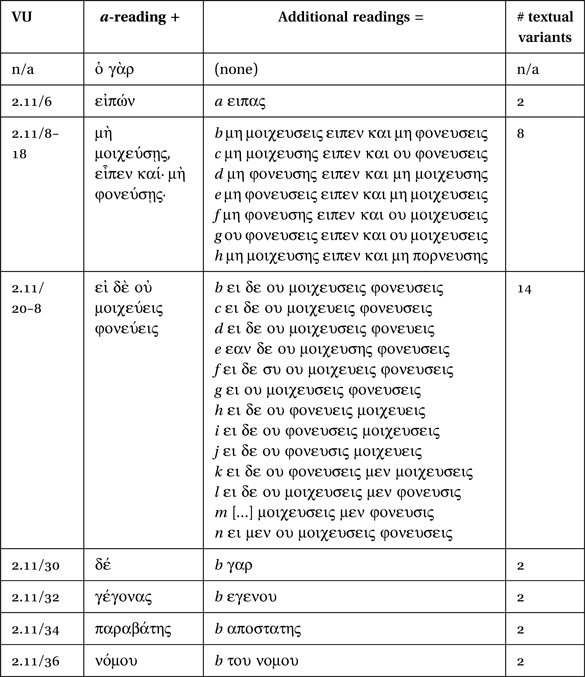
Textual variant: any distinct ‘reading’ for a VU, including that which is deemed the a-reading. This definition follows Gurry and, consequently, differs slightly from the ECM, which describes only non-a-readings as ‘variants’. The ECM's more narrow definition makes sense for its context, but for the task of quantifying ‘textual variants’, it is best to include all readings, regardless of whether this or that textual critic deems it to be ‘initial’/‘original’.Footnote 16 Hence, all VUs by definition have at least two ‘textual variants’: the a-reading (regardless of edition) plus one or more alternative. To build on the prior example, the breakdown of ‘textual variants’ for each VU in James 2.11 is as shown in Table 3.
Inventory of Readings for James 2.11 in ECM–CL.Footnote 1

1 This listing excludes forms of the text deemed deficient for spelling reasons, such as bv1–5, dv, gv, iv1–2 and jv at 2.11/20–8.
For this verse, then, there are thirty-two total ‘textual variants’ across these seven VUs (excluding the first two words where there is no known variation). While this illustration may be pedantic for those familiar with the ECM, it hopefully clarifies the mechanics of computing meaningful numbers of ‘textual variants’ by following the ECM's approach to simplifying the data into pieces of text that can be compared.
In sum, this article seeks to quantify the number of all (including whatever one deems ‘initial’/‘original’) distinct readings across the entire set of VUs for Acts/CL, confined to the sixteen witnesses being studied. We will, then, attempt to extrapolate for the rest of the GNT from there.
3.2 Selecting the Key Witnesses
The decision to delimit the scope of inquiry from ‘all’ witnesses to a sub-set of them necessitates a brief defence of those selected.Footnote 17 The sixteen witnesses chosen for this effort include those that, for Acts/CL, are most frequently deemed to be representatives (apart from the D-tradition, see above) of the major branches of the textual traditionFootnote 18 and treated as ‘frequently cited witnesses’ for one or both corpora (per NA28).Footnote 19 Of course, every textual critic would probably give a different personal list of sixteen ‘key’ witnesses, but the goal here is to be somewhat comprehensive in reflecting those ‘usual suspects’ that tend to dominate conversations about the most important manuscripts for text-critical work for Acts/CL – regardless of one's text-critical school.
Majuscules (4): obvious choices for Acts and the Catholic Letters are 01/א (Sinaiticus), 02/A (Alexandrinus), 03/B (Vaticanus) and 04/C (Ephraemi Rescriptus).Footnote 20 The first three are perennial heavyweights (though 02's text is more mixed in other parts of the GNT), and the mixed nature of 04 in the Catholics is actually a good thing for an effort like this. The extant papyri are too fragmentary in Acts/CL to be included.
Byzantine witnesses (4): while there is a tendency to view the Majority/Byzantine tradition as a monolithic entity,Footnote 21 the variations among Byzantine manuscripts are more pronounced than is often realised.Footnote 22 Therefore I have included four witnesses that the ECM editors deemed to be good Byzantine representatives for most of ECM–Acts and ECM–CL: 18, 35, 319 and 617.
Other minuscules (8): there are several key minuscules that reflect different kinds of textual affinities, but all of them are generally deemed – for various reasons – to be of greater-than-average value in textual criticism. I include both Family 1 (minuscule 1) and Family 13 (minuscule 69). I also include 33 (the ‘queen of the cursives’),Footnote 23 81 (‘one of the most important of all minuscule manuscripts’)Footnote 24 and 1739 (‘of extreme importance’)Footnote 25 – as well as 1175, 1241 and 2344.
3.3 Gathering the Data and Computing Known Variants
The method to be pursued here requires a full collation of all sixteen manuscripts with respect to each other. Only with such data can we quantify, at each VU along the way, the total number of textual variants across this set of manuscripts. Prior to the ECM project, such data were difficult to attain, given that prior (print-driven) collations are typically limited to two manuscripts (e.g. collating 1739 against TR), a single book of the GNT (e.g. Jude or Philemon) or single textual families/clusters (e.g. Family 1).Footnote 26 Moreover, the prospect of picking through a critical apparatus to pull out shared as well as dissimilar readings across these sixteen manuscripts would be tedious and error-prone, given the selective nature of a negative apparatus. However, the electronic data made available by the Institut für Neutestamentliche Textforschung in conjunction with the print ECM volumes makes this goal readily attainable.Footnote 27
Using the databases, the following steps produced the desired data set. First, I used the ‘Comparison of Witnesses’ tool – which only works with two witnesses at a time – to run comparisons of each of these sixteen witnesses individually against the Ausgangstext for Acts and CL. I chose the Ausgangstext as the basis for comparison not to privilege it over, say, the Byzantine text, but because it is the only ‘witness’ (so to speak) in the ECM that includes every VU. It is, in other words, the best fixed point from which we can with assurance generate all textual variants. The output of the ‘Comparison’ tool, once cleaned up a bit, yields all VUs where the given witness disagrees with the a-reading, as well as the alphabetical code for the reading it does contain (b, c, etc.).
Second, I combined all sixteen such outputs and consolidated them by VU, producing a database that includes one row per VU and one column for each witness with the reading it contains. VUs for which all sixteen manuscripts agree with the a-reading do not, by definition, show up in the database (but will be factored into the computations, of course). Only those VUs for which at least one of the sixteen witnesses disagree with the a-reading will have a row in the resulting database.
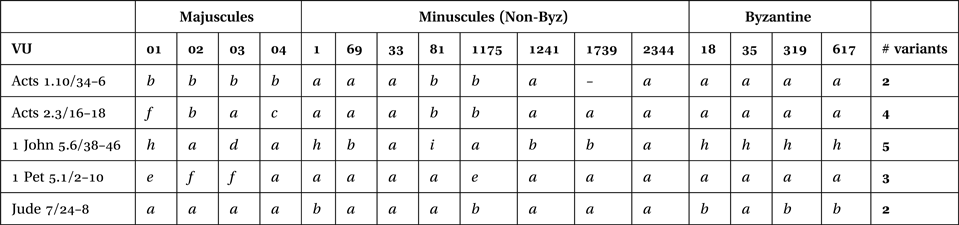
Armed with this set of data for Acts/CL, computing textual variants for the known data becomes straightforward: simply tabulate the distinct readings (a, b, etc.) for each row in the database to generate the total textual variants, including the a-reading, for that VU.
A sample of the database, with the count of variants, appears as shown in Table 4.

From there it is straightforward to compute for each book (or chapter, etc.) in the extant ECM–Acts and ECM–CL data the total actual textual variants for these sixteen manuscripts – including both the a-reading and all ‘additional’ variants – which can then be compared with Gurry's findings. The data also allow further analysis beyond simply quantifying total variants, as we will see.
4. Results and Discussion for Acts/CL
Our results will be presented by posing and answering seven questions using the empirical data for ECM Acts/CL.
4.1 What Part of the Extant Textual Tradition Lacks Any Variation at All (in Acts/CL)?
This initial question is infrequently asked or quantified, but for our purposes it is helpful in order properly to frame the results. As defined above, the ECM segments the GNT into VUs that, by definition, have at least two competing readings in the tradition. Any cursory glance at the ECM volumes will, however, reveal numerous strings of text (typically one or two words) where there are no known alternate readings and, hence, no VU. To my knowledge, this non-variant portion of the GNT has rarely if ever been rigorously quantified.Footnote 28
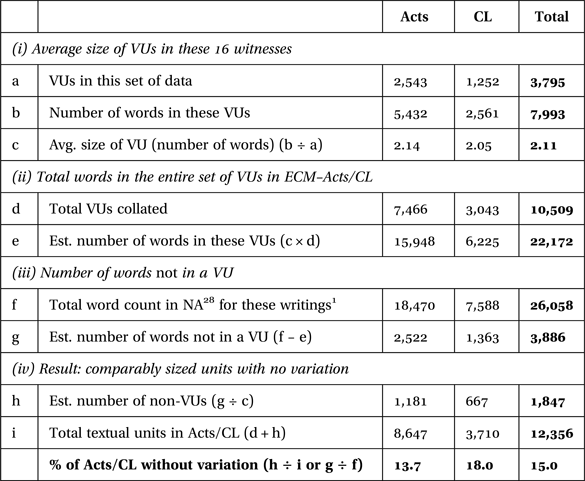
Using the database produced above, I can approximate it by (i) determining the average word count of actual VUs in the database used here (a subset of the total VUs); (ii) multiplying that by the total VUs collated for ECM–Acts and ECM–CL to estimate the total number of words that comprise the ECM's VUs; (iii) subtracting this from the total words in Acts/CL to identify the proportion that is not included in a VU and, thus, has no extant variants; (iv) deriving (using the same average word count estimate from (i)) the theoretical number of comparably-sized textual units without variation, which I will denote ‘non-VUs’. The results are as shown in Table 5.
Estimation of the Portion of Acts/CL without Known Variation.

1 In NA28, computed using Accordance.
For this section of the GNT, ~ 15% is non-variant (higher for CL, lower for Acts), yielding a total of ~ 12,356 total textual units (averaging about two words in length), with 10,509 being collated as true VUs in the ECM, with a remaining ~ 1,847 non-VUs.
With this comprehensive assessment of the total textual units (VU and non-VU), we can proceed with the core of our analyses. We will, of course, be focusing on VUs which, as shown here, comprise about 85% of the total text, though we will integrate the non-variant textual units (non-VU) as needed.
4.2 How Similar are These Sixteen Manuscripts on the Whole?
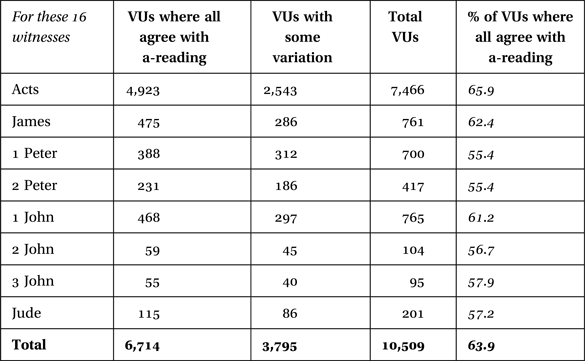
We begin with a broad summary of the VU-level data, which will give insight into how similar these manuscripts are among themselves. Typically prior studies (whether individual collations, Text und Textwert, or the ECM ‘Comparison’ tool) only allow one to gauge percentage agreements among pairs of witnesses, but these data allow us to probe more deeply. There are only 3,795 VUs for which any of these sixteen witnesses disagree; in all other cases, they agree fully with the a-text and, thus, with each other. The breakdown is as shown in Table 6.
Estimation of Total Agreement among Sixteen Key Witnesses.

In short, these sixteen manuscripts – including four Byzantine witnesses – completely agree with each other nearly two thirds of the time where there is any known variation in the tradition. The rate of agreement is highest for Acts and lowest for the Petrine epistles; for CL as a whole it is 59% (1,252 VUs with some variation out of 3,043). When we factor in the ~ 15% of total textual units that have no variation in the entire collated set of data (non-VU), the total rate of agreement for these sixteen diverse witnesses is ~ 69%. This indicates a relatively stable core textual tradition.
4.3 How Many Variants Are There for Acts/CL in These Sixteen Witnesses?
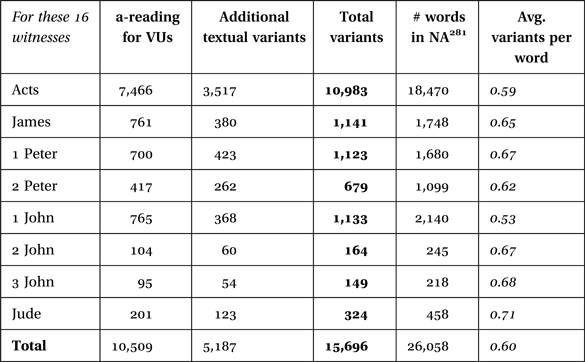
Each a-reading at a VU counts as one textual variant, as discussed above. The focus, then, is on quantifying the total ‘additional’ variant pool found for the 3,795 VUs of our set. We can also compute ‘avg. variants per word’, which is the key metric used in Gurry's analysis, so that we can compare the estimates. The results are as shown in Table 7:
Estimation of Total Variants among Sixteen Key Witnesses.

1 This total word count for Acts/CL represents 19% of the ~ 138,000 total in NA28. Byzantine-text proponents would rightly observe that I am using the (generally) shorter NA text for word counts; the total word count for the Byzantine text is ~ 1.5% longer. However, the ECM already includes all major Byzantine ‘pluses’ in its VU segmentation (where a would read ‘omit’), so the choice of which word count to use in the denominator does not really matter so long as I am consistent. Moreover, Gurry's estimate used the NA text rather than Byzantine.
The total number of textual variants found in the key sixteen witnesses for Acts/CL is 15,696, including the a-text; within that, the number of ‘additional’ variants (b, c, d, etc.) is 5,197. If our estimate above for the total textual units (VU + non-VU) is correct (~ 12,356), for every unit of the ‘initial text’ (however one defines it), the scribes for these sixteen witnesses introduce ~ 0.42 ‘additional’ variants.
The metric ‘avg. variants per word’ ranges from a minimum of 0.53 for 1 John to a maximum of 0.68 for Jude, with a weighted average of 0.60. One immediately observes that this finding is much smaller than the 3.54–3.87 variants per word found in Gurry's study. This is to be expected, given that we are using a vastly smaller pool of manuscripts; the difference may also stem from differing VU segmentation approaches among the three separate collations used in his study and the ECM used here.
4.4 What Portion of the Total Variants for All Witnesses for Acts/CL Does This Represent?
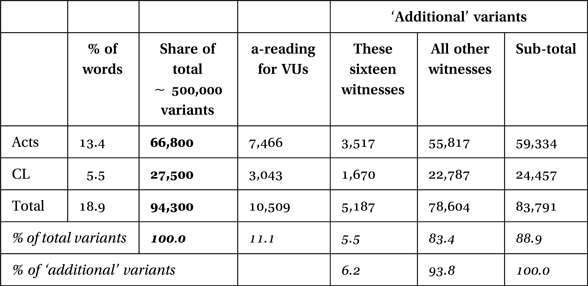
If we assume a more or less consistent variation rate across the corpora of the GNT, as Gurry did – in actuality, the Gospels and Paul/Hebrews may be more variable – Acts/CL would constitute ~ 19% of the total ~ 500,000 variants based on word count. If so, we can further refine our analysis, yielding the results found in Table 8.
Proportion of Known Variants Attested in Sixteen Key Witnesses.

These sixteen witnesses account for roughly ~ 17% of the total variants for Acts/CL, including the a-text. Moreover, we find that the a-text at each VU constitutes around one tenth of total variants, such that ‘additional’ variants (or real variants, according to the traditional understanding as found in the ECM itself) constitute nine tenths. Of that number, these sixteen witnesses contribute ~ 6% (5,187 out of ~ 83,800). The remaining ~ 94% of ‘additional’ variants are still noteworthy in terms of studying textual transmission, but we can now more precisely position them as the result of copying events over the remaining 5,600+ witnesses outside this narrow but important sub-group (which, recall, includes the Byzantine tradition).
4.5 Just How Variable is the Textual Tradition Reflected in These Witnesses?
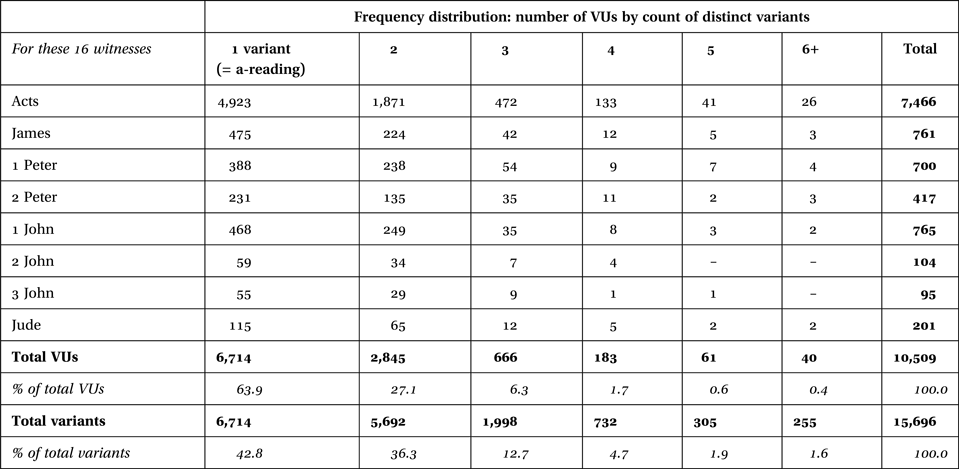
An additional step in understanding the development or growth of the textual tradition is to quantify the degree to which the core tradition ‘branches out’, so to speak, in this set of witnesses.Footnote 29 Is the number of ‘additional’ variants driven by rampant variation, whereby VUs have tremendous diversity within themselves, or are we looking at only a small number of alternative readings for each one? Put differently, how many times does a VU have two readings, or three readings, or eight readings among these sixteen witnesses? We can quantify this for Acts/CL, as found in Table 9.
Degree of Variability Reflected in Sixteen Key Witnesses.

Over 91% of VUs among these sixteen witnesses have at most two total textual variants (accounting for ~79% of total variants). While there are plenty of cases where even these key witnesses vary from one another tremendously (the maximum is eight total textual variants at Acts 26.3/4–24; Acts 26.26/28–40; 1 John 5.13/8–36), the overall picture further corroborates a controlled nature of the growth in textual variation within these witnesses.
4.6 How Do These Manuscripts Contribute to the Growth of the Variant Pool?
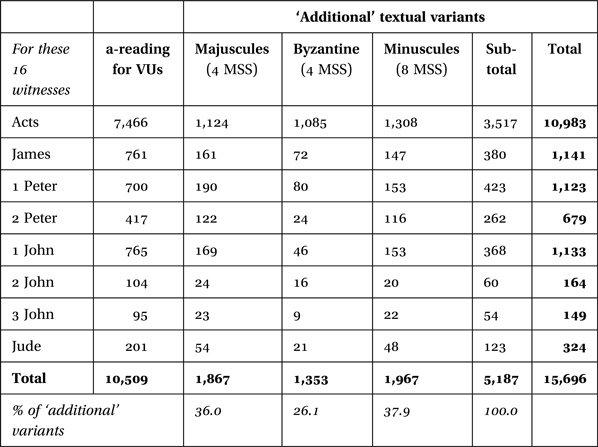
Another way to think about transmission deals with how or when the textual variants enter into the textual stream. In some respects this is one of the holy grails of textual criticism, and it lies behind much of the genealogical work underlying the Coherence-Based Genealogical Method (CBGM). We could, in principle, arrange these manuscripts in chronological order by date and then trace when the variants enter the picture. Such an approach is fundamentally flawed, however, in that the date of the artefact does not reflect date of the reading (i.e. recentiores non deteriores), and the presence of a variant in a witness does not necessarily mean its scribe originated it. We can, however, approach the question from a different angle and at least get a read on how the ‘additional’ variant pool is distributed among the three major groups of these witnesses – the majuscules, Byzantine minuscules, and other minuscules. There are numerous ways this could be done, none of which is perfect. One workable way is to allocate an ‘additional’ textual variant to the majuscules if it appears in any of the four majuscules at all; to the Byzantine group if it appears in at least one of them but not in a majuscule; and everything else to the remaining minuscule group.Footnote 30 Though certainly imperfect, this allocation at least approximates at which stage in the tradition the ‘additional’ variants are (roughly) attested – not necessarily introduced, though this is certainly true in many cases – among the majuscules (which the minuscules simply adopt), the Byzantine witnesses (if not already present in the tradition reflected in the majuscules), and the other minuscules (non-uncial + non-Byzantine). The results are as shown in Table 10.
Variant Attestation Based on Manuscript Category.

Each sub-group attests a decent share to the pool of ‘additional’ variants. It is not surprising that the minuscules would attest proportionally more, as there were eight in the group. But it may be a bit surprising to see the majuscule proportion substantially exceeding the Byzantine proportion. Perhaps more importantly, acknowledging that these key witnesses span a variety of textual affinities, time horizons and geographic provenances, we can tentatively conclude the following: though the majuscules attest a lot of variants, there does not appear to be a kind of ‘pre-Cambrian explosion’ of textual variants at some early stage, but rather a somewhat more evenly spread distribution over time.
4.7 What is the Profile of Textual Variability within a Writing, Particularly Acts?
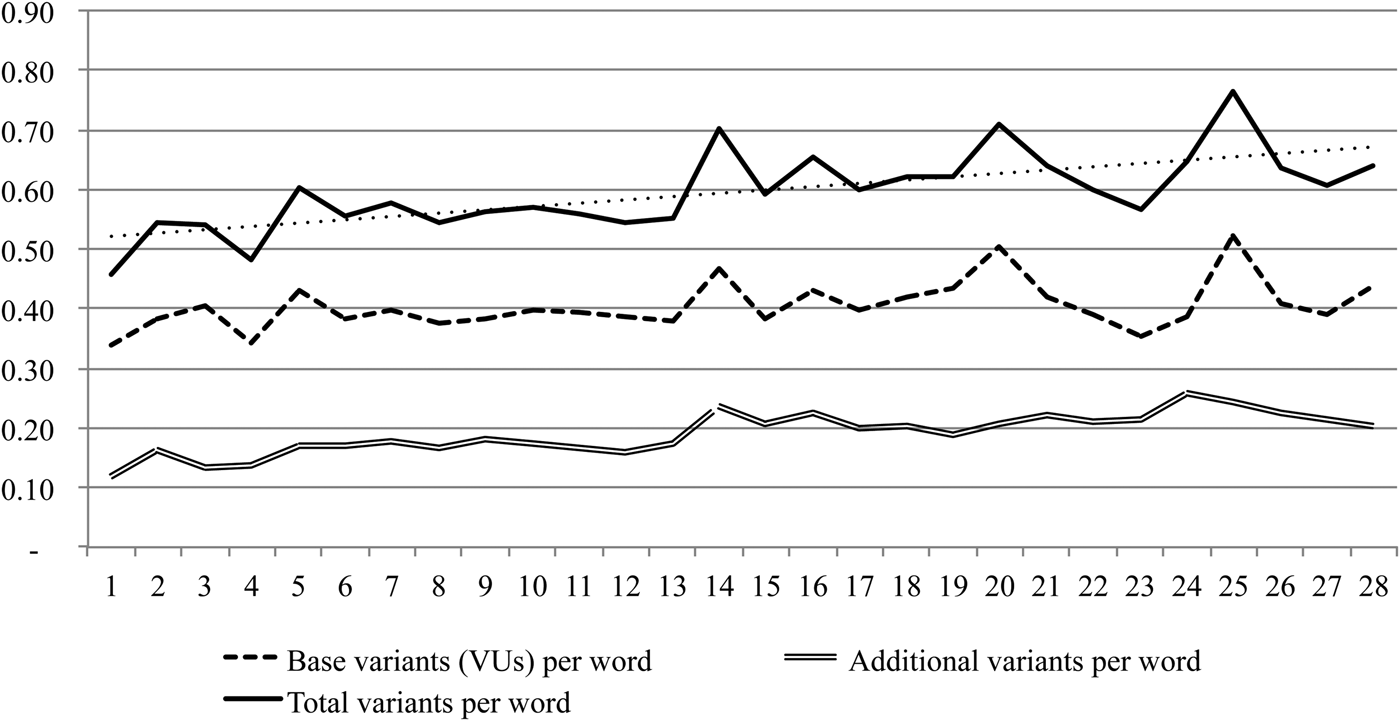
Scholars have long recognised that textual profiles vary across the different corpora of the GNT (Gospels vs Paul and so on) and within a given manuscript (e.g. ‘block mixture’; the mixed quality of 02 and several others). There is also variation in textual quality and variation patterns within individual NT writings, and in our data the most interesting is Acts.Footnote 31 Using variation rate, or ‘avg. variants per word’, as our key metric, we can quantify what the pattern of variation among these sixteen witnesses looks like across Acts, per chapter (see Figure 1).
Pattern of Variation for Acts across Sixteen Key Witnesses.

Though chapters 22–3 are minor exceptions, overall the level of textual variability increases markedly from Acts 1–13 (average of 0.55 variants per word) to Acts 14–28 (average of 0.64 variants per word), as the trendline shows.Footnote 32 The data, of course, cannot tell us why this is the case, but it is nevertheless helpful empirical confirmation in the aggregate (for sixteen witnesses) of what textual critics have hypothesised for Acts within individual witnesses.Footnote 33
We have, at this point, summarised the most important findings from this study of the textual variants in Acts/CL among chosen key witnesses. We turn now to the ‘thought experiment’ about how we might use these known data to extrapolate across the rest of the GNT.Footnote 34
5. Extrapolating across the Rest of the GNT
One of the values of Gurry's study is that it yields an estimate for the whole GNT, whereas this study is limited to the known data for about one fifth of it. The common metric used in both is ‘avg. variants per word’, which for our sixteen witnesses is computed as ~ 0.60 (section 4.3). If we followed Gurry's method, we could take this number and multiply it by the number of words in the rest of the GNT to produce a comprehensive estimate. Such a seemingly elegant solution unfortunately faces three problems.
(i) Among the sixteen witnesses, 04, 69, 81, 319 and 1739 feature non-trivial lacunae in Acts; for CL, the lacunae are fairly negligible (see ECM–CL–Supp §2.3). If we actually had text at those VUs for said witnesses, we would expect ‘avg. variants per word’ to increase slightly due to the presence of yet more textual variants for these witnesses. To account for this, I reran the entire analysis for Acts after removing all VUs at which any of those witnesses was lacunose – about half of the VUs in total – so that we would be comparing only fully continuous portions of text. I also adjusted the total word count accordingly. This yielded an increase in ‘avg. variants per word’ of ~ 1%.
(ii) Such an extrapolation makes an important assumption about future ECM instalments: namely, that the average size (number of words) of textual units remains consistent in collation efforts, so that we are comparing ‘apples-to-apples’ in terms of estimating textual variants. So far for ECM–Acts and ECM–CL, this assumption appears to hold true. In the analysis discussed in section 4.1, the average VU size for this data set ranges as follows: Acts 2.14 (words per VU); James 2.07; 1 Peter 1.90; 2 Peter 2.15; 1 John 1.98; 2 John 2.78; 3 John 1.63; Jude 2.30; average 2.11 (total spread of ~ 27% from low to high). We could accommodate this variability by presenting low–medium–high estimates, which should cover the spectrum of possibilities for future ECM efforts in terms VU segmentation.
(iii) The biggest hurdle for extrapolating across the rest of the GNT for these sixteen witnesses lies in the stark differences we face in moving from Acts/CL to the other corpora. This was true for Gurry's study as well, in which he moved from an estimate based on a set of witnesses containing John 18/Philemon/Jude to the rest of the GNT, which such witnesses may not even contain. However, the issue is more pronounced here insofar as we have narrowed ourselves to sixteen actual witnesses as opposed to theoretically all of them. The majuscules and Byzantine minuscules are still usable for this extrapolation, as the impact of their lacunae (e.g. 03 in Revelation, 02 in Matthew) would be relatively small, as shown for Acts/CL above. The bigger issue lies with four non-Byzantine minuscules (81, 1175, 1739, 2344) that lack the Gospels, in particular. Conceptually we could swap them out for, say, 565, 579, 700 and 892 (‘key’ minuscules for the Gospels) to yield a new group of comparable witnesses being studied, and go from there. Of course, for now we lack ECM collations for this latter group of minuscules, but if we assumed a broadly similar variation pattern for these as we saw for the former four in Acts/CL – a big assumption, of course, but not an entirely unreasonable one – we could at least venture a directional guess for the rest of the GNT.
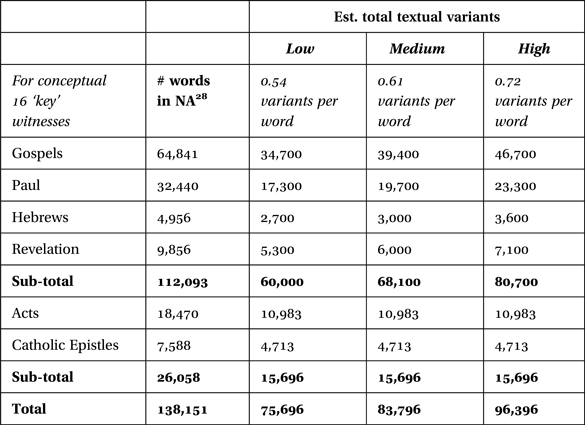
Taking the low–medium–high findings for ‘avg. variants per word’ in Acts/CL (now increased by 1% to accommodate lacunae) – and conceptually conducting the minuscule swap described above – we arrive at the following range of estimates for the rest of the GNT (Table 11):
Estimation of Variants for the Remainder of the GNT (for Sixteen Key Witnesses).

The low/high range is roughly +/– 17% relative to the ‘Medium’ scenario of roughly 84,000 total variants across this sixteen-witness set of data (actual for Acts/CL, conceptual for the remainder). Working ‘backwards’ to estimate the total number of VUs (and non-VUs) for the remainder of the GNT – and, thus, the ‘additional’ variants beyond the a-text – would be illuminating, but the challenges involved, particularly if the Gospels and Paul/Hebrews are more variable than Acts/CL, make such an endeavour overly speculative. However, the basic method outlined here has value insofar as it could be revised/re-computed once ECM data for the remaining writings become available. It does, ultimately, remain a thought experiment.
6. Conclusions
This analysis has attempted to build on Gurry's top-level estimate by providing a truly empirical and comprehensive way of measuring the development or growth of the NT textual tradition in Acts/CL across the most important sixteen witnesses to the text. Inevitably, it leaves many questions unanswered, but it has hopefully allowed for more meaningful conclusions to be drawn by narrowing the playing field from the misty cloud of ~ 500,000 variants across 5,600+ witnesses to something one can get one's head around. Our key findings for Acts/CL are as follows:
• All witnesses collated in the ECM agree entirely (that is, among non-VUs) about 15% of the time; of the remaining portion of text (VUs), this mix of sixteen uncials, Byzantine minuscules and frequently cited non-Byzantine minuscules entirely agree over 60% of the time. The net total agreement across all textual units (VU + non-VU), then, among these key witnesses is nearly 70%. While it remains true that the GNT textual transmission involves substantial variation, this is largely a feature of the sheer number of copying events. When we look at the main trunk of the family tree, so to speak, we see substantial integrity.Footnote 35
• Around 11% of the total variant pool for Acts/CL – as estimated by Gurry – is made up of the Ausgangstext itself (however one chooses to define it).
• The total variants (according to our definition, shared with Gurry) among these witnesses in Acts/CL is roughly 15,700, of which about 5,200 are ‘additional’ to the base text (a-readings) of 10,500. This pool of ‘additional’ variants represents ~ 6% of the total across all witnesses for Acts/CL. For the vast majority of VUs across these witnesses, there are only 2–3 distinct readings.
• Each sub-group of witnesses attests its fair share of ‘additional’ variants; they do not all enter the tradition early, nor do they all enter the tradition late. These findings point in the direction of a quite stable textual core among the most valuable witnesses, such that the large mass of remaining variants are attributable to the plethora of copying events among the vast numbers of other, lesser witnesses.
• Extrapolating from Acts/CL to the rest of the GNT is fraught with peril, but conceptually we can hypothesise that, for a given pool of sixteen ‘key’ witnesses, their variants constitute a bit less than one fifth of the total estimated number of variants, including the a-text. From one perspective this may seem high, given that these sixteen would represent fewer than 5% of total witnesses (depending on how one counts them). From another perspective, this portion covers the waterfront of variants that ‘matter’ in most cases, with the remainder constituting a ‘long tail’ (statistically) of readings that are less likely to vie for originality, scattered among a large cloud of other witnesses.
The method employed here could be refined further by integrating data from future ECM editions, expanding the manuscript pool (especially for the D-tradition) and attempting to quantify in a more rigorous way the introduction of textual variants over time. This study, at least, lays a foundation for such work.Footnote 36