Introduction
The scaled quail (Callipepla squamata) is found in arid and semi-arid regions of south-eastern Colorado, south-western Kansas, Oklahoma, Texas, New Mexico, extending to southern Arizona and south into Mexico (Schemnitz, Reference Schemnitz, Poole and Gill1994). Most previous helminth surveys of scaled quail in Texas were conducted over three decades ago (Wallmo, Reference Wallmo1956; Howard, Reference Howard1981; Dancak et al., Reference Dancak, Pence, Stormer and Beasom1982). Only one published study used a helminth community-based approach (Landgrebe et al., Reference Landgrebe, Vasquez, Bradley, Fedynich, Lerich and Kinsella2007); however, this study was restricted to a single wildlife management area (Elephant Mountain Wildlife Management Area in Brewster County, Texas) during a single collection period (August 2002).
Helminth community composition in scaled quail occurring within Texas has not been fully characterized and it is unclear whether pathogenic species are present. Our objectives were to determine helminth community structure (prevalence, intensity and abundance) in scaled quail occurring within semi-arid regions of Texas, relate our findings to strategies used by helminths occurring within a xeric environment and document the presence of pathogenic helminth species occurring within this host.
Materials and methods
Study area
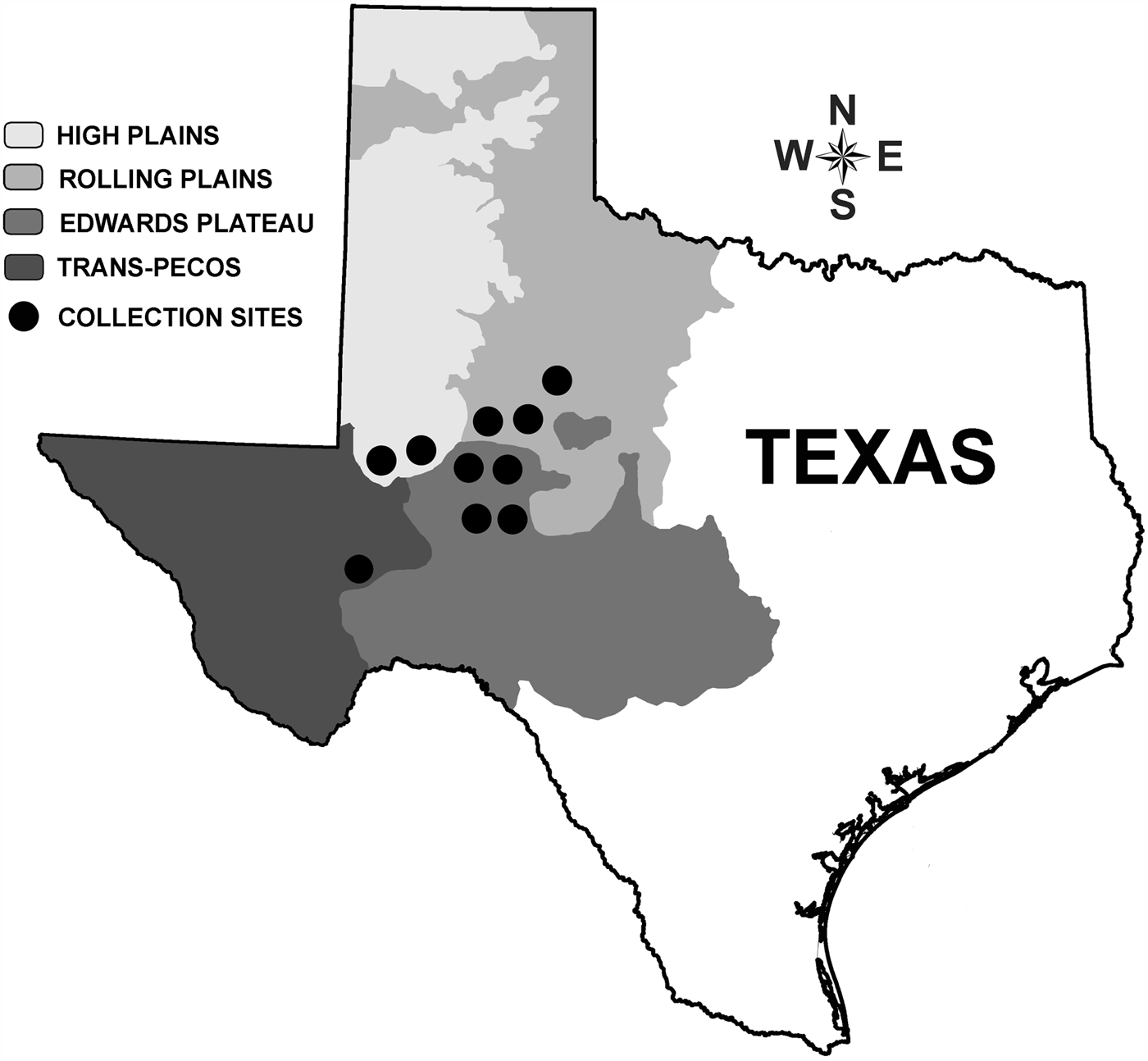
This study spanned four ecoregions in Texas: Trans-Pecos, High Plains, Edwards Plateau, and Rolling Plains (fig. 1). Vegetation communities within the study area are determined by a rainfall gradient ranging from <31 cm to 86 cm. The resulting plant communities consist of creosote bush (Larrea tridentata) flats, desert grassland and montane areas comprising juniper (Juniperus spp.) and oak (Quercus spp.) in the Trans-Pecos ecoregion (<31 cm of rainfall annually), shortgrass prairie dominated by buffalograss (Bouteloua dactyloides), with honey mesquite (Prosopis glandulosa), juniper, sand shinnery oak (Quercus havardii) and sand sagebrush (Artemisia filifolia) in the High Plains ecoregion (38–56 cm), interspersion of grasslands with juniper, oak and mesquite in the Edwards Plateau ecoregion (38–86 cm), and mesquite-shortgrass savannah rangeland interspersed with agricultural crops in the Rolling Plains (51–71 cm) (Smith & Campbell, Reference Smith and Campbell1996).
Ecoregions in Texas where scaled quail (Callipepla squamata) were collected during the 2012–2013, 2013–2014 and 2014–2015 hunting seasons within a semi-arid region of Texas. Texas ecoregion map from Gould et al. (Reference Gould, Hoffman and Rechenthin1960) subsequently modified by Texas Parks and Wildlife Department (2011).

Host and helminth collection
Scaled quail carcasses were obtained from hunters during the 2012–2013, 2013–2014 and 2014–2015 hunting seasons. Participants were given a protocol describing that harvested quail were to be sealed in individual plastic freezer bags, labelled with the county name and date of harvest, and placed in a cooler with ice until the birds could be frozen upon returning from the field. Carcasses were stored in a freezer prior to being necropsied in the Buddy Temple Wildlife Diagnostic and Pathology Building at the Caesar Kleberg Wildlife Research Institute, Texas A&M University–Kingsville.
Frozen carcasses were thawed and examined for helminths. The following tissues and organs were dissected and examined macroscopically with the aid of a variable power (1–40×) dissection scope, when needed: eye surface, nictitating membrane, eyelid, Harderian gland, lacrimal duct, conjunctival sac, nasal cavity, sinuses, trachea, lungs, heart, kidney, liver, gall bladder, oesophagus, crop, proventriculus, gizzard koilin, pancreas, spleen, small intestine, large intestine, ceca, bursa of Fabricius (when present in juveniles) and cloaca. In addition, each carcass was skinned to expose the skeletal musculature from the base of the head to the femorotibial joints.
Nematodes were fixed in 95% glacial acetic acid and stored in individually marked glass vials containing 70% ethyl alcohol and 8% glycerine, whereas acanthocephalans and cestodes were fixed in acetic acid–formalin–ethyl alcohol and stored in individually marked glass vials containing 70% ethyl alcohol. Specimens were identified and counted using ethyl alcohol wet mounts with a dissection scope (1–40×) and a compound light microscope (100× and 400×). Voucher specimens were deposited at the Sam Houston State University Parasite Museum, Sam Houston State University, Huntsville, Texas (Oxyspirura petrowi SHSUP001216; Aulonocephalus pennula (=A. lindquisti) SHSUP001217; Procyrnea pileata SHSUP001218, SHSUP001219; Fuhrmannetta sp. SHSUP001221).
Definitions
The terms prevalence, intensity, abundance, mean abundance, infracommunity and component community follow definitions of Bush et al. (Reference Bush, Lafferty, Lotz and Shostak1997). Common, intermediate and rare species are those helminths that occurred in >75, 25–75 and <25%, respectively, across the collective host sample (Landgrebe et al., Reference Landgrebe, Vasquez, Bradley, Fedynich, Lerich and Kinsella2007). Habitat, in relation to helminths, refers to the host and microhabitat refers to host tissues and organs where helminths occur.
Statistical analyses
Prevalence data of the common and intermediate helminth species were analysed with a generalized linear model (GLIMMIX; SAS Institute Inc.) with main and interaction variables as fixed effects and a logit link function. The ESTIMATE function was used to estimate probabilities of helminth occurrence (prevalence) and are reported with their standard errors. The ‘Pearson chi-square over df’ statistic indicated adequate model fit. Abundance data were analysed with the same generalized linear model procedure and a log link function for a negative binomial response distribution; results are presented as estimated means and their standard errors; when the Pearson chi-square over df indicated over- or underdispersion, we set the scale parameter equal to 1 by Pearson scaling using the GENMOD procedure (SAS Institute Inc.). Main effects and interaction effects variables for which cell sizes were small (n ≤ 10) were not evaluated or interpreted. The level of significance for all analyses was P ≤ 0.05.
Results
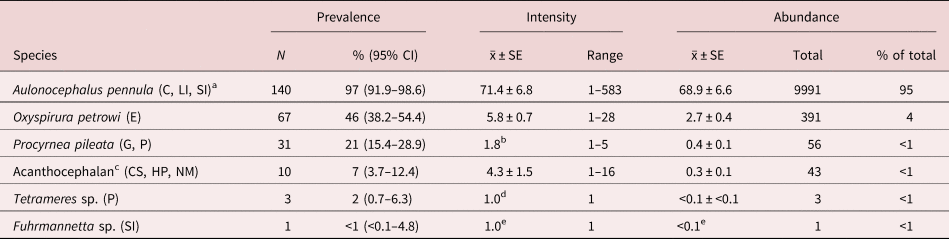
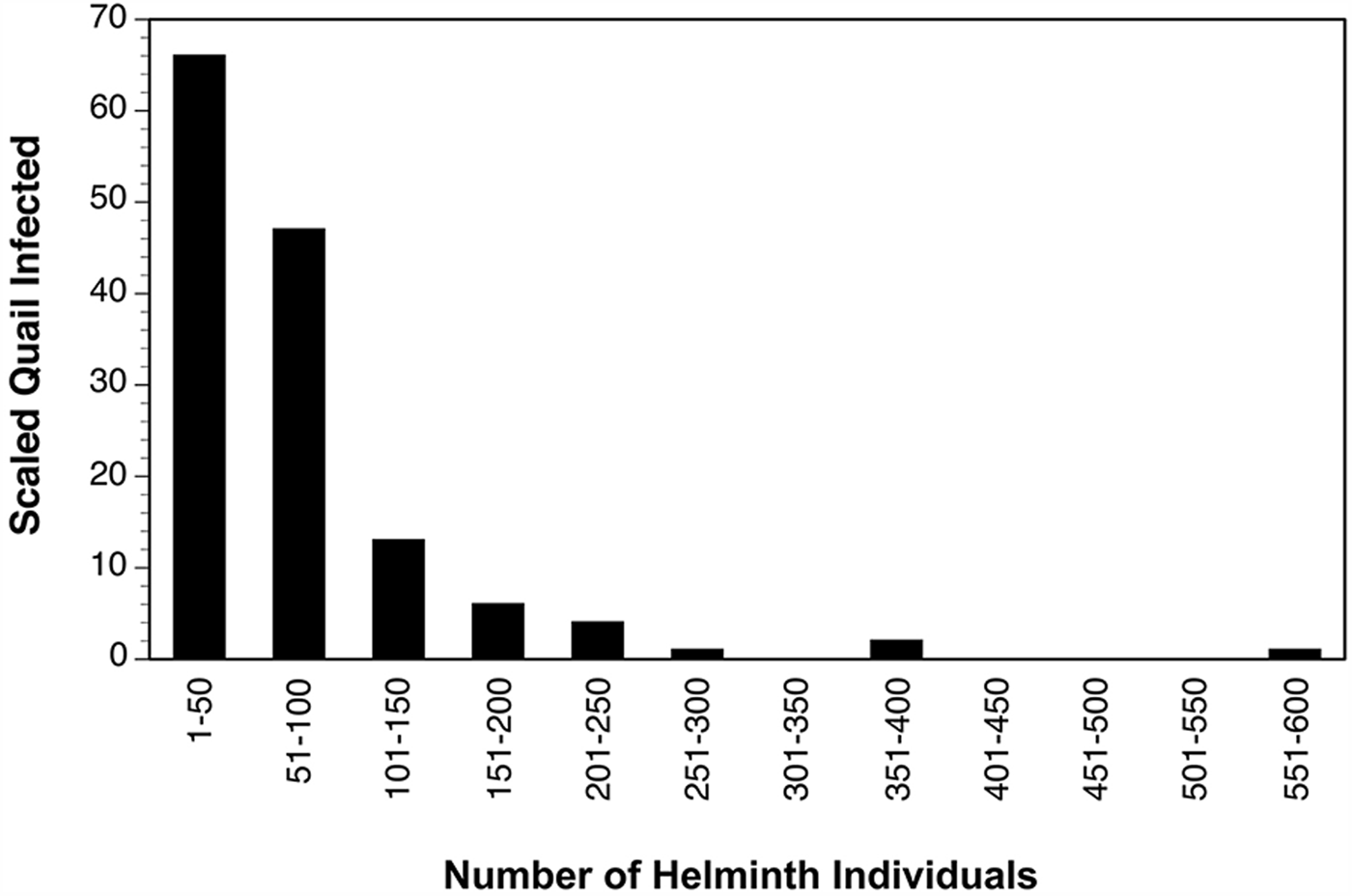
One hundred and forty-five scaled quail were donated during the 2012–2013 (n = 28; High Plains ecoregion: n = 18, Rolling Plains ecoregion: n = 6, Edwards Plateau ecoregion: n = 4), 2013–2014 (n = 74; High Plains ecoregion: n = 29, Rolling Plains ecoregion: n = 8, Trans-Pecos ecoregion: n = 10, Edwards Plateau ecoregion: n = 27), and 2014–2015 (n = 43; High Plains ecoregion: n = 26, Rolling Plains ecoregion: n = 17) quail hunting seasons. At the infracommunity level, 144 of 145 hosts were infected with one to four helminth species and averaged 1.7 species. Six helminth species, representing 10,485 individuals, were found at the component community level, which consisted of four nematodes, one acanthocephalan (cystacanth) and one cestode (table 1). Of these, A. pennula was the most common and abundant, occurring in 97% of hosts and representing 9991 individual helminths (95% of helminth individuals found), followed by O. petrowi (46% prevalence, 391 individuals, 4% of total). Each of the remaining four species was rare (<1–21% prevalence) and individually contributed few individuals (<1%) (table 1). In addition, A. pennula demonstrated an aggregated distribution pattern in which most (n = 66; 46%) scaled quail were infected with 1–50 individuals, whereas a few hosts (n = 3; 2%; all juveniles) were heavily (>300 individuals) infected (fig. 2).
Helminth prevalence, intensity, abundance and microhabitat from 145 scaled quail (Callipepla squamata) collected during the 2012–2013, 2013–2014 and 2014–2015 hunting seasons within a semi-arid region of Texas.

a C (ceca), CS (crop serosa), E (eye surface, intraorbital glands and ducts), G (gizzard), HP (heart pericardium), LI (large intestine), NM (neck muscle), P (proventriculus), SI (small intestine).
b Convergence questionable; no standard error presented.
c Cystacanth, likely to be Oncicola canis larvae (Olsen, Reference Olsen2014).
d Dispersion parameter estimated to be zero; no standard error presented.
e Occurred in only one host.
Distribution of Aulonocephalus pennula found in 145 scaled quail (Callipepla squamata) collected during the 2012–2013, 2013–2014 and 2014–2015 hunting seasons within a semi-arid region of Texas.

Prevalence and abundance
Two helminth species (A. pennula and O. petrowi) met the requirement for statistical analyses, occurring at ≥25% prevalence across the collective host dataset. However, because of the inconsistencies in the number of hunter-donated scaled quail among ecoregions and years, we were only able to test hypotheses related to (1) differences in prevalence and mean abundance among hunting seasons 2012–2013, 2013–2014 and 2014–2015 for the High Plains ecoregion, (2) differences in prevalence and mean abundance between the High Plains and Edwards Plateau ecoregions for the 2013–2014 hunting season and (3) the interaction between hunting season and ecoregion for seasons 2012–2013, 2013–2014 and 2014–2015 and High Plains and Rolling Plains ecoregions.
Prevalence data for A. pennula were not analysed because 140 of 145 (97%) scaled quail were infected with this parasite. In the High Plains ecoregion, prevalence of O. petrowi differed among hunting seasons (F 2,136 = 7.81, P < 0.0006) and was higher in 2013–2014 (20/29; 69.0% ± 8.6) than either 2012–2013 (2/18; 11.1% ± 7.4; t 136 = 3.38, P = 0.0009) or 2014–2015 (7/26; 26.9% ± 8.7; t 136 = 3.01, P = 0.0031). Prevalence of O. petrowi was higher (F 1,136 = 4.38, P < 0.0383) in the High Plains ecoregion (20/29; 69.0% ± 8.6) than the Edwards Plateau ecoregion (11/27; 40.7% ± 9.4) during the 2013–2014 hunting season. The interaction term between hunting season (2012–2013, 2013–2014 and 2014–2015) and ecoregion (High Plains and Rolling Plains) was not significant (F 2,136 = 1.04, P > 0.3568).
Within the High Plains ecoregion, mean abundance of A. pennula did not differ (F 2,136 = 2.62, P > 0.0765) in scaled quail among the three hunting seasons (69.2 ± 14.9, 103.4 ± 17.5, 131.2 ± 23.4, respectively). Mean abundance of A. pennula was higher (F 1,136 = 40.11, P < 0.0001) in scaled quail from the High Plains ecoregion (103.4 ± 17.5) than found in the Edwards Plateau (21.7 ± 3.9) during the 2013–2014 hunting season. The interaction between hunting season and ecoregion was not significant (F 2,136 = 1.85, P > 0.1615).
Within the High Plains ecoregion, mean abundance of O. petrowi varied (F2,136 = 8.17, P < 0.0004) among seasons for 2012–2013 (0.28 ± 0.16), 2013–2014 (4.24 ± 1.38) and 2014–2015 (2.04 ± 0.72). Mean abundance was lower in 2012–2013 than in 2013–2014 (t 136 = 4.03, P < 0.0001) and 2014–2015 (t 136 = 2.88, P = 0.0046). An ecoregion effect was also observed for mean abundance during the 2013–2014 hunting season, being higher (F 1,136 = 4.80, P < 0.0302) in scaled quail from the High Plains ecoregion (4.24 ± 1.38) than the Edwards Plateau (1.48 ± 0.52). The interaction between hunting season and ecoregion was not significant (F 2,136 = 1.92, P > 0.1511).
Discussion
Helminth fauna
The helminth component community in scaled quail from the semi-arid regions of Texas seems to be depauperate, consisting of six heteroxenous species dominated by a single commonly occurring and numerically dominant species (A. pennula). Similar helminth community structure and patterns found in our study were reported in scaled quail by Landgrebe et al. (Reference Landgrebe, Vasquez, Bradley, Fedynich, Lerich and Kinsella2007), in northern bobwhites (Colinus virginianus) within South Texas (Olsen & Fedynich, Reference Olsen and Fedynich2016), and except for species richness, in northern bobwhites within the Rolling Plains of Texas and western Oklahoma (species richness = 13; Bruno et al., Reference Bruno, Fedynich, Rollins and Wester2018). These studies found most if not all species were heteroxenous, one species (A. pennula) was highly prevalent and abundant, and most of the remaining species rarely occurred and contributed few individuals to the helminth component community. These findings contrast dramatically with those found in wild northern bobwhites occurring in the south-eastern USA (a geographic region that has substantially more precipitation than semi-arid regions of Texas) from which at least 24 species (six monoxenous and 18 heteroxenous species) collectively have been reported from the region (Cram et al., Reference Cram, Jones, Allen and Stoddard1931; Ward, Reference Ward1945; Davidson et al., Reference Davidson, Kellogg, Doster, Schitoskey, Schitoskey and Talent1982; Forrester et al., Reference Forrester, Conti, Bush, Campbell and Frohlich1984), and typically consist of multiple common (>75% prevalence), intermediate (25–75% prevalence) and rare (<25% prevalence) species (Davidson et al., Reference Davidson, Kellogg and Doster1980; Reference Davidson, Kellogg, Doster and Moore1991; Moore & Simberloff, Reference Moore and Simberloff1990). Absent in our study was the nematode Trichostrongylus cramae (=T. tenuis = T. pergracilis), which has been reported in northern bobwhites from more mesic regions of Texas (Demarais et al., Reference Demarais, Everett and Pons1987; Purvis et al., Reference Purvis, Peterson, Dronen, Lichtenfels and Silvy1998) and is often found throughout the south-eastern USA (Cram et al., Reference Cram, Jones, Allen and Stoddard1931) along with Heterakis isolonche (=H. bonasae) and Cyrnea colini, both of which are particularly prevalent (>76%) in northern Florida (Davidson et al., Reference Davidson, Kellogg and Doster1980; Reference Davidson, Kellogg, Doster and Moore1991; Forrester et al., Reference Forrester, Conti, Bush, Campbell and Frohlich1984; Moore et al., Reference Moore, Freehling and Simberloff1986; Moore & Simberloff, Reference Moore and Simberloff1990).
In semi-arid environments, very low transmission potentials may occur for monoxenous species because infective stages are directly exposed to adverse environmental conditions (Gray et al., Reference Gray, Pence and Simpson1978), whereas temporal persistence of heteroxenous species may be the result of maintaining viable infective life stages in intermediate hosts (Mackiewicz, Reference Mackiewicz1988). Our findings of a small helminth component community of heteroxenous species containing a single common and abundant species (A. pennula) provide additional support for the supposition of Fedynich et al. (Reference Fedynich, Monasmith and Demarais2001) and Landgrebe et al. (Reference Landgrebe, Vasquez, Bradley, Fedynich, Lerich and Kinsella2007) that the predominance of heteroxenous species tends to occur in semi-arid to arid regions in which helminth infective stages are maintained within intermediate hosts.
Pathogenic species
Four helminth species found in Texas quails have been known to cause pathological responses in wild northern bobwhites; localized inflammation has been reported for infections by Tetrameres pattersoni (Davidson et al., Reference Davidson, Kellogg, Doster and Moore1991; Olsen & Fedynich, Reference Olsen and Fedynich2016), Cheilospirura spinosa and Dispharynx nasuta (Davidson et al., Reference Davidson, Kellogg, Doster and Moore1991). In addition, the eyeworm O. petrowi can cause damage to the eye surface, conjunctiva, lacrimal ducts, lacrimal glands and Harderian gland (Bruno et al., Reference Bruno, Fedynich, Smith-Herron and Rollins2015; Dunham et al., Reference Dunham, Reed, Rollins and Kendall2016). Of these species, only O. petrowi was found in scaled quail in our study. Because only three female Tetrameres sp. were found, we were unable to identify this nematode to species using morphological characteristics (requires an adult male specimen). It was likely T. pattersoni, which has been reported in scaled quail from South Texas (Olsen, Reference Olsen2014) and northern bobwhites in the Rolling Plains ecoregion (Villarreal et al., Reference Villarreal, Bruno, Fedynich, Brennan and Rollins2016; Bruno et al., Reference Bruno, Fedynich, Rollins and Wester2018, Reference Bruno, Rollins, Wester and Fedynich2019), whereas the other potential species, Tetrameres americana, is typically found in poultry (Macklin, Reference Macklin2019). Tetrameres americana has been reported once in Texas from scaled quail in south-eastern Pecos County, Texas (Edwards Plateau ecoregion) (Howard, Reference Howard1981), in wild northern bobwhites from Florida (Kellogg & Prestwood, Reference Kellogg and Prestwood1968) and in captive bobwhites associated with chickens in the south-eastern USA (Cram et al., Reference Cram, Jones, Allen and Stoddard1931). We cannot discount the potential presence of C. spinosa and D. nasuta within the study area because these heteroxenous species have been found to rarely occur in northern bobwhites within the Rolling Plains ecoregion (Villarreal et al., Reference Villarreal, Bruno, Fedynich, Brennan and Rollins2016; Bruno et al., Reference Bruno, Fedynich, Rollins and Wester2018, Reference Bruno, Rollins, Wester and Fedynich2019).
Acknowledgements
We thank researchers at Texas Tech University and Texas A&M University who assisted in the project, and are grateful to participating Texas hunters, ranch managers and landowners. Dr M. Kinsella, HelmWest Laboratory, assisted in identifying helminths. This is manuscript No. 19-115 of the Caesar Kleberg Wildlife Research Institute.
Financial support
This research was funded by the Rolling Plains Quail Research Foundation (grant number SPR-1100136) and supported by the Caesar Kleberg Wildlife Research Institute.
Conflict of interest
None.
Ethical standards
Scaled quail were necropsied in accordance with Texas A&M University-Kingsville Institutional Biosafety Committee Approval (009-2011).