Introduction
Exercise (including leisure-time and recreational physical activities) and physical activity (PA) help to prevent chronic disease, physical functional disability, cognitive functional disability, lapses in morality and boost the quality of life among older adults (Keysor and Jette, Reference Keysor and Jette2001; Keysor, Reference Keysor2003; Nelson et al., Reference Nelson, Rejeski, Blair, Duncan, Judge, King, Macera and Castaneda-Sceppa2007; Motl and McAuley, Reference Motl and McAuley2010; Paterson and Warburton, Reference Paterson and Warburton2010; Carvalho et al., Reference Carvalho, Rea, Parimon and Cusack2014). Levels of exercise and PA among older adults are generally lower than among other age categories around the world (De Moor et al., Reference De Moor, Beem, Stubbe, Boomsma and De Geus2006; Hallal et al., Reference Hallal, Andersen, Bull, Guthold, Haskell and Ekelund2012), yet a survey from Japan indicates that the rate of participation in exercise increases with age (Ministry of Health, Labour and Welfare, Government of Japan (MHLW), nd). A growing number of nations recommend that exercise and PA be promoted to achieve optimal health benefits among older adults (Nelson et al., Reference Nelson, Rejeski, Blair, Duncan, Judge, King, Macera and Castaneda-Sceppa2007; King and King, Reference King and King2010). In Western countries, various studies have examined differences in the levels of exercise and PA resulting from differences in socio-economic status (SES); persons with low SES are less likely to exercise and be physically active, even if the outcomes are somehow distinguished by the type of exercise and PA being measured (Blair, Reference Blair and Dishman1988; Gidlow et al., Reference Gidlow, Johnston, Crone, Ellis and James2006; Beenackers et al., Reference Beenackers, Kamphuis, Giskes, Brug, Kunst, Burdorf and van Lenthe2012). Studies conducted in Asian Pacific countries, such as Taiwan and China (Lee et al., Reference Lee, Xu, Zheng, Li, Yang, Xiang and Shu2007; Chen et al., Reference Chen, Wu, Narimatsu, Li, Wang, Luo, Zhao, Chen and Xu2015; Lin et al., Reference Lin, Chiang, Yates, Tzeng, Lee and Chiang2016), Australia (Eime et al., Reference Eime, Charity, Harvey and Payne2015) and Japan (Anzai et al., Reference Anzai, Ohkubo, Nishino, Tsuji and Hisamichi2000; Fukuda et al., Reference Fukuda, Nakamura and Takano2005; Saito et al., Reference Saito, Oguma, Inoue, Tanaka and Kobori2013) support the notion that in those regions, SES differences impact levels of both exercise and PA. Although there have been a few studies on older adults in regard to this matter (Walsh et al., Reference Walsh, Pressman, Cauley and Browner2001; Chad et al., Reference Chad, Reeder, Harrison, Ashworth, Sheppard, Schultz, Bruner, Fisher and Lawson2005; Hillsdon et al., Reference Hillsdon, Lawlor, Ebrahim and Morris2008; Ashe et al., Reference Ashe, Miller, Eng and Noreau2009; Browning et al., Reference Browning, Sims, Kendig and Teshuva2009; Haley and Andel, Reference Haley and Andel2010; Yamakita et al., Reference Yamakita, Kanamori, Kondo and Kondo2015), these have also found SES differences to impact on levels of both exercise and PA in older adults.
Hence, prior studies have explored the mechanisms that account for differences in levels of exercise and PA by SES. Considering the detrimental effect of non-participation in exercise and physical inactivity on health, research on factors that contribute to SES differences in levels of exercise and PA can be used to create more effective intervention strategies in order to improve these levels in people with lower SES. Previous quantitative studies on the mediators that explain the differences in levels of exercise and PA focus on a wide range of factors. While only a few investigations clearly present theoretical models, they utilise the socio-ecological model as their theoretical one (Ball et al., Reference Ball, Timperio, Salmon, Giles-Corti, Roberts and Crawford2007; Cerin and Leslie, Reference Cerin and Leslie2008; Kamphuis et al., Reference Kamphuis, van Lenthe, Giskes, Huisman, Brug and Mackenbach2009; Eime et al., Reference Eime, Harvey, Craike, Symons and Payne2013). The core concept of the socio-ecological model is that behaviour has multiple levels of influence, including intrapersonal (biological, psychological), interpersonal (social, cultural), organisational, community, physio-environmental and policy (Sallis et al., Reference Sallis, Owen, Fisher, Glanz, Rimer and Viswanath2008) influences. If we were to categorise mediators based on the socio-ecological model, the mediators regarding intrapersonal influences could be found in the health domain in the form of perceived health status (Droomers et al., Reference Droomers, Schrijvers and Mackenbach2001; Cerin and Leslie, Reference Cerin and Leslie2008), and in the psychological domain as perceived control or efficacy (Droomers et al., Reference Droomers, Schrijvers, van de Mheen and Mackenbach1998, Reference Droomers, Schrijvers and Mackenbach2001; Ball et al., Reference Ball, Timperio, Salmon, Giles-Corti, Roberts and Crawford2007; Cerin and Leslie, Reference Cerin and Leslie2008; Kamphuis et al., Reference Kamphuis, van Lenthe, Giskes, Huisman, Brug and Mackenbach2008, Reference Kamphuis, van Lenthe, Giskes, Huisman, Brug and Mackenbach2009; De Cocker et al., Reference De Cocker, Artero, De Henauw, Dietrich, Gottrand, Béghin, Hagströmer, Sjöström, Plada, Manios, Mauro, Molnár, Moreno, Ottevaere, Valtueña, Maes and De Bourdeaudhuij2012), outcome expectations (Ball et al., Reference Ball, Timperio, Salmon, Giles-Corti, Roberts and Crawford2007; Kamphuis et al., Reference Kamphuis, van Lenthe, Giskes, Huisman, Brug and Mackenbach2008, Reference Kamphuis, van Lenthe, Giskes, Huisman, Brug and Mackenbach2009; De Cocker et al., Reference De Cocker, Artero, De Henauw, Dietrich, Gottrand, Béghin, Hagströmer, Sjöström, Plada, Manios, Mauro, Molnár, Moreno, Ottevaere, Valtueña, Maes and De Bourdeaudhuij2012) or intention (Ball et al., Reference Ball, Timperio, Salmon, Giles-Corti, Roberts and Crawford2007). The mediators regarding interpersonal influences include social support (Ball et al., Reference Ball, Timperio, Salmon, Giles-Corti, Roberts and Crawford2007; Cerin and Leslie, Reference Cerin and Leslie2008; Kamphuis et al., Reference Kamphuis, van Lenthe, Giskes, Huisman, Brug and Mackenbach2008; De Cocker et al., Reference De Cocker, Artero, De Henauw, Dietrich, Gottrand, Béghin, Hagströmer, Sjöström, Plada, Manios, Mauro, Molnár, Moreno, Ottevaere, Valtueña, Maes and De Bourdeaudhuij2012; Eime et al., Reference Eime, Harvey, Craike, Symons and Payne2013), social participation (Lindstrom et al., Reference Lindstrom, Hanson and Ostergren2001) and social influence (De Cocker et al., Reference De Cocker, Artero, De Henauw, Dietrich, Gottrand, Béghin, Hagströmer, Sjöström, Plada, Manios, Mauro, Molnár, Moreno, Ottevaere, Valtueña, Maes and De Bourdeaudhuij2012). The mediators regarding the environment include neighbourhood safety, neighbourhood attractiveness and access to resources for exercise (Ball et al., Reference Ball, Timperio, Salmon, Giles-Corti, Roberts and Crawford2007; Kamphuis et al., Reference Kamphuis, van Lenthe, Giskes, Huisman, Brug and Mackenbach2008, Reference Kamphuis, van Lenthe, Giskes, Huisman, Brug and Mackenbach2009; Eime et al., Reference Eime, Harvey, Craike, Symons and Payne2013). In addition, some qualitative studies have covered financial barriers (Steenhuis et al., Reference Steenhuis, Nooy, Moes and Schuit2009; Cassou et al., Reference Cassou, Fermino, Rodriquez Añez, Santos, Domingues and Reis2011), time constraints (Steenhuis et al., Reference Steenhuis, Nooy, Moes and Schuit2009; Cassou et al., Reference Cassou, Fermino, Rodriquez Añez, Santos, Domingues and Reis2011), poor health or functional ability (Burton et al., Reference Burton, Turrell and Oldenburg2003; Gray et al., Reference Gray, Murphy, Gallagher and Simpson2016) and adverse environments (Burton et al., Reference Burton, Turrell and Oldenburg2003; Kamphuis et al., Reference Kamphuis, van Lenthe, Giskes, Brug and Mackenbach2007; Cassou et al., Reference Cassou, Fermino, Rodriquez Añez, Santos, Domingues and Reis2011) as barriers that make it less likely that people with low SES will engage in exercise.
However, studies that have investigated the mechanisms that account for the impact of SES differences on levels of exercise and PA have some limitations. First, most prior research does not focus on older adults. Since SES differences in levels of exercise – including recreational PA – widen with age up to 74 years old (Farrell et al., Reference Farrell, Hollingsworth, Propper and Shields2013), shedding light on the mechanisms that influence them is an urgent issue for older and young adults alike. Given that differences in the factors related to participation in exercise by age have been found (Plotnikoff et al., Reference Plotnikoff, Mayhew, Birkett, Loucaides and Fodor2004; Renner et al., Reference Renner, Spivak, Kwon and Schwarzer2007), it is unclear whether the significant mediators that have been revealed in studies on young people function as effective mediators among older adults. Second, few studies have comprehensively examined the influences of a wide range of mediators including health, psychological, social and environmental domains, as the socio-ecological model indicates (Droomers et al., Reference Droomers, Schrijvers, van de Mheen and Mackenbach1998, Reference Droomers, Schrijvers and Mackenbach2001; Cerin and Leslie, Reference Cerin and Leslie2008; Kamphuis et al., Reference Kamphuis, van Lenthe, Giskes, Huisman, Brug and Mackenbach2009). Research that focuses on the mechanisms of SES differences in levels of PA or exercise need to use the socio-ecological model to identify effective intervention targets in order to reduce SES differences among older adults (Ball et al., Reference Ball, Timperio, Salmon, Giles-Corti, Roberts and Crawford2007; Kamphuis et al., Reference Kamphuis, van Lenthe, Giskes, Huisman, Brug and Mackenbach2009). Thus, the mediators that can most effectively explain SES-influenced differences in levels of exercise and PA remain vague.
This study examined which health, psychological, social and environmental mediators can most effectively explain education and income differences in relation to participation in exercise among older Japanese adults. We created a wide range of candidates for mediators based on the socio-ecological model. Only a few studies recognise health as a mediator (Droomers et al., Reference Droomers, Schrijvers and Mackenbach2001; Cerin and Leslie, Reference Cerin and Leslie2008). According to a review article, health indicators are important elements related to levels of PA (Bauman et al., Reference Bauman, Reis, Sallis, Wells, Loos, Brian and Martin2012). In addition, SES influences health indicators (Sugisawa et al., Reference Sugisawa, Harada, Sugihara, Yanagisawa and Shinmei2016). As a result, we added health indicators as a candidate for mediators.
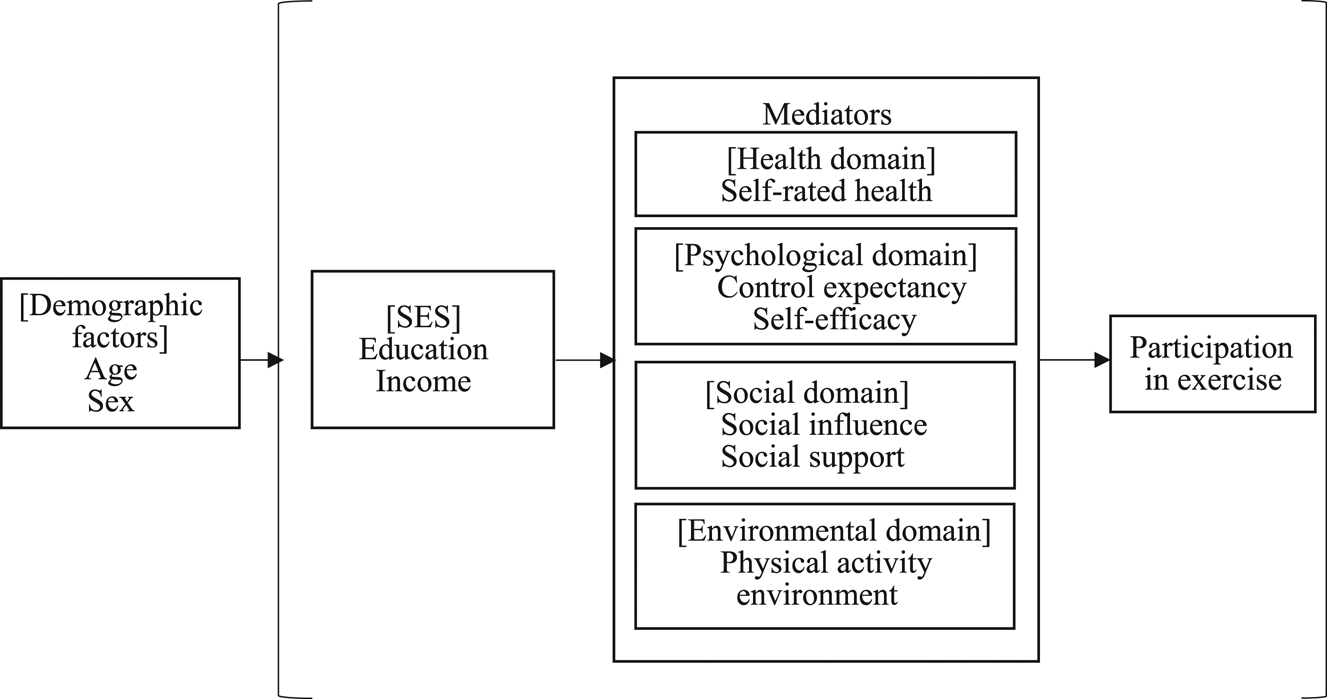
Figure 1 outlines the analytic framework used in this study. We constructed it based on ones developed by Cerin and Leslie (Reference Cerin and Leslie2008) and Ball et al. (Reference Ball, Timperio, Salmon, Giles-Corti, Roberts and Crawford2007), who applied the socio-ecological model. As shown in the Introduction, we found the chosen mediators in the four domains of health, psychological, social and environmental conditions. We measured health using self-rated questions based on a previous study (Cerin and Leslie, Reference Cerin and Leslie2008), and we evaluated psychological mediators through control expectancy and self-efficacy based on previous studies (Ball et al., Reference Ball, Timperio, Salmon, Giles-Corti, Roberts and Crawford2007; Kamphuis et al., Reference Kamphuis, van Lenthe, Giskes, Huisman, Brug and Mackenbach2008, Reference Kamphuis, van Lenthe, Giskes, Huisman, Brug and Mackenbach2009; De Cocker et al., Reference De Cocker, Artero, De Henauw, Dietrich, Gottrand, Béghin, Hagströmer, Sjöström, Plada, Manios, Mauro, Molnár, Moreno, Ottevaere, Valtueña, Maes and De Bourdeaudhuij2012). Social mediators included social support and social influences, which have been used in prior research (Ball et al., Reference Ball, Timperio, Salmon, Giles-Corti, Roberts and Crawford2007; Cerin and Leslie, Reference Cerin and Leslie2008; Kamphuis et al., Reference Kamphuis, van Lenthe, Giskes, Huisman, Brug and Mackenbach2008; De Cocker et al., Reference De Cocker, Artero, De Henauw, Dietrich, Gottrand, Béghin, Hagströmer, Sjöström, Plada, Manios, Mauro, Molnár, Moreno, Ottevaere, Valtueña, Maes and De Bourdeaudhuij2012; Eime et al., Reference Eime, Harvey, Craike, Symons and Payne2013).
Analytic framework.

Few studies have focused on social influence as a mediator for SES–exercise and PA. The influence of ‘significant others’ who participate in exercise was apparent in the levels of exercise or PA among young adults (Anderssen and Wald, Reference Anderssen and Wald1992; Keresztes et al., Reference Keresztes, Piko, Pluhar and Page2008) and older adults (Voorhees and Young, Reference Voorhees and Young2003). Furthermore, PA in early life is a predictor of a physically active lifestyle later on (Hirvensalo and Lintunen, Reference Hirvensalo and Lintunen2011). In terms of other health behaviours, such as dietary habits, part of the observed SES differences can be explained by social influences operating as mediators (Sugisawa et al., Reference Sugisawa, Nomura and Tomonaga2015). Thus, according to previous studies, it is possible that social influences on one's lifecourse could explain SES differences in exercise among older adults.
We hypothesise that the mechanisms of SES differences in participation in exercise differ by education and income. Few studies have examined this proposition (Cerin and Leslie, Reference Cerin and Leslie2008; Kamphuis et al., Reference Kamphuis, van Lenthe, Giskes, Huisman, Brug and Mackenbach2008). Education affects the onset of health problems through psycho-social resources such as social support and self-efficacy (Hard et al., Reference Hard, Goesling and House2007). On the other hand, those with higher incomes can better afford to live in clean and safe neighbourhoods (Hard et al., Reference Hard, Goesling and House2007). According to these suggestions, we can hypothesise two things: (a) psycho-social factors, such as self-efficacy and social support, can mediate a sizeable portion of education's impact on participation in exercise; and (b) income's influence on participation in exercise can greatly mediate environmental factors, more than psycho-social factors.
Methodology
Participants
Using systematic sampling, we selected a total of 2,000 individuals aged 65 years and older, living in two cities in the Tokyo metropolitan area. We chose the two particular cities to recruit test subjects with large SES differences, including income and educational attainment. The annual income per taxpayer in 2014 and 2010 in the two cities was 3.60 and 5.36 million yen, respectively, and the percentage of university graduates among all residents was 16.6 and 25.3 per cent, respectively (Statistics Bureau, Ministry of Internal Affairs and Communications (MIAC), 2016). We conducted face-to-face interviews at respondents’ homes in March 2016. We strove to increase participation rates by visiting subjects who could not be interviewed due to tentative absence, or had no time to be interviewed, at least three times when the interviewers first visited their homes. The final number of participants was 761. The overall participation rate for the subjects was 38.1 per cent. Considering the motives for non-participation, the rates for the test subjects were 41.3, 13.3, 3.4, 2.4, 0.6 and 0.9 per cent for refusal, absence, poor health, relocation, death or another reason, respectively. In this study, the final number of usable participants for analyses was 739, as we excluded those with a high possibility of cognitive impairment. We measured cognitive impairment through the Short Portable Mental Status Questionnaire (SPMSQ; Pfeiffer, Reference Pfeiffer1975). We did not ask about the ‘name of this place’, because this item was almost identical to ‘your street address’, as the interviewers spoke with almost all of the participants in their own homes. Since the original item cut-off points were maintained (Liang et al., Reference Liang, Borawski-Clark, Liu and Sugisawa1996), we excluded those with over three errors based on the respondents’ answers to the SPMSQ.
Assessment
Demographic variables
The demographic variables are gender (1 = male, 0 = female), age and city of residence (1 = city of residents with higher SES, 0 = city of residents with lower SES).
Education
We asked the participants to indicate their highest level of education from the following: ‘junior high school’, ‘high school’, ‘vocational school’, ‘junior college’ and ‘university’ or ‘graduate school’. We assigned 9, 12, 13, 14, 16 and 18 to each category to quantify the responses. These figures reflect one's number of years of education according to the Japanese educational system.
Equivalent annual income of participants and their spouses
The survey asked for participants’ and their spouses’ approximate annual income before tax deductions the previous year. We provided nine levels, and used the mid-point of each category for quantification. For example, we assigned the categories ‘more than 2 and less than 3 million yen’ and ‘more than 7.5 and less than 10 million yen’ 2.5 and 8.75 million yen, respectively. Due to a relatively high item non-response rate (about 30 per cent) for household income in Japan (Miwa and Maeda, Reference Miwa, Maeda and Yasuda2018), we did not ask about annual household income. For example, the rate of ‘Don't know’ or ‘Refuse to answer’ for answer choices to a question on household income was 26 per cent among older respondents according to the Japanese General Social Survey (JGSS), based on a representative sample of people over 20 years old (JGSS Research Center at Osaka University of Commerce, 2013). Another survey showed that the money provided by one's children comprised 7 per cent of income among older adults (Cabinet Office, Government of Japan, nd). As a result, we evaluated older adults’ economic status by using their and their spouse's annual income, which had a lower item non-response rate than household income. We newly calculated the couple's equivalent annual income based on the work of Groundy and Holt (Reference Groundy and Holt2001). According to their adjustment method, we distinguished married respondents from unmarried ones. In the case of married respondents, we set individual income at 80 per cent of the couple's income. We examined the validity of this measurement by using an external criterion of equivalent household income, calculated by household income divided by the square root of the number of family members living together. We obtained data on older respondents, which we used to examine external validity, from the JGSS 2012 (JGSS Research Center at Osaka University of Commerce, 2013), mentioned earlier. Since the correlation coefficient between the couple's equivalent income and the equivalent household income was 0.876, it appears that the validity of the couple's equivalent income is confirmed.
Health
We measured health using self-rated health (SRH). We asked, ‘In general, how would you rate your health today’? The choices were (1) ‘excellent’, (2) ‘very good’, (3) ‘good’, (4) ‘fair’ and (5) ‘poor’. We assigned a score of 1–5 for each choice to measure quantity.
Control expectancy for exercise
We assessed expectations of physical outcome using three items, asking participants to rate whether they expected to (a) sleep better, (b) feel refreshed or (c) feel less stressed, if they slowly and steadily increased their participation in exercise. The possible responses ranged from 1 (agree) to 4 (disagree). These three items were used in the scale developed by Anderson et al. (Reference Anderson, Wojcik, Winett and Williams2006). We used principal component analysis (PCA) to extract a single component by using an eigenvalue > 1.0 criterion. This explained 85.9 per cent of the total variance in the three items, which all loaded above 0.9 on this component. The Cronbach's alpha for this index was 0.917.
Self-efficacy for exercise
This variable was composed of three items that were used in the scale developed by Oka (Reference Oka2003). We asked the participants questions about their confidence, specifically whether they would play a sport or exercise even if (a) the weather is relatively bad; (b) they are busy; or (c) they are a little tired. We scored the responses on a four-point scale, ranging from 1 (not at all confident) to 4 (very confident). We used PCA to extract a single component by imposing an eigenvalue > 1.0 criterion. This explained 88.1 per cent of the total variance in the three items, which all loaded above 0.9 on this component. The Cronbach's alpha value for this index was 0.933.
Social support for exercise from family and friends
This variable was composed of three items based on the scale developed by Prochaska et al. (Reference Prochaska, Rodgers and Sallis2002). We asked the participants about the level of perceived social support they received from their family/friends in each of the following scenarios: (a) to encourage them to exercise or play a sport if they don't do it; (b) to praise them when they make an effort to exercise or play a sport; and (c) to make time to play a sport and exercise with them. We scored the responses on a four-point scale, ranging from 1 (not supportive or no support) to 4 (very supportive). We used PCA to extract a single component by imposing an eigenvalue > 1.0 criterion. This component explained 77.4 per cent of the total variance in the four items, which all loaded above 0.8 on this component. The Cronbach's alpha for this index was 0.854.
Social influence for exercise from family and friends
We measured the social influence on one's lifecourse as a social factor. We asked the participants if important ‘others’, such as their family and friends, exercised during three periods in their lives: (a) when they were in junior high school; (b) when they were about 20 years old; and (c) when they were about 40 years old. We created the measure by counting the frequency of social influences over their lifecourse, because the frequency of social influence over a lifecourse showed an effect on exercise in our preliminary analysis for this database.
Physical activity environment
This variable was composed of four items based on the International Physical Activity Questionnaire for the Elderly (Inoue et al., Reference Inoue, Murase, Shimomitsu, Ohya, Odagiri, Takamiya, Ishii, Katsumura and Sallis2009a, Reference Inoue, Murase, Shimomitsu, Ohya, Odagiri, Takamiya, Ishii, Katsumura and Sallis2009b). We added 11 items (seven core and four recommended items) from the module (17 items) to the questionnaire, based on a study by Saito et al. (Reference Saito, Oguma, Inoue, Tanaka and Kobori2013). To score each item, we followed the system that they used. We created the variables by adding a score for the items that had individually significant impacts on exercise, even if there was a controlling effect from other items present. Four items had a significant effect on exercise: (a) access to shops; (b) access to exercise facilities; (c) the social environment (seeing people being active); and (d) aesthetics (e.g. the qualities of a neighbourhood that encourage participants to walk). Previous studies from Japan show that these items had the same significant effects on PA (Saito et al., Reference Saito, Oguma, Inoue, Tanaka and Kobori2013).
Participation in exercise
We defined people who exercise for 30 minutes or longer twice a week, or for 20 minutes or longer three times a week, over the course of a year as participants who practise exercise. This amount of exercise should be equal to at least four MET-hours per week (MET stands for ‘metabolic equivalent of task’) and improves physical fitness (Wenger and Bell, Reference Wenger and Bell1986). This criterion was also used to define people as practitioners of exercise in a National Health and Nutrition Survey conducted by MHLW in Japan. We established numerical targets based on this criterion as defined in ‘the second-phase of the National Health Promotion Movement in 21st-century Japan’ (MHLW, 2013).
Statistical methodology
This study examined whether or not certain mediators could explain the relationships between SES and participation in exercise. We used Mplus Version 8.1 (Muthén and Muthén, Reference Muthén and Muthén1998–2017) in the data analysis. In addition, we used multiple mediation analysis as proposed by Preacher and Hayes (Reference Preacher and Hayes2008) to facilitate the estimation of the total and specific indirect effects in a multiple factor model. In addition, we examined the null hypotheses that the indirect effects of each mediator resulting from the education and income indicators are equal (Preacher and Hayes, Reference Preacher and Hayes2008). We standardised all variables in the model to compare the sizes of the indirect effects produced by each mediator. We used bootstrapping to estimate the total and specific indirect effects of the mediators. We determined the point estimates and 95 per cent confidence intervals according to the null hypothesis.
We employed a full-information maximum likelihood approach to handle missing data in the analysis (Muthén and Muthén, Reference Muthén and Muthén1998–2017). We examined whether there were mediation effects, even if the total effect of the independent variable (income) did not have a significant effect on the dependent variable (participation in exercise). This approach was based on the suggestion that the significant effect of the independent variable is not always necessary for mediation to occur (Preacher and Hayes, Reference Preacher and Hayes2008). If M1 acts as a mediator and a second mediator, M2, acts as a suppressor, the total effects of the independent variable on the dependent variable might be reduced, given the possibility that the indirect effects of M1 and M2 might cancel each other out. We assessed the overall model fit using the root mean square error of approximation (RMSEA) and the comparative fit index (CFI). It is recommended that the RMSEA be below 0.05 (Brown and Cudeck, Reference Brown and Cudeck1992) and the CFI above 0.90 (Bentler, Reference Bentler1990).
Results
Descriptive statistics
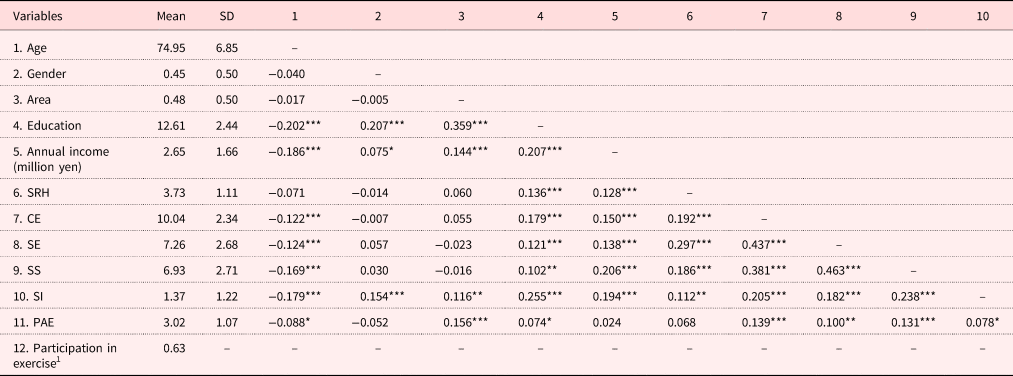
Table 1 provides the descriptive statistics and correlations among the variables related to the participants. The average age was 74.9 years and 45.0 per cent were male, while the average years of education was 12.6 and the average of a couple's equivalent annual income was 2.68 million yen. All correlations among the variables were less than 0.5, and multicollinearity did not arise.
Descriptive statistics and correlations among the variables

Notes: We calculated means and correlations using the full-information maximum likelihood method. 1. As participation in exercise is a dependent and categorical variable, we did not calculate its correlations with the independent variables. SD: standard deviation. SRH: self-rated health. CE: control expectancy for exercise. SE: self-efficacy for exercise. SS: social support for exercise. SI: social influence for exercise. PAE: physical activity environment.
Significance levels: * p < 0.05, ** p < 0.01, *** p < 0.001.
Overall, 63.3 per cent of participants said they take part in exercise. The path coefficient of education (0.163, p = 0.002) was significant, but the path coefficient of income was not significant (0.039, p = 0.489) after entering age, gender and area as control variables.
Multiple mediation
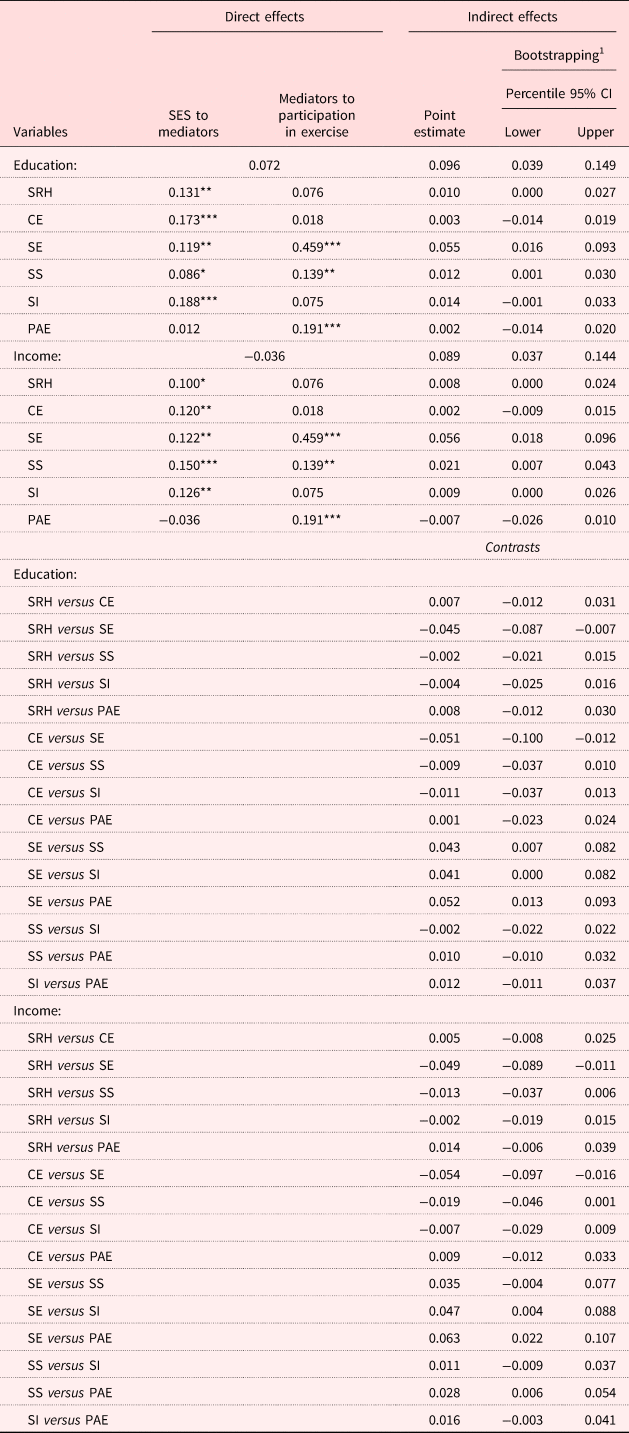
Table 2 displays the results of the multiple mediation analysis. The RMSEA was 0.085 and the CFI was 0.994. Thus, this model's fitness was moderately acceptable. The direct effects of both education and income on each mediator were significant. Only the physical activity environment had no significant, direct effects on both education and income, in contrast to the effects of other mediators. The direct effects of self-efficacy for exercise, social support for exercise and the physical activity environment on participation in exercise were significant. Multiple mediation analysis revealed that both education and income had significant, total indirect effects on participation in exercise. In addition, after reducing the indirect effects, each direct effect of education and income on participation in exercise became smaller and not significant (the path coefficients of education and income were 0.072 and –0.036, respectively).
Direct and indirect effects of socio-economic status (SES) on participation in exercise through health, psychological, social and environmental mediators

Notes: We obtained the effects of each variable after controlling for the influence of other variables, without the variable in question. 1. Five thousand bootstrap samples. Fitness index of the model: the root mean square error of approximation (RMSEA) = 0.085; the comparative fit index (CFI) = 0.994. CI: confidence interval. CE: control expectancy for exercise. SE: self-efficacy for exercise. SS: social support for exercise. SI: social influence for exercise. PAE: physical activity environment.
Significance levels: * p < 0.05, ** p < 0.01, *** p < 0.001.
The bootstrap estimates showed that self-efficacy for exercise and social support for exercise were significant, specific mediators of relationships between both education and income and participation in exercise. Social support for exercise explained more of the income differences affecting participation in exercise than it did for educational differences. In terms of SRH, the 95 per cent confidence interval of the indirect effect was 0.000–0.027 for education and 0.000–0.024 for income. Since the direct effects of SRH on participation in exercise were not significant, we interpreted both indirect effects as insignificant. The path coefficient of self-efficacy for exercise was largest among all of the path coefficients relating to the mediators between both education and income and exercise. As a result of testing the contrast hypothesis, regarding education, the indirect effect of self-efficacy for exercise was significantly higher than the indirect effects of other mediators without social influence for exercise. For income, the indirect effect of self-efficacy for exercise was significantly higher than the indirect effects of other mediators without social support for exercise, and the indirect effect of social support for exercise was significantly higher than the indirect effects of the physical activity environment.
Discussion
While several existing studies indicate the significant influence of both the SES indicators of education and income on levels of exercise or PA (Chad et al., Reference Chad, Reeder, Harrison, Ashworth, Sheppard, Schultz, Bruner, Fisher and Lawson2005; Ashe et al., Reference Ashe, Miller, Eng and Noreau2009; Browning et al., Reference Browning, Sims, Kendig and Teshuva2009; Yamakita et al., Reference Yamakita, Kanamori, Kondo and Kondo2015), other studies that identified the significant influence of education on levels of exercise did not in fact observe the influence of income as an SES indicator (Walsh et al., Reference Walsh, Pressman, Cauley and Browner2001; Haley and Andel, Reference Haley and Andel2010). Our findings also indicate the significant influence of education on participation in exercise, and we did not observe any significant influence from levels of income. In our review of studies on older adults in other populations, the influence of education on exercise tended to be stronger than that of income (Gidlow et al., Reference Gidlow, Johnston, Crone, Ellis and James2006). However, other review articles indicate that although education has been the most frequently studied SES indicator, it cannot be confirmed as a stronger influence on levels of exercise than other SES indicators (Beenackers et al., Reference Beenackers, Kamphuis, Giskes, Brug, Kunst, Burdorf and van Lenthe2012). More studies on SES differences in levels of exercise and PA among older adults, using both education and income as indicators, are therefore needed to develop a concrete view on this matter.
Although this study found no significant influences of income on participation in exercise, it showed that there are significant, indirect influences from income on participation in exercise through the mediators. Many studies have only covered a narrow range in terms of mediators between SES and levels of exercise or PA, with only a few covering a wide range of mediators. In a study of people aged 20–65, Cerin and Leslie (Reference Cerin and Leslie2008) showed that while the influence of education and income on levels of exercise can be explained through the operation of self-efficacy and social support mediators, that of income was also – to a smaller extent – explained by barriers to walking as an environmental characteristic. Ball et al. (Reference Ball, Timperio, Salmon, Giles-Corti, Roberts and Crawford2007) investigated people aged 18–65, and found that the association between education and levels of PA is in major part explained by self-efficacy, enjoyment, behavioural intentions and social support, and that environmental variables make a substantial contribution. In this study, self-efficacy for exercise and social support for exercise had significant, specific mediation effects on the relationships between both education and income and participation in exercise. Accordingly, psycho-social factors of self-efficacy for exercise and social support for exercise may be common, important mediators of the influences of both education and income on participation in exercise among younger and older adults alike.
However, this study found that the physical activity environment did not effectively explain income-moderated differences in participation in exercise, which differs from other studies (Cerin and Leslie, Reference Cerin and Leslie2008). Our findings do not support our hypothesis. The influence of income on participation in exercise can be greatly mediated by environmental factors, even more than psycho-social factors. Since no studies have examined environmental influences as mediators in Japan, we must be deliberate in generalising this finding. However, Takano et al. (Reference Takano, Nakamura and Watanabe2002) examined the physical environment's influence on mortality among older adults living in Tokyo, as well as participants in this study, in relation to walkable green streets and spaces near homes. They found that the physical environment's effect on mortality was almost the same, even after controlling for the respondents’ living expenses. Their outcomes suggest that SES indicators have a low association with the physical environment in Japan's metropolitan regions. Why are individual SES indicators not strongly linked with the physical environment? Tokyo has low residential segregation by income compared to other big urban centres around the world (Maloutas and Fujita, Reference Maloutas and Fujita2012). As Tokyo includes a lot of mixed-income areas, it is possible that diversity in the physical environment is lower in Tokyo than in large cities in other countries. Such environments may cause the physical environment not to mediate between income and participation in exercise in Tokyo, which this study selected for fieldwork.
On the other hand, psycho-social factors of self-efficacy for exercise and support for exercise mediated between income and participation in exercise, while the environment did not. In this study, this mechanism was the same as the influence of education on participation in exercise, and was also supported by results obtained in valuable studies (Ball et al., Reference Ball, Timperio, Salmon, Giles-Corti, Roberts and Crawford2007; Cerin and Leslie, Reference Cerin and Leslie2008). In terms of general self-efficacy, one explanation for the positive association between SES and self-efficacy is that individuals with high SES have a large pool of resources to draw on that increase the range of potential daily activities, ultimately increasing the likelihood of having mastery experiences (Hughes and Demo, Reference Hughes and Demo1989). As people with higher education or higher incomes have larger psychological or material resources, they are likely to have mastery experiences through easy access to affluent resources. These experiences of efficacious action may boost self-efficacy among higher-income older adults. In terms of support in general, it is hypothesised that the relationship between SES and social support is mediated by life events that disrupt and impair social relationships (House et al., Reference House, Lepkowski, Kenney, Mero, Kessler and Herzog1994). Network members among people with lower incomes and less education tend to share fewer resources to enhance people's capacity to solve problems. They are likely to have experienced negative life events because their own resources and networks are generally limited. Under these circumstances, approaching their networks during multiple events, such as loss of job and friends, might overwhelm the network's limited recourses and availability. These mechanisms may work to reduce social support among older adults with lower education or lower incomes. However, the above explanations are related to education and income differences for ‘general’ – rather than specific – self-efficacy and social support. As there are few studies on the mechanisms of SES differences in specified self-efficacy and social support, such research should be conducted in the future. Also, our findings suggest that social influence is an ineffective mediator. In a study on adolescents conducted by De Cocker et al. (Reference De Cocker, Artero, De Henauw, Dietrich, Gottrand, Béghin, Hagströmer, Sjöström, Plada, Manios, Mauro, Molnár, Moreno, Ottevaere, Valtueña, Maes and De Bourdeaudhuij2012), although social influence had a significant function as a mediator, self-efficacy and social support were ineffective at explaining the impact of SES differences on levels of PA. Thus, the explanatory power of social influence on SES differences in exercise may be weaker in older adults than in adolescents.
Several limitations of this study should be acknowledged. First, low participant rates may have introduced a bias into the results. In the National Health and Nutrition Survey that used the same questions about exercise, 38.9 per cent of people aged 65 years and over said they participate in exercise (MHLW, 2016). However, the rate of participation in exercise in our study was approximately 20 per cent higher than in the national survey. In addition, it is possible that people with lower SES do not respond to surveys (Galea and Tracy, Reference Galea and Tracy2007). Thus, the higher response rate in this study among older adults with higher SES may account for the higher rate of participation in exercise, although the response rate of approximately 40 per cent of respondents in our study was not very different from that of other face-to-face interview surveys conducted in Tokyo (Hanibuchi et al., Reference Hanibuchi, Muranaka, Hanaoka and Nakaya2011). If a higher response rate had been achieved, it is possible that larger differences in the rate of participation in exercise resulting from SES than the ones seen in this study would have been observed, and the mediators used in this study would have explained a smaller portion of the differences caused by SES. Secondly, we solely chose the Tokyo region as our survey field. As the rate of participation in exercise was higher in urban areas than in rural ones in a nation-wide survey by Martin et al. (Reference Martin, Kirkner, Mayo, Matthews, Durstine and Hebert2005), differences in survey fields may partially account for the differences in the rate of participation in exercise between this study and the National Health and Nutrition Survey.
Thirdly, the scale we used to evaluate PE is similar to leisure-time PA, and only measured a narrow range of PA (the outcome variable used in this study was participation in exercise). However, in previous studies, considerable differences in the direction of inequalities have been seen in the different domains of PA (Beenackers et al., Reference Beenackers, Kamphuis, Giskes, Brug, Kunst, Burdorf and van Lenthe2012). People with higher SES had higher levels of leisure-time PA compared to ones in lower SES areas, and lower SES groups were likely to become involved in occupational PA opportunities. Moreover, SES differences in total PA and active transport PA did not show a consistent pattern. The reasons for higher occupational PA in lower SES groups may be related to the more physically demanding work in those SES groups (Kirk and Rhodes, Reference Kirk and Rhodes2011). In Japan, as the labour force participation rate was 31.1 per cent in older male adults in 2015 (Statistics Bureau, MIAC, 2017), the exclusion of work-time PA as an outcome variable caused problems, especially for men. Measuring not only participation in exercise, but also work-time PA (including domestic work), is an important consideration for future research, while using total PA measures would increase our ability to understand the complexity of the influence of SES differences on PA. Fourthly, the data used in the present study were cross-sectional, precluding the testing of causally mediated influences on participation in exercise. Longitudinal studies should thus provide more credible evidence of mediators’ role in explaining the impact of SES differences on participation in exercise.
Despite these limitations, the present study provides new insights into the mechanisms underlying SES-based differences in participation in exercise among older adults. The findings suggest that public health programmes and policies that aim to promote participation in exercise among disadvantaged older adults should focus on supporting participation in exercise by the people near them (such as family members and friends), in addition to enhancing their self-efficacy with respect to participation in exercise.
Conclusions
This study implies that the influence of education and income on participation in exercise is mediated by self-efficacy and social support, and self-efficacy has the strongest effect.
Author ORCIDs
Hidehiro Sugisawa, 0000-0003-1646-1824
Acknowledgements
The Japanese General Social Surveys (JGSS) are designed and carried out by the JGSS Research Center at Osaka University of Commerce (Joint Usage/Research Center for Japanese General Social Surveys accredited by the Minister of Education, Culture, Sports, Science and Technology), in collaboration with the Institute of Social Science at the University of Tokyo. The project is financially assisted by the Japanese Ministry of Education, Culture, Sports, Science and Technology and Osaka University of Commerce.
Author contributions
HS formulated the research question, designed the study, analysed the data and wrote the manuscript. KH designed and carried out the survey and wrote the manuscript. YS designed and carried out the survey, analysed and interpreted the data, and revised the manuscript. SY and MS designed and carried out the survey and revised the manuscript.
Financial support
This work was supported by the Japan Society for the Promotion of Science (JSPS) KAKENHI (grant number 21119005).
Conflict of interest
The authors declare no conflicts of interest.
Ethical standards
The study complied with the guidelines of the Helsinki Declaration. All procedures were approved by the Research Ethics Board at J.F. Oberlin University.