Introduction
Surgical site infection (SSI) is among the most common and potentially preventable postoperative complications and healthcare-associated infections (HAIs). Incidence is particularly high in colorectal surgery, with reported rates from 5% to 26%. Reference Tang, Chen and Wang1–Reference Cai, Wang, Wang and Zhou6 These infections have a significant impact on patient outcomes, as increased morbidity and mortality, longer hospital stays, reduced health-related quality of life, and substantial economic burden. Reference de Lissovoy, Fraeman, Hutchins, Murphy, Song and Vaughn7–Reference Astagneau, Rioux, Golliot and Brücker13
SSIs are classified by the Centers for Disease Control and Prevention (CDC) and the American College of Surgeons National Surgical Quality Improvement Program (ACS-NSQIP) into three categories: superficial, deep, and organ/space. 14 Although often grouped in studies, these categories differ markedly in risk factors, pathophysiology, and management. Reference Keenan, Speicher, Thacker, Walter, Kuchibhatla and Mantyh15–Reference Lawson, Hall and Ko17
While grouping may simplify data reporting, it can overestimate event rates and obscure specific risk factors and cost drivers. At our institution, SSI surveillance follows the European Centre for Disease Prevention and Control (ECDC) guidelines, 18 and the mean reported incidence of all three categories over the past 5 years has been 24%.
Moreover, the combined analysis may induce significant bias. In particular, the inclusion of organ/space SSIs can exaggerate the differences between infected and non-infected patients, as these infections are typically more severe and require reoperation, prolonged intensive care, and extended antimicrobial therapy.
In contrast, the economic impact of incisional SSIs—comprising superficial and deep infections—has been less thoroughly investigated. Though less severe than organ/space infections, incisional SSIs are more frequent and potentially more amenable to targeted prevention. Reference Falconer, Ramsay, Hudson and Watson19,Reference Dixon, Biggs, Messenger and Shabbir20
The aim of this study was to compare 60-day hospital costs between patients undergoing colorectal surgery who developed incisional SSI and those who did not.
Methods
Study Design and Ethical Compliance
This single-center, retrospective cohort study was conducted to assess hospital costs associated with incisional SSIs in patients who underwent colorectal surgery at a tertiary oncologic center between January 1, 2018, and December 31, 2023. The study protocol was developed in accordance with the Consolidated Health Economic Evaluation Reporting Standards (CHEERS) 2022 guidelines Reference Husereau, Drummond and Augustovski21 and was approved by the local Clinical Research Unit and Ethics Committee (approval reference: UIC/1756).
Eligibility criteria and patient selection
Inclusion Criteria:
-
Patients aged 18 years or older;
-
Undergoing surgical resection for a primary neoplasm of the colon, rectum, or anal canal, whether benign or malignant.
Exclusion Criteria:
-
Patients undergoing complex multivisceral resections (eg, pelvic exenterations or sacrectomies);
-
Cases involving organ/space SSIs;
-
Diagnosis of SSI occurring after reoperation.
Patient selection was conducted in two steps. First, eligible patients were identified through two complementary sources: (i) a prospectively maintained institutional database curated by the Colorectal Surgery Unit within the Department of General Surgery, and (ii) a national registry managed by the Portuguese Directorate-General of Health, developed for the epidemiological surveillance of SSIs and based on the European HAI-Net SSI protocol (ECDC, version 2.2). 18 Second, the diagnosis of SSI was confirmed through detailed review of each patient’s electronic medical record.
Outcomes
The primary outcome was the comparison of 60-day hospital costs between patients undergoing primary surgery for colorectal neoplasm who developed incisional SSI and those who did not. The 60-day observation period was chosen to capture infection-related costs while avoiding the inclusion of expenditures associated with adjuvant oncologic therapies. This timeframe was supported by prior evidence from our cohort indicating that over 10% of patients with incisional SSI require more than 30 days between the date of surgery and complete infection resolution.
Secondary outcomes included the impact of incisional SSI on the need for surgical reintervention, length of hospital stay, and use of hospital resources.
Outcome measures
Event Definition: SSIs were defined according to the criteria established by the U.S. CDC and ACS-NSQIP. 14 SSIs were classified as superficial (involving the skin and subcutaneous tissue), deep (involving the fascial and muscular layers), or organ/space (involving any part of the anatomy that was opened or manipulated during surgery). For the purposes of this study, only incisional SSIs—superficial and deep infections—were considered. Events were included if diagnosed within 30 days of surgery and established by trained healthcare professionals. During the index hospitalization, SSIs were diagnosed by members of the surgical team or inpatient nursing staff. After discharge, diagnoses were mostly made by surgical team members or dedicated outpatient nurses. In a minority, diagnosis was made by primary care physicians, and supported by positive microbiological culture. Reference Ituk, Dexter, Patel, Bremer Gama and Sibenaller22
Cost estimation: Hospital costs were estimated for each patient over the 60-day postoperative period. This analysis was conducted by the Department of Planning, Analysis, and Management Control, extracting individual-level resource utilization data from institutional databases, including predefined cost-related variables (eg, inpatient days, diagnostic tests, outpatient visits, and therapeutic interventions). For each resource used, cost was calculated using the institution-specific unit price at the time of consumption. These costs reflect the actual expenditure incurred by the hospital. Costs are reported in Euros (€), and no inflation adjustment was applied. This decision was based on the nature of the institutional cost structure, where some unit prices—such as outpatient consultations, certain antibiotics, and other consumables—have decreased over time due to contract renegotiations, centralized purchasing, or internal efficiency measures.
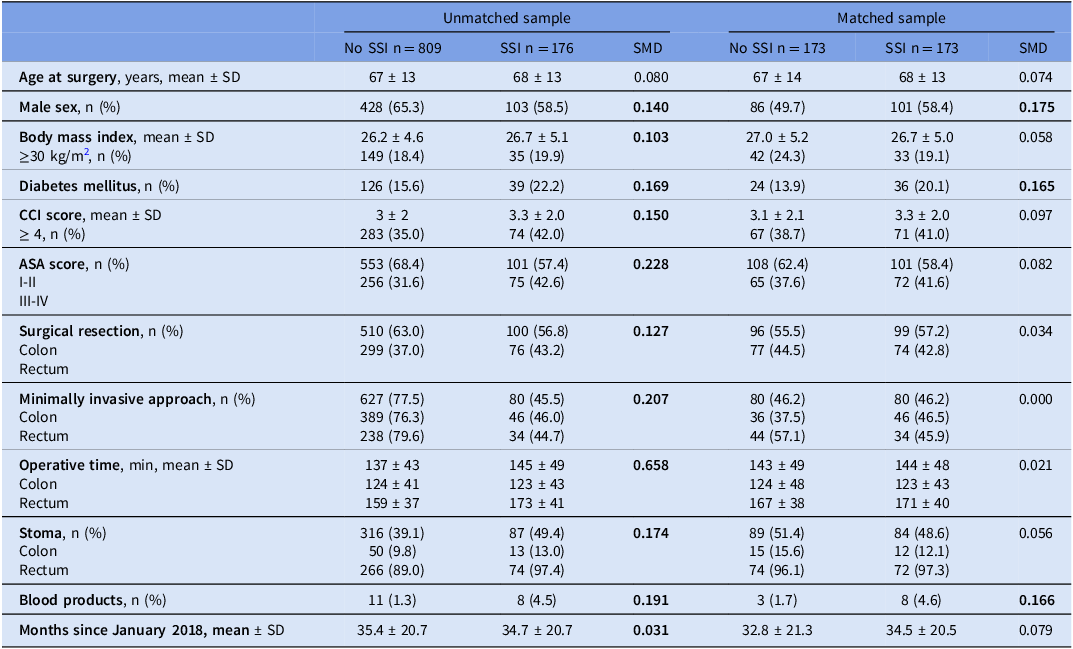
To account for potential temporal confounding related to cost trends over time, we created a continuous variable representing the number of months elapsed since January 2018. This variable was used to assess baseline distribution between groups (Table 1).
Baseline and surgical characteristics of patients with and without SSI, before and after propensity score matching

Note. SMD, Standardized mean differences.
Data collection
Sociodemographic and clinical characteristics: age (years), sex, body mass index (BMI, kg/m2), diabetes mellitus, Charlson Comorbidity Index Reference Charlson, Pompei, Ales and MacKenzie23 (CCI), American Society of Anesthesiologists Physical Status Classification System 24 (ASA), tumor location, surgical procedure, surgical approach, duration of surgery (minutes), presence of stoma, administration of blood products, Clavien-Dindo Reference Dindo, Demartines and Clavien25 classification of surgical complications, presence and classification of SSI.
Hospital cost-related variables: surgical reintervention, length of initial hospital stay (days), length of readmission (days), intensive care unit (ICU) admission (days), diagnostic tests, inpatient antibiotic therapy, negative pressure wound therapy (days), number of postoperative medical and nursing consultations, emergency department visits, duration of SSI (days).
Statistical analysis
Categorical variables are presented as absolute number and percentages. Continuous variables are presented as mean ± standard deviation (SD) or median and interquartile range (IQR), as appropriate.
Due to baseline imbalances between groups, propensity score matching was used to identify comparable cohorts. The propensity score was estimated using multivariate logistic regression, with SSI as the dependent variable, and the covariables age, BMI, diabetes mellitus, ASA classification and surgical factors (colectomy vs proctectomy; minimally invasive vs open approach). Matching was performed using a 1:1 nearest-neighbor matching with a caliper width of 0.2 of the standard deviation of the logit of the propensity score. Standardized mean differences (SMDs) were used to assess covariate balance before and after matching; SMDs ≤ 0.1 were considered indicative of adequate balance.
Postoperative outcomes were analyzed using univariate and multivariate logistic regression models within the matched cohort, to evaluate independent associations with SSI status, while controlling for pair-matching. Cost analysis was performed using Wilcoxon rank sum test. Differences in hospital costs according to SSI status were analyzed with a linear regression model. Multivariate logistic regression was performed to test for variables associated with increased total expenditure. Given the known right-skewness of cost data, we used robust standard errors (Huber–White/HC3) to account for potential heteroscedasticity. To validate the model, we conducted two sensitivity analyses: a linear regression model using log-transformed total costs as the dependent variable, and a generalized linear model (GLM) with gamma distribution and log link. Multicollinearity between independent variables was assessed using the Variance Inflation Factor (VIF). In the comparison of hospital cost components between patients with and without SSI reported P-values were adjusted using Holm-Bonferroni method; additionally unadjusted mean differences are reported. Statistical significance was set at P ≤ 0.05. All analyses were performed using IBM SPSS Statistics®, version 29 (IBM Corp., Armonk, NY, USA).
Results
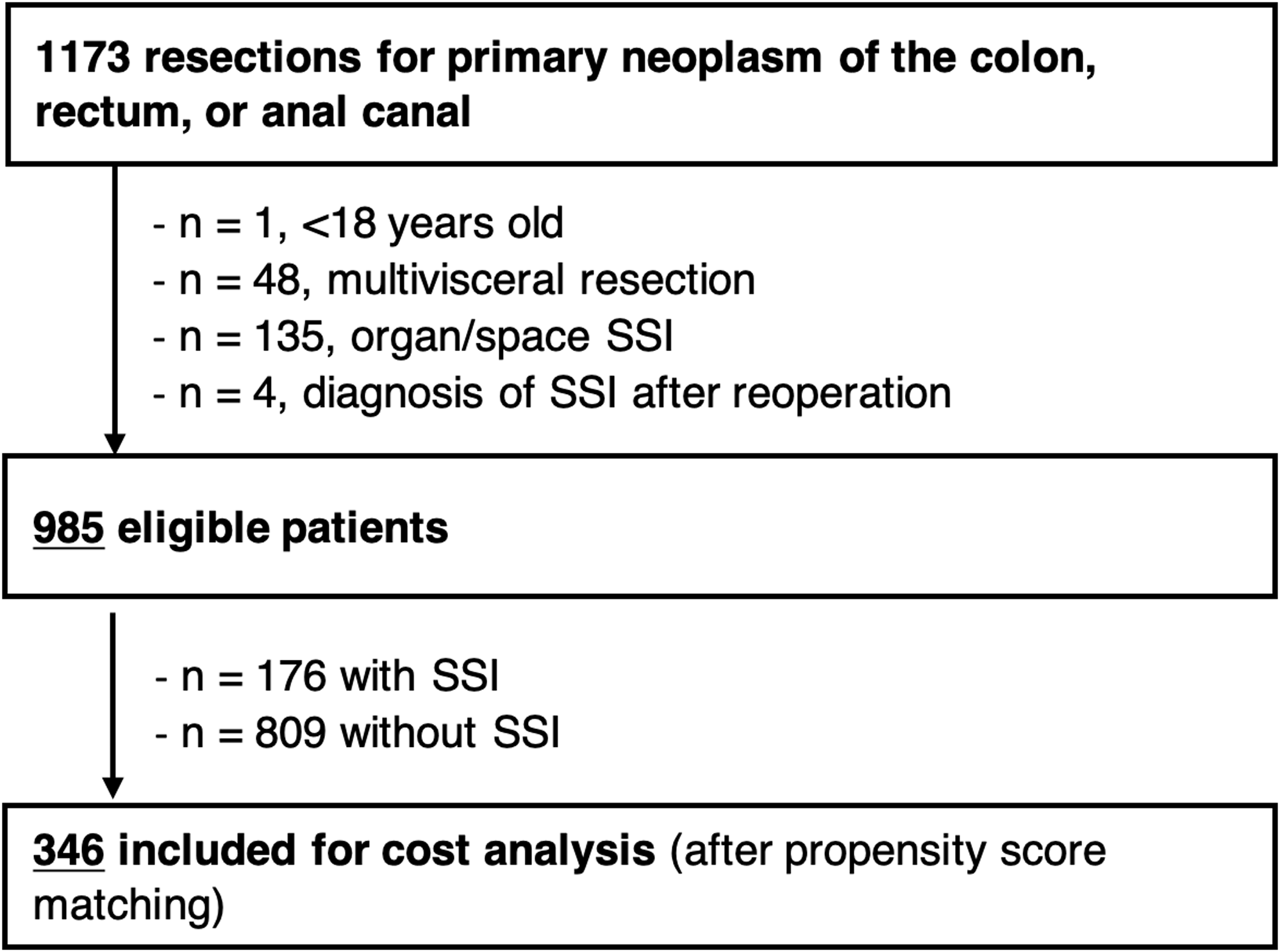
Of the 1,173 patients who underwent surgical resection for a primary neoplasm of the colon, rectum, or anal canal during the study period, 985 met the eligibility criteria and were included in the analysis. Among these, 176 patients (17.9%) developed incisional SSI, either superficial or deep. The flow diagram illustrating patient selection is presented in Figure 1.
Flow diagram of patient selection and inclusion for cost analysis.

Baseline, surgical, and postoperative characteristics
Among the 985 eligible patients, the mean age at the time of surgery was 67.2 ± 13.1 years, and 531 (53.9%) were male. The mean BMI was 26.3 ± 4.7 kg/m2. Diabetes mellitus was present in 165 patients (16.8%). The median CCI score was 3 [IQR 2–4], and 331 patients (33.6%) were classified as ASA III or IV.
A colonic resection was performed in 610 patients (61.9%) and a rectal resection in 375 (38.1%). The colonic procedures comprised 304 (49.8%) right colectomies, 60 (9.8%) left colectomies, 203 (33.3%) sigmoid colectomies and 43 (7.0%) subtotal or total colectomies. Rectal resections included 278 (74.1%) anterior resections, 74 (19.7%) abdominoperineal resections and 23 (6.1%) proctocolectomies. A minimally invasive approach was used in 707 cases (71.8%), and the mean operative time was 138 ± 44 minutes.
Among those undergoing colonic resection, 547 patients (89.7%) had an anastomosis without a diverting stoma, 40 (6.6%) had an anastomosis with a diverting stoma, and 23 (3.8%) received a terminal stoma. In the rectal resection group, 35 patients (9.3%) underwent an anastomosis without a diverting stoma, 242 (64.5%) had an anastomosis with a diverting stoma, and 98 (26.1%) received a terminal stoma.
Regarding postoperative outcomes, the mean length of hospital stay was 6.5 ± 4.3 days, and 26 patients (2.6%) required surgical reintervention. Nineteen patients (1.9%) needed intensive care during the index hospitalization, with a mean ICU stay of 4.9 ± 6.4 days. Hospital readmission occurred in 36 patients (3.7%), none of whom required ICU care. The 90-day postoperative mortality rate was 1.9% (19 patients).
Incisional SSI diagnosis and management
Of the 176 patients diagnosed with an incisional SSI, 118 (67.0%) had superficial infections and 58 (33.0%) had deep infections, including 42 cases involving the perineal wound. The diagnosis was established during the initial hospital stay in 95 patients (53.9%) and during outpatient follow-up in 81 patients (46.0%). The mean time from surgery to SSI diagnosis was 9.1 ± 5.7 days, with a mean time to infection resolution of 12.1 ± 10.4 days; however, in 22 patients (12.5%) the infection was only resolved more than 30 days after surgery, and in 4 cases (2.3%) it extended beyond 60 days.
Management included wound drainage in 104 patients (59.1%) and antibiotic therapy in 152 (86.4%). Negative pressure wound therapy was applied in 8 cases, with a mean duration of 17.5 ± 17.0 days.
Group comparability and propensity score matching
Before propensity score matching, moderate to large imbalances were observed between the SSI and no-SSI groups in ASA classification, use of a minimally invasive approach, and presence of a stoma (SMDs > 0.20). Propensity score matching was performed, resulting in a matched cohort of 346 patients (173 with SSI and 173 without SSI). Three patients with SSI could not be matched and were excluded from the cost analysis.
After matching, the SSI and no-SSI groups were well balanced across all baseline and surgical characteristics, with only a small residual difference in sex (SMD = 0.175), diabetes mellitus (SMD = 0.165) and administration of blood products (SMD = 0.166). Baseline and surgical characteristics of the SSI and no-SSI groups, before and after matching, are summarized in Table 1.
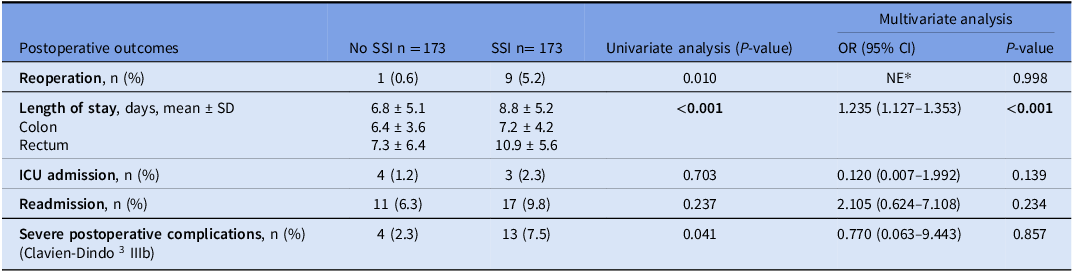
As to postoperative outcomes, multivariate analysis confirmed that the presence of incisional SSI was associated with longer hospital stay (P < 0.001) but didn’t independently influence any other outcomes. Full results of the regression model are provided in Table 2.
Univariate and multivariate analysis of postoperative outcomes after propensity score matching

* Model could not estimate the odds ratio due to quasi-complete separation.
Cost analysis
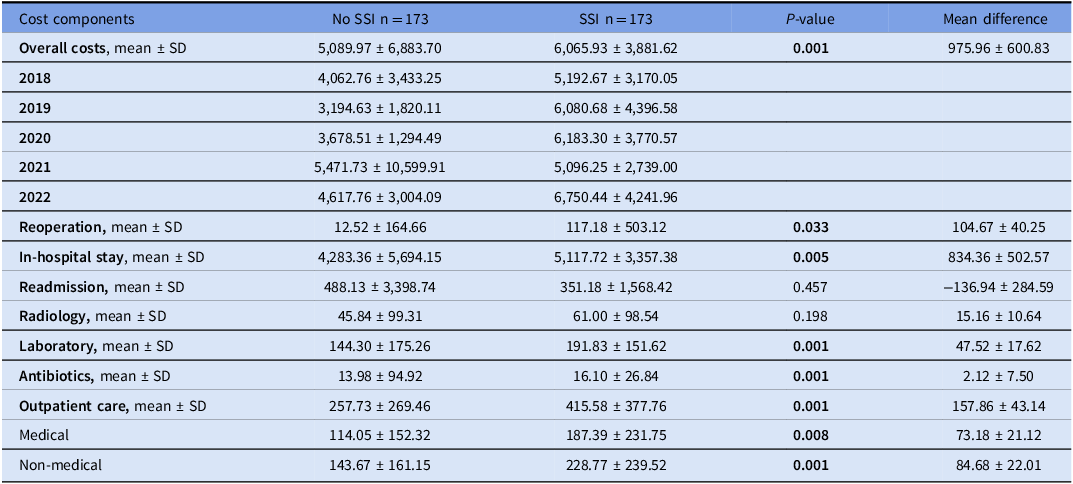
Patients who developed incisional SSI incurred significantly higher overall hospital costs compared to those without SSI. The mean total cost per patient was €6,065.93 (SD €3,881.62) in the SSI group versus €5,089.97 (SD €6,883.70) in the non-SSI group (P < 0.001). As shown in Table 3, this difference was primarily driven by increased expenditures in the index hospital stay (€5,117.72 [SD €3,357.38] vs €4,283.36 [SD €5,694.15], P < 0.001) and in outpatient care (€415.58 [SD €377.76] vs €257.73 [SD €269.46], P < 0.001). Although of smaller magnitude, costs related to reoperations, laboratory tests and antibiotic therapy were also significantly higher in the SSI group (P < 0.05). No statistically significant differences were observed in costs associated with readmissions or radiologic examinations (P > 0.05). A detailed breakdown of cost components is presented in Table 3.
Comparison of hospital cost components between patients with and without SSI. Costs are presented in Euros (€)

Note. SD, standard deviation.
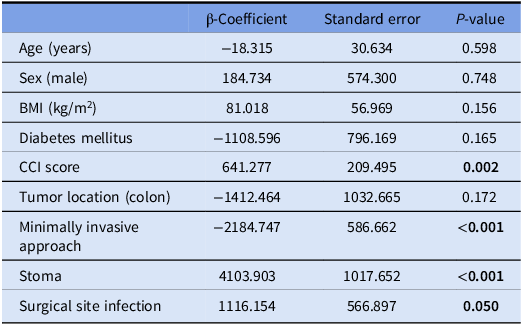
To adjust for potential confounding factors, a multivariate linear regression analysis was conducted. Although some collinearity was noted (VIF 2–5) between surgical approach, type of resection and presence of stoma—reflecting known clinical interdependence—the regression confirmed that incisional SSI was associated with higher hospital costs (P 0.050). Sensitivity analyses using alternative model specifications also supported this association—in the log-linear model, incisional SSI was associated with a 34% increase in hospital costs (β = 0.292; 95% CI: 0.171 to 0.414; P < 0.001); and in the GLM with gamma distribution and log link, the estimated increase was 20% (β = 0.201; 95% CI: –0.006 to 0.407; P = 0.057). Additionally, CCI score, open surgical approach, and the presence of a stoma were also significant predictors of increased expenditure. Full results of the regression model are presented in Table 4.
Multivariate analysis of factors associated with total hospital costs

Note. β coefficients represent absolute differences in mean total cost (€); positive values indicate higher cost.
Discussion
This study demonstrates that SSIs, even when limited to superficial and deep layers, are associated with increased hospital costs following colorectal surgery for neoplastic disease. Using real-world hospital data and a propensity score-matched cohort, we showed that the mean cost per patient with incisional SSI was approximately €976 higher than for those without infection. Main cost drivers were prolonged hospital stays and greater use of outpatient care. Multivariate analysis confirmed that SSI contributes to higher costs.
The observed cost difference reflects the additional clinical burden and resource use. While €976 per patient may seem modest, it represents a 19.2% increase and becomes significant when extrapolated to high-volume units. This difference was mainly due to longer index stays and increased outpatient care, consistent with more complex recovery in SSI patients and aligned with prior literature. Reference Kashimura, Kusachi and Konishi16,Reference Badia, Casey, Petrosillo, Hudson, Mitchell and Crosby26,Reference Tanner, Khan, Aplin, Ball, Thomas and Bankart27 However, the lower bound of the 95% confidence interval was close to zero (5€), reflecting the wide variability in the clinic and economic impact of incisional SSIs.
Multivariate analysis also identified CCI score, open surgery, and stoma presence as predictors of increased hospital costs. These findings reflect the expected complexity of older, comorbid patients. The association between open surgery and higher costs also supports the preferential use of minimally invasive techniques, when feasible, to reduce postoperative morbidity and resource consumption. Reference Fernández Lobato, de Adana Belbel, Angulo Morales, García Septiem, Marín Lucas and Limones Esteban28,Reference Sheetz, Ibrahim, Regenbogen and Dimick29 Stoma presence likely contributes to higher costs by prolonging hospital stay and requiring additional outpatient care.
The 60-day postoperative period was selected to ensure a comprehensive assessment of the clinical and economic burden of incisional SSI. Preliminary data showed that 12.5% of patients experienced infection resolution more than 30 days after surgery, while only four cases (2.3%) extended beyond 60 days. A shorter observation period would likely underestimate the true burden of infection management. The extended follow-up allowed us to capture most clinically and economically relevant events, while minimizing the influence of unrelated late complications.
To further reduce bias, we excluded patients with complex multivisceral resections or organ/space SSIs, which are often associated with higher costs due to reintervention, prolonged ICU stays and intensive antimicrobial therapy. Reference Jenks, Laurent, McQuarry and Watkins30,Reference Fadayomi, Kasumova and Tabatabaie31 We also excluded patients who developed incisional SSI only after a reoperation, where the main driver of cost was likely the primary complication, rather than the subsequent SSI. This narrowing aimed to isolate the economic impact of incisional SSI and improve internal validity.
Our results are consistent with previous studies on the economic burden of SSIs in colorectal surgery. Reference Levy, Wilt and Castle32,Reference Gantz, Zagadailov and Merchant33 However, few studies have specifically addressed incisional SSIs using real-world cost data from hospital accounting systems.
From the healthcare provider’s perspective, this study estimated direct hospital costs incurred within 60 days of surgery, using institution-specific unit prices that reflect actual expenditures. This offers a more accurate and internally valid view than using standardized tariffs or billing codes. Propensity score matching improved group comparability and reduced confounding. However, the analysis did not account for indirect costs such as productivity loss or broader societal consequences, which may underestimate the total burden of SSIs.
Our findings reinforce the potential value of targeted SSI prevention strategies, particularly those addressing modifiable risk factors such as perioperative care practices (eg, perioperative glycemic control, wound protectors, triclosan-coated sutures, and 80% inspired oxygen during and after surgery). 34 Even modest reductions in infection rates could yield meaningful cost savings, particularly in high-volume centers operating under constrained capacity. Institutional initiatives—including bundles, surveillance, and feedback—may both improve clinical outcomes and yield substantial economic benefits. Reference Rudder, Borgert, Kallies, Smith and Shapiro35
This study has limitations. Its retrospective, single-center design may limit generalizability. Despite matching, residual confounding cannot be ruled out, while linear regression model is less common in cost analyses due to right-skewed data, it allowed for direct estimation of absolute cost differences in Euros—relevant for administrators and healthcare planners. We addressed model assumptions using robust standard errors and sensitivity analyses. Nonetheless, alternative models may be more suitable where relative cost differences are preferred. We did not perform a formal probabilistic sensitivity analysis, as the study relied on real hospital cost data rather than modeled estimates. Still, uncertainty was addressed through standard deviations and P-values; the robustness of results was supported by matching and multivariate adjustment. While the provider perspective is relevant for hospital-level decision-making, it may not reflect the broader economic impact.
Future studies should validate these findings in multicenter or population-based settings. Cost-effectiveness analyses of specific preventive strategies and the inclusion of indirect costs and quality-of-life measures would offer a more comprehensive view. Expanding the analysis to include organ/space infections and other complications may further improve understanding of postoperative costs in oncologic care.
Data availability statement
The data sets generated and/or analyzed during the current study are not publicly available due to privacy and ethical restrictions but are available from the corresponding author on reasonable request. Interested researchers may contact the corresponding author to gain access under conditions that adhere to the ethical standards of the research committee and with respect to confidentiality agreements.
Acknowledgments
This study used data collected from patients treated at Instituto Português de Oncologia de Lisboa Francisco Gentil. The reporting and interpretation of data are the sole responsibility of the authors.
Competing interests
This study did not involve any funding, and there are no conflicts of interest to report.