1. INTRODUCTION
Religions played a major role in the lives of people in the Russian Empire at least until the First World War. Among them, the Orthodox religion was intimately linked to the Russian monarchy. The place of religion was especially important in the Don Army Territory (Don Territory for short), the southern region (oblast) of European Russia, famous for its Cossacks and one of the foremost grain-growing regions of Russia. After the cities of Rostov-on-Don and Taganrog were incorporated in 1888, the region provided access to the Azov Sea and thence to the Black Sea, a key strategic concern for Russia.Footnote 1 Religion in the pre-revolutionary Don Territory determined the social status of populations and in particular the question of land and property rights. Most writers on the Don Territory concentrate on the military, economic or political history of the Don Cossacks, though Andreas Kappeler emphasises that religion was the most important criterion determining group identity in Russia during this period.Footnote 2 Education was strongly marked by religion, with schools organised on strict denominational lines. Although different denominations shared the same spatial context, contact between them was limited. Most lived as self-governing communities, led by rabbis in the case of Jews, for example. The largest denominational group remained the Orthodox (90 per cent of the population of the Don Territory), especially in the countryside; certain other denominations (Jews, Muslims, Armenian-Gregorians, Catholics) were concentrated in urban areas; and one district (Salsk'ii) was predominantly Buddhist.
Between the sixteenth and mid-nineteenth centuries, the Don Cossacks organised themselves as a group constituted on both ethnic and denominational bases, a situation favoured by the Tsars.Footnote 3 This double origin shaped their political and military organisation, and influenced the development of legislation, group identity, culture and traditions.Footnote 4 The Russian Orthodox Church had achieved hegemony among the Don Cossacks even before the Don Territory was incorporated into Russia in the early eighteenth century. The Don Cossacks claimed to be defenders of Orthodoxy and the Russian motherland. The Russian government and the Patriarchs of the Russian Orthodox Church understood the importance of religion in Cossack society and encouraged efforts to increase its influence. Under the authority of the Tsar, the Orthodox Church guaranteed social cohesion and stability,Footnote 5 and, from the mid-nineteenth century onwards, it functioned as a unifying force in Russian nationalism. Hierarchs were appointed to – and dismissed from – the Synod, by the Tsar, who also had full powers to appoint, promote, demote or transfer bishops.Footnote 6
In this context, marriage and the respect or non-respect of the religious interdicts relating to it, constitute a critical marker of the strength of denominational obedience or, conversely, for the extent of secularisation. Marriage was inseparable from religion in Don society and was also the pivotal social institution.Footnote 7 The present study of seasonality is part of a larger project aimed at disentangling the roles of religion, politics, economics and climate in the demography of southern Russia, at a time when some groups had started their demographic transition while other, neighbouring groups continued to function under the old demographic regime. Based on raw marriage data by age and month adjusted only for seasonal fluctuations, the project is a contribution to understanding the role of religion in the differentials in mortality, nuptiality, migration and fertility that have been reconstructed using an original and rigorous method.Footnote 8
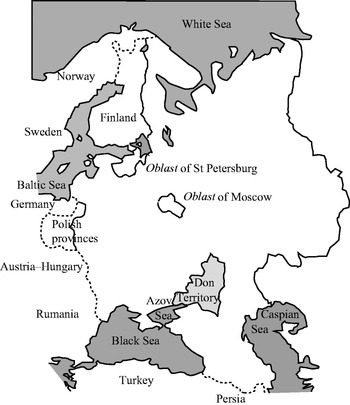
By 1914, the area of the Don Territory (Figure 1) had nearly four million inhabitants. Cossacks gave the region its distinctive identityFootnote 9 but in fact accounted for only 42 per cent of the population in 1914, while peasants native to the Don made up 24 per cent and outlanders (inogorodtsi, meaning Russian or Ukrainian immigrants to the Don Territory) 29 per cent. The Don Territory was defined by the corporate structure of the Cossack estate, the Don voisko (the ‘Don Army’),Footnote 10 originally a free independent community settled in the sixteenth century which gradually turned into a closed military society whose members were in the service of the Russian Empire and which had its own administration and rules, with democratically elected local chiefs (called Atamans).Footnote 11 Although the Don Territory is the region of Cossacks, they were a numerical minority, and our data cover all inhabitants, Cossack and non-Cossack, living in the Territory. Cossacks were Orthodox, Old Believers, Coreligionists or Buddhists. They had rights over all the natural resources of their villages.Footnote 12 Most lived from working or letting their lands, but they could hold any position, including in the clergy. The majority of Cossack marriages took place before the age of 20 years, before a Cossack, whatever his religious affiliation, left for military service.Footnote 13 Because the families bore the high cost of the wedding, most Cossacks from the Don were already married when they left, in contrast to soldiers in Western countries, who usually had to discharge their military duties before they could marry. We also consider the Orthodox population who were not Cossacks; for the most part members of the peasantry. Men with Cossack status were required to serve in the army for up to 25 years before 1868 and for 6 years after that date,Footnote 14 but non-Cossacks (peasants, merchants, clergy, outlanders) had no military service obligations. The population was primarily rural, but cities did develop thanks to the presence of coal and to the growth of commerce and light industry associated with agriculture.Footnote 15 These cities attracted a number of ethnic groups, each with its own religion. We also exploit the data on Jews, Catholics, Lutherans, Armenian-Gregorians and Muslims, none of whom were Cossacks. The Don Territory in fact contained members from most of the denominations present in Russia at the time.
The Don Army Territory in 1900 European Russia. (Source: M. Gilbert, The Dent atlas of Russian history, 2nd edn., London, 1993.)

Observing marriage seasonality by denomination over the period 1867–1916 thus offers a major insight into the stratification of society in the Don Territory, and its transformation during an era of major demographic, social and political change. The comparative history of marriage seasonality is hampered by the scarcity of reliable sources on practices among different denominations in the same setting at the same time. This limitation arises partly because research has concentrated on Western European countries where historically a single religion predominated (Catholic France,Footnote 16 Anglican England,Footnote 17 Catholic AndorraFootnote 18) or where religious affiliation was not recorded, as in the Netherlands.Footnote 19 The seasonality of marriage has also been studied for Chile,Footnote 20 Australia,Footnote 21 Western Europe,Footnote 22 and for three Orthodox villages of the Moscow region.Footnote 23
In Catholic countries, historians have noticed that marriages were less frequent during the Lenten and Advent periods, and more frequent in January and February, the months of relative inactivity in the agricultural cycle.Footnote 24 Noël BonneuilFootnote 25 has charted the gradual decline of these Lenten and Advent interdicts in nineteenth-century France. Frans van PoppelFootnote 26 has studied the spatial and temporal differences in observance of the marriage interdicts in the Netherlands, and related the seasonal patterns of marriage to economic contexts and levels of secularisation.
Thanks to the quality and detail of its statistics, notably the monthly marriage time-series that runs from 1867 up to the Revolution of 1917, the Don Territory in southern Russia offers a unique opportunity to observe multiple varieties of religious obedience. We propose first to situate the seasonality of marriage in a comparative denominational perspective, in relation to political history, economics and the urban–rural divide. The next stage aims to evaluate the extent and the possible spread of secularisation. This evaluation was made possible by the parish registers (of each religion), which formed the basis of civil registration until the law of 18 December 1917 when this function was taken over by the Soviet State. The seasonality of marriage has been used as a marker for secularisation in Belgium and in France.Footnote 27 The concomitant question to secularisation in the various religions present in southern Russia is that of whether a comparison of marriage seasonality by religious affiliation can also reveal the internal divisions of a society like that of the pre-revolutionary Don Territory.
2. RELIGION AND THE ECONOMY
2.1 Data and method
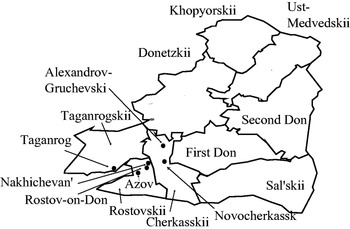
During the period 1867–1916, the Don Territory was made up of districts (okrug), represented in Figure 2. The population comprised soldiers (41 per cent in 1897) (not all of them Cossacks) plus large numbers of farmers and peasants. In return for providing a military contingent in the service of the Tsar, the Don Territory enjoyed a particular governance status.Footnote 28 It was divided into seven districts until 1887, when it gained the two districts of Rostovskii and Taganrogskii.Footnote 29
Cities (indicated by dots) and districts of the Don Army Territory in 1900.

Up to the 1917 Revolution, the Tsar was the head of the Russian Orthodox Church. Official practice was that Russians were automatically Orthodox from birth, with the exceptions of Old Believers and sectarians.Footnote 30 The responsibility of the Orthodox Church for recording births, deaths and marriages is stipulated in the Collection of Laws of the Russian Empire (Svod Zakonov Rossiskoj imperii), volume X, article no. 25–33.Footnote 31 Marriage was in fact registered only by the Church; there was no such thing as civil marriage. The priest had absolute power to refuse a wedding, on grounds of kinship ties between bride and groom or because of periods of interdicts. The Church had the task of recording vital statistics (Collection of Laws, volume X, article no. 28, 34, 35, 78). Questions of marriage and divorce were dealt with by religious courts (Collection of Laws, volume X, article no. 24, 33, 38, 73). From 1863 onwards, the Statistical Committee was in charge of compiling annual figures, though monthly marriage statistics begin only in 1867. Each district was required to supply demographic information on births, deaths, caste, religious affiliation and marriage. The time-series of marriages by Julian calendar monthFootnote 32 stops in 1918. For the Orthodox, the Orthodox Coreligionists and Old Believers, the Armenian-Gregorians, the Catholics and the Lutherans, their respective clergies had to send one copy of their parish registers to their respective consistories, which had ecclesiastic, administrative and judiciary functions. These consistories were required to send the statistics once a year to the Statistical Committee of the Don Army Territory, which in turn sent a copy to the Interior Ministry. For Jews, the rabbis sent one copy of the parish registers to the police and another copy to the city administration, both of which in turn had to send the statistics to the Statistical Committee. For Buddhists, marriage was celebrated by the lama supervised by a military officer. This officer had responsibility for sending the statistics to the Statistical Committee. For Muslims, the imam who celebrated the marriage had to report to the police. For the rest of Russia, the vital events of Old Believers were registered by the police until 1905, which was a source of under-registration; after 1905, priests took over the task and reported directly to the Statistical Committee. The Don Territory is an exception in Russia in that Old Believers were all Cossacks and all lived in Cossack villages (called stanitzas, non-Cossack villages being called volosts). The priest who celebrated the marriage reported to the administration of the stanitza, which was in charge of recording and counting Old Believers and of sending the statistics to the Statistical Committee and, for Cossacks (Old Believers, who were all Cossacks, Buddhists, who were also all Cossacks, and part of the Orthodox) also to the military administration of the district. So the Don Territory in fact had two statistical systems, one military, run by the Chancellery, and one civil, run by the Statistical Committee. That is why the vital statistics of Old Believers were particularly well organised in the Don Territory, contrary to the rest of Russia. The mission of the Statistical Committee was to present a yearly report of vital statistics to the Russian Interior Minister. The Committee was dissolved in 1917, since when the statistics have been kept in the State archives of the Rostov region. Anatoli Agafonov and Anatoli Venkov confirm the good quality and good conservation of vital statistics and censuses, especially those relative to Cossacks.Footnote 33 The same is not true for statistics on economic activity and social life. Both collections, that of the Chancellery and that of the Statistical Committee, present very few lacunae and have been preserved intact. For Kalmyks (Buddhists), we checked the data against the Kalmyk government archives; for Jews, we checked the data against the archives of the Rostov-on-Don and Taganrog Jewish Society; and for Armenians, we checked the data against the parish registers.
Archives relating to adulteries and abortions reveal that people could and did disobey religious proscriptions, that ‘the peasants were not in full harmony with the Church’ and that ‘many observed its rules and attended its ceremonies without real comprehension of Christian doctrine’.Footnote 34 However, the liberty to decide on marriage during forbidden times was extremely limited in the countryside, as our study of marriage seasonality will reveal. The influence of priests operated mainly through exhortation and their ability to persuade people of the importance of confession and Eucharist.Footnote 35 In canon law, minor sanctions (epitimia in Russian) available to priests were, insofar as they had any power over people, to impose fasting, prostration, prayer, acts of charity, and, for more serious crimes (murder, homosexuality, heresy, schism, adultery and abortion), temporary or permanent excommunication. People did not go to church more than necessary, especially not Cossacks, and the enforcement of marriage rules depended on priests, who were themselves under pressure from the Church hierarchy dominated by the Synod. If the social control of priests depended on their contact with the people and thus on their physical presence, this control would be exercised more easily in the countryside than in the towns. In any case, people wanting to marry had no choice but to go through the priests. The priests, in turn, were duty bound to respect the interdicts, failing which they could be punished by their hierarchy.
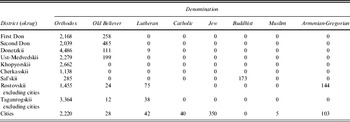
Table 1 presents the total number of marriages by district and by denomination in 1897, this date being chosen to allow comparison with the census of that year. All individual districts are rural, while the cities of Rostov-on-Don, Novocherkassk, Alexandrov-Gruchevski, Taganrog and Nakhichevan' are regrouped in the category ‘cities’. This table shows that the Orthodox formed the majority, especially in rural districts, and that Old Believers were distributed over the whole of the territory. The proportion of Orthodox was lower in cities and in the Sal'skii district, which alone was peopled by Buddhist Kalmyks (who had Cossack status). Table 1 also shows that Jews, Catholics and Muslims were concentrated in cities, and that Armenian-Gregorians lived mainly in the Rostovskii district or in cities, notably Rostov-on-Don and Nakhitchevan'.
Number of marriages by district (okrug) and denomination, Don Army Territory, 1897

Source: State archives of the Rostov region: collection 353, core inventory 1, file 479a.
To get an initial idea of whether religious differences were reflected in spatial segregation, we used the 1913 and 1914 yearbooks of Rostov-on-Don and Nakhichevan'.Footnote 36 These books provide the surnames, first names and addresses of householders in the two cities. In 1913 Rostov-on-Don, on 12 streets chosen at random, we found Jewish surnames (such as Grinberg, Lipkovitch, Prjedetzkii), Slavic surnames (such as Perekalina, Padtchenko, Gouleva), Armenian surnames (such as Tutuntchian, Kantzapetian, Egiazarov) or German surnames (such as Fukx, Strastman, Kuntzelman) in the same streets: for example, Bogatianovskii alley counted 55 Slavic surnames, 9 Jewish, 1 Armenian and 3 German. The same is true for three streets taken at random in 1913 Nakhichevan', a city that we could have thought to be inhabited by Armenian-Gregorians only, because this city was founded by Armenian-Gregorians after an edict of Catherine II allowing them to do so. Such a list of householders has not been found for the city of Taganrog, but we do have instances of buildings used by different religions in the same street (Orthodox and Lutheran churches, or a Greek monastery and a Muslim house of prayers). The differences between denominations were then not associated with spatial segregation.
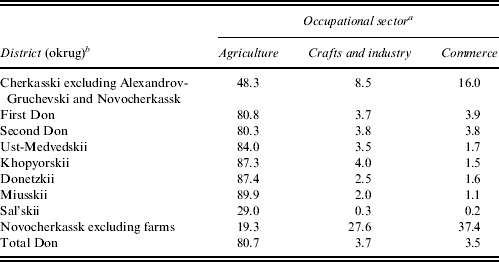
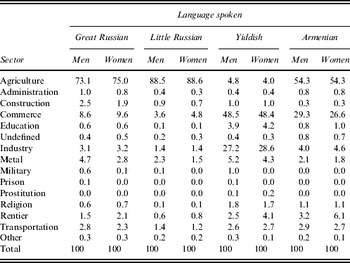
The distribution of economic sectors by district (but not by denomination) is recorded only in the 1873 census and is presented in Table 2. The distribution of occupations by language (but not by district or denomination) is available only in the 1897 census and is presented in Table 3. Tables 2 and 3 both show the dominance of agricultural occupations for the large Orthodox majority. Robert McNealFootnote 37 notes that Cossack commerce (mainly Orthodox) had lost all importance by the end of the nineteenth century, except in Novocherkassk. At that time commerce was in the hands of Armenian-Gregorians and Jews.
Percentage of all employed men working in the economic sectors of agriculture, crafts and industry, and commerce by district (okrug), Don Army Territory, 1873
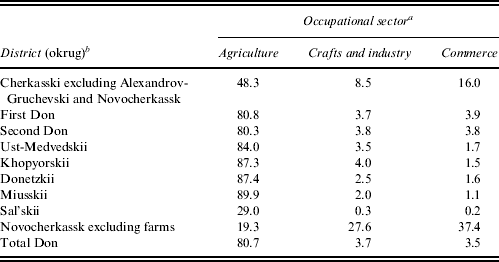
a Those in ‘other’ economic sectors are not shown, so rows do not sum to 100 per cent.
b Rostovskii and Taganrogskii were not attached to the Don Army Territory until 1888.
Source: ‘The Don Army Territory from the 1873 census’ (1879), Collection 1–4, Novocherkassk, the Statistical Committee of the Don Army Territory.
Percentage of men and women speaking selected languages in various occupations in the Don Army Territory, 1897

Source: 1897 census of the Russian Empire, the Don Army Territory (1905), volume XII, Saint-Petersburg, edition of V. P. Mecherskogo, 160–65.
Van PoppelFootnote 38 obtains the seasonal component of marriage using a ‘standard index’, in which the figure 100 represents the number of events that would occur in one month if the annual total of marriages were distributed evenly across the year, taking into account the different number of days in each month. We use instead the more accurate census method seasonal adjustment programFootnote 39 to decompose the time-series X t,m of monthly total numbers of marriages year t month m into trend μt,m, multiplicative seasonal component s t,m when μt,m is not null, and irregular values and residuals εt,m:
 $$X_{t\comma m} \equals \mu _{t\comma m} \lpar 1 \plus s_{t\comma m} \rpar \plus \varepsilon _{t\comma m}$$
The seasonal component s t,m of X t,m captures the variation within each year ‘that is repeated in an evolving fashion from year to year’ (see SAS online documentationFootnote 40). The higher s t,m (which will be positive because the sum of seasonal components at a given year is null), the larger the deviation at month m above the trend μt,m, and the more likely couples are to marry during this month m. This deviation is likely to repeat itself in the years to come, with possible variation. Conversely, the lower s t,m (then negative), the larger the deviation below the trend μt,m, and the less likely couples are to marry during this month m, and this deviation is also likely to repeat itself in the years to come. Also, the larger the dispersion between the s t,m in a given year t, the larger the contrast between the 12 months, and conversely, if the dispersion is low, people marry without marked seasonal variation. Besides the advantage of obtaining the seasonal components net of trend effects and residuals, we can follow these components year on year, because there is no reason why seasonal components should be constant. The variation over time of s t,m is likely to reflect change in social behaviour associated with specific months of the year, and is thus of particular interest for the study of marriage seasonality. From each time-series X t,m, by district and denomination, we then extract the seasonal component s t,m. We compare the seasonal components s t,m of marriages for different denominations and different districts.
2.2 Comparison of denominations with respect to marriage seasonality
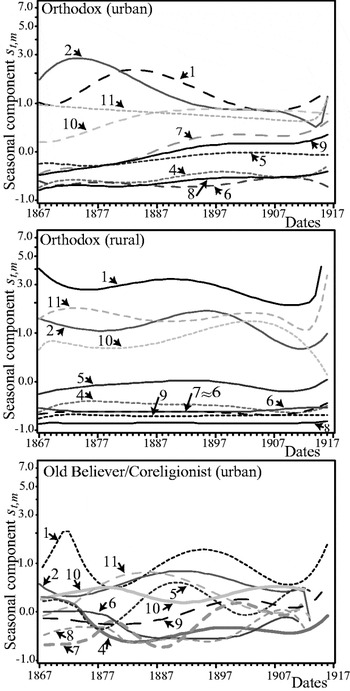
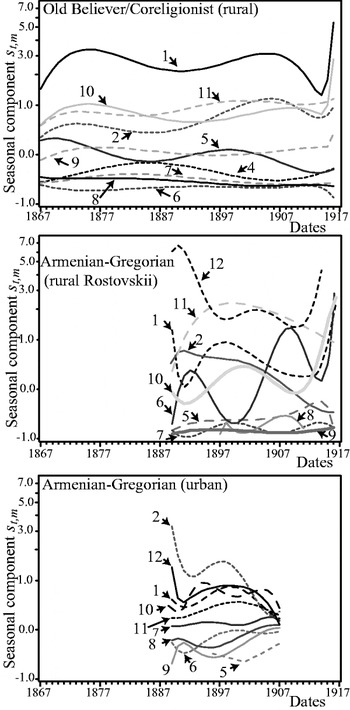
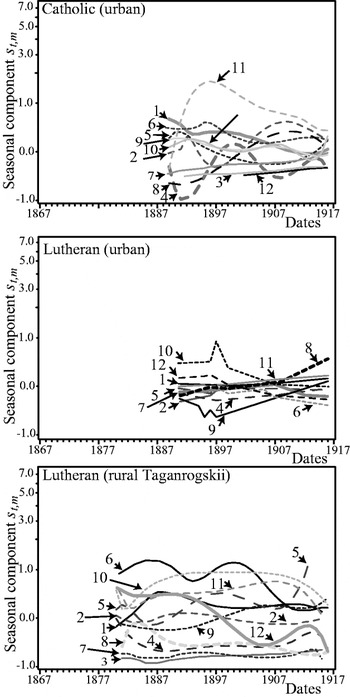
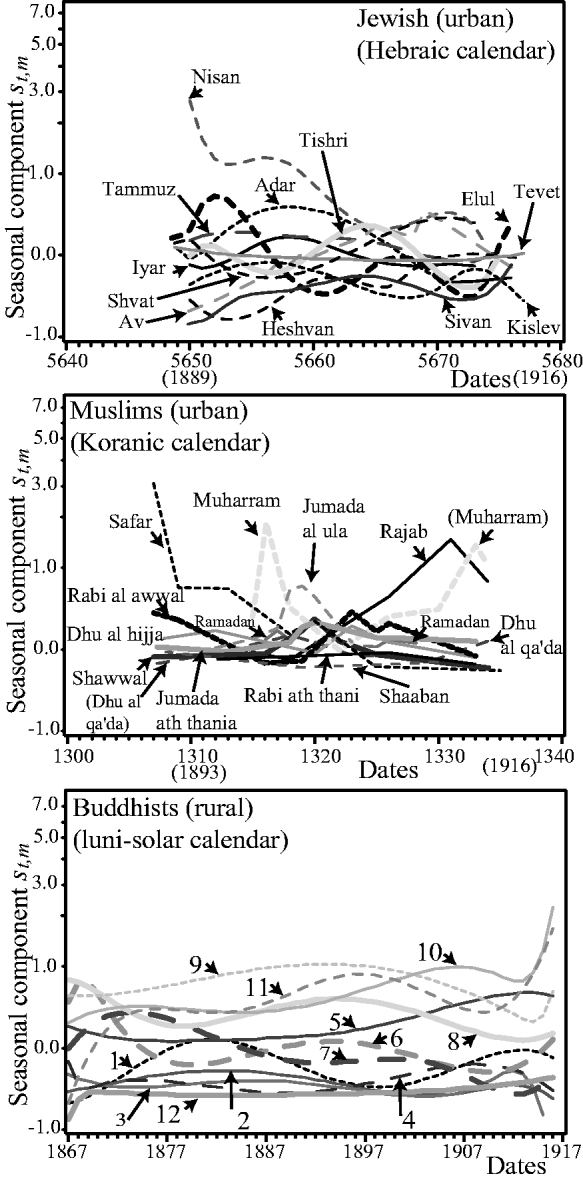
Figures 3, 4, 5 and 6 represent the seasonal components of marriage by denomination and urban or rural residence. Orthodox, Old Believers and Coreligionists had a preference for marrying in January, followed, depending on denomination, by November or February or October. The other months come far behind; the least common are always December and March. For Catholics, the most frequent month for marriage is November, followed by June, January, February and September, while the least common months are again March and December. The Lent and Advent interdicts were obeyed during March and December, and the intensity of agricultural work prevented people from marrying in August. The reasons for this ‘seasonal custom’ have been abundantly discussed. For example, in ancien régime France, people married in winter, which, coming after the harvest or vintage, was a period of both rest and relative abundance.Footnote 41 The preference for January may have arisen because this month follows the Christmas fast. Since Advent and Lent constituted prohibited times, there remained only three available months: November, January and February, and the latter month was sometimes encroached upon by the liturgical calendar. The preference for November and October may have arisen to anticipate the Christmas interdict. For all the denominations in the Netherlands, Lent and Advent interdicts created large fluctuations from one year to the next because the timing and length of Lent varied from year to year.Footnote 42
Seasonal components by denomination (smoothed), Don Army Territory. Digits 1–12 represent months. A logarithmic ordinate scale, sign(s t,m) ln(1+|s t,m|), is used because it represents small values clearly. Missing months (March and December for Orthodox and Old Believers) correspond to a trend of zero marriages, or μt,m =0 (hence s t,m is not defined in this case).

Seasonal components by denomination (smoothed), Don Army Territory. Digits 1–12 represent months. A logarithmic ordinate scale, sign(s t,m) ln(1+|s t,m|), is used because it represents small values clearly. Missing months (March and December for Old Believers, March and April for Armenian-Gregorians) correspond to a trend of zero marriages, or μt,m=0 (hence s t,m is not defined in this case).

Seasonal components by denomination (smoothed), Don Army Territory. A logarithmic ordinate scale, sign(s t,m) ln(1+|s t,m|), is used because it represents small values clearly. Catholics and urban Lutherans inhabited mostly Rostov-on-Don, which was not appended to the Don Army Territory until 1888.

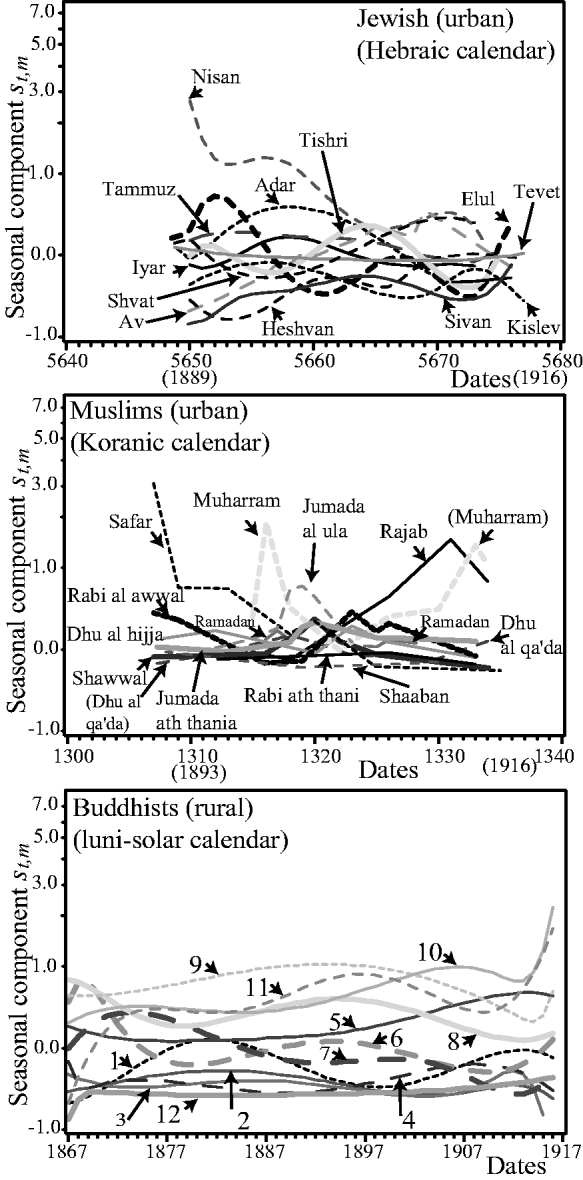
Seasonal components by denomination (smoothed), Don Army Territory. Digits 1–12 represent months. A logarithmic ordinate scale, sign(s t,m) ln(1+|s t,m|), is used because it represents small values clearly. Jews and Muslims inhabited mostly Rostov-on-Don and Taganrog, which were not appended to the Don Army Territory until 1888. For Jews, time is measured in the Hebraic calendar; for Muslims, time is measured in the Koranic calendar. For both, the corresponding Julian dates are in parentheses.
The religious calendars for marriage in the Don Territory were more restrictive than the Catholic calendar in France used here as a comparison. France is a remarkable case where the agrarian year and the Church year were closely matched, and where the erosion of religious obedience reflected the spread of secularisation. Using the 3000 Family Survey, based on a representative sample of 45,071 marriage certificates from across France of couples married between 1803 and 1832 and of their descendants who married up to 1903, Bonneuil computed the seasonal components of urban and rural marriage from 1803 to 1903.Footnote 43 He found that urban seasonality was close to a flat line, whereas the probability in the countryside was high for marrying in January and, above all, in February, followed by October and November. During these months with no Catholic interdict, work on the land was less demanding. The least likely months for marriage in France were March, August and December.Footnote 44 The temporal follow-up of the coefficients of seasonality for each month from 1835 to 1903 shows a gradual decline for February, which had the highest frequency of marriages, while March and December, months containing the Lent and Advent interdicts in the Catholic tradition, increased steadily. Michel Dupâquier, using vital statistics, had also noted what he called a ‘change in behaviour’.Footnote 45 Bonneuil confirmed the secularisation process by computing the probability of marrying as a function of the day of the week, a piece of information that is absent from the statistics of the Don Territory.Footnote 46 In the Don Territory, for the contexts where city dwelling was associated with increased personal freedom, the maintenance or relaxation of the religious calendars should be directly related to the control exercised over couples by the Orthodox and Armenian-Gregorian churches. This is what we examine now.
Orthodox
The seasonal pattern of Orthodox marriages depended on religious fasting and agricultural routines, but also on the obligations of military service. Marriages among the Orthodox population were not celebrated during either the Christmas fast (15 November to 25 December), nor the Christmas feasts (26 December to 7 January). Nor were they during the Great Fast or during Easter; during the fast of Saint Peter (the date of which varies each year, between late May and early July, depending on the date of Easter); during Dormition – the fast of Assumption (1–14 August); or on the eve and the day of Decapitation of Saint John the Precursor (28–29 August); on the eve and the day of the Exaltation of the Holy Cross (13–14 September); or on the eve of great religious feasts.
The Easter period has no fixed date and can begin in March or April. The first ecumenical Council of Nicea in the fourth century laid down that Easter be celebrated after the Jewish Easter, on the first Sunday after full moon following the vernal equinox, and Holy Week ends on Easter day. People could marry during one week before the start of Easter fasting and during one week after Easter. In total, the religious interdicts on marriage accounted for between 16 and 21 weeks of each year.
The taboos on marriages could be ignored, however, when the demands of military activity were too great. Up to 70 per cent of the Cossack population in the Don Territory were involved in the military. The Church was forced to follow the rhythm of local life dominated by wars, rallies and training exercises.
One Orthodox priest we spoke to mentioned the widely held belief among the Russian Orthodox population that May marriage condemned couples to a needy existence. In the Russian language, the words ‘maï’ (May) and ‘maïat'sia’ (to extenuate oneself) are consonant, a linguistic curiosity unrelated to religion. Vladimir Dahl, in his Explanatory dictionary of the living great Russian language, first published between 1863 and 1866, quotes several Russian proverbs reflecting this superstition from the period covered by this study: ‘Who marries in May shall languish’, ‘May wedding, long suffering’, ‘I shall well marry, if May allowed me to do so’, ‘In May, honest people do not marry’. The same point was also made by a present-day Armenian priest, although the consonance in Russian is lost in Armenian.
Agricultural work created an obstacle to marriage from March to October. People in the Don region grew two sorts of wheat: spring wheat (garnovka) was sown from late March to April, and harvested in August; while winter wheat (girka) was sown in September and October and harvested from late June to late July. The first haymaking lasted from late May to early June, the second took place in July. As noted by van Poppel for the Netherlands, marrying during the harvest could mean the loss of the crop and of high wages, so people tended to avoid marriage during the harvest.Footnote 47
The differences between urban and rural Orthodox populations point to the relative importance of religious observance and the constraints imposed by agricultural work. Most of those who migrated to the towns to work in mills and factories kept strong links with their villages. More than half the workers on industrial sites also had an agricultural activity,Footnote 48 and factory work typically left workers the time for essential agricultural work. For example, a manager might hire workers for the period from October to Easter, but free them for the rest of the year so they could return to their villages to take part in agricultural work.Footnote 49 This form of dual activity was widespread among workers at least until 1890. City dwellers might also own land, which they either worked themselves or let out to others. Figure 3 shows an urban seasonal component only slightly attenuated in January, and slightly strengthened in June, compared with that for the rural populations. Temperatures in January regularly fell below 10 degrees Celsius, bringing agricultural work to a halt and leaving villagers the time to marry. City dwellers, by contrast, could avoid marrying during the cold of January, which may explain the smaller January component among urban compared with rural populations. Seasonal components remained marked in cities, showing that religion was still a force here, as in the countryside. However, Figure 3 shows a slow but clear decrease for January and February down to 1905, as well as for November, associated with a simultaneous increase for all other months except March and December. The Lent and Advent interdicts were thus respected, because the priests were closely controlled by their hierarchy and the people could marry only in church, but an emancipation from the calendar of agricultural work enabled people to marry in months that were busy in the countryside. The mean age at marriage and the age difference between spouses at first marriage, as well as the associated variances of these two variables, were higher in cities.Footnote 50 The reason the authors find for this rural–urban contrast is that moving to a city weakened the role of parents in arranging marriage and undermined the traditional marriage system. Through the opportunities for wage earning in the growing industrial and trading sectors, young couples in cities had access to means of accumulating wealth other than by marriage.
To agricultural constraints were added those of Cossack military service from late May to late June, when manoeuvres were held locally or on the western border, and from August to September on the Caucasian border, so that few marriages were recorded during these months. These manoeuvres mobilised large numbers of Cossacks as did the Russian–Turkish war (1877–1878), the Russo–Japanese war (1904–1905), the First World War and military operations against revolutionary movements (1905–1907).
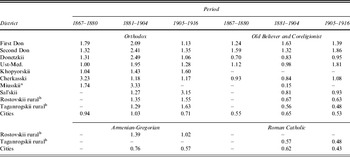
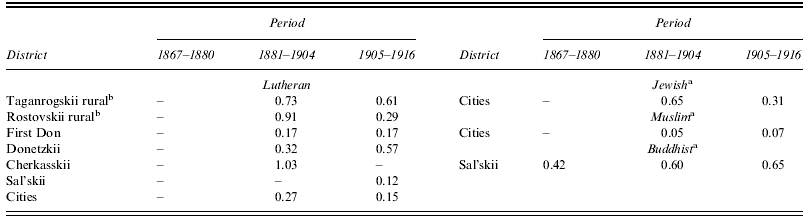
The spatial variation in the standard deviation for the seasonal components of each year may follow a spatial gradient reflecting the concentration of towns in the south, mainly on the Azov seaboard, as shown in Figure 2. The districts of Sal'skii in the south and of Second Don, for example, were very rural and the proximity of cities might be expected to flatten the curve of seasonal components. For a summary interpretation of the spatial variation in this standard deviation, we refer to Figure 3, which shows that 1881, the year the conservative Alexander III came to the throne, and 1905, the year of the October Revolution, appear to be turning points, especially for city dwellers. After 1881, November, January and February marriages decline, while all months from April to September increase for Orthodox, Old-Believer and Catholic city dwellers; after 1905, the dispersion between the seasonal components increases, as June declines and November, January and February now increase. The death of Alexander III (20 October 1894) and the advent of his son Nicolas II, who reigned until 1917, are not associated with any clearly identifiable change on the diagrams in Figure 3. The seasonal components for individual districts are very similar to those for the Don Territory as a whole in Figure 3, with the same hierarchies between months, so that the standard deviation is sufficient to describe the overall magnitude. In Tables 4 and 5 we present the mean standard deviation for each denomination in each district over each of the three periods: 1867–1880, 1881–1904 and 1905–1916. The values for Lutherans, Jews, Muslims and Jews are presented in Table 5 merely to allow comparison with the other denominations present in the Territory, though their urban concentration means that the information duplicates the diagrams in Figures 4, 5 and 6. The same holds true for Buddhists who are exclusively rural.
Standard deviations of the seasonal components of marriage by period, district and denomination (Orthodox, Old Believer and Coreligionist, Armenian-Gregorian, Catholic), Don Army Territory, 1867–1916

a Miusskii ceased to exist as a district in 1888.
b Rostovskii and Taganrogskii were attached to the Don Territory only in 1888.
Standard deviations of the seasonal components of marriage by period, district and denomination (Lutheran, Jewish, Muslim, Buddhist), Don Army Territory, 1867–1916
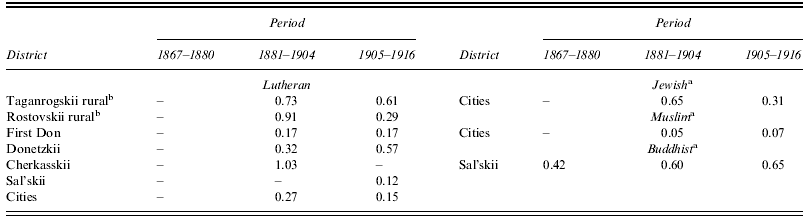
a For Jews, Muslims and Buddhists the standard deviations are computed for the respective religious calendars.
b Rostovskii and Taganrogskii were attached to the Don Territory only in 1888.
In Tables 4 and 5, the standard deviation of seasonal components amongst the Orthodox in rural districts is high compared with other denominations, similar across all rural districts, and relatively low in the cities. Apart from this rural–urban contrast, Tables 4 and 5 shows no clear spatial gradient: for example, the Rostovskii and Taganrogskii districts have high standard deviations, and hence a strong contrast between the permitted months (January, February, November) and the months of interdicts (March, December) or unavailability (August). The absence of marriage in the months of interdicts, March and December, over the whole period is evidence that secularisation did not affect Orthodox or Old Believers and Coreligionists in their marriage calendars. Alexander III embarked on a Russification campaign in 1881, which Nicolas II continued, undeterred by the creation of the Parliament (duma). The seasonal components of marriage show no relaxing of marriage interdicts among the Orthodox in either rural or urban settings. Religious observance never weakened, nor did the control of priests by the Synod. This pattern contrasts with that observed in most of Western Europe, where the demographic transitionFootnote 51 was accompanied by varying degrees of secularisation.Footnote 52 In the context of the growth of discontent that led ultimately to the 1917 Revolution, and given that the majority of the Cossacks sided with the Tsar and, after his death, opposed the Bolsheviks, the strength of religious taboos may reflect the action of the Orthodox Church in support of the efforts of the monarchy to reinforce values associated with the Russian tradition and Tsarist power. At the turn of the century, land was scarce and its distribution was a source of tension, all the more acute since Cossack status was associated with land ownership. The submission to tradition was strengthened by the exacerbated question of identity, itself linked to that of economic survival. It was also driven by ideology, in the religious reaction launched by Alexander III after 1881 and energetically prosecuted by the archconservative K. P. Pobiedonostsev, Over Procurator of the Most Holy Synod of the Russian Orthodox Church in 1880. Although replaced as Over Procurator in 1905, Pobiedonostsev retained effective control over the administration of the Church until 1917. He strongly supported reactionary policies to counter the influence of Western-oriented liberal and secular ideas, notably the repressive policies implemented against the Jews by the Interior Ministers Ignatiev in 1882 and Plehve in 1903. From 1881 onward, the Russification policy favoured conversion to Orthodoxy by sectarians, Muslims, Buddhists and Animists who lived on the margin of society. The formalities for marriage of Orthodox with Catholics or Lutherans were rendered more complicated. In addition to government provocations, inter-religious conflicts, notably involving Armenians (1903–1905) and Jews, resulted less from religious differences than from the deterioration of living conditions.Footnote 53 It was the latter that fed Cossack discontent directed against the new industrial proletariats in the cities of Rostov-on-Don, Taganrog and Alexander-Gruchevskii, and prepared the way for conflicts between province and the central government, between Cossacks and non-Cossacks, between city and countryside. So, if the ideological dimension cannot be underrated, the importance of the question of landownership points to its possible instrumentalisation. Marriage seasonality for the Orthodox in Figure 3 probably reflects a combination of both factors, though religious control in the Don Territory was already so strong that the radicalisation brought about by the Russification campaign hardly registers in the seasonal components. The rapid increase of the seasonal components for November, January and February in 1914–1916 probably reflects the manpower shortage that left soldiers on short leaves no time for anything other than agricultural work. More than ever, marriages were now celebrated during the months when there was little or no work on the land. A few marriages are recorded during March 1915, but none during December 1914, 1915 or 1916. Thus religious interdicts were respected until at least 1916, perhaps as a sign of continued religiosity, at least because people had no choice but to obey the strong control exercised by the priests. This does not mean there was not growing secularity in the timing of marriage.
Old Believers and Coreligionists
Old Believers (Raskolniks) comprised a variety of groups that had broken away from the Russian Orthodox Church in 1666–1667 over the reforms introduced by the patriarch Nikon in 1653. Russian speakers refer to this schism as Raskol (in Russian: раскол – from the term for a ‘cleaving-apart’). After 1801, the Old Believer communities that submitted to the jurisdiction of the Orthodox Church while retaining pre-Nikonian rites became known as Coreligionists (Edinovertsies or Yedinoveries). Though not Old Believers in the strict sense, they can be grouped with them as regards marriage seasonality. Old Believers resisted the persecution coming from the Orthodox Church in this period. They formed a closed group, opposed to ideas of change. Often deprived of churches, they were registered in the census by delegates from the civil service. Because they were Cossacks and participated in land distribution, they appeared in the census and in vital statistics, but they were not recognised as a minority group until after 1905, when they were finally allowed to build their own churches. After 1905, they were granted the same right as other denominations to marry Orthodox people, under the Act of religious freedom of 17 April 1905 which ended the persecution of religious minorities in Russia.
With regard to fasting, the calendar of the Old Believers coincides with that of other Orthodox. The weddings of Old Believers were subject to religious taboos: during the fasting for Christmas, Easter, Saint Peter and Assumption (Dormition); feasts of Christmas; on the eves of religious feasts. Old Believer priests were authorised to remove the interdict on Sunday work during the summer, which could explain why the seasonal component of August is slightly higher for Old Believers than for other Orthodox, and the same is true of June in the cities (Figures 3 and 4). As amongst the Orthodox, priests could interrupt fasts and lift interdicts in times of war.
Before 1881, Old Believers and Coreligionists show a lower standard deviation than the Orthodox except in the eastern part of the Don Territory (Second Don and Ust-Medvedskii). This smaller dispersion is visible in Figure 4 for both rural and urban populations. This may be because the Orthodox Church tended to ignore these groups, leaving them greater freedom to adapt the marriage calendar to the demands of agriculture. As for the other Orthodox, the seasonal components of November, January and February increased rapidly in 1914–1916. A few marriages are also recorded exceptionally in March 1915, but none in December 1914, 1915 or 1916. We cannot then talk about any relaxation of marriage interdicts before 1916.
Armenian-Gregorians
A total of 27,118 Armenian-Gregorians were recorded in the 1897 census in the Don Territory as a whole. They were divided between cities – Nakhichevan' had 11,363 – and the countryside, where almost all (15,405) lived in the rural parts of the Rostovskii district centred on Rostov-on-Don city. For both town and country, the monthly marriage time-series also show profiles at least as sharply contrasted as those for the Orthodox. The preference coincides with winter months, including December; no marriages were recorded during March and April. The large standard deviation of the seasonal components is due to a particularly restrictive marriage calendar. The days of the Armenian Church calendar are in fact divided into three groups: Feasts of the Lord, 136 days; patron saints' days, 112 days; and fast days, 117 days. Marriage was not allowed on fast days or days of Feasts of the Lord, which together totalled 253 days a year.
Thus there was a strong probability that marriages would be concentrated in the remaining 112 days, the patron saints' days, from which the busiest months of agricultural work had to be subtracted. January began with the fast for Christmas (30 December to 5 January) before the nine days of Christmas (6–13 January). Between 30 December and 13 January, marriages were seldom celebrated. That is why fewer marriages were held in January than in December, contrary to the situation for the Orthodox and Catholics, who fasted in December but not in January. February was less favoured than December because the Great Easter Fast could extend over part of February when Easter, whose date varies between 22 March and 25 April, fell in March. The interdict on marriage was extended to the 49 fast days preceding Easter. Moreover, two weeks before, Great Easter is preceded by a pre-fast that lasts one week and often falls in February. A remarkable result shown in Figure 4 is that country dwellers married less in February than in December, reflecting their strict religious observance, while city dwellers showed a preference for February as early as 1889, revealing their continuing respect for the Easter interdicts.
The Lenten interdict applied to March, but April and May could include the Easter period feasts and the Feasts of the Lord, which lasted until Ascension. Marrying before Pentecost was also prohibited, that is during the 50 days after Easter. Agricultural work also began in May. If Easter was late and fell in the second half of April, then the feast days before Pentecost could occur in May, when marriages were prohibited. Conversely, when Easter was early, the feast days could fall in April, which then had fewer marriages. June contained no forbidden days, but was a time of intense agricultural activity, while July, in addition to the work of haymaking, included the fast of Transfiguration that lasted five days, from Monday to Friday, and whose date varied each year.
The only marriage interdict in August was the fast from Monday to Friday preceding the day of the Feast of Dormition of the Mother of God (Assumption). If the total number of marriages was low, this was because people were fully occupied with harvesting. Heat, like that experienced in June and July, was a further deterrent, due to the risk of the wedding victuals spoiling in the open air, a point explained by the priest Ter Tadeos Gaybarian. September was a period of harvesting, with a fast from Monday to Friday preceding the day of the feast of the Exaltation of the Holy Cross. October counted no prohibited days, and Figure 4 shows an upsurge in marriages that lasts until November, a month that includes the prohibited period of Pentecost of Christmas (5–21 November). Finally, the fast of Christmas began only on 30 December and ended on 5 January, and December was the preferred month for marriage in the countryside.
Figure 4 shows that this religious and agricultural rhythm was scrupulously adhered to by Armenian-Gregorians in the countryside and, until 1896 – one year after the death of Alexander III – in the cities too, February excepted. Apart from the difference over the preferred month for marriage between country (December) and town (February), which reflects the less strict urban observance of the Easter fast, the other salient fact reinforcing the relative decline of December as a favoured month for marriage among city dwellers is the collapse of marriage seasonality in this population after 1896 while it persisted undiminished among the rural population. These different movements between urban and rural are quantified in Tables 4 and 5. We have here evidence of secularisation among Armenian-Gregorians, with the rural–urban contrast showing the role of city life in the abandonment of religious observance and the effect of industrial and craft work that was available more continuously through the year.Footnote 54 Revealing this rapid divergence between two spatially adjacent groups belonging to the same denomination is the strength of comparative analysis.
Roman Catholics
Catholics were concentrated in the cities, primarily Rostov-on-Don (where 2,572 Catholics were recorded in the 1897 census out of 8,365 in the whole Don Territory) and Taganrog. Catholics not recorded in the cities lived mostly in the district of Taganrogskii (3,476 in 1897). Figure 5 shows only urban Catholics, but the diagram for rural Catholics, all in the Taganrogskii district, is practically identical. The Catholics of the Don Territory had two periods when marriage was prohibited: from the first Sunday of Advent until Christmas, and from Ash Wednesday until Easter Sunday. In addition to the dominance of November and the lesser prominence of January and February compared with, for example, the French curves,Footnote 55 perhaps reflecting the extreme cold of those months, the most salient results are the steady decline in the variance between 1889 and 1916 and the appearance of marriages in March, which began to be recorded from 1891, and in December, recorded from 1902. This contrasts with the practice of the Orthodox, who, including city dwellers, continued to observe strictly the calendar of their church. The Catholics of the Don, then, may have been part of a secularisation process similar to that experienced by Catholics in Western Europe,Footnote 56 where the March and December interdicts gradually declined.
Lutherans
Lutherans lived in their own milieu marked by central European influences.Footnote 57 They were present as a minority in almost all districts, with concentrations in districts on the Azov seaboard, Taganrogskii (12,026 in 1897) and Rostovskii (2,044), and in the corresponding cities of Taganrog (371) and Rostov-on-Don (968).
Figure 5 shows that the seasonal components are salient among the rural populations but almost non-existent among their urban counterparts. The favoured months for marriage were October and November – months free from agricultural work – but also June and May, about which Lutherans did not share Orthodox reservations. Indeed, Lutheranism has no Marian month (May for Catholics), and Lutherans in the Don Territory seem to have been untouched by superstitions based on the consonance of May with ‘maïat'sia’. This choice of May by Lutherans is consistent with the observation made for the Netherlands where Lutheran marriages were also frequent.Footnote 58 March remains the month with fewest marriages, though this has less to do with any Lenten interdict than with the piety of believers preparing for Easter. Among rural Lutherans, after March, the months with the fewest marriages are July and August, for reasons of agricultural work. This seasonality no longer appears among the urban Lutherans in Figure 5.
Among Lutherans, fasting is not associated with an interdiction on marriage. The only interdict concerns the weekdays of Friday and Saturday. Lutherans have no Vatican to make pronouncements on what should or should not be done, only national Churches. Moreover, the real Lutheran wedding does not take place in the church: the public announcement makes the marriage, so the pastor in effect simply blesses the union. Consents are always expressed outside the church, which is why the ‘door of marriages’ is located outside the church. The blessing day may be different from the day of the civil union, and several years may separate the two. For rural Lutherans, the marriage calendar reflects primarily the rhythm of the agrarian year, and only very marginally the piety of believers manifesting itself through observance of the Lenten and Advent fasts.
As in the case of Armenian-Gregorians, a workload (mainly in crafts and industry) more evenly distributed through the yearFootnote 59 was behind the attenuation of differences between months with regard to marriage. The city dweller who took a few days off work to marry lost only these days, whereas for the country dweller a few days of inactivity could compromise the entire harvest.Footnote 60
The spatial differentiation that is measured by the standard deviations in Table 5 shows only the urban–rural contrast and the atypical position of the Sal'skii district, where the newly settled Lutherans had held on to urban customs and habits.
Lunar calendar
The seasonal decomposition by Julian calendar months for Jewish and Muslim marriages gives diagrams that lack clarity. Converting to Hebraic and Koranic months makes the seasonal components much clearer and facilitates interpretation (see Appendix).
Jews
The Hebraic calendar is lunar. It contains 12 or 13 months depending on the year (the thirteenth month, second Adar, does not occur every year). By combining the months of first and second Adar when this latter month occurred, we rescaled the Hebraic year to 12 months, each with a duration normalised to that of the Gregorian months. The seasonal adjustment software is run on the transformed data.
The Jews of the Don were Ashkenazi who had migrated from the west of the Russian Empire after the division of Poland into three parts between 1775 and 1785.Footnote 61 Most Jews lived in cities, principally in Rostov-on-Don (12,727 of 17,591 in all cities in 1897), where they specialised in commerce and industry (Table 3) and owned shops, bars and factories. Many were artisans, notably tailors; others were physicians, businessmen, teachers or mine engineers; educational levels were commonly above average. Since 1791 under Catherine II, Jews were excluded from owning land and from living in most places (the term ‘pale of settlement’ appeared only in 1835). The involvement of a Jewish terrorist in the conspiracy behind the assassination of Alexander II on 1 March 1881 was the pretext for mass pogroms against Jews.Footnote 62 Jews were not allowed to settle in the countryside from May 1882 onwards. They formed a community closed in upon itselfFootnote 63 whose culture and daily life were deeply imbued with religion. From 1 January 1888, with the administrative incorporation of the Rostovskii and Taganrogskii districts into the Don Territory, the Jews in these districts were subject to the legal restrictions specific to the region, which excluded them from settling freely, from settling outside cities, from acquiring and letting land and real estate, from participating in local government, and from selling alcohol, because their trickery, it was claimed, made them a danger for unsuspecting peasants.
Figure 6 shows the seasonal components of Jewish marriages. As benchmarks for conversion, the year 5649 began on 25 August 1888 on the Julian calendar and the year 5677 on 15 September 1916.
The Jewish marriage calendar contained few prohibited periods, and Jews were excluded from both agricultural work and military duties. The favourite month, Nisan, which overlaps March and April, decreases steadily over the period 1889–1916. The seasonal components show a smaller variance than in the Christian calendars, so that the second most preferred, Elul, which overlaps July and August, is close to the average. The convergence of all components, especially after 1899, is striking: from 1905–1906 onwards, Jews married evenly over the year.
The least favoured months at the beginning of the period were Av, Sivan, Heshvan and Kislev, but they gradually move into conformity with the other months after 1905 (corresponding to the years 5665 and 5666 in the Hebraic calendar). The presence of prohibited days does not guarantee that months will have fewer marriages, because more people may marry on the permitted days. However, the fast from 17 Tammuz to 9 Av lasts three weeks and corresponds to a period of mourning, when marriage is prohibited (as too is buying new clothes and eating from new plates). The feast of Shavuot, the most important Jewish feast, devoted to the Torah, takes place on 6 or 7 Sivan. Heshvan and Kislev, partially overlapping November and December, contain the Hanukkah feast from 25 Kislev to 2 Tevet, which is considered unlucky for doing business.
Among the months that are less favoured than Nisan or Elul, Tammuz contains a period of mourning. Tishri includes the interdict of the New Year (Rosh Hashanah) feasted on 1–2 Tishri (in September or October), the feast of Sukkot, between 15–21 Tishri, when there is an interdict on doing work and the Shemin Atzeret and Sim'hat Torah feasts during Tishri, when matrimony was prohibited. With a similar seasonal component, Iyar overlaps April and May and includes the feast of Jewish Easter, the Pessa'h, which takes place between 25 March and 20 April. It lasts eight or nine days, including some on which marriage is prohibited. The morrow days last from 22 Nisan to 4 Iyar, and marriage is prohibited on 5 Iyar. These feasts reduce the number of marriages celebrated during Iyar. During the months of Nisan and Iyar, Jews also count the period of Omer, during which marriage is prohibited. The day of Lag Ba'omer (18 Iyar) marks the end of a long fasting period. The feast of Purim on 14 Adar and its eve, which is a fast day, are prohibited.
The Jewish wedding requires certain procedures to be performed in the open air, beneath the huppa, a decorative wedding canopy. The cold weather, then, may dissuade some couples from marrying in January and February (which correspond more or less to the Jewish months of Tevet and Shvat). For orthodox Jews in particular, it is essential that nothing come between the traditional huppa and the sky. As weddings sometimes take place indoors, certain synagogues have an opening in the roof, so that the huppa is directly under the sky. In Figure 6, Shevat indeed saw few marriages before 1905, but their number increases thereafter.
Compared with the favourite month for marriage, Nisan, the other months either contained prohibited days or coincided with extreme temperatures. The seasonal components in Figure 6 are consistent with this religious calendar, and with the fact that the permitted days for marriage are more numerous than in the Orthodox or Armenian-Gregorian religions. The relative decrease in the frequency of marriages celebrated during Nisan and their more even distribution over the year suggest a falling off in religious observance, either because of an evolution in habits and customs, or as a consequence of civil unrest. The first Revolution, in 1905, which led to the introduction of the parliament (Duma) recognised by Nicolas II, opened a new political phase marked by civil disordersFootnote 64 in which Jews were deeply involved at both individual and group levels. One consequence of the 1905 revolution was the decree for ‘reinforcing religious tolerance’ that granted greater religious freedom for the whole of Russia, thus removing the pressure on people to declare themselves Orthodox through fear of the consequences if they did not.
Figure 6 is thus consistent with the Hebraic calendar, with contemporary political events, and with a growing secularisation reflected in a weaker observance of the religious calendar.
Muslims
The totals of Muslim marriages recorded in the months of the Julian calendar were similarly re-scaled into the months of the Koranic calendar.Footnote 65 As benchmarks, the year 1306 began on 25 August 1888 on the Julian calendar and the year 1335 on 15 October 1916.
Muslims were concentrated in cities, chiefly Rostov-on-Don (2,234 of the 4,456 Muslims counted in the Don Territory in 1897), the remainder in Novocherkassk and Taganrog. As city dwellers, therefore, their behaviour could be expected to include no longer differentiating between months of the year for weddings.
According to the Superior mufti Djafar Bikmaev, interviewed in Rostov-on-Don in 2008, the Koran stipulates no interdict on celebrating marriage on certain dates, and Figure 6 does indeed show little variability. Like Jews, Muslims had no involvement in either agricultural work or military duties. As well as varying in relation to Julian (or Gregorian) months, Koranic months also drift steadily between years. From 1889 to 1916, each Koranic month corresponds successively to one Julian month. The month of Rajab corresponds broadly to February in 1889, but then drifts steadily over the years: January in 1893, December in 1896, November in 1898, October in 1901, and so on, before reaching June in 1912 and May in 1915. The changing position of Rajab thus accompanies improving weather. In contrast, the month of Safar, whose seasonal component declines steadily, becomes increasingly associated with cold weather: September in 1890, May–June in 1900, February in 1910 and December in 1913. Other months whose position changes, such as Muharram, are also consistent with a temperature-related pattern. However, seasonal components with respect to Julian months (not shown) are unclear; there is no dominance of warm months such as June. Seasonal components for Muslims could reflect a combination of climatic and religious considerations. Ramadan in particular, wherever it falls in the Julian year, saw extremely low totals of marriages: Aïd el-Fitr marks the end of the fast of the month of Ramadan, a sacred period for Muslims during which they are not allowed to eat and drink or fulfil conjugal duties before nightfall, and thus one not likely to be chosen for marriages. This is confirmed by Figure 6: marriages were celebrated during this period in only 4 out of 27 years (1898, 1899, 1907 and 1908) for which no obvious explanation can be given. Every year, the date of Aïd el-Fitr is advanced by 10, 11 or 12 days on the Gregorian calendar because the Muslim calendar is lunar. Aïd el-Fitr is the day after the last day of the sacred month of Ramadan: depending on the year, then, it occurs 29 or 30 days after the beginning of Ramadan.
The result, then, is that for Muslims we detect no discontinuity with regard to marriage seasonality that can be imputed to religion.
Lamaist Buddhists
The months of the Buddhist Mongol-Kalmyk calendar numbered 1–12 correspond more or less to Gregorian months, starting with February. The Mongol-Kalmyk calendar is specific to the region and is not to be confused with other Buddhist calendars. Almost all (98 per cent) the Buddhists resided in the Sal'skii district, whose entirely rural steppe landscape is adapted to Kalmyk nomadism. The latter descended from a Mongol tribe that arrived in the second half of the seventeenth century. The Lamaist Buddhist calendar is lunisolar, but there is no month when marriage is prohibited. The months corresponding to January, February and March are sacred, and although this period contains no formal interdict it is not favoured for marriage, a fact clearly visible in Figure 6. For the rest of the year, there remain the constraints of agricultural activities. As early as 1853, certain groups abandoned a nomadic existence and began growing grain and vegetables. March and April, when the harvest of the previous year was exhausted, were devoted to livestock. Sheep shearing took place in March and in the autumn. July was the month of transhumance, and it is noteworthy that Figure 6 shows a decrease in marriages in July. The aversion to December marriage sprang from the preparations for wintertime, imposing a heavy burden of building pens and other temporary shelters for the horses, goats, cows and camels that had to be rebuilt each year. In September and October, when livestock was no longer on the move and before the onset of the cold weather, marriages could be fitted in. Throughout the period 1867–1916, the seasonality of marriages changed hardly at all, except for the shift away from July, possibly linked to the growing sedentarisation of this population and the increasing commitment of Kalmyks to livestock-breeding activities, specifically including transhumance. As Cossacks, the Buddhists participated in the First World War, and their traditional marriage months experienced the same increase in 1914–1916 as that seen for the Orthodox and Old Believers. As was the case for the latter, the shortage of manpower may have meant that soldiers on short leaves were in demand during the months of heaviest agricultural work.
3. CONCLUSION
The Don Territory offers a rare opportunity for comparative analysis of the effects of work constraints, military obligations and religious observance in the same spatial context over the same period and for a large number of denominations. We first found a close concordance between the curves based on records in the Rostov-on-Don archives and the detailed descriptions of the religious calendars obtained through interviews with priests and mufti, with the coordinator of the Don Jewish federations and with a Lutheran pastor based in Paris (the present-day Don Territory counts too few Lutherans to have a resident pastor). These clergy informed us about levels of religious practice and local specificities regarding marriage such as the avoidance of times of extreme heat or cold. In the countryside, the constraints of agricultural work combined with religious rules and superstitions and the rigours of climate to impose seasonal patterns of marriage. The timing and intensity of the agricultural cycle also varied with the district of residence and type of economic activity (nomadic, industrial, horse-rearing or grain-growing) of the denominational groups. City dwelling and industrial work freed people, partly or entirely, from agricultural work, as shown by the comparison between rural and urban Lutherans or between rural and urban Orthodox. The question was then addressed of whether city dwelling favoured secularisation. We found that different denominations reacted in different ways when no longer bound by the imperatives of the agrarian calendar: among urban Orthodox and Old Believers respect for the religious calendar was undiminished; in contrast, urban Armenian-Gregorians, Catholics, Lutherans and Jews emancipated themselves from their respective calendars. Muslims constitute a unique denomination from the viewpoint of marriage seasonality, in that for them marriage was permitted in all months.
Following up seasonal components of marriages over time showed no relaxation of calendar interdicts among Orthodox and Old Believers/Coreligionists. No marriages were registered for these groups in March or December before 1916. Thus the change observed for urban Orthodox and Old Believers/Coreligionists (the slow rise of July and September, the slow decline of November, the smaller dispersion compared with country dwellers) reflects the partial liberation from agricultural tasks more than a hypothetical secularisation. As expected (for example, by AndersonFootnote 66, in the case of England), village landowners who defended the values of the peasant family remained attached to a more restrictive, more traditional matrimonial system. In contrast, the seasonal components of marriage revealed the pace with which secularisation gained ground among Catholics, Lutherans, Jews, and above all urban Armenian-Gregorians, reflected in the relaxation of religious obedience.
The compliance with or relaxation of the seasonal pattern of marriage reveals the cleavage produced in Don society by Tsarism and Revolution, but also that between a rural economy trading mainly in grain, horses and fish, and a growing industrial economy – notably with the working of the Donetz mines – run by Lutherans, Armenian-Gregorians and Jews.
The abandonment of an agricultural way of life appears a necessary prelude to secularisation, but it is not sufficient, as the case of the Orthodox and Old Believers shows. The set of changes that gradually redefined nuptiality in this region of Russia sharpened the existing divisions both between denominational groups and also within them, exposing the rupture between traditionalists and modernists. The seasonality of marriages thus functions as a marker for what would become a major line of cleavage in Don society during and after the 1917 Revolution.
ACKNOWLEDGEMENTS
We extend warm thanks to the priests in Rostov-on-Don and Paris who kindly answered our questions: the Orthodox protoiereus Vladimir Ter-Arakeliantz, Saint Georges church, Rostov-on-Don; the Old Believer priest Ioanne Sevastianov, priest in the Old Believer Pokrov Cathedral, Rostov-on-Don; the Catholic priest Mikhail Nytzkovsky; the coordinator of Jewish federations in southern Russia Iuri Rubinov; historian Evgeny Gimodudinov, researcher from the State Archives of the Rostov region; the Armenian-Gregorian priest Ter Tadeos Gaybarian, dean of the Armenian Church Sourb Ambartsoum in Tchaltyr; Russian historian Akop Khatlimadjiian, specialist of Armenian-Gregorian metric books; the mufti Superior Djafar Bikmaev, Rostov-on-Don; the Lutheran pastor Jacques-Noël Pérès, from the Faculté théologique of Paris; and Hocine Benkheira, from École pratique des sciences sociales, Paris. We would also like to thank Jacques Sapir, Frans van Poppel and Vladimir Kostov for helpful comments on the manuscript.
APPENDIX Computation of marriage totals in the lunar calendar from vital statistics in the Julian (or Gregorian) calendar
We know the correspondence between the lunar and Julian calendars for the period 1867–1916 and the marriage totals by Julian (or Gregorian) month. The available statistics are not daily but monthly, so we cannot assign marriages individually to their lunar months. One could think of smoothing the totals of marriages over time and of redistributing them by lunar months. But this is erroneous because the smoothed distribution is based on a function that assigns marriages from the Julian calendar evenly between lunar months, thus eliminating possible differences between lunar months. Our solution is more complex because it uses stochastic optimisation in a large number of dimensions. For a period of, say, 10 years, we start from an arbitrary array x of 120 values for Koranic years, x being the marriage time-series in the Koranic calendar. The procedure is the same for the Hebraic calendar, except that certain years count 13 months and the dimension x is slightly larger than 120, depending on the period considered. Then x is smoothed by a cubic spline,Footnote 67 yielding the totals of marriages y(t, i) by Julian year t and Julian month i. The distribution is compared with the statistics m(t, i), through the Euclidean distance. Then, by simulated annealing,Footnote 68x is repeatedly modified in the 120-dimensional space, according to specific geometric transformations (reflections, expansions, contractions), so as to minimise the distance between the candidate x and the observed marriage totals, to which we add the variance between totals for the same months. The minimal sum of variances guarantees the uniqueness of the solution:
 $${\rm Min}_{\rm x} \sum\limits_{i \equals \setnum{1}}^{\setnum{12}} {{\rm Var}_{t} \lpar y\lpar t\comma i\rpar \rpar } \plus \sum\limits_{t \equals \setnum{1889}}^{\setnum{1916}} {\sum\limits_{i \equals \setnum{1}}^{\setnum{12}} {\lpar y\lpar t\comma i\rpar \minus m\lpar t\comma i\rpar \rpar ^{\setnum{2}} } }\hfill$$
The program (in Fortran) for the Hebraic and the Koranic calendars can be obtained upon request from the authors. The procedure is applied to successive 10-year periods, which is enough to determine x, while remaining tractable. The comparison of the successive x arrays between 10-year periods reveals a high degree of coherence.