Introduction
Introductory political sciences courses can be both a blessing and a
curse for professors. At many universities they are required classes,
creating a demand for more sections and hence more professors. However,
these classes are often sizable and, to make matters worse, full of
disinterested students. A recent report finds that only 28% of the
freshman class of 2000 believes that it is very important or essential
to keep current with political affairs (Bennett and Bennett 2001). Teaching in a room full of disinterested
students is a formidable challenge. What strategies can political
scientists employ to teach these courses more effectively?
The adoption of learning communities in introductory political science
classes is a promising method of responding to these challenges and is
well documented by Arthur Sanders and his colleagues at Drake University
(Sanders 2000). The learning communities model
can provide a method for delivering large introductory courses and
making the experience more meaningful for students because they help
create small communities of students with an academic purpose (MacGregor
2000). At Texas A&M University-Corpus
Christi (A&M-Corpus Christi), learning communities have been a
central part of the general education curriculum for all full-time,
first-year students since the 1994 fall semester.
Learning communities are widespread at A&M-Corpus Christi, but do
they make a difference? The aim of this article is to:
- [bull ] Review the literature justifying learning
communities;
- [bull ] Identify learning community
goals;
- [bull ] Present the development of the learning
communities at A&M-Corpus Christi;
- [bull ] Discuss
the structure, requirements, and teaching in the U.S. Government
and Politics “linked class learning community;”
- [bull
] Analyze the goals of learning communities;
- [bull ]
Discuss the implications both for A&M-Corpus Christi and for
universities considering creating learning
communities.
Review of Literature
What are Learning Communities?
Cross defines learning communities “as groups of people engaged in
intellectual interaction for the purpose of learning” (Cross 1998). In learning communities students and
faculty organize into smaller groups with an integration of
curriculum (Shapiro and Levine 1999).
While there is not a consensus on a precise definition of learning
communities, the overall idea is that students and faculty are
brought together in ways that will make for a more meaningful
educational experience (Sanders 2000).
One method of forming learning communities in large classes is to
have the same group of students enroll in a linked group of courses.
This arrangement is known as the “linked class learning community,”
and involves attaching a small enrollment class, such as first-year
seminar or composition, to a larger one (MacGregor 2000). Students could enroll in one of six
composition courses, for example, that are linked to one large
political science course.
Why Bother Making These Communities?
A growing body of literature strongly suggests that learning
communities can address some of the obstacles to learning in modern
universities (Gabelnick et al. 1990).
Learning communities are not a new concept and their rebirth has
occurred at a time when universities are experiencing a more diverse
study body (Shapiro and Levine 1999).
Universities are fragmented institutions that do not actually create
an educational community; hence learning communities can add
cohesion to the university (Gabelnick et al. 1990). This is meaningful because a sense of community
at college has been found to affect student satisfaction with
college (Gardiner 1998). Thus, learning
communities can help students bond with each other and the
university. Learning communities can also help students become
socialized to college (Shapiro and Levine 1999) and contribute to positive views about the
institution (Cross 1998).
Findings From Previous Research
Previous research demonstrates that learning communities lead to
increased student success in college (Shapiro and Levine 1999). Not only can learning communities
help students find greater coherence in what they learn, but they
can also increase intellectual interaction among the members of the
community (Gabelnick et al. 1990). Growth
in intellectual interests among students is more likely among those
in learning communities (Cross 1998).
Hence, learning communities offer numerous benefits—benefits that
can be quite valuable for students making the transition into
introductory political science courses.
A major shortcoming of much of the learning community research is
that there is minimal research in the evaluation of the
effectiveness of learning communities. Sanders' research is
noteworthy because the research focuses on political science and,
unlike much of the previous research, evaluates the effectiveness of
learning communities (2000). Sanders found that the learning
community in his study did improve student performance in
introductory American government. Also, consistent with the goals of
learning communities, the students were able to incorporate
materials from all of their learning community courses. A major
difference between the learning communities in Sanders' research and
those at A&MCorpus Christi is in their breadth. Sanders'
findings are based on a onesemester experience with a relatively
small class at a private university. At A&M-Corpus Christi,
learning communities have been a regular part of the curriculum
since 1994 and include large lecture classes (150 students or
more).
Why Are Learning Communities Important For Political
Science?
Learning communities can be of special salience to political
scientists for several reasons. The large lecture is a fact of life
on many campuses and a downside to these large classes is that
students frequently feel lost. One of the chief advantages of
learning communities is that they allow for large lecture courses
(often necessary for budgetary reasons) yet divide those students
into smaller groups that have scheduled class meeting times. The
disinterest in politics of first year students (Bennett and Bennett
2001; Mann 1999) can be combated by having students meet in smaller
groups to discuss and write about politics. In addition, students
can find connections with other courses. A learning community can
help students understand the important connections that politics has
in their lives.
Goals
Thus, goals of learning communities are to:
- [bull
] Create a group of students who work together (Shapiro and
Levine 1999);
- [bull ]
Increase intellectual interaction (Gabelnick et al. 1990);
- [bull ] Enhance
student learning (Cross 1998;
Shapiro and Levine 1999).
Learning Communities at Texas A&M University-Corpus
Christi
A&M-Corpus Christi is a state university with a growing student body
of approximately 7,400 students (approximately 5,100 students fall
1994). Roughly 38% of the students are Hispanic, 60% female, 75%
full-time, 61% under 25 years of age, and 81% are undergraduates.
A&M-Corpus Christi admitted its first freshman class during the fall
1994 semester. Prior to fall 1994, A&M-Corpus Christi had been an
upper-division undergraduate and graduate university.
Development of Learning Communities
The faculty developed linked class learning communities as part of
the new core curriculum (general education). The expectations were
consistent with learning community goals. The goals were to create
groups of students who work together, increase intellectual
interaction, and keep failure rates low by enhancing student
learning.
Out of this process the “Tetrad” was born and made its debut during
the fall 1994 semester.1
The learning
community was originally called a Triad. The Triad consisted
of a large lecture component (two courses), first year
seminar, and English composition. In fall 2000, this
original Triad was renamed a Tetrad because it has four
courses.
Tetrads are learning communities composed
of four courses. These four courses are two large lectures (maximum
enrollment 275 students), first-year seminar (FYS), and English
Composition (EC). The FYS and EC have maximum enrollments of 25
students. One of the Tetrads includes American History to 1865 and
U.S. Government and Politics as the two large lecture courses.
2 Tetrad A included Environmental
Science and Sociology while Tetrad C included Psychology and
Music Appreciation.
Students enroll in both large
lectures and also into linked seminars and composition classes.
Additionally, the students in a seminar section are also in the same
composition class section.
As with most ambitious projects, there were unanticipated problems
with the program's design and implementation. Weak linkages among
the classes in the learning community were a major concern. Also,
the four course format presented scheduling problems for the
students. The scheduling problem led to learning communities that
had students who were not enrolled in all four courses. Finally,
there was a sense among the large lecture faculty that the FYS spent
too much time on “college experience” material at the expense of
content from the large lecture courses.
To address these problems, reforms were implemented for the fall 2000
semester. To eliminate some scheduling problems and to further
improve the links between the classes, a Triad learning community
was created. The Triad is composed of one large lecture course, FYS,
and EC. For example, the American government Triad includes American
Government, FYS, and EC. Also, the college experience material was
dropped from the curriculum of the FYS. Efforts continue to this day
to improve the links and to improve communication between the entire
participating faculty in the Tetrads and Triads with the goal of
creating successful linked class learning communities.
University Support
The Texas A&M University-Corpus Christi Core Curriculum
First-Year Learning Communities Program sponsors Teaching Institutes
during August and January the week before classes begin for the fall
and spring semesters. The Teaching Institutes gather all of the
instructors and professors teaching in the coming semester's Triads
and Tetrads for planning sessions. During these planning sessions,
the learning community instructors and professors meet to create and
develop assignments, syllabi, and work activities for the
semester.
The large lecture professor typically takes the lead role in these
collaborative meetings. Organizing and leading these learning
communities is a time consuming process, thus large lecture
professors who participate receive credit for teaching two courses
instead of one. Finally, each learning community has a great deal of
autonomy in developing their program.
U.S. Government and Politics Triad
Common themes are beneficial for connecting the courses in a learning
community. The themes typically chosen for the American Government
Triad learning community are: 1) What is the role of government? and
2) How do diverse experiences shape our interpretations and
perspectives? The themes are important because they supply linkages
across the courses that re-emphasize the learning community.
U.S. Government and Politics Large Lecture
The textbook used in the U.S. Government and Politics Triad is
Understanding American Government (Welch et al.
2001).3
The choice of books and assignments varies according
to which professor is teaching.
The material is
presented using a multimedia driven lecture format with numerous
pauses for reflection and discussion. The outlines are presented
with web pages which offer a guideline for the presentation, and
include electronic photos, sound, and video files where
appropriate. In addition to the web page outline, web sites are
used to provide context. A presentation on interest groups, for
example, includes visits to interest group web sites. At the end
of most classes, students are asked to write and turn in
responses to two questions: 1) What is the most important thing
you learned in class? and 2) What question remains uppermost in
your mind? This exercise is known as a
Minute Paper
(Angelo and Cross
1993); the students
submit these responses to their seminar leaders and political
science professor. The responses are shared and can serve as
discussion points in the seminars since several questions are
answered at the beginning of the next political science
class.
The students earn their grades by taking five non-cumulative,
multiple-choice exams with the option of writing assignments.
Students can earn up to 500 points on their exams (5 exams×100
points=500 points) and up to 50 points if they complete two
optional writing assignments.
First-Year Seminar and English Composition
MacGregor writes that learning communities can be vital for large
classes because those developed in the seminar and composition
classes are small and have an academic purpose (MacGregor 2000). A learning community has an
academic purpose when the students sense that the learning
contributes to the other classes in the community. Furthermore,
MacGregor argues that learning communities foster an
understanding of course content obtained through student
collaboration and provide useful feedback for students.
The FYS is a one-credit class and is an essential component of
the linked class learning community. Seminar leaders are either
graduate students or adjuncts with at least a master's
degree.4
The Texas A&M
University-Corpus Christi Core Curriculum First-Year
Learning Communities Program hires the seminar leaders.
Faculty members participate in the interview stage of
the hiring process.
A&M-Corpus Christi does
not offer a graduate program in political science, so seminar
leaders in the political science learning communities rarely
have previous expertise or training in politics. Rather, seminar
leaders who express an interest in politics are assigned to the
Triad and Tetrad political science learning communities. Seminar
leaders attend a training workshop during the summer that
focuses on developing their talents as discussion leaders and
facilitators of learning. The seminar leaders teach their own
FYS courses and serve as graders for the large lecture
course.
In seminar, students have a valuable opportunity to explore
issues and controversies raised by the readings and large
lecture presentations. Furthermore, because of their smaller
size (25 students maximum) the seminars provide a less
intimidating environment for student participation. Through this
community the students share ideas and learn from each other in
an interactive and supportive environment. Students often work
in groups to answer questions and discuss material. Also, the
seminar leaders can adapt their class to address any particular
themes or issues that need additional emphasis. Finally, the
seminar leaders can provide useful feedback for the professors
on how well the students understand the material.
The English Composition faculty works closely with the seminar
leaders in selecting readings and developing assignments. EC is
a two course sequence—English 1301 and English 1302. English
1301 examines the principles, techniques, and processes of
analyzing and writing. English 1302 builds on this foundation
and focuses on research and report writing. Students often work
in groups to develop and discuss their research topics and
assignments. In the U.S. Government and Politics Triad, rather
than writing about traditional literary themes, the students
research issues that have political connections. Typically, most
first-year students in learning communities enroll in English
1301 during the fall semester and English 1302 during the
spring.
The composition professors and seminar leaders foster the
learning community by creating strong links between their
classes. Assignments often count for credit in both classes,
their syllabi reinforce each other, they create course web pages
that make clear links across the learning community, and some of
the composition and seminar leaders share common reading
assignments. Additionally, they present themselves to the
students as a team.
The learning community thus seeks to achieve the goals of working
in groups and increasing intellectual interaction. The
expectation is that the ability to work in groups and an
increase in intellectual interaction will enhance student
performance.
Projects
Connections across the linked learning communities in the U.S.
Government and Politics learning community are reinforced by the
projects. The projects are writing assignments that integrate
the composition instruction with political science material. The
points earned from the projects are optional in the political
science class, but are required assignments in EC. Hence, most
students earn the 50 optional points. The project assignments
are collaboratively created among the U.S. Government and
Politics Triad instructors and vary from semester to semester. A
notable feature of learning communities is that they promote
collaboration among teachers (Bystrom 1997). The composition classes are research classes
so the EC faculty assists the students in researching issues of
interest to them. Typically, the EC faculty also has a librarian
visit their class to provide instruction on using the library's
electronic resources. This presentation is not a generic library
tour; rather, it is tailored to the class assignments. As the
students research their issues, their seminar leaders help them
see how politics affects their issues. Furthermore, as the
students begin exploring the issues they are guided by the
themes of “what is the role of government” and “how do diverse
experiences shape our interpretations and perspectives.”
For example, if a student is interested in surfing
(A&M-Corpus Christi is minutes from the beach), they would
proceed to examine how government and politics can affect
surfing. The student could examine policies dealing with water
quality, beach erosion, or the creation of more surf parks.
Additionally, the student would examine what, if any, role
government should have and examine the differing viewpoints of
the various stakeholders. After the student researches the
issues, he or she investigates the means to advocate their
issue. They might advocate the formation of an interest group,
or launch a media campaign. The key is that the students are
learning about government and politics and sharing these ideas
in a learning community. This is a semester-long undertaking
divided into three smaller projects.
These projects count for credit in all components of the Triad.
Since each project builds on knowledge and material from those
previous, the final project is the culmination of their work.
The EC professors and seminar leaders grade students on the
quality of their written work, research, and links to the
material from the political science class. Projects are graded
on an accept/resubmit basis, allowing students to resubmit
projects that are not initially accepted.
Data
Each semester from fall 1999 through spring 2001 the Texas A&M
University-Corpus Christi Core Curriculum Program administered an
end of semester survey to all students in core curriculum
classes.5
The survey instrument
used before spring 1999 is not compatible with the one used
from spring 1999 through spring 2001. Data is missing for
the spring 2001 Triad. All of the data is from the author's
sections of U.S. Government and Politics. This survey was
discontinued because of a desire among faculty to assess the
core curriculum with a different set of measures.
The “create a group of students who work together” and “increase
intellectual interaction” goals are analyzed with two items from the
survey. The items ask students to respond to the following
statements: “This course has enhanced my ability to learn in groups
of students” and “This course has resulted in my talking much more
with my friends about ideas.” The percentage of students that
respond with “excellent” or “good” in a section of U.S. Government
and Politics will serve as the unit of analysis.
6 The response options are excellent, good,
satisfactory, poor, very poor, and not applicable.The not
applicable category is dropped when calculating the
percentages.
Thus, the course section and not the
individual student is the unit of analysis.
7 The analysis will examine the author's sections of
U.S. Government and Politics.
Additionally, a goal is to “enhance student learning”; this goal is
operationalized with failure rates. Comparing failure rates poses
some methodological problems because the evaluation criteria used in
the Triad and Tetrad learning communities include assignments that
are not given in the stand alone sections (not part of a learning
community). The students in the stand alone sections do not have the
option of earning 50 points from project assignments, hence a
comparison of final grades would not be valid. Thus, rather than
looking at the overall failure rate for each section of U.S.
Government and Politics, the percentage failure rate on the exams
will be used.8
Even this is
problematic. As students who are failing drop the class, it
can drive up the passing rate on exams.
The time
period for the failure rate analysis is from spring 1999 through
spring 2002.
Analysis, Observations, and Findings
Analysis
Group Learning and Talking About Ideas
To investigate the role of the learning communities, a comparison
will be made between stand alone sections of U.S. Government and
Politics (spring 1999 through spring 2001), Tetrad sections
(from spring 1999 and spring 2000), and a Triad section (fall
2000). The expectation is that the learning community sections
(Triad and Tetrad) will have a higher percentage of excellent or
good responses to the group learning and talking about ideas
items compared to the stand alone sections.
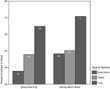
Figure 1 presents a comparison of the
percentages broken down by section type. The first grouping
presents the findings for “group learning” with the different
bars representing the type of section. The group learning
finding indicates that the Triad section has the highest
percentage of positive responses with the stand alone sections
having the lowest and the Tetrads in the middle. The positive
response in the Triad was 65% for the ability to learn in groups
question. The Tetrad sections had a 48% positive response and
the stand alone had the lowest at 38%. According to the
findings, the Triad learning community is achieving the “create
a group of students who work together” goal.
The “talking about ideas” findings are in the second grouping.
The bar representing the Triad section yields the highest
percentage of positive responses at 71%. This compares to the
stand alone at 48% and the Tetrad at 51%. Students in the Triad
section are the most likely to positively report that the class
led them to talk about ideas with their friends in comparison to
the stand alone and Tetrad sections. The results indicate that
the Triad is more effective at meeting the “increase
intellectual interaction” goal than the Tetrad and stand alone
sections.
Failure Rates
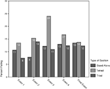
Figure 2 presents the findings from the
comparison of exam failure rates by type of section. The
expectation is that the learning community sections of the
Tetrad and Triad, by enhancing student learning, should have the
lowest failure rates. Each grouping represents an exam and the
bars in each grouping represent the failure rate for the section
type. On four of the five exams the Triad sections have the
lowest failure rate. The stand alone sections have the lowest
failure rate on exam 2. The Tetrad sections have the highest
failure rate on all of the exams. Overall, the evidence suggests
that only the learning communities in the Triad are having the
desired effect of lowering the failure rate and meeting the
“enhance student learning goal.”
Observations From the Triad Learning Communities
The quantitative analysis offers positive support for the Triad
learning communities, yet there are some features of the learning
communities that are diffi- cult to quantify. The following
observations from the Triad learning communities can put the
quantitative analysis results into context.
Create a Group of Students Who Work Together
Seminar leaders and composition instructors have the most impact
on the “create a group of students who work together” goal
because of group-based assignments and discussions. Perhaps the
most important part of creating a group of students is that they
can get to know each other easier in smaller classes. The same
25 students are in composition and seminar. They develop
friendships and relationships that are helpful with studying,
solving problems (including non-academic problems), and
developing a sense of belonging.
Increase Intellectual Interaction
The seminar leaders and composition instructors are much closer
to the students than the large lecture professor. They have
reported that the students do sense that the classes are
connected and that they are able to better understand the
material because they write about and discuss it in three
classes. It has also been reported that many students actually
enjoy researching their topics and that they find it interesting
that government and politics are linked to things that are of
interest to them. Some students have become so interested in the
issues they researched that they became active with local
interest groups.
The learning community also increases intellectual interaction
for faculty and instructors. The semester-long interaction among
the faculty and instructors leads to dialogues about innovative
approaches to teaching and intellectually invigorating academic
discussions. Also, the seminar leaders and composition faculty
(possibly because they are not trained in political science)
raise interesting points and interpretations about the material
that may elude the political science professor.
Enhance Student Learning
Another positive result is that the discussions of the material
do not end with the large lecture; discussion in FYS and the
student research in EC extends the political science material
beyond the large lecture course. An additional benefit of the
learning community is that the students learn to write from
trained EC instructors. The political science professor and
seminar leaders support the EC instructors instead of teaching
composition.
The students have differing reactions to the enhancement of
student learning goal. One student, in an anonymous written
response to a question about what is working well in a U.S.
Government and Politics Triad wrote: “I feel that the seminar
classes are very helpful. In my eyes it is very hard to
comprehend most of the material in such large lecture classes
[sic].” Not all students enjoy the learning community. One wrote
in response to the same question: “… it is torture to have three
‘political science’ classes a day.”
Findings
The findings indicate that the learning communities found in the
Triads are achieving the learning community goals. Group learning is
developed and students are more likely to discuss ideas with their
friends, indicating an increase in intellectual interaction. Also,
student learning is enhanced because failure rates are lower in the
Triad learning community. The Tetrad learning community is not as
successful in fulfilling the learning community goals.
Why are the Triad learning communities more successful in achieving
the goals than the Tetrad learning communities? A plausible
explanation is that in a Triad all of the energy, assignments, and
focus is on the content from one large lecture instead of two. In a
Tetrad, FYS leaders and EC instructors must balance their time with
content from two large lectures. The Triad has more focus, whereas
the Tetrad is diffuse.
Conclusions
The expectation from the literature is that learning communities should
make a difference for students. The evidence supports the expectation.
The linked class learning community with one large lecture course
(Triad) creates a group of students who work together, increases
intellectual interaction, and enhances student learning. The evidence
supports the use of learning communities for first-year students. The
evidence does not support the use of linked class learning communities
with two large lecture courses (Tetrads).
Learning communities are an additional tool political science professors
can employ in dealing with the challenge of teaching disinterested
students in introductory political science classes. The students benefit
from the additional time spent on the material, discussions, and
writing. Furthermore, students learn to work together, there is an
increase in intellectual interaction, and they perform better on exams.
Learning communities are not a panacea, but they do make a positive
difference.
The learning communities do not just make a difference for students.
Professors and instructors also benefit by not teaching in isolation.
Collaboration on research is common, but many toil in isolation with
teaching. The learning community model allows faculty members to
collaborate on teaching, and as collaboration is expected to improve
research, it should also improve teaching and learning.
The implications for A&M-Corpus Christi are clear–continue with the
Triads and continue to work at making stronger learning communities.
Additionally, the remaining Tetrads need further assessment. If they are
not meeting the learning community goals, they should be converted to
Triads. Assessment of the other learning communities needs to be a
priority. Also, steps should be taken to explore the possibility of
expanding learning communities into junior and senior level courses.
What are the implications for universities considering creating learning
communities? Sanders ably demonstrated that faculty members interested
in moving to a learning communities model could start on a small scale
(Sanders 2000). An institutional commitment is
essential. Resources are needed to hire and support seminar leaders and
composition instructors, and fund faculty release time. A commitment of
time is also required. The learning community faculty and instructors
must dialogue with each other and spend more time before and during the
semester planning and coordinating their courses. Furthermore, it takes
time to evaluate and refine a learning community program. It also takes
faculty and instructors committed to the philosophy of learning
communities. Personnel must also be flexible and committed to
teamwork.
The commitment and development of learning communities at A&M-Corpus
Christi has been demanding and often frustrating. However, the work has
come to fruition. The Texas A&M University-Corpus Christi First-Year
Learning Communities Program was recognized as one of 13 “Institutions
of Excellence in the First College Year” by the Brevard College Policy
Center on the First Year of College (2002) and was one of five Texas
institutions of higher education honored in 2001 with the first annual
Texas Higher Education Star Awards from the Texas Higher Education
Coordinating Board. Overall, learning communities do make a difference.
This is a system that can make introductory required political science
courses a more positive experience for students and faculty. It is a
demanding process, but it is worthwhile.