The goddess can be recognized by her step.
Virgil, The Aeneid, I, 405.
Introduction
Durga puja, or the worship of goddess Durga, is the single most important festival in Bengal's rich and diverse religious calendar. It is not just that her temples are strewn all over this part of the world. In fact, goddess Kali, with whom she shares a complementary history, is easily more popular in this regard. But as a one-off festivity, Durga puja outstrips anything that happens in Bengali life in terms of pomp, glamour, and popularity. And with huge diasporic populations spread across the world, she is now also a squarely international phenomenon, with her puja being celebrated wherever there are even a score or so of Hindu Bengali families in one place. This is one Bengali festival that has people participating across religions and languages. In that sense, Durga puja has an unmistakable cosmopolitan hue about it. With more than 10 million people visiting the different pandals (the temporary, covered pavilions or marquees created for the goddess) in Kolkata alone on any one of the four days of festivity (now effectively extended to a whole week), Durga puja could well be the biggest carnival on earth. Kolkata's image has become synonymous with this grand autumnal festival of the goddess.
Yet very little has been written about the puja as public culture, although there is no dearth of scholarship on the complex genealogy of the goddess. For instance, scholars have looked at her tribal inheritance as Chamundeshwari centuries back, noting the thick racial and erotic underpinnings of her skewed relation with Mahishasura (literally, the buffalo-demon), the dark king of the tribal asura people she slaughters. Others have undertaken ethnographic studies of the celebration of the goddess in rural Bengal.Footnote 1 Tapati Guha-Thakurta's magnum opus, In the Name of the Goddess: The Durga Pujas of Contemporary Kolkata, redresses the lack of attention that has been paid to the public life and visual culture of the festival. Her lens hones in on the churnings of vernacular modernity through an investigation of the boundaries of the worlds of popular art production and spectatorship in the city.
The book—mammoth, extensively researched, exhaustive in details, very readable, and packed with plates—focuses squarely on Durga puja in contemporary times.Footnote 2 The concentration of the book is on Durga puja from the turn of the millennium, when the theme puja and its corollary, the art puja, came into their own. If the first indicates the development of a specific concept, theme or site, the other is showcased as an auteurial enterprise. The lines between the two moments will always blur, as they are folds within folds of a larger change, that is, the celebration of Durga puja as public art, and more than just an idiosyncratic display of pomp and flourish.
The very use of Durga puja in the plural indicates that the author is not after any unified idea but is keen on exploring the diversity of practices. This stress on practices takes the work into many dimensions: the involvement of established artists, art college graduates, artisans and craftsmen, the question of changing neighbourhoods, the emergence of a new middle-class taste culture, the involvement of corporate sponsors and advertising, a culture of discipline through the economy of awards, and even the history of artistic pedagogy and commercial art in the city. Alongside this runs, as a tapestry, the concern with fissiparous notions of the sacred, the religious, and of profanation: how at the very heart of the religious lies the act of profanation when, at the end of the four-day festivity, the whole edifice is dismantled and the goddess is literally thrown into water, where she disintegrates, gradually, into clumps of hay.
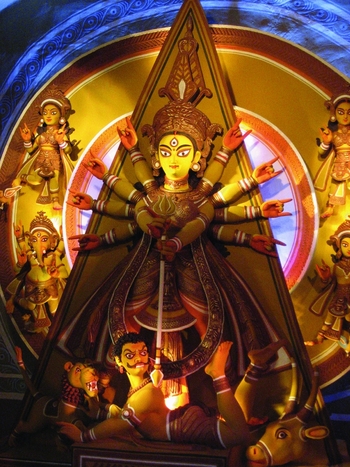
Although internal boundaries are tactfully retained, this is one festival in Bengali life where people across classes and religion participate, even if to a limited extent, in the revelries, feasting, and entertainments. The openness could be due largely to the humanist dimension that Durga evokes. The goddess, bestowed with ten hands, heroically slays Mahishasura, the vicious demon who hides in a buffalo and who had defeated the collective of gods before encountering her. She thus acquires the nom de plume, Mahishasura-Mardini (the crusher of the buffalo-demon). As the epitomic expression of the strength, rage, and cunning of all the gods put together, riding a majestic lion and wearing a necklace of snakes, she descends on the earth with one singular aim: to kill the demon and cleanse the earth of evil. But this official narrative lends itself to another quieter, more intimate story where she is imagined as a harassed mother returning to her parental home with her four children every year for a few days away from her husband, Shiva, a genial but dopey and scattered character. The two stories should have been diametrically opposed in spirit but here they cause no split.Footnote 3 The pastoral charm of the daughter returning to her parental abode with grandchildren absorbs all that could have been sectarian on such an occasion. Durga stands for both primal strength and intimate domestic joy and angst. Such is her narratological virtue that she easily becomes a part of quotidian Bengali life and also a metaphor for home and loss, roots and exile, which is perhaps the reason why Ritwik Ghatak, the famous Bengali filmmaker, uses the motif of Durga so often in his films.
The city as one long exhibition
At one level, Durga puja is all about being an exhibition. This is where the goddess, with the festivity that surrounds her, meets the metropolis at large, for the entire city becomes one ongoing exhibition.Footnote 4 The city stands transformed—into fantasyland palaces, make-believe fortresses, historical monuments, and glittering golden barge. Altogether kaleidoscopic wanderings and displaced cartographies become one huge ‘spectatorial complex’, with a point of view veering between that of the flâneur and that of the stalker. Call it transportation or transference or even transversal, this making of one thing into something else is what captures the essence of Durga puja as a public art: transferring the familiar locality into the magical; a small piece of land into something large, almost huge; crafts into art; workmen into craftsmen; craftsmen into artists; folk art into what can be called (high) modernist folk art, and so on. Nothing is impossible in the catholicity of representational choices: Jaipur's Hawa Mahal (Palace of Wind), the Bangalore Vidhana Soudha (Assembly House), the Senate building of Kolkata University, a church from Tsarist Russia, European castles, the gigantic wreck of the Titanic, a model of the Columbia space shuttle, the Hansheswari Temple of nearby Banshbaria, a dilapidated zamindari mansion complete with wild foliage and creepers. Nothing can remain purely religious in its rendition. Durga puja is a giant factory of ‘secular mass identity’.Footnote 5
Be it matchsticks, pins or abandoned black discs of defunct gramophone records, a metal mesh or a flurry of stencilled tinplate spearheads—so dexterous is the bricolage of puja artists that any artefact can be made uniquely valuable for the idol and pandal. Guha-Thakurta explains the play between the material and metaphoric by employing city-space historian Swati Chattopadhyay's concept of ‘fungibility’,Footnote 6 meaning both the principle of how an everyday space or structure can become interchangeable with a fabricated site from some distant past or remote corner of the globe, and in the process indicate how one single site can trigger multiple transfigurations and interpretive possibilities.
Writing in 2003, sociologist Pradip Bose describes his experience of the magical transference of the ordinary that Durga puja occasions in the following way:
One morning I open my window and see, standing right in front of me, the Mysore Palace in all its splendour, complete with the ornamental golden pitcher at the top. A neat garden has been laid out at the front with variegated trees—from coconut to even grapefruit. Ornate decorations adorn the interior. As with every year, I find the ponds, parks and roads of Kolkata teeming with a variety of imposing constructions. With scant respect for time, space, nation or history, the city has become, in effect, a gallery of the world's monumental edifices. The spectator is in turn amazed, enthralled, charmed, stunned. At places, the ambience is downright eerie: ‘Inside the pandal are stark strobe lights. They flash up and go off the next moment, giving the appearance that the goddess is turning her neck around from side to side for a good coup d'oeil.’Footnote 7
Years later, Tapati Guha-Thakurta narrates her experience of Durga puja in Hatibagan, an area in north Kolkata known in the puja map for the work of the stellar auteur, Sanatan Dinda, in the following terms:
After viewing Sanatan's youthfully vibrant Durga in her lotus-shaped abode, if we continued walking through the winding back alley of Nalin Sarkar Street, we arrived at the next intersection at another exquisite grey and ochre mud hut complex, with a museum-like display of some 900 wooden Santhal puppets at the Hati Bagan Nabin Pally Puja. With Kamaldeep Dhar providing again the design conception, a Santhal wood carver of Birbhum and his team had created these puppets of varying shapes, sizes and colours, which were meant to move after the Pujas to a private folk art museum in Santiniketan. Hurried along the tiny space by local child volunteers, who exhorted spectators to keep moving, we returned to the main Arabinda Sarani and walked across the road to the Hatibagan Sarbojanin Puja. Here, we saw a modernist installation with shuttle-like structures draped with blue, white and silver banners, a central waterway, panels with falling water, and a colour-synchronized Durga image whose ten arms held water pots in the place of weapons.Footnote 8
How do we interpret Durga puja as public art, and all the pomp and splendour that surrounds it? Looking at this aspect of splendour, which is beyond the book's purview, it may be asked whether Debord's understanding of the spectacle, widely accepted as paradigmatic, would be relevant here. For Debord, modern spectacle comes into being only at the point of the demise of sacred spectacle (which has its source in the sacred illusion uniting the throne of the monarch with the godly altar). This clears the space for the spectacle of the people which, for its part, is translated as the spectacle of commodity via the theatrics of the baroque stage (defined by perspectivism, stage machinery, and magic illusion). In the modern world, Debord holds, commodity carries the legacy of the sacred spell. In the case of Durga puja, we reckon, such a line of analysis is not all that helpful as a perspective. Durga puja today is, no doubt, commodified, primarily through corporate sponsorship and the heavy buying and selling that this annual festivity of Bengali Hindus involves. But it is not the sacredness of the regime of the commodity that Debord gestures at; rather, this sacredness has its source in the worship of goddess Durga and the various mythologies and rituals that surround her, albeit collaborated, transmitted, and even reframed through the many contemporary channels of cosmopolitan festivity and consumer culture. As such, like other religious (and political) festivities in India, Durga puja cannot be mapped onto Debord's scheme.
Can the phantasmagoria that theme and art puja evoke be called utopias? Or do they indicate a different order of the fabular? Following Foucault and in the vein of analysis inaugurated by Pradip Bose, Tapati Guha-Thakurta too considers that, unlike utopias, these are not simply unreal, imagined spaces, but real places of a special kind. They are counter-sites, where the real is at once ‘represented, inverted and challenged’, a concept that Foucault termed ‘heterotopia’. By deploying this term, Bose, and subsequently Guha-Thakurta, have effected a distinct departure in the analysis of Durga puja or, for that matter, any other such festivity. One needs to, however, remember a crucial difference. In Foucault's use, what is highlighted is the subtext of power. For instance, in considering the menstruating woman as a heterotopic site, he was gesturing towards her ostracization for those few days of the month. Or, the brothel, a special kind of space, ‘a place without a place, that exists by itself, that is closed in on itself’ and at the same time is given over to the populace. Or, the cemetery in modern times, when death is viewed in terms of illness and as a failure instead of being considered sacred (as in earlier times).
For cultural theorist, Georges Teyssot, utopias are ‘untroubled spaces’. In contrast, heterotopias must then be disjunctive terrains which Teyssot elaborates in the following terms: ‘heterotopias are disturbing, probably because they secretly undermine language, because they make it impossible to name this and that, because they shatter common names, because they destroy “syntax” in advance, and not only the syntax which causes words and things (next to and also opposite one another) to “hold together”’. In calling Durga puja, of the theme or art variety, a heterotopia, one is not so much making a reference to power relations or to the juxtaposition of interstices of the social, but merely to the juxtaposition of incompatible, heterogeneous elements in the construction, and the invariably metaphoric relation it fosters, of the original site replicated. This new-wave puja, so to speak, does create a sense of disjunction of time and space, but more than a political statement, it works on the register of a humorous sense of oddness (given the local space in which the edifice is transcreated) and also creates a genuine sense of awe at the intricacies of the construction emerging from ordinary, humdrum materials. A narrow, poorly lit lane, with such ‘normal’ sights as people spitting or relieving themselves, suddenly becoming the passage to a magnificently recreated, glittering edifice. This does create a sense of ‘visual turmoil’ (Flaubert) but one that is more on the genial register.
In the course of traversing nearly two decades of Kolkata's theme and art pujas, Guha-Thakurta has identified a crucial shift towards the turn of the millennium. From the gaudy fantasy of make-believe and erratic assemblage (where each detail reaches out to meet the spectator), she argues that we gradually move to new, more coordinated spaces of art and craft as the first decade of the millennium progresses: ‘The late 1990s and the early 2000s brought a series of paradigmatic shifts in the forms of the city's puja tableaux, propelling an internal metamorphosis of the festival from a “low” to a “high” culture profile, with different ethnic tastes and artistic identities furrowing this social space of festivity.’Footnote 9 The point of pride here is in meticulous research, recreating a gigantic site in a tiny open space on the street corner, the exactitude with which it is replicated, and also making it an occasion of public pedagogy and a display of ‘good taste’ conveyed through music played and crowd management, among other things. Guha-Thakurta notes that at times even the blue Archaeological Survey of India signboards are not missed out.Footnote 10 As a reader, I was reminded of Timothy Mitchell's observation that for the sake of a realistic representation of medieval Cairo in the Paris World Exhibition in 1889, even the paint on the buildings was made dirty.Footnote 11 In this staging of the truthfulness of the original, it was actually possible to create a truth more powerful than the original. But the staging also leaves clues as to the difference from the original; proclaiming authenticity also carries a hint of its disavowal. This is the charm of the replica which captures the spectator.
Mitchell considered this play of real and replica as cardinal to modernity, calling it the ‘world-as-exhibition’. If the world is an exhibition, then the modern subject is, by definition, a spectator. There is, however, a crucial difference between the world that Mitchell evokes from the one encountered in Kolkata. Despite the determined efforts to isolate the exhibition as merely the perfect representation of realities in far-off corners of the world, says Mitchell, the real world beyond the gates turned out to be rather like an extension of the exhibition. And even though, for those few days, the city becomes the paradigmatic moment of the art form new to it (that is, installation), at the point where the world of exhibition ends, observes Guha-Thakurta, ‘begins not a city of arcades, departmental stores and ordered vistas, but one of dark alleys, decaying neighbourhoods and crowded streets’.Footnote 12 Here, time is, literally, out of joint, not so much because of what is presented inside the pandals—those fantasy works of splendour and meticulous transcreations—but the stark contrast that lies outside. The spectator hops in and out of these illuminated spectacles in streamlined walkways cordoned off by ropes and manned by local boys and girls in sponsored T-shirts. This is not the anthropological gaze, as elaborated in Michel de Certeau's classic essay, ‘Walking in the City’—that is, one is not working one's way ‘through the thicks and thins of an urban “text”’Footnote 13 —at best, this is like a jostled, rushed flâneur, unsighted but seeing, taking in without always registering, or a camera whose shutter closes but only very erratically.
The new civic, the new puja
The industrial and advertising art of Bengal has a long tradition of engaging with indigenous motifs and mythological narratives, especially the Durga iconography and narrative. So when corporate capital started becoming available from the early 1990s onwards, along with the liberalization of the economy, it was no wonder that advertising singled out Durga puja as its big bonanza. With this came the trend for giving awards to pujas in several separate categories (idol, decoration, artwork, lighting, music, crowd management, and so on) by famous commercial brands and media houses. As a matter of fact, the corporate economy of the festival is now inalienable from its cultural and artistic self-image. What the award economy effectively did was to make the pujas conduct themselves according to certain codes of conduct. In other words, it brought Durga puja within the purview of what social science parlance these days calls ‘governmentality’. This thrust toward self-monitoring made the pujas subjects of power, rather than its objects, and it thus was gradually located in an inward-looking web of power relations. As Tony Bennett once said, ‘knowing power and what power knows, and knowing themselves as (ideally) known by power, interiorizing its gaze as a principle of self-surveillance and, hence, self-regulation’.Footnote 14 Theme puja and, subsequently, art puja very much became entrenched municipal creatures, aided by a certain kind of cultural capital that supported it, a taste culture of its patrons and clients, an overall social peace, and a prevailing practice of being secular that did not challenge one's religious identity.
We learn from Guha-Thakurta's account that for all their thickening clusters, about 1,000 out of the 4,500 pujas in the city would fall within the category of art and theme pujas.Footnote 15 Interestingly, it seems even for the large number that does not fall within this bracket there is the passive influence of the new civic disciplining of religious and aesthetic performance. The popularity of the theme and art puja heralds the coming into being of a taste culture richly aided by the participation of the electronic and print media, which, along with the corporate economy, provides a certain self-profiling of the festivity and a new discourse of the social. This discursive change was premised on the city's middle class attaining a certain solvency which effectively meant that the post-partition refugee phase of the city was finally over. The social texture was one of continuous peace, particularly remarkable given that it followed the mayhem and political violence from the mid-1960s on, until the Left Front came to power in 1977. One of Guha-Thakurta's key concerns is to locate the changing face of Durga pujas from the 1990s within the broader transformations of the public culture of Kolkata, and its manifold drive towards the refurbishing of civil society:
Durga Puja as a public art event is closely tied to the changing social profiles of Kolkata's neighbourhoods, and to the shifting hierarchies between elite and non-elite localities, to the transforming aspirations of local worlds of art practices, to the new blending of amateur and professional enterprise, and to the entry into the scene of art college trained artists and designers from the graphic, film and television media.Footnote 16
A lot started changing from the 1980s, and especially since the 1990s. With more imagination, decency, and discipline came a broad-based public appreciation of the puja, which reaches the upper echelons of the administration and the professional classes. Durga puja was no longer seen as an unruly plebeian mass festivity as it was in the 1960s and 1970s when the Youth Congress, through different local clubs, dominated the scenario of the puja and in the process alienated the intelligentsia. The culture then was of unabashed revelry, with Bollywood providing the music and its heroines, the model for the goddess. The Left preferred to call it ‘apasanskriti’, by which they meant a degenerate or lumpen culture.
Guha-Thakurta acutely analyses the ongoing tussle between unruly plebeian excess during the festival and municipal regimes of discipline as a thing of the past. Ideologically ambivalent towards the puja for a long time, ironically it is the Left which sowed the seeds of its contemporary popularity by insisting on new civic regulations, right from the time it took over in 1977. This paved the way for more middle-class participation and subsequently for theme and art puja experiments, although it was never hugely enthused by these developments. In 1978, the Left Front attempted to bring Durga puja under strict administrative control by laying down rules against the obstruction of main roads, restricting the use of loudspeakers, fixing deadlines regarding immersions, and so on. The Kolkata High Court added momentum to this civic activism in a landmark ruling in 1983 which made observance of a number of civic codes mandatory. By the mid-1990s, the demand for a more disciplined puja became entrenched, indicating a wider change in the political location of the city: from Youth Congress muscle power in the 1970s to a hegemony of the educated Bengal middle class, thanks to the Left Front rule. Regardless of these developments, politicians from the Congress and its breakaway, Trinamool Congress, kept pressing for a state of emergency during ‘those few days’ of the puja. Most prominently, Subrata Mukherjee, the city's mayor (elected on a Congress–Trinamool Congress platform), openly sympathized with law-flouting pujas. However, the might of the Left Front prevailed and the puja increasingly became an affair of the cultural class of the city. The direct result of this was the emergence, at the turn of the millennium, of the theme puja and, close on its heels, the art puja.
What is particularly refreshing about the book is its incorporation of the civic squarely within the domain of art analysis. Managing the city's all-important festival, observes Guha-Thakurta, has become the new objective of civic governance. The regime of civic regulations and corporate promotional strategies together have calibrated a space for the aesthetic that was not there earlier, bringing the artistic and the civic into dialogue. Supervising a crowd of no less than a million every day for a whole week, Durga puja is a gigantic administrative bandobasht (arrangement) that requires close cooperation between the divisional heads of the police force and the executive authorities of all the main branches of urban municipal services.
The chequered course of the festivity of the goddess over the last two centuries makes for rich history. The journey began in the early nineteenth century, when the puja was observed exclusively in rich Bengali households (mostly landlords, merchants, and traders of the East India Company) or Bonedi bari as they were called (‘bari’ being the Bengali word for ‘house’ or ‘household’). These were occasions of no religious reverence whatsoever but sheer decadence and hedonistic excesses (‘shameful ostentation, bacchanalian revelry and unending entertainment’Footnote 17 ) in a society where wealth was determined not by what one retained in reserve but by what one squandered. The tables turned in the middle of the century, when these rash merrymakers were replaced by a group of enthused citizens, who started holding pujas as a collective enterprise. From Bonedi bari puja, we thus enter the theatre of Barowari puja. The characters change but the spectacle remains, as does the ostentation and vulgarity.
Regardless, this emergence from the enclosures of individual households into the open is hugely significant, for it led, by the turn of the twentieth century, to a new civic culture and public communitarian spirit, with the participation of the bhadralok (the educated, modern Bengali gentry). From this point, Barowari puja or puja of collectivity was called Sarbojanin puja or ‘puja for all’. The democratic thrust thickened with the rise of nationalist spirit early in the century, contributing to a new impulse of sacredness far outside the caprices and brawls of the preceding century.
The author is perhaps a touch too impatient in placing the transformation of the civilized Sarbojanin pujas, at the turn of the last century, alongside the transition from the brashness of the 1960s and 1970s to the civic-minded, high culture festival of the present,Footnote 18 thus smoothly telescoping a passage of time of nearly one hundred years. This of course is nothing as capacious as the Bengali cultural historian, Sripantha, comparing ‘the excesses and immoderations of both the Banedi Bari and Barowari Pujas of colonial Kolkata with the simplicity, decency and neighbourly spirit of the residential block Puja’ of upmarket Salt Lake, a satellite township adjacent to Kolkata that came up in the 1980s and 1990s.Footnote 19
Behind the historian's parochial, well-nigh hyperbolic, affection for the puja of the locality in which he lived is a bhadralok preference for a civilized, somewhat pastoral form of the festivity, captured in the term ‘pally’, which, though used here to denote an urban municipal borough, has its roots in the village. The more common and contemporary expression for urban locality is ‘para’ and Durga pujas, even the stellar ones, do retain an organic connection with the paras in which they are held. A puja is not a portable item; its para roots are organic and deep. The municipal authorities realized this when working on a Kolkata High Court ruling which tried to remove the famous Bosepukur puja from its premises next to a thoroughfare to an interior ground. The attempt was stoically resisted by the organizers and local people, who came up with alternative schemes of crowd management and traffic regulation. As Guha-Thakurta writes: ‘What emerges from these tensions at Bosepukur are not just custodial clashes over urban space but also countering notions of what makes for a civic, people-friendly celebration.’Footnote 20
The emergence of a teeming band of spectators from across the city going into the recesses of a para introduced a new socio-cultural dynamic that has a deep impact on its self-understanding. As one is continuously jostled and herded inside and outside these crowded complexes, there is precious little scope for viewing and appreciation of the displays, let alone worship or devotion. Walking down the narrow lanes does introduce a tactile apprehension and kinaesthetic appropriation but of a very different kind from what Michel de Certeau has discussed. The intricacies of the idols and pandals are best viewed on the television screen. The television channels, in the process of bringing the better known pujas to the sitting room, also function as surveillance centres. Television advertisements about sponsored events at puja sites—like Zee TV's Amio Dekchhi (‘I am watching too’)—valorizes a panoptic, disciplining gaze. With the prospect of awards in mind, the puja committees do not mind being closely monitored too.
With the consolidation of Hindu paras in post-partition Kolkata came the consolidation of Durga puja. The puja gave a certain kind of identity to the localities and a texture of sociality. In the post-partition upheaval, refugees from the other side of Bengal's border took the lead in para pujas in the south of the city due to their sheer numerical superiority, while in the older north, the pujas are controlled by their traditional residents. The more the bhadralok hegemonized the para, the more the puja became the primary signature of the locality and, by the same token, the more cosmopolitan it became, announcing the message of peace and harmony across communities. Originating as a tribal deity—a fearless virgin, a fierce warrior—over the past two centuries Durga became at once religious and secular. And such is the overall ambience, this is no matter of contradiction.
Installation art, the Durga puja kind
The ‘theme/art’ puja has been called Bengal's own installation art. Interestingly, it was during the emergence of these varieties of puja that installation as a formal art form became popular in the city's galleries.Footnote 21 The question to ask is: what makes a Durga puja pavilion an installation work?Footnote 22 What is the alchemy of achieving the Holy Grail? Modernist experiments done with discarded car parts and metal junk on the theme of industrial pollution by the city's artists failed to catch the imagination of people, nor did Gregor Schneider's flat postmodernism at Ekdalia Evergreen puja in South Kolkata. For quite some time in the West, installation art has been viewed in a much more flexible and fluid manner. Take, for instance, the famed art theorist Nicholas Bourriaud's description of the work of Robert Barry. On the morning of 5 March 1969, in a park in New York, Barry released half a cubic metre of helium into the atmosphere, prompting the spectators to move around in order to observe the work as it formed—the artwork only existed in the first place by virtue of this observation and this too was transitory. Bourriaud calls these examples ‘relational aesthetics’ in a book by the same name—an art that is interactive, user-friendly, and relational. It dodges the empire of predictability and instead tries to generate relationships with the world. It replaces, so argues Bourriaud, forms by formations.Footnote 23 Modern installation is more a set of conditions than a collection of finite objects, what Grace Glueck calls an ‘aesthetic laboratory’.Footnote 24
If the theme or art puja is an installation, it is more so in a classical sense. Guha-Thakurta maintains that, more than the mixed media installations that we see in our galleries, puja productions involve a degree of proximity and collaboration with artisanal labour that often threatens to collapse the crucial line separating the artist from this mixed workforce. In terms of mobilizing cultural traditions and styles, puja art is a highly eclectic affair, where disparate elements from different folk and modern archives are put into strange ensembles. The ensuing articulation is something akin to what Craig Calhorn calls ‘culture-making’,Footnote 25 indicating the unpredictable extension of meaning. The unpredictability creates an odd sense, its promiscuity being the source of much wild imagination. As in most installations, and in Durga puja too, the body is on tour in the play of enclosure and openness. This promiscuity does not, however, come in the way of a sacred communion with the goddess.
Continuing with this theme, I would like to add that in the crushing crowd, the viewer barely has the chance to participate in the discursive wanderings that the image and ambience might present. As a viewer, however, she does for a moment become a darshanarthi, a seeker of darshan, the divine glance. This is the moment when the goddess bestows her blessings through a direct look at the seeker: the subject is looked at by the goddess, lured, transfixed, summoned to take up position. Because it has a strong narrative attached to it, perspective here does not simply remain a geometric proposition but carries an unconscious dimension with it. It is darshan that allows the worldly narratives of the goddess-as-housewife to be transformed into the mystical understanding of her infinity. This happens best in the traditional ek-chala idol, where Durga and her family are depicted together in one place behind a single semi-circular frame—Durga at the centre of the chala, flanked by her four children, on one side by Lakshmi and Ganesh and on the other by Kartik and Saraswati. Infinity here is the name for happy homogeneity.
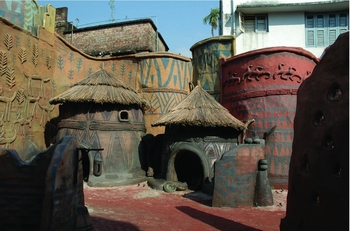
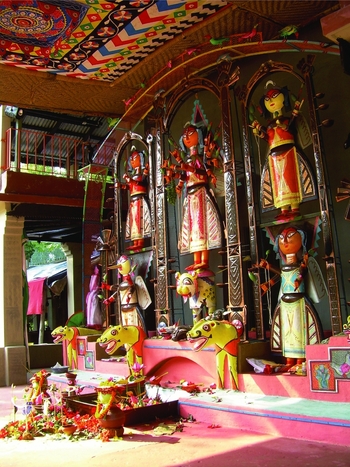
The theme puja, as the name suggests, works on the development of a subject or concept; for instance, an African tribal village, or an old, dilapidated zamindari mansion, or a popular temple in some part of the country. It is milieu-specific and follows a hold-all approach that accommodates not only a diverse range of artefacts but also of ideas and styles. At the same time, it is not an abstract collage and is mostly restricted by a rudimentary, even if arbitrary, sense of realistic reproduction. This openness and fluidity of the theme puja is responsible for its indiscriminate proliferation and in a way has worked as an inspiration for the art puja, which in contrast is ‘proper’ art and truly an auteurial enterprise. Having said this, it needs to be remembered that such practices keep blurring and trespassing into each other's zones; the possibility of congealing into stable entities is virtually ruled out.
The first decade of the new millennium is when theme and art pujas came into their own. This is the decade about which, understandably, the author is most enthused. As mentioned earlier, this decade also witnessed the fruition of a new cultural class—a process that started in the early 1990s—which arguably has a symbiotic relationship with the new styles of pandal and image-making. The equation of the ‘art’ puja, entirely auteur-driven as it is, with the idioms and vocabularies of modern art, is relatively uncomplicated. What is fuzzy in terms of ‘art as such’ is the location of the theme puja which, somewhat uncharitably perhaps, I have described as a ‘hold-all affair’. Guha-Thakurta calls it a matter of ‘epistemic ambivalence’.Footnote 26 It is my surmise that the theme puja liberates the viewer from the centricity of the geometrical point of view. Rather like early European cinema, they become what Tom Gunning has called a collection of multiple curiosities. The sites are constructed in such a manner that the total gaze becomes just one more gaze—the whole is only a part. Talking about the evolution of the theme puja, with the passage of time, the playful and gaudy displays of the 1990s gave way to finer sensibilities, as puja sites became self-contained spaces of metaphoric density with more authorial control. However, the piling together in the early years of incommensurate artefacts, the ‘fast and furious’ recoveries of the past and what Hal Foster calls, in the context of American neo-conservative postmodernism, ‘the hysterical pastiche’ did lend to a departure from received notions. The kitschy jumble of everyday mundane objects alongside the iconic puts the whole issue of expressive art on a tentative footing.Footnote 27
Guha-Thakurta has, persuasively and elaborately, tried to make a case for the festival's very ephemerality as an occasion for a fresh departure in art theory. All through the book, she makes the argument about the festival producing its own particular aesthetics of ‘public art’, one that defies the given categories of traditional ritual art or modern/modernist installation art and calls for its own standards of appraisal. In this new installation form, traditional folk art and crafts meet fine art in a modernist format and also caters to public tastes. It has become primarily a festival of public art, deploying all forms of prevailing artistic culture, both traditional and modern. Fundamental to the theme or art puja is the confluence of corporate capital and professional artistic enterprise for an elaboration of changing urban folk aesthetics. And one of its expressions is in the primacy of design: ‘The claims of “art” in this sphere redounds on a new primacy of design: one that spills outwards from the image of the goddess and the multiple forms of the tableaux that grow around her into the promotional banners, brochures, invitation cards and advertisements that are generated around the event.’Footnote 28
Durga puja of the theme and art variety, even though its primary obligation is to entertain, belongs to the chequered interface of art history, visual culture, and popular culture. The figure of the artist, therefore, acquires a critical distinction because they need to continually reinvent themselves and seek new distinctions from the artisans and craftspeople engaged in the work. The issue becomes more interesting if we consider that most of the better known artists engaged in the production of Durga puja art today—Sanatan Dinda and Bhabatosh Sutar are the two biggest names here—actually come from socially underprivileged artisan and crafts castes. One of the ways of carving out such distinction vis-à-vis artisanal labour is to make one's work a matter of research—complete with field trips and scholarships—to achieve the utmost fidelity to the original site or artistic traditions reproduced. That such work has to ultimately draw its raison d'être from public appreciation is a matter of both ambivalence and artistic challenge.
Artists who have achieved prominence have done so, argues Guha-Thakurta, precisely by catering to both constituencies. The award economy and media discourse, for their part, help in shaping public taste by attributing a degree of seriousness and respectability to the ‘art’ of the theme and art puja. Smallness has become the hallmark of this acquired seriousness and respectability: ‘smallness of budgets, of sizes of productions, of spaces out of which they grew, and of localities which sought a new social and cultural profile’.Footnote 29 Smallness is a kind of maker of time, the sign of a change of guard in terms of patrons—from the political class of gregarious tastes and shady reputations to the para's educated gentry. Creating innovative and artistically refined design ideas out of inexpensive material became the premium aesthetic challenge.
Very clearly Durga puja as a new installation form blends traditional folk arts and crafts with fine art in modernist, and quite often high modernist, formats. Sanatan Dinda and Bhabatosh Sutar, artists who shot to fame by virtue of designing and composing art/theme pujas, are among the country's very best high modernist artists practising at the moment. Of the two, Sanatan is clearly auteurial—his signature is visible from the first idol he designed—and more adventurous in terms of the iconography of the goddess. The transfiguring power of the sacred succeeds, despite (and, in fact, is often enriched by) the high modernist renditions of the goddess. His works emerge out of a closely studied corpus of the Hindu and Tibetan Buddhist pantheon of eastern India, are high modernist in style, and carry strong erotic overtones, with the latter lending a certain Archimedian detachment in an otherwise fairly strong authorial point of view. He, as the author rightly claims, is the true pioneer of the art puja.
Sanatan uses the dingy, cramped space of his para—a tiny lane, Nalin Sarkar Street in north Kolkata—to the utmost aesthetic advantage by giving it the look of an inner temple sanctum leading to the image of the goddess, a shimmering vehicle for a metaphysical enunciation of the sacred: ‘In 2011, Sanatan undertook one of his most extravagant Puja productions to date, transforming the alley into a massive boat covered with blue and silver fishing nets and hanging window frames, leading to a large vertical monolith with laser lighting effects. The theme music playing here was the song Moner Manush by Lalan Fakir, the mystic bard of rural East Bengal, to match the symbolic setting of a boat on a river.’Footnote 30 By 2009, solo exhibitions of his paintings were organized in Kolkata, Mumbai, and London. His stoic attachment to his dingy para gave him the aura of an aesthete in our juxtaposed times—rootedness in his locality in a shabby quarter of north Kolkata, but also a jet-setting global performer. With his audacious experiments, Sanatan brought Durga puja installations within the ambits of academic art practice, inserting his gallery art freely into the public domain. His installations are, properly speaking, artworks within the established grammar of high modern art.
Like Sanatan, Bhabatosh Sutar comes from an underprivileged artisan caste and made it through school by plying a rickshaw after hours. With the support of a local art teacher, he completed his degree from Kolkata's Government Art College. True to his peasant origins, he uses folk materials and forms like painted wood and bamboo carvings to bring a mellow, pastoral simplicity to his works. This is how Guha-Thakurta describes what she considers his best work so far:
Working the next year, 2007, at the Khidirpur 25 Pally Puja, by now a well-marked ‘theme’ Puja site, Bhabatosh created what I consider one of the finest installations in this field of festival art. The work grew out of the metaphors of agriculture and cultivation, inspired by lines from an eighteenth-century Ramprasad shyama-sangeet, which talked of how the human mind, like the soil, would yield its bounty of gold only if properly ploughed. What is worth noting, though, is the striking disjunction between the deeply rural devotional affect of this song that the artist drew on and the recognizable modernist idioms of pavilion art that he opted for.Footnote 31
Staging the sacred
A book on the worship of goddess Durga has to necessarily engage with the question of the sacred, especially in relation to public culture. It seems to me that the author's interest lies not so much in the sacred as such but in how the sacred is staged. Much of the sacred associated with Durga puja in Kolkata today is post-partition, Bengali, middle-class sacred, related to the coming of the transistor set. One wonderful instance of the technologically transmitted ‘sacred’ was the Chandipaath by Birendra Krishna Bhadra on the dawn of Mahalaya, the ritual beginning of the Durga puja seven days before puja. It is also the day on which offerings are made to one's ancestors in a river in the early morning. The whole atmosphere would become incestuously sacred. Bhadra, the man who monopolized the act of recitation on the radio until the very end of his life, would reach the All India radio station at the crack of dawn after a dip in the Ganges, to find his artistes, some of them mega-celebrities of the day, waiting for him with rapt attention. The sacred that theme/art puja creates is an ‘arty’ sacred, not that of barir pujo, or even the traditional club puja. This sacred is neither that of the demon-slaying goddess nor of the homecoming of the goddess as the housewife that one might like to think of. If theme puja and art puja have inaugurated a sacred, it is an arty, new age, cosmopolitan sacred and lives alongside that of the more traditional kind of puja, the best epitomic expression for which is dakersaaj or the dak style (‘ornamentation for the goddess crafted in golden and silver tinsel foil; the name derives from the history of this imported material initially arriving by post (dak) in colonial India’Footnote 32 ).
There are three elements of Durga puja: ritual, iconography, and narrative. For Hindus, being religious is a matter of endless rituals, a matter of stories upon stories. If we call this narrative ‘religiosity’, then it is what constitutes the everyday of Hindus where the gods are immersed in the world of humans as much as humans are in the world of the gods. To speculate: can we think any more of a Durga not interested in the Big Ben, the Akshardham temple or the Bollywood heroines whose physique she at times takes? (In a sequence of a popular mega-serial named after the goddess Durga, she is seen hiding under the cot, defeated by human machinations.) Such feats are unimaginable for a centralized religion like Christianity, where the ‘religious’ has been thoroughly disciplined.Footnote 33 The fluidity of the Hindu imagination of divinity allows for the concurrent existence of devotion, advertising, and art that go towards the making of the current life of the festival.
Guha-Thakurta talks of a kind of resacralization that she thinks is happening in our globalized world. This does not, however, take us away from the secular taste in vogue today. Thanks to what can be called the ‘modern sacred’, for theme and art pujas, and the spectatorship they demand, the question of resacralization (or, for that matter, desacralization) needs to consider that the sacred and the secular are not constitutively opposed categories here. A new secular taste culture has developed that is not disturbed at the marshalling of the ritual religious as long as it is aesthetically performed. In fact, the secular and the sacred are bound up in an aesthetic transaction in which rituals do not get in the way. No matter how important the non-religious dimensions are for the festival, they do not by any means hinder the celebration of the goddess. The idea is not to produce something that is wholly religious or uncompromisingly secular, but to have popular entertainment that works on the rhetoric and deep association of religion. The religious and the secular meet incommensurability in their inadequacy.
Prior to the eighteenth century, secularization denoted merely the civil conversion of ecclesiastical property and jurisdiction.Footnote 34 In India, just as secularism, politically speaking, means coexistence of all religions without constraints, similarly the popular understanding of being secular means participation across religions. In other words, both secular and secularism gesture at a cosmopolitan appeal. Durga puja is secular only in the sense of participating spectators. Rarely are people of other religions, especially Muslims, welcome in the rituals of worship.Footnote 35
The affective self of the goddess—as both a fierce warrior and loving mother—has a long genealogy stretching into the nineteenth century, or even beyond, to the Mangalkavyas, the poetry produced between the thirteenth and eighteenth centuries depicting quotidian lives and the rural gods and goddesses of Bengal. Along with the revelry around Durga puja in rich houses, there was this other, steadily flowing streak in ordinary nineteenth-century life, of which of Michael Madhusudan Dutt'sFootnote 36 sonnet, ‘Bijoya Dashami’,Footnote 37 remains the most poignant and popular expression: ‘Jeyona, rajani, ajiloyetara dale!/ Gele tumi dayamoyi e paranjabe’ (Don't depart today, O Night, with stars on your firmament/ If you do, O Kindness, this life will pass away).
However, the contours of the warrior-cum-loving mother goddess started becoming clearer with the rise of Hindu nationalism in the early twentieth century in the form of the Swadeshi movement. The deep imbrications of bhakti from much earlier times is the reason why, later on, bhadralok devotion could easily blend the two, but prioritizes the domestic self without alienating the slaying goddess. Tithi Bhattacharya has done extensive work on unravelling the new affective powers of the goddess in middle-class sensibility and in the rising political rhetoric of Hindu nationalism whereby the difference between the two selves of the goddess will be denied. This is seen as the expression of the Bengali psyche in its fullness.Footnote 38 From that point onwards, the civic identity and sacred aura of the goddess Durga are seen as coextensive. As Guha-Thakurta notes:
Divested of her wild Tantric pasts, removed also from the unruly celebrations of the less reputable, she would now reign as much in her domesticated role as a Bengali married daughter as in her nationalist role as a reawakened mother-goddess. Rescued from the clutches of sahibs, banias, baijisand sawng performers, she would be rendered into a new object of bhadralok devotion.Footnote 39
One can look for resonances of nineteenth-century revelries and pomp in the Sarbojanin puja of the 1960s and 1970s,Footnote 40 but that would be compressing too complex and too long a passage of time into some apparent similarities. A comparable thing could be said about attempts to draw parallels between the early twentieth-century nationalist incorporation of Durga puja by the Hindu bhadralok and the cosmopolitanism of theme and art pujas of our times.
A different order of imagination is required both to portray the goddess who kills the asura, and the harassed, modern Bengali domestic woman. This transition seems seamless in Hindu culture, such is the manner of socialization. The author judiciously places less emphasis on the religious/secular divide and instead engages, like Giorgio Agamben, with the categories of the sacred/profane and tries to think of their co-mingling and co-constitution in a process that the philosopher calls profanations, in which the consecrated object of the divine is continually returned to the ‘free use and commerce of men’.
I would also point out that in Agamben, the sacred and the profane are linked by a logic of conscription, both sacred and cursed, coming from the Latin ‘sacrificium’ (sacr, sacer, sacrificium). In other words, the sacred also carries traces of blood. Either way, sacred (as pure) and cursed (as polluted) are acts of god. The meanings of sacred and profane, observes Leland de la Durantaye, are ambiguous and circular: consecration as opposed to profanation.Footnote 41 Profane, indicates Agamben, means the normal flow of life, unhindered by the incursion of the sacred. To announce something as sacred is to take it out of the profane realm of life and declare it a special space, a space of emergency. Sacred space could be either divine (a temple), or special in a non-religious sense (a theatrical space like the dais) or polluted and cursed (a menstruating body). Profanation, as an opposite act of sacralization, means to recoup that special space and bring it back to the continuum of the ordinary. To profane is not to debase but is a positive act of liberation; sacred is exclusion, profane is restoration through counter-exclusion.
The main burden of this recherché coinage (profanation), to continue with the theme, is to have a sustained confrontation with secularization, a concept with which it is supposed to share common ground. Derived from the Latin provenance, etymologically ‘secularization’ simply means ‘worldly’ as opposed to the eternal or heavenly world.Footnote 42 To put the two oppositions—namely, secular against religious and profane against sacred—in one place, reads something like this: secular (worldly) as opposed to religious (other worldly), and profane (continuum of the everyday) against sacred (cordoning off spaces as special) or, put more schematically, worldly/other worldly vis-à-vis conscription/liberation.
Durga, who has her origins as a non-Brahmanical deity, went through a long period of Sanskritization (that is, attaining higher social status) by acquiring humanized and familial qualities. This domestication of the goddess, I would like to argue, is neither sacral nor profane in the way Agamben uses these terms. In the context to which the goddess belongs, the sacred is never effectively distinguished from the profane. Hence, the idea of conscription by the sacred, followed by liberation back to the flow of the profane, seems somewhat alien in this world of fluidity. It is true that once the goddess leaves for her heavenly abode, her ‘worldly’ remains are treated as sheer leftover, a body without a soul, perishable, odious. The haystack that once made up the goddess floats on the river—‘specters of apathy and abandon’—as the city returns to its practised self. This might look like defilement, but not to a Hindu:
So, on the heady occasion of the annual descent to earth of this divine family, each act of what Agamben calls ‘profane contagion’ become forms of creative appropriation and reanimation—whereby Durga's affective powers as an icon are neither neutralized nor deactivated but continually recharged in her promiscuous entanglements with the everyday worlds of human consumption and celebrations.Footnote 43
In the last phase comes the most intense humanization, when married women, decked in white saris with bright red borders, bid the goddess farewell by engaging in sindurkhela (the play of vermillion), which involves smearing sindur on Durga's forehead and parting her hair, and performing the same act for one another. At the end of this play, the immersion procession begins, with men and women dancing to the beat of the dhak (the local drum),Footnote 44 some clearly inebriated. The expenditure of surplus comes to its culmination. Here profane is, I hold, pure festivity, an eternally transient world. Benjamin will explain this state as liberation from the sacred, but without simply abolishing it: to remove an object from the sacred context and return it to the sphere of the profane, without negating or nullifying its sacred history.
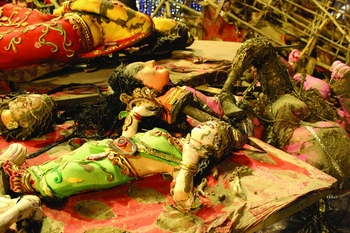
The goddess is set floating on water, sometimes thrown into the water. Rampant destruction follows, remorselessly indifferent to anything that is divine, beautiful, and sacred. It is violence to something that has expired its term as sacred. Is it a cleansing, generative violence that readies the community for a renewal of the sacred? Gerard's observation of the sacred and the community might be relevant: ‘Having brought the community into existence, the sacred brings about its own expulsion and withdraws from the scene, thereby releasing the community from its direct contact.’Footnote 45
What remains of art that only a day before had seemed so utterly permanent, eternal? Are the floating haystacks signs of the fugitive, an impermanent dimension of immutable art, as in the West? Or do we need to invent other categories, other kinds of interpretation? Here is the author's graphic portrayal of the technology of immersion:
Offloaded from the trucks, stripped of the flowers and other Puja accessories on their bodies that are to be deposited in vast garbage vats, these vast images on their wooden frames are circled around a few times by the coolies to hoarse cries of victory to the goddess and invocation of her return the next year, before they are lowered onto the muddy banks, and pushed to the edge of the waters. The images are given a token submersion in the river, but they are no longer allowed to float away into the deep. Contained within a roped enclosure, the job of the cranes is to immediately scoop up the bodies and give them a ritual dip in the waters before dumping these idol corpses on the barges. . . . The epitomic image of the occasion remains that of the goddess’ upturned face and clenched fists gently bobbing above water, surrounded by fragments of her ornaments and weapons. But in stark contrast stands today's surreal scene of the mauling of the images by cranes, as flaying limbs and torsos drop from above, and detached heads pop out of the mangled bodies of straw and clay.Footnote 46
Not everything of the puja is mauled and destroyed. There is a circulation economy at work, whereby the more successful artworks of pandals move to pujas that follow in quick succession: Kali and then Jagatdhatri, in and outside Kolkata. To provide more permanent housing for the year's best images, a museum was set up in 2012 in a converted warehouse inside the beautiful precincts of Rabindra Sarabar, the largest cluster of lakes and foliage in the city, located in the south. The idea was to have a Durga gallery, complete with puja-themed merchandising for sale and a children's workshop in clay idol-making, as a site for the year-long commemoration of Durga. The project failed. The city was not ready for an archive of the goddess which, as it turned out, was neither a modern art gallery nor a puja mandop (site), but more like a warehouse of yesteryear's divinity. Locally, the place soon acquired the nom de plume ‘thakur-der gallery’ (the gallery of the gods and goddesses), referring to Durga and her sons and daughters. A year later, with no maintenance and no visitors, the museum lay in shambles, its open-air displays broken and the grounds covered in slush and stagnant water. The strength of the art or theme puja lies in its non-fixity, its fungibility, located in a public discourse and performance of sacred and secular, of commerce and aura, art and stunt. The steel figure of the blood-sucking monster, Raktabeej, brought from the nearby Lake Temple Road Shibmandir puja tableaus, stands mauled by storms. The giant feet that Sanatan Dinda constructed for the Barisha Club pavilion is now part of the lakeside garbage.Footnote 47 Ironically, this is quite in fitting with the spirit of Durga puja, for, at its best and worst, it is a performance of transversal, a constant transmuting of identities. Clearly, ephemerality, destruction, and disintegration is constitutive of the entity of the ‘art’ puja, underscoring its liminal ‘art but not quite’ status.
Conclusion
Each season, Durga puja offers a new city to be discovered and traversed. The city of the festival becomes a liminal site for imaginary journeys in time and space across India and the globe, inculcating new tastes in archaeological tours, heritage viewing, and art and craft consumption. One both unlearns and re-engages with the ‘everyday city’. The Kolkata Durga puja wields a neat hegemony not only over Bengal, or India for that matter, but even globally. With fibreglass icons coming in vogue, transportation has become less cumbersome, leading to increased numbers of diasporic pujas. Even in offshore celebrations, the art (if not the theme) puja is slowly catching up. There have, however, been attempts to challenge the influence of city-centric, Bengali bhadralok-dominated pujas. As well as a few examples of Mahishasura celebrations in the tribal reserve forests of Sonajhuri (near Tagore's Santiniketan), the late artist, Badhan Das, experimented with what can be called a ‘modernist tribal’ Durga puja with the active participation of local tribal people. Das successfully drew on the long tradition of art-as-rural-activism, of which Tagore himself was a proponent. With her origins as a fierce tribal woman, the iconography of Durga lends itself rather easily to tribal imaginary. Artistic experiments are done with a range of durable materials and the image is not immersed but recycled over different seasons. Das's experiment has taken root and has continued long after his death. However, even the Sonajhuri tribal Durga puja cannot but relate, even if as difference, to Kolkata's art and theme puja. Besides, it too is a performance, not an ‘authentic’ tribal puja in any imagined sense.
Experiments like that of Das are clearly an exception. By and large, Durga is presented as the most glamorous in the entire pantheon of gods and goddesses that the Bengalis worship. What story does her conquest tell when translated into the contemporary? What story of glamour and pomp do the millions of spectators, mostly poor, underprivileged, and outside the Brahmanical corpus, take home with them? Is there a natural bonhomie between the goddess and the culturally dominant classes of Kolkata? The special status of the Durga puja for the middle-classes vis-à-vis other pujas, and its social self-positioning as the meta-festival and a ‘high-culture’ event is something that has not yet received adequate academic attention. The goddess in her post-tribal manifestations—fair, the epitome of Aryan beauty, armed to the hilt—and the asura—dark, sinewy, moustached—can be imagined as being caught in a primal theatre of seduction and sexuality with distinct racial undertones.Footnote 48 In their juxtaposed trajectories are mapped a conundrum of oppositions—white and black, female and male, deities and earthlings, deceitful and primal, Aryan and tribal. Added to this is Durga's own double posture of being both murderous and loving at the same time. Attempts at over-determination only make the oppositions more volatile, as is happening at the time of writing this article, when one witnesses a strong push from the subaltern perspective that believes Durga killed Mahishasura, the non-Aryan king of the pastoral asura people, through deceit, using alcohol and sex as an inducement. The asura people still mourn the death of Mahishasura, their king, on ‘Ashwin Purnima’, the day of the full moon after Durga puja in the month of Ashwin. This tradition is gaining popularity as well as visibility of late, with Dalit activists making major strides, both politically and discursively, across the country.Footnote 49
For all her popularity and hegemonic presence, the way the goddess is worshipped today—with all the rituals, customs, methods, and invocations—is not more than 200 years old. Within these two centuries, as our discussion has shown, the mode of worship has undergone distinct shifts. Clearly, at this point, it looks like the particular era of Durga puja that Tapati Guha-Thakurta so painstakingly delineates has again arrived at a turning point. What the end could be like is being worked out in the new historical conjuncture that, with the coming of the new political regime in 2011, the state of West Bengal has reached. We are already seeing a marked reversal of the brandishing of size, scale, and ostentation of the 1960s and 1970s; for example, the Star Cement mammoth Durga idol at Deshapriya Park in South Kolkata which boasted the ‘world's tallest Durga’ and caused a stampede-like situation on the very first day of the puja in 2015. A corollary is the takeover of the tastes and assertions of a new ‘political class’, with the coming of the Trinamool Congress as the state's new rulers. In the current political and cultural atmosphere, the theme and art puja as we knew them a few years ago already seem somewhat out of joint, carrying the dreams of a time that, though recent, is looking increasingly recoupable. In this way, Guha-Thakurta's study has already acquired the status of a historical account, documenting the latest phase of this centuries-old mega-phenomenon of Bengali culture.
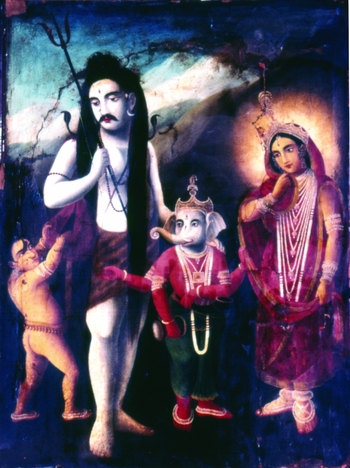
Shiber Paribar, The Family of Shiva. Anonymous oil painting circa the nineteenth century. Source: Guha-Thakurta, In the Name of the Goddess, p. 8. Used with kind permission of the author.

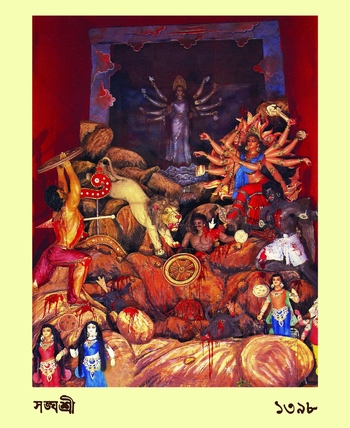
Puja of earlier times: Sanghasree Durga. Image by Jiten Pal 1398–1991. Source: Guha-Thakurta, In the Name of the Goddess, p. 124. Used with kind permission of the author.

Theme puja: Ghana village. Barisha Sahajatri puja, 2004. Source: Guha-Thakurta, In the Name of the Goddess, p. 57. Used with kind permission of the author.

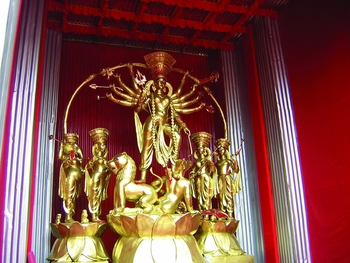
Theme puja: Gilted Durga with Egyptian-style costume and headdress, Hatibagan, 2007. Source: Guha-Thakurta, In the Name of the Goddess, p. 233. Used with kind permission of the author.

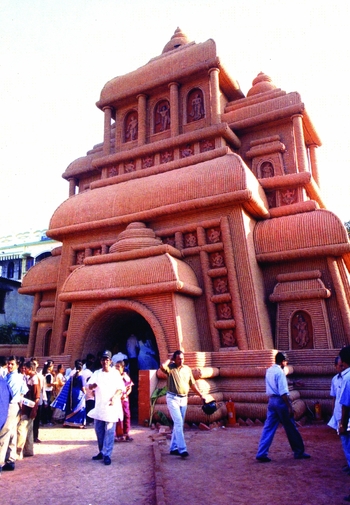
Theme puja: Earthen teacup pandal, Bosepukur, 2001. Source: Guha-Thakurta, In the Name of the Goddess, p. 310. Used with kind permission of the author.

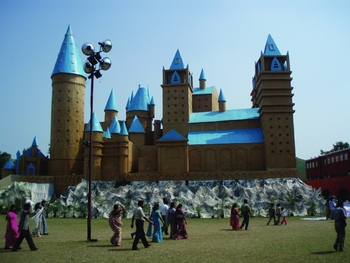
Theme puja: Harry Potter castle, FD Block puja, Salt Lake, 2007. Source: Guha-Thakurta, In the Name of the Goddess, p. 59. Used with kind permission of the author.

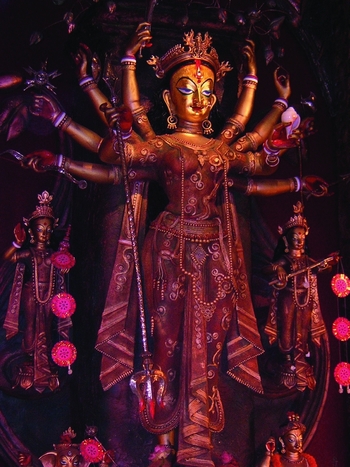
Art puja: Sanatan Dinda Durga in the form of a Tibetan bronze sculpture, Nalin Sarkar Street, 2006. Source: Guha-Thakurta, In the Name of the Goddess, p. 257. Used with kind permission of the author.

Art puja: Sanatan Dinda fibreglass Durga, 95 Pally puja, Jodhpur Park, 2012. Source: Guha-Thakurta, In the Name of the Goddess, p. 261. Used with kind permission of the author.

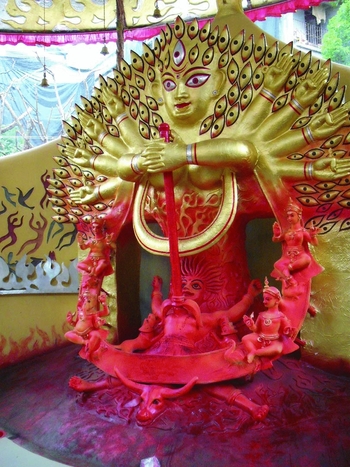
Art puja: Bhabatosh Sutar Durga in the form of a giant flame. Naktala Udayan Sangha puja, 2009. Source: Guha-Thakurta, In the Name of the Goddess, p. 269. Used with kind permission of the author.

Art puja: one of Bhabatosh Sutar's signature style Durgas, Rajdanga Naba Uday Sangha, 2008. Source: Guha-Thakurta, In the Name of the Goddess, p. 204. Used with kind permission of the author.

Art puja: Bhabatosh Sutar Durga at the Warehouse Gallery, November 2012. Source: Guha-Thakurta, In the Name of the Goddess, p. 358. Used with kind permission of the author.

Daker Saajer puja: Maddox Square Durga image, 2008. Source: Guha-Thakurta, In the Name of the Goddess, p. 68. Used with kind permission of the author.

Goddess group made out of painted cast iron and metal utensils, Sonajhuri, 2005. Source: Guha-Thakurta, In the Name of the Goddess, p. 251. Used with kind permission of the author.

Abandoned and desecrated. Source: Guha-Thakurta, In the Name of the Goddess, p. 339. Used with kind permission of the author.

Women performing sindurkhela before bidding farewell to the goddess. Source: Guha-Thakurta, In the Name of the Goddess, p. 347. Used with kind permission of the author.