1 Introduction
Transparent vowels in harmony systems pose particular difficulties for theoretical analyses (Gafos & Dye Reference Gafos, Dye and van2011). Both autosegmental theories of feature spreading and constraint-based approaches (Baković & Wilson Reference Baković and Wilson2000, Kimper Reference Kimper2011) have wrestled with how best to treat transparent vowels. Some cases of transparent vowels, however, have proven to be illusory. Where prior research suggested a single transparent vowel that was immune to vowel harmony, acoustic and/or articulatory investigations have revealed that apparent transparent vowels have different realisations when they co-occur with different harmonic sets (see Gick et al. Reference Gick, Pulleyblank, Campbell and Mutaka2006 on Kinande ATR harmony, Benus & Gafos Reference Benus and Gafos2007 on Hungarian palatal harmony and Hansson & Moore Reference Hansson, Moore, Tuttle and Lovick2011 on Kaska palatal harmony). For example, Gick et al. show that Kinande has ten surface vowels rather than the nine previously reported; the short low /a/ is not transparent, but has a [+ATR] alternant in [+ATR] harmonic contexts. These results suggest that cases of transparency merit more detailed investigation, and that transcriptions that rely on perceptual impressions alone may not be fully accurate. Besides palatal and ATR harmony, transparent vowels have also been reported for labial harmony ([i] in Khalkha Mongolian (Svantesson et al. Reference Svantesson, Tsendina, Karlsson and Franzén2005) and Gunu (Hyman Reference Hyman2001)) and height harmony ([e] in the Ascrea dialect of Italian and [a] in Pasiego Montanes Spanish (Penny Reference Penny1969)), but no phonetic investigations have yet been conducted on illusory transparency in these harmony systems.
In this article, we present data from the height-harmony system of Moro, a Kordofanian language spoken in the Nuba Mountains of Sudan (ISO 639-3 mor) that also appears to have transparent vowels. Moro has seven contrastive vowels /i e a o u ɜ ə/, according to previous descriptions (Black & Black Reference Black and Black1971, Gibbard et al. Reference Gibbard, Rohde, Rose, Matondo, Mc Laughlin and Potsdam2009). Moro harmony is a ‘one-step’ cross-height harmony system, in which the lower vowels /e a o/ raise to their higher counterparts [i ɜ u]. The steps refer to a low–mid–high scale, in which the low vowel /a/ raises one step to a mid vowel [ɜ], and the mid vowels /e o/ raise one step to high vowels [i u], as shown in (1). (In previous work on Moro, [ɜ] was transcribed as [v]. Acoustic data in this paper suggest that [ɜ] is a more accurate transcription.)
-
(1)


Harmony is illustrated in (2a), where the /i/ in the root /kið/ triggers raising of the prefixes and suffixes. The short mid central vowel in (b), /ə/, co-occurs with both sets of vowels within a root. It therefore appears to be transparent to height harmony. When it occurs alone in a root, as in (c), however, it conditions either lower vowels or higher vowels on an apparent lexical basis.
-
(2)

These data raise the question of whether the [ə] is truly transparent or not, especially as it appears to act as a trigger in (2c). If it is phonetically distinct in different harmonic contexts, including when it occurs alone in a root, this may provide evidence for two short central phonemic vowels instead of one. The [ə] has short duration and if there is a distinction, it is difficult to perceive. The Moro orthography uses <ə> consistently, and the speakers we worked with did not note a distinction. Acoustically and articulatorily, however, the two vowels might be distinct.Footnote 1
Besides the transparency issue, Moro height harmony presents a phonological representation conundrum. As discussed in Clements (Reference Clements1991), Parkinson (Reference Parkinson1996), Gnanadesikan (Reference Gnanadesikan1997) and Pulleyblank (Reference Pulleyblank2011), the standard phonological features [high] and [low] are inadequate to capture stepwise height harmony such as that in Moro, or in Lena Spanish (Hualde Reference Hualde1989), in which low /a/ raises and fronts to mid [e] before high vowels ([‘gata] (fem sg) vs. [‘getu] (masc sg) ‘cat’) and mid /e/ raises to [i] ([‘nena] (fem sg) vs. [‘ninu] (masc sg) ‘child’). Raising from low to mid would involve a featural change of [+low] to [−low], whereas raising from mid to high would involve a change from [−high] to [+high], two different featural changes for what is essentially the same process. In raising systems of this kind, the trigger is higher than the target. High vowels trigger raising of low or mid vowels to mid or high (Parkinson Reference Parkinson1996, Pulleyblank Reference Pulleyblank2011). In Moro, however, the higher harmonic set includes both mid /ɜ/ and high /i u/. The mid vowel [ɜ] occurs as the output of raising of /a/, but it can also trigger raising of the other mid vowels, /e o/, to high [i u], as in (3c).
-
(3)

The vowel /ɜ/ is classified as mid on the basis of the fact that its first formant (F1) is similar to that of the other mid vowels, but it patterns like a high vowel phonologically. This creates abstraction in the interpretation of phonological features to model the harmony system if the /ɜ/ is treated as [+high]. Scalar systems, such as that of Clements (Reference Clements1991), also fare poorly in accounting for this pattern, since such systems treat all mid vowels uniformly, with the same feature specification. We will argue that a particle analysis (Schane Reference Schane1990) provides the best representation of the harmony system, as it is able to characterise the /ɜ/ both as a mid vowel and as sharing a natural class with the high vowels.
Height-harmony systems do have some commonalities with ATR systems. In nine- or ten-vowel ATR systems, a mid [+ATR] vowel can shift a [−ATR] high vowel such as /ɪ/ to [+ATR] [i], a change that involves acoustic lowering of F1, as well as articulatory tongue-root advancement. This property is what Stewart & van Leynseele (Reference Stewart and van Leynseele1979) label the ‘cross-height’ nature of ATR harmony. The Moro system behaves in some ways like an ATR system, in that it shows cross-height harmony. Modelling it with the feature [ATR], however, requires abstraction, as there are no ATR contrasts among the peripheral vowels /i e o u/. Based on evidence from related languages, we conjecture that Moro harmony likely developed from an ATR-harmony system, which may explain the retention of some of its characteristics. Vowel merger and centralisation led to ATR alternations being reinterpreted as height alternations, and led to the emergence of one or more phonemic central vowels.
The paper is organised as follows. In §2 we provide a basic description of the vowel-harmony system. In §3, we consider a possible analysis of the behaviour of schwa. In §4, we present the results of an acoustic experiment that addresses the issue of whether there are two short central vowels. We discuss typology and the representation of the Moro height-harmony system in §5. In §6, we present arguments for centralisation and vowel merger. We conclude in §7.
2 Description of the vowel-harmony system
In this section, we present a more detailed description of the vowels and the height-harmony system. As stated in the introduction, the status of /ə/ and /ɜ/ presents analytical challenges. The vowel /ə/ appears to be both inert and participatory in harmony, while /ɜ/ is a mid vowel, and yet patterns with the high vowels both in triggering harmony and in being the raised counterpart of a lower vowel. From an articulatory point of view, vowel height is defined in terms of the height of the tongue body (Chomsky & Halle Reference Chomsky and Halle1968, Lindau Reference Lindau1978). However, other researchers have pointed out problems with vowel height being defined in terms of tongue-body height (Ladefoged Reference Ladefoged1971, Lindau Reference Lindau1978), and instead favour acoustic-auditory definitions in terms of F1 (Ladefoged Reference Ladefoged1975, Reference Ladefoged2001, Casali Reference Casali1996; see Pulleyblank Reference Pulleyblank2011 for a summary).
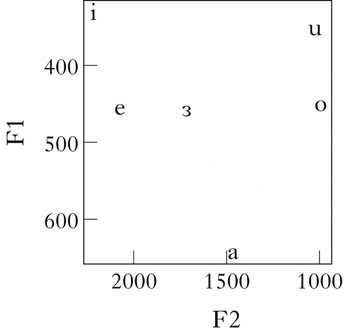
The plot of the acoustic vowel space of the six harmonising vowels in Moro in Fig. 1 shows that the central vowel [ɜ] has an F1 in the same range as the other mid vowels [e o], rather than the high vowels. These data (3611 tokens averaged across four speakers: 3 male, 1 female) come from the acoustic study described in §4. The acoustic measurement of F1 has to be mapped to appropriate phonological features; if there is a relatively direct mapping to the descriptive categories of low, mid and high, [ɜ] is a mid vowel, and should be specified for the same height features as the other mid vowels, which have similar F1 values. We return to this issue in §5.
Mean F1 and F2 values for four Moro speakers (3 male, 1 female).

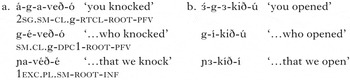
Examples of harmony are shown in (4) for verbs.Footnote 2 The effects of vowel harmony triggered by the root vowel are seen on the affixes. Each verb form in (4) consists of a root with prefixes and a suffix (1sg.sm-cl.g-rtcl-root-pfv).Footnote 3
-
(4)

Other verb forms show similar harmonic effects on affixes, as in (5).
-
(5)
Harmony is also observed in nominal forms, as seen with the locative prefix /é-/ in (6); this prefix may be either [é] or [í], in accordance with the vowels of the noun stem. Nominal roots also obey vowel harmony.
-
(6)

In the verb, the domain of vowel harmony is the verb stem. This domain excludes the object, instrumental and locative enclitics that follow the aspect/mood suffix, which do not participate in harmony (Jenks & Rose Reference Jenks and Rose2015). The verb forms in (4) and (5) have an aspect/mood/deixis suffix, but do not include additional clitics at the right edge. Verb roots generally contain only one full vowel; the few longer roots also obey vowel harmony: /mi¿ɜʧ-/ ‘show’, /ɜnduð-/ ‘bite’, /ondaʧ-/ ‘be pregnant’, /toðal-/ ‘start’. In the nominal system, prefixes participate in harmony, but suffixes generally do not, except for some inalienable possessive suffixes (see below). We consider nominal suffixes to be outside the domain of harmony, as they neither trigger harmony nor undergo it. In the orthography, each vowel is accorded a separate symbol (/ɜ ə/ are written <ë ə> respectively), but vowel harmony applied to affixes is not systematically encoded.Footnote 4 Nevertheless, the vowel-harmony system is productive, and also applies to Arabic loanwords, e.g. Arabic sukwar ‘sugar’ → Moro [sukwɜr]; Arabic tuum ‘garlic’ → Moro [it̪úmí].
Verb roots often contain /ə/ in addition to one of the other six vowels. It can occur with either the high or the low set of vowels, and in any position in the root. Harmony is determined by the other vowel in the root, as in (7), which suggests that /ə/ does not participate in the harmony.
-
(7)

Nevertheless, some verb roots contain only /ə/. These roots are divided into two classes: some roots co-occur with affixes containing the lower set of vowels, [e a o], as in (8a), and some co-occur with affixes containing the higher set, [i ɜ u], as in (b).
-
(8)

The verb roots /dəɾ/ ‘care for baby’ and /dəɾ/ ‘stand, cover’ constitute a minimal pair in terms of harmony, but there are very few such pairs in our data.
Noun stems typically contain more than one vowel. As in verbs, /ə/ can co-occur with any of the other vowels. Harmony is determined by the other vowel, as shown by the locative forms in (9).
-
(9)

Some nouns (nine from our database of about 775 noun lexemes) contain only /ə/. Despite the sparseness of these forms and a lack of minimal pairs, these nouns still belong to different harmonic sets, as can be seen from the locative form. One of the nine co-occurs with the high prefix [í-], as in (10d).
-
(10)

In addition to root or stem-controlled harmony, Moro has a dominant-recessive harmony pattern, in which certain suffixes trigger raising of the root vowel and preceding prefixes. In verbs, these suffixes also raise the vowel of the following aspect/mood/deixis suffix. These harmony-triggering suffixes are causative /-i/, applicative /-ət̪/ and passive /-ən/.Footnote 5 It is due to the behaviour of these suffixes that we term Moro harmony a ‘raising’ harmony rather than a ‘lowering’ harmony. While two of these suffixes contain /ə/, not all extension suffixes with schwa trigger raising. The antipassive /-əð/ does not. Furthermore, if the antipassive occurs with a root with a high vowel, it does not trigger lowering, and appears to be transparent to vowel harmony. In (11), verb roots with raising suffixes are illustrated, conjugated in the 1st singular perfective. Note that the /ə/ of the extension suffixes can be optionally dropped after certain consonants.
-
(11)

Raising triggered by suffixes is also observed in the nominal system. While suffixes generally do not participate in vowel harmony, inalienable possessive suffixes, which appear on kinship terms, undergo harmony if low, and trigger raising if high. Consider the two roots /et̪/ ‘father’ and /ib/ ‘sibling-in-law’. The suffix /-áɲ/ in (12a) is raised to [ᴈɲ], due to the root containing a high vowel. Moreover, the root /et̪/ is raised to [it̪] in (12b), due to the suffix containing /ɜ/, a vowel from the higher set.Footnote 6
-
(12)

In sum, the vowel-harmony system constitutes a cross-height raising harmony whereby the lower vowels /e a o/ raise one step to their higher counterparts [i ɜ u]. Raising is triggered by the higher vowels /i ɜ u/. /ə/ co-occurs with vowels from either set, and appears to be transparent to raising. Nevertheless, there appear to be two kinds of /ə/ in both roots and suffixes: some /ə/’s trigger raising harmony and some do not. This suggest that there may be two vowels phonologically with different behaviours, but it is not clear whether they are phonetically distinct or not.
3 Possible analyses of short central /ə/: one vowel or two?
In this section, we discuss three possible analyses of the two kinds of /ə/: (i) a morpheme analysis, (ii) a phonetic merger analysis and (iii) a fully distinct analysis.
A morphemic analysis would hold that certain morphemes are marked for raising, with an autosegmental feature or a rule. The /ə/ itself is not associated with the raising feature in the input, but may receive it in the output. This is the essence of early autosegmental approaches to vowel harmony (Clements Reference Clements1980). If the raising feature associates to other vowels but not /ə/ in the output, phonetic neutralisation between the two kinds of /ə/ is expected. If, on the other hand, the raising feature does associate with /ə/ in the output, two distinct phonetic [ə]’s are expected. Some support for a morphemic analysis comes from the fact that there are verb and adjective roots composed of only a consonant. Most of these are non-raising. However, as shown in (13), there are two verbs and two adjectives that do condition high vowels, despite the root being vowelless (adjectives conjugate in a similar fashion to verbs, but their paradigms have distinct properties, not shown here).
-
(13)

Speakers would need to memorise which of these roots have high-vowel affixes, even without the benefit of a root vowel. Representationally, the roots would be distinguished with a floating feature which associates to the affixes. The same analysis could be applied to morphemes with /ə/. This type of analysis has been proposed for Chukchee (Kenstowicz Reference Kenstowicz, Clyne, Hanks and Hofbauer1979, Krause Reference Krause1979), which exhibits lowering or [−ATR] harmony whereby /i u e/ are realised as [e o a] respectively. The vowel /ə/ does not appear to undergo harmony; yet some morphemes containing only /ə/ do condition harmony. In addition, some vowelless roots also trigger harmony while others do not. The triggering cases with /ə/ or no vowel are marked with a floating [−ATR] feature (Kenstowicz Reference Kenstowicz, Clyne, Hanks and Hofbauer1979).
A second analysis would maintain that the two /ə/’s are distinguished phonologically via distinctive feature specifications, but are phonetically similar or neutralised on the surface. Such an approach would be along the lines of the two /i/’s in Kashaya (Buckley Reference Buckley1994), in which one /i/ is underspecified for features, and tends to undergo assimilation and mutate, while the other is fully specified, resists assimilation and mutations, but triggers uvular raising. A similar analysis of strong and weak /i/ in Inuit dialects is presented in Compton & Dresher (Reference Compton and Dresher2011), following earlier work by Kaplan (Reference Kaplan1981). In some Inuit dialects, there is a distinction between /ə/ and /i/. In others, such as North Barrow Inupiaq, the distinction is collapsed to /i/, but /i/ descended from original *i maintains the ability to palatalise, whereas that descended from *ə does not. Compton & Dresher (Reference Compton and Dresher2011) propose that there are four underlying vowels in such dialects; /i/ is specified as [coronal], but /ə/ is featureless. The surface phonetics merge these two vowels. Other examples of this type are analyses of Kàlɔ̀ŋ high vowels (Hyman Reference Hyman, Sauzet and Zribi-Hertz2003) and the two kinds of e in Chukchee (Kenstowicz Reference Kenstowicz, Clyne, Hanks and Hofbauer1979, Archangeli & Pulleyblank Reference Archangeli and Pulleyblank1994). In these analyses, the two vowels are assumed to be phonetically identical, but phonologically distinct.
Third, there is a ‘fully distinct’ analysis, which maintains that there are two distinct schwas, both phonologically and phonetically (acoustically and/or articulatorily), but they are similar enough that prior transcriptions have not differentiated them. This analysis is similar to a morphemic analysis that allows some /ə/’s to receive the harmonising feature in the output and be realised as acoustically distinct from those that do not, but assumes that the vowels are themselves distinguished underlyingly.
While these three analyses address the ability of /ə/ to trigger the raising of other vowels when it occurs alone in a morpheme, there is also the issue of its transparency. When a verb root has the shape /CəC/, the other vowels in the word are raised by a trigger suffix, but is the /ə/ also raised in examples such as (14)?
-
(14)

Moreover, when /ə/ co-occurs with another vowel in a morpheme, is it transparent to harmony triggered by that vowel, as in (7) and (9), or does it participate?
Transparency has been a thorny issue in phonological studies of vowel harmony (van der Hulst & Smith Reference Hulst, Smith, Bogers, van der Hulst and Mous1986, Baković & Wilson Reference Baković and Wilson2000, Gafos & Dye Reference Gafos, Dye and van2011, Kimper Reference Kimper2011). In some analyses, a transparent vowel undergoes harmony, but then problematic feature combinations are ‘repaired’, or interpreted at the surface level (e.g. Clements Reference Clements1977, Finley Reference Finley2008, Jurgec Reference Jurgec2011). Under other analyses, they are skipped (Pulleyblank Reference Pulleyblank1996, Nevins Reference Nevins2010, Kimper Reference Kimper2011), with different methods of addressing the issue of ‘strict’ segmental locality. Finally, some studies have examined the articulatory and acoustic behaviour of transparent vowels and shown that they participate to some degree in vowel harmony. For example, Benus (Reference Benus2005) and Benus & Gafos (Reference Benus and Gafos2007) show that transparent front vowels in back contexts in Hungarian are retracted. Gick et al. (Reference Gick, Pulleyblank, Campbell and Mutaka2006) demonstrate with acoustic and articulatory data that Kinande ‘transparent [a]’ constitutes two separate low vowels, one [+ATR] and one [−ATR]. Kenstowicz (Reference Kenstowicz2009) confirms this with acoustic data from a different speaker.
In light of these studies, and the issues posed by schwas in Moro, an acoustic study was conducted. The goal of the study was to examine the acoustic properties of /ə/ in different verb roots and to test the hypothesis that there are two distinct /ə/’s both phonologically and acoustically, which both participate fully in harmony. This hypothesis will be supported if /ə/ in a root that co-occurs with the higher set of affix vowels (henceforth ‘trigger schwa’) has a significantly lower F1 than /ə/ in a root that co-occurs with the lower set of affix vowels (henceforth a ‘non-trigger schwa’). Furthermore, if /ə/ is not transparent, but participates fully in vowel harmony, there should also be F1 differences when it co-occurs in a root with a vowel from the lower harmonic set rather than with a vowel from the higher harmonic set. Finally, non-trigger /ə/ should show a significantly different F1 in a plain form than in a context with a raising trigger suffix, whereas trigger /ə/ should show no significant F1 differences in the two contexts, on the assumption that it is already high and will not be raised further. Our test materials are all verbs, as verbs can be controlled for tone, and can also be marked more readily with harmony-triggering suffixes than nouns.
Due to the tendency for short /ə/ vowels to undergo coarticulation, it is also possible that differences in F1 may be due to coarticulation effects from consonants or from the vowels of surrounding affixes, particularly in roots with a single /ə/. It was not possible to control for neighbouring consonants, due to the type of available roots. However, to minimise the effects of coarticulation from vowels, we also tested longer roots with two schwas in the imperative, a verb form with only a single suffix. If the F1 value of /ə/ is due to coarticulation with the suffix vowel, the first /ə/ in the root should have similar F1 values in both kinds of verbs, while the second /ə/ will show F1 differences, due to its proximity to either the lower vowel or the higher vowel in the suffix. However, if the F1 value of /ə/ is due to acoustically different vowels, we predict that the F1 values of both /ə/’s should be distinct, with a higher F1 for the non-trigger schwa verbs. Coarticulation with the suffix should still affect the second schwa.
To summarise, if the distinct schwa hypothesis is correct: (i) schwas in trigger roots will have significantly lower F1 than schwas in non-trigger roots; this holds both for schwas that occur alone (/CəC/ and /CəCəC/ roots) and schwas that co-occur with other vowels (/CəCVC/ roots); (ii) non-trigger schwas in raised contexts (followed by a trigger suffix that causes raising) will have a significantly lower F1 than non-trigger schwas in non-raised contexts (followed by a suffix that undergoes harmony). Trigger schwas in raised contexts will not show significantly different F1 values than trigger schwas in non-raised contexts, as they are assumed to be high and not subject to further raising; (iii) in /CəCəC-V/ forms, the effects should be the same as those outlined in (i) and (ii). In addition, the second schwa should show stronger coarticulation effects with the suffix than the first.
This study builds on an earlier pilot study (Ritchart & Rose Reference Ritchart, Rose, Kramer, Zsiga and Boyer2015) that presented data from one speaker, and did not include long roots with two schwas.
4 Acoustic experiment
4.1 Subjects
The participants were four adult native speakers (3 male, 1 female) of the Thetogovela dialect of Moro.Footnote 7 All four speakers also spoke Sudanese Arabic and English. Participants were between 35 and 55 years of age. Three of the speakers resided in the United States and one in Sudan. Only a subset of the data was recorded in the case of the female speaker (see below).
4.2 Materials
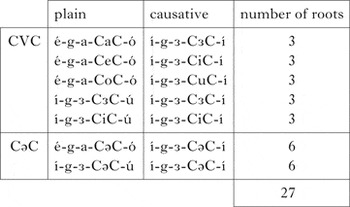
Materials were constructed to elicit both the schwa and the non-schwa vowel inventory of the language. /CVC/ verb roots (henceforth referred to as ‘short’) were conjugated in the 1st singular perfective root clause form, which has the shape /é-g-a-root-ó/ (cf. (4) above), and allows for all three lower vowels, /e a o/, to be represented in the affixes. Furthermore, the perfective has a consistent tone pattern across all verb roots. The non-schwa vowels represented in the root were /i ɜ e a o/, with three examples of each vowel, giving a total of 15 verbs.Footnote 8 Causative forms of each of these verb forms were also constructed, to test the effects of raising triggered by a suffix. The causative suffix was chosen, as it is the most straightforward to add to a variety of verb roots from a semantic perspective. Some examples are given in (15a) (a complete list can be found in the online appendix). The /a/ of the root /vað/ is raised to [ɜ], due to the presence of the causative suffix.
-
(15)

Short CVC roots with schwa, as in (15b), were also used. There were six short roots with trigger schwa and six short roots with non-trigger schwas, for a total of twelve roots. Causative versions of these verbs were also constructed.
Table I summarises the short root materials.
Plain and causative /CVC/ short roots used in the experiment.

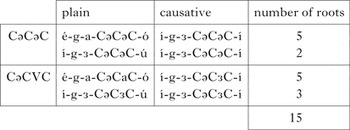
Long roots consisted of two kinds. First, there were roots with two /ə/’s, with the shape /CəCəC/. There were five roots with non-trigger schwas, as in (16a), and two verbs with trigger schwas, as in (16b). The number was not balanced, due to the paucity of the latter type. Second, there were roots of the shape /CəCVC/, with non-trigger and trigger vowels in the second position of the root: /CəCaC/ (five verbs) and /CəCᴈC/ (three verbs). Numbers were not balanced, as there are fewer types of the latter kind in the verb lexicon.
-
(16)

Causative versions of each of these verbs were also recorded, as in (17).
-
(17)

Table II summarises the list of long root verbs used in the experiment.
Plain and causative /CVCVC/ long roots used in the experiment.

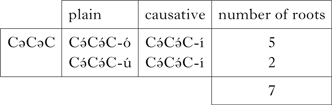
Finally, in order to minimise the effects of coarticulation on /ə/ of surrounding vowels in affixes, long roots with two schwas in the proximal imperative form were used, as in Table III. This verb form is the most minimal, consisting of the root and a single suffix. These are the same roots as used in Table II.
Plain and causative /CəCəC/ long roots used in the experiment.

4.3 Procedure and analysis
Production data from IE, EJ and AN were recorded by the second author in private homes, on a PMD 660 Marantz recorder with an external microphone sampled at 44.1 kHz. As IA resides in a different city, he was recorded by AN on a Tascam handheld recorder after AN had participated in the study. Although pilot data with EJ were presented in carrier sentences, speakers were uncomfortable with this methodology, and requested that the verbs instead be presented as lists of words. Materials were written in Moro orthography for two speakers (IA, AN) and in IPA for the other speakers (IE, EJ), who were not as familiar with Moro orthography. Moro orthography incorporates IPA symbols, so there are few differences between the two transcription systems. Glosses were provided in English, and the recorder prompted the speaker by saying the Moro word if he or she was unsure. If there were any errors or disfluencies in the production, the speaker was asked to repeat the item. Words were repeated three times (speakers IA, IE) or four times (speakers EJ, AN), depending on speakers' comfort level with longer sessions. Speaker IE did not record any long roots, due to her limited time availability.
Acoustic analyses were made using Praat (Boersma & Weenink Reference Boersma and Weenink2015). Vowel midpoints (or steady states, if the midpoint was not steady) were marked, and formant values were automatically collected using Praat scripts. The automatically collected values were checked in the resulting spreadsheet. An automatic measurement was deemed to be incorrect if the value deviated from the speaker's average for that vowel. For these and any borderline cases, we checked the values by hand. All /ə/ values were also checked by hand. Acoustic data on non-schwa vowels was compiled from both roots and affixes, and data on schwa from roots.
The values of the first and second formants were extracted, and used to create vowel-space plots. As F1 is the acoustic correlate of vowel height, this formant was used to assess differences in the height of schwa. Mixed-effects models with maximal random structure were used to assess whether significant differences existed for F1 values between trigger schwas and non-trigger schwas and between schwas in low and high contexts. Model results are reported using the corresponding variable's t-value; values greater than |2| are considered significant (Baayen et al. Reference Baayen, Davidson and Bates2008). Formant values of the peripheral vowels and schwas were plotted using the ggplot2 package in R (Wickham Reference Wickham2009). We use the term ‘peripheral’ here to reference the non-schwa vowels /i e a o u ɜ/, although we recognise that /ɜ/ is not a peripheral vowel in the conventional sense of being at the edge of the acoustic vowel space.
In addition, duration measurements of root vowels were taken for speaker EJ to assess additional differences between schwas and peripheral vowels. Duration measurements followed standard procedures for determining vowel edges (the first and last glottal pulses of the vowel). T-tests were used to assess whether differences in duration were significant, with alpha set at p < 0.05. Two roots with schwa, /mət̪/ ‘grow’ and /mwət̪/ ‘sip’, were removed from the analysis, since the schwa in many tokens was too short to be reliably measured, and the slight labialisation in the latter may have affected formant values.
4.4 Results
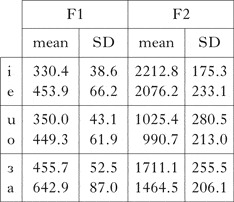
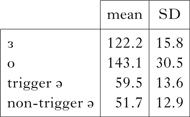
Mean F1 and F2 and standard deviations for the peripheral vowels are provided in Table IV for all four speakers. The F1 of the low vowels [e o a] is on average at least 99 Hz higher than that of their high counterparts [i u ɜ].
Mean F1 and F2 of lexical vowels (Hz).

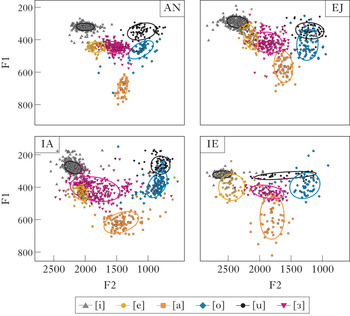
The peripheral vowels for each individual speaker are dispersed within their respective acoustic vowel spaces as in Fig. 2.
F1 and F2 of peripheral vowels, separated by speaker. In this and following figures, ellipses encompass 75% of the data.

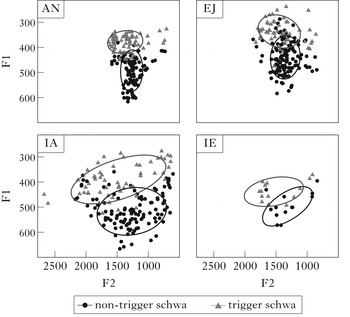
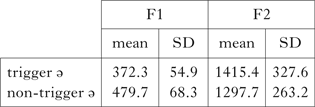
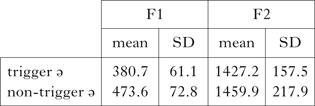
Mean F1 and F2 values for non-trigger schwa and trigger schwa in CVC roots are given in Table V. The mean F1 of trigger schwa is significantly lower than that of non-trigger schwa (β=…107.86, SE=8.35, t=−12.92). Non-trigger schwa is followed by [o], which has a mean F1 of 449.3, whereas trigger schwa is followed by [u], which has a mean F1 of 350.0. The difference in schwas is therefore similar to that between the back mid vowel and the back high vowel, although the schwas have a higher F1 than their mid and high counterparts respectively. The schwas also have a higher mean F2 than the mean F2 of the back vowels ([o] = 990.7, [u] = 1025.4), so they are on average more central than the vowels that follow them. The vowel space of the schwa tokens is depicted in Fig. 3 for each speaker.
Vowel space of schwas in CVC verb roots, separated by speaker.

Mean F1 and F2 of schwas in CVC roots (Hz).

Given that schwas are articulated in the central vowel space along with /ɜ/, we examined whether schwas can be distinguished from /ɜ/ and other peripheral vowels by duration. Duration measurements of trigger and non-trigger schwas and lexical vowels /o/ and /ɜ/ were compared in CVC root contexts for speaker EJ. As shown in Table VI, schwas were significantly shorter (t(23) = 20.03, p<0.01) than their peripheral counterparts.
Mean duration of schwa and peripheral vowels (ms).

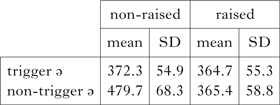
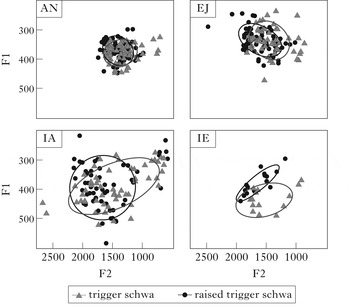
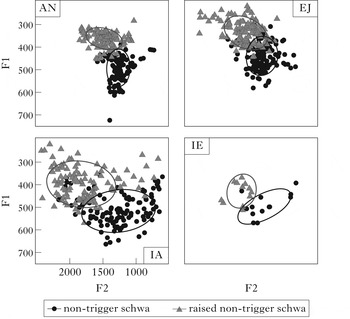
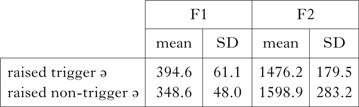
Non-trigger schwas in raised (causative) contexts have a significantly lower mean F1 than their non-raised counterparts (β = −116.02, SE = 9.28, t = −12.51). However, as shown in Table VII, this does not hold true for the trigger schwa, whose mean F1 is not significantly different in the raised environment (β = 6.14, SE = 12.28, t = 0.5).
Mean F1 and F2 of non-raised and raised schwas in CVC contexts (Hz).

The vowel space of the trigger schwa and its raised counterpart are depicted in Fig. 4, and the vowel space of the non-trigger schwa and its raised counterpart in Fig. 5.
Trigger schwa: raised and non-raised contexts, separated by speaker.

Non-trigger schwa: raised and non-raised contexts, separated by speaker.

For schwas that appear with other vowels in long /CəCVC/ roots, there is a significant difference (β = −91.6, SE = 25.98, t = −3.53) between the mean F1 of those schwas that occur in a high context with [ɜ] (labelled triggers in Table VIII) and those that occur in a low context with [a] (non-triggers).
Mean F1 and F2 of schwas in CəCɜC and CəCaC roots (Hz).

However, no significant difference was found for these same schwas in the causative (raised) forms (β = −26.2, SE = 18.52, t = −1.42). That is, the F1's of raised trigger schwas (/CəCᴈC-i/) and raised non-trigger schwas (/CəCaC-i/ → [CəCᴈCi]) were not significantly different from each other, as shown in Table IX.
Mean F1 and F2 of schwas in CəCVC-i contexts (Hz).

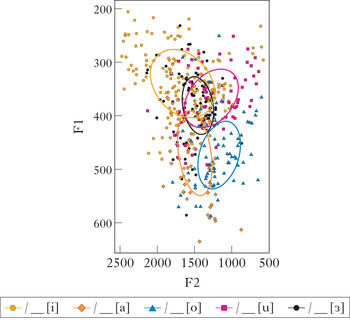
It can be observed in the figures presented so far that the F2 of the schwas varies, possibly conditioned by the quality of the following vowel due to coarticulation. For example, when the mean F2's of non-raised schwas (followed by back [o]) and raised schwas (followed by [i]) are compared, the raised schwas show a significantly higher F2 (β = 328.13, SE = 58.02, t = 5.66), despite the large standard deviations. Those vowels with the highest F2 (1628.5 Hz) are followed by /-i/, although [i] itself is in the 2200 Hz range. Similarly, those with the lowest F2 (1297.7 Hz) are followed by /-o/, but [o] itself has an average F2 of 990.7 Hz. These composite data are displayed in Fig. 6. Each data point represents the F1/F2 measurements of a schwa token. Data points are labelled and grouped on the basis of the quality of the vowel that precedes schwa in the word. Although there is overlap, there are groupings that reflect the following vowel. See the discussion section for consideration of a coarticulation explanation for the behaviour of schwa.
Distribution of schwas within the vowel space, separated by following peripheral vowel. In this figure, ellipses encompass 50% of the data.

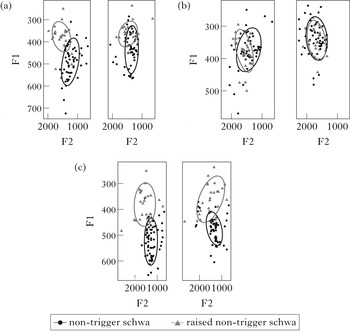
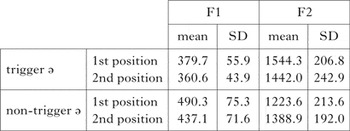
Forms with two schwas were also examined. Schwas in trigger vs. non-trigger roots showed a significant difference in F1 in both first position (β = −117.94, SE = 20.59, t = −5.73) and second position (β = −72.19, SE = 16.27, t = −4.44). In addition, results revealed a significant difference in F1 between the first and second schwas for non-trigger schwas (β = −54.13, SE = 18.81, t = −2.88), but not for trigger schwas (β = −10.82, SE = 26.13, t = −0.41). These results (for three speakers) are illustrated in Table X and Fig. 7a.
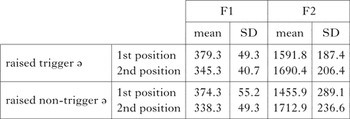
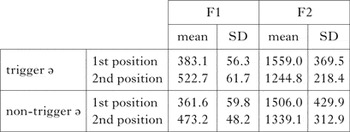
Distribution of schwas in first vs. second position in (a) CəCəC non-trigger and trigger roots; (b) raised CəCəC non-trigger and trigger roots; (c) CəCəC-o non-trigger and CəCəC-u trigger imperative forms.

Mean F1 and F2 of schwas in CəCəC roots (Hz).

For the raised causative forms, schwas in raised trigger vs. raised non-trigger roots showed no significant difference in F1 in first position (β = 0.75, SE = 25.33, t = 0.03) or in second position (β = −14.13, SE = 18.87, t = −0.75). However, results revealed a significant difference in F1 between the first and second schwas for raised non-trigger schwas (β = −36.17, SE = 8.96, t = −4.04), but not for raised trigger schwas (β = −6.76, SE = 39.63, t = −0.17). These results (for three speakers) are illustrated in Table XI and Fig. 7b.
Mean F1 and F2 of schwas in raised CəCəC roots (Hz).

Coarticulation effects with a neighbouring vowel are more evident in the proximal imperative forms with two schwas (/CəCəC/ roots with only a suffix). Schwas in trigger vs. non-trigger roots showed a significant difference in F1 in both first position (β = −139.18, SE = 17.69, t = −7.87) and second position (β = …110.71, SE = 23.24, t = −4.76). Results also revealed a significant difference in F1 between the first and second schwas for non-trigger schwas (β = −49.69, SE = 9.23, t = −5.39), but not for trigger schwas (β = −21.49, SE = 11.34, t = −1.9). These results (for three speakers) are illustrated in Table XII and Fig. 7c.
Mean F1 and F2 of schwas in imperative CəCəC roots (Hz).

4.5 Discussion
The acoustic study revealed that the mean F1 of trigger schwas is significantly different than the mean F1 of non-trigger schwas in both short and long roots that contain only schwas. Furthermore, the mean F1 of non-trigger schwas is significantly different than the same vowels in raised causative contexts, but the F1 of trigger schwas is not significantly different than the same vowels in raised causative contexts. Again, this holds for both short and long roots. These results suggest that the trigger schwa is a higher vowel than the non-trigger schwa. Trigger schwa does not undergo additional raising in a raising context, but non-trigger schwa is affected by raising harmony, and is therefore not transparent to harmony. Moreover, non-trigger schwa in long roots with [a] also show F1 differences from trigger schwa in long roots with [ɜ], further confirming their non-inertness with respect to raising. Put together, these results strongly suggest that there are two different ‘schwas’ acoustically, a higher one, which can be transcribed as [ɘ], and a lower one, transcribed as [ə].Footnote 9
One analysis discussed in §3, the ‘neutralisation’ hypothesis, maintains that the vowel distinctions are phonological, but that the schwas are neutralised phonetically. Any acoustic difference between the vowels would be due to coarticulation from the surrounding segments. If this hypothesis is correct, /CəCəC/ roots with only a suffix (the proximal imperative forms) should show differences between the two schwas. There should be no differences between trigger and non-trigger contexts for the first schwa, but the second one would be prone to coarticulation with the final suffix (either /-o/ or /-u/). Results revealed, however, that there were significant differences between trigger and non-trigger schwas in both first and second positions. Moreover, in the non-trigger verbs, the first schwa showed significantly higher F1 than the second schwa, the reverse of what the neutralisation hypothesis predicts. These results were also found in the perfective forms of the same roots, which contained prefixes as well as a suffix, although the mean F1 of non-trigger schwas was lower in these cases than in the imperative forms with no prefixes. This is somewhat surprising, as they are preceded by a low /a/ vowel in the prefixed forms. We hypothesise that the second schwa shows F1 closer to that of the suffix /o/ due to coarticulation, but the first one does not, and thus displays its more ‘natural’ state. Non-trigger schwas generally have higher F1 than /o/, and the first schwa in /CəCəC/ roots shows even higher F1 than those in short roots or /CəCaC/ roots; it appears that the F1 of the second schwa has been pulled closer to that of the following /o/. Trigger schwas, on the other hand, display a F1 which is more comparable to /u/; the first schwa in trigger /CəCəC/ roots is around 380 Hz, very similar to the trigger schwa in /CəC/ and /CəCᴈC/ roots, and only slightly higher than the second schwa (around 360 Hz) and /u/ (around 350 Hz). There are no strong coarticulation differences between first and second positions, because both are close to /u/. We conclude, therefore, that the coarticulation hypothesis is less consistent with the acoustic results than the hypothesis that the vowels are fully distinct.
The morphemic hypothesis, that the raising feature is a property of the morpheme rather than of the individual vowels, may or may not be compatible with these results. If a trigger root and non-trigger root are associated with different features, but these features associate to the surrounding full vowels rather than the short central vowels, then the two /ə/’s would be expected to be neutral, subject only to coarticulation. The same arguments about coarticulation apply to this hypothesis. However, as mentioned in §3.2, it is also possible that a morphemic analysis allows the raising feature to associate to all the vowels in the stem, including the short central vowels, rendering them distinct at both the phonological and phonetic levels. The acoustic phonetic results support both the morphemic interpretation and the fully distinct vowels analysis. The morphemic analysis does enjoy the advantage of allowing consonant-only roots to be distinguished by raising vs. non-raising. However, given the small number of roots that would require such an analysis, we believe it is more parsimonious to assume that the vowels are simply distinctive and do not require floating features or autosegmental representations, but we do not view this as a major theoretical issue for this paper. The main point is that any successful analysis must recognise a distinction both at the phonological and phonetic levels.
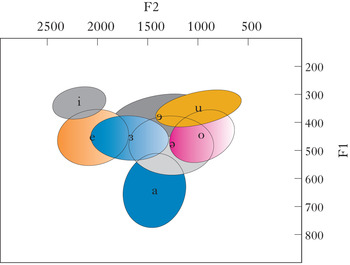
Based on the acoustic measurements, Fig. 8 shows the average for each of the vowels across all four speakers. The location of the vowel symbol in the chart represents the F1 and F2 means. The vowel transcribed as /ɘ/ is a high vowel, but not quite as high as /u/. /ə/ is acoustically a mid vowel, slightly lower than the other mid vowels. /ɜ/ tends to be articulated further forward than /a/ or the other central vowels, and it is longer than /ə/ and /ɘ/.
Mean F1 and F2 of the four Moro speakers, including the two distinct central vowels.

5 Typology and representation
We have now established that Moro has eight distinct vowels, rather than seven, and that the two short central vowels also participate in harmony. Forms previously transcribed with [ə] may be more accurately notated as [ɘ] if the word contains other high vowels. In this section we compare Moro to other cases of vowel-height harmony, and consider several methods for representing the Moro harmony system with phonological features or elements. At issue is the relationship between the acoustic properties of the vowels and their phonological representation. While the acoustic measurements in §4 shed light on the harmony system and the realisation of vowels, do these acoustic measurements correlate with phonological feature representation? We first discuss how Moro fits within the typology of other height-harmony systems, and then consider several different approaches to vowel representation. We conclude that a particle analysis provides the best fit for the system and the most direct means of expressing the chameleon-like behaviour of the vowel /ɜ/, which is acoustically mid, but patterns phonologically with the high vowels.
The Moro system only partially accords with attested height-harmony systems. We focus here on discussion of similar ‘one-step’ raising harmony patterns of low to mid or mid to high. Parkinson (Reference Parkinson1996) identifies two types of raising height-harmony patterns in the languages of the world: ‘complete height’ and ‘partial height’. Complete height-harmony patterns involve raising to the same height as the trigger. Partial height patterns occur when vowels move towards a particular trigger height, but do not necessarily assume it. Both can occur in the same language. In (18), the first case represents complete height harmony, but the others are partial, since the trigger is a high vowel, but the change is from low to mid. In each case, vowels raise to a height that is the same as or lower than the trigger vowel. In these analyses /εɔ/ are considered low vowels.Footnote 10
-
(18)

Moro displays these patterns when the mid vowel /e o/ is raised to high [i u] and the low vowel /a/ is raised to mid [ɜ] due to a high trigger /i u/. However, when the target is a mid peripheral vowel /e o/ and the trigger is the mid central vowel /ɜ/, it does not match the general pattern. In this case, the target and trigger are the same height, yet the target raises to a height that is higher than the trigger. Moreover, in the typological studies mentioned, it is high vowels rather than mid vowels that trigger raising, even of low vowels (Parkinson Reference Parkinson1996, Pulleyblank Reference Pulleyblank2011), but, in the Moro system, the mid vowel /ɜ/ can trigger raising of a low vowel /a/, as in (19).Footnote 11
-
(19)

The standard SPE vowel-feature set of [low] and [high] has difficulty in accounting for this pattern in a unified manner. Raising of mid vowels to high would involve a change from [−high] to [+high], whereas raising of the low vowel to mid would be expressed as a change from [+low] to [−low]. Two different features would have to be employed to express the one-step raising. Furthermore, if /ɜ/ is treated as a mid vowel phonologically and specified as [−high, −low], it cannot form a natural class with the other raising triggers, which are united as [+high]. The main issue, then, is that the mid vowel /ɜ/ behaves like a high vowel, as if it were /ɨ/. The most obvious solution to this problem would be to divide the vowels into two sets characterised as [−high] and [+high], and assign /ɜ/ to the [+high] set to account for its phonological behaviour, despite its acoustic position as a mid vowel. The featural representation follows from the phonological alternations rather than from the articulatory/acoustic characteristics of the vowels. This is compatible with emergent feature theory (Mielke Reference Mielke2008), which allows for phonologically active classes to be ‘unnatural’ in the sense that their phonetic properties also characterise other segments that do not participate in the same process. In this case, these would be the other mid vowels. However, it is worth exploring whether there is a better analysis, in which the relationship between the phonetic realisation of the vowel (its F1 range) and its phonological representation is less abstract.
A scalar feature such as [open] (Clements Reference Clements1991) or [closed] (Parkinson Reference Parkinson1996) has the ability to express stepwise harmonies of the Moro type, but also faces a problem with defining the class of raising vowels. Clements' model employs [open] as a binary feature, whereas Parkinson's model uses the opposite value as a monovalent feature. In a three-height system, the representations are as in (20).
-
(20)

In the Clements model, raising is accomplished by spreading of [−open], and delinking of [+open]. In the Parkinson model, raising is expressed as assimilation by spreading the [closed] feature to all non-high vowels. However, in both models, there is no clear means of expressing the natural class of Moro trigger vowels, since /ɜ/ would have the same representation as the other mid vowels in terms of aperture. It would need to spread [−open] or [closed] without allowing the other mid vowels to do so. Again, a possible solution to this problem is to analyse the vowel system as involving only two degrees of height: /ɜ/ would have the same height representation as /i u/, and /a/ would have the same height representation as the mid vowels /e o/.
Another possible approach to the harmony system is to assume a form of dispersion theory (Flemming Reference Flemming, Hayes, Kirchner and Steriade2004). Under this theory, the goal is to maximise distinctiveness of contrasts but minimise articulatory effort. One could impose a constraint that harmonic pairs must be articulated with a fixed F1 distance from each other. As the vowel /a/ has a high F1, its harmonic counterpart cannot be realised with a low F1 like /i u/, even though this would disperse vowels more widely within the vowel space. Instead, the F1 of /ɜ/ must be distinct from /a/, but within the bounds of harmonic pairing. Its F1 is therefore similar to /e/ and /o/, but it is positioned between them on the F2 dimension, so they are dispersed and distinct. Harmony would involve shifting all vowels up by a similar F1 value. This is similar to any stepwise theory. However, this addresses the constrained output of raising, but not the quality of the triggers that invoke raising. The triggers would have to be identified collectively as the higher of the harmonic pairs, but the analysis does not address what harmonic property they share.
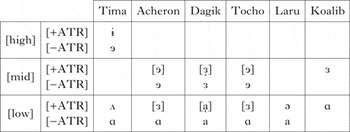
Although we have described the Moro system as height harmony, another possible analysis is that it involves [ATR] harmony. Indeed, related Kordofanian languages have [ATR] harmony. Tima (Bashir Reference Bashir, Schadeberg and Blench2013) has a twelve-vowel system, which also has ATR contrasts among central vowels. In the Talodi group of Kordofanian, there are ATR contrasts among high vowels but not mid vowels (/i ɪ u ʊ ε ə ᴈ ɑ ɔ/), a pattern Casali (Reference Casali2008) terms a 2IU system. Vowel harmony creates alternations among the high vowels and [+ATR] allophones from the lower [−ATR] vowels. This system exists in Tocho (Alaki & Norton Reference Alaki, Norton, Schadeberg and Blench2013), Lumun (Smits Reference Smits2012), Dagik (Vanderelst Reference Vanderelst2016) and Acheron (Norton Reference Norton, Schadeberg and Blench2013). Both height and [ATR] contrasts involve differences in the acoustic measure F1 (Casali Reference Casali2008 and references therein). Articulatorily, ATR involves tongue-root advancement and concomitant pharyngeal cavity expansion. However, ATR systems exhibit a relationship between target and trigger that height systems do not, and these patterns set the two systems apart. In a nine-vowel system, /i ɪ e ε a ɔ o ʊ u/, with ATR harmony, any of /i e o u/ can cause /ɪ ε a ɔ ʊ/ to alternate, resulting in cross-height harmony in many cases, such as mid /o/ causing high /ɪ/ to shift to high [i], for example. Height systems do not have this property. In 2IU seven-vowel systems containing /i ɪ ε a ɔ ʊ u/, the general pattern is one of [+ATR] dominance (Casali Reference Casali2008), and harmony creates allophones, so that /i u/ can cause /ε ɔ/ to become [e o]. While this could be construed as a height system, crucially, /ε ɔ/ do not raise to [ɪ ʊ] in these systems, /a/ does not become [ε] or [ɔ], nor do /ɪ ʊ/ trigger raising of lower vowels. This is distinct from height-harmony systems such as Sesotho (Clements Reference Clements1991), which shows raising of /ε ɔ/ to [e o] by two sets of high vowels. If the high vowels were distinguished by ATR, only one set should act as triggers. In seven-vowel systems with contrasts in mid vowels such as /i e ε a ɔ o u/ (1IU; Casali Reference Casali2008), [+ATR] dominance causes /ε ɔ/ to raise to [e o], triggered by any of /i u e o/. Raising of /e o/ to [i u], however, is unattested. If [−ATR] is dominant, alternations are in the opposite direction, affecting /e o/ and causing them to shift to [ε ɔ], triggered by /ε ɔ a/. But these triggers do not cause /i u/ to lower to [e o]. In conclusion, even though there are similarities between height and ATR systems, the patterns of alternation between targets and triggers is different.
If an [ATR] analysis were applied to Moro, the higher vowels of the harmonic pairs, [i ɜ u ɘ], would be analysed as [+ATR] and the lower vowels, [e a o ə], as […ATR]. Such an analysis is assumed in Stirtz (Reference Stirtz2009) for the Sudanese language Gaahmg, which has the six-vowel system /i ə u ε a ɔ/. The vowels /i ə u/ are considered [+ATR] and /ε a ɔ/ are [−ATR]. Stirtz remarks that /ə/ is phonetically low. However, Stirtz (Reference Stirtz2004) notes that the vowels have a wide range of pronunciation, with /ə/ as high as [ɨ], the mid vowels between [e] and [ε], and the high vowels between [i] and [ɪ], but he does not consider a height analysis of these data. The Gaahmg system resembles Moro, except that the raised [ɜ] is consistently mid in Moro, and the Moro mid vowels are mid-close [e] and [o]. Kera also has six vowels, /i ɨ u ε a ɔ/, a similar system to Gaahmg, but Pearce (Reference Pearce2003) characterises its raising pattern as height harmony rather than ATR. An acoustic analysis, however, shows that the F1 of [ɨ] is similar to the mid vowels [e] and [o], whereas [ə], which is the result of raising /a/, has a lower F1, approaching that of [i] and [u]. Pearce remarks (Reference Pearce2003: 6) that ‘we are using these symbols because in my analysis, [ɨ] acts as a high vowel but [ə] does not’. This means that the raising pattern is very similar to Moro, but Pearce chooses to analyse the central vowel as a high vowel phonologically and transcribe it as such, even though it has higher F1 than [ə]. These cases demonstrate that decisions about transcription are sometimes based more on phonological behaviour than on acoustic F1 values and a close approximation to the IPA, and decisions about characterising the harmony as height or ATR may be arbitrary.
There are several problems with using [ATR] to analyse Moro harmony. First, [ATR] is typically not invoked for systems that do not have /e~ε/ or /i~ɪ/ contrasts, or their back/round counterparts (Schadeberg Reference Schadeberg1995). There are a few exceptions to this, such as the Gaahmg case discussed above, Hyman (Reference Hyman, Sauzet and Zribi-Hertz2003) on Punu and Archangeli & Pulleyblank (Reference Archangeli and Pulleyblank1994) on (Futankoore) Pulaar. However, the Pulaar data (Paradis Reference Paradis1986) do involve an ATR contrast among mid vowels; contrasts are observed in suffixes. Second, the vowels /e o/ in Moro would be analysed as […ATR], despite the fact that the vowels [ε] and [ɔ] exist as allophones in the language. [ε] is a variant of /e/ in closed syllables before rhotics and nasals; [ɔ] is a rounded variant of /ɜ/, appearing adjacent to labialised consonants. Of course, this does not mean that such transcriptions correlate with ATR distinctions, but the more consistent realisation of the vowels is as [e o], pronunciations that do not match well with typical realisations of [−ATR] mid vowels. Third, the related Kordofanian language Koalib has the same one-step raising harmony system as Moro, but in addition shows contrasts between the vowels /e ε o ɔ/ in roots (Quint Reference Quint2009). [ə] does occur in Koalib, but it is not treated as an underlying vowel, and is instead the product of centralisation or epenthesis. If [ATR] were employed to capture the contrast among mid vowels in Koalib roots, then it cannot be employed to express /e o/ → [i u], since all these mid and high vowels would be [+ATR]. Indeed, Quint (Reference Quint2009) analyses the process as height harmony, and the contrast between /e o/ and /ε ɔ/ as one of height. By extension, height harmony also appears to be the most appropriate analysis for Moro, despite the evidence for ATR systems in related languages.
If standard height features, aperture [open] or [closed] features, and [ATR] do not match well with the Moro system, there is one other representational approach to vowel systems to consider, namely particle theory. In particle theory (Schane Reference Schane1984, Reference Schane1990, Reference Schane and Goldsmith1995) and element theory (Anderson & Jones Reference Anderson and Jones1974, Kaye et al. Reference Kaye, Lowenstamm and Vergnaud1985, Reference Kaye, Lowenstamm and Vergnaud1990, Harris Reference Harris1994, Reference Harris, Carr, Durand and Ewen2005, Harris & Lindsey Reference Harris, Lindsey, Durand and Katamba1995), raising of vowels is not treated as assimilation, but as a loss of a particle or element. Raising of /e o/ to [i u], for example, is analysed as loss of the particle a or the element A. Particle phonology provides an elegant solution to the Moro harmony system, as it achieves the three levels of height by using multiple a aperture particles, but without the problems associated with other scalar approaches. We provide a representation of the vowel system using particles in (21). In terms of correlation with the acoustic-auditory dimension, the i particle corresponds to palatality, signified by a low F1/high F2. The u particle corresponds to labiality and low F1/low F2. Schane (Reference Schane1990) uses the acoustic trait F1 to define aperture, represented by the particle a. A single a particle corresponds to a mid-high F1 (> ~350 Hz). In order to model the schwa-like central vowels, we add a new ə particle, which signals short centrality (akin to the centrality component in Anderson & Ewen Reference Anderson and Ewen1987, the ‘cold vowel’ in Kaye et al. Reference Kaye, Lowenstamm and Vergnaud1985 or the @ element in Harris Reference Harris1994 and Harris & Lindsey Reference Harris, Lindsey, Durand and Katamba1995). The ə particle corresponds to short duration, mid F1/F2 and even spectral peaks. With this representation, /ɘ/ is treated as a high vowel, with ə but no aperture specification, whereas the /ə/ has the same ə particle and a single a particle, as in (21). Vowel raising is expressed by deletion of an a particle, which causes F1 to lower.
-
(21)

Using this system, the distinction between low, mid and high vowels is expressed by the number of aperture particles – high has none, mid has one and low has two. One-step vowel raising would be represented uniformly as loss of an a. The target vowels are those vowels with two particles, one of which is a: /e o a ə/. The class of trigger vowels cannot be defined in terms of exact numbers of aperture a particles (all mid vowels have one), but can be defined as those vowels that have only a single particle: /i u ᴈ ɘ/. Raising involves a change from two particles to one. This representational system models three height levels, and allows the /ɜ/ to be simultaneously a mid vowel and to pattern with the high vowels as a trigger of harmony. It also allows for a system in which a low vowel could potentially shift to high rather than mid if the raising rule were expressed as loss of all a particles (as in Gaahmg). The particle analysis is successful in expressing the natural class of trigger vowels and target vowels and the one-step raising process. One drawback of this approach is that it does not express harmony as assimilatory spreading. Harris & Lindsey (Reference Harris, Lindsey, Durand and Katamba1995) propose that height harmony can nevertheless be expressed as inter-nuclear licensing. Moreover, there have been several analyses of vowel harmony within Optimality Theory that do not employ autosegmental spreading, but instead use constraints requiring that adjacent vowels agree (Baković Reference Baković2000) or correspond and share identity (Rhodes Reference Rhodes2010). Under such analyses, harmony would be expressed as agreement for number of particles.
In conclusion, none of the analyses considered provides a problem-free solution to characterising Moro height harmony. However, the particle analysis fares best in characterising the raising in a uniform manner, expressing the natural class of target vowels and trigger vowels, and at the same time providing a representation for the mid vowel /ɜ/ which puts it on a par with other mid vowels with a consistent acoustic correlate. Although most Kordofanian languages for which descriptions are available have ATR-harmony systems, Moro and Koalib have height harmony. We now turn to the question of how such a height system might have developed from an ATR system, with a focus on the emergence of the two central vowels.
6 The development of /ɘ/ and /ə/
In this section, we explore the hypothesis that historical changes in ATR vowel systems gave rise to a height system and the two vowels /ɘ/ and /ə/.
6.1 Comparative evidence for the emergence of /ə/
We reported in §5 that ATR systems are common in related Kordofanian languages. Although transcriptions differ, each language has a set of central vowels that are contrastive and/or participate in harmony, as shown in Table XIII (see Bashir Reference Bashir, Schadeberg and Blench2013 for Tima, Norton Reference Norton, Schadeberg and Blench2013 for Acheron, Vanderelst Reference Vanderelst2016 for Dagik, Alaki & Norton Reference Alaki, Norton, Schadeberg and Blench2013 for Tocho and Abdalla Kuku Reference Abdalla Kuku2012 for Laru). We also include Koalib (Quint Reference Quint2009), although its central vowels do not appear to involve ATR contrasts.
Related Kordofanian languages with central vowels that are contrastive and/or participate in vowel harmony.

This raises the question of whether Moro once had an ATR-harmony system that has shifted to one of height harmony. The loss of ATR contrasts is attested in numerous Niger-Congo languages, as well as neighbouring Nilo-Saharan languages, and typically involves mergers. The vowels /i ɪ/ have merged to /i/, or /ɪ e/ have merged to /e/ (and similarly for their back/round counterparts) in Kwa (Stewart Reference Stewart and Sebeok1971) and Bantu languages (Schadeberg Reference Schadeberg1995, Hyman Reference Hyman, Hombert and Hyman1999). Elugbe (Reference Elugbe1989: 120) documents the vowel patterns of twenty Edoid languages and reports that high [−ATR] /ɪ ʊ/ merged with other vowels in about half the languages: /ɪ ʊ/ merged with /e o/ in North-Central Edoid, but with /ε ɔ/ or /i u/ in North-Western Edoid. In addition, in Mayak (Andersen Reference Andersen1999), a Nilo-Saharan language of Sudan, the vowels /ɪ e/ and /ʊ o/ have merged to the high vowels /ɪ/ and /ʊ/ respectively. Mergers can lead to situations in which a vowel retains its previous phonological properties. For example, in Agoi (Yul-ifode Reference Yul-ifode2003), an Upper Cross language of Nigeria, the high [−ATR] vowels have nearly merged with the high [+ATR] vowels (a few morphemes still maintain the distinction), but have retained their [−ATR] behaviour. Sometimes merger results in loss of vowel harmony, due to the creation of disharmonic forms if the merger collapses [+ATR] and [−ATR] vowels, as is the case in many of the Edoid languages that have shifted from nine vowels to seven.
In the Heiban languages, the Kordofanian sub-group to which Moro belongs, data on vowel harmony is sparse. In Tira, Moro's closest relative (Watters Reference Watters1993), and in Laru (Abdalla Kuku Reference Abdalla Kuku2012), contrasts occur only among the high vowels /i ɪ u ʊ ε ɔ ə a/, and ATR harmony creates alternations between high vowels.Footnote 12 In Laru, for example, the noun class prefix [ŋʊ-] alternates with [ŋu-], depending on the [ATR] quality of the vowel in the stem, as in (22).
-
(22)

However, vowel harmony affects lower [−ATR] vowels by raising them to [+ATR] high vowels: /ε ɔ a/ → [i u ə]. For example, the passive reflexive suffix /-ni/ triggers harmony on root vowels. Note that the vowels /ɔ/ and /ʊ/ both become [u], creating neutralised pairs in the passive/reflexive forms in (23). Abdalla Kuku (Reference Abdalla Kuku2012) does not investigate neutralised vowels phonetically; transcriptions were provided by the author, a native speaker.
-
(23)

There are certainly similarities between Laru and the Moro system, in that the low vowel /a/ is raised to mid [ə] (in Moro, this would be [ɜ]) and the mid vowels are raised to high.
Given the comparative evidence from related Kordofanian languages for contrasts among high vowels, and the pattern in Laru, one likely scenario is that Moro may have had an ATR system, but that the high vowels /i ɪ/ and /u ʊ/ merged to /i/ and /u/ respectively. A comparison of Moro and Laru cognates (Abdalla Kuku Reference Abdalla Kuku2012) suggests, however, that [−ATR] high vowels may have instead centralised to [ə] in Moro, as shown in (24a). For the lower vowels in (24b), the Laru vowel /ε/ corresponds to /e/ in Moro cognates. Since each language has only one mid vowel, this comparison is not intended to focus on the exact height/ATR value of /ε/ vs. /e/, but to illustrate that there is not clear evidence for centralisation. The back vowels /ɔ/ and /ʊ/ both appear to correspond to /o/, so this constitutes some evidence for merger with the mid peripheral vowels, but no obvious centralisation.
-
(24)

Centralisation of /ɪ ʊ/ to [ɨ ʉ] is attested synchronically in other Niger-Congo languages. It has occurred in Nawuri (Casali Reference Casali2002), and diachronically a new […ATR] high vowel /ɨ/ is hypothesised to have emerged in Anii from /ɪ/ when it occurred before liquids and nasals (Morton 2012). Moreover, centralisation is an attested synchronic process in Moro as well as in the related Heiban languages Tira (Watters Reference Watters1993) and Koalib (Quint Reference Quint2009). In Moro, centralisation affects the peripheral vowels /i u e o/, which reduce to [ɘ] or [ə] between consonants, typically following the attachment of prefixes. (25a) gives examples of nouns with the locative prefix /ék-/ and the plural noun class marker /n-/; the initial vowel of the noun reduces to [ə] or [ɘ] with the addition of the prefix. Note that reduction does not appear tied to any metrical structure: the reduced vowel is in initial position in ‘drums’ and in peninitial position in ‘in drum’.
-
(25)

In the verb system, centralisation is observed with the ‘progressive’ prefix /v-/, which causes no change in meaning to the verb, as in (25b), and can also affect the final vowel of words in connected speech, as in (c).
While [ə] can occur as an allophone of /e o/ under synchronic centralisation, and [ɘ] as an allophone of /i u/, diachronic centralisation may have been responsible for their emergence as phonemes in the language; /ə/ contrasts with all other low vowels and /ɘ/ with all other high vowels, as shown in (26).
-
(26)

Furthermore, there are no /CuC/ verb roots in Thetogovela Moro, unless they bear a causative suffix, such as [ðúg-í] ‘breastfeed!’, or contain a [w]: [dúw-ú] ‘stir!’. There are, however, /CuCC/ roots, such as [t̪únd̪-ú] ‘cough!’ or [t̪úrt̪-ú] ‘wait for!’. This suggests that vowel reduction has occurred in /CuC/ roots. The related Werria dialect sometimes has [u] where Thetogovela has [ɘ], as in (27) (tone patterns in Werria are not known).
-
(17)

One of the few schwa-only noun roots in Thetogovela that triggers raising, [ŋgwɘ́ɲ] ‘sign, letter’, is realised as [ŋwuɽiɲ] in Werria, with two peripheral high vowels.
Finally, the extension suffixes that trigger raising have cognates with [i] in the related languages Tira and Otoro, according to Stevenson (Reference Stevenson1943). The cognate suffix that does not trigger raising has a lower vowel, as in (28) (where /ö/ represents a central back unrounded vowel in Stevenson's transcription).
-
(28)

These comparative data, and the data from contextual vowel reduction, point to vowel centralisation as one of the main sources of the short central vowels in Moro. It appears that /ə/ emerged from centralisation of [−ATR] high vowels and possibly mid vowels, and /ɘ/ from centralisation of [+ATR] high vowels. The distinction between these vowels prior to centralisation appears to have been preserved in the behaviour of the vowels in the vowel system, where /ə/ does not trigger harmony and /ɘ/ appears to trigger raising harmony, just as high [+ATR] vowels do in related languages. Nevertheless, without more systematic comparative evidence, this remains only a hypothesis.
It would be fruitful in future research to examine whether there is an articulatory difference that corresponds to the acoustic difference, and to examine whether this involves tongue-root retraction, as Gick et al. (Reference Gick, Pulleyblank, Campbell and Mutaka2006) did for Kinande. At the present time, however, we do not have access to ultrasound or other articulatory equipment in the same location as the speakers. It would also be interesting to test the perceptual difference between the two short central vowels. It is possible that they are indeed articulated differently, with acoustic consequences, but that the perceptual system neutralises these differences, perhaps in part due to their low functional load. In Moro, there are few words that contain only /ə/ or /ɘ/, and few minimal pairs. Cases of such perception/production mismatches, or near mergers, are attested in the literature, and include the recently analysed cases of Cantonese mid tone (Yu Reference Yu2007) or Blackfoot final voiceless vowels (Gick et al. Reference Gick, Bliss, Michelson and Radanov2012).
7 Conclusion
In this paper we have presented data from Moro vowel-height harmony that examines the issue of whether the language has two distinct short central vowels, acoustically as well as phonologically. An acoustic study supports the proposal that there are two distinct central vowels, /ə/ and /ɘ/. /ə/ appears to participate in harmony by raising from a low-mid position to a high-mid position in the vowel space, while /ɘ/ participates in the system as a vowel-harmony trigger. We have proposed that distinct schwas may have emerged from centralisation and reduction of peripheral vowels, as Moro shifted from an ATR system, evident in neighbouring languages, to a height system. This has led to a height system that is typologically unusual, and under standard feature systems would entail a mismatch between the phonological behaviour of the vowels and their acoustic F1 properties and classification as mid or high vowels. We have proposed that a particle-based analysis offers the best characterisation of the system, with a more direct match between the phonological representation and their acoustic properties. This paper further contributes to the ongoing debate regarding the nature of transparent vowels, as the evidence points to Moro vowels not being transparent. While this does not mean that other cases of transparent vowels in languages are not truly transparent in both the phonological and phonetic senses, it does indicate that acoustic studies are valuable in deciding on this question.