Goat milk is experiencing a surge in popularity as an alternative to bovine milk-based products. Claims are made for a superior nutritional and potentially neutraceutical profile, ease of digestibility and reduced allergenic properties as well as environmentally conscious farming practices (Watkins et al., Reference Watkins, Jaborek, Teng, Day, Castada, Baringer and Wick2021; Albenzio et al., Reference Albenzio, Santillo, Avondo, Nudda, Chessa, Pirisi and Banni2016). However, like other animal foods, goat milk possesses a high proportion of saturated fatty acids (FA) (Orzuna-Orzuna et al., Reference Orzuna-Orzuna, Chay-Canul and Lara-Bueno2023), which in the past have been associated with health conditions such as cardiovascular diseases in humans (Gómez-Cortés et al., Reference Gómez-Cortés, Juárez and Angel De La Fuente2018). Thus, studies have been conducted to modulate the composition of milk fatty acids (FA) towards an increased proportion of polyunsaturated FA (PUFA). Dietary microalgae have been reported as an effective means to improve performance and FA composition in goat milk (Mavrommatis and Tsiplakou, Reference Mavrommatis and Tsiplakou2020). Vegetable oils (soybean and flaxseed) were also tested in dairy goats, however, no significant impact on milk FA composition was reported (Almeida et al., Reference Almeida, Ferraz, Susin, Gentil, Polizel, Ferreira, Barroso and Pires2019). Indeed, extensive biohydrogenation of dietary PUFA occurs in the rumen when fat is not protected from ruminal microorganisms (Glasser et al., Reference Glasser, Schmidely, Sauvant and Doreau2008).
Whole cottonseed (WCS) is a valuable and nutritious feedstuff that offers many benefits for livestock. Rich in fat, protein and fiber, WCS is an excellent energy source for ruminants. Additionally, cottonseed has a noteworthy FA composition that makes it candidate for modulating FA composition of milk. This oilseed is primarily recognized for its high levels of PUFA, with linoleic acid (LA, 18:2 n-6) being the predominant FA (> 50% FA; NASEM, 2021). LA is the primary precursor for conjugated linoleic acid (CLA), a collective term encompassing its positional and geometric isomers, which is a contentious topic. Although the presence of conjugated linoleic acid (CLA) in milk is sought after for its postulated anticarcinogenic, immunomodulating and antiatherosclerotic effects (den Hartigh, Reference den Hartigh2019), the trans10,cis12-18:2 isomer is implicated in the downregulation of key gene transcripts involved in de novo synthesis in the mammary gland of cows (Harvatine et al., Reference Harvatine, Boisclair and Bauman2009) and goats (Ghazal et al., Reference Ghazal, Berthelot, Friggens and Schmidely2014). In addition, biohydrogenation of WCS fat may be suppressed by its sturdy hull, abundant fiber lintand the absence of processing, which could otherwise diminish the rate of ruminal FA availability and lower formation of CLA isomer associated with the downregulation of milk fat synthesis (Pierce et al., Reference Pierce, Adeniji, Bomberger, Goodall and Harvatine2023). However, there is a scarcity of dose-response studies examining the impact of elevated dietary fat levels via WCS in dairy goats. We hypothesized that WCS would improve fat digestibility and PUFA in milk fat without reduction of milk fat yield. Thus, this study was conducted to evaluate the feeding behavior, intake, apparent total tract digestibility, blood parameters, milk yield, milk composition and milk FA profile in dairy goats fed diets containing increasing levels of WCS.
Material and methods
The guidelines of the local Ethical Committee for the Use of Animals in Experimentation of Embrapa Gado de Leite (Coronel Pacheco, Brazil) were followed, and all experimental procedures were approved (CEUA, CNPGL 07/2013).
Animals, diets and experimental procedures
Eight multiparous Toggenburg goats were assigned to a replicated 4 × 4 Latin square design with four 21d periods (balanced to residual effects) and 7-d washout period in between periods. Treatments consisted of dietary cottonseed levels as follows: (1) control diet with no WCS; (2) diet containing 120 g WCS/kg DM; (3) diet containing 150 g WCS/kg DM; and (4) diet containing 180 g WCS/kg DM. Whole cottonseed contained, on DM basis, 234 g/kg CP, 189 g/kg EE, 419 g/kg NDF, 338 g/kg ADF and 82.9 g/kg ADL.
Animals were weighed on the first and last day of each experimental period. Goats averaged 50.1 ± 2.45 days in milk, 1.61 ± 0.153 kg milk/day and 51.5 ± 1.61 kg body weight. They were housed in individual stalls (3 m2) with slatted floors and equipped with feeders and drinkers. Goats were fed twice a day (7:00 h and 16:00 h) for ad libitum intake (150 g/kg of refusals as fed). The diets (online Supplementary Table S1) were formulated to meet the requirements of dairy goats, according to NRC (2007).
Feed intake was recorded daily, and samples of total mixed diets, orts and faeces (faecal grab samples) were taken daily from days 15 to 21, pooled by goat and period, and then frozen at −20 °C. Intake behavior was assessed on day 18 over 24 h by observing feeding, rumination and idleness activities. The total chewing time was determined as the sum of the times spent on feeding and rumination. Night-time observations were carried out using artificial lighting (fluorescent lamps). Feeding and rumination efficiencies were calculated as follows:
 \begin{equation*}{\text{Feeding efficiency (g DM}}\text{.h}^{-1}) = \frac{{DM\,intake\,\left( g \right)}}{{Total\,feeding\,time\,\left( h \right)}}\end{equation*}
 \begin{equation*}{\text{Rumination efficiency (g DM}}\text{.h}^{-1}) = \frac{{DM\,intake\,\,\left( g \right)}}{{Total\,feeding\,time\,\left( h \right)}}\end{equation*}
Titanium dioxide was used to predict faecal output (Myers et al., Reference Myers, Ludden, Nayigihugu and Hess2004). From days 10 to 20, 4 g of titanium dioxide (TiO2) mixed with 50 g of concentrate was administered to animals after milking and right before the first daily meal (the complete intake of this concentrate was assured by the team). Faecal grab samples were taken from day 15 to 21 at 26-h intervals, pooled on a period basis for each animal, and stored at −20 °C.
Blood samples were collected on 21 d from the jugular vein after the morning milking using vacuum tubes containing EDTA-K3 and sodium fluoride. Plasma was obtained via centrifugation at 1.500 g for 15 min and stored at −20 °C. Goats were milked twice daily (6:00 h and 14:00 h), and milk yield was recorded daily throughout the experiment. Data from days 15 to 21 of each period were averaged and subjected to analysis. Milk samples from days 15 to 21 were collected from two consecutive milkings, pooled on a yield basis, and divided into two aliquots. One aliquot was kept frozen at −20 °C without any preservative for determination of FA profile in milk fat. The second aliquot was stored at 4 °C with a tablet containing 8 mg bronopol-B2 until the typical milk composition (fat, protein, and lactose) was analyzed.
Chemical analyses
Samples (food, orts, and faeces) were oven-dried (55°C for 72 h) and then ground in a mill to pass through a 1-mm screen sieve for analysis. Dry matter was assessed according to method no. 934.01 of the Association of Analytical Communities (AOAC, 2000). Total protein was determined following method no. 986.06 of the AOAC (2000). Ether extraction of diets was conducted with Tecnal TE- 044/1 according to method no. 920.39 of AOAC (2000). The concentration of neutral detergent fiber (aNDF), including residual ash, was assessed as described by Mertens (Reference Mertens2002) using heat-stable α-amylase and sodium sulfite. The ADF content, including residual ash, was determined using method 973.18 of the AOAC (2000). The lignin content was determined via cellulose solubilization with sulfur acid, as previously described by Van Soest et al. (Reference Van Soest, Robertson and Lewis1991).
Milk composition (protein, fat, lactose and urea N) was analyzed via infrared spectrophotometry (Bentley model 2000; Bentley Instrument Inc., Chaska, MN, USA). The milk somatic cell count was performed using an electronic counter (Somacount 500, Chaska, MN, USA). Fat in milk was separated according to method 985.05 (AOAC, 2000). Methylation was performed as previously described by Christie (Reference Christie1982) following the modification reported by Chouinard et al. (Reference Chouinard, Corneau, Saebø and Bauman1999). Fatty acid methyl esters (FAME) were quantified using a gas chromatograph (Agilent 6890 PLUS, Agilent Ltd., USA) equipped with an autosampler, a flame-ionization, and a CP-Sil 88 FAME column (100 m and 0.25 mm i.d., 0.20 mm film thickness). Operating conditions were set as previously described by Cruz-Hernandez et al. (Reference Cruz-Hernandez, Kramer, Kennelly, Glimm, Sorensen, Okine, Goonewardene and Weselake2007). Briefly, injector and detector temperatures both at 250 °C, H2 as carrier gas (1 mL/min) and for the flame-ionization detector (35 mL/ min), N2 as makeup gas (30 mL/min), and purified air (286 mL/min). The temperature program was: initial temperature of 45 °C and held for 4 min, increased by 13 °C/ min to 175 °C and held for 27 min, raised by 4 °C/ min to 215 °C and held for 35 min. The FAME were identified by comparison with a GC reference FAME standard to which a CLA mixture consisting of 4 positional isomers and long-chain saturated FAME (21:0, 23:0, and 26:0) were added. The short-chain FAME were corrected for mass discrepancy using the correction factors reported by Wolff et al. (Reference Wolff, Bayard and Fabien1995).
Plasma parameters
Plasma glucose, total protein, albumin, cholesterol and triglycerides were assessed via spectrophotometry (Bel SPECTRO S05, Ramos, RJ, Brazil) using specific commercial kits (LabTest Diagnóstico S.A., Lagoa Santa, Brazil). Non-esterified fatty acids were determined at 550 nm using a commercial kit (LabAssay ™ NEFA, FUJIFILM Wako Shibayagi Corporation, USA).
Statistical analyses
All results were analyzed using the MIXED procedure of SAS (SAS 200, SAS Institute). Data were analyzed using a replicated 4 × 4 Latin square design with the following general model:
 \begin{equation*}{{\text{Y}}_{{\text{ijk}}}} = \mu + {{\text{T}}_{\text{i}}} + {{\text{P}}_{\text{j}}} + {{\text{Q}}_{\text{k}}} + {\text{A/}}{{\text{Q}}_{\text{k}}} + {{\text{e}}_{{\text{ijk}}}}\end{equation*}
where Yijkl = dependent variable; µ = overall mean, Ti = fixed effect of treatment (i = CONT, 120CS, 150CS, and 180CS; Pj = fixed effect of period (j = 1 to 4), Qk = fixed effect of square (k = 1, 2), A/Qk = random effect of cow within square, and eijk = random residual error. Polynomial contrasts were used to test the linear, quadratic, and cubic effects of CS. Significance was declared at P < 0.0.
Results
No effect (P > 0.05) of the dietary levels of WCS on feeding time, idleness and feed efficiency was observed in the dairy goats (Table 1). Total chewing time showed a numerical and linear (but non-significant) increase (P = 0.08) and rumination increased linearly (P = 0.02) with WCS dietary levels. However, rumination efficiency (min.kg−1 DM) was linearly reduced with increasing WCS levels in the diet.
Feeding behavior, intake, and apparent total tract digestibility (ATTD) in dairy goats fed diets containing increasing levels (0, 120, 150, and 180 g/kg) of whole cottonseed

a L = Linear effect; Q = Quadratic effect.
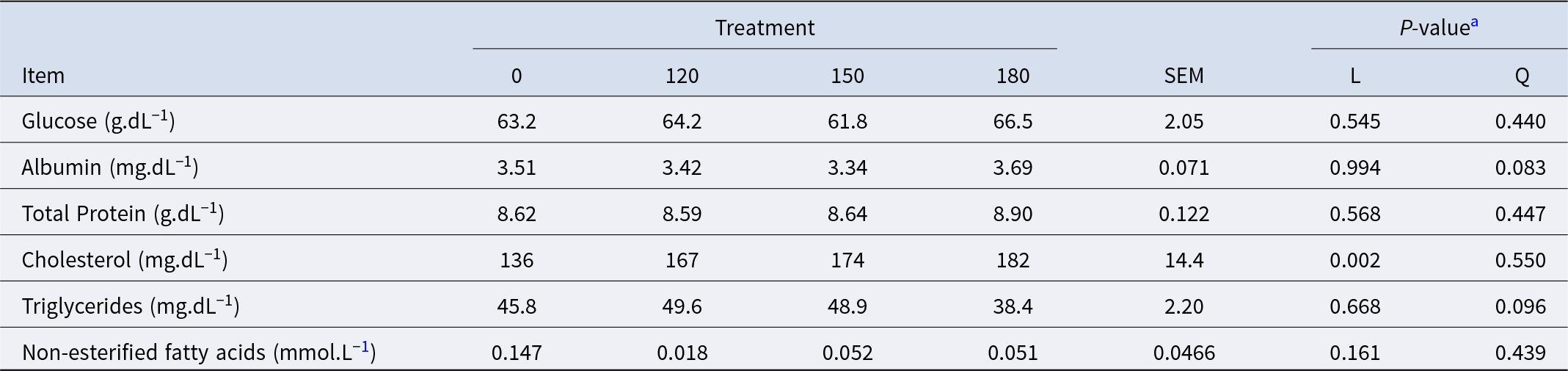
Intakes of DM, CP, and aNDF were not affected (P > 0.05) by treatments, while EE intake was increased (P < 0.01) quadratically by dietary WCS levels. Similarly, the digestibility of DM, CP, and aNDF was not affected by the treatments, however, the ether extract digestibility was linearly increased (P < 0.001) with dietary WCS levels. No treatment effect was observed (P > 0.05) for blood glucose, albumin, triacylglycerol, total protein, and non-esterified fatty acids (Table 2). However, blood cholesterol was linearly increased (P < 0.01) in goats fed increasing WCS levels.
Blood parameters in dairy goats fed diets containing increasing levels (0, 120, 150, and 180 g/kg) of whole cottonseed

a L = Linear effect; Q = Quadratic effect.
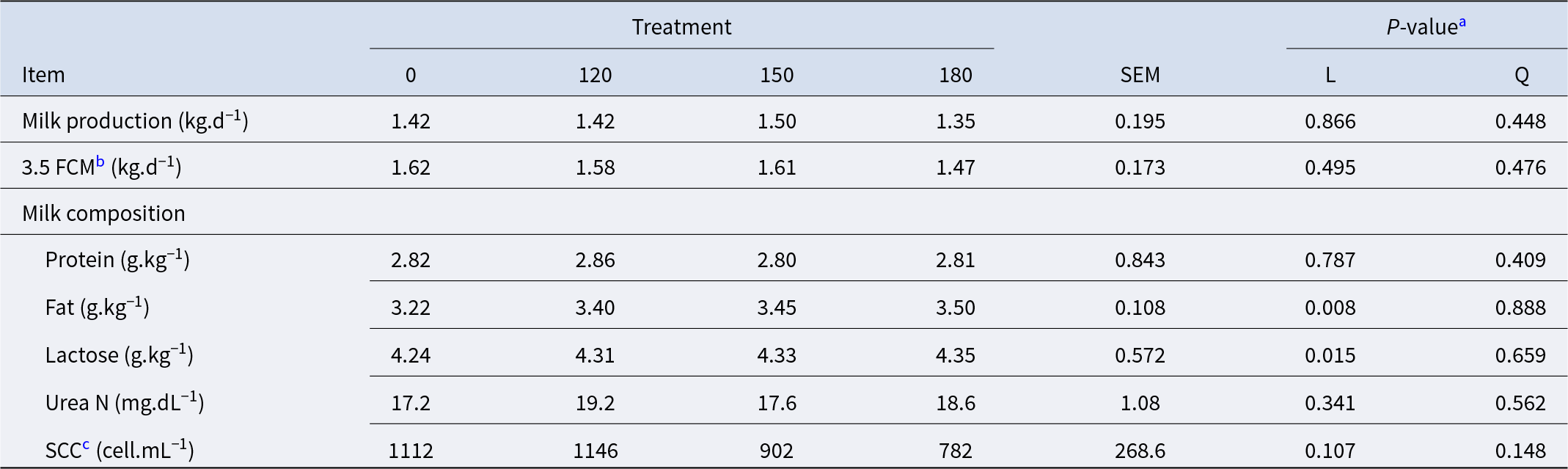
Milk production, expressed as kg/d or as 3.5% fat-corrected milk, was not affected (P > 0.05) by the treatments (Table 3). Similarly, treatments did not alter milk protein, urea N, and somatic cell counts. However, milk fat and lactose were linearly increased (P ≤ 0.01) with dietary WCS levels.
Milk production and milk composition in dairy goats fed diets containing increasing levels (0, 120, 150, and 180 g/kg) of whole cottonseed

a L = Linear effect; Q = Quadratic effect.
b FCM = Fat-corrected milk.
c Somatic cell counts: data were log-transformed for statistical analysis but presented on the original scale of measurements.
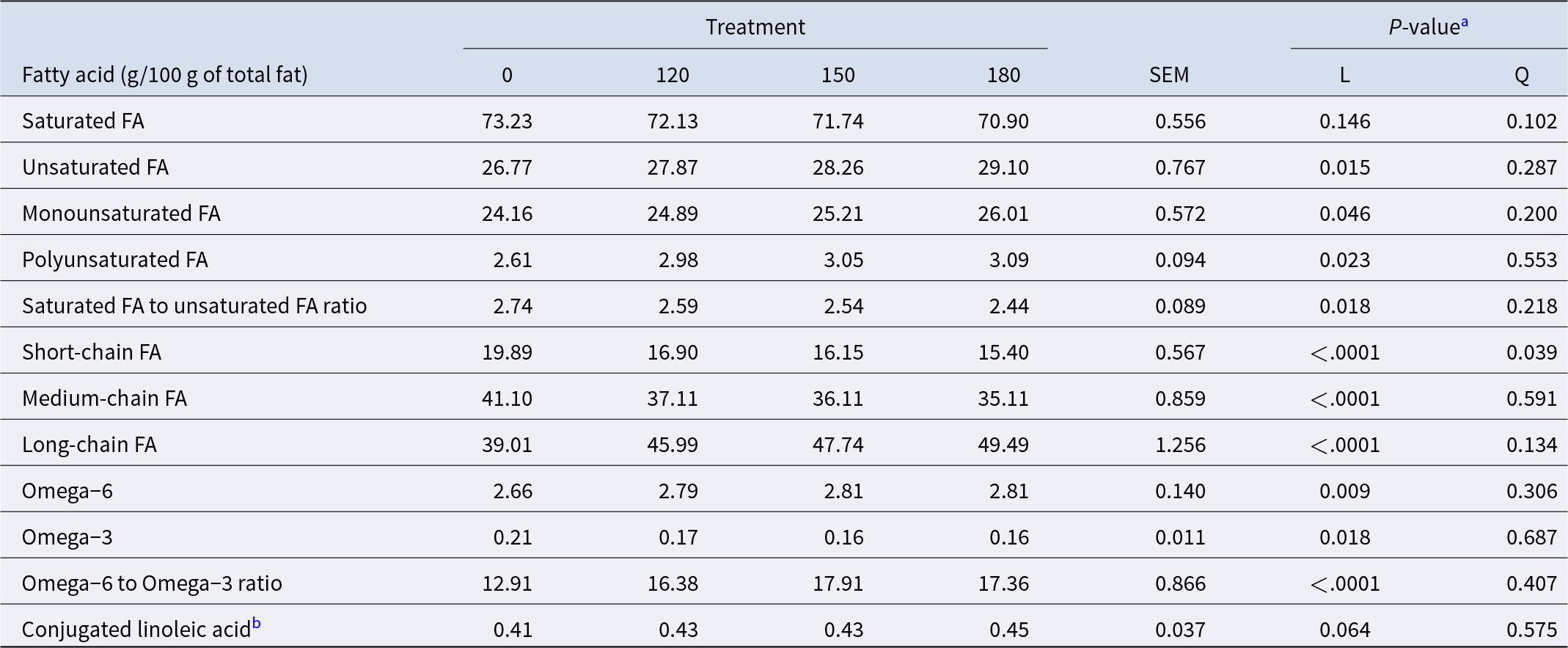
Changes in the proportions of milk FA were observed in the present study (Table 4). Reduced (P < 0.0001) short- and medium-chain FA proportions and increased (P < 0.0001) long-chain FA in milk were observed. Unsaturated FA (monounsaturated and polyunsaturated) were linearly increased with dietary WCS levels (P < 0.05). Omega-6 and Omega-3 FA were, respectively, linearly increased (P < 0.01) and decreased (P = 0.01) with dietary WCS levels. There was a numerical but non-significant linear increase in total CLA (P = 0.06).
Fatty acid (FA) proportions in the milk of dairy goats fed diets containing increasing levels (0, 120, 150, and 180 g/kg) of whole cottonseed

a L = Linear effect; Q = Quadratic effect.
b trans10,cis12-18:2 + cis9,trans11-18:2.
Detailed saturated and unsaturated fatty acid values are given in online Supplementary file (Tables S2 and S3, respectively). Briefily, the concentration of 6:0, 8:0, 10:0, 11:0, 12:0, 14:0, 15:0 and 17:0 in milk was linearly reduced (P < 0.05), while 18:0 was linearly increased (P < 0.05) with dietary WCS levels. Trans 18:1 FA mostly exhibited an increasing linear response (P < 0.05) to dietary WCS levels, while cis 18:1 FA was not affected. The concentration of 14:1 and 17:1 FA showed quadratic (P < 0.05) behaviors with the increasing content of WCS in the total diet. The concentrations of cis9,cis12-18:2 and cis9,trans9-18:2 FA in milk were linearly increased by dietary WCS. There was a numerical but non-significant linear increase in cis9,trans11-18:2 (P = 0.06). For completeness, we also report levels of branched-chain fatty acids (online Supplementary Table S4).
Discussion
We partially replaced soybean meal and corn in the diets of dairy goats by whole cottonseed (WCS). Goats from all treatments were fed the same proportion of corn silage (550 g/kg DM). However, besides having a high fat and protein content, WCS is rich in fiber, containing high NDF, ADF and ADL concentrations (419, 338 and 82.9 g/kg, respectively). Rumination is expected to increase when high-NDF diets are provided (Salfer et al., Reference Salfer, Morelli, Ying, Allen and Harvatine2018). Moreover, WCS fiber has been reported to be physically effective in promoting chewing and maintaining rumen function in ruminants (Mooney and Allen, Reference Mooney and Allen1997). Altogether, this could explain the linear increase in rumination and, to a lesser and non-significant extent, total chewing time we observed with the increasing levels of WCS. The linear increase in the total chewing time coupled with the lack of effect in DMI explains the linear reduction we observed for rumination efficiency with the increasing levels of WCS.
No effect of treatments on DMI was observed. Contrary to this, in a recent study conducted with primiparous and multiparous dairy cows, Pierce et al. (Reference Pierce, Adeniji, Bomberger, Goodall and Harvatine2023) reported a linear reduction in DMI with increasing levels of WCS. These authors explained this effect based on increased dietary energy provided by fat from WCS. It suggests that the increased energy concentration in the diet from our study provided by the levels of WCS did not downregulate DMI, which is interesting because WCS dietary levels were higher in our study (120, 150 and 180 g.kg−1) than in theirs (34, 68 and 99 g.kg−1). This difference is possibly related to interspecies physiological differences regarding feeding behavior and regulation.
Earlier studies have shown that fat decreases aNDF digestibility in steers and sheep (Ward et al., Reference Ward, Tefft, Sirny, Edwards and Tillman1957; Devendra and Lewis, Reference Devendra and Lewis1974; Jenkins and Palmquist, Reference Jenkins and Palmquist1984). However, despite the increased EE intake, we did not observe effects on aNDF, DM and CP digestibility. This lack of effect suggests that the fat from WCS did not affect ruminal nutrient degradation. Indeed, the seed coat of WCS is expected to slow the release of FA in the rumen, which could reduce negative effects on cellulolytic microorganisms (Moore et al., Reference Moore, Swingle and Hale1986; Pierce et al., Reference Pierce, Adeniji, Bomberger, Goodall and Harvatine2023). The fact that WCS levels enhanced EE digestibility suggests that the seed coat was disrupted by chewing and microbial digestion, releasing FA in the rumen and making them available in the small intestine. This hypothesis is corroborated by the greater rumination and total chewing time we observed with increasing WCS.
Increasing WCS did not affect milk production, however, the milk lactose concentration was slightly increased, which is interesting because milk lactose concentration is usually minimally influenced by diet. Lactose is known to osmotically draw water into the Golgi vesicles, impacting the overall volume of milk produced (Holt, Reference Holt1983), such that its concentration should not vary significantly at the point of secretion. However, increases in lactose concentration have also been observed in previous studies where dairy cows (Petit, Reference Petit2002; Petit and Côrtes, Reference Petit and Côrtes2010; Lima et al., Reference Lima, Palin, Santos, Benchaar, Lima, Chouinard and Petit2014) and goats (Bernard et al., Reference Bernard, Shingfield, Rouel, Ferlay and Chilliard2009) were fed high PUFA diets. Indeed, PUFA has been reported to increase mitochondrial and peroxisomal oxidation and decrease liver triglycerides (TG) synthesis and storage (Ikeda et al., Reference Ikeda, Cha, Yanagita, Nakatani, Oogami, Imaizumi and Yazawa1998; Ide et al., Reference Ide, Kobayashi, Ashakumary, Rouyer, Takahashi, Aoyama, Hashimoto and Mizugaki2000) and TG accumulation in cultured hepatocytes can decrease gluconeogenesis (Cadorniga-Valino et al., Reference Cadorniga-Valino, Grummer, Armentano, Donkin and Bertics1997). Thus, our findings suggest that the reduced synthesis and storage of TG in the liver of goats fed increasing WCS may have enhanced the glucose supply to the mammary gland, increasing lactose synthesis. The increase in milk lactose with no modification in milk production could also suggest variations in inorganic salts concentration to maintain milk isotonic with blood; however, we did not evaluate it in the present experiment.
Milk fat depression (MFD) is defined as a reduction in milk fat content without significant changes in milk yield or other milk components (Bauman and Griinari, Reference Bauman and Griinari2001). High dietary intake of PUFA has been reported to induce MFD in dairy cows, which has been attributed to an increase in certain FA (trans10-18:1, trans10,cis12-18:2) isomers in the mammary gland, which possess an inhibitory effect on lipogenesis (Bauman et al., Reference Bauman, Perfield, Harvatine and Baumgard2008; Shingfield et al., Reference Shingfield, Bernard, Leroux and Chilliard2010). Contrary to expectations for dairy cows, our study demonstrated a linear increase in milk fat concentration in dairy goats. These results are consistent with findings from a meta-analysis (Marín et al., Reference Marín, Sánchez, Sigler, Blanco, García and Ruipérez2015) examining the effects of dietary oilseeds and oils on ewes and goats. Marín et al. (Reference Marín, Sánchez, Sigler, Blanco, García and Ruipérez2015) reported an increase in milk fat, expressed as a percentage or grams per day (g.d⁻1), in ewes and goats fed diets enriched with PUFA such as cis-9,cis-12 18:2 and cis-9,12,15 18:3. Although susceptible to MFD when fed marine lipids rich in n-3 FA (Suárez-Vega et al., Reference Suárez-Vega, Gutiérrez-Gil, Toral, Hervás, Arranz and Frutos2019), dairy goats and ewes do not exhibit the same susceptibility to MFD under dietary conditions involving plant-derived PUFA that typically induce MFD in cows (Chilliard et al., Reference Chilliard, Ferlay, Rouel and Lamberet2003; Reference Chilliard, Glasser, Ferlay, Bernard, Rouel and Doreau2007; Toral et al., Reference Toral, Rouel, Bernard and Chilliard2014; Suárez-Vega et al., Reference Suárez-Vega, Gutiérrez-Gil, Toral, Hervás, Arranz and Frutos2019). Toral et al. (Reference Toral, Chilliard, Rouel, Leskinen, Shingfield and Bernard2015) compared lipid metabolism between goats and cows and highlighted species-specific differences in mammary lipogenesis, suggesting that goats exhibit lower sensitivity to the inhibitory effects of trans10,cis12-CLA. Additionally, Toral et al. (Reference Toral, Chilliard, Rouel, Leskinen, Shingfield and Bernard2015) suggested that the ruminal biohydrogenation pathways in goats are more stable and less susceptible to diet-induced shifts toward trans10-containing intermediates than cows. Furthermore, species-specific differences may also be related to lower inhibition of acetyl-CoA carboxylase and de novo lipogenesis by long-chain FA, particularly those with a high degree of unsaturation, in the mammary gland of goats and ewes (Chilliard and Ferlay, Reference Chilliard and Ferlay2004; De Andrade and Schmidely, Reference De Andrade and Schmidely2006).
We observed a decrease in short- and medium-chain FA, which could suggest reduced de novo FA synthesis. Similar findings were reported by Antonacci et al. (Reference Antonacci, Bussetti, Rodriguez, Cano and Gagliostro2018), who documented a substantial 27% decline in de novo synthesized FA concentrations in the milk of ewes fed PUFA-rich oils at 70 g/kg dry matter (DM) but with no effect on milk yield or gross composition. The linear increase in milk fat with the addition of WCS in our study suggests that this reduction in de novo synthesized FA was offset by a corresponding increase in the mammary uptake of preformed FA. This compensation could be attributed to a mass-action effect on esterification, perhaps driven by a high supply of unsaturated FA to mammary cells. Fatty acids are not randomly distributed across the three positions of the triacylglycerol molecule. In ruminant milk, short-chain FA are almost exclusively esterified at the sn-3 position, medium-chain FA are predominantly esterified at the sn-1 and sn-2 positions, and long-chain FA are preferentially esterified at the sn-1 and sn-3 positions (Månsson, Reference Månsson2008; Yener et al., Reference Yener, Pacheco-Pappenheim, Heck and van Valenberg2021). In goat milk fat, unsaturated FA are primarily esterified at the sn-1 and sn-3 positions (Ferreira et al., Reference Ferreira, Santos, Zangirolami, Alfcs, da, Basso and Santos2024). Therefore, the esterification of unsaturated FA at these positions likely displaces medium- and short-chain FA, particularly at the sn-3 position, where short-chain FA are almost exclusively located (Breckenridge and Kuksis, Reference Breckenridge and Kuksis1968). This displacement may explain the significant decrease in short- and medium-chain FA observed with increased dietary WCS in our study.
Increasing the inclusion of WCS in the diet of dairy goats significantly enhanced the concentration of monounsaturated (MUFA) and PUFA in milk fat, particularly those from the n-6 family. This suggests that a substantial proportion of unsaturated fatty acids from WCS bypassed ruminal biohydrogenation. By contrast, Pierce et al. (Reference Pierce, Adeniji, Bomberger, Goodall and Harvatine2023) found no effect of increased dietary WCS on milk cis9,cis12-18:2 levels in dairy cows. Notably, the dietary WCS levels used in Pierce et al. (Reference Pierce, Adeniji, Bomberger, Goodall and Harvatine2023) ranged from 34 to 99 g/kg of dry matter (DM), significantly lower than the range in the present study (120 to 180 g/kg DM), which may partially explain these discrepancies. Moreover, although dietary WCS levels differed between Pierce et al. (Reference Pierce, Adeniji, Bomberger, Goodall and Harvatine2023) and our study, other factors possibly contributed to the observed interspecies differences. Rumen biohydrogenation depends on several ruminal conditions, such as microbial populations, pH and passage rate, which differ notably between goats and cows (Giger-Reverdin et al., Reference Giger-Reverdin, Domange, Broudiscou, Sauvant and Berthelot2020). For instance, a lower ruminal pH can result in incomplete biohydrogenation, increasing trans-FA production (Lourenço et al., Reference Lourenço, Ramos-Morales and Wallace2010). Goats have been reported to exhibit approximately ten times longer chewing duration than cows (Sauvant et al., Reference Sauvant, Giger-Reverdin, Archimède and Baumont2008), which may facilitate greater bicarbonate recycling per gram of DMI, thereby helping to maintain a higher rumen pH. Additionally, while literature reports on passage rate differences are somewhat mixed, goats generally demonstrate a faster digesta passage rate compared to cows (Schlecht et al., Reference Schlecht, Richter, Fernandez-Rivera and Becker2007) and sheep (García et al., Reference García, Aguilera and Alcaide1995), likely due to their greater capacity for feed sorting, even in trough-fed conditions (Hadjigeorgiou et al., Reference Hadjigeorgiou, Gordon and Milne2003). Overall, these factors suggest that a larger proportion of dietary MUFA and PUFA may bypass ruminal biohydrogenation in goats, becoming available for intestinal absorption and subsequent FA transfer to milk. Based on this hypothesis, as WCS is a rich source of cis9,cis12-18:2 (NASEM, 2021), an increase in the concentration of these FA in milk fat would be expected. This outcome is less typical in dairy cows, where the factors mentioned above tend to limit similar levels of unsaturated FA bioavailability.
Increasing WCS resulted in a small (non-significant) increase in the overall concentration of CLA in milk fat. This was in part driven by a numerical increase in cis9,trans11-18:2. Only trace concentrations of trans10,cis12-18:2 were identified in milk fat in the present study. According to De Andrade and Schmidely (Reference De Andrade and Schmidely2006), trans10,cis12-18:2 is found at very low concentration in goat milk, except when it is post-rumen infused. The isomer trans10,cis12-18:2 has been previously reported to reduce milk fat concentration in dairy goats fed a lipid-encapsulated form (Ghazal et al., Reference Ghazal, Berthelot, Friggens and Schmidely2014) A literature review (den Hartigh, Reference den Hartigh2019) highlights that CLA consistently confers some degree of body weight and/or adiposity loss in animal models and humans and protection against atherosclerosis in several animal models.
Altogether, our results indicate that increasing dietary WCS did not affect the ruminal fermentation and the performance of dairy goats and improved milk fat quality by enhancing MUFA, PUFA and CLA concentration.
In conclusion, we have shown that increasing the inclusion of WCS in the diets of dairy goats offers potential nutritional benefits without negatively impacting intake, digestibility or ruminal fermentation. Notably, WCS-enhanced diets led to improved milk fat composition, with increased concentrations of beneficial FA such as MUFA, PUFA, and, to a limited extent, conjugated linoleic acid, specifically cis9,trans11-18:2, which is associated with various health benefits. These results support the use of WCS as an effective feed ingredient to enhance milk quality in dairy goats, leveraging both the high-energy content and fiber structure of WCS, which promotes rumen health and function without reducing DMI.
Supplementary material
The supplementary material for this article can be found at https://doi.org/10.1017/S0022029925000299.
Acknowledgements
The authors thank Embrapa Caprinos e Ovinos, Núcleo Regional Sudeste, for lending the goats and facilities used in the present study.