Correct classification of the place of acquisition of infections is crucial for guidance of empirical antibiotic treatment and infection surveillance.Reference Cardoso, Almeida and Friedman 1 Traditionally, infections have been classified as community-acquired (CA) or hospital-acquired. However, owing to major increases in outpatient clinical care a separate healthcare-associated (HCA) group has been proposed in order to extend the definition of CA definitions.Reference Friedman, Kaye and Stout 2 , Reference Siegman-Igra, Fourer and Orni-Wasserlauf 3 Still, there is still no consensus on the definition of HCA, which may have methodologic implications for studies of infection.
Using a large cohort of patients with Staphylococcus aureus bacteremia (SAB), we investigated whether different definitions of HCA influenced the proportion of patients classified as HCA, and whether the prevalence of patient characteristics and mortality observed in the HCA group varied with different definitions.
METHODS
We conducted this cross-sectional study from 2000 to 2011 in Northern Denmark within a population of approximately 1.8 million inhabitants, all provided with free, tax-supported healthcare. Using the unique Civil Registration Number assigned to all Danish citizens,Reference Schmidt, Pedersen and Sørensen 4 a complete hospitalization and drug prescription history was obtained for all patients admitted with SAB.
Patients aged at least 15 years with a first hospitalization for monomicrobial SAB were identified in the databases of the regional departments of clinical microbiology. S. aureus was identified and tested for susceptibility by standard methods.
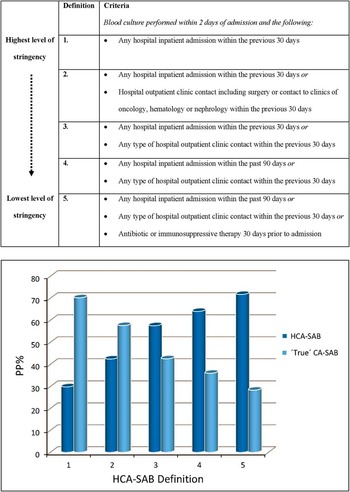
In order to classify patients by acquisition, we retrieved information on all in- and outpatient contacts and medication use up to 90 days before the current admission using the Danish National Patient RegistryReference Lynge, Sandegaard and Rebolj 5 and the Aarhus University Prescription Database.Reference Ehrenstein, Antonsen and Pedersen 6 All SAB patients were initially classified as either CA-SAB or hospital-acquired–SAB on the basis of the interval between time of admission and blood culture sampling (≤2 days vs >2 days). Next, on the basis of a review of the literature,Reference Cardoso, Almeida and Friedman 1 – Reference Siegman-Igra, Fourer and Orni-Wasserlauf 3 we proposed 5 different definitions of HCA as described in Figure 1. In order to facilitate comparisons among groups, the definitions were ranked in a decreasing order with regard to stringency of criteria. Using each individual definition alternately, all patients with CA-SAB were then subcategorized as either “true” CA-SAB (ie, not fulfilling the HCA-SAB definition in question) or HCA-SAB.
Definitions 1–5 of healthcare-associated (HCA) Staphylococcus aureus bacteremia (SAB) and prevalence proportion (PP) of patients classified as HCA-SAB and true community-acquired (CA) SAB according to the 5 different definitions.

We used all diagnoses recorded in the Danish National Patient Registry up to 10 years before the current admission to identify previous comorbidity included in the Charlson Comorbidity Index score.Reference Charlson, Pompei, Ales and MacKenzie 7 Three levels of comorbidity were defined: low (0), corresponding to patients with no preexisting registered comorbidity; intermediate (1–2); and high (≥3). We also obtained data on alcohol-related conditions, hypertension, and osteoporosis. Information on 30-day all-cause mortality was retrieved from the Civil Registration System,Reference Schmidt, Pedersen and Sørensen 4 which contains information on residency, vital status, and exact date of death.
Prevalence proportions of patients classified as HCA-SAB were computed according to each HCA definition. We estimated prevalence proportions for patient characteristics and outcomes according to each of the 5 HCA definitions. The 5 HCA groups were compared with each other and with the group containing all CA-SAB patients (ie, true CA-SAB and HCA-SAB). The Kaplan-Meier method was applied to ascertain 30-day all-cause mortality within groups. Statistical analyses were performed using Stata, version 11.2 (StataCorp). The project was approved by the Danish Data Protection Agency (ref. no. 2012-41-0942).
RESULTS
During the study period 4,385 patients aged at least 15 years were hospitalized with incident SAB, of which 2,638 (60.2%) were classified as CA-SAB and 1,747 (39.8%) as hospital-acquired–SAB. Methicillin-resistant SAB accounted for only 0.6% of all patients. Among patients with CA-SAB, the proportion classified as HCA-SAB ranged from 29.8% when applying the most stringent definition (def. 1, Figure 1) to 71.7% when the least stringent definition was used (def. 5).
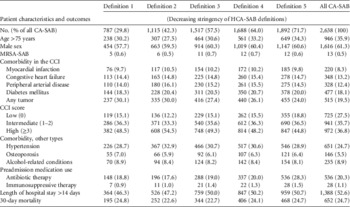
Table 1 displays patient characteristics and outcomes according to each of the 5 definitions. The proportion of male patients classified as HCA-SAB according to the most stringent definition (def. 1) constituted 57.7% compared with 60.6% for patients classified using the least stringent definition (def. 5). The percentage of patients older than 75 years was 30.2% and 34.3% using def. 1 and def. 5, respectively. The proportion of patients with at least 3 conditions registered in the Charlson Comorbidity Index ranged from 48.5% for patients classified according to def. 1 to 44.8% for patients classified according to def. 5. Thirty-day all-cause mortality was 24.8% and 24.7% in patients classified according to def. 1 and def. 5, respectively.
Prevalence Proportions of Patient Characteristics and Outcome According to 5 Different Definitions of Healthcare-Associated (HCA) Staphylococcus aureus Bacteremia (SAB)

NOTE. Data are no. (%) of episodes. CA-SAB, community-acquired SAB; CCI, Charlson Comorbidity Index; MRSA-SAB, methicillin-resistant SAB.
Comparing the group including all CA-SAB patients with patients in the def. 1 group, a larger proportion of CA-SAB-patients was male (61.3% vs 57.7%), the CA-SAB patients were more often older than 75 years (35.9% vs 30.2%), but they had less comorbidity (Table 1).
DISCUSSION
In this large cross-sectional study the prevalence of patients classified as HCA-SAB varied substantially with different definitions of HCA infection. Use of different HCA-SAB definitions also influenced the distribution of patient characteristics, whereas 30-day all-cause mortality remained comparable among the 5 groups.
The prevalence of HCA bacteremia, including SAB, has varied notably from 17% to 55% in previous studies,Reference Vallés, Calbo and Anoro 8 – Reference Shorr, Tabak, Killian, Gupta, Liu and Kollef 10 which employed a wide span of different definitions. In our study, we observed substantial disparities in the prevalence of HCA-SAB across the 5 different definitions. These results may reflect that the wide variation in HCA bacteremia prevalence found in previous studies is affected largely by the choice of definition, and perhaps less by actual differences in local settings and study populations.
Interestingly, comparing the group containing all patients initially classified as CA-SAB (ie, true CA-SAB and HCA-SAB) with patients classified according to definitions 1–5, the variance in patient characteristics gradually became less pronounced with decreasing stringency of the HCA definition. Thus, it is possible that the use of abundantly permissive definitions may prompt an overestimation of HCA infection prevalence and a corresponding underestimation of true CA infection prevalence. In contrast to previous studies,Reference Vallés, Calbo and Anoro 8 – Reference Shorr, Tabak, Killian, Gupta, Liu and Kollef 10 we observed no difference in 30-day all-cause mortality among patients with CA-SAB and HCA-SAB. HCA-SAB was previously found to be associated with an increased mortality compared with CA-SAB conveyed partly by increased colonization and infection of methicillin-resistant S. aureus.Reference Vallés, Calbo and Anoro 8 – Reference Shorr, Tabak, Killian, Gupta, Liu and Kollef 10 Because the prevalence of methicillin-resistant SAB was very low in our study setting, this might explain our results to some extent.
The main strengths of our study include its considerable size and a population-based design; still, some limitations should be acknowledged. Contacts to outpatient hospital clinics of oncology, hematology, and nephrology were used as proxies for data on chemotherapy and dialysis. This is probably not likely to influence the overall results, yet misclassification of some patients cannot be completely ruled out. We lacked data on nursing home residence or specialized home care, which is often included in definitions of HCA infection. Taking the primary objects of our study into account, it is probably unlikely that the addition of these criteria would have substantially altered the main results. Still, we recognize the importance of these exposures and consider them relevant for any definition of HCA infection.
In conclusion, we observed substantial variation in the prevalence of patients classified as HCA-SAB when different definitions of HCA infection were used. The different definitions also influenced the distribution of patient characteristics, whereas mortality estimates remained robust. This study highlights some of the methodologic challenges associated with studies of HCA infections and emphasizes the need for caution when comparing studies using different definitions.
ACKNOWLEDGMENTS
Financial support. Heinrich Kopp, Hertha Christensen, and North Denmark Health Sciences Research Foundations.
Potential conflicts of interest. All authors report no conflicts of interest relevant to this article.