Introduction
Togo is primarily an agricultural country, with the rural population being estimated at 80% of the total population. According to Aklobessi and De Souza (Reference AKLOBESSI and DE SOUZA2007), animal production contributes about 5% to gross domestic product (GDP). In the 1970's new livestock development policies, such as the use of fast growing animals, especially poultry, as key elements to better food production, were launched. However, species with short production cycles are faced with constraints such as poor husbandry techniques and health care, thus limiting the socio-economic role of this type of farming activity for rural populations.
In Togo, traditional farming is centred on backyard production. However, the income from this system is very low and is primarily practiced for family subsistence. Although the production of village chickens is still an important as a food producing activity and plays a role in the preservation of species biodiversity, its commercial impact is decreasing every year in favour of semi-commercial poultry production systems. Recently, small farmers started raising commercial layers. As a result, the proportion of farms with layers have been increasing rapidly. Between 2001 and 2005, imported day-old chicks increased from 263,702 to 478,555 (Aklobessi and De Souza, Reference AKLOBESSI and DE SOUZA2007). The husbandry of highly productive breeds of hens is dependent on external inputs such as day-old chicks, medicines and feed formulation. In addition, although factors that influence flock performance, such as genetics, management practices, nutritional and environmental conditions, are well documented (Kidd, Reference KIDD2000; Acamovic, Reference ACAMOVIC2001 and Veldkamp et al., Reference VELDKAMP, KWAKKEL, FERKET and VERSTEGEN2002), there is no information about feeding and production aspects or management practice in Togo. The aim of this study was to establish the state of the art of laying hen production practices in Togo in view of the laying hen population, available feed components and their incorporation in chicken feed rations, as well as nutritive values (crude protein and gross energy) of feed components and feed mash.
Laying hen survey
The survey was based on information primarily collected by interviewing poultry farmers within the Région Maritime of Togo. Information from the National Association of Poultry Producers (ANPAT) estimated the number of poultry farmers in Togo at around 260-300, of which more than 78% were established in the Région Maritime. Based on this information, a sample of 60 poultry farmers (25-30% of the total farmers in the area) were interviewed based on a questionnaire dealing with the nature of layer chicken population, origins of day-old chicks, feeding and production parameters, and management practices.
layer chicken populations in Togo
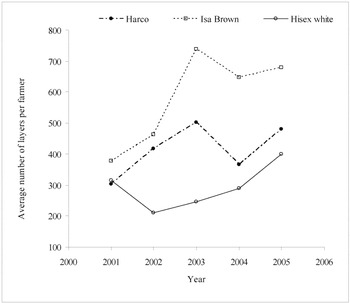
The layer population includes several strains including Isa Brown (IB), Harco, Lohman, Bovans, Hisex White (HW), and Derko, with Isa Brown being most popular, followed by Harco and HW. These three strains required more attention in terms of husbandry, to maintain performance. In recent years, the numbers of the three main layer strains population in Togo has increased rapidly. Figure 1 shows the changes in average chicken numbers per farmer from 2001 to 2005. It should be mentioned that layer populations varied widely from 150 to 5000 between farming enterprises. From 2001 and 2005, the Isa Brown population increased most rapidly followed by Harco.
Average number of layers per poultry farm according to strains and year.

flock management
In general, hen houses did not correspond with any standards required in tropical climatic zones. In most cases, housing was characterised by roofing with shallow slopes (38.9%) and of low height (less than 2.5m in 72% of the cases), resulting in insufficient air circulation. All farmers interviewed agreed the side of poultry houses should have an angle of 30° to 150° and suitably angled depending upon prevailing winds. In reality, the orientation of the houses was based on the area available (70%).
Most of the farmers interviewed (95%) increased the hen house temperature during the first 10 to 14 days of the pullets life by burning charcoal in clay pots. Temperature was regulated on an empirical basis by observing chick movement around the clay pots. Relative humidity as well as ventilation rate was not given any attention by most farmers.
Survey results indicated that poultry farmers sourced day old chicks mostly from Ghana (80%) or from Europe via Ghana (12%) or via importers at Togo airports (8%). Only 25% of the farmers monitored growth by weekly weighing. Almost 40% of the farmers interviewed did not use artificial light in addition to natural day-length, which is more or less a 12 h cycle throughout the whole year. For the remaining 60% of poultry farmers who applied a lighting programme, only 15% added 12 h (7%) or 4h (8%) to the natural day-length during the first week of age (90%) or during the laying phase (10%). During laying, stocking density varied widely between 4 and 8 hens per m² according to facilities and the capability of the farmers.
productive performance
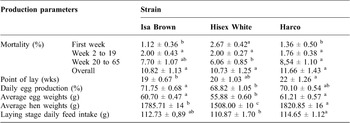
Table 1 shows mortality rates, point of lay, average daily egg production and feed intake according to the three most commonly used breeds. Overall mortality rates and rates from two to 19 weeks of age were comparable between strains. However, mortality differed during early life and during lay, in the following order HW>IB=Harco (pullets) and HW<IB=Harco (in lay) (P<0.05), respectively during the first week and from 20 to 65 weeks. Harco hens started laying two or three weeks later than IB and HW respectively. Average daily feed intake and egg production rate were lower in HW layers compared to IB and Harco (P < 0.05).
Production parameters according to layer breeds used commercially in Togo.

a, b Within row, data sharing no common letter are different (P < 0.05).
feeding management
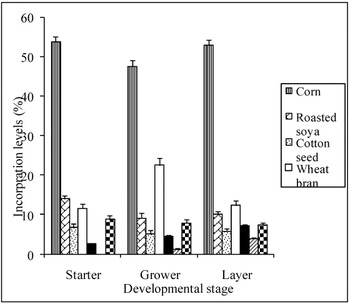
In the majority of cases (>70%), each poultry farmer formulated his own rations using feed ingredients available locally, such as maize (corn), wheat bran, cotton seed, roasted soya, whole soya, groundnuts, fish meal, Leucena and oyster shell. For all farmers, ration formulation was simple and functional, including a starter, grower and layer phase. Figure 2 shows average rates of incorporation of different ingredients in feed rations according to developmental stages. All feed rations were corn-based with high levels of wheat bran, soya and fish meal. Incorporation levels of corn or wheat bran was, respectively, lower or higher in grower ration. Whereas, incorporation levels of oyster shell and Leucena increased from starter to layer phases.
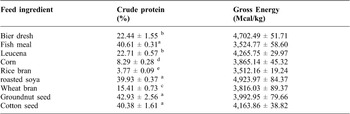
Table 2 indicates the CP and GE of the sampled feed ingredients (Table 2a) and mash diets (Table 2b). For feed ingredients, there were slight differences between energy values, but, for protein, the feed ingredients can by classified in three different groups:
• Ingredients with high protein levels (39 to 42% CP) i.e. fish meal, dried soya, groundnut seed and cotton seed
• Ingredients with mid-level protein such as Leucena and bier dresh
• Ingredients with low protein levels: rice bran, corn and wheat bran.
Starter feed mash GE value was higher (P<0.05) than that of grower and laying diets, which were similar. Grower feed mash CP levels were lower (P<0.05) than that of starter and laying diets, which were comparable.
Incorporation levels of different local feed ingredients in feed different feed mashes according to stage of development. For each ingredient, * indicates difference between type of feed mash (P < 0.05).

Crude protein and gross energy levels of feed ingredients used in laying diets.

Crude protein and gross energy levels in laying mash samples.

a, b Within columns, data sharing no common letter are different (P < 0.05).
Discussions
The survey provided information about laying hens and egg production in Togo. In general, the study revealed that the Togolese poultry industry, with regard to egg production, is underdeveloped and needs to be supported. Indeed, several bottlenecks, such as lack of hatchery for day-old chick production, proficient feed formulation, technical information and training with regard to management practices has retarded the poultry industry in Togo.
Chick mortality during the first few weeks of age appears to be high in all strains. Most mortality occurred during the first three to five days of arrival of the chicks at the poultry farm. This high rate of mortality during the early rearing stage may be a consequence of high stress induced by long delays in feed access combined with transportation conditions. In fact, there is no proficient hatchery in Togo that provides day-old chicks to farmers. So, day-old chicks are imported from Europe or from neighbouring countries (Ghana, in most of the cases) implying two different conditions of transportation: 1) road transport only and 2) road + air + road transport. Moreover, it is well known that a long delays in feed access and/or inappropriate climatic conditions during first few days of life for day-old chicks contribute to lower post-hatch performance at least in broiler (Pinchasov and Noy, Reference PINCHASOV and NOY1993; Turner et al., Reference TURNER, APPLEGATE and LILBURN1999; Careghi et al., Reference CAREGHI, TONA, ONAGBESAN, BUYSE, DECUYPERE and BRUGGEMAN2005) and probably in some aspects of layer performance such as egg weight. Also, the immune system of the hatchling requires oral feed intake for full and rapid development. Fasting, and the stress of processing chicks in the hatchery, stimulates secretion of corticosteroids which inhibit immune cell proliferation (Dibner, 1998).
In addition, since day-old chicks are imported, their costs are so high that farmers cannot justify an increase in the number of animals they buy, and thus are unable to meet demand. The establishment of a local hatchery industry would reduce day-old chick costs, provide enough day-old chicks to the farmers and decrease significantly the time delay for access to feed and water. An inter-university programme, between the Catholic University of Leuven and the University of Lome is dealing with research and developmental aspects of hatchery management in Togo as well as the installation of hatchery.
Poultry production in Togo is dominated by village chicken production with approximately 75% of chicken population (Bebay, Reference BEBAY2003; Aklobessi and De Souza, Reference AKLOBESSI and DE SOUZA2007). However, the dynamic increase of layer strain population between 2001 and 2005 suggests that poultry production with a single goal (egg production) is penetrating the Togolese poultry farmer population. With regard to layer chicken strains, the indigenous birds are, numerically, the more important in Togo. This can be explained by indigenous bird's robustness, which allows it to cope with hard climatic conditions (hot and wet) together with its higher body weight at the end of laying cycle. However, differences in production parameters (mortality, age of maturity, egg production, feed intake etc.) may not be solely linked to strain. These differences can be also due to different management practices or feeding managements since all chicken were not reared under similar environmental conditions. Lack of application of standard management practices may be due to lack of information about effects of local environmental conditions on poultry production. Such information is also scarce in the neighbouring countries (Ghana or Benin), and there is few information on eggs and poultry meat production management practices (Defly, Reference DEFLY1999). For instance, moulting is not practiced at all, even though farmers are faced to day-old chick supply problems.
The CP and GE values if commonly used feed ingredients determined in this study can be used to provide relevant information to poultry farmers and feed millers for feed rations formulation. However, additional analyses for determining metabolisable energy and levels of other important nutrients such as calcium, phosphorous and essential amino-acids are necessary.
This study identified important bottlenecks for the poultry industry development in Togo. It was concluded that promotion of poultry industry in Togo may focus on establishment of hatchery, proficient feed mill units, providing information about management practices and training those involved in the sector on appropriate technologies.