





Introduction
Palmer amaranth is regarded as one of the most common and troublesome weeds in cotton according to a recent Weed Science Society of America (WSSA) survey (Van Wychen Reference Van Wychen2022). Palmer amaranth will compete aggressively with cotton when the crop is being established, which may result in stand loss and reduction in yield and quality (Norsworthy et al. Reference Norsworthy, Schrage, Barber and Schwartz2016). Following the development of RoundupReady cotton in the mid-1990s, there was a shift in herbicide use across the United States that favored glyphosate products (Benbrook Reference Benbrook2016). The overreliance of glyphosate in a cotton monoculture system resulted in the first documented case of glyphosate-resistant Palmer amaranth in 2003 (Culpepper et al. Reference Culpepper, Brown, Davis, Grey, Hanna, Kichler, Vencill, Webster and York2006). Today, there are a total of 17 reported cases of glyphosate-resistant Palmer amaranth growing with cotton, including resistance to single and multiple modes-of-action, with the most recent occurring in Tennessee in 2022 (Heap Reference Heap2025). The continuous rise in herbicide-resistant Palmer amaranth can be attributed to the overreliance on glyphosate, lack of diversified rotation in herbicide modes of action, and the decline in the use of soil-active herbicides (USDA-NASS 2022).
One of the best management practices for reducing herbicide-resistant weeds is to plant crops into weed-free fields and then maintain fields as weed-free as possible (Norsworthy et al. Reference Norsworthy, Ward, Shaw, Llewellyn, Nichols, Webster, Bradley, Frisvold, Powles, Burgos, Witt and Barrett2012). This can be achieved using preplant and preemergence herbicides. Preplant herbicides, specifically the dinitroaniline chemistries, were previously applied to 90% of the cotton acreage in the Southern High Plains of Texas (Keeling and Abernathy Reference Keeling and Abernathy1989). Although their use has declined across the region since the 1980s, preplant herbicides continue to be recommended to Texas cotton growers as an effective option for controlling glyphosate-resistant Palmer amaranth (Dotray et al Reference Dotray, Baughman, Baumann and Keeling2004; Reed et al Reference Reed, Villalba and Keeling2016). Additionally, the ability to incorporate dinitroaniline herbicides by mechanical means is critically necessary for rainfed cotton production systems, which account for 65% of the cotton acreage in Texas (PGC 2023).
Another residual herbicide that is effective at controlling glyphosate- and auxin-resistant Palmer amaranth biotypes is isoxaflutole. Isoxaflutole is a herbicide that inhibits p-hydroxyphenylpyruvate dioxygenase (HPPD) and is used for preemergence control of broadleaf and grass weeds in corn (Zea mays L.), and more recently, isoxaflutole-resistant soybean [Glycine max (L.) Merr.] (BASF 2020; Shaner Reference Shaner2014). In 2024, BASF Corporation commercialized four Axant Flex cotton varieties that are tolerant to isoxaflutole applied preemergence and postemergence. Axant Flex is the first quadruple herbicide–tolerant trait package available for use on cotton. Cotton germplasm with the Axant Flex technology traits is also tolerant to labeled applications of glyphosate, glufosinate, and dicamba. Approval for the use of BASF’s isoxaflutole herbicide (Alite ISO) on Axant Flex cotton is still under review by the U.S. Environmental Protection Agency (EPA) (BASF 2025). Studies also have confirmed postemergence tolerance of Axant Flex cotton to an additional HPPD active ingredient, topramezone (Singletary et al. Reference Singletary, Dotray, Baldwin, Pabuayon, Asher and Hixson2025).
The most commonly used preemergence herbicides in cotton are from the Herbicide Resistance Action Committee (HRAC) mode of action Groups 3, 5, 12, 14, and 15 (USDA-NASS 2022). Although herbicides with these modes of action provide various levels of Palmer amaranth control when applied alone, previous studies have reported increased weed suppression when isoxaflutole (Group 27) was tank-mixed with herbicides from these HRAC Groups (Farr et al. Reference Farr, Norsworthy, Barber, Butts and Roberts2022; Foster et al. Reference Foster, Dotray, Thompson, Baldwin and Moore2022). According to the current EPA registration documents for Alite 27 (EPA Reg. No. 7969-433), isoxaflutole can be applied preplant, preemergence, and early postemergence to isoxaflutole-resistant soybean (BASF 2020). No study has evaluated isoxaflutole applied preplant incorporated (PPI) within a cotton weed management system. This application timing would be useful for rainfed growers to reduce their reliance on natural rain to activate herbicides applied at planting. Therefore, the objective of this study was to determine the efficacy of isoxaflutole on Palmer amaranth control when used PPI or preemergence within a simulated early season Axant Flex cotton weed management program.
Materials and Methods
Non-crop field experiments were conducted in 2022 and 2023 at the Texas A&M AgriLife Research and Extension Center, in Halfway, Texas (34.1876443°N, 101.9496703°W). The soil is a Pullman clay loam (19% sand, 42% silt, and 39% clay) with 0.96% organic matter, and pH 8.1 (USDA-NRCS 2025). The experimental site has a history of dense Palmer amaranth populations (40,365 plants ha−1) (Foster et al. Reference Foster, Dotray, Thompson, Baldwin and Moore2022). After the previous year’s cotton harvest, the site was prepared by twice running a tandem disk across the field followed by a bed lister to create raised beds prior to study implementation. Treatments were arranged as a randomized complete block design with four replications. Plots consisted of four rows spaced 101.6 cm apart by 9 m in length. The location is equipped with an overhead center pivot sprinkler irrigation system. Rain data were collected using an on-site research-grade weather station (WatchDog 3250 Wireless ET Station; Spectrum Technologies, Aurora, IL). Total rain and irrigation data for both study years are reported in Figure 1.
Daily and cumulative precipitation and irrigation in (A) 2022 and (B) 2023 at the Texas A&M AgriLife Research Center in Halfway, Texas. Preplant incorporated (PPI) treatments were applied on April 26, 2022, and April 27, 2023. Preemergence (PRE) treatments were applied on May 16, 2022, and May 31, 2023.

Figure 1. Long description
The image contains two graphs labeled A and B, representing daily and cumulative precipitation and irrigation in 2022 and 2023, respectively, at the Texas A&M AgriLife Research Center in Halfway, Texas. Each graph features two y-axes: the left y-axis measures daily precipitation in millimeters, while the right y-axis measures cumulative precipitation in millimeters. The x-axis represents dates from April to July in 2022 and from April to August in 2023. The graphs use different colors to distinguish between cumulative rainfall, cumulative irrigation, rainfall, and irrigation. In graph A, preplant incorporated treatments were applied on April 26, 2022, and preemergence treatments on May 16, 2022. In graph B, preplant incorporated treatments were applied on April 27, 2023, and preemergence treatments on May 31, 2023. The graphs illustrate the variations in daily and cumulative precipitation and irrigation over the specified periods, highlighting the impact of these treatments on the agricultural practices at the research center.
Treatments consisted of pendimethalin (Prowl H2O, BASF Corporation, Research Triangle Park, NC) at 1.13 kg ai ha−1 applied alone or in a tank-mixture with isoxaflutole (Alite ISO; BASF) at 0.11 kg ai ha−1 applied preplant followed by (fb) preemergence applications of prometryn (Caparol; Syngenta Crop Protection, Greensboro, NC) at 1.33 kg ai ha−1, fluometuron (Cotoran; ADAMA, Raleigh, NC) at 1.12 kg ai ha−1, diuron (Diuron 4L; Drexel Chemical Company, Memphis, TN) at 0.91 kg ai ha−1, fluridone (Brake; SePRO Corporation, Carmel, IN) at 0.25 kg ai ha−1, fomesafen (Reflex; Syngenta) at 0.28 kg ai ha−1, acetochlor (Warrant; Bayer CropScience, St. Louis, MO) at 1.26 kg ai ha−1, or S-metolachlor (Dual Magnum; Syngenta) at 1.4 kg ai ha−1 applied alone or tank-mixed with isoxaflutole (Table 1). No treatment contained isoxaflutole at more than one application timing. A nontreated control was included for comparison.
Herbicides used in the study.

Table 1. Long description
The table presents a list of herbicides used in a study, detailing their common names, trade names, application rates in kilograms of active ingredient per hectare, and manufacturers. The herbicides include acetochlor, diuron, fluometuron, fluridone, fomesafen, isoxaflutole, pendimethalin, prometryn, and S-metolachlor. Each herbicide is associated with a specific trade name and manufacturer. The application rates vary, with the highest rate being 1.4 kilograms per hectare for S-metolachlor and the lowest being 0.11 kilograms per hectare for isoxaflutole.
a All herbicides were used according to labeled rates in kg ai ha−1.
b Manufacturer locations: ADAMA, Raleigh, NC; BASF Corporation, Research Triangle Park, NC; Bayer CropScience, St. Louis, MO; Drexel Chemical Company, Memphis, TN; SePRO Corporation, Carmel, IN; Syngenta Crop Protection, Greensboro, NC.
Preplant treatments were applied using a tractor-mounted sprayer with a 4-m eight-nozzle boom traveling at 6.4 kph calibrated to deliver 140 L ha−1 at 317 kPa with Turbo TeeJet 11002 nozzles (TeeJet Technologies, Springfield, IL) on April 26, 2022, and 172 kPa with TT11003 nozzles on April 27, 2023. Preplant treatments were applied and immediately incorporated twice using a rolling cultivator set to a 5-cm depth followed by a bed conditioner. Preemergence treatments were applied on the simulated cotton planting date on May 16, 2022, and May 31, 2023, using a CO2-pressurized backpack sprayer traveling at 4.8 kph with a 2-m four-nozzle boom calibrated to deliver 140 L ha−1 at 179 to 207 kPa. Turbo TeeJet 11002 nozzles were used for all preemergence applications. At least 51 mm of activating irrigation or rain was applied or received within 4 d of the preemergence application in both study years. A burndown application of paraquat at 0.56 kg ai ha−1 + a nonionic surfactant at 2.5 mL L−1 was broadcast applied to all treatments immediately following the preemergence applications to control any emerged weeds and to evaluate residual weed control starting from the simulated planting date; however, in 2023, this application was delayed by 13 d due to continuous rain that led to nonpractical spray conditions within the field.
Palmer amaranth control was visually evaluated on a scale from 0 to 100%, with 0 representing no control and 100% representing complete control (Frans et al. Reference Frans, Talbert, Marx, Crowley and Camper1986). Percent control was recorded 3 wk after the preplant incorporated (PPI) application (prior to the burndown treatment), 14 d after the preemergence application (DAA), and every 7 d until 70 DAA, except in 2023, when Palmer amaranth control began 28 DAA due to a delay in weed germination from the burndown treatment. Palmer amaranth density was determined at each evaluation by recording the number of weeds from two 0.25-m2 quadrants per plot. At 70 DAA, Palmer amaranth plants within a 0.25-m2 quadrant were cut at the soil surface and weighed for fresh biomass.
Data were analyzed using the GLIMMIX procedure in SAS software (v.9.4; SAS Institute, Cary, NC). Herbicide treatment and application timing were treated as fixed effects, while replication was considered a random effect (Littell et al. Reference Littell, Milliken, Stroup, Wolfinger and Schabenberger2006). Year was treated as a random effect due to the limited number of sampling years, and year-by-treatment interactions were tested to determine whether to pool information by year. Data on visual Palmer amaranth control from the nontreated plots were excluded from the analyses. Treatment means were separated using the Fisher protected LSD test at α = 0.05.
Results and Discussion
Visible Palmer Amaranth Control
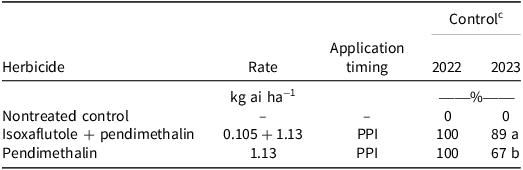
There was a significant interaction between year and treatment for Palmer amaranth control (data not shown). As a result, the data for the visual Palmer amaranth control were analyzed separately by year. In 2022, complete Palmer amaranth control (100%) was achieved 3 wk after PPI applications of pendimethalin with and without isoxaflutole (Table 2). Early season precipitation in April and May of 2023 likely promoted a flush of Palmer amaranth that resulted in <90% Palmer amaranth control following an application of isoxaflutole + pendimethalin (89%) and pendimethalin alone (67%) (Table 2).
Comparison of Palmer amaranth control among PPI treatments immediately prior to PRE applications in 2022 and 2023. a,b

Table 2. Long description
The table presents data on Palmer amaranth control using different herbicide treatments in 2022 and 2023. It includes three rows for different treatments: nontreated control, isoxaflutole plus pendimethalin, and pendimethalin alone. The columns show the application timing and control percentages for the years 2022 and 2023. In 2022, all treatments achieved 100% control. In 2023, the control percentages were 89% for isoxaflutole plus pendimethalin and 67% for pendimethalin alone.
a Abbreviations: PPI, preplant incorporated; PRE, preemergence.
b Means followed by a common letter or no letter within the same column are not significantly different at the 0.05 level of significance.
c Rating scale: 0 indicates no control and 100% indicates complete control.
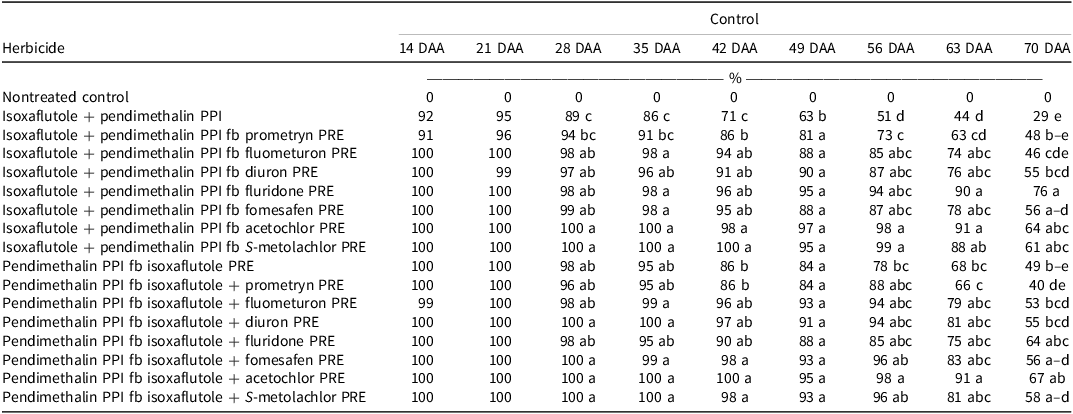
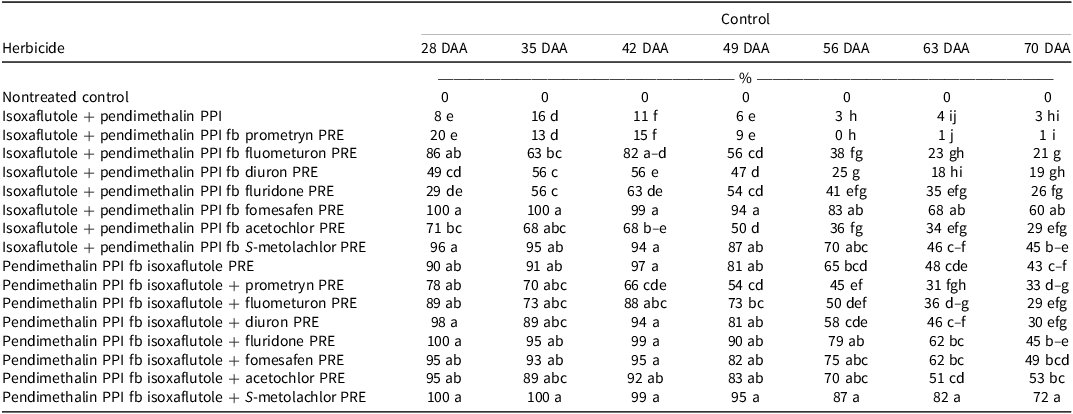
By 28 DAA in 2022, complete Palmer amaranth control was observed with isoxaflutole + pendimethalin applied PPI fb acetochlor or S-metolachlor applied preemergence, and pendimethalin applied PPI fb isoxaflutole + diuron, fomesafen, acetochlor, or S-metolachlor applied preemergence (Table 3). At 28 DAA in 2023, Palmer amaranth control did not differ among the eight treatments that contained isoxaflutole applied preemergence (Table 4). Isoxaflutole + pendimethalin applied PPI fb fomesafen (100%) or S-metolachlor (96%) applied preemergence achieved greater Palmer amaranth control than isoxaflutole + pendimethalin applied PPI fb prometryn (20%), diuron (49%), fluridone (29%), or acetochlor (71%) applied preemergence.
Comparison of Palmer amaranth control among treatments at different evaluation dates after the PRE application in 2022. a–c

Table 3. Long description
The table presents data on Palmer amaranth control using various herbicide treatments at different days after application (DAA) in 2022 and 2023. The table includes a control column and multiple treatment columns, each evaluated at different DAA intervals: 14, 21, 28, 35, 42, 49, 56, 63, and 70. The treatments involve combinations of isoxaflutole, pendimethalin, and other herbicides applied preemergence (PRE) or post-planting incorporated (PPI). Notable trends include complete control observed with specific treatments by 28 DAA in 2022, such as isoxaflutole pendimethalin applied PPI followed by acetochlor or S-metolachlor applied PRE. In 2023, treatments containing isoxaflutole applied PRE showed no significant differences in control by 28 DAA. Specific combinations like isoxaflutole pendimethalin applied PPI followed by fomesafen or S-metolachlor applied PRE achieved higher control rates compared to other combinations. The table provides detailed percentage values for each treatment and evaluation date, highlighting the effectiveness of different herbicide combinations over time.
a Abbreviations: DAA, days after preemergence application; fb, followed by; PPI, preplant incorporated; PRE, preemergence.
b Means followed by a common letter or no letter within the same column are not significantly different at the 0.05 level of significance.
c Rating scale: 0 indicates no control and 100% indicates complete control.
Comparison of Palmer amaranth control among treatments at different evaluation dates after the PRE application in 2023. a–c

Table 4. Long description
The table presents data on the control of Palmer amaranth using various herbicide treatments at different days after application (DAA) in 2023. It includes a control column with evaluations at 28, 35, 42, 49, 56, 63, and 70 DAA. The treatments include combinations of isoxaflutole, pendimethalin, and other herbicides applied preemergence (PRE) or preplant incorporated (PPI). Notable trends include high control rates with isoxaflutole and pendimethalin combinations, particularly with acetochlor and S-metolachlor. The table shows percentages of control for each treatment at different evaluation dates, highlighting the effectiveness of certain combinations over others.
a Abbreviations: DAA, days after preemergence application; fb, followed by; PPI, preplant incorporated; PRE, preemergence.
b Means followed by a common letter or no letter within the same column are not significantly different at the 0.05 level of significance
c Rating scale: 0 being no control and 100% being complete control.
At 42 DAA in 2022, all herbicide treatments containing a preemergence treatment, with the exception of isoxaflutole + pendimethalin applied PPI fb prometryn applied preemergence, and pendimethalin applied PPI fb isoxaflutole applied alone or in a tank-mixture with prometyrn applied preemergence, provided >90% control of Palmer amaranth (Table 3). Foster et al. (Reference Foster, Dotray, Thompson, Baldwin and Moore2022) reported >90% Palmer amaranth control at 42 DAA when isoxaflutole was added to a tank-mixture with other residual cotton herbicides applied preemergence. In 2023, >90% Palmer amaranth control at 42 DAA was achieved with isoxaflutole + pendimethalin PPI fb fomesafen or S-metolachlor applied preemergence, and pendimethalin applied PPI fb isoxaflutole applied alone or in a tank-mixture with diuron, fluridone, fomesafen, acetochlor, or S-metolachlor applied preemergence (Table 4). Smith et al. (Reference Smith, Soltani, Kaastra, Hooker, Robinson and Sikkema2019) reported >99% control of certain Amaranthus spp. up to 8 wk after isoxaflutole applied preemergence alone or in a tank-mixture with metribuzin to a soybean crop system.
In 2022, control of Palmer amaranth with isoxaflutole + pendimethalin applied PPI fb a preemergence application of prometryn, fluometuron, diuron, fluridone, fomesafen, acetochlor, or S-metolachlor was similar to that of pendimethalin applied PPI fb isoxaflutole plus the same preemergence herbicides across all observation intervals and within each treatment from 28 d to 70 d after preemergence application (Table 3). Conversely, herbicide combinations that contained prometryn or fluridone resulted in enhanced residual control of Palmer amaranth when isoxaflutole was applied preemergence over PPI at each evaluation in 2023 (Table 4). Similar results were reported by Johnson et al. (Reference Johnson, Chahal and Regehr2012) that better control of giant foxtail (Setaria faberi Herrm.), large crabgrass [Digitaria sanguinalis (L.) Scop.], Palmer amaranth, waterhemp [Amaranthus tuberculatus (Moq.) J.D. Sauer], velvetleaf (Abutilon theophrasti Medik.), and ivyleaf morningglory (Ipomoea hederacea Jacq.) was observed with preemergence applications of isoxaflutole alone or tank-mixed with other residual corn herbicides compared with applying it as PPI. In 2022 and 2023, Palmer amaranth control was below 80% when observed 70 d after the preemergence application.
Palmer Amaranth Density and Biomass
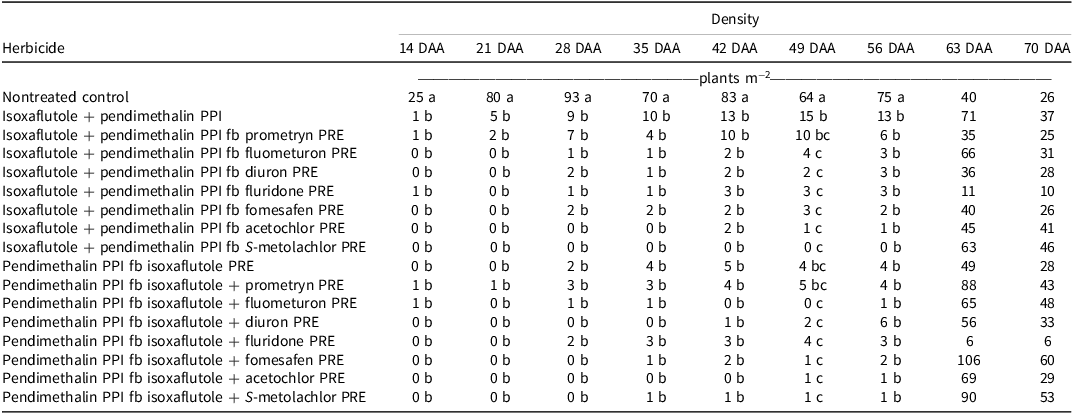
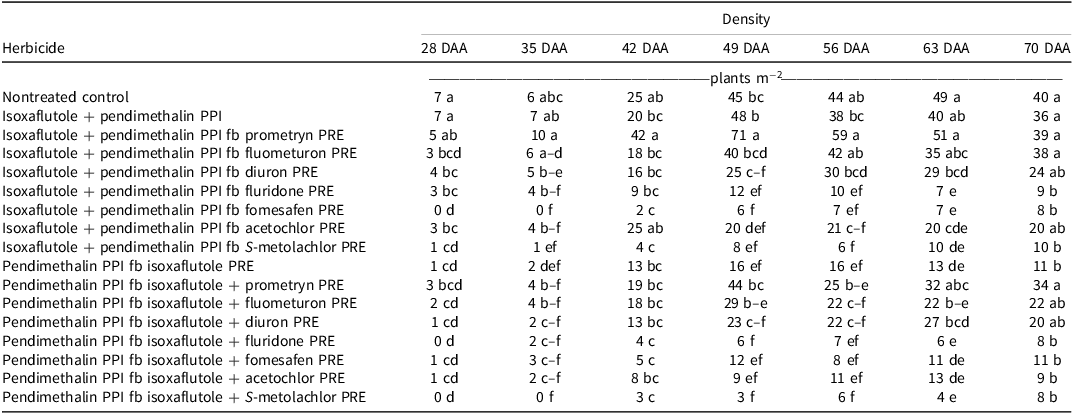
There was a significant interaction between year and treatment for Palmer amaranth density (data not shown). As a result, data for the Palmer amaranth density were analyzed separately by year. In 2022, compared with untreated controls, Palmer amaranth density was reduced by all herbicide treatments between 14 and 56 DAA (Table 5). At 35 DAA, Palmer amaranth density from PPI treatments that contained isoxaflutole was ≤10 plants m−2, whereas preemergence treatments that contained isoxaflutole alone or in a tank-mixture resulted in ≤4 plants m−2. In 2023, compared with the nontreated control, when assessed at each evaluation date from 28 to 70 DAA, Palmer amaranth density was less with a PPI application of isoxaflutole + pendimethalin fb a preemergence application of fomesafen or S-metolachlor, and a PPI treatment with pendimethalin fb a preemergence treatment with isoxaflutole + S-metolachlor (Table 6). Similar to 2022, Palmer amaranth density at 35 DAA in 2023 was ≤10 plants m−2 after PPI treatments with isoxaflutole and ≤4 plants m−2 from treatments with isoxaflutole applied alone or in a tank-mixture applied preemergence.
Comparison of Palmer amaranth density among treatments at different evaluation dates after the PRE application in 2022. a,b

Table 5. Long description
The table presents data on Palmer amaranth density measured at different days after application (DAA) for various herbicide treatments in 2022. The table includes 17 rows and 9 columns, with columns representing density measurements at 14, 21, 28, 35, 42, 49, 56, 63, and 70 DAA. The rows list different herbicide treatments, including a nontreated control and various combinations of isoxaflutole, pendimethalin, and other herbicides applied pre-plant incorporated (PPI) and pre-emergence (PRE). Notable trends include significant reductions in Palmer amaranth density across all herbicide treatments compared to the untreated control. At 35 DAA, treatments containing isoxaflutole resulted in 10 plants per square meter, while pre-emergence treatments with isoxaflutole alone or in mixture resulted in 4 plants per square meter. The data highlights the effectiveness of different herbicide treatments in reducing Palmer amaranth density over time.
a Abbreviations: DAA, days after preemergence application; fb, followed by; PPI, preplant incorporated; PRE, preemergence.
b Means followed by a common letter or no letter within the same column are not significantly different at the 0.05 level of significance.
Comparison of Palmer amaranth density among treatments at different evaluation dates after the PRE application in 2023. a,b

Table 6. Long description
The table presents data on Palmer amaranth density across various treatments and evaluation dates in 2023. It includes 17 rows and 8 columns, with columns representing different densities measured at 28, 35, 42, 49, 56, 63, and 70 days after application (DAA). The rows list different herbicide treatments, including nontreated control, various combinations of isoxaflutole, pendimethalin, and other herbicides applied preemergence (PRE) or as a follow-up (fb). Notable trends include significant reductions in Palmer amaranth density with certain treatments compared to the nontreated control, particularly with combinations involving isoxaflutole and pendimethalin. Specific data points highlight the effectiveness of these treatments at reducing plant density over time.
a Abbreviations: DAA, days after preemergence application; fb, followed by; PPI, preplant incorporated; PRE, preemergence.
b Means followed by a common letter or no letter within the same column are not significantly different at the 0.05 level of significance.
There was no significant interaction between year and treatment for Palmer amaranth biomass (data not shown). Therefore, the results presented in this study were average values for both growing years. End-of-season aboveground Palmer amaranth fresh biomass from treatments that contained isoxaflutole applied PPI was 2,641 to 6,060 g m−2, whereas treatments that contained isoxaflutole alone or in a tank-mixture applied preemergence resulted in a fresh biomass of 2,492 to 4,697 g m−2. Palmer amaranth biomass did not vary among treatments in 2022 and 2023 in relation to the nontreated control (3,979 g m−2) (data not shown).
Practical Implications
The results of this study demonstrate that excessive early season rain can influence the effectiveness of preplant residual herbicides. In a year with <50 mm of rain between PPI and preemergence applications (2022), Palmer amaranth control was similar whether isoxaflutole was applied PPI or preemergence within each respective preemergence herbicide combination with prometryn, fluometuron, diuron, fluridone, fomesafen, acetochlor, or S-metolachlor. In a year when >150 mm of rain fell between PPI and preemergence applications (2023), greater Palmer amaranth control was observed at 49 DAA when isoxaflutole was applied preemergence with fluridone, diuron, prometryn, or acetochlor compared to when these same herbicides contained isoxaflutole applied PPI. Tank-mixing isoxaflutole with other common cotton residual herbicides from HRAC Groups 5, 12, 14, and 15 provided effective Palmer amaranth control. The ability to use isoxaflutole PPI or preemergence within a cotton weed management program will give growers added flexibility in how they choose to manage glyphosate-resistant Palmer amaranth and other troublesome weeds in the Southern High Plains.
Acknowledgments
We thank Blaine Patton, Bobby Rodriguez, Kyle Russell, Maxwell Smith, and undergraduate student workers for their support in conducting these studies.
Funding
Partial funding was provided by the Texas State Support Committee – Cotton Incorporated, and BASF Corporation.
Competing Interests
The authors declare they have no competing interests.



 Open access

