INTRODUCTION
The strength of inter-specific competition is affected by the similitude between the involved species (Abrams, Reference Abrams1983). To reduce inter-specific competition, the coexistence requires that the species differ in how they affect and how they are affected by the resources (Chesson, Reference Chesson2000), how and what resources they are using, when and where they use them and the limitations of where they experiment (Amarasekare, Reference Amarasekare2003). Thus, it is expected to have stronger inter-specific competition as species are more similar.
Life-history traits and other inherent differences between species allow them to escape or minimize competition through different mechanisms (Chesson, Reference Chesson2000). One of these mechanisms, in environments spatially homogeneous where competition is possible, involves some form of intra-specific grouping and inter-specific segregation (Bolker & Pacala, Reference Bolker and Pacala1999). The dominant competitor cannot exploit all the resources or spaces available leaving gaps in the landscape that are occupied by the inferior competitor (Murrell & Law, Reference Murrell and Law2003). In this competition by displacement, the coexistence is maintained generating spatial differences in the niche between species (Amarasekare, Reference Amarasekare2003). Competitive interactions are stronger between species with similar functions operating at the same scale (Peterson et al., Reference Peterson, Craig and Holling1998). However, this similitude of functions needs to have a threshold to allow the coexistence between competitors (Abrams, Reference Abrams1983).
The role that different species play on the regulation of processes operating at community level has motivated several hypotheses that relate the vulnerability of the systems with the presence of species with similar functions (Johnson et al., Reference Johnson, Vogt, Clark, Schmitz and Vogt1996; Lawton, Reference Lawton and Kinne2000). The existence of functionally redundant species (sensu Walker, Reference Walker1992) is one of the more discussed hypotheses. This hypothesis states that in some communities some species are functionally redundant, meaning that they could be lost without much effect on the ecosystem functioning (Walker, Reference Walker1992). Thus, high conservation effort should go to species with low redundancy to ensure the stability of the whole ecosystem (Walker, Reference Walker1995). However, there are evidences that the functional roles that the species play are under the influence of local environmental conditions and they may perform the same function under restricted conditions but their functions may vary in natural heterogeneous environments (Wellnitz & Poff, Reference Wellnitz and Poff2001). Moreover, species are more likely classified as redundant when less variables are measured (Rosenfeld, Reference Rosenfeld2002). Recently, it has been proposed that the redundancy effect is rare; so, it is more conservative to refer to similar species (instead of redundant species; Chalcraft & Resetarits, Reference Chalcraft and Resetarits2003) that under some circumstances play the same ecological role.
In soft-substratum habitats competition for space and direct interference within and among species is not a dominant process (e.g. Peterson, Reference Peterson1991; Wilson, Reference Wilson1991). This is mostly explained by the vertical and horizontal partitioning of the space that the three-dimensional structure of soft-sediment allows (Wilson, Reference Wilson1991). Thus, direct competition for space is minimized because organisms can live at different depths within sediments. There is, however, some habitat displacement involving dwellers or burrowing species (e.g. Peterson, Reference Peterson1977; Peterson & Andre, Reference Peterson and Andre1980; Wilson, Reference Wilson1980; Brenchley & Carlton, Reference Brenchley and Carlton1983; Kurihara et al., Reference Kurihara, Hosada and Takeda1989). In such cases, given that the space needed to construct a burrow is not magnified by the three-dimensions of soft-sediment, the competition cannot be minimized by inhabiting at different depths. The habitat displacement between the south-west Atlantic intertidal crabs Neohelice granulata (formerly known as Chasmagnathus granulatus) and Cyrtograpsus angulatus is a good example that competition for space may occur between burrowing species in soft-sediment habitat (Iribarne et al., Reference Iribarne, Martinetto, Schwindt, Botto, Bortolus and García Borboroglu2003; Martinetto et al., Reference Martinetto, Valiñas, Palomo and Iribarne2007b). These crabs are common in south-west Atlantic coastal and estuarine areas (Boschi, Reference Boschi2000), but there are few places where they share the same microhabitat. They are similar in size and in many life history traits (Boschi, Reference Boschi2000; Luppi et al., Reference Luppi, Spivak, Anger and Valero2002) which promote competition. The crab N. granulata is the dominant species in soft-sediment and salt-marsh intertidal areas from southern Brazil to northern Patagonia Argentina, where it forms extensive burrowing beds (Spivak et al., Reference Spivak, Anger, Luppi, Bas and Ismael1994; Iribarne et al., Reference Iribarne, Bortolus and Botto1997; Boschi, Reference Boschi2000). Its burrowing activity leads to deep changes in sediment characteristics as well as on infaunal community (Botto & Iribarne, Reference Botto and Iribarne1999, Reference Botto and Iribarne2000). For instance, this species modifies sediment microtopography and granulometry promoting the accumulation of fine particles (Botto & Iribarne, Reference Botto and Iribarne2000). The presence of N. granulata burrowing beds also affects the distribution of meiofaunal organisms (Botto & Iribarne, Reference Botto and Iribarne1999; Rosa & Bemvenuti, Reference Rosa and Bemvenuti2005) as well as the habitat use by shorebirds (Botto et al., Reference Botto, Palomo, Iribarne and Martinez2000; Palomo et al., Reference Palomo, Botto, Navarro, Escapa and Iribarne2003; Escapa et al., Reference Escapa, Iribarne and Navarro2004; Iribarne et al., Reference Iribarne, Bruschetti, Escapa, Bava, Botto, Gutierrez, Palomo, Delhey, Petracci and Gagliardini2005) and juvenile fish (Martinetto et al., Reference Martinetto, Iribarne and Palomo2005, Reference Martinetto, Valiñas, Palomo and Iribarne2007a), the distribution of the fiddler crab Uca uruguayensis (Daleo et al., Reference Daleo, Ribeiro and Iribarne2003), and the feeding behaviour and the distribution of polychaetes (Escapa et al., Reference Escapa, Iribarne and Navarro2004; Palomo et al., Reference Palomo, Martinetto and Iribarne2004). The geographical distribution of C. angulatus overlaps with N. granulata but it also extends south to central Patagonia (Spivak, Reference Spivak1997; Boschi, Reference Boschi2000; Iribarne et al., Reference Iribarne, Martinetto, Schwindt, Botto, Bortolus and García Borboroglu2003). When these species coexist N. granulata constrains the distribution and modifies some population characteristics (e.g. sex-ratio, size and incidence of limb autotomies) and burrowing behaviour of C. angulatus (Iribarne et al., Reference Iribarne, Martinetto, Schwindt, Botto, Bortolus and García Borboroglu2003; Martinetto et al., Reference Martinetto, Valiñas, Palomo and Iribarne2007b). However, some populations of C. angulatus live in burrows forming dense burrowing beds in soft-bottom intertidal areas where N. granulata is not present (Iribarne et al., Reference Iribarne, Martinetto, Schwindt, Botto, Bortolus and García Borboroglu2003). Where both species coexist, C. angulatus rarely constructs burrows and N. granulata clearly dominate soft-sediment areas forming conspicuous burrowing beds (Martinetto et al., Reference Martinetto, Valiñas, Palomo and Iribarne2007b). These evidences suggest that these crab species could be ‘redundant species’ in some effects related to burrowing activities.
To test this hypothesis we experimentally compare the effect of N. granulata and C. angulatus on sediment characteristics and infaunal community in a soft-sediment intertidal area of the Argentinean biogeographical province where N. granulata is the dominant species.
MATERIALS AND METHODS
The experiment was performed in Mar Chiquita coastal lagoon (37°32′S and 57°19′W, northern Argentinean Atlantic coast) where both crab species coexist. The lagoon is a body of brackish water affected by a semidiurnal tidal regime and characterized by mud flats surrounded by a large cord grass area (Spartina densiflora; Iribarne et al., Reference Iribarne, Bortolus and Botto1997; Bortolus & Iribarne, Reference Bortolus and Iribarne1999). The crab N. granulata lives in burrows and C. angulatus lives free in the subtidal, in sandy or muddy flats avoiding the other crab species (Martinetto et al., Reference Martinetto, Valiñas, Palomo and Iribarne2007b).
To evaluate whether C. angulatus and N. granulata are similar in their effects on the sediment and on the infaunal community we ran an experiment in the intertidal area where N. granulata often forms a conspicuous burrowing bed. We used 27 wire cages (1 m2 area, 0.2 m high, with a mesh size of 5 cm) that were inserted into the sediment and randomly assigned 9 replicates to each of the following treatments: (1) inclusion of N. granulata; (2) inclusion of C. angulatus; and (3) control cages without crabs. Weekly, cages were checked and the construction of burrows by both species was verified. To test if treatment effect changed through time, 5 replicates were obtained after 1 month and 4 after 2 months. Similar cages have been used in former studies in this area without artefact effect on the variables measured in this study (Botto & Iribarne, Reference Botto and Iribarne1999; Botto et al., Reference Botto, Palomo, Iribarne and Martinez2000; Escapa et al., Reference Escapa, Iribarne and Navarro2004).
To evaluate differences among treatments on sediment structure, water content, organic matter content and grain size-frequency distributions were determined. Water content of the sediment was obtained as the difference between wet and dry weight (after dried at 70°C for 72 hours). Organic matter was evaluated as the percentage of ash free dry weight (AFDW; combustion of a 10 g subsample at 550°C for 8 hours; Crisp, Reference Crisp, Holme and McIntyre1971). Grain size distributions were obtained by sieving following Carver (Reference Carver1971). Samples were sieved through three mesh sizes (2000 µm, 500 µm and 63 µm) separating the samples into gravel, sand, fine sand and silt.
To compare the effect of both crab species on the infaunal community samples of sediment were taken from each cage. Samples of 5 cm diameter and 2 cm depth were taken to determine meiofauna abundances and samples of 10 cm diameter and 5 cm depth for macrofauna. Meiofauna samples were homogenized and subsamples of 2 cm diameter and 2 cm depth were stained with Bengal rose to visualize the organisms and preserved in formalin 4%. Samples were sieved through 0.1 mm mesh size and the organisms quantified and grouped in broad taxonomic categories under microscope (4 ×). Macrofaunal samples were sieved through a 500 µm mesh and all the retained organisms were sorted, identified, and counted.
All the results were evaluated with two-way analysis of variance with treatment (C. angulatus, N. granulata and no crabs) and time (1 and 2 months) as factors (Zar, Reference Zar1999). Homogeneity of variance was tested with the Cochran test. Square root transformation was applied when homogeneity of variance was not met. Because treatments can differ because they cause different patterns of variation among replicates rather than differences among means (Underwood, Reference Underwood1997), we reported the results of the Cochran test as an experimental outcome.
RESULTS
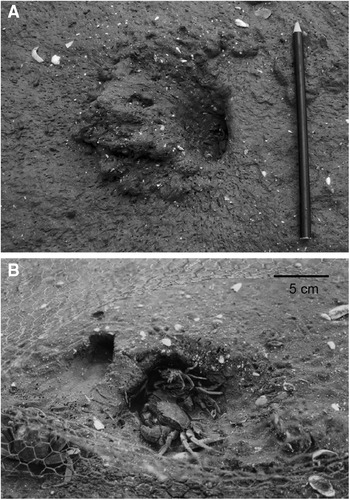
During the eight weeks experiment, crabs built burrows in all the inclusion treatments. Neohelice granulata burrows were easily distinguished from those of C. angulatus (Figure 1a, b). The burrows of N. granulata had a funnel tunnel entrance while C. angulatus built burrows with a simple straight tunnel entrance (Botto & Iribarne, Reference Botto and Iribarne1999; Iribarne et al., Reference Iribarne, Martinetto, Schwindt, Botto, Bortolus and García Borboroglu2003). In addition, the sediment removed from the burrows was disposed differently. Neohelice granulata built a mound near the entrance of the burrow, whereas C. angulatus spread the sediment over the surface with no structure or mound.
Neohelice granulata (A) and Cyrtograpsus angulatus (B) burrows constructed inside the experimental units. Photograph credits: P. Martinetto (A); M. Bruschetti (B).

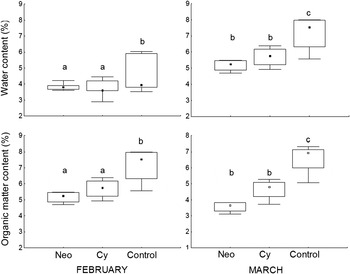
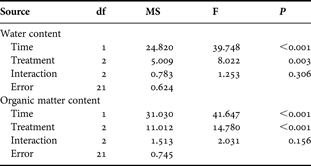
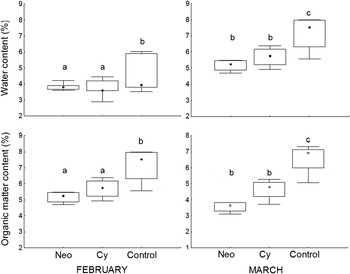
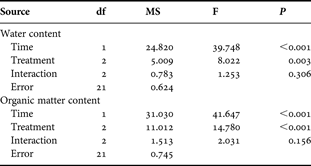
The variances in sediment water content (WC) and organic matter content (OMC) were homogeneous. Sediment WC and OMC were both higher in the control cages than in the crab inclusion cages (Table 1; Figure 2). There were no differences in WC and OMC between inclusion of N. granulata and C. angulatus treatments. In addition, WC and OMC were higher in March than in February (Table 1; Figure 2).
Percentages of water content and organic matter content after one (February) and two (March) months of different treatments manipulating crab presence. Treatments are: Neo, Neohelice granulata inclusion; Cy, Cyrtograpsus angulatus inclusion; and control, exclusion of both crab species. Different letters indicate differences in mean values among treatments. Here and thereafter, box plots are constructed with limits being the 75th and 25th percentile, lines represent 10th and 90th percentile, and points inside boxes are medians.
Two-way analysis of variance results testing for differences in water content and organic matter content in experimental cages including Neohelice granulata or Cyrtograpsus angulatus, or excluding crabs (treatments) during 1 and 2 months (time).
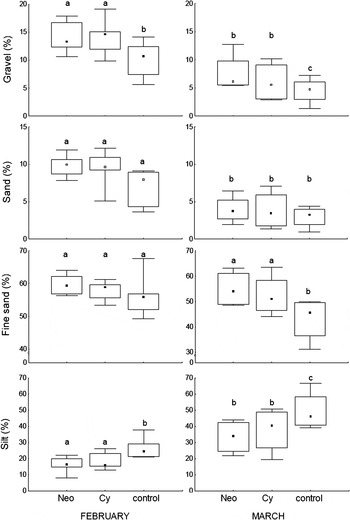
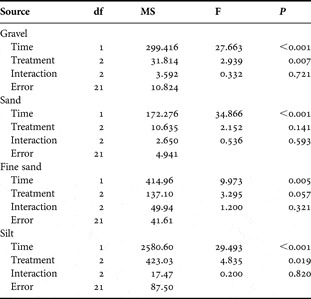
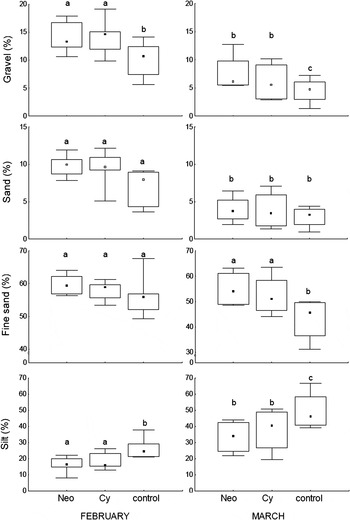
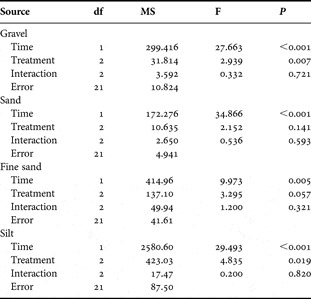
The variances in percentage of gravel, sand, fine sand and silt were homogeneous. Percentages of gravel and sand were higher in the crab inclusion treatments than in the control and also higher in February than in March (Table 2; Figure 3). Percentage of fine sand was lower in control cages in March than in the control cages in February or the crab inclusion cages in February and in March (Table 2; Figure 3). Silt percentage was higher in the control than in the crab inclusion cages either in February or in March (Table 2; Figure 3). In addition, silt percentage was higher during March (Table 2; Figure 3).
Proportion of gravel, sand, and silt after one (February) and two (March) months of different treatments manipulating crab presence. Treatments are: Neo, Neohelice granulata inclusion; Cy, Cyrtograpsus angulatus inclusion; and control, exclusion of both crab species. Different letters indicate differences among treatments.
Two-way analysis of variance results testing for differences in grain size proportions in experimental cages including Neohelice granulata or Cyrtograpsus angulatus, or excluding crabs (treatments) during 1 and 2 months (time).
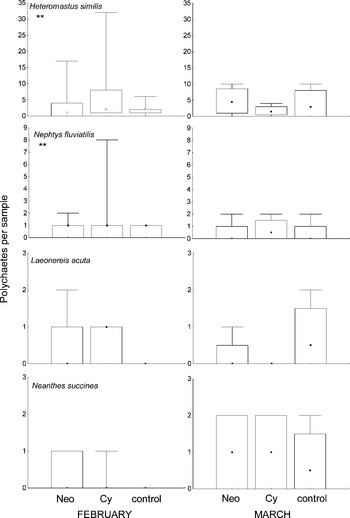
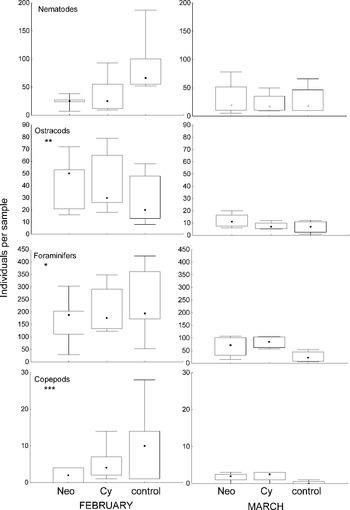
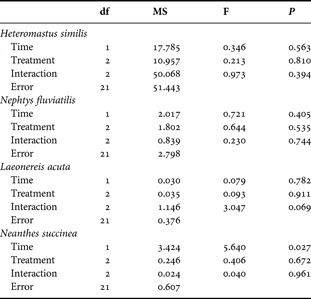
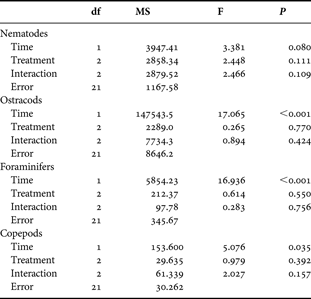
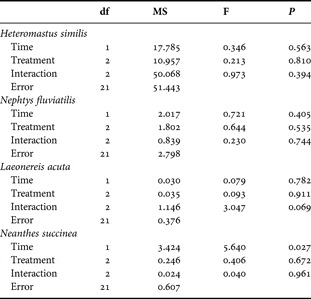
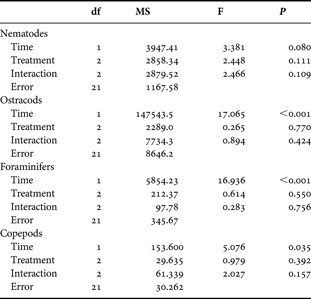
Four polychaete species were found in macrofaunal samples (Heteromastus similis, Nephtys fluviatilis, Laeonereis acuta and Neanthes succinea) and 4 groups were identified in the meiofaunal samples (nematodes, foraminifers, ostracods and copepods). Higher variances were observed in H. similis (C 5 = 0.626, P = 0.007) and N. fluviatilis (C 5 = 0.746, P = 0.006), in treatments with crab inclusion (Figure 4). Mean densities of H. similis, N. fluviatilis and L. acuta did not show difference among treatments nor between months (Table 3; Figure 4). The density of N. succinea was higher in March than in February, while it was no different among treatments (Table 3; Figure 4). The variances of ostracods, foraminifers and copepods were not homogeneous (C 5 = 0.390, P = 0.004; C 5 = 0.489, P = 0.014; C 5 = 0.780, P < 0.001 respectively). Variances in ostracods were higher in February than in March (Figure 5). Foraminifers showed higher variances in the N. granulata inclusion treatment and in the control than in the C. angulatus inclusion (Figure 5). Copepods had higher variances in the control than in the treatments with crab inclusions (Figure 5). Mean densities of meiofaunal organisms were not different among treatments but ostracods, foraminifers and copepods showed a significant effect of time being more abundant in February (Table 4; Figure 5).
Abundance of polychaetes after one (February) and two (March) months of different treatments manipulating crab presence. Treatments are: Neo, Neohelice granulata inclusion; Cy, Cyrtograpsus angulatus inclusion; and control, exclusion of both crab species. Sample size is 10 cm diameter and 5 cm depth. Asterisks indicate heterogeneity of variances (**: P < 0.010; Cochran test).

Abundance of meiofaunal organisms after one (February) and two (March) months of different treatments manipulating crab presence. Treatments are: Neo, Neohelice granulata inclusion; Cy, Cyrtograpsus angulatus inclusion; and control, exclusion of both crab species. Sample size is 2 cm diameter and 2 cm depth. Asterisks indicate heterogeneity of variances (*: P < 0.050, **: P < 0.010, and ***: P < 0.001; Cochran test).

Two-way analysis of variance results testing for differences in abundance of polychaetes in experimental cages including Neohelice granulata or Cyrtograpsus angulatus, or excluding crabs (treatments) during 1 and 2 months (time).
Two-way analysis of variance results testing for differences in abundance of meiofaunal taxa in experimental cages including Neohelice granulata or Cyrtograpsus angulatus, or excluding crabs (treatments) during 1 and 2 months (time).
DISCUSSION
The results of the experiment showed that C. angulatus modify sediment water and organic matter contents and grain size–frequency distributions similarly to N. granulata. These results were also consistent through the experimental time. There were neither mean effects of N. granulata nor C. angulatus on the abundance of infaunal organisms during the experiment. However, their variances showed the same patterns in many cases, indicating effects. Thus, in addition to the similarities in life history traits, our results show that these species have similar effects on sediment structure and species interactions supporting the hypothesis that these crab species play some sort of redundant role. It has implications for the competitive interaction, but also for the possibility of recovery of an ecosystem.
Competition between similar species should be stronger (Abrams, Reference Abrams1983) than between non-related species. In our studied system, the plasticity of C. angulatus to live in the subtidal when N. granulata is present allows for their coexistence. The burrows play a key role in the life of N. granulata, whereas for C. angulatus, burrows seem to be less important (Iribarne et al., Reference Iribarne, Martinetto, Schwindt, Botto, Bortolus and García Borboroglu2003, Martinetto et al., Reference Martinetto, Valiñas, Palomo and Iribarne2007b). However, when N. granulata is absent C. angulatus can construct burrows and have similar effects on the sediment and infauna. Inside N. granulata burrowing beds, C. angulatus has lower density, larger sizes, lower incidence of limb autotomies, and a higher percentage of males than in adjacent areas without N. granulata burrows (Martinetto et al., Reference Martinetto, Valiñas, Palomo and Iribarne2007b). When N. granulata were experimentally excluded within their burrowing beds, new settlers of C. angulatus colonized these areas, made burrows and maintained them until they reached large size (Botto & Iribarne, Reference Botto and Iribarne1999). Another field experiment shows that in absence of N. granulata, adults of C. angulatus construct their own burrows and never use empty N. granulata burrows (Martinetto et al., Reference Martinetto, Valiñas, Palomo and Iribarne2007b). Thus, C. angulatus burrowing activity is constrained when it is sharing the habitat with N. granulata indicating that competitive interaction is strong and N. granulata is the dominant species. The similarity in ecological roles regarding effects on sediment characteristics and abundance of infaunal organisms reported in this study add evidence that the strength of the competitive interaction between these crab species is strong.
Co-occurring species with similar ecological roles turn the ecosystem less vulnerable to disturbance or random species extinction (Walker, Reference Walker1995). This concept has been discussed under different hypotheses (Peterson et al., Reference Peterson, Craig and Holling1998). The major criticism that these hypotheses have received, specially the ‘redundant species’ one (Walker, Reference Walker1992), is that species that are redundant in some ecosystem functions could not be necessarily redundant in their responses to environmental changes or in all the food web interactions (Rosenfeld, Reference Rosenfeld2002). Indeed, the two species here studied do not have potential for redundancy in their food web participation. A stable isotopic study shows that in Mar Chiquita the signature of C differs between them (Botto et al., Reference Botto, Valiela, Iribarne, Martinetto and Alberti2005), indicating that these species have different nutrient sources and that their roles in the food web are different. However, our results support the prediction that the effect of C. angulatus on the sediment and infaunal organisms is similar to the effect of the dominant species. Thus, C. angulatus can potentially play a similar role to N. granulata in the effect on sediment structure and abundance of infauna but it is unknown if other roles, such as food web interactions, can be also similar to N. granulata when it is absent. Given its high abundance and the many ecological interactions mediated by N. granulata (e.g. Botto & Iribarne, Reference Botto and Iribarne2000; Daleo et al., Reference Daleo, Ribeiro and Iribarne2003; Palomo et al., Reference Palomo, Martinetto and Iribarne2004; Martinetto et al., Reference Martinetto, Iribarne and Palomo2005, Reference Martinetto, Ribeiro and Iribarne2007a) it is important to know if there are species in these ecosystems with similar ecological functions. As mentioned above, competition is stronger among species with similar functions and this enhances the functional diversity through and across an ecosystem. This diversity is necessary to maintain the possibility of ecosystem recovery. Our results are evidences that, at least partially, C. angulatus play a redundant role.
ACKNOWLEDGEMENTS
This project was supported by Universidad Nacional de Mar del Plata, ANPCyT and CONICET.