VOX POPULI …
In the late fifth century, the Athenian assembly decided to honour a certain Proxenides, son of Proxenos, of the polis of Knidos in Asia Minor – a decision we know of only because one of the honours granted to Proxenides was for the resulting decree to be inscribed on a stone stele erected on the Acropolis (IG I3 91).Footnote 1 From the fragments which survive, and comparison with other similar texts from the same period, it seems likely that Proxenides was granted, appropriately enough, the prestigious status of proxenos of the Athenians, their official contact and guest-friend at his own community. The details of the decree formulae of this text, well paralleled in contemporary texts, emphasise the orderliness and rationality of the collective decision-making processes involved and hence its authority: the formal decree formula (‘it was decided by the boule and demos’); the preamble specifying the Athenian tribe in prytany at the time (Akamantis); and the names of the men serving as secretary and president of the prytany, and of the formal proposer of the decree.
… VOX DEORUM
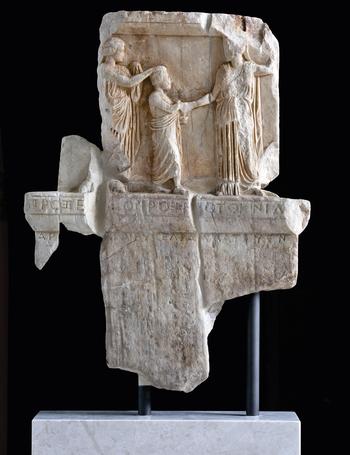
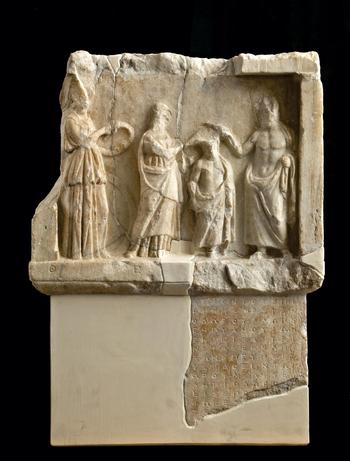
However, probably when this marble stele was commissioned, the decision was also taken to have a relief sculpted at the top of the monument which presents an image of divine agency (Fig. 1). The relief, which would originally have been painted in polychrome (Lawton Reference Lawton1995, 13–14), depicts three well-executed figures: a bearded man flanked by two goddesses whose divine status is signalled by their larger size. The goddess on the right, Athena (identified by her helmet, shield and, lost, bronze applique spear), holds out a crown to the mortal, who is presented to Athena by another female deity. The identity of the mortal honoured in the relief, a stock portrait of the himation-wearing man of Greek public life, is clearly signalled by the honorific decree and specifically by the heading, inscribed in large writing immediately below the relief, which labels the monument as a whole and bridges the space between this image and the text of the decree which follows – ‘Of Proxenides, son of Proxenos, the Knidian’. The correspondence between text and decree is deliberate and obvious – the Athenians honour Proxenides/Athena honours Proxenides. This stone stele, like the many others which juxtapose decrees of the Athenian assembly with reliefs depicting Athena performing equivalent actions, thus asserts a relationship between the two actors, the Athenian assembly and Athena.
Marble stele bearing Athenian honorific decree for Proxenides of Knidos, c.430–415 bc (text: IG I3 91; relief: Lawton Reference Lawton1995, no. 68). Image © Acropolis Museum, AM 2996 (photo: Socratis Mavrommatis).
Heading (reading: Walbank Reference Walbank1978, no. 64): Theoi (‘gods’).
Heading below relief: ‘Of Proxenides, son of Proxenos, the Knidian’.
Heavily restored text begins: ‘Archikles of Alaia was secretary, it was decided by the boule and the demos when the tribe Akamantis was in prytany, and Archikles was secretary, and Antikrates presided, Demostratos proposed the motion: since Proxenides does whatever good he can for the Athenians, both now and in previous time, to praise him and write him up as a proxenos and benefactor on a stone stele and place it on the acropolis …’
Προξε[νίδ]ο Προξένο το͂ Κνιδ[ίο]·
Ἀρχ̣ικλε̣͂[ς] Ἁ̣λ̣αιεὺς ἐγραμμάτευεν v [ι] Ἀθενα̣[ίος καὶ νῦν καὶ ἐν το͂ι πρόσ]-
ἔδ[ο]χσε[ν τε͂ι βολε͂ι καὶ το͂ι δέμ]οι· Ἀ- [θε]ν χρόν̣[οι ἐπαινέσαι τε αὐτο͂ι κα]-
κα̣[μ]αντ[ὶς ἐπρυτάνευ]ε, [Ἀρχικλ]ε͂[ς ἐ]- [ὶ ἀνα]γρ[άφσαι αὐτὸν ἐστέλει λιθί]-
[γ]ραμμά[τευε, Ἀντικράτες] ἐ[πε]στά[τ]- [νει πρόχσενον καὶ εὐεργέτεν Ἀθε]-
[ε], Δεμόσ[τρατος εἶπε· ἐπειδὲ εὖ ποι]- [ναίον καὶ καταθε͂ναι ἐμ πόλει ․․․]
εῖ Προχ[σενίδες ℎό τι ἂν δυνατὸς ἐ͂]- …
This observation is the starting point for the present article. Although it has not been entirely overlooked, it has attracted surprisingly little discussion, principally because an apparently obvious interpretation of the relationship between the two has been assumed in most modern scholarship. For the most part, the document reliefs have been read as symbolic illustrations of the actions of the decrees: Athena, in crowning Proxenides, is read as ‘representing’ the Athenians, and, similarly, other deities, where they are depicted, are read as straightforward symbols standing for other state actors.Footnote 2
The purpose of this article is to explore the consequences of taking these depictions of gods in action seriously as references to divine agency and to unpick the nature of the relationship which they depict between the gods and public authorities. It takes its particular impetus from recent work, most notably by Robin Osborne, Verity Platt and Jaś Elsner, emphasising the importance of visual culture as a source for ancient history, and especially ancient theologies (Osborne, R. Reference Osborne2011; Platt Reference Platt2011; Elsner Reference Elsner2015; see also Gaifman Reference Gaifman, Eidinow, Kindt and Osborne2016).Footnote 3 Central is the idea that the evidence of visual culture is best explored alongside textual sources precisely because it provides a perspective which is in some sense independent of them, since the ‘discourse of image’ had its own conventions, capabilities and constraints, which were distinct from, and complemented, those under which the ‘discourse of text’ operated (Elsner Reference Elsner2015). In particular, images tend to be under-determined and permit certain kinds of ambiguity, and this made them particularly fruitful for dealing with issues of divine agency in ancient contexts in which knowledge of the actions of the gods in particular instances was recognised as being fundamentally uncertain (Platt Reference Platt2011, 39).
In this article, after discussing the iconography of the document reliefs and their treatment in modern historiography, I examine the theological interests of these monuments by exploring them firstly in the context of dedicatory monuments with similar representations of the gods and then in the context of the other ways in which inscribed public documents were connected with the gods, namely by being placed in sacred spaces and inscribed with the heading theoi. The second half of this article then addresses the question of how these references to the gods could have been read by contemporaries and accommodates their ambiguities by exploring a range of different readings enabled by these monuments.
The crucial question which the exploration of these monuments poses, concerning the role of gods in public decision-making, has attracted surprisingly little attention, despite the centrality of the polis religion paradigm to scholarship on Greek religion over the last 30 years, and the work of Josine Blok on citizenship as a contract between citizens and their gods has given it a new urgency (Blok Reference Blok, Rapp and Drake2014; Reference Blok2017).Footnote 4 Moreover, in one recent contribution in which this issue has been considered, the lack of reference to gods in the oratorical sources has been taken to demonstrate that the gods had no such role in relation to the decisions of the Athenian assembly (Martin Reference Martin, Eidinow, Kindt and Osborne2016). In this article, on the contrary, I argue that the document reliefs present vivid evidence that the gods were accorded a role, but allow for uncertainty regarding its nature.
HISTORY AND ICONOGRAPHY
In total, fragments of almost 190 Athenian document reliefs have been identified, 187 of which are catalogued in Carol Lawton's lavishly illustrated handbook (Lawton Reference Lawton1995).Footnote 5 The surviving evidence suggests that document reliefs first begin to be attested at Athens in the last third of the fifth century bc, a period which saw a considerable expansion at Athens of the production of public, honorific inscriptions as well as of dedicatory reliefs.Footnote 6 Thereafter, the practice of inscribing document reliefs is well attested until the end of the fourth century bc when it seems to disappear in the context of a wider transformation of Athenian documentary practice in the Early Hellenistic period.Footnote 7 In Lawton's catalogue, the material is spread relatively evenly over this period, with c.28 (allowing for margins of uncertainty) assigned to the fifth century bc and almost all the remainder split quite evenly between the first and second halves of the fourth century bc. The overall impression is that reliefs represented a reasonably frequent feature of Athenian documentary practice throughout this period, especially by comparison with the much more limited evidence for non-Athenian examples which paints a picture of patchy and sporadic attestation elsewhere.Footnote 8 Nonetheless, the numbers involved make it unlikely, even at Athens, that document reliefs were ever commissioned for more than a minority of the texts which were selected for inscription (Lawton Reference Lawton1995, 22).
Despite the relatively long period over which these different reliefs were produced, taken together they exhibit a remarkably restricted iconographic range. To leaf through Lawton's illustrated catalogue is to be presented with a stream of constantly repeating actors and scenes, which is narrow even by the standards of a visual culture given to stock scenes and repeating types. Perhaps the most striking feature of these reliefs is their preoccupation with the gods. Whereas the document reliefs sporadically attested for other communities are most likely to reproduce a symbol associated with the honorand (usually the parasemon of his home polis), at Athens this type is comparatively rare, with perhaps no more than 14 examples.Footnote 9 By contrast, there is reasonably clear evidence for no fewer than 146 of the surviving examples (many of which survive in a very fragmentary state) that at least one deity was depicted, usually Athena.Footnote 10 In addition, the reliefs, as a rule, do not depict a single deity in isolation, but scenes involving multiple figures, either more than one deity or deities alongside mortals, and involving interactions between them. Their particular focus appears to have been on depicting the gods as active agents.
Although the fragmentary nature of the surviving evidence means that many scenes cannot be clearly identified, it is apparent that a relatively small number of types of scene predominate. The Proxenides relief is an example of the most frequently attested scene type, in which the deity is depicted holding out a crown to a mortal or placing it on their head (Meyer, M. Reference Meyer1989, 132–9; Blech Reference Blech1982, 175–82). In decrees of the Athenian demos, the deity in question is usually Athena (Lawton Reference Lawton1995, 31–3), but from the middle of the fourth century bc Athena is replaced or supplemented as the crowning deity by a personification of the demos itself, sometimes accompanied by a corresponding female personification of the boule (Meyer, M. Reference Meyer1989, 177–86; Lawton Reference Lawton1995, 55–8; Glowacki Reference Glowacki2003; Smith Reference Smith2011, 96–103). Conversely, in the decrees of demes and other groups within Athens, deities particularly associated with these groups become the principal actors (Lawton Reference Lawton1995, 33–6). In total there are no fewer than 43 clear examples of this kind of scene, spanning the whole period in which document reliefs were sculpted at Athens, and it is very likely that the majority of all document reliefs consisted of this type.Footnote 11
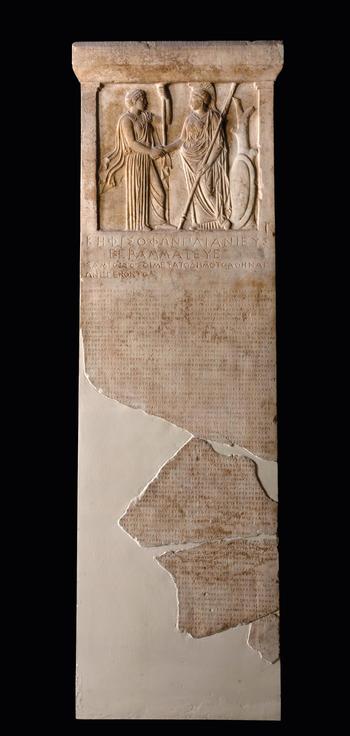
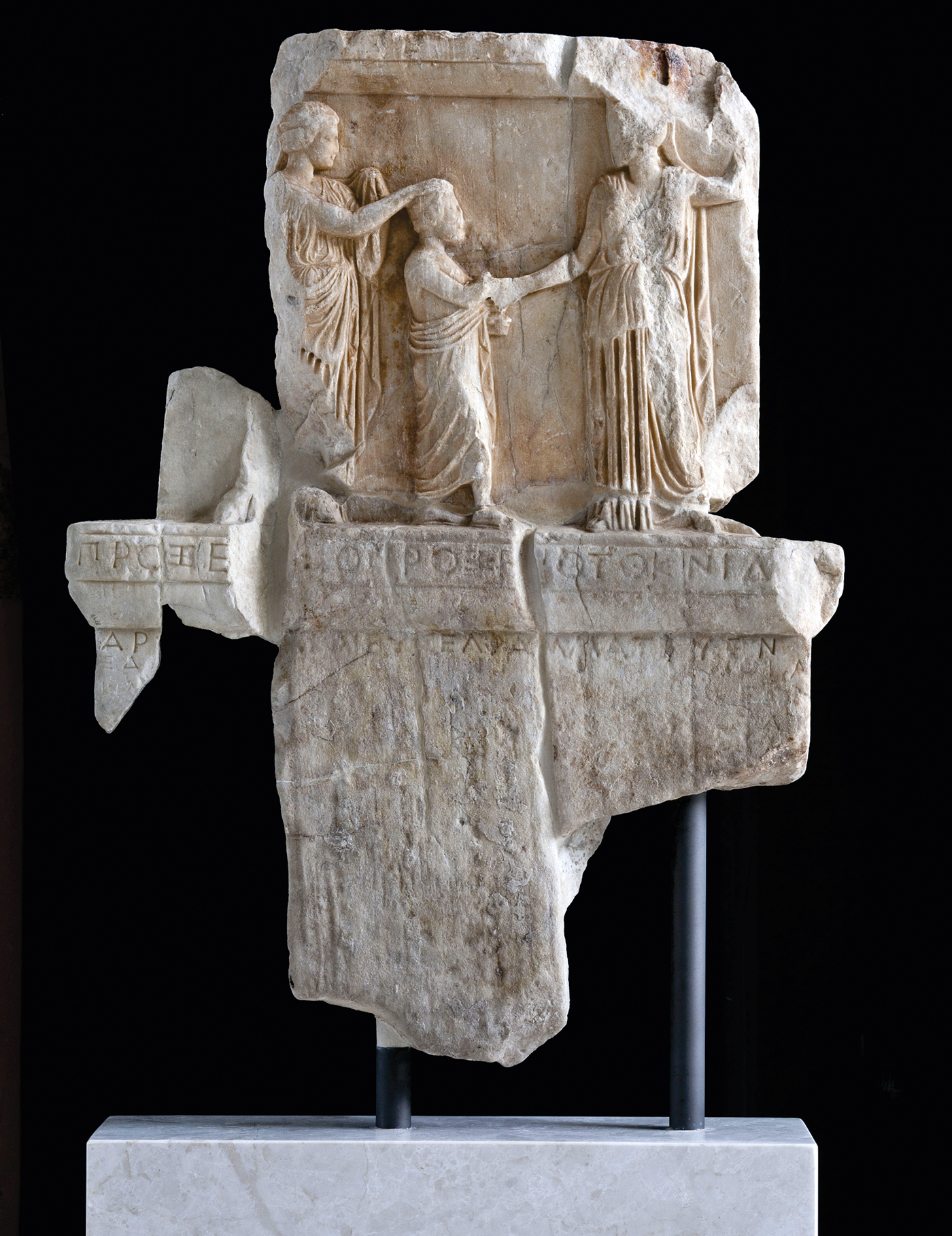
The second type of relief which places a particularly strong emphasis on divine action is that which depicts two deities (one of them usually Athena) engaged in dexiosis (clasping right hands; Meyer, M. Reference Meyer1989, 140–4). The most famous example of this dexiosis type is the Athenian stele inscribed with decrees honouring the Samians, on which Athena is depicted clasping the hand of Hera, the patron deity of the Samians (Fig. 2). There are 11 clear examples of divine dexiosis preserved in the record, the earliest in 424/423 bc, the latest in 354/353 bc, though the latter is rather an outlier – all the other examples seem to fall in the late fifth century bc and the first quarter of the fourth century bc (Lawton Reference Lawton1995, 36–7, nos 2, 5, 7, 9, 12, 13, 14, 16, 28, 82, 110).
Marble stele bearing Athenian decrees for the Samians, 403/402 bc (texts – three Athenian decrees, spanning the late fifth and early fourth centuries, and therefore treated separately: IG I3 127 and Rhodes – Osborne, GHI 2; relief: Lawton Reference Lawton1995, no. 12). Image © Acropolis Museum, AM 1333 (photo: Socratis Mavrommatis).
Heading 1: ‘Kephisophon of the deme Paiania was secretary’.
Heading 2 (smaller letters): ‘For the Samians who were with the demos of the Athenians’.
First decree (late fifth century bc) begins: ‘It was decided by the boule and the demos, the tribe Kekropis was in prytany, Polymnis of Euonymon was secretary, Alexias was archon, Nikophon of Athmonon presided, proposal of Klesophos and his fellow prytany members: to praise the ambassadors from Samos …’
Κηφισοφῶν Παιανιεὺς
ἐγραμμάτευε.
Σαμίοις ὅσοι μετὰ το͂ δήμο το͂ Ἀθηναί-
ων ἐγένοντο vac.
ἔδοξεν τῆι βολῆι καὶ τῶι δήμωι· Κεκροπὶς ἐπρυτάνευε, Πόλυμνις Εὐωνυμεὺς
ἐγραμμάτευε, Ἀλεξίας ἦρχε, Νικοφῶν Ἀθμονεὺς ἐπεστάτει· γνώμη Κλεσόφο
καὶ συνπρυτάνεων· ἐπαινέσαι τοῖς πρέσβεσι τοῖς Σαμίοις…

There are two other less well-defined types of scene involving the gods, which are also less obviously defined by a concrete action performed by the deity: a third type, reliefs depicting more than one god standing or sitting alongside each other (10 examples: Lawton Reference Lawton1995, nos 3, 8, 20, 24, 34, 96, 154, 155, 156, 157); and, a fourth type, reliefs depicting a deity approached by one or more mortals who are often presented as worshippers, sometimes with altars (11 examples: Lawton Reference Lawton1995, nos 22, 47, 61, 73, 83, 87, 125, 127, 138, 142, 152). Both, however, still tend to communicate the idea of a particular event through their depiction of a specific set of actors and interaction between them, by means of hand gestures and lines of sight. Finally, as a fifth type, with only two extant examples, are reliefs which depict a variant of the crowning scene, in which both the figure presenting the crown and the figure receiving it are deities (Lawton Reference Lawton1995, nos 38, 143).
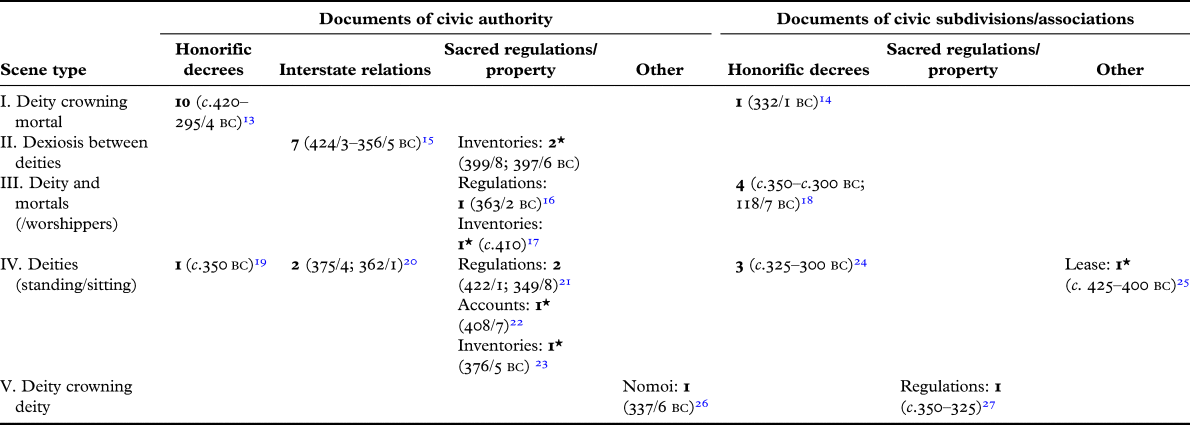
The fragmentary state in which so many reliefs and decrees are preserved means that only in a comparatively small number of cases can we confidently make a comparison between the scenes depicted and the content of the decrees they accompany – 28 documents of the Athenian state and 10 produced by demes, tribes and various Athenian associations. Nonetheless, from the set of examples which we do have, clear patterns emerge in relation to the use of the first two types of scene in connection with particular kinds of civic decrees (see Table 1).
The relationship between the subject matter of public documents and the accompanying relief iconography involving gods. Asterisks denote documents produced by officials rather than decrees of the Athenian assembly or the collective assembly of a civic subdivision or association.

13 Lawton Reference Lawton1995, nos 65 (IG I3 65), 68 (IG I3 91), 30 (IG II2 133), 36 (IG II3 1 231), 46 (IG II3 1 351), 49 (IG II3 1 376), 54 (IG II3 1 378/II2 448), 59 (IG II3 1 853).
14 Lawton Reference Lawton1995, no. 32 (SEG XXVIII 102).
15 Lawton Reference Lawton1995, nos 2 (IG I3 61), 5 (IG I3 86), 7 (IG I3 101), 9 (IG I3 124), 12 (IG I3 127/II2 1), 16 (IG II2 18), 28 (IG II2 128).
16 Lawton Reference Lawton1995, no. 22 (SEG XXI 241).
17 Lawton Reference Lawton1995, no. 73 (SEG XXXVII 31).
18 Lawton Reference Lawton1995, nos 47 (IG II2 1256), 127 (IG II2 1187), 152 (IG II2 1193), 61 (AM 66, 228 no. 4).
19 Lawton Reference Lawton1995, no. 132 (IG ΙΙ3 1 497).
20 Lawton Reference Lawton1995, nos 96 (IG II2 97), 24 (IG II2 112).
21 Lawton Reference Lawton1995, nos 3 (IG I3 79), 34 (IG II3 1 297).
22 Lawton Reference Lawton1995, no. 8 (IG I3 375).
23 Lawton Reference Lawton1995, no. 20 (IG II2 1410).
24 Lawton Reference Lawton1995, nos 154 (SEG XXXVI 186), 155 (IG II2 1202), 157 (SEG III 116).
25 Lawton Reference Lawton1995, no. 156 (IG II2 2496).
26 Law against tyranny: Lawton Reference Lawton1995, no. 38 (IG II3 1 320).
27 Lawton Reference Lawton1995, no. 143 (SEG XXI 519).
The deity-crowning-mortal scene seems to be exclusively used on document reliefs accompanying honorific decrees, and on this basis it seems reasonable to suppose, as Lawton does, that where we can identify scenes of this kind we should assume that they accompanied honorific decrees (see also Lambert Reference Lambert2012, 180–3). The evidence of other kinds of divine scene used in relation to honorific decrees of the assembly is also slight, confined to a single example (and here the idea of the honorand being crowned may in fact be conveyed by the relief).Footnote 12
The correlation between the use of the dexiosis scene and documents concerning relations with other states is almost as strong. All nine extant reliefs involving dexiosis for which there is textual evidence seem to derive from civic monuments, and six with certainty, seven with high probability, accompanied decrees relating to interstate relations.Footnote 28 Two other decrees relating to interstate relations – treaties with Corcyra in 375/374 bc and the Arkadians, Achaians, Eleians and Phleiasians in 363/362 bc – are accompanied by reliefs depicting deities who do not engage in dexiosis (though here it may be relevant that both date towards the end of the period during which the use of dexiosis scenes is attested and depict more than the two gods who could engage in dexiosis).Footnote 29
These two correlations, between reliefs depicting deities crowning mortals and honorific decrees, and, to a lesser extent, between reliefs depicting dexiosis and interstate-relation documents, define the use of document reliefs at Athens and their iconographic programme. Of all the types of public document, honorific decrees in particular accompany by far the largest number of reliefs produced within this tradition, including some 90 examples which we can confidently identify on the basis of preserved textual or iconographic evidence, nearly half Lawton's total of all surviving examples.Footnote 30 For this reason, these two types of monument are the primary focus of the present examination of the role of the gods in public affairs which these texts suggest.
By contrast, many fewer decrees with a specifically religious content seem to have been accompanied by reliefs in the first place (13), and, where enough of the relief survives for us to identify confidently the scene depicted, their iconography exhibits a considerable amount of variation (Lawton Reference Lawton1995, nos 3, 4, 6, 8, 13, 14, 20, 22, 34, 67, 70, 73, 143). For example, the four reliefs accompanying inventories with identifiable scenes involving the gods depict different types of scene, and this complicates their interpretation without necessarily implying important differences in the meanings which were invested in them. The documents accompanied by a relief produced by civic subdivisions – tribes, demes and religious associations of different kinds – exhibit even less evidence of a settled iconography, presumably a reflection of the sporadic and secondary nature of the production of document reliefs at this level. In relation to honorific decrees, for example, civic subdivisions are attested as using no fewer than three different types of relief in their honorific decrees, and the style and execution of some of these owes much more to the depiction of devotional scenes on dedicatory reliefs than to the conventions exhibited by other document reliefs.Footnote 31
HISTORIOGRAPHY
The iconographic programme of the document reliefs, which present scenes of divine agency sculpted above inscriptions recording analogous public speech-acts, poses a question to viewers: how should the relationship between these two coinciding acts – and two sets of actors – be read? In modern scholarship there has been little acknowledgement of this as a question, because a clear answer has been assumed, which, effectively, reads the gods out of these monuments. In the monographs devoted to the document reliefs they have been viewed as illustrations of the decrees, primarily intended, in the words of Lawton, ‘to convey in symbolic pictorial terms the specific content of their inscriptions’ (Lawton Reference Lawton1995, 40; cf. Meyer, M. Reference Meyer1989, 254). In consequence, in both Lawton Reference Lawton1995 and Meyer, M. Reference Meyer1989, and most of the scholarship which makes serious use of this material, the deities in these reliefs have been interpreted as little more than symbolic representations, or ciphers, of relevant state actors – with Athena representing Athens and other state actors symbolised by deities associated with their communities.Footnote 32 At most, passing reference has been made to the possibility that the depictions of deities in these decrees might be taken seriously as representations of gods, but without detailed consideration of what this might mean or entail in general or specific cases (Lawton Reference Lawton1995, 28; cf. Meyer, M. Reference Meyer1989, 207, 247 and Meyer, E. Reference Meyer2013, 468).
Although little explicit argument has been offered in support of this interpretative approach to the deities of the document reliefs, as primarily symbols for states, it is not hard to identify reasons why it has been favoured. Not least of these is the fact that it provides a straightforward key which can easily be used to read the iconography of these monuments and the relationship between the texts and images which they present. In the case of the Proxenides monument, for instance, reading Athena as simply a representation of the Athenian collective responsible for the decree and the other deity, usually identified as Aphrodite, as a symbol of the city, Knidos, of which she was patron deity, appears to be the least complex way of interpreting the link which is implied by the juxtaposition of the two and, incidentally, results in a satisfying symbolic reading of the relief as a visual representation of proxeny, as an institution linking poleis (Mack Reference Mack2015, 1–2). A symbolic reading of the depiction of dexiosis between Hera and Athena on the Samian stele, as an expression of friendship and agreement between two city-states, is apparently even more straightforward, especially given the partial semantic overlap between ancient dexiosis and the modern handshake (Lawton Reference Lawton1995, 30). Theological readings of this material, by contrast, rapidly pose difficult questions about the precise ways in which the agency of the gods should be understood in relation to political action at Athens.
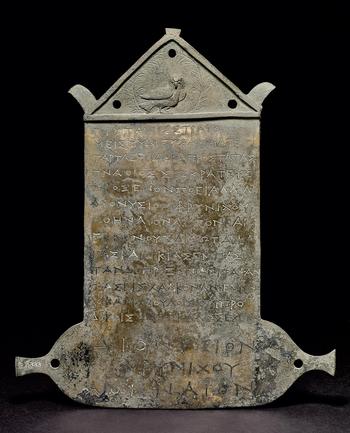
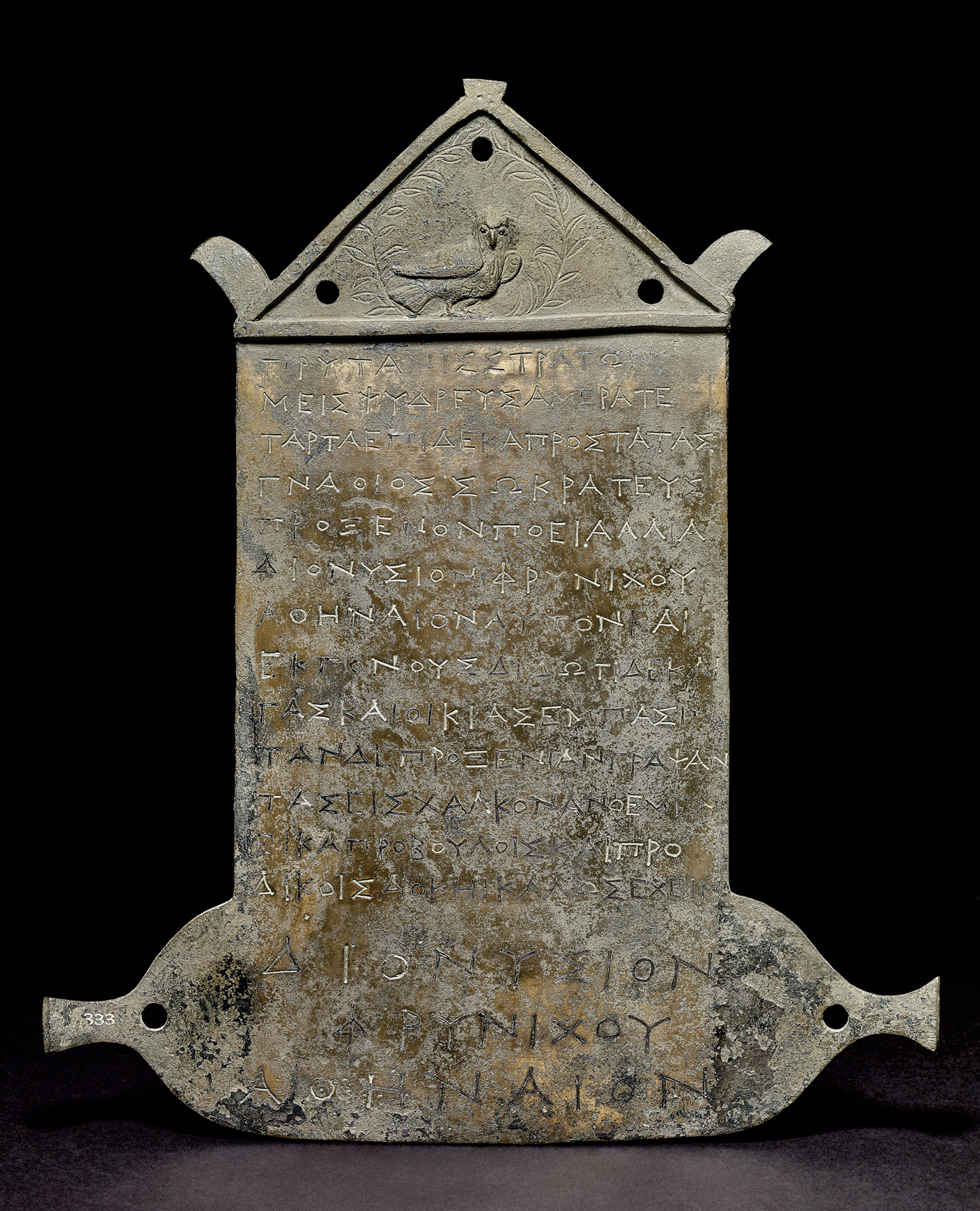
Readings which essentially treat the depiction of the deities on the document reliefs as a form of illustration seem, on the face of it, to make more sense of the apparently haphazard nature of the processes which led to the production of this material and the probable role, which some critics have seen, for personal agency (see below, ‘Modalities of production’). Scholars have also presumably been encouraged in concentrating on the symbolic reading by the fact that these scenes depicting the gods occur alongside document reliefs which do use imagery in this way, notably those which reproduce the parasemon of the honorand's polis – the symbol used in official contexts by a community, such as on the seal of state and civic coinage (Ritti Reference Ritti1969; Meyer, M. Reference Meyer1989, 150–6; Killen Reference Killen2017). Thus an Athenian proxeny decree for a citizen of Akragas is decorated with a relief depicting a crab, the punning civic blazon of Akragas.Footnote 33 Similarly, above a Corcyrean proxeny decree for an Athenian inscribed on a bronze plaque we find the owl of Athens (Fig. 3). The picture is further complicated by the depiction of eponymous heroes and heroines whose names suggest a particularly close link with the community in question.Footnote 34
Bronze plaque bearing proxeny decree of the Corcyreans for Dionysios the Athenian, end of fourth century bc (text: IG IX Ι2 4 786). Image © The Trustees of the British Museum, BM 1868,0110.3.
Decree: ‘The prytanis was Straton, the month Psydreus, on the 14th day, the prostates, Gnathios son of Socrates. The assembly makes Dionysios the son of Phrynichos, the Athenian, a proxenos and his offspring as well and gives (him) the right of purchasing land and houses. Having inscribed the proxeny on a bronze plaque, place it where it seems good to the probouloi and prodikoi.’
Heading (below the text): ‘Dionysius son of Phrynichos, the Athenian’.
πρύτανις Στράτων·
μεὶς Ψυδρεύς, ἁμέρα τε-
τάρτα ἐπὶ δέκα· προστάτας
Γνάθιος Σωκράτευς·
πρόξενον ποεῖ ἁ ἁλία
Διονύσιον Φρυνίχου
Ἀθηναῖον αὐτὸν καὶ
ἐκγόνους. δίδωτι δὲ καὶ
γᾶς καὶ οἰκίας ἔμπασιν.
τὰν δὲ προξενίαν γράψαν-
τας εἰς χαλκὸν ἀνθέμεν
εἷ κα προβούλοις καὶ προ-
δίκοις δοκῆι καλῶς ἔχειν.
Διονύσιον
Φρυνίχου
Ἀθηναῖον.
More recent work has challenged this approach to reading the reliefs as primarily the illustrations of the actions of inscriptions. In particular, Alastair Blanshard and Jaś Elsner have used particularly detailed readings of one particular monument, the Samos stele (of which Elsner offers the first full publication of both text and relief), to develop a new approach to this material, which opens up gaps between document and relief, and highlights the possible mismatch between the two and potential for idiosyncratic, even subversive readings.Footnote 35 Nonetheless, although both show more caution in reading a symbolic equivalence between the deities depicted and the states mentioned in the decree, neither abandons it completely as an interpretative strategy or explores the theological readings of this material in general.Footnote 36 In part this is because their focus is primarily on exploring the particularities of (and parallels for) a specific example, rather than on the expected readings of this repetitive material as a genre.
VISUAL THEOLOGY
On closer examination of this material en masse, the reading of gods in document reliefs as straightforward symbolic representations of civic authority encounters a number of arguably insoluble problems. In particular, depictions of gods probably could not have served simply as flat emblems of civic identity. Unlike the owl of Athens or crab of Akragas, which had little meaning in a public context beyond the cities they symbolised, a depiction of the goddess Athena – who was, of course, the recipient of cult in many places other than Athens – would necessarily invite a more complex response. Even though Athena and, for example, Herakles were undoubtedly closely linked with the polis of Athens and the various Herakleias, it is difficult to see how they could have been intended to be read simply as symbols for these states.
This is also the implication of a rich vein of recent research, which has highlighted the importance of visual representations of divinity both as evidence of contemporary engagement with theological issues and as a visual environment which would itself have shaped such engagement (Osborne, R. Reference Osborne2011; Platt Reference Platt2011; Gaifman Reference Gaifman, Eidinow, Kindt and Osborne2016). The work of Verity Platt, in particular, uses a related category of reliefs, from votive dedications, to explore the issue of divine presence. In these reliefs, human worshippers are depicted making offerings to particular gods, whose presence is signalled by sculptors in different ways. In one case, Asclepius is depicted seated within the temple building, in the form of his official cult statue which would have been familiar to viewers, but he is represented, within the context of the relief, not as a statue but in the same naturalistic style as the mortal devotees who gaze at him. The visual implication is that Asclepius is present in this scene in a similar way to the worshippers and is accessible by them through his cult statue. In Platt's analysis, another example, from Aegina, explores a different model for understanding divine presence. In this relief a female goddess, probably Hekate, is shown in the context of a libation at an altar, but here the goddess is carved in much shallower relief than the worshippers and is pushed into the background of the image; she is present at the ritual honouring her, but apparently unseen by the participating mortals themselves (Platt Reference Platt2011, 31–50).
Though Platt's analysis is particularly nuanced, she is, of course, far from the first scholar to read relief sculpture as an important source of evidence for ancient religion. In fact, scenes depicting the gods, similar to those deployed in relation to documents, have regularly been read in the context of other monuments without the kind of secularising interpretation which is the norm for the document reliefs. For example, when a victorious athlete dedicated an image of himself being crowned by the gods, the athlete in question was, modern scholars have argued – surely rightly – making an uncontroversial statement of gratitude that his victory, on the mortal plane, was brought about through the action and intervention of the gods above (Spivey Reference Spivey1997, 88–9). In the same way, it is hard to fault Christian Habicht's reading of the Spartan victory monument at Delphi, celebrating their defeat of the Athenians. This statue group, which included a statue of the successful admiral, Lysander, being crowned by a statue of Poseidon (with statues of the Dioskouroi, Zeus, Apollo and Artemis also present), clearly makes pious reference to the role played by the gods and particularly Poseidon in bringing about the Spartan victory at the Battle of Aigospotamoi; this is further underlined by the inclusion of a statue of Lysander's seer, Agias, along with one of his helmsman (Pausanias 10.9.7 with Habicht Reference Habicht1970, 6; Blech Reference Blech1982, 176–7).
The contrast is striking. In relation to these kinds of victory dedications, it has been relatively unproblematic to identify and understand Greek beliefs in divine intervention given the role which chance played – beliefs which were so conventional that military conquest itself was frequently represented as a basis for legitimate ownership of territory and major athletic victors themselves acquired more than a patina of holiness as a result of being crowned by divine favour.Footnote 37 The deployment of the same iconography in relation to Athenian honorific decrees, however, has led to a reading which in practice all but effaces theological content, presumably because of modern secularising assumptions concerning Athenian political institutions and their ‘rational’ basis in collective, deliberative decision-making. The implication of this is that ancient viewers on the Athenian Acropolis, when presented with a visual field densely populated with images of the gods and above all Athena, would be expected to identify some Athenas as primarily standing in as symbols for the Athenian state, in contrast with Athenas depicted in reliefs set up to thank the god and, indeed, cult images of the deity (some of which were in fact imitated by the document reliefs).Footnote 38
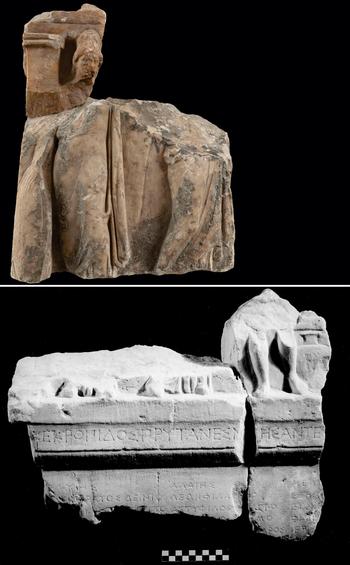
A different kind of victory monument highlights the contradictions of this approach to interpreting the deity-crowning-mortal scene type in the two kinds of relief (Fig. 4). This is a stele which resembles in form the Athenian document reliefs sufficiently closely to be incorporated in Lawton's catalogue despite the fact that the inscription clearly identifies it as a victory dedication (Lawton Reference Lawton1995, no. 97 = IG II3 4 23) and despite Lawton's criticism of the inclusion of other dedicatory reliefs by Marion Meyer in her study of the document reliefs (Lawton Reference Lawton1995, 3). The inscription begins ‘the victorious prytaneis of the tribe Kekropis [dedicated this]’ followed by a list of the demes and names of the prytaneis. The relief above, preserved in fragments, depicts, from left to right, Athena with shield and then Nike holding out what must have been a crown to a smaller male figure, who is interpreted as standing in for the 50 victorious prytaneis whose names were inscribed below (Fig. 4). The iconography of this relief, like other victory monuments, clearly presents victory as a manifestation of divine favour, but, despite the depiction of the prytanis as bare-legged (a nude athlete or chiton-wearing warrior rather than a himation-wearing man of civic life), ‘his’ victory was manifestly political rather than athletic or military. It was the result of a vote, probably in this case by the Athenian assembly rather than the boule itself, to crown the most effective prytany of the year and award a hydria, depicted here next to the honorand (Rhodes Reference Rhodes1972, 23).
Two fragments of marble stele dedicated by the tribe Kekropis to commemorate their victory, first half of the fourth century bc (text: IG II3 4 23; relief: Lawton Reference Lawton1995, no. 97). Upper fragment image © Acropolis Museum, AM 3367 + 2542 (photo: Socratis Mavrommatis); lower fragment image © Epigraphic Museum, EM 8024.
Heading: ‘the victorious prytaneis of the tribe Kekropis [dedicated this]’ (the names of the prytaneis, in three poorly preserved columns, follow below).
Κεκροπίδος πρυτάνες ν[ικ]ήσαντε[ς ‒ ‒ ‒ ‒ ‒]

On this basis, there seems little reason to doubt that the reliefs which are the focus of this article similarly imply the involvement of the gods in the political actions represented by the inscriptions they accompany, especially (as in the last case) in relation to decisions of the Athenian assembly. It is therefore incumbent upon us to explore the ways in which divine agency is likely to have been envisaged in these cases. First, however, it is important to situate these document reliefs within the wider context of references which public inscriptions more generally made to gods, at Athens and elsewhere, and examine the relevance of the processes by which document reliefs were commissioned for particular inscriptions – and not others – to our interpretation of their theological significance.
PUBLIC INSCRIPTIONS AND THE GODS
Reliefs depicting the gods were not the only means by which inscribed public documents were brought into a relationship with the gods, and nor were they the most common. Both before and during the period in which document reliefs were regularly produced, the vast majority of all public documents inscribed at Athens were erected in the sacred space of the Athenian Acropolis (including most of those with document reliefs)Footnote 39 and a large number of public documents were also inscribed with the heading theoi, ‘gods’. The exploration of the meaning of the document reliefs, with their representations of the gods which are in some respects quite explicit, provides an important opportunity to reconsider the meanings which were invested in these other, apparently more ambiguous epigraphic practices, and they, in turn, are vital for understanding the wider context within which the document reliefs arose and developed.
Inscriptions as dedications
The normality, in the Greek world, of the use of religious sanctuaries as places for the publication of public documents is well recognised (Lalonde Reference Lalonde1971, 52–67; Detienne Reference Detienne and Detienne1988, 42; Hölkeskamp Reference Hölkeskamp1992, 100; Thomas Reference Thomas, Foxhall and Lewis1996, 28–9). For Athens, the central importance of the Acropolis as a place of publication for the development of Athenian public epigraphy has been clearly established (Liddel Reference Liddel2003),Footnote 40 and its prominence has come to be widely accepted as reflecting the importance of the Acropolis as a religious space, which thereby conferred ‘a religious aura’ on the enactments erected there (Osborne, R. Reference Osborne, Goldhill and Osborne1999, 347; Liddel Reference Liddel2003, 81). Other features of the form and fabric of the document stelai at Athens (and elsewhere) have also been identified as drawing these monuments into a relationship with the gods – including the pediments adorning many of the stelai which echo the architecture of surrounding temples (Lambert Reference Lambert2018, 22), the care given to the layout of the lettering, to make it pleasing to the gods (Meyer, E. Reference Meyer2013, 461) and even the very fabric of the stelai themselves, imperishable marble (Bresson Reference Bresson, Bresson, Cocula and Pébarthe2005). Two recent contributions, by Elizabeth Meyer and Stephen Lambert, have explored at some length the importance of the Acropolis as a sacred context for the interpretation of these monuments. The key question they raise concerns the status of these monuments – in particular whether, given the fact that they were deliberately set up in the sanctuaries, they should be understood as dedications to the gods. For Meyer, public document stelai set up in sanctuaries should, like any other property placed in a sacred space, be recognised as gifts for the gods, but Lambert highlights certain difficulties (Meyer, E. Reference Meyer2013, 459–60; Lambert Reference Lambert2018, 22–3).Footnote 41
In part, this is an issue of terminology. Dedications tend to be identified, in accompanying inscriptions, by the use of the aorist verb anetheken, he/she ‘set up’, often specifying a recipient deity in the dative, or are typically described as an anathema, a ‘thing set up’, or an agalma, an ‘adornment’ (van Straten Reference Straten and Versnel1981; Parker Reference Parker2004; Jim Reference Jim2012; Patera Reference Patera2012). Although there is at least one honorific decree, from Elis, inscribed on a bronze disc, which describes itself as an ‘agalma belonging to Zeus’,Footnote 42 at Athens, documentary inscriptions tend to refer to themselves in different terms. The publication clauses of public decrees instead refer to ‘writing up’ (anagrapsai) the text on a stone stele, which is to be ‘stood’ (stesai) or, sometimes, ‘set down’ (katatheinai) in a particular place (usually on the Acropolis), but not for a particular god (Liddel Reference Liddel2003; Lambert Reference Lambert2018, 22–3).
The real crux of this debate, however, is the sense in which document stelai could have been considered gifts for the gods. How far could they have been conceived of as gifts benefitting the gods in any of the ways which seem to have been recognised by contemporaries, for example those set out by the eponymous interlocutor in Plato's Euthyphro – as giving honours (timai), the god's dues (gera) or thanks (charis)?Footnote 43 Other kinds of dedications, following victory or the fulfilment of a prayer, obviously fulfil more than one of these functions (van Straten Reference Straten and Versnel1981, 65–75). They give thanks for a positive result brought about by a god and honour the deity in question by bearing witness to their power. How the stelai inscribed with public documents could be thought of as benefitting the god in this way is, on the face of it, harder to pin down.Footnote 44 That is, unless we take the evidence of the document reliefs seriously.
The document/relief monuments seem to provide answers to both of the central questions in this debate, making the ‘strong conceptual overlap’, which Lambert acknowledges between document stelai and dedications in general, nearly perfect (Lambert Reference Lambert2018, 23). In form, these monuments identify themselves with dedicatory reliefs, as they would have appeared in situ, much more closely than is now apparent: visually, they combine the relief which was ‘set up’ (anatheken) with the pillar which was the means by which it was ‘set up’ off the ground (van Straten Reference Straten and Schachter1992; Lawton Reference Lawton2017, 19, fig. 2). The reliefs themselves, moreover, by depicting deities performing an action which was equivalent with and therefore linked in some way to the action of the decree, suggest a way in which these monuments could have been thought of as suitable gifts for the gods. As I have argued, the implication in these cases is that the gods were in some way involved in the decisions and actions which the inscriptions documented. On this basis, the document stelai (both those set up with a relief and potentially those without) could have been understood as gifts to the gods, like other dedications, honouring them by highlighting their power to influence the Athenian state and, perhaps, expressing thanks.
ΘΕΟΙ
The practice of inscribing, above the text of a public inscription, the Greek word for god, in either the singular (theos) or the plural (theoi), was a widespread epigraphic practice in the Greek world, attested, by my count, at more than 60 communities (see Larfeld Reference Larfeld1902, 436–7, for an extensive list). The four letters of the heading are often inscribed in larger or smaller lettering than the document they accompany, and, at Athens, are further distinguished from it by often being incorporated in the architectural mouldings of the inscription or by being spaced evenly across its width (Θ Ε Ο Ι). At Athens, this heading (always in the plural) is first attested in public epigraphy in the 440s bc, in relation to the accounts for Pheidias’ statue of Athena Parthenos, not long before the first document reliefs.Footnote 45 In this first case it appeared alongside the words ‘Athena’ and ‘Tyche’ (Fortune). Thereafter, on its own, it was apparently a regular, if apparently haphazard feature of public Athenian epigraphic practice, preserved in relation to 136 documents produced under civic authority and 34 documents produced by civic subdivisions (tribes, demes, phratries, orgeones) until the end of the fourth century.Footnote 46 Its irregular use is also attested, idiosyncratically, in a small handful of mostly private texts of different kinds.Footnote 47
A variety of terms have been applied by scholars to this heading, usually in passing, without much by way of discussion:Footnote 48 Weiheformel (‘dedication formula’: Larfeld Reference Larfeld1902, 436–7), ‘words of good omen’ (Robinson Reference Robinson1958, 74) and, most frequently, ‘invocation’ (Hill and Merrit Reference Hill and Meritt1944, 8; Guarducci Reference Guarducci1969, 43; Chaniotis Reference Chaniotis1996, 84–5; Rhodes with Lewis Reference Rhodes and Lewis1997, 4). Despite this variation in terminology, it has generally been assumed to reflect some kind of ritualised appeal to the gods, and one made in relation to the text recorded and what it represents (e.g. decree), rather than the monument on which it was inscribed as a physical object.Footnote 49 The reason for this is presumably the fact that this heading is almost never found in relation to other monuments explicitly set up as dedications to the gods.Footnote 50 However, opinions have differed concerning the precise timing and object of the ritualised appeal. Geoffrey Woodhead, in particular, has taken it, in an Athenian context, as indicating that ‘the proper religious exercises had been performed or invocations made’ before the assembly which made the decree,Footnote 51 and, in fact, such prayers, along with a purificatory sacrifice of a piglet, are well attested at Athens (Rhodes Reference Rhodes1972, 36–7; Parker Reference Parker2005, 99–101; Sommerstein in Sommerstein and Bayliss Reference Sommerstein and Bayliss2012, 47–56), with a number of references surviving in the Attic Orators (Aeschines 1.23; Demosthenes 19.70, 23.97, 24.20), as well as a lengthy parody in Aristophanes’ Thesmophoriazusae (l. 295–372). Other scholars, conversely, have tended to take it as a reference to a subsequent act, commending the contents of the text to divine protection and/or praying that its consequences will be conducive to the best interests of the community – and here a model has been identified in decrees which (perhaps exceptionally) make specific provision for subsequent sacrifices and prayers.Footnote 52
One difficulty posed to the interpretation of this heading is the haphazardness with which it seems to have been used in all of the local epigraphic traditions in which it is attested. At Delos, for example, where the inscription of the theoi heading was a regular feature of epigraphic practice, the 65 examples identified by Robert Pounder constitute only 18 per cent of the stelai which survive with their top intact on his analysis.Footnote 53 At Eretria, where the number of surviving texts is lower, for the period before 300 bc the proportion is higher – it is present in nine of 17 (53 per cent) examples where the top is intact – but for some reason it falls out of use entirely on decrees produced after 300 bc.Footnote 54 It is difficult to derive strictly comparable figures for Athens for the Classical period as a whole. On the face of it, the number of examples which we know of for Athens in the Classical period – 174, a very small fraction indeed of the total number of public documents inscribed – suggests that the use of this heading was even more sporadic at Athens. However, the highly fragmentary state in which most decree stelai are preserved makes this kind of simplistic comparison problematic. The recently published, well-illustrated volume of Athenian decrees, IG II3 1, makes it possible, for particular periods, to compare the number of uses of this heading and the number of tops of decree stelai preserved intact without it. Thus for the only fourth-century period currently covered, 352/351–322/321 bc, there are 41 attestations of the heading against only three apparently clear examples of its absence.Footnote 55 For the next published period, 300/299–230/229 bc, there are 28 attestations as opposed to nine apparent examples of absence.Footnote 56 Nonetheless, although the use of this heading at Athens was perhaps not as intermittent as the raw figures would imply, the variation which we do see, at Athens and elsewhere, suggests that, whatever the precise significance of the heading, inscribing it cannot have been felt to be a ritual necessity.
The best means of assessing the meaning of this heading is to consider the ways in which it could have been read. Details of grammar and vocabulary, in particular, are important in terms of the theological readings of the inscribed headings which they allow and privilege.Footnote 57 The heading – always written as theoi at Athens – was capable of being read as either nominative or vocative, which are indistinguishable in the plural.Footnote 58 The nominative reading takes strong support from the fact that the version of this heading used by Greek cities of the mainland, the singular theos, is only capable of being read in the nominative. There is also some support for a contemporary reading of this in the vocative, given the use of theoi in the plural as an interjection in speech in Classical Athenian literary texts (see below).
The use of the dative or genitive cases would have expressed specific roles for the gods, whom one would expect to be either specifically named or obvious in context – in the first instance, as the recipient/s of an object which was being dedicated and, in the second, as the owner/s of the object in consequence of its dedication (Parker Reference Parker2004, 274–81). Instead, a reading in the nominative case would place the gods in the role of active agents, performing some kind of action (indeed, a verb, although omitted, is sometimes implied where the heading is used in the singular in central Greece, when it is juxtaposed with an object in the accusative, clearly implying a syntactic relation).Footnote 59 The significance of a vocative reading is somewhat harder to pin down. In particular, there are some problems with reading theoi in the vocative as the direct quotation of the invocation from a formal prayer, given that such prayers generally use both names and cult epithets in an effort to obtain the aid of particular gods (Burkert Reference Burkert1985, 74–5; e.g. Aristophanes, Thesmophoriazusae 312–30). Where it occurs in literary texts, usually following the interjection ‘o’ (lacking here), and often in connection with other deities (o Zeus and gods!), theoi in the vocative often seems to function as an exclamation, generally at a moment of revelation or strong emotion.Footnote 60 On a few occasions, however, a sense of this as a deliberate invocation of divine power is more clearly apparent, especially in the cases where it seems to be connected with the expression of a wish using a verb in the optative, which sometimes functions as a kind of informal prayer.Footnote 61
The word theos itself was the primary way in which divine agency, in both the singular and the plural, was described from the human perspective, in historical and literary sources.Footnote 62 Its use as an anonymous term for a divine actor seems to have reflected a conventional understanding that divine intervention in human affairs was real and that its occurrence could be recognised, but that the identity of the divine actor in question was usually beyond human knowledge. It was also, however, used in other contexts, like divination, in instances when the identity of the deity should not have been in doubt. Thus, although the oracular sanctuaries at Dodona and Delphi were inseparably connected with particular gods, Zeus and Apollo respectively, who might be addressed directly by consultants in posing their questions, replies were often presented as being made by or sought from not Zeus or Apollo, but ho theos, the god.Footnote 63 In fact, this usage is embedded in the language used to describe divination itself, from the term for divine utterances and signs (thesphaton), to the term for seer (theopropos) and the state of divine inspiration proper to them (theazein; on these, see Burkert Reference Burkert1985, 112). In Walter Burkert's analysis, what connects the uses of the word theos, including the exclamation theoi, is the idea of the manifestation of divine power in action.Footnote 64
The reference of the divine action, according to both readings, is not explicitly pinned down, and because of this it is possible to reconstruct a range of different ways in which this agency could have been read. The two modern mainstream interpretations of this heading, in fact, lead in different directions. In the first instance, in which this reference to the gods is related to the performance of prayers before the act commemorated by the inscription was performed (a decision reached by the assembly, and now documented), theoi would make for a stronger statement and imply a finite verb (‘gods have done …’) or, in the case of the vocative reading, the recognition of a manifestation of divine power (‘o gods’). In the second instance, in which the heading is read as referring to a subsequent ritual invocation performed in aid of the success of the action which has been decided upon, that future assistance would imply an optative (‘may the gods …’;Footnote 65 in the case of the vocative reading ‘gods, may …’).
The theoi heading, in presenting the gods as active agents, converges with the document reliefs, which depict gods in precisely this way. Whether or not the theoi heading was one of the inspirations for the figured document reliefs – and, given their relative chronology, this is possible – both seem to reflect a wider belief in the involvement of the gods in political action at Athens. The document reliefs, however, arguably resolve the potential ambiguity of the headings, at least partially, and suggest that the stronger reading was favoured at Athens – that it served as a statement or recognition of divine power. The depiction of the gods performing a concrete action equivalent to that performed by the document below seems to assert a role for them in relation to the action of the decree, whatever the precise mechanism of that involvement, rather than to express an uncertain wish for their future interest in it.
Modalities of production
The study of public epigraphic culture rapidly raises the question of why inscribed monuments, and particular features of them, were produced. In this case, why were some decrees and public documents (and apparently not others) inscribed on imperishable media and deposited in sanctuaries – and, why, at Athens, above some of these inscriptions (and not others) were reliefs sculpted and/or the heading theoi?
Despite a recent challenge from Michael Osborne, it is clear that not all public enactments were inscribed in the Greek world, even at Athens, where the epigraphic record is richest.Footnote 66 Inscription, instead, was selective, and from the quite patchy collection of material which has survived, it is clear that selection was largely dictated by particular functions which inscription was understood to perform that were relevant to the purpose of particular kinds of enactments, rather than for general democratic transparency and accountability, or, indeed, as a means of highlighting texts of particular religious concern (Meyer, E. Reference Meyer2013). This emerges quite clearly from consideration of the relative numbers of different kinds of decree which survive, which have been categorised and quantified for the fifth century to 404/403 bc, by James Sickinger (Reference Sickinger1999, 242 n. 45), and for the short fourth, 403/402–322 bc, by Mogens Herman Hansen (Reference Hansen1987, 110). The largest category of surviving Athenian decrees for the fifth and fourth centuries bc, honorific decrees, seems to reflect the fact that inscription of such a decree was an honour in itself – constituting 38 per cent (68 of 177) of all identifiable decrees for the fifth century and 74 per cent (288 of 388) of all identifiable decrees for the fourth century.Footnote 67 Some of the next largest category, decrees relating to interstate relations – 31 per cent (54 of 177) of identifiable fifth-century decrees and 17 per cent (67 of 388) of identifiable fourth-century decrees – are also explicitly honorific, granting praise and privileges to foreign communities; most of the remainder are treaties, deposited according to what was already a well-established practice by which states sought to endow them with additional authority and binding power by placing them under the protection – and scrutiny – of the gods (e.g. Meiggs – Lewis, SGHI 10; Rhodes – Osborne, GHI 39 l. 17–22 with Thomas Reference Thomas1989, 46), reinforcing the role the gods were already called on to play in the oaths that were sworn (Steiner Reference Steiner1994, 64–6; Bayliss in Sommerstein and Bayliss Reference Sommerstein and Bayliss2012, 151–75). Specifically religious enactments are only the third-largest category quantified by Sickinger and Hansen – 25 per cent (46 of 177) in the fifth century and five per cent (21 of 388) in the fourth. Other laws and decrees account for five per cent (nine of 177) of the fifth century dataset and three per cent of the fourth (12 of 388). In the case of public decrees of other kinds, and particularly laws (which were only rarely inscribed, especially in the fourth century), there is usually a clear logic apparent for the inscription and erection of that particular text (often in a specific place beyond the Acropolis), which suggests that there was not a strong underlying general drive for publication (Richardson Reference Richardson, Flensted-Jensen, Nielsen and Rubinstein2000; Lambert Reference Lambert2018, 19–46). As we have seen, in the case of reliefs, it is similarly hard to identify any particular religious preoccupation in their general use.
There is, moreover, little reason to believe that document reliefs in particular were the result of a specific public mandate, as none of the publication clauses which have been preserved in texts makes any reference to an accompanying relief, and there is no clear correlation even between the sum allocated for publication and the presence of a document relief (Lawton Reference Lawton1995, 22–8; Clinton Reference Clinton1996). Because of this silence, the detail of the process involved is disputed – whether document reliefs were paid for by supplements to the formal grant by those particularly associated with a monument (e.g. the honorand, his family, the proposer of the decree or, indeed, the secretary, whose service it commemorated)Footnote 68 or were obtained by the commissioning officials within the designated budget through a competitive tendering procedure (Lawton Reference Lawton1995, 22–8; Deene Reference Deene2016). However they were paid for (and they need not all have been paid for in the same way), the reliefs were probably the result of some form of personal initiative, for which the primary motivation was presumably the desire to enhance the visibility, prestige and perhaps the beauty of particular monuments.
In the case of the theoi heading, as in the case of the two other kinds of epigraphic practice, there is no evidence that the decision to add this heading was determined or even particularly strongly influenced by the religious significance of the content of the document. Instead the numbers of different kinds of document for which headers have been preserved, correspond quite closely to the proportion of that kind of text inscribed in the first place (compare above).Footnote 69 Excluding 26 decrees which cannot be categorised with certaintyFootnote 70 and 24 accounts (a category not included in Sickinger's and Hansen's datasets),Footnote 71 as well as a single civic lease (Agora 19 L6) and the two dedications by prytaneis (IG II3 4 29, 79), we are left, by my count, with 83 attestations in relation to public documents. For the fifth and fourth centuries, honorific decrees account for 62 per cent (52 of 83) of those with the heading,Footnote 72 a further 19 per cent (16 of 83) relate to interstate relations,Footnote 73 13 per cent (11 of 83) relate to specifically religious affairsFootnote 74 and the remaining five per cent (four of 83) are laws of other kinds.Footnote 75 Unlike document reliefs, however, it is not clear that this heading served a function other than as a reference to divine agency, which would explain its sporadic use. In this case the answer probably relates to the fact that, within the wider context of making these monuments, the reference to divine agency which it made was already made clear to contemporaries in other ways – through a document relief, the physical form of the inscription, the deposition of the monument in a sanctuary or, indeed, rituals and references embedded in the process of making the public enactment which the document recorded.Footnote 76 In consequence, the decision to inscribe this heading (the cost of which would have been effectively nil) – whether made by the secretary commissioning the decree or perhaps even the mason inscribing it – may not have been particularly marked.
The desire to make specific reference to the gods does not seem to have been the primary driver behind decisions relating to the inscription of particular decrees, or their adornment with a document relief or the theoi heading. Nonetheless, the fact that references to divine agency were made – in some cases in pursuit of other ends – was not accidental, and nor was the way in which they were made idiosyncratic. These practices clearly reflect a strong sense of what was appropriate (especially in terms of the iconography used), which suggests that they reflected a wider understanding of the relationship between public authority and the gods.
MINDING THE GAP
The document stelai which have reliefs, with their regular juxtaposition of particular kinds of scene involving the gods with particular kinds of decree, provide us with the means to explore how this relationship between public authority and the gods was understood because they are more explicit and in some ways less ambiguous in their reference to divine agency than the use of the heading theoi or the practice of dedication in sacred space. Other elements of ambiguity, however, remain. Although these monuments anchor the reliefs within an interpretative context – of a particular public enactment or kind of enactment detailed by the document – the precise relationship remains unspecified. The document reliefs leave a gap between human action and divine agency which viewers are invited to make an interpretative effort to bridge.
In what follows, I argue that we can identify three different ways in which this relationship could have been read by contemporaries, which seem to be suggested by the layout of the monuments in question – direct divine causation, human imitation of divine behaviour and ritual invocation of the gods. In developing these readings, I draw on evidence from a range of different contexts in which questions of the relationship between divine power and human action were explored at Athens. These included recitations of the Homeric epics, performances of contemporary plays and other retellings of myth, consultations of oracles, trials in the courts and deliberations in the council and assembly, as well as participation in public and private religious rituals of different kinds. These were, of course, contexts with distinct structural dynamics, conventions and traditions with which viewers would have been conversant (Parker Reference Parker1983, 13–15). In particular, the conventions and narrative structure of myth permitted a perfect human knowledge of divine action which could not be expected in daily life (at least without recourse to oracles). By contrast, deliberative or forensic speeches, which were intended to persuade, were restricted to ways of talking about and arguing in terms of gods which had more general traction. This does not, however, amount to a complete ‘mental balkanisation’ of these ideas concerning divine intervention (Parker Reference Parker and Pelling1997; Feeney Reference Feeney1998, 12–25). In interpreting the relationship presented by these monuments, it is likely that viewers reached to interpretative models from different contexts in which they gained experience of their gods and, indeed, that individuals were expected to draw on parallel modes of reading.
As above, so below: divine determination
The Athenians honoured Proxenides, Athena honoured Proxenides: one of the readings which this juxtaposition of equivalent actions arguably invites is to explain the relationship between the two in terms of causation. From the modern viewer's perspective the Athenian decree preceded and is necessary for explaining the existence of the relief. The physical layout of the monument, however, suggests a different causal connection between the two coinciding acts. The visual implication, on this reading, is that the divine action, depicted above, preceded and determined the human action, presented below. In the case of the Proxenides monument, according to this deterministic reading, the Athenians honour Proxenides because or as a result of the fact that Athena honours him and intervened in some way to bring about this result on the mortal plane. By the same token, in the case of the divine dexiosis monuments, the friendly relations between Athens and other cities would be understood as being rooted in an act of friendship between Athena and the tutelary deity of the other city in question.
On the face of it, this sort of deterministic reading of these monuments sits uncomfortably with the emphasis in the public decrees they bear, on the agency of the popular assembly in making these specific decisions. Decrees at Athens and elsewhere began with the confident statement ‘it was decided by the council and the assembly …’ and often note who was formally responsible for proposing a particular motion. Literary depictions of the gods, such as the Homeric poems, Athenian tragedies and, indeed, Herodotus’ Histories, however, suggest a framework for understanding how these two different levels of determination could co-exist, a phenomenon which modern scholars know as ‘dual motivation’ or ‘double determination’.Footnote 77 According to this model, a complex range of decisions and causal factors which were understood as operating on both human and divine levels coincided to produce a particular result, for which moral responsibility could be represented as being borne by actors at both levels.
Divine determination within these genres occurs through a variety of mechanisms. In the Homeric poems, in particular, gods are recognised as being able to intervene in both the physical and the mental worlds of men, physically restraining them, instructing them and implanting emotional states and intentions, to achieve particular outcomes which they personally desire within overarching deterministic frameworks of ‘fate’ and/or ‘the plan of Zeus’. For example, Agamemnon represents his actions in dishonouring Achilles as the result of ate, a stubborn blindness inflicted upon him by Zeus, and Achilles implicitly accepts this, but this does not negate the moral responsibility of Agamemnon and thus the necessity of compensation (Iliad 19.85–144). In other cases, mortals are endowed with menos by the gods, a kind of inner, mental force which enables mortals to do extraordinary things on and off the battlefield (Dodds Reference Dodds1951, 8–10). The Homeric epics also offer direct models for understanding the intervention of gods in the collective political institutions of men – by causing an assembly to be called, either by inspiration (Hera: Iliad 1.55) or suggestion (Athena in disguise: Odyssey 1.272–3) and, in one case, by determining the outcome of an assembly by influencing the psychological state of the crowd (‘Pallas Athena took away their judgement’: Iliad 18.311). The clearest expression of the idea of double determination in relation to an assembly, however, comes in Aeschylus’ Suppliants, in which an assembly of the Argives to decide the fate of the Danaids is reported by Danaos. The description in general emphasises the agency of the Argive people in agreeing the proposal put to them by their king, Pelasgos, but right at the end it is also described, in closely echoing language, as an event determined by Zeus:
Hearing this (proposal), the Argive populace decreed (ekran), without being called to vote, that it should be so. The Pelasgian demos heard, obedient, the turns of public speech, and Zeus ordained (epekranen) the result.Footnote 78 (Aeschylus, Suppliants 621–4)
Evidence of similar modes of thought regarding divine intervention can be identified in the surviving Athenian oratory, contemporary with the document reliefs (Dover Reference Dover1974, 136–41; Mikalson Reference Mikalson1983, 18–26). Speakers in the courts regularly talk about the direct intervention of gods in the mental and emotional processes of individuals, especially with a view to bringing about the destruction of offenders. In one particularly convoluted example, the orator Andocides refutes the claim of his accusers that the goddesses, seeking his destruction, dazzled him and thus caused him to place a suppliant-branch on the altar in the Eleusinion (an act which would have been in contravention of Athenian law and an indication of his own guilt). Andocides’ counterargument reveals the inherent flexibility of this discourse of divine intervention, in which he argues that, had the goddesses done this, they would certainly have caused him to admit the offence, whether or not he had committed it, when the herald asked who was responsible (Andocides 1.113–14). Elsewhere, divine intervention is credited, more positively, with inspiration (Isocrates 5.149–50). In other contexts orators also talk more generally in terms of an anonymous god (theos) or gods (theoi) intervening to bring about particular outcomes in a similar way to the human speakers of epic (Mikalson Reference Mikalson1983, 66–8; Parker Reference Parker2011, 65). In these cases, divine intervention is represented as a reality in the lives of individuals, but the particular agent or means is, in most cases, beyond human knowledge.
In one speech transmitted in the Demosthenic corpus, the speaker envisages direct divine involvement in the legislative processes of the Athenians as a matter of course:
Everyone ought to obey the law for many reasons, in particular because every law is an invention and gift of the gods, as well as a decree formulated by wise men, a means of correcting voluntary and involuntary errors, and a common covenant of the polis in accordance with which all those in the polis should live.Footnote 79 ([Demosthenes] 25.16)
This remarkably strong emphasis on the divine origin of law is exceptional in Attic oratory and is perhaps another indication, alongside the many recently marshalled by Edward Harris, that this speech is itself a Hellenistic imitation (Harris Reference Harris2018, 193–7; but see Martin Reference Martin2009, 183–202). The understanding of law attested here is, however, well paralleled in philosophical sources and narratives of law-making and law-makers (Harris Reference Harris2006, 51–3; Mikalson Reference Mikalson2010, 224, 227–8; Willey Reference Willey, Eidinow, Kindt and Osborne2016). What the passage usefully highlights is the different levels of agent which could be represented as responsible for creating a law and the way in which each layer of authorship lent it authority: beginning with the gods (of course) before proceeding to ‘wise’ human proposers and the collective will of the polis which formally instituted it.Footnote 80 The document reliefs, on this interpretation, could be read as reflecting a belief that Athena was the prime mover responsible for the decision of the assembly.
Looking up to the gods: imitation
Another way of viewing these monuments is to begin with the inscribed decree on the lower part of the stele, which generally takes up the majority of the stone and is present even when the decision has not been taken to add a sculptural relief. The decree, as we have seen, emphasises the initiative and agency of the assembly itself – so what is the relationship between the two, if this element is foregrounded? In theological terms, the causal arrow cannot simply be inverted – it is difficult to see how the equivalent action of the goddess in honouring Proxenides could be determined by and subsequent to the action of the human assembly. The action of the deity ought to retain a primacy over, just as it is depicted above, the equivalent human action. However, instead of determining the human decision, in this reading agency remains with the assembly and its decree is to be read as imitating the model – both general and specific – provided by divine action, as depicted on the relief.
This reading works best for honorific document relief monuments. The key point is that honorific decrees themselves are always represented as being reactive – as responding to benefactions performed by individuals and other communities. For those of the second half of the fourth century bc the decrees regularly include a clause which gives the following as the official reason for their promulgation and, sometimes specifically, publication: ‘so that all may know that the demos of the Athenians gives great thanks for those who perform benefactions’.Footnote 81 The point is that there was a strongly felt moral obligation, on the part of recipients of benefaction, to reciprocate with appropriate thanks, and the decrees are inscribed as a way of communicating the fact that the Athenians comply with this obligation in this specific case, but they also, with their stereotypical and often non-specific descriptions of the honorand, communicate a paradigm of responding to benefactions in general.Footnote 82
The divine imagery would arguably function in a similar way in this reading. In the case of the Proxenides monument, the logic would be as follows: Athena can be represented as honouring Proxenides, because that is what reciprocity demands as a result of his services for the polis of which she is the tutelary deity. Indeed, within this framework, services for Athenians can be interpreted as motivated by a desire to honour their goddess, Athena, and thus as services for her to respond to. Honorific decrees at Delos and Delphi in particular frequently link services performed for the polis by benefactors to their reverence for the god or shrine with which the polis was closely associated (e.g. FD III 2 72; IG XI 4 558), and there are also a number of cases where reverence for particular deities is clearly signalled on the part of proxenoi who are attested making dedications to the gods of the city in question (Mack Reference Mack2015, 10 n. 23). The gods in this case would be read as paragons or exemplars of moral behaviour – an approach which has less in common with the complex, vengeful characters of epic and tragedy than with the understanding of gods as perfect moral agents more common in popular and philosophical discourses (Dover Reference Dover1974, 78–80; Mikalson Reference Mikalson1983, 58–62; Reference Mikalson1991, 208–41; Parker Reference Parker, Gill, Postlethwaite and Seaford1998).
The Proxenides relief, with its non-specific portrait of Proxenides, ties in with the stereotypical language in which the decree describes his actions – and similarly communicates a paradigm of honouring those who, like the figure depicted raising his hand up before Athena in a gesture of adoration, benefit Athens and honour the goddess through their actions. On this reading the action of the Athenian assembly in honouring Proxenides is presented not as a direct consequence of Athena's intervention so much as a deliberate decision to imitate the act which she, as a paradigm of moral behaviour, could be expected to have performed. Even on this reading, however, the presence of this general and specific divine paradigm still has the effect of investing this monument and the decision of the Athenian assembly with divine authority.
Praying to the gods: ritual invocation
There is also a third reading, however, which would place a greater emphasis on the agency of the Athenians in initiating the decree for a benefactor than the first reading, but also a stronger emphasis on the active intervention of Athena in decision-making at Athens than the second. This would be to read the relief as depicting divine action as a result of a specific appeal made by the Athenian political community – of prayers before the assembly. The starting point for such a reading might be the heading, theoi, if Geoffrey Woodhead and others are right to believe that it made a reference to such prayers (or, indeed, if it was a reference to divine action resulting from such prayers). This heading, where it occurs on the document relief stelai, serves as the clearest point of contact between the texts and images on these monuments.
The assembly prayers, which we know from an extensive parody in Aristophanes’ Thesmophoriazusae, set out a series of different ways in which the gods were entreated to intervene in the Athenian assembly, influence the result and police the conduct of its participants.Footnote 83 From this material it is clear that, after a purificatory sacrifice of a pig, attested elsewhere,Footnote 84 the gods were entreated to be present at the assembly:
Oh Zeus of great name, and you of the golden lyre, who hold holy Delos, and you mighty maiden, grey eyed and with a spear of gold, who dwell in and protect our city, come hither …Footnote 85 (Thesmophoriazusae 315–19, Loeb translation)
They were also, however, specifically entreated to intervene in two ways in the process of the decree – to ensure that the assembly itself was conducted properly, and with results that were for the benefit of the city, and that the speaker who gave the best advice be victorious:
Pray to the Twain Thesmophorian Goddesses … that this assembly and today's convocation be conducted in the finest and most excellent manner, to the great benefit to the city of Athens and with good fortune for you yourselves, and that she have the victory whose actions and whose counsel best serve the demos of the Athenians and the demos of the Women's Commonwealth.Footnote 86 (Thesmophoriazusae 301–9, Loeb translation, adapted)
The second of these provisions is particularly interesting. In this prayer, the assembly, like the battlefield or athletic games, is envisaged as a competitive arena of complex human interaction in which there is room for direct divine intervention to ensure the victory (nike) of one combatant, for example, by bestowing particular force (of persuasion rather than arms) on one participant.Footnote 87
The first of these provisions, however, is also significant, and it is echoed in the request which the chorus expresses at the end of its lengthy invocation of the gods: ‘may we well-born women of Athens hold our assembly teleōs’ (Thesmophoriazusae 329–30). Here the adverb (translated as ‘faultless’ by Jeffrey Henderson in the Loeb edition) connects the idea of ritual correctness, emphasised by the context of the prayer, with procedural correctness, political authority and finality – and suggests that the assembly could be conceived of as a ritual as well as an institution for reaching collective decisions.Footnote 88 Why should it matter that the assembly was conducted well, if the god was capable of ensuring that the correct decision was made regardless? The point is presumably that assemblies could be believed to operate under the guidance of the gods as long as the humans involved played their part honestly and diligently, and as though acting independently. In this context it makes sense that the surviving speeches should make infrequent reference to the gods, as certain knowledge of the gods, their actions and desires, could not plausibly be claimed, especially in speeches intended to persuade (Martin Reference Martin2009; Reference Martin, Eidinow, Kindt and Osborne2016). The divine framework did not replace, but operated externally, alongside the human institution, and, in fact, relied upon the latter's proper working, because there was always the possibility that it could be corrupted by the improper behaviour of human participants. This is illustrated by the other element of the prayer: the curses uttered against malefactors (the most heavily elaborated element in Aristophanes’ parody) amongst whom were listed ‘those who deceive’ as well as ‘those who plot against’ the city.Footnote 89 As Alan Sommerstein has shown, this served as a practical alternative to individual oaths which could not have been administered to the many participants of the assembly, and, unlike the other elements of the prayer, invoked the intervention of the gods after the assembly proper, as a threat to ensure that it was held ‘faultlessly’ by participants (Sommerstein in Sommerstein and Bayliss Reference Sommerstein and Bayliss2012, 47–56).
There were also some direct communications from the gods that were looked for and acted upon in relation to public assemblies – in the entrails of sacrificial animals and certain meteorological phenomena (Parker Reference Parker2005, 100–1). In this case, it seems that these forms of divination concerned the question of whether it was propitious to hold a meeting – that is the absence of unpropitious signs, such as rain – rather than in relation to particular proposals, but this could nonetheless be taken as a form of positive guidance by the gods.
On this reading, the Proxenides relief depicts the ideal (and expected) result of this prayer, always supposing that it was completed in a ritually appropriate way and that the subsequent assembly had not been corrupted by malign participants – the normal explanation for decisions taken by the demos which turned out to be bad ([Xenophon], Constitution of the Athenians 2.17; Parker Reference Parker and Pelling1997). Specifically, it depicts Athena present, as requested, and the decree honouring Proxenides as the result of her benign influence, a manifestation of her will. This reading of the monument as depicting the Athenian decree as a kind of epiphany may be highlighted where the theoi heading occurs alongside the document relief, which perhaps invites the viewer, reading it aloud, to exclaim theoi, addressing the gods depicted above.
Variation and theme
The importance of the possibility of filling the gap between documents and reliefs in different ways is illustrated when we look beyond the honorific decrees to other kinds of public document bearing these reliefs. In these cases, some of the different readings of the relationship presented by the document relief stelai seem to work better than others. So, for example, for the document relief monuments involving interstate relations and dexiosis between gods, the determination and invocation readings make better sense than the imitation reading. The idea that relationships between communities might be determined by relationships between their respective patron deities, or that they would be invoked to provide guidance in such a context, fits easily within the wider theological frameworks which I have discussed. It is a little harder to see how treaties or even interstate honours could be thought of as imitating the gods as moral exemplars of behaviour, given that such documents inevitably also suggest interstate conflict and warfare. By contrast, when the same scene is deployed (briefly) in relation to inventories of sacred property, the suggestion that the treasurers of Athena and the other gods might be presented as seeking to imitate an inherent divine order – in the case of the first preserved example, the friendship of Athena and Demeter – makes good sense, especially in the context of the then recent reconciliation between Athens and Eleusis which had resulted in the transfer of the Eleusinian goddesses into the care of these officials.Footnote 90 However, while ritualised appeals to the gods for guidance were surely made by the treasurers, permitting the third reading in this case as well, it is harder to read their administrative activities as likely to have been seen as determined directly by the gods.
More generally, the possibility of these parallel readings which was enabled by this juxtaposition of human and divine actors arguably allowed these monuments to function effectively in an intellectual context in which, while divine agency was for the most part an accepted fact of human life, uncertainty was necessarily built into discourse about it at every level. Platt's comparison of the equivocating rhetoric of dedicatory reliefs with multi-stable images – images which simultaneously depict, for example, either an old woman or a duck – is equally apt for the document reliefs (Platt Reference Platt2011, 36–41). In both cases, interpretation of the relationship presented involves making a choice between distinct alternatives but also recognising that multiple readings are possible (Mitchell, W.J.T. Reference Mitchell1994, 45–57).
Nonetheless, although the ways of reading these monuments outlined here have different starting points and explain the connection between relief and document in distinct ways, they do converge to assert what seems to us a very marked claim about the role of the gods, but which to contemporaries seemed, on the basis of this imagery, to have been a public orthodoxy: whether they suggest that the decree was caused by direct divine intervention, was made in imitation of divine action or was the result of an effective prayer for the guidance of the gods, the effect of each of these readings is to assert that the human decisions of Athenian democracy were underwritten in some way by divine authority.
Whether this understanding was, for any citizens, a deeply held personal belief, we cannot say. Indeed, it seems most likely that viewers would have been prompted to engage in this process of ‘reading’ the relationship between the assembly's decision and the gods in individual cases where they were inclined to disagree with the wisdom of a particular decree, because of opposition at the time and/or the benefit of hindsight. In such cases, the different ways of reading the relationship between relief and document would have provided space for downplaying the strength of divine intervention in a particular case or even, through reference to human corruption, making a complete exception of it. To account for the production of this material, however, it is necessary to posit this kind of understanding of the relationship between public authority and the gods, and specific ways of making sense of it, an understanding which was generally taken as true for the purposes of running the polis. It is, in any case, closely paralleled by – or, better, an expression of – a wider, well-documented article of Athenian public faith, that Athens was particularly dear to the gods (which, from the start, entailed the essential corollary, that it was harmed by corrupt political leaders).Footnote 91
Standing en masse on the Acropolis, with their eye-catching polychrome sculptures amidst the forest of other documentary stelai and votive dedications, the document relief stelai would have offered viewers a continually repeating performance of the relationship between human authority and divine authority – expressing lapidary certainty in the existence of a link, but allowing for a necessary uncertainty, given the limits of human knowledge, about its precise nature in particular cases.
VISUALISING THE GODS
A number of connected factors seem likely to have facilitated the first production of the document reliefs in the late fifth century: the increasing frequency of the practice of inscribing public decrees; the increased availability of marble offcuts and expertise in working them, as a result of the Parthenon building project; and the increasing activity of workshops producing other types of relief, notably funerary monuments and dedications. Nonetheless, the timing of the first appearance of this apparently confident statement of divine involvement (and favour) does not seem to have been accidental. The Athenian democracy of the late fifth century, still in command of a substantial empire, was not shy of expressions of muscular self-confidence, and this would fit closely with Michael Jameson's interpretation of the contemporary sculptural programme of the parapet of the Athena Nike temple on the Acropolis, as a blunt statement ‘that Victory [the goddess] and Athena will guarantee the success of the Athenian people’ (Jameson Reference Jameson and Stallsmith2014, 138).
The act of visualising divine agency through the sculptural programme of document reliefs necessarily ruled out the kind of anonymous reference of the kind communicated by the theoi/theos heading, and necessitated a choice about which deity to depict – although the decision to depict Athena as the principal divine agent with an interest in the Athenian state may not have appeared, to contemporaries, as a choice at all, given her special status for the Athenians (Parker Reference Parker2005, 395–7, 443–5). Over the course of the fourth century, however, the document reliefs at Athens accompanying civic decrees underwent an interesting iconographic development. In particular, reliefs depicting Athena crowning an individual gradually give way to two other types of scene – in which Athena looks on while one or two smaller divine figures actively crown a still smaller mortal (Fig. 5) or is absent and supplanted by them in this context entirely (Lawton Reference Lawton1995, 31–2; Glowacki Reference Glowacki2003). The figures who supplement and sometimes replace Athena, a mature, bearded, himation-wearing male and a female figure with her himation drawn over the top of her head, are particularly interesting. A couple of reliefs which label them individually allow us to identify these figures as personifications of the two institutional actors of the Athenian decrees, Boule, or the Athenian council, and Demos, which referred to the popular assembly and also the Athenian people as a whole (Glowacki Reference Glowacki2003; Blanshard Reference Blanshard2004).
Marble stele bearing Athenian honorific decree for two ambassadors from Phocis including Asklepiodoros, 323/322 bc (text: IG II3 1 376; Lawton Reference Lawton1995, no. 49). Image © Acropolis Museum, EM 2811 + 7180 (photo: Socratis Mavrommatis).
Heading (lower border of relief): Theoi (‘gods’).
Heavily restored text: ‘In the archonship of Kephisodoros, … in the third prytany in which Eukles, son of Pythodoros, of the deme Alopeke was secretary, on the eighteenth day of the month Puanopsion, the thirty-sixth day of the prytany. In the Principal assembly, of the proedroi … put it to the vote. It was decided by the demos, … of the deme Melite proposed, since Asklepiodoros and …, the Phocians, served as ambassadors …’
θε[οί]·
[ἐπὶ Κηφισοδώρου] ἄρχοντος, ἐπὶ v [․․․․․․13․․․․․․․ε]υς· ἔδοξεν τῶι δ-
[τῆς ․․․6․․․ίδος τ]ρίτης πρυτανε- [ήμωι ․․․․9․․․․․]δώρου Μελιτεὺς
[ίας, ἧι Ἀρχίας Πυθ]οδώρου Ἀλωπεκ- [εἶπεν· ἐπειδὴ Ἀσ]κληπιόδωρο[ς ․․]
[ῆθενXἐγραμμάτευ]εν· Πυανοψιῶν[ο]- [․․․․․11․․․․․․ Φω]κεῖς ἐπρ[εσβευ․]
[ς ὀγδόηι ἐπὶ δέκα]· ἕκτει καὶ τρια- [․․․․․11․․․․․․ τῶ]ν Φωκέ[ων ․․․6․․․]
[κοστεῖ τῆς πρυτα]νείας· ἐκκλησί- [․․․․․․13․․․․․․․]Σ̣ΤΟ[․․․․․10․․․․․]
[α κυρία· τῶν προέδ]ρων ἐπεψήφιζε [— — — — — — — — — — — —]
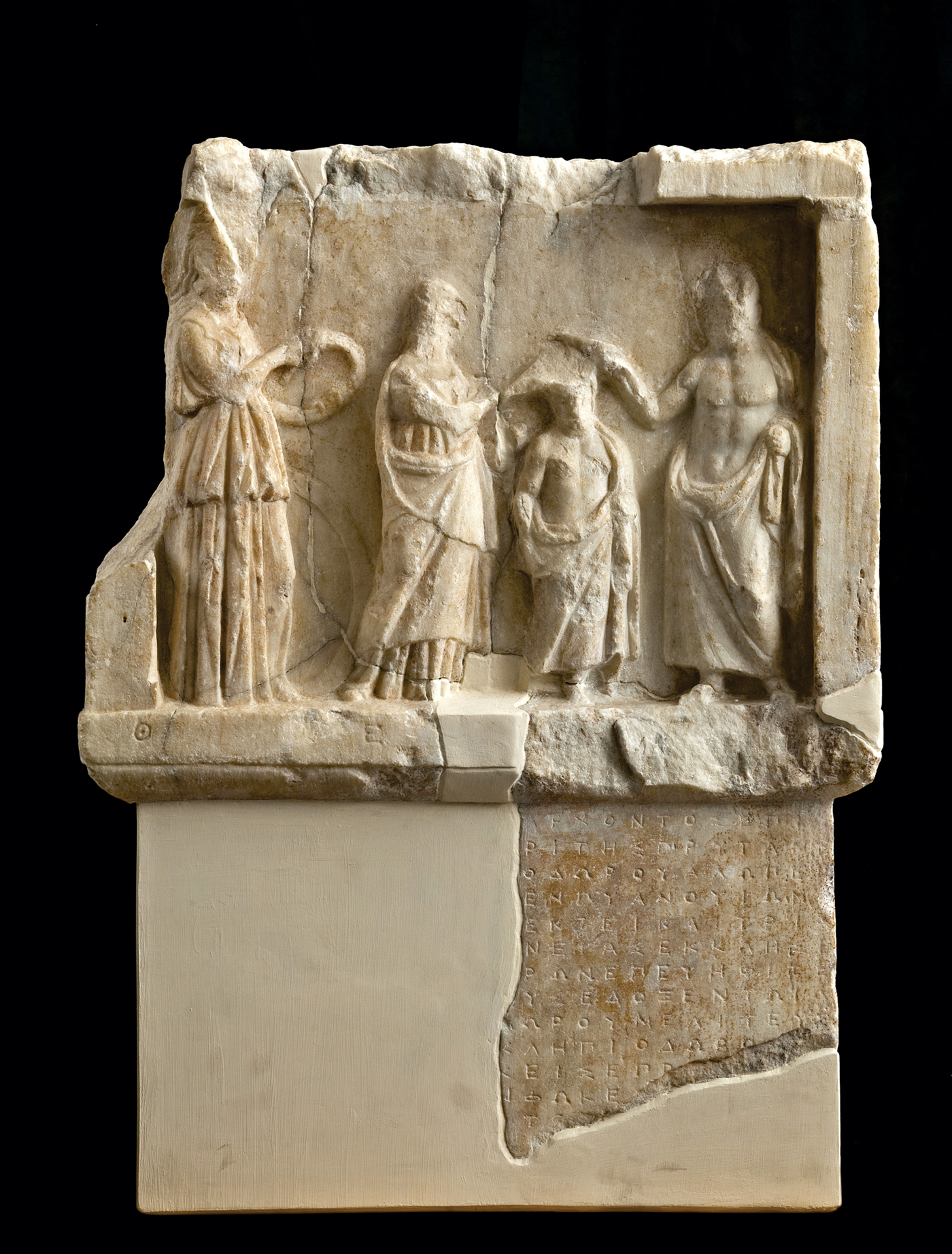
An Athenian decree from the late fourth century (323/322 bc) in honour of Asklepiodoros and another man, both from Phokis, is a particularly good example, and allows us to explore some of the interpretative issues which these types raise (Fig. 5). Athena, on a larger scale to the left of the relief, holds a crown in both hands while two smaller figures, Boule and Demos, simultaneously crown a third even smaller mortal figure between them. The heading which occurs below the relief, theoi, seems to label the active agents depicted: Athena and also Boule and Demos, who are represented as being of larger than mortal size. Demos and Boule are examples of one of the most characteristic features of Greek religion, in which personified entities receive cult (Parker Reference Parker1996, 228–37; Stafford Reference Stafford2000; Smith Reference Smith2011). These reliefs are not the only attestation of cult for Demos, as evidence stretches back to the late fifth century (for Boule the picture is less clear).Footnote 92 Their occurrence in the context of these reliefs, however, is striking – the visual suggestion in this particular example is that the gods invoked and represented as active agents in the sculptural relief are in fact to be identified with the human active agents, the Athenian council (boule) and assembly (demos) whose decree follows below. (That the surviving decree in the case of the Asklepiodoros relief omits reference to the boule and seems to honour two men, reveals an interesting mismatch between decree and relief reflecting the generic nature of these reliefs: Blanshard Reference Blanshard2004, 10.)
The proper interpretation of this development is less clear. Is this evidence of a growing unease with the implications of relief sculptures representing Athena performing an action analogous to that of the Athenian assembly? Does it reflect diminishing confidence of the Athenians in their link with the gods following the destruction of their fifth-century empire?Footnote 93 Or is it, mutatis mutandis, in itself an expression of self-sufficiency, of confidence in the immortality and divinity of the Athenian democratic collective? At best the change is gradual, and incomplete. Depictions of Athena as the sole active agent persist throughout the Classical period and into the Hellenistic (the latest securely dated example of Athena crowning an honorand is Lawton Reference Lawton1995, no. 59 = IG II3 1 853, from 295/294 bc). It is also a shift which would not necessarily have been very visible to contemporaries viewing the accumulation of monuments on the Acropolis, except as a diversification. It is, nonetheless, suggestive of a change in the way of viewing the decisions of the Athenian assembly, the demos – away from one in which divine authority is conferred by a separate divine entity, towards a situation in which the demos and its properly constituted decisions had a claim to a quasi-divine authority in its own right.
The way in which this divine authority is represented is itself interesting. It has frequently been recognised that Demos in these reliefs is apparently closely modelled on, or at least very difficult to distinguish from, representations of Zeus – and the similar visual echo of Zeus’ consort, Hera, in the representation of Boule in the Asklepiodoros relief underlines the connection (Lawton Reference Lawton1995, 57, n. 127 for bibliography). However, in this art of recurrent types, this is not the limit of the repetition or resonance of the mature, half-nude, soft-muscled, himation-wearing man. We began with one such figure in the first monument discussed, who represents the mortal honorand Proxenides (Fig. 1) and in Figure 5 we are presented with another. Indeed, what is most striking about the Asklepiodoros relief is the way that two virtually identical versions of this type are juxtaposed, indistinguishable except in size, representing the Athenian demos and the honorand(s) in question. ‘Men make the likenesses of gods in their own image’ was not a new observation even when Aristotle made it (Politics 1252b25–30; cf. Xenophanes DK 15–16), but the point – that societies create images of divine authority which reflect and reinforce an idealised version of contemporary authority – seems no less valid for all that. The choice here to represent Zeus and Demos in the image of the fully mature adult male in his prime – without individualising or distinguishing marks of status, an ‘everyman’ (Blanshard Reference Blanshard2004, 9–10) – is hardly surprising in a society in which full citizenship in Aristotle's terms (including the right to sit on the boule and serve as a juror in legal cases) was reserved for the over-30s.
What is interesting, however, is that this is not a depiction, specifically, of Athenian citizens, an identity-group which, as Robin Osborne has recently pointed out, is surprisingly elusive in visual culture given the importance ascribed to it in modern historians’ treatments of the textual sources (Osborne, R. Reference Osborne2011, 105–23). The decrees honouring Proxenides and Asklepiodoros rely on the fact that those honoured are not Athenian citizens for all that, in some respects, they may have behaved like good Athenians should. These representations of power are less interested in questions of specifically Athenian identity than a more general Greek paradigm of power, centred on political participation by adult male citizen populations in general. This is presumably one of the reasons why this iconography of the deified demos had considerable traction at other poleis in the Hellenistic world.Footnote 94
CONCLUSION
The document reliefs are significant because they highlight an understanding of the role played by gods in collective decision-making which seems to have been central to Athenian democratic ideology but has been largely overlooked in the modern scholarship which has illuminated its other aspects (Brock Reference Brock1991; Ober Reference Ober1991; Reference Ober1998; Ismard Reference Ismard2015, 147–54). The juxtaposition which they perform makes it clear that collective public authority at Athens was thought of as underpinned by divine agency and suggests that this orthodoxy was deeply enough embedded that its assertion was not particularly marked. The monuments themselves enable us to explore some of the ways in which this role for the gods could be conceived of in relation to the political institutions of the Athenians.
More importantly, although the document reliefs which depict deities performing actions are an Athenian idiosyncrasy, they have implications for our understanding of Greek political culture and collective political institutions more widely. The document relief monuments are evidence of a particularly strong reading of the relationship between collective political authority and the gods at Athens, but they also highlight the existence of other, widespread references to divine agency in relation to civic decrees – in epigraphic practice in the form of the deposition (probably dedication) of authoritative civic documents in sanctuaries and also in the use of the theos/theoi heading. The idea that gods might have a role in legitimating political power is hardly surprising from a wider historical perspective or, indeed, from a Greek perspective, given that, in the Iliad, Agamemnon's authority as a king, symbolised by his sceptre, was derived from Zeus.Footnote 95 Nonetheless, this idea has not been explored in detail in relation to the collective decision-making institutions of the Greek city-states, although it is surely important for understanding, for example, the broad-based citizen assemblies which characterised Greek polis culture, transcending the ideological opposition between demokratia and oligarchia and positively attested at 114 Greek city-states during the Archaic and Classical periods.Footnote 96
The document relief monuments open up the possibility of writing a history, albeit a history composed of fragments and case studies, of the changing relationship between collective public authorities and the gods which should explore epigraphic practices alongside other appeals to divine authority, including oracles (Parker Reference Parker, Cartledge and Harvey1985; Bowden Reference Bowden2005). If Greek cities were, as Oswyn Murray argues (Reference Murray, Murray and Price1990; Reference Murray1991; Reference Murray and Hansen1997; see also Harrison Reference Harrison, Goldhill and Osborne2006), cities of reason in the sense that they were able consciously to reshape their politico-religious institutions to an extraordinary extent for rational ends, then the reason that they were able to do this was probably in part because of the roles attributed to the gods in collective decision-making.
ACKNOWLEDGEMENTS
I am grateful to audience members for their responses to versions of this article presented in Reading, Birmingham, Cambridge and Oxford, as well as to those who were kind enough to read and comment on drafts or respond to queries, in particular Andrew Bayliss, Leslie Brubaker, Jan-Mathieu Carbon, Eleanor Dickey, Ken Dowden, Naomi Garner-Mack, Niall Livingstone, John Ma, Dominik Maschek and Gareth Sears; special thanks are owed to Jaś Elsner, Stephen Lambert, Robin Osborne, the Annual’s co-editor, Peter Liddel, and anonymous readers for particularly detailed comments. The Acropolis Museum and Epigraphic Museum in Athens provided photographs and permission to reproduce them, as did the British Museum. I am grateful to Tania Gerousi for her assistance in applying for images and rights.