INTRODUCTION
Newborn sea otters (Enhydra lutris, Linneaus 1758) are the most altricial (helpless, incapable of coordinated movements) of marine mammals born at sea and are highly dependent on their mothers for the first 6–12 months of life (Kenyon, Reference Kenyon1969; Riedman et al., Reference Riedman, Estes, Staedler, Giles and Carlson1994; Monnett & Rotterman, Reference Monnett and Rotterman2000). Neonatal sea otters are unusual in their complete inability to swim despite living in the marine environment. After birth of the generally single pup (Williams et al., Reference Williams, Mattison and Ames1980), they are carried on the mother's abdomen especially during the first weeks after birth (Kenyon, Reference Kenyon1969). Pups begin to swim when 3–4 weeks old (Payne & Jameson, Reference Payne and Jameson1984; M. Staedler, personal communication), and begin to dive when 6–10 weeks old (Estes, Reference Estes1980; Payne & Jameson, Reference Payne and Jameson1984; Faurot-Daniels, Reference Faurot-Daniels1991). If pups are weaned too early, the probability of successful survival is reduced (Garshelis & Garshelis, Reference Garshelis and Garshelis1987; Riedman et al., Reference Riedman, Estes, Staedler, Giles and Carlson1994; Monnett & Rotterman, Reference Monnett and Rotterman2000), generally due to starvation (Garshelis, Reference Garshelis1983). This reflects the importance of the mother–pup bond for developing skills such as foraging as the pup matures.
Pups reduce heat loss to the marine environment with a dense, natal fur (lanugo) that is groomed by the female, although the pups exhibit some grooming behaviour from one week of age onward (Kenyon, Reference Kenyon1969; Vandevere, Reference Vandevere1972; Sandegren et al., Reference Sandegren, Chu and Vandevere1973; Hanson et al., Reference Hanson, Bledsoe, Kirkevold, Casson and Nightingale1993). They moult their natal pelage (highly buoyant due to an air layer trapped within the dense fur) and acquire adult pelage at an age of about 13 weeks (Payne & Jameson, Reference Payne and Jameson1984). To maintain the fur as thermal insulation, sea otters must groom and aerate it daily (Kenyon, Reference Kenyon1969; Rotterman & Simon-Jackson, Reference Rotterman, Simon-Jackson and Lentfer1988; Riedman & Estes, Reference Riedman and Estes1990). Because of their small body size, the absence of a blubber layer and complete reliance on fur for insulation, sea otters have a resting metabolic rate 2–3 times greater than a terrestrial mammal of the same body mass to maintain a stable core temperature (Costa & Kooyman, Reference Costa and Kooyman1982). As a result, they consume ~25% of their body weight in food daily (Kenyon, Reference Kenyon1969; Costa, Reference Costa1982) and thus, require habitats with abundant prey resources. A female with a pup does not only have to feed herself, but has to provision the pup with milk as well. Pups initially rely solely on milk for nourishment, but begin eating solid food provided by the female around the age of 4–6 weeks (Payne & Jameson, Reference Payne and Jameson1984; Hanson et al., Reference Hanson, Bledsoe, Kirkevold, Casson and Nightingale1993).
In this study, females with pups were observed to determine the change in their behaviour as pups age, and if weather, tide and time of day influence their behaviour. A combination of pup behaviour and body length as well as fur condition was used as a proxy for its age. With age, older pups were expected to increase time spent actively, and their mothers were expected to especially increase feeding behaviour to supply the pups' nutritional needs. At the same time, females should not reduce their efforts necessary for self-maintenance such as grooming themselves. Rain can increase sea otters' grooming behaviour, and females with small pups need to groom their pup more as well to dry the fur and maintain its insulation, similar to grooming their fur after feeding dives (cf. Sandegren et al., Reference Sandegren, Chu and Vandevere1973). Otters may spend more time feeding and grooming, when adverse weather conditions increase energetic demands of otters to compensate for heat loss (cf. Costa & Kooyman, Reference Costa and Kooyman1982; Garshelis, Reference Garshelis1983; Garshelis et al., Reference Garshelis, Garshelis and Kimker1986). Tide may have an effect on feeding behaviour because the low intertidal zone and shallow reefs can be accessed more easily during low tide allowing easier capture of certain prey, e.g. mussels. Some sea otter populations show various activity peaks (e.g. foraging peaks) during the course of a day (Shimek & Monk, Reference Shimek and Monk1977; Gelatt et al., Reference Gelatt, Siniff and Estes2002), e.g. to avoid predation of pups by bald eagles in the daytime (Gelatt et al., Reference Gelatt, Siniff and Estes2002).
As the pup matures and begins to develop grooming and locomotory skills, its behaviour changes, and the mother needs to adapt her behaviour. Despite the crucial importance of this early period for pup survival, we do not know of any other simultaneous study of mother–pup behaviour and time allocation in the wild that covers a complete 24-hour period. The goal of this study was to determine daily activity budgets for sea otter pups and their mothers as the pup matures during the first three months of life, and potential influence of the weather, day time and tide.
MATERIALS AND METHODS
Study area and otter population
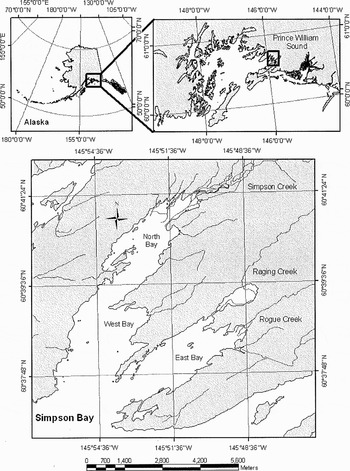
Simpson Bay (~60.6° N 145.9° W), located in north-eastern Prince William Sound, Alaska (Figure 1), was used as the study area because of its manageable size for daily surveys, protection from rough seas and reliable presence of sea otters, all allowing for easy and frequent observations. It is approximately 21 km2 in area; 7.5 km long in the northern and western bays, 5 km long in the eastern bay, and 2.5 km wide at the entrance. The average water depth is about 30 m, and the maximum depth is 125 m. Bottom sediments consist primarily of soft sediments (mud and mixed mud and gravel), with some rocky reefs (Gilkinson, Reference Gilkinson2004; Noll, Reference Noll2005). There are no large-bodied kelps (e.g. Nereocystis) that form canopies, but large fronds of sugar kelp (Laminaria saccharina) cover the benthos in many areas of the bay from the subtidal to a depth of ~10 m (Davis, unpublished observation). After the near extinction of the sea otters in the early 19th Century (Estes et al., Reference Estes, Bodkin, Ben-David, Perrin, Würsig and Thewissen2009), the bay was re-colonized by male sea otters in 1977–1978, and females moved into the area between 1983 and 1985 (Garshelis, Reference Garshelis1983; Garshelis & Garshelis, Reference Garshelis and Garshelis1984; VanBlaricom, Reference VanBlaricom, VanBlaricom and Estes1988). Since 2002, the summer (June–August) population has been fairly stable at 119 ± 9.3 SD sea otters on average, including 91 (±6.8 SD) adults and subadults and 28 (±3.8 SD) pups (6-year average; R. Davis, personal observation). During the summer of 2008 (31 May to 12 August), the average population size was 132.4 sea otters (N = 6 surveys) of which 97.6 were adults and sub-adults and 34.8 were pups. During winter, only about 50 otters stay in the bay (F. Weltz, personal observation), but it is unknown, however, where the remaining otters disperse.
Simpson Bay in north-eastern Prince William Sound, Alaska (Noll et al., Reference Noll, Dellapenna, Gilkinson and Davis2009).

Field methods
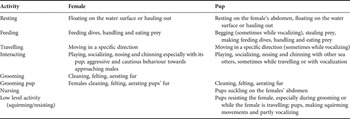
A total of 240 30-minute observation periods were conducted to obtain a 24-hour activity budget for females and their pups. Sixty focal follows (Altmann, Reference Altmann1974) were made in each of four time periods, adjusted to true astronomical time (i.e., astronomical midnight was ~01:57 local time (LC)) at the study site: dawn (5:00–11:00 LC), day (12:00–17:00 LC), dusk (17:00–23:00 LC) and night (23:00–5:00 LC). Observations were made from June to August 2008, from either a 7-m aluminium skiff or a 5-m fibreglass skiff usually with 2–4 people onboard. A female with a pup was usually approached to within ~50–150 m and not closer than 30 m. During each usually 3–4 hour session, no mother–pup pair was monitored more than once. Animals were chosen for focal observations only if they did not appear to be disturbed (i.e. changed their behaviour with the presence of the boat). Detailed behavioural observations were made every minute using 8–24 × 25 and 7 × 40 binoculars to influence the otters as little as possible. Behaviours were later sorted into seven activity categories for the pup (resting, nursing, low level activity (squirming/resisting), grooming, interacting, travelling and feeding), and six for the female (resting, grooming, grooming pup, feeding, travelling and interacting) (Table 1). Time, tidal state, weather, water depth (measured with a Garmin bathymeter) and GPS position (Garmin Model 126) were recorded at the start of each focal follow.
Definitions of various behaviours for females and pups used in this study.

Pups were classified into three behavioural and morphological categories, small, medium and large (hereafter designated as S, M and L, respectively). When using a combination of behaviour, body length and fur appearance, categorizing pups was simple and consistent (see Table 2 for criteria).
Characterization of S, M and L pups.

Due to changing daylight conditions during the summer, it was not possible to obtain the same number of focal follows for each pup category in each of the four time periods. Focal follows often have disadvantages similar to scan sampling, such as not being able to observe otters during night (Estes et al., Reference Estes, Underwood and Karmann1986; Garshelis et al., Reference Garshelis, Garshelis and Kimker1986). However, in the present study, illumination was still good enough to observe otters until close to 00:30 h and after about 03:30 h, during June and early July. Nevertheless, there was a gap of 3 hours without observations, and another gap was around 20:00 h. A potential bias may also have been introduced by not detecting females with L pups for 5 days towards the end of June and the beginning of July, as well as no females with M pups for about 10 days at the end of July.
For this study, focal follows were deemed an appropriate method to observe a larger number of otters, as well as to characterize more diverse behaviours of females and their pups than would have been possible to distinguish using radio tagging (Garshelis et al., Reference Garshelis, Garshelis and Kimker1986; Wilkin, Reference Wilkin2003). There may be a bias introduced by individual variations influencing the data because we were not able to identify individuals, and some females and pups might have been monitored more frequently than others.
Statistical analyses
Generalized linear models (GLMs; Baayen, Reference Baayen2008) were used to test if the response variables, the otters' behaviours, correlated with age or were influenced by tide, weather or day time. We included age as a covariate and tide and weather as factors. To incorporate day time, we first converted hours and minutes, indicated as fractions of hours, into a circular variable ranging from 0 to 2*π. Then, the sine and cosine of this variable were included in the model. Based on the distribution of the response variables, we used Gaussian error and identity link (i.e. simple linear regression) for pup resting on the mother (pRm) and Poisson error and log-link for all other response variables. However, data were unlikely to be independent because we can only preclude multiple observations of the same individuals within one session but might have observed the same mother–pup pair more than once in various sessions. Hence, we established significance using a permutation procedure (Adams & Anthony, Reference Adams and Anthony1996; Manly, Reference Manly1997) whereby we permuted the response variable restricted to the sessions. Therefore, permutations took place only within sessions (since within each session no mother–pup pair contributed more than one observation). Note that this permutation approach also accounts for potential temporal autocorrelation because the structure of the data is unchanged with regard to any pattern occurring beyond what happens within a session. This permutation test is conservative with regard to day time, tide and weather because these varied only little within sessions. For each response variable, we conducted 1000 permutations, whereby we included the original data as one permutation.
We established significance of the full model (comprising all the predictors) as compared to the null model (comprising only the intercept) based on the F value derived from an ANOVA as the test statistic for pRm and based on the Chi2 (χ2) revealed by a likelihood ratio test as the test statistic for all other variables. Eventually, the P value was estimated as the number of permutations revealing a test statistic being at least as large as that of the original data. In case this revealed significance, we established the significance based on the F values revealed for the individual effects in the case of pRm and based on a likelihood ratio test comparing the full with the reduced model for all other response variables. These reduced models did not comprise the term or terms to be tested, e.g. in case of day time the reduced model did not comprise the sine and the cosine of day time.
An error level correction was required because we tested 14 response variables separately. We achieved this using Fisher's omnibus (Haccou & Meelis, Reference Haccou and Meelis1994) test. This procedure combines a number of P values into a single χ2-distributed variable with degrees of freedom equalling twice the number of P values.
In the case of the response variable being pup resting on the mother, we checked for the validity of the model by visual inspection of a plot of residuals against predicted values, particularly focusing on homogeneity of the residuals and the absence of outliers. In the case of the other response variables for which we applied a Poisson regression, we did not use such a check because for such models visual inspection of such plots does not reveal deviations from model assumptions. Note, though, that we established significance using a permutation approach in which case assumptions are considerably relaxed because the sampling distribution is directly derived from the data rather than based on theoretical models.
We calculated linear regression and Poisson regressions using the functions lm and glm, respectively, of the statistical software R (version 2.9.1; R Development Core Team, 2009). Permutation tests were run using an R script written by Roger Mundry.
RESULTS
24-hour time budget for pups of different age categories
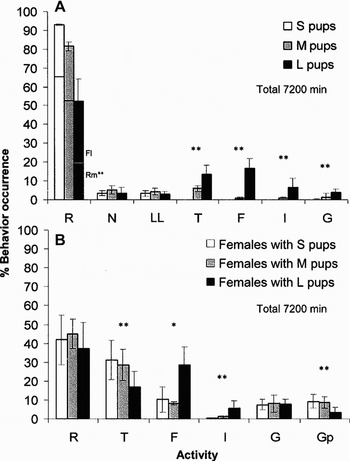
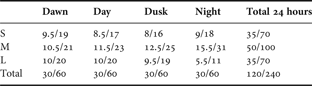
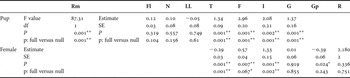
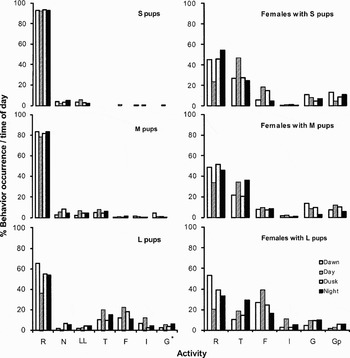
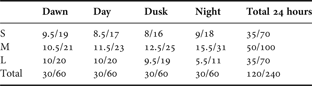
Sea otters were observed for 240 30-minute focal follows (120 hours) with a 30 hour total in each of the four time periods (dawn, day, dusk and night) (Table 3). Overall, the duration of behaviours was clearly influenced by the predictors (comparison of full with null models, Fisher's omnibus test combining 14 regressions: χ2 = 113.7, df = 28, P < 0.001). This was also the case when considering the mothers and the pups behaviours separately (pups: χ2 = 78.3, df = 16, P < 0.001; mothers: χ2 = 35.4, df = 12, P < 0.001). Pups increased their level of activity as they matured (Table 4; Figure 2A). S pups spent most of the time resting, primarily on the female's abdomen which significantly decreased with the maturation of the pup. Foraging occurred mainly in L pups when they were able to make shallow dives, although prey items were mostly given to them by the female. Travelling more than doubled for L pups compared to M pups. Grooming and interacting increased significantly for L pups compared to M pups and was nearly absent in S pups. Time spent nursing and in low level activity (squirming/resisting) did not change significantly among the three pup categories.
24-hour activity budget for: (a) S, M and L pups; and (b) for females with S, M and L pups. The standard deviations show the variations in different times of day. Total time of observations was 7200 minutes. R, resting with; Rm, resting on the mother + Fl, floating for pups and Fl on top of Rm; N, nursing; LL, low level activity (squirming/resisting); T, travelling; F, feeding; I, interacting; G, grooming; Gp, grooming pup; *, significant; **, highly significant.

Sample sizes in hours/pairs for females and their pups of different categories (S, M and L) in different time periods and totals over 24 hours for females and their pups of different ages and totals for each time period.
Activity budget of females and their small, medium and large pups averaged over a 24-hour period. F-, df-, P values and P values of the full versus the null model or estimate, SE (standard error), P values and P values of the full versus the null model of the generalized linear models, respectively, comparing each behaviour of females with small to large pups and small to large pups over a 24-hour period. Rm, resting on the mother; Fl, floating; N, nursing; LL, low level activity (squirming/resisting); T, travelling; F, feeding; I, interacting; G, grooming; Gp, grooming the pup; R, resting.

*, significant; **, highly significant.
Females appeared to adapt their behaviour in response to that of the pups, which resulted in changes in the female's activity budget (Table 4; Figure 2B). Travelling and interacting were the most variable behaviours for females with different sized pups, followed by grooming the pup and foraging. Feeding and interacting increased significantly for females with L pups relative to those with smaller pups. Females with S pups travelled significantly more than females with L pups. Females groomed pups significantly less as they began to self-groom, but there were no significant differences in the amount of time females spent in grooming themselves, regardless of pup age. Resting as well, did not vary significantly with the maturation of the pup.
Activity budget of pups for different age categories, weather conditions, and day time
The combination of pup category, weather condition, day and tidal state, which were analysed with GLMs, influenced the mother's and pup's behaviours as mentioned above (Tables 4 & 5; Figures 2, 3 & 4). Age of the pup appeared to have the greatest influence on the otters' behaviour because it showed the most significant results. As pups matured, they spent less time resting on the female's abdomen and nursing and more time travelling and feeding by themselves; females spent less time travelling and grooming pups and more time feeding and interacting.
Activity budgets for dawn, day, dusk and night for small, little and large pups (left) and their mothers (right). Observation time is available in Table 3. R, resting; N, nursing; LL, low level activity (squirming/resisting); T, travelling; G, grooming; I, interacting; F, feeding; Gp, grooming the pup; *, significant.

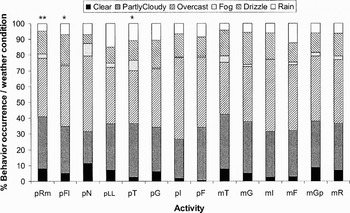
Proportions in percentage of various behaviours of females and their pups in regard to weather conditions (clear, partly cloudy, overcast, fog, drizzle and rain). Rm, resting on the mother; Fl, floating; N, nursing; LL, low level activity (squirming/resisting); T, travelling; G, grooming; I, interacting; F, feeding; Gp, grooming pup; R, resting; p, pup; m, mother; *, significant; **, highly significant.

F values of sine (sin) and cosine (cos) and P value or estimate of sin and cos and P values of the generalized linear models comparing each behaviour of females with small, medium and large pups in regard to day time. Rm, resting on the mother; Fl, floating; N, nursing; LL, low level activity (squirming/resisting); T, travelling; F, feeding; I, interacting; G, grooming; Gp, grooming pup; R, resting.

*, significant.
Weather appeared to have an effect on the amount of time the pup spent resting, both on the female's abdomen (P = 0.001) and floating (P = 0.047), and travelling (P = 0.015; Figure 4). Foggy conditions had the greatest influence on the floating and travelling behaviours of pups which then decreased floating and increased travelling. Other weather conditions were not correlated with the otter's behaviour. This permutation test is conservative because weather, tide and day time did not vary much within sessions and may not show all variations. There may be some decreased nursing behaviour of pups during periods of drizzle (P = 0.08).
Tide and mostly also day time did not have significant influences on the otter's activities. Only grooming by pups was affected by day time (estimate sine = 0.11, estimate cosine = 0.21, P = 0.028) and mainly took place during dawn for M pups and during dawn and dusk for L pups (Figure 3), but this result may be spurious. However, Figure 3 indicates less resting behaviour but increased travelling, feeding and interacting activities during the day for L pups, and females with S, M and L pups decreased resting during the day as well. Feeding in females with L pups was highest during the day when L pups' feeding activity was also the highest. Travelling appeared to shift from a mainly day-time to night-time activity as pups aged. Females with M pups travelled less during the day and more at night than females with S pups and females with L pups did most of their travelling during the night (Figure 3). However, perhaps due to the small sampling size and a conservative testing method, these trends were not significant.
DISCUSSION
Females and their pups changed their behaviours with the maturation of the pup. With age, pups increased their active time, i.e. increased their time spent travelling, feeding, interacting and grooming themselves and spent less time resting. Females with older pups travelled and groomed the pup less but fed and interacted more. In pups, grooming behaviour varied significantly throughout the day. Resting tended to differ in females with pups and L pups within the time periods and was lowest during the day. Females with M pups groomed themselves most during dawn and least at night. Weather appeared to have an effect on the time the pup spent resting and travelling (P = 0.015; Figure 4). Fog caused pups to spend less time floating and more time travelling.
24-hour time budget for pups of different age categories
The allocation of time to different activities by both females and their pups changed as the pups matured. Some behaviours only developed as pups became older, while others decreased or increased. S pups spent most of their time resting which is likely associated with growth and physiological development (Siegel, Reference Siegel2005 and references therein; Heraghty et al., Reference Heraghty, Hilliard, Henderson and Fleming2008). Resting decreased in M and L pups, and they became more active and interacted more. This was not surprising as this progression is usual for other altricial mammals, including carnivores generally (Starck & Ricklefs, Reference Starck, Ricklefs, Starck and Ricklefs1998), and mustelids specifically (Stubbe & Krapp Reference Stubbe, Krapp, Niethammer and Krapp1993a, Reference Stubbe, Krapp, Niethammer and Krappb and references therein).
S pups rested mainly on the females' abdomen or floated on the water surface while the female was feeding or self-grooming. Because sea otters are one of the smallest marine mammals and, therefore, S pups are relatively light and potential prey for bald eagles (Krog, Reference Krog1953; Sherrod et al., Reference Sherrod, Estes and White1975; Anthony et al., Reference Anthony, Estes, Ricca, Miles and Forsman2008), small pups are likely to be more protected on the females' abdomen. As they became older, L pups rested mostly with only their head on the female or floated beside the female. These large pups were less likely to rest fully on the females' abdomen because they were too large.
Pups became more mobile and travelled and interacted more as they matured. As mentioned above, larger pups are less likely to be fully supported by the female and therefore need to travel by themselves more than younger pups. The increase in feeding behaviour by larger pups might be explained by their increased size and higher activity level, and therefore reflect their higher energy demands; a developmental pattern also observed in captive pups (Hanson et al., Reference Hanson, Bledsoe, Kirkevold, Casson and Nightingale1993). M pups' requirements were likely to be lower than those of L pups and if the time spent nursing and feeding were summed, it indicated, that nourishment increased from small to large pups. In other studies, the allocation of time for nursing of 10–31% (Vandevere, Reference Vandevere1972; Sandegren et al., Reference Sandegren, Chu and Vandevere1973; Hanson et al., Reference Hanson, Bledsoe, Kirkevold, Casson and Nightingale1993) was generally higher than in this study (4%). However, it is possible that nursing behaviour was underestimated in this study due to pups falling asleep while in the nursing position (Kenyon, Reference Kenyon1969) making it thus difficult to determine whether a pup nursed or slept.
Feeding behaviour of pups increased when they started to dive and obtain a small part of their food for themselves if in a shallow area. Nevertheless, females provided most of the solid food also for L pups and therefore increased their foraging behaviour to keep up with the pups' energy requirements. This might also explain the decrease in travelling of females with L pups. They spent much more of their time feeding (28.4% versus 10.2% and 8.3% for females with S and M pups respectively), and thus needed to decrease other behaviours without risking their own survival. Additionally, they may have a wider range of potential feeding habitats because females with large pups varied their foraging locations regarding water depth more than females with small pups (Osterrieder & Davis, Reference Osterrieder and Davis2009). Females with larger pups appeared to stay submerged longer than females with small pups, indicating deeper foraging dives but also used shallow habitats often (Osterrieder & Davis, Reference Osterrieder and Davis2009). This may allow females with L pups to travel less when changing foraging locations.
A decrease in resting and increase in feeding and other active behaviours (such as swimming and interacting) were also observed for maturing sea otters of other populations and in captivity (Vandevere, Reference Vandevere1972; Payne & Jameson, Reference Payne and Jameson1984; Faurot-Daniels, Reference Faurot-Daniels1991; Hanson et al., Reference Hanson, Bledsoe, Kirkevold, Casson and Nightingale1993). However, the amount of time allocated to feeding will be influenced by prey abundance and energy content, which can have a large impact on the females' feeding behaviour (Kenyon, Reference Kenyon1969; Krebs, Reference Krebs, Krebs and Davis1978; Garshelis, Reference Garshelis1983; Estes et al., Reference Estes, Jameson and Rhode1982, Reference Estes, Underwood and Karmann1986). Changes in the females' behaviour as pups matured were similar to what was observed in our study. Feeding increased and grooming of pups decreased as pups aged (Sandegren et al., Reference Sandegren, Chu and Vandevere1973; Hanson et al., Reference Hanson, Bledsoe, Kirkevold, Casson and Nightingale1993; Gelatt et al., Reference Gelatt, Siniff and Estes2002). Because the amount of time spent feeding presumably also reflects prey abundance and energy content of available prey in an area which is likely to differ from region to region, females with pups probably should only be compared to single females in the same region.
In a previous study in Prince William Sound, females without pups fed less than females with pups and females with pups old enough to feed on solid food but not yet able to acquire their own food, fed more (Garshelis et al., Reference Garshelis, Garshelis and Kimker1986). Gelatt et al. (Reference Gelatt, Siniff and Estes2002; Amchitka Island) observed females with small pups feeding less than single females, but this was not the case for females with large pups. This indicates that the different feeding behaviours of females with or without pups changed due to the pups' requirements and were unlikely due to a change in prey abundance or composition during the observation period.
Although in another study feeding behaviour made up only ~7% of their total activity budget (Walker et al., Reference Walker, Davis and Duffield2008), there might be a bias in our study. Times spent foraging were very low and thus, we may have missed and therefore observed fewer feeding animals, although we tried to pick animals as randomly as possible with different behaviours at the observation start.
For all females, an average of 41% resting and 8% grooming seemed to be preferred for their own maintenance and therefore barely varied with the age of the pup. As in other studies (Kenyon, Reference Kenyon1969; Payne & Jameson, Reference Payne and Jameson1984; Hanson et al., Reference Hanson, Bledsoe, Kirkevold, Casson and Nightingale1993), especially small pups were not able to groom themselves and needed to be groomed by their mothers. When larger pups gradually developed their grooming behaviour (Vandevere, Reference Vandevere1972; Payne & Jameson, Reference Payne and Jameson1984; Faurot-Daniels, Reference Faurot-Daniels1991), the females could spend less time in this activity.
Activity budget for pups of different age categories, weather conditions, and day time
The pups' age had the greatest effect on both pup and female behaviour. However, they were also affected by fog whereas other weather conditions had little effect. Pups floated on the surface less when the weather was foggy but increased travelling behaviour. However, the meaning of this difference is not obvious. Maybe due to the small sample size, we were not able to show other significant weather effects on the otters' behaviours. We expected, for example, increased grooming behaviour due to rain because otters always try to keep themselves dry and warm similarly to grooming fur after feeding (Sandegren et al., Reference Sandegren, Chu and Vandevere1973).
Time of day only influenced grooming behaviour of sea otter pups. But the most variability between the four time periods tended to be observed for females with L pups. Resting was always reduced during the day (11:00–17:00h), indicating that otters were more active during this time. As a result, pup feeding, travelling and interacting behaviours were highest during the day. Mothers of S and M pups travelled more during the day, when those of L pups mostly fed. Shimek & Monk (Reference Shimek and Monk1977; California) observed an activity peak around 7:00h, mainly due to increased feeding, after a late morning period of rest leading to an activity low around noon, and another activity peak at about 16:00h in the afternoon. Similar results were noted in an earlier study in Simpson Bay (Garshelis Reference Garshelis1983). The mid-day low was considered to be a heat conserving strategy (Shimek & Monk, Reference Shimek and Monk1977). But with lower daytime temperatures and only few sunny days in Alaska, heat conserving was probably not an issue for Alaskan sea otters, which were more active during that time of day.
Feeding for females with S pups was slightly higher during day and dusk and was evenly distributed throughout the day for females with M pups. These observations are somewhat different from a study at Amchitka Island (Gelatt et al., Reference Gelatt, Siniff and Estes2002) where females with small pups foraged equally during the night and day. They decreased their nocturnal foraging time and therefore increased diurnal feeding when pups became larger. Nocturnal feeding bouts were explained as an avoidance of bald eagle predation on small sea otter pups (Gelatt et al., Reference Gelatt, Siniff and Estes2002). No such changes were observed in the present study. Females with small pups may choose to forage mainly during daylight hours when the mother was also able to see the pup at the surface after her foraging dives.
Self-grooming in M pups was highest when the females' grooming behaviour was highest as well, and pup travelling behaviour increased slightly when females travelled more. These mother–pup similarities indicate that pups were beginning to copy the behaviours of their mothers, and probably also that mothers let their pups travel more by themselves. These trends are even more apparent in L pups. The daily fluctuations in their resting, interacting, feeding, and partly their travelling and grooming behaviour, show the same increasing and decreasing trends as in the females.
More comparative research between Alaskan and Californian females with pups is necessary to gain insight into the differences between pup rearing strategies between the two subspecies. Dependency periods seem to be longer in Alaska than in California (Riedman & Estes, Reference Riedman and Estes1990). Possibly due to higher food abundance (M. Staedler, personal communication) or genetic differences between the subpopulations, Alaskan sea otter pups apparently are larger than pups in California at weaning (M. Staedler, personal communication). Furthermore, if pups in Alaska are older at weaning, they may start swimming and diving later because they appear to have more time before weaning.
This study showed that sea otter females with pups changed their behaviours as the pups grew and matured during the first few months of life. This indicates that pups gradually developed their active behaviours (Chalmers, Reference Chalmers1987) in the process of becoming mature and finally living by themselves. With age, resting decreased and travelling, feeding, interacting and grooming themselves increased as pups matured. For females, the allocation of time foraging and interacting with their pups increased and the amount of time travelling and allo-grooming the pups decreased. Resting and grooming appear to be important for self-maintenance and were always carried out in about the same proportion.
ACKNOWLEDGEMENTS
We thank Olivia Lee, Ryan Wolt, Ian Davis, Allison McInnes and Kathryn Wheatley for assisting in the field, and thanks to Olivia Lee, Christian Noll and Ryan Wolt for providing information on sea otters and Simpson Bay. Thanks also to all the teachers and students from the field summer course for their assistance with the field work. We thank Fred Weltz for discussing aspects of the field research. Thanks as well to Tim Dellapenna for information and help in the camp. Michelle Staedler answered questions on mother–pup behaviour of sea otters; thanks for that and for the informative e-mail communication. We also thank Stacie Arms for administrative assistance. Thanks to Daniel Österwind and Roger Mundry for helping with statistical analysis and to Michael Dähne for help with the statistics, for discussing graphs, solving program problems and offering support. Thanks also to Adrian Dahood for help with literature requests and to Bernd Würsig for editing our manuscript and for all of his advice. Finally, thanks to Stefan Bräger for advice and support during manuscript preparation. This research was conducted under the Letter of Confirmation No. MA078744-2 from the US Fish and Wildlife Service.