Introduction
More than 20 years ago, Widom (Reference Widom1989) demonstrated that victims of childhood maltreatment (CM) have an increased risk of becoming involved in later crime. A few years later, in the Adverse Childhood Experiences Study, for the first time long-term effects of exposure to childhood adversities were systematically investigated in a large sample of over 17 000 participants. This study revealed not only a high prevalence rate for abusive experiences, but importantly a cumulative negative impact on health in later life; including an increased risk for the perpetration of violence (Anda et al., Reference Anda, Felitti, Bremner, Walker, Whitfield, Perry, Dube and Giles2006). By today, a large body of research supports this hypothesis of an ongoing cycle of violence. For adolescents, a number of studies have found evidence that CM predicts a higher risk of involvement in a variety of aggressive, antisocial, or violent behaviors (e.g. Maas et al., Reference Maas, Herrenkohl and Sousa2008; Wilson et al., Reference Wilson, Stover and Berkowitz2009; Hoeve et al., Reference Hoeve, Colins, Mulder, Loeber, Stams and Vermeiren2015). In this research, both multi-type maltreatment and physical abuse have been regarded as the most toxic types of adversity with regard to precipitating juvenile delinquency (Maas et al., Reference Maas, Herrenkohl and Sousa2008). Yet, other studies point to similarly devastating effects from less-visible types of adversity such as emotional abuse or witnessed violence (Teicher et al., Reference Teicher, Samson, Polcari and McGreenery2006; Teicher and Vitaliano, Reference Teicher and Vitaliano2011). In addition, research confirms a cycle of violence that reaches beyond adolescence into adulthood (e.g. Glasser et al., Reference Glasser, Kolvin, Campbell, Glasser, Leitch and Farrelly2001; Widom et al., Reference Widom, Czaja and Dutton2014; Brown et al., Reference Brown, Perera, Masho, Mezuk and Cohen2015; Nandi et al., Reference Nandi, Bambonyé, Elbert, Weierstall, Reichert, Zeller and Crombach2017). For example, in a large prospective study, young male and female adults with official records of abuse and/or neglect were compared to matched controls without exposure experiences. Individuals with a history of exposure to violence were much more likely to become violent in young adulthood (Milaniak and Widom, Reference Milaniak and Widom2015). Associations between exposure to childhood violence and later aggression were also reported from different contexts and settings such as Eastern African (e.g. Augsburger et al., Reference Augsburger, Meyer-Parlapanis, Bambonyé, Elbert and Crombach2015; Crombach and Bambonyé, Reference Crombach and Bambonyé2015) or Asian regions (Kerley et al., Reference Kerley, Xu, Sirisunyaluck and Alley2010; Hou et al., Reference Hou, Yu, Fang and Epstein2016).
A key aspect concerns gender-specificity in the development of a cycle of violence. A recent meta-analysis about male perpetrators reports associations between exposure to cumulated multi-type CM and intimate partner violence (IPV) with effect sizes in the small range (Godbout et al., Reference Godbout, Vaillancourt-Morel, Bigras, Briere, Hebert, Runtz and Sabourin2017). In support of this finding, another review demonstrates a turnover from victim to perpetrator in 16 out of 19 studies. From these, four studies contained a male-only sample (Kimber et al., Reference Kimber, Adham, Gill, McTavish and MacMillan2018). This reflects the fact that most studies have focused on male-to-female violence. Likewise, a comparative synthesize of research for women is currently lacking.
Investigating mechanisms involved in the female cycle of violence is crucial for several reasons: First, there is heterogeneity concerning the evidence for distinct developmental pathways for men and women. Whilst some studies report gender differences in risk factors for the perpetration of violence (e.g. Scarpa et al., Reference Scarpa, Haden and Abercromby2010; Brown et al., Reference Brown, Perera, Masho, Mezuk and Cohen2015; Jung et al., Reference Jung, Herrenkohl, Lee, Hemphill, Heerde and Skinner2017), other findings do not support this view (e.g. Teague et al., Reference Teague, Mazerolle, Legosz and Sanderson2008; Topitzes et al., Reference Topitzes, Mersky and Reynolds2012). Second, researchers have revealed substantial gender differences in aggressive strategies. A meta-analytical review concludes that women are more likely than men to perpetrate IPV, and men are more likely to severely harm the partner (Archer, Reference Archer2000). When it comes to aggression outside of a relationship, women seem to favor less risky types of aggression such as psychological aggression (e.g. Archer, Reference Archer2004; Cross and Campbell, Reference Cross and Campbell2011; Campbell, Reference Campbell2013). Whilst this strategy might be favorable for the female perpetrator's physical integrity, the impact on the victim can be equally severe. Third, there are gender-specific exposure rates to specific types of CM. For instance, women are more likely to become victims of sexual violence (c.f. Stoltenborgh et al., Reference Stoltenborgh, van Ijzendoorn, Euser and Bakermans-Kranenburg2011; Rasche et al., Reference Rasche, Dudeck, Otte, Klingner, Vasic and Streb2016). And lastly, women in many countries still hold major responsibilities for child rearing. Assuming that primarily their own offspring are affected by women's increased risk for aggression, a vicious cycle of violence might directly transfer to the next generation (Augsburger et al., Reference Augsburger, Meyer-Parlapanis, Bambonyé, Elbert and Crombach2015). In order to develop tailored intervention strategies, a quantitative integration of research findings concerning women is essential.
Taken together, these studies indicate that maltreated children, including girls, are vulnerable to becoming future perpetrators. But despite this evidence, critical aspects remain. Some scholars have criticized the validity of the research findings and point to methodological weaknesses in those studies with strongest effects, for example, the lack of longitudinal investigations and the associated risk of a memory bias (Thornberry et al., Reference Thornberry, Knight and Lovegrove2012). Also, whilst levels of abuse experiences within perpetrator samples are high, most children with exposure do not become future perpetrators (c.f. Glasser et al., Reference Glasser, Kolvin, Campbell, Glasser, Leitch and Farrelly2001). In addition, while the cycle of violence has often been studied separately in different samples, for example, in offender samples in contrast to general populations, there is reasonable evidence that these might reflect two sides of one coin (c.f. Milaniak and Widom, Reference Milaniak and Widom2015).
The aim of this meta-analysis was to investigate the female victim-perpetrator cycle of violence. It seeks to address factors affecting the strength of the relationship between exposure to childhood violence and future aggression. A holistic perspective was applied by incorporating findings from different samples, countries, and settings. Altogether, this led to the following research questions:
1. How strong is the relationship between any type of CM and current aggression in women?
2. Does the relationship depend on the specific type of CM (cumulative multi-type, psychological, physical, sexual, verbal abuse, neglect), and the type of current aggression (multi-type, physical, psychological, sexual, or violent crime)?
3. What additional study moderators are relevant (sample type, research design, world region, time frame of aggression, assessment type)?
Methods
Search strategy
This analysis was part of a larger project assessing the overall cycle of violence arising from any type of victimization or post-traumatic stress disorder (PTSD). In this study, only the effects related to the exposure to childhood adversities are reported.
Articles were identified by searching different databases (Scopus, Psycarticle/Medline, PILOTS, Embase, ScienceDirect, Web of Science/ScienceCitationIndex) for the following terms in June 2017: In title, abstract or keywords: [‘female (aggress*’ OR ‘violen*’ OR ‘delinquen*’ OR ‘antisocial behav*’ OR ‘offend*’ OR (‘violen*’ OR ‘aggress*’ OR ‘antisocial behav*’ OR ‘aggress* behav*’ OR ‘delinquen*’ OR ‘violent behav*’ (in (‘wom?n’ OR females’))) OR ‘offen* of (women*’ OR females’)] AND (PTSD OR abuse OR trauma* OR posttraumatic* OR maltreatment). Additionally, the following search terms were used [(in the title: (‘gender* pathways’ OR ‘sex differences’ OR ‘gender differences’ OR *generational OR ‘gender-specific’ OR ‘sex-specific’) AND (aggressi* OR violen* OR ‘antisocial behav*’ OR offending OR delinquen*)] AND (in title, abstract or keywords: PTSD or abuse or trauma* or posttraumatic* OR maltreatment).
Inclusion and exclusion criteria
Publications from peer-reviewed journals reporting quantitative results about the association between victimization and sequelae (CM, lifetime traumatic experiences, or PTSD) as predictors and aggressive behavior as outcome in female adults with a minimum age of 18 years were considered. CM was defined as any type of potentially harmful experience during childhood or adolescence (c.f. Leeb et al., Reference Leeb, Paulozzi, Melanson, Simon and Arias2008). That is, not only physical or sexual abuse but also (verbal or emotional) abuse and neglect were considered. Aggression was defined as any action with the goal of harming another person, either psychologically or physically (Baron and Richardson, Reference Baron and Richardson1994; Knox et al., Reference Knox, Carey and Kim2003). Accordingly, a range of aggressive acts were included. Both incidence and frequency reports were included.
No restrictions were made concerning year of publication, study design, sample type, or assessment modality. Studies were excluded for the following reasons: if (1) minors participated and no separate analysis was available, (2) studies did not provide a direct measurement of a traumatic predictor (e.g. indirect markers for CM), (3) there was no direct measurement of aggression (e.g. risk assessment for re-offending, only aggressive attitudes without acts of behavior), (4) no association between predictor and outcome was reported, or (5) there was no adequate control group (e.g. men as control group only).
Procedure
The meta-analysis was pre-registered at PROSPERO (ID: CRD42017065823). Additional ethical approval was not necessary as it was a secondary analysis on previously published data, for which approval had already been obtained by the primary study authors. In addition, all data were anonymized and no individual participant information was identifiable. Study selection was done independently by the first two authors. Coding of studies was done by the first author and cross-checked by two student assistants not previously involved. Ambiguities were resolved in discussions between the authors. Inter-rater reliability (Cohen's κ) between authors was very high with 0.81
Primary study authors were contacted if summary statistics for females were not reported (e.g. merged across genders). Studies were dropped from the analyses if no response was available within 4 weeks. Studies were also excluded if additional ethical approval from the primary study institution was requested before sharing data (k = 1). Quality rating of all primary studies was based on the STROBE criteria (von Elm et al., Reference von Elm, Altman, Egger, Pocock, Gøtzsche and Vandenbroucke2007). All studies showed sufficient quality to be included.
Coding of studies
The following information was extracted from the primary studies: first author and year; study design; study region of origin; sample size and type of sample; type of predictor and subtypes within each broad predictor type; type of aggression; assessment type of predictor and outcome; time frame of aggression; and summary statistics. In addition, studies were coded for aspects potentially compromising the validity of results; for adjusted and merged effect sizes. Due to inconsistencies in the way of reporting (e.g. mean v. percentages), no socio-demographic information could be coded. More detailed information about categories and coding procedures is described in the appendix.
Synthesis of data
Cohen's d was used as the standardized effect size. Summary statistics were converted based on formulas described in Borenstein et al. (Reference Borenstein, Hedges, Higgins and Rothstein2009). If no study variance was reported, confidence intervals were estimated from reported p-values, following Altman and Bland (Reference Altman and Bland2011). Since multiple summary statistics (e.g. different types of aggression) were reported in a large number of studies, effect sizes within the same study and thus their sampling errors were not independent. In this case, a multi-variate meta-analysis is the gold standard approach, since ignoring study dependencies can lead to a substantial bias (Riley, Reference Riley2009). However, no study reported covariance for within-study results which is required for computing a multivariate meta-analysis. In addition, studies did not only provide multiple outcomes but also multiple predictors, nested within the same study. Accordingly, a multi-level structure was present that extends beyond the classical two-level approach (c.f. Konstantopoulos, Reference Konstantopoulos2011). To account for this complex data structure in light of unknown dependencies within the same study, the following analysis strategy was applied:
For research question #1, first an overall association was calculated by merging effect sizes from the same study across different types of CM. In order to account for the multi-level structure of the dataset (multiple types of aggression), a three-level meta-analysis was applied with aggression types nested in authors. Since this model does not control for an overlap in participants but assumes independency of effect sizes within studies, a robust estimator of standard errors was calculated and compared to the original estimator (see Hedges et al., Reference Hedges, Tipton and Johnson2010). This approach has proven to be robust even if the variance–covariance structure is miss-specified. Regarding research question #2 and #3, a more complex model was calculated that accounted for both CM type and aggression type in a multi-level fashion. In case of over-parameterization, a less complex model was run with study authors modeled as an additional random effect. Like above, multi-level results were compared to those received with the robust estimators in order to account for dependency between effect sizes.
Restricted maximum likelihood estimator was used for model fitting because it has been shown to be unbiased when estimating residual heterogeneity (Viechtbauer, Reference Viechtbauer2005). Moderators were included by means of mixed-effect models in a meta-regression framework. Continuous moderators were ‘centered’ at their minimum value. Sensitivity analyses were performed to consider effects of study quality. The Knapp and Hartung adjustment was used in order to base test statistics on a t or F distribution. This approach has been shown to reduce the risk of false-positive results (c.f. Assink and Wibbelink, Reference Assink and Wibbelink2016). Study heterogeneity was tested with Cochran's Q test. A potential publication bias was visually assessed by funnel plots and Egger's regression test. In addition, Rosenbauer's fail-safe rate was calculated. All analyses were carried out in the R environment (R Core Team, 2016) with the package metafor (Viechtbauer, Reference Viechtbauer2010) and respective dependencies.
Results
Selection and study characteristics
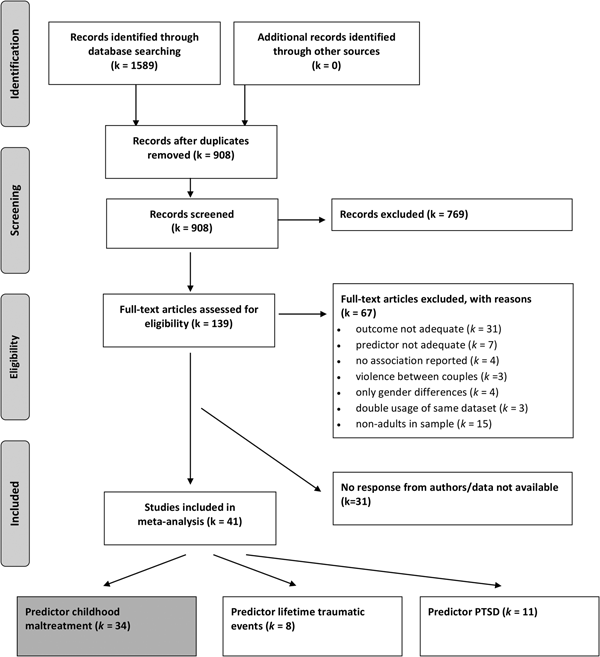
The initial search resulted in a total of k = 1589 studies (Scopus k = 655, PsycArticle/Medline k = 126, PILOTS k = 82, Embase k = 36, ScienceDirect k = 40, Web of Science/Science Citation Index k = 650). Figure 1 presents details of study selection and reasons for exclusion.
Study selection flow chart with reasons for exclusion. In the current analysis, only studies investigating the impact of childhood maltreatment are included. Figure adapted from Moher et al. (Reference Moher, Liberati, Tetzlaff and Altman2009).

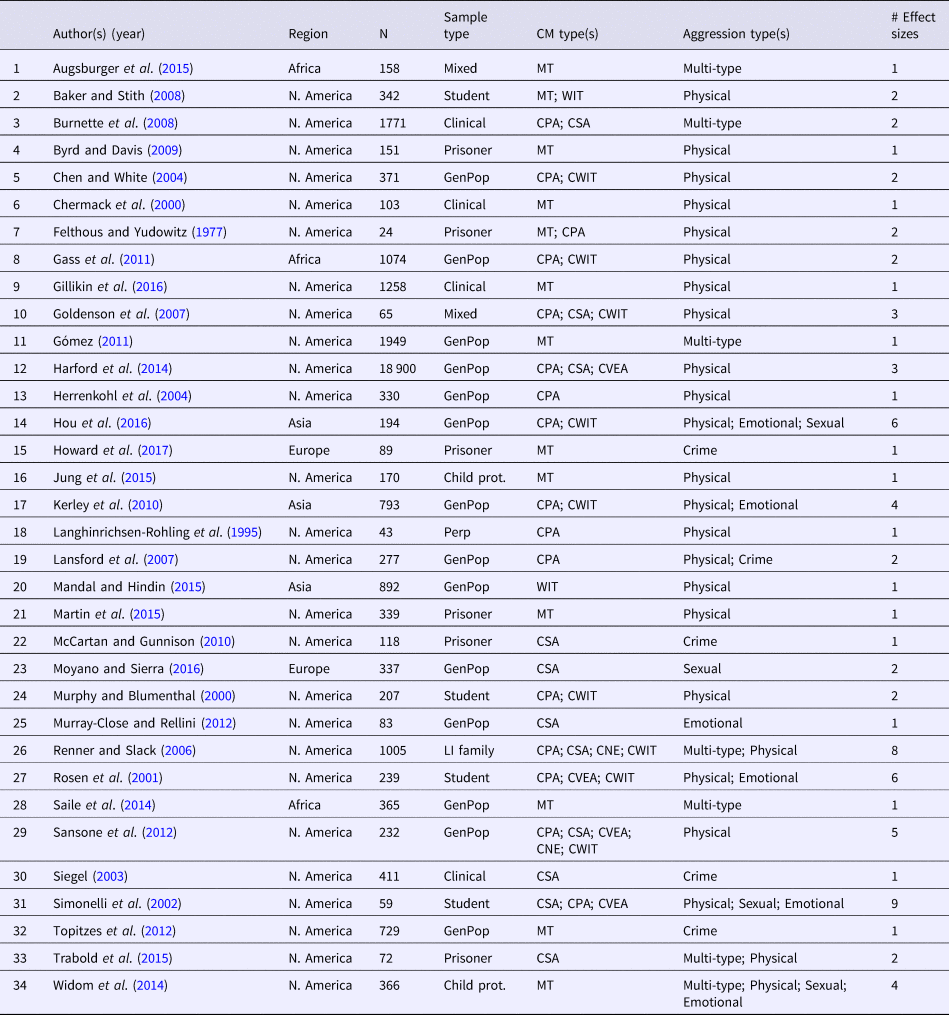
In total, k = 41 studies were extracted. Of these, k = 34 (with 81 effect sizes) investigated at least one type of CM and were included in the current analyses. This resulted in a sample size of N = 32 349. Most studies provided more than one effect size (e.g. multiple types of CM and/or aggression). Table 1 presents characteristics of all studies.
Characteristics of studies included

N. America, North America; Perp, perpetrators of domestic violence; GenPop, General Population; LI family, low-income family; Child Prot., sample from child protection service; CM, childhood maltreatment; PTSD, post-traumatic stress disorder; TE, traumatic events; MT, multi-type (composite score including different types of CM); CPA, childhood physical abuse; CSA, childhood sexual abuse; CVEA, childhood verbal/emotional abuse; CNE, childhood neglect (physical or emotional); WIT, witnessed violence during childhood.
Research question #1: overall association between CM and aggression in women
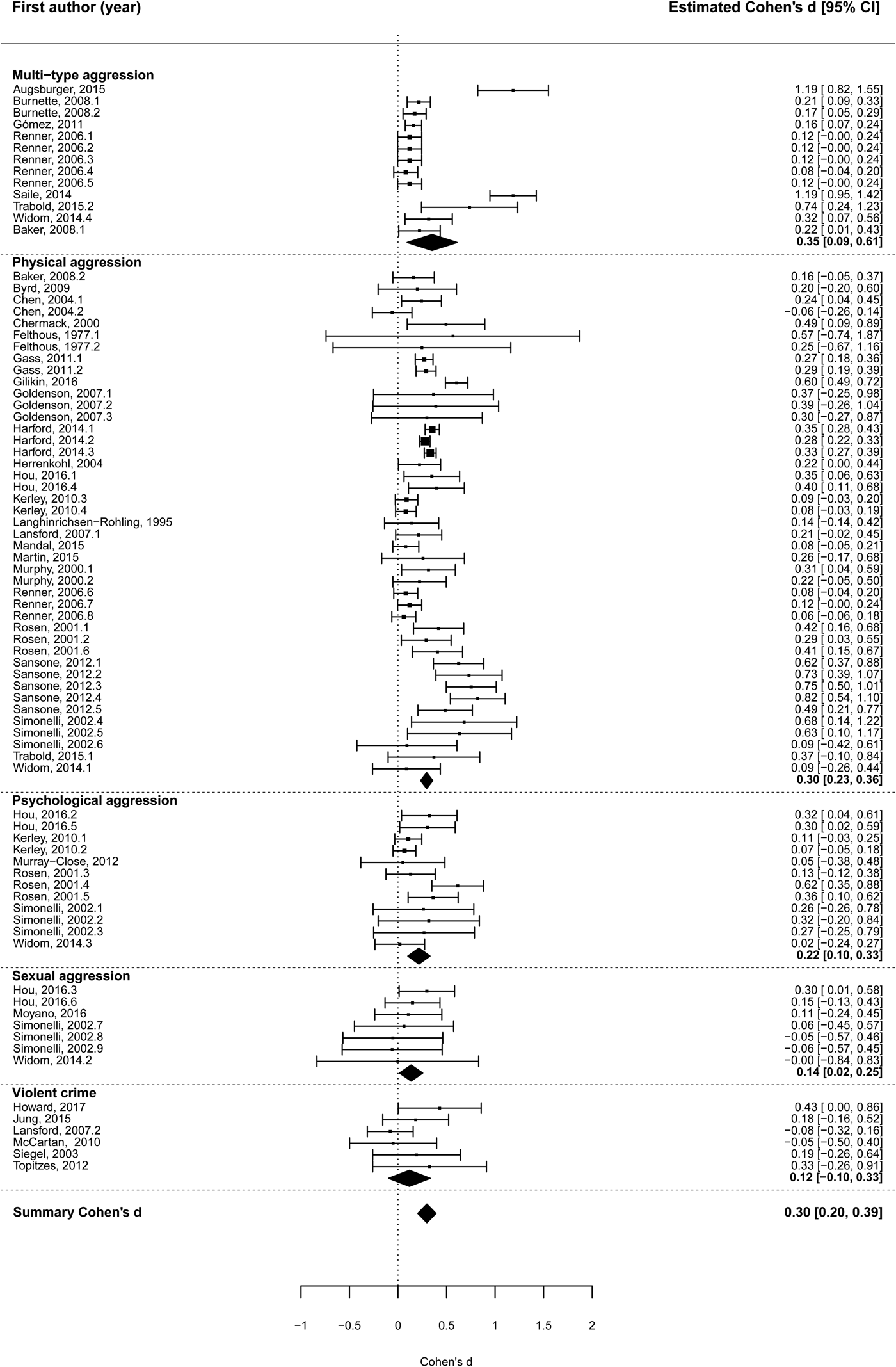
The overall model of effect sizes merged for types of CM, nested in aggression types and studies, resulted in an overall small effect size Cohen's d of 0.30 [s.e. = 0.07; 95% CI 0.15–0.44, t(42) = 4.19, p < 0.001]. Controlling for the dependency between effect sizes from the same study with a robust estimator resulted in negligible changes (in the third or fourth decimal place). Thus, the initial model was assumed to be valid.
Research question 2: types of CM and aggression
Subsequently, effect sizes were nested in aggression types, within CM types, nested in authors, and including both factors as moderators. This model was over-parameterized as indicated by flat profile likelihood plots for variance components (not further shown here). Consequently, a simpler model was applied that included only author level as a random effect. In this model, the omnibus test for the two moderators was significant [F (9,71) = 2.22, p < 0.05]. However, only types of aggression were relevant, whereas the specific CM did not have any impact. Compared to the baseline of multi-type aggression, both sexual aggression and violent crime were significantly lower, whilst physical and psychological aggression had similar effect sizes compared with multi-type aggression. Again, the robust estimation did not change the results. Figure 2 presents these findings in a forest plot, separate for each aggression type.
Forest plot for all effect sizes of k = 34 studies reporting an association between childhood maltreatment and aggression.

This model resulted in substantial residual heterogeneity [Q E(71) = 244.44, p < 0.0001]. Subsequently, additional moderators were investigated.
Research question 3: additional moderators
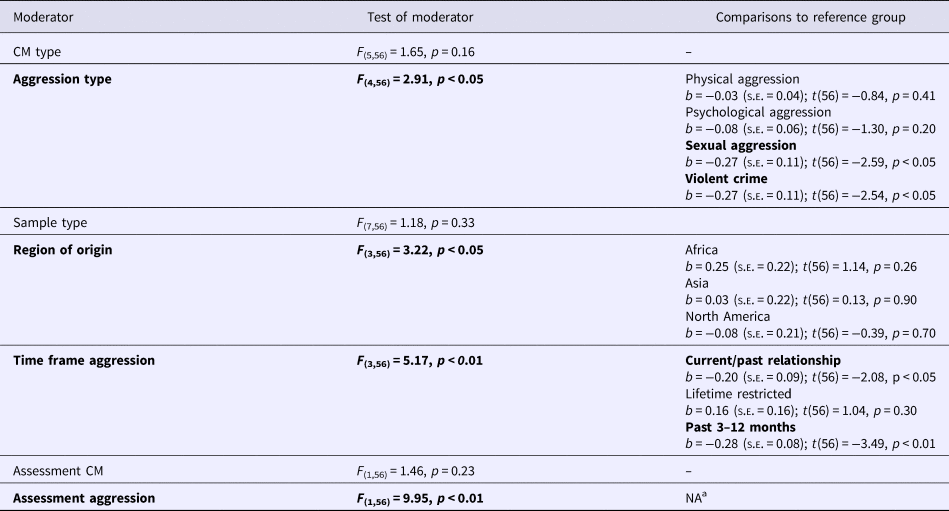
All other moderators (study design, sample type, study region of origin, time frame of aggressive acts, assessment method frequency v. incidence for predictor and outcome) were simultaneously entered into meta-regression in addition to type of CM and type of aggression. Again, the omnibus test was significant [F (24,56) = 3.66, p < 0.001]. Next to type of aggression, also the ‘frequency v. incidence’ measurement of aggression was significant in the direction that assessment via incidence lead to a significantly reduced effect size compared with assessment via frequency. Additionally, time frame of aggressive acts was significant. Compared to the reference of lifetime aggression, the association was lower for aggression assessed within a smaller period of time (i.e. in the relationship or during the last months). Lastly, study region of origin resulted in a significant moderator. Study sites in Africa, Asia, or North America did not differ compared with studies conducted in Europe. However, further pairwise comparisons revealed higher effect sizes for African countries compared with North American regions (p < 0.01). Table 2 summarizes details. This model sufficiently accounted for residual heterogeneity [Q E(56) = 56.86, p = 0.44].
Moderator analysis for subset CM

a Only two levels available, thus no further analyses was required. Significant coefficients are printed in bold.
Baseline, multi-type aggression; baseline, Europe; baseline, lifetime; baseline, frequency.
Sensitivity analysis
Finally, it was tested if indices of study quality change results. Compared with non-adjusted effect sizes, adjusted effect sizes did not have an impact [F (1,79) = 2.18, p = 0.14]. The model was also not affected by merged effect sizes [F (1,79) = 1.68, p = 0.20]. Lastly, the eight effect sizes from studies with quality concerns and flaws in statistical reporting did not lead to significant changes compared to the baseline of no concerns [F (2,78) = 1.57, p = 0.22].
Publication bias
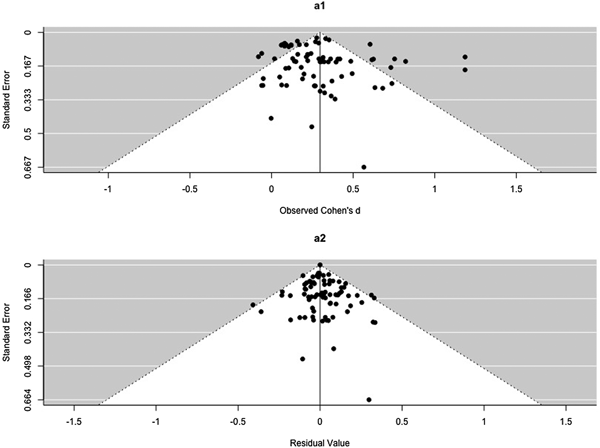
According to Rosenberg's fail-safe rate, a large number of total 13 184 studies with non-significant results would be needed to ‘nullify’ the overall effect. Funnel plots were visually examined. The moderator model indicated a symmetric funnel centered at low values for the standard error (see Fig. 3). As expected, the test for funnel asymmetry was not significant [t(54) = 0.52, p = 0.61]. Thus, a publication bias was of no concern.
Funnel plots for CM for the initial model (a1) and the moderator model (a2).

Discussion
The current meta-analysis adds cumulative evidence for a cycle of violence in women by revealing a small but significant overall positive association between exposure to CM and a broad range of aggressive behaviors. Thus, it supports the perspective that long-lasting behavioral alterations or action preferences can be induced by early adverse experiences. In addition, this meta-analysis provides insights into mechanisms underlying this cycle by investigating several important moderators. The findings demonstrate that specific types of CM do not significantly differ in their effects. This is in line with recent studies showing that less-recognized types such as emotional abuse or neglect also have similarly devastating potential just like physical abuse (Teicher et al., Reference Teicher, Samson, Polcari and McGreenery2006; Teicher and Vitaliano, Reference Teicher and Vitaliano2011; Teicher and Samson, Reference Teicher and Samson2016). However, the limited number of studies available for specific CM types (k = 7 studies for psychological abuse, and k = 3 studies for neglect) makes it difficult to draw a more solid conclusion.
Regarding varying effects on specific dimensions of aggression, the current analysis revealed the largest associations for multi-type aggression together with physical and (to a descriptively lesser extent) psychological aggression. Both violent crime and sexual aggression showed reduced effect sizes, with confidence intervals being near to (sexual aggression), or including zero (violent crime). Since multi-type aggression might most likely include acts of both psychological and physical violence, similar associations can be expected. For sexual violence, with the exception of one study (Moyano and Sierra, Reference Moyano and Sierra2016), all studies investigated intimate partner sexual violence. It is likely that other factors such as bi-directionality or partner-related dynamics like marital attitudes (Hou et al., Reference Hou, Yu, Fang and Epstein2016) that were not assessed in the current analysis, might be more relevant for predicting sexual aggression than abusive experiences during childhood alone. For violent crime, this category reflects a broad range of severe violent acts, all having resulted in prosecution. Consequently, effect sizes from individual studies strongly varied from almost-zero (e.g. Lansford et al., Reference Lansford, Miller-Johnson, Berlin, Dodge, Bates and Pettit2007) to moderate associations (e.g. Howard et al., Reference Howard, Karatzias, Power and Mahoney2017). Different definitions of the term ‘violent crime’ might account for this heterogeneity. Interestingly, in the study from Lansford et al. (Reference Lansford, Miller-Johnson, Berlin, Dodge, Bates and Pettit2007), sexual aggression was explicitly included in the definition of crime, and likewise presented the smallest effect size. This is in line with similar findings above.
Regarding the use of retrospective or longitudinal research designs, this did not have an impact on the associations. In contrast to concerns raised by some scholars (e.g. Thornberry et al., Reference Thornberry, Knight and Lovegrove2012), a memory bias was not found to impact the findings. Also, the fact that both quality concerns as well as controlling for merged or adjusted effect sizes were not significant is a further indication for the robustness of findings regarding the cycle of violence in women. Lastly, the results did not differ with respect to the sample. Similar mechanisms involved in the cycle of violence are likely to occur independently of investigating the general population, clinical samples, child welfare participants, or offenders. Taken together, the current results argue in favor of a general and integral risk of increased aggression due to childhood experiences of adversity.
Nevertheless, there are systematic effects beyond aggression types that can substantially explain the heterogeneity found in the data. First, there is evidence for cultural aspects, e.g. world regions with dominating socioeconomic developments, affecting the relationship between exposure to CM and aggression. Further pairwise comparisons revealed significantly higher effects for sites in African countries in contrast to North American studies. Two African studies took place in post-conflict regions, and presented effect sizes in the high range (Saile et al., Reference Saile, Ertl, Neuner and Catani2014; Augsburger et al., Reference Augsburger, Meyer-Parlapanis, Bambonyé, Elbert and Crombach2015). It is likely that cumulative exposure to war and conflict-related adversities, being unique to these two studies, might lead to stronger effects. Also, effect sizes were smaller when being assessed over a shorter period of time. This can be explained by the fact that a number of studies investigated the frequency of aggressive acts, leading to higher scores for a longer compared with a shorter period. The argument is also supported by the finding of higher effect sizes when aggressive behavior was reported as frequency in contrast to incidence.
Whilst this meta-analysis provides further evidence for the progression from childhood victim to adult perpetrator in women, the underlying mechanisms still lack clarity. Qualitative interviews conducted in a study with male IPV perpetrators revealed that exposure to CM resulted in significantly worse school performance. Participants with a history of abuse reported an early onset of mental health problems, including substance abuse, but without access to treatment (Watt and Scrandis, Reference Watt and Scrandis2013). It remains to be determined if transmission pathways in women work in a similar fashion. Lastly, from a neurobiological perspective, there is evidence for alterations in brain development as a functional adaptation in response to early adverse experiences (Teicher and Samson, Reference Teicher and Samson2016). A review based on studies with rodents demonstrated that exposure to stress during vulnerable periods such as adolescence predicts adult aggression due to disruptions related to the dopaminergic system (Tielbeek et al., Reference Tielbeek, Al-Itejawi, Zijlmans, Polderman, Buckholtz and Popma2016). Whilst these animal models cannot be considered as homologous to the human brain system, they suggest potential starting points for further investigation of human biological pathways.
Limitations
This meta-analysis presents a number of limitations: First, though in the initial model, the four-level structure of the data was statistically taken into account, this resulted in over-parameterization when including moderators. From a statistical point of view, the subsequent simpler model resulted in a miss-specification because dependency was not taken into account. However, the application of a robust estimator that accounts for this miss-specification did not alter the findings and thus confirmed the validity of the results.
Another limitation arises from the fact that interactions between moderator variables could not be included due to limited numbers of studies available. It cannot be excluded that these interactions affect the results. Also, for the same reason, several variables modeled in primary studies were not coded because there was too much variety. For instance, the impact of substance abuse as a mediator was investigated in some studies (e.g. Parrott et al., Reference Parrott, Drobes, Saladin, Coffey and Dansky2003; Howard et al., Reference Howard, Karatzias, Power and Mahoney2017) but not in others, whilst it is known to play a significant role in predicting aggression (Rasche et al., Reference Rasche, Dudeck, Otte, Klingner, Vasic and Streb2016). A similar problem is related to potential victims of aggressive acts perpetrated by women. Considering an inter-generational transmission of violence toward their own children, it is crucial to identify individuals most at risk of being victimized.
Regarding the outcome variable, our narrow definition of aggression only incorporated reports of aggressive acts across different dimensions as well as violent crime. This definition limits the generalizability. For instance, we did not differentiate between reactive or proactive types. In light of women preferring different aggression strategies than men (Cross and Campbell, Reference Cross and Campbell2011), a further consideration of this aspect might reveal important insights.
Lastly, despite significant efforts to contact study authors, a number of studies could not be included because no response was given. We cannot completely rule out the possibility that an inclusion of these studies might have altered the findings, though the assessment of a publication bias indicates otherwise.
Conclusion
This meta-analysis provides evidence for a robust cycle of violence for women, arising from exposure to childhood adversities, yet with a small effect size. The strength of the current analysis lies in the holistic approach by demonstrating associations across varying samples, designs, and cultural settings. The findings imply that it is not only essential to routinely screen for exposure to childhood adversities in healthcare settings but also take into account the risk of future (female) perpetration of violence. Though it was not possible to determine the impact of aggression on specific groups of victims, a substantial group might be the offspring of these women, thus increasing the vulnerability for poor health outcomes within the next generation and perpetuating the cycle.
Whilst the current analyses can rule out a number of concerns regarding the transition from childhood victimization to the perpetration of aggression in adulthood, they cannot provide answers arising from potentially important interactions between variables due to the limited numbers of studies available. Future research should focus on less-investigated types of both abuse (e.g. neglect) and aggression (e.g. risk factors for sexual aggression). In addition, it is strongly suggested to incorporate gender-specific perspectives. Overall, the findings point to the significance of early interventions that can target families at risk in order to prevent ongoing cycles of violence.
Supplementary material
The supplementary material for this article can be found at https://doi.org/10.1017/S0033291719000680
Author ORCIDs
Mareike Augsburger, 0000-0002-6564-0717; Andreas Maercker, 0000-0001-6925-3266.
Acknowledgements
We would like to thank the two student assistants for their support, Jenny Lee and Désirée Thommen. Our thanks go to Clare Killikelly for proofreading and helpful language advice.
Financial support
This research received no specific grant from any funding agency, commercial or not-for-profit sectors.
Conflict of interest
None.