The inherent attractions of Greece and Italy, are, to the scholar, so various and so great, that a succession of travelers thither will doubtless be never wanting so long as the studies of our youth give to those countries that immense preponderance of interest which they so justly claim. Some will repair there ardent with no unfounded hopes of discovery; for not an acre of ground, in a country of such narrow limits and such gigantic fame as Greece, but deserves to be explored. To others no greater motive will be wanting than to obtain the noble gratification of beholding objects, of which none are content with the description (Lyall Reference Lyall1817, 32–33).
Visiting ruins, I enjoy the texture of the weathered stones. The wide space, colored in spring by wildflowers. Open space and vistas, the heady smell of grasses drying in the hot sun. Birds sing as they have since Plato's cicadas. Once, alone near the ruins, I heard a strange rhythmic clicking in the grass: two tortoises making love. The ruins that I visit remind me of antiquity not because I picture Socrates walking through the Stoa, but because I picture him walking along the still undeveloped riverbank, smelling these grasses, listening to these birds. The simplicity that I long for, however, is not millennia away, but only centuries. It is almost at arms’ length, but just out of view. What I find there is nature in a frame of culture. Like most tourists, I cannot transform the stones into the imaginary film of antiquity that the European brain of the nineteenth century, steeped in a classical education, projected onto them. Yet their vision was no more authentic than mine: in order to project the past onto stones, they had to erase the present.
For the acropolis they visited teemed with life: of people who lived among the ruins. For them the monuments were not redolent with a classical past. For Christian Greek and Muslim Ottoman alike, the Classical past was a foreign land brought to life only in the distant brain of the educated European. For the denizens of Athens, the ruins around them were simply home.
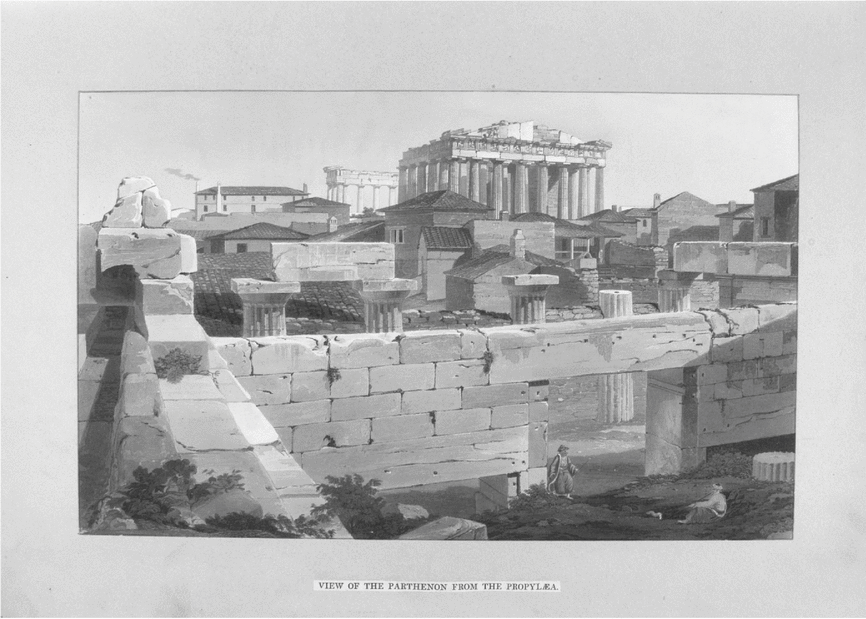
We see these homes in paintings of the Acropolis from the early nineteenth century, including those by the antiquarian Edward Dodwell (1767–1832), an Irish painter who traveled around Greece in the early nineteenth century with fellow antiquarian Sir William Gell (1777–1836). His View of the Parthenon from the Propilaya clearly illustrates the intimate connection between contemporary habitation and the ancient temple area [Figure 1]. In the 1821 Views in Greece where this image was published, he mentions the contemporary situation of the monument through a picturesque anecdote:
The figure, who is in a sitting posture and is smoking, is the Disdar, or governor of the castle. As we sometimes had our dinner brought up to the acropolis and dined amongst the ruins, the Disdar used generally to discover our retreat, and never omitted the opportunity of indulging in the forbidden liquor, and of drinking the greater part of our wine. The figure, who is seen entering the gate, is another Turk of the garrison. This portrait manifests symptoms of astonishment at having surprised the Disdar in the act of drinking a tumbler of wine, which he hastily withdrew from his lips on the approach of the other Turk, but not in time to elude his observation (Dodwell Reference Dodwell1821, 26).
Edward Dodwell, “View of the Parthenon from the Propylaea,” Views in Greece (1821), 27. Digital Collection, University of Heidelberg

The story, depicting the local administrator as an opportunist drunk who lies to his compatriots in breaking his religious laws, condenses the far more extensive contempt expressed in Dodwell's Reference Dodwell1819 Classical and Topographical Tour through Greece during the Years 1801, 1805, and 1809. Explaining the complexities required to bribe the Disdar and his soldiers to give him freedom to spend all day drawing, he contemptuously describes the inhabitants of the town:
[I]t was stipulated that the payment should take place after I had completed all my drawings and observations. Many days however had not elapsed before the Disdar became impatient for the money, and asked me for a part of the promised sum: upon my refusal of which he prohibited my admission to the Acropolis. But when I returned, I succeeded in gaining an entrance, after enduring some insolent speeches from the soldiers, which I pretended not to understand. At length however I obtained their good graces by making some small presents to their children, who became so accustomed to this kind of tribute, that they used to watch for me over the wall of the citadel; and whenever I returned I always found them collected at the door. By throwing a few paras amongst them, I acquired the name of the Frank of many Paras, and for a small expense purchased the civility of the soldiers (Dodwell Reference Dodwell1819, 293).
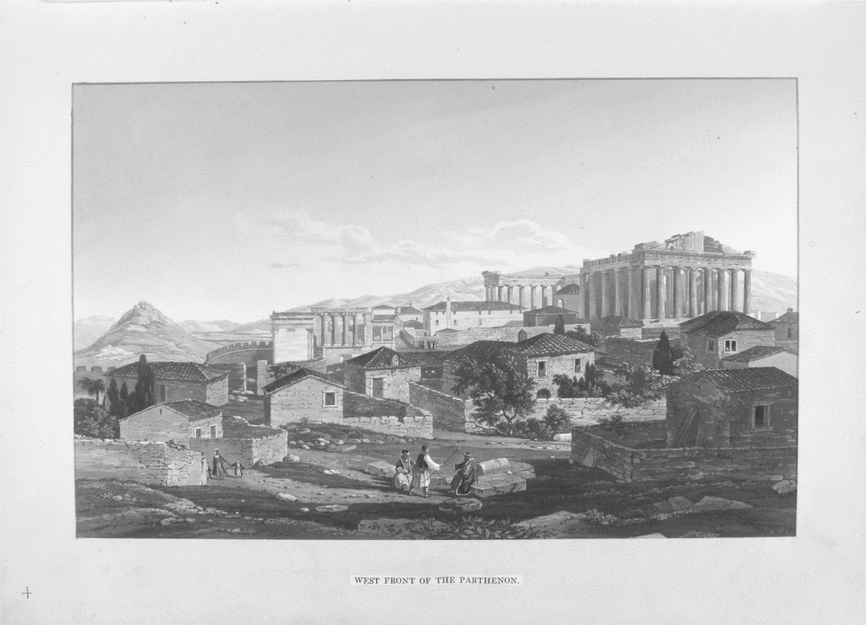
Understanding the locals as mere nuisances, Dodwell revels in his mastery of the territory through his knowledge of classics, developing recognition of the area through extensive and erudite quotation of multiple authors. He brushes away the inconvenient people inhabiting the stage of his fantasy, enabled through the fee he pays and enlivened by the musicians who play every day at three for the pleasure of foreign visitors [Figure 2]. He thereby establishes his superior right to the space through a practice of imaginary colonialism, through which he declares the home of another more rightfully his own on behalf of a people, the Greeks, who had long since requisitioned the antique past that he celebrated to a pagan and forgotten prehistory. Far more interested in the glory of heaven under the dominion of Christ than in the legacy of Athena under their own feet, local Greeks had no more interest in Turks in the ruins that harmonized with the houses, sky and grass all around them (Gourgouris Reference Gourgouris1996).
Edward Dodwell, “West Front of the Parthenon,” Views in Greece (1821), 31. Digital Collection, University of Heidelberg.

This imaginary colonialism began with the mapping of ancient literature onto physical space, and continued through the mapping of physical space onto portable paper. The transfer of ownership through presence to ownership through knowledge depended on the technology of recording, which could reproduce and transport the real. Underscoring the Disdar's technological inferiority, Dodwell relates his bewilderment when he shows him the workings of the camera obscura which he used to draw the Parthenon. Unable to understand its magic, the Disdar responds with amazement, initially praising God with wonder. But, devious as with the wine, he changes his tune when his soldiers appear.
[H]e now became outrageous; and after calling me pig, devil, and Buonaparte, he told me, that if I chose, I might take away the temple and all the stones in the citadel; but that he would never permit me to conjure his soldiers into my box. When I found that it was in vain to reason with his ignorance, I changed my tone, and told him that if he did not leave me unmolested, I would put him into my box; and that he should find it a very difficult matter to get out again. (Dodwell Reference Dodwell1819, 294–95)
The technology of visual reproduction redoubled the claim to ownership through knowledge of antiquity. The camera obscura becomes a trap, capable not only of capturing the image, but of imprisoning that which it represents. No wonder, then, that the sculptures of the Acropolis would soon wend their way to Britain.
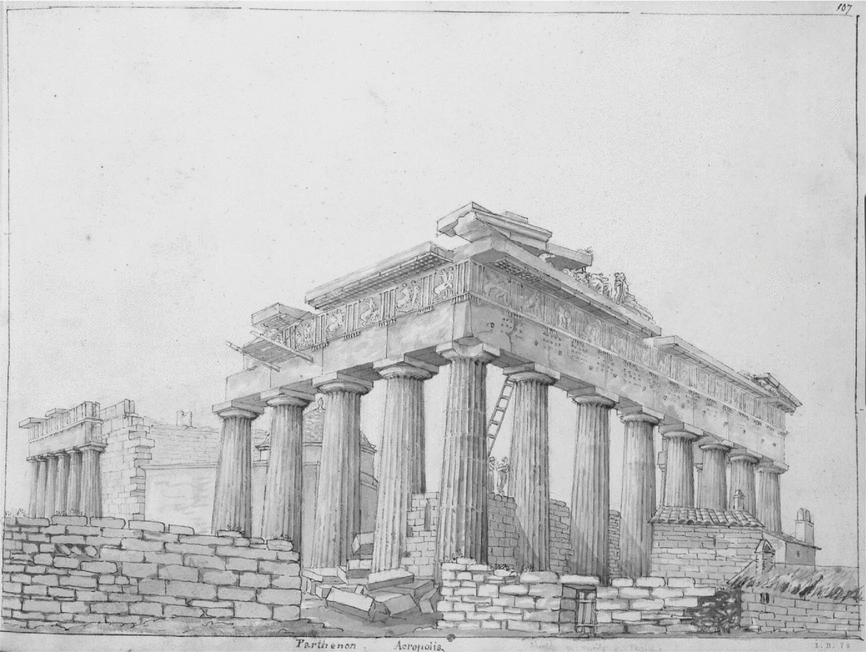
Despite the supposed predations of the wine- and image-hating Turk, the Parthenon marbles were nearly intact when Gell visited the site. [Figure 3] Their supposed conservation entailed their dismantling and transport from the site, denuding the building and enforcing an iconoclasm never attempted under even the most image wary of Byzantine Christians or Muslims who had used the site for worship. The traveler Edward Daniel Clarke (1769–1822) described the violence of the process through which architecture was transformed into art:
We saw this fine piece of sculpture raised from its station between the triglyphs: but the workmen endeavouring to give it a position adapted to the projected line of descent, a part of the adjoining masonry was loosened by the machinery; and down came the fine masses of Pentelican marble, scattering their white fragments with thundering noise among the ruins. The Disdar, seeing this could no longer restrain his emotions, but actually took his pipe from his mouth and, letting fall a tear, [declared] nothing should induce him to consent to any further dilapidation of the building. (Clarke Reference Clarke1815, 40)
William Gell, “The Parthenon,” Sheet 76 from sketch-book 13; exterior view of the Parthenon, 1811. Pen and ink with brown and black wash ink. British Museum 1853,0307.109

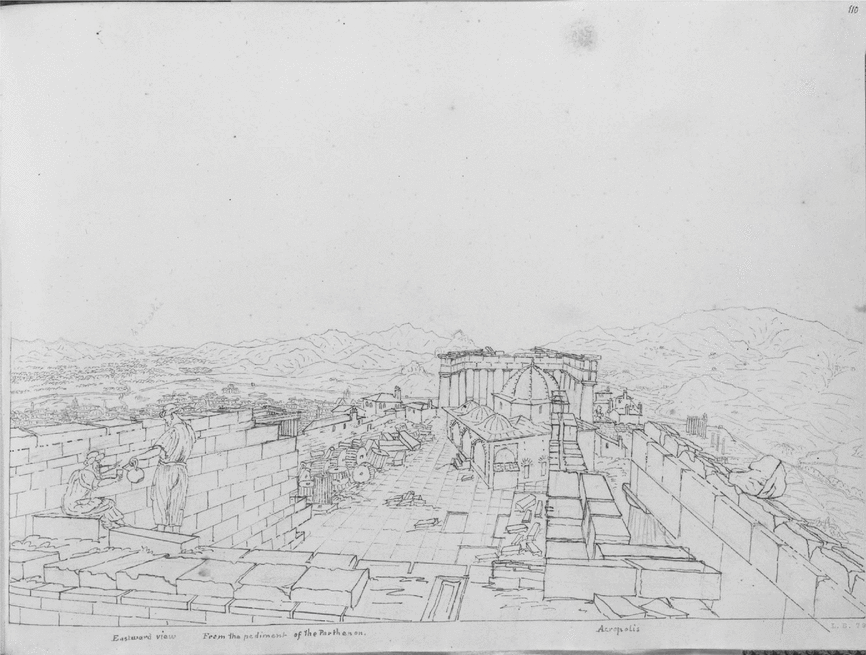
By sketching the Disdar as backward, Dodwell promoted a discourse that reframed ownership of the antiquities from the locals who would protect them to the British who would place them not only in the boxes of their cameras, but also in the holds of their ships. The dislocation of these relief panels, known as the “Elgin Marbles” after the lord who had them disassembled and sent to England, has become central to a longstanding controversy over ownership of the past (St. Clair Reference Clair1998). Greece has built an entire museum dedicated to their repatriation. But what was lost with the marbles was not simply some sculptures, amply reproduced and reproducible with increasingly accurate technologies, but also a way of knowing the world through the natural processes of change. The people who lived in the town of the Athens acropolis inhabited the physical spaces of the past through natural processes of loss and recycling. Along with the loss of the cultures that had built them, ruins had acquired new functions that allowed them perpetual life in a renewed present tense. The shaky line of William Gell's drawing of the Eastward view from the pediment of the Parthenon reveals his hand passively recording a truth that the camera obscura saw, but which he and Dodson preferred to ignore [Figure 4]. Against the domed mosque bringing the purpose of worship to life in the ancient ruin, Gell sketches an antique couple in the unlikely fantasy of enjoying water inside the temple, distant from the stream. Just like one can't have one's cake and eat it too, you can't both have ruins and have those who made them still alive.
William Gell, “Eastward view from the pediment of the Parthenon,” 10 July 1801 – 15 September 18, British Museum 1853,1307.112

Restoration laid this present tense to ruin, giving the remains of two deaths—that of the builders, and that of the inhabitants—over to the new owners of the site, the tourists who faithfully perform a pilgrimage that erases the appropriations through which modern Europe invented its past. Among them, a tortoise munches the wild greens as lugubriously as time itself. Bereft of the option to see space like him so closely that everything is natural, removed from the option of habitation, and distant from the predations of classical imaginations, how can the ruins come to life today? What is the story outside of our own visit that animates the trek up a distant hill? Who is the goddess whom we seek there, if she is no longer Athena, and if the place is no longer just simply home?