Cars! They are the most amazing product of industrial manufacturing Jomo. Is it true the word “manufacturing” is now irrevocably obsolete in English? Anyhow, I was telling you something about cars:
They attract everyone from passionate lovers of the fast life through thieves and burglars to pretty women with the least resistance to the material lure of this world.
Pensioners, social hustlers, not-made-too-good and ageing civil servants in faded, old-fashioned neckties, drive around in them as do business tycoons, diplomats and big time thieves in impenetrable masks.
During the Rawlings administration, our Customs, Excise and Preventive Service seized under law, a large number of cars whose importers had failed to pay duties on them. The seized cars, I was told were being sold at relatively cheap prices to public servants.
The car fever caught me then and I spent nearly a year investigating the sale of the seized cars to public servants, an assignment that took me from the CEPS headquarters to the old Publishing Corporation Yard at Tema where seized and “overaged” cars seized from importers are kept.
One for the Road—A Letter to Jomo, George Sydney AbugriFootnote 1THE COMMODITY AND THE STATE
This essay probes the role of commodities in the crafting of state power, working from the vantage point of contemporary Ghana, a polity at once post-socialist and staunchly neoliberal, least-industrialized and highly cosmopolitan. Among the many commodities which Ghana's citizens and state bodies identify with and rely upon, cars are of critical significance. In what follows, I explore the raft of interventions surrounding car importation and allocation imposed by Ghana's Customs Service, and the resulting public critique, in an effort to capture the shifting contours of state authority in the context of an electoral and economic transition spurred by neoliberal reform.
The intensification of Customs controls with respect to cars allows the enhancement of state authority, and thus contradicts official representations of neoliberalism that stress the streamlining of state institutions. Through the metaphoric reclamation of car production, together with official and unofficial strategies of car seizure and redistribution, state bodies garner revenue and prop up state functionaries and allied elites, while policing the socio-economic mobility of the wider populace. These functions hold much in common with the sumptuary regimes of both early modern and socialist polities. These interventions also open a space for public claims against the state, as is evident in a spate of allegations that surfaced in Ghana's daily papers in 2000 and 2001. These discourses ignite discussions of materiality and morality, citizen rights and government responsibility, private property and political privilege, and have put cars at the center of a distinctively neoliberal public sphere. They check the extension of state power as they bolster and legitimate private accumulation.
Throughout the world at many different historical moments elites seeking to mark power and protect privilege have controlled the circulation of consumer goods through sumptuary regulations (Bowie Reference Bowie1993; Earle Reference Earle1994; Hunt Reference Hunt1996; Wilks Reference Wilks1993). With the rise of capitalism and industrialization, the commodity, the quintessential sign of modernity's abstractions and impersonations, came to mark state authority along with individual identity and social position (Mintz Reference Mintz1985). Given the tendency of commodities to ceaselessly extend their range of circulation due to the possibilities of commensuration and replication (Kopytoff Reference Kopytoff and Appadurai1986), the insertion of such material forms into state sumptuary regimes is necessarily fraught.
Such a nexus of commoditization, sumptuary control, and the negotiation of state-based political hierarchy is evident in Ghana's history. The expansion of the Asante Empire in the eighteenth and nineteenth centuries depended on the oversight of trade and the collection of taxes and tributes. This was accomplished through state control of the circulation of the most-valued forms of material wealth—notably gold, but also a variety of foreign manufactures such as alcohol, cloth, and eventually firearms—via an extensive and highly disciplined bureaucratic apparatus (Wilks Reference Wilks, Forde and Karberry1967: 214–16; Reference Wilks1993). The material endowments of ruling elites reflected vividly these commercial and sumptuary conventions. Royal regalia were typically forged out of gold and meticulously crafted, resulting in extensively decorated and expensively endowed manifestations of otherwise functional goods, European imports among them (McLeod Reference McLeod1981: 87, 93). Although most striking in the Akan court traditions of Ghana's forest zone, these objects and attendant protocols were influenced by coastal elites of Ga, Fante, or mixed European and African ancestry (ibid.: 95, 98). Members of such groups served as conduits for most imported items moving north and were crucial go-betweens in the assertion and containment of European political and economic influence. Within these multicultural political and economic networks, the designation of authority was often marked by the display of objects and insignias combining imported forms with indigenous design, to which access was assiduously guarded.
The formal imposition of the colonial state apparatus in the Gold Coast and its hinterland during the second half of the nineteenth century similarly depended on the extension of imported goods (and desires for them), along with processes of commercial rationing and sumptuary ranking. Once the Gold Coast Colony was established in 1874, it was colonial officials who oversaw the terms of commodity consumption and circulation. Colonial policies enabled the dominance of a handful of trading concerns, among them the French Compagnie Francaise de l'Afrique Occidental (CFAO) and the British United Africa Company (UAC). With these enterprises came distinctive retailing systems that featured a specific array of brands and products, from textiles and guns to tea, soap, and bicycles. Colonial administrators ruled according to a mercantilist logic, and imposed strict standards of monetization and taxation and ardently promoted cash cropping for the export market (Austen Reference Austen1987: 129–30, 136; Chalfin Reference Chalfin2004), which fostered further importation of manufactured items.
Despite the desire to break with the colonial past that fueled the drive for self-rule in Ghana during the 1940s and 1950s (Austin Reference Austin1964), at independence in 1957 many of these conventions were replicated in a new guise. However ardent the government's rejection of Western dependence and intervention, commodities, and the ideals of industrial manufacture and mass marketing they embodied, remained central to the state project. As Kwame Nkrumah, Ghana's first prime minister and leader of the independence movement, developed his vision of African socialism, the state continued to harness signs of modern nationhood by way of the commodity. At this historical juncture, in contrast to the earlier focus on imported goods, state-run industries, state stores, state farms, and state brands became the norm (Austen Reference Austen1987: 212; Hopkins Reference Hopkins1973: 277, 278). A State Gold Mining Corporation, State Footwear Corporation, State Fishing Corporation, and a panoply of manufacturing enterprises from fruit processing to corned beef canning (Killick Reference Killick1978) served as central symbols of progress and development, even though many items (cars included) were never to be made in Ghana.
Sustaining this nationalist vision, the state imposed import restrictions, and the Ghana National Trading Corporation (GNTC) was established to displace private importers (Chazan Reference Chazan1983: 48, 166; Austen Reference Austen1987: 228, 237, 250–51; Killick Reference Killick1978: 264). The independent government likewise hardened its monopoly of agricultural export by enlarging colonial-era marketing boards. This was so despite the fiercely independent reputation of Ghanaian cocoa farmers, who were a primary source of foreign exchange and whose protests had earlier served as a major impetus to the achievement of national independence (Beckman Reference Beckman1976). In the crafting of such an alter-modernity, the commodity came to serve as a prime battleground between state and society. Consumers and business people sought to evade onerous exchange controls through all sorts of informal economic activity, from smuggling and black-marketeering to the sale of import licenses (Azarya and Chazan Reference Azarya and Chazan1987).
With Ghana's turn to neoliberalism in the mid-1980s, such aspirations and enterprises of a self-sustaining economic order were all but jettisoned in favor of unfettered commercial flows, floating exchange rates, foreign investment, and the shrinkage of state services and firms (Rothchild Reference Rothchild1991).Footnote 2 Yet, even as Ghana crafts its modernity upon a free market, certain commodities remain potent signs of the state. The significance of these goods grows as other avenues and objects of state intervention fall by the wayside in the wake of economic reform, and they have emerged anew as charged sites of negotiation between government and the public. Nowhere is government reliance on commodity rule, and its public contestation, more evident than in the case of cars.
CARS HAVE ALWAYS BEEN MODERN
If cloth can be taken to be the original commodity of modernity due to its pivotal role in the initiation of factory work, industrialization, and the possibilities of mass-marketing and consumption (Devries Reference Devries1976; Goody Reference Goody1982; Hansen Reference Hansen2000; Steiner Reference Steiner1985), cars can be considered the most enduring. Not only are cars the original “durable good,” built to last, to be repaired, renewed, and eventually recycled, they may also well represent a “metaphor for modernity” more generally (Thomas, Holden, and Claydon Reference Thomas, Holden, Claydon, Thomas, Holden and Claydon1998: 1; Barthes Reference Barthes1972). Their every detail dictated by an aesthetic of function, cars inspire and are inspired by “the adulation of the machine” (Brandon Reference Brandon2002: 201), a hallmark of modernist style. The model for rationalized mass-production and assembly-line work—what economists refer to as Fordism—derives from the process of car manufacture. Representing modernist ideals of technical efficiency, automobile manufacture is equally allied with the rise of scientific-management (Harvey Reference Harvey1990: 125), automation, and the sort of “de-skilling” that makes workers as interchangeable as machine-made parts.
Cars at the same time speak to the transitory nature of modernity. Due to variations in makes, models, and use, cars convey the play of fashion, taste, and individual predilection that are as characteristic of the modern age as modernist efficiency and interchangeability. Alfred P. Sloan, an icon of the automobile industry and early president of General Motors, was quick to recognize the car as an item that could whet and satisfy consumers' desire for innovation, and he introduced a range of new models every year (Brandon Reference Brandon2002: 240). For nearly as long as cars have existed they have been stylized, incorporating and influencing the broader trends of the day. Accessorized to reflect personal needs and sensibilities, they embody and facilitate what Gaonkar (Reference Gaonkar and Gaonkar2003) identifies as the creative self-making of Baudelairian modernity.
Cars set us apart from nature, the past, and each other, and may thus be the technology of daily life that most makes us modern. With their varied designs, prices, brands, and origins, cars speak to consumers' class positions and personal tastes as well as their political leanings and geo-political locations. Holden (Reference Holden, Thomas, Holden and Claydon1998) describes how different car brands and design features convey distinct national values, a situation finding its roots in states' efforts throughout the twentieth century to establish national car industries as a sign of economic advancement and independence. Earlier modes of public and private transport also conveyed political and economic distinctions by dint of cost, style, and decoration. But early motorcars were primarily objects of leisure rather than function, and they were particularly admired by the nouveau riche for whom cash, not pedigree, was the route to recognition (Brandon Reference Brandon2002: 43; Holden Reference Holden, Thomas, Holden and Claydon1998: 116). Cars thus served as an especially labile status marker, and they remain so today.
In Africa, cars position self and other along these axes of differentiation in the making of modernity's distinctions. They are foremost among the many commodities that force the confrontation of the industrial/non-industrial divide. Despite the presence of automotive industry in South Africa and North Africa, and discussions of the possibility of motor vehicle assembly in a number of African states (Economist 1999; Africa Report 1990), automotive production is lower in Africa, particularly sub-Saharan Africa, than on any other continent (Auto Industry 2007). In 2002, for example, passenger vehicles accounted for 80 percent of global auto production, but of the more than forty-one million produced that year, less than two hundred and fifty thousand came from Africa. Thus, in Ghana and most other places on the continent cars always embody an elsewhere, a modernity that is multiply and unevenly sited.
Ghanaians notice cars and make much of the possibilities and distinctions they represent. A friend explained to me: “Every Ghanaian who aspires to greatness in society aspires to own a car. Especially for the average Ghanaian who goes outside, his dream is to return with a car.” Perhaps inspired by indigenous monarchical traditions of conspicuous consumption geared to the display of foreign wealth, Ghanaians abroad who send personal effects home almost always include in the shipping container cars or car parts, from dozens of tires, to motor engines and components, to entire vehicles. These exchanges enable the aggrandizement of both the giver and the recipient and incite “reciprocal moral duties” among those at home and abroad (Arhinful Reference Arhinful and van Kessel2002: 154). If one cannot afford a new car, there are plenty of used ones available since 80 percent of the cars coming into Ghana are second-hand. European shipping firms find it highly profitable to service the used car trade (Beuving Reference Beuving2004: 513; Business Week 2000). One informant close to the car business told me, “Some Ghanaians travel to Europe especially to bring cars down (fifteen to twenty per month) and go into partnership with Europeans.”Footnote 3 Arhinful asserts, “[O]ne can partly attribute the thriving second-hand car market in Ghana to the illustrious way migrants in The Netherlands and other European countries fulfill obligatory roles to relatives back home” (2002: 158).
These are not the only sources of second-hand vehicles; many come from Japan, a result of Japanese government policies and cultural norms that encourage residents to jettison aging cars (Zaun and Singer Reference Zaun and Singer2004). Ghanaians in North America often supplement their incomes and status by partaking in the used car trade, purchasing dozens of “accidented vehicles” at insurance company auctions and shipping them back to Ghana. The vehicles arriving in Ghana exhibit a range of makes and sources, attesting to Ghana's shifting political and economic ties and Africa's position at the crossroads of a myriad of global flows. There are Yugoslav Ladas, East German Trabis, every imaginable Japanese make and model, Scandinavian brands, and the usual host of American and Western European imports. This sort of vehicular diversity is not new, as indicated by a 1970 Volga Engineers advertisement for Moskvitch right-hand-drive cars.
Considered damaged or ‘totaled’ in the country of exportation, second-hand imports can be repaired by Ghana's army of highly skilled and low-paid mechanics, fitters, body workers, and sprayers who bring back to life the detritus of the West. Suame Magazine (Schildkrout Reference Schildkrout1996), located in Ghana's second largest city of Kumasi, is renowned as the largest used car repair center in the sub-region and possibly the continent. In the capital of Accra and other cities and towns, too, spare-part sellers, automotive repair centers, and mechanics abound. Once repaired, second-hand cars are nearly equally potent markers of status as are new goods, especially if they bear the luxury marks of Benz, BMW, Audi, Citroen, and the like. All car owners lavish care on their vehicles, frequently washing and polishing them and adorning their interiors with seat covers and decorations. Private vehicles are not typically as graphically appointed as are trucks and taxies, which sport hand-painted proverbs, slogans, and Christian, Islamic, and indigenous iconography, but they do display decals and insignia that demonstrate their owner's religious persuasion, international connections, and ties to prestigious schools. Carefully cleaned and subtly adorned, the private vehicle takes a form easily decipherable, with make, model, and owner's affiliation clearly legible.
In the years leading up to independence, cars were acquired by civil servants, merchants, prosperous farmers, as well as traditional leaders (British Broadcasting Corporation 2006; Genoud Reference Genoud1969: 33), and they have a long history in Ghana as a marker of status and cosmopolitan consciousness. Attesting to the scope of private car ownership, by the late 1950s there were Ford dealerships in five cities (where none exist now). On the advertising pages of the Daily Graphic, Mobil Oil could boast of “half a century of service to Ghana,” and Texaco trumpeted their “ultra-modern automated car-washing apparatus” found at numerous locations around the capital.
Young men in Accra cultivated forms of self-presentation borrowed from abroad, and referred to themselves as “Jaguars,” as did the popular Jaguar Jokers performance troupe, for whom the vehicle marked the “quintessence of the modern imported urban dream of the fifties … to be fine, modern or of high class” (Collins Reference Collins1994: 377). One well-respected academic captured the enduring association of cars with rank and status by recounting the importance of cars in making visible the social hierarchies of the University of Ghana in the 1960s and 1970s: the vice-chancellor, full professors, deans, and department chairs were known to drive, or be driven, in Mercedes-Benz 220s; associate professors drove new Volvos of the GL140 range; and senior lecturers new Toyotas or Datsuns. The lowest-ranking lecturers had to make do with a variety of second-hand models of no particular mark or distinction.
It was not only private citizens who coveted the car as the sign of wealth, status, and worldliness; in Ghana the state sought to possess the same vehicular modernity. In sharp contrast to Europe and North America, where cars were initially a private possession falling outside the range of state regulation (Lavenir Reference Lavenir and Levin2000: 130), in Africa colonial governments were the first to import and use large numbers of cars.Footnote 4 In the early decades of the twentieth century in the Gold Coast, colonial agents and administrators in both the capital and outlying districts were often equipped with vehicles.Footnote 5 The colonial archives abound with imagery of colonial officers and their African counterparts within or astride motorcars, an entanglement repeatedly and deliberately staged for the sake of posterity and public consumption. Recapitulating already established sumptuary codes, such an association is evident, for instance, in the 1925 image of the Prince of Wales and the Prince of Larteh at Nsawam posed next to a new sedan (Hutchinson Reference Hutchinson and Doortmont2005: 324). John Iliffe, a leading historian of Africa, has gone so far as to suggest that the scope of transformations that occurred during the colonial period can be traced through the motorcar (Reference Iliffe1995). In Ghana, the vehicles of colonial officialdom paved the way for cars in Ghanaian life and social imagination.
As Ghanaian socialism took hold in the aftermath of independence, in the late 1950s and early 1960s the state reclaimed the vehicle as a marker of its modernizing capacity, and purchased and distributed cars to its many programs and backers. With the fall of the Nkrumah in 1966 and the rise of democratic and later militarist rule, the car remained a centerpiece of state power and patronage.Footnote 6 In the 1980s, Jerry Rawlings' Provisional National Defense Council (PNDC) government was nicknamed the “Pajero and Nissan Development Corporation.” In the 1990s, his National Democratic Congress (NDC) party is remembered for the many new pickups and campaign vehicles purchased and displayed around election time. During the 1992 elections, the government released a slew of Yugoslav Ladas, a strategy replicated and enhanced in subsequent contests. These distributions were not restricted to political patrons and included state agencies. Today, the state continues to advertise itself through vehicular signs. Although employees of NGOs and international organizations now drive the newest and biggest vehicles, cars and trucks emblazoned with the logos of government departments, programs, and regions abound, many of them remnants of past regimes and initiatives.
VEHICLES OF STATE-MAKING: CUSTOMS AND CARS
In Ghana, through most of the 1970s and into the early 1980s, cars were considered “personal effects” by the government, and their private import—already difficult due to foreign exchange shortages (Pellow and Chazan Reference Pellow and Chazan1986: 82)—was subject to only limited state oversight. As neoliberal reform fell into place in the mid-1980s, and the rate and volume of car importation began to rise, there was an accompanying rise in regulation. The intensification of state control of the car trade is boldly evident in the tariff and taxation schedules from this period. A glance at the duty schedules from 1986, 1994, and 1999/2000 shows the state's creeping grip on car imports, contradicting the popular wisdom that market reforms inspire the free flow of commodities and the decline of state exactions.
Customs has a long-standing history as a source of upwards of 50 percent of government revenue, a situation with roots in the very earliest instantiations of colonial administration in the Gold Coast in 1839 (Anim-Asante Reference Anim-Asante1988). Though it may appear to undercut the neoliberal tenet of government downsizing, the enlargement of Customs controls at this juncture is not entirely surprising. Customs duties are again a particularly attractive source of wealth for the state since the protracted reforms in the closing decades of the twentieth century led to both declines in government revenues from areas affected by cutbacks and a growing dependence on imports. Indeed, we see here the stirrings of a much wider neoliberal trend in which financial institutions, both public and private, claim increasing authority within and over the state apparatus (Chalfin Reference Chalfin2006; Harvey Reference Harvey2005; Lee and Lipuma Reference Lee and LiPuma2004).
Ghana Customs Motor Vehicle Duty and Taxation Rates 1986, 1994, 2000

Source: Ghana Customs Excise and Preventive Service.
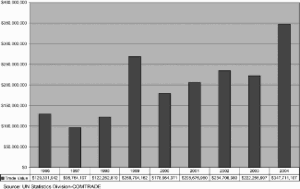
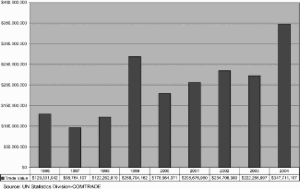
In the early 1990s, after nearly two decades of deep economic decline and the virtual arrest of Ghana's once-promising trajectory as a middle-income nation, the country experienced a torrent of cultural and commercial modernization. Going hand in hand with a broader economic reopening associated with structural adjustment, Ghana found itself in the midst of its own perestroika. Suddenly there was access to CNN and Black Entertainment Television, a resumption of tourism and regular air travel (Chalfin Reference Chalfin2005), an opening of the market to all sorts of foreign-made goods, access to foreign exchange, and the movement of more and more Ghanaians overseas by desire or necessity (Manuh Reference Manuh2000). With this came a steady increase in car imports. Traffic choked Accra motorways, which inspired new road building projects that have come to transform the city. Imported vehicles, often acquired with the help of relatives abroad, were increasingly available both for private use and for hire. While the former reflected the renewal of bourgeois endowments and aspirations, the latter served as a key source of social mobility for a working class that faced falling opportunities for state employment due to privatizations and retrenchments stipulated by the World Bank and the International Monetary Fund. In 1999 alone, Ghanaians imported more than fifty thousand vehicles, followed by thirty-five thousand more in 2000 (Public Agenda 2001: 4).Footnote 7 Despite occasional contractions, the importation of passenger vehicles has continued to rise throughout the decade, with notable surges in 1999 and 2004 (see Table 2).Footnote 8
Value of Passenger Vehicle Imports to Ghana, 1996–2004
The intersection of socio-economic mobility and political-economic regulation with respect to cars in Ghana finds a parallel in the sumptuary regimes of early modern Europe. In the European setting, governments transcended the play of market forces and restricted consumption of luxury items. Sumptuary regimes worked through a combination of legal and moral prescriptions to protect social hierarchies through the involvement of state agents and institutions in the regulation of individual lifestyles. They targeted goods considered sources of social visibility and recognition (such as food, dress, and funeral and marriage arrangements) and focused their controls on members of the rising social classes—those persons more but not most endowed (Hunt Reference Hunt1996: xii). These legal orders were protectionist in nature and were typically tied to the emergence of discrete national economies and efforts to contain the entry of foreign goods (Hunt Reference Hunt1996: 363).
Similarly, in Ghana at the close of the twentieth century, the boundaries of economic life were being rapidly renegotiated. At a time when an established and new middle class aspired to car ownership due to falling prices, rising supply, and a renewed cosmopolitan outlook, the government asserted control over the terms of car access. The state posed strict constraints over the type of vehicles imported and requirements of importation, with onerous terms of Customs clearance that further narrowed eligibility for car acquisition. It justified this as a defense of public safety and national interest. In Ghana, these restrictions did not work simply to police the boundary between elites and non-elites: the state endowed government agents and agencies with the capacity to allocate and accumulate vehicular wealth, to establish itself as both arbiter and subject of this divide. A double mandate exposing the tenuous standing of the ruling class in an era of transition, the project's legitimacy soon came under public attack.
CLEARING CARS: SYMBOLIC VEHICLES OF STATE-MAKING
Nowhere in Ghana are the possibilities of car ownership and state quest to control them more evident than at the Car Park at Tema Harbor, overseen by Ghana's Customs Excise and Preventive Service. Tema is Ghana's main seaport and the bulk of car imports enter the country there. They are unloaded several hundred at a time from huge cargo ships known as “roll-on, roll-offs,” which are designed exclusively for transshipment of motor vehicles. While national law stipulates the terms of car importation—the type and age of vehicles which can enter into the country, and duty rates and taxation regimes to which they are subject—it is Ghana's Customs, Excise and Preventive Service (commonly known as CEPS) that carries out and enforces these mandates. Customs oversees the many acres of motor vehicles landed at the harbor, which remain there until it releases them, and Customs imposes penalties upon and adjudicates the challenges posed by those who contravene the government's legal directives.
Given the many meanings attached to cars within Ghana, at the harbor cars mark and mediate the interface between global north and south, nation and trans-nation, socialism/militarism and neoliberalism, and private property and public status. Customs officers explicitly and implicitly claim control over these transpositions in a material and metaphorical contest to render the car a vehicle of a state that is both intimate and transcendent. Here, Customs is the state's interlocutor, at once amplifying and parasitic upon the multiple connotations of the motor vehicle. As we will see, this capacity has both bolstered and undermined Customs' might.
At the harbor, through a prolonged clearance process to which each vehicle is subject, Customs makes cars its own, turning them from private objects to objects within the state's domain, and back again. Once at the port, until a vehicle is cleared, it is separated from its legal owner and made the official property of the state. Sometimes clearance takes a few days; in other cases, it may take weeks, months, or an eternity of years as vehicles fail to meet the requirements of importation, or fall into a bureaucratic ‘black hole’ due to their suspicious commercial history, doctored documentation, or simply their own allure. Whether the interval between a car's dispossession and repossession is long or short, even after the legal restitution of private ownership the state's imprint lingers on in the body and history of the vehicle. Traces of the car, and the memory of its use as a platform for the playing out of a distinctive set of state capacities, likewise remain attached to the state.
Betraying Ghana's socialist past, the break from which is both recent and in many ways incomplete, the Customs Service asserts its oversight of car consumption and distribution largely through the symbolism of production. The regulatory regimes Customs employs are a hybrid mode of commodity rule, and as such, they betray and condense Ghana's multiplex political history at the same time as they reveal the common roots of socialism and industrial capitalism. Verdery's description of the rationale of socialist governance is helpful in making sense of these tactics: “Power in this system is tied to social ownership of the means of production; enhancing the means of production so owned enhances the dominance of the political apparatus that controls them.” Equally relevant to the Ghanaian case, Verdery goes on to state: “[S]ocialism's central imperative is to increase the bureaucracy's capacity to allocate, … not necessarily the same as increasing the amounts to be allocated” (Reference Verdery1991: 421).
Demonstrating the play of this productivist logic, the rendering of the car as an avatar of the state occurs through the disassembly and reassembly of vehicles in the complex process of Customs clearance. Although by 2000 it had been somewhat reduced, in 1986 Customs clearance of a vehicle required forty separate steps. The distinctions of technological modernity embodied in the motor vehicle, simultaneously claimed and rejected, are a central trope of this transposition. Specifically, Customs officers recapitulate and rework cars' productive ontogeny by playing upon the schema of modern car manufacture. This gives state agents a hand in both production and allocation, and is a way in which the state carves out a relationship to the modern and transfigures it. Taussig's (Reference Taussig1999) reading of state power through the lens of “defacement,” a form of transgressive mimesis revealing the forbidden or submerged through its repetition, seems appropriate here. The source of the car's power is deconstructed only to be reclaimed, a move that is at once affirming and parasitic, derogatory and enchanting.
The strategies of vehicular clearance play with these distinctions, and are both self-aggrandizing and self-mocking. In the course of garnering revenue and commanding notice for the state, we can regard the many steps of the clearance process as a symbolic attempt by Customs to recreate an industrial past that, even at the height of Ghana's socialist experiment, the polity never had the means to realize. Due to the myriad requirements of multilaterally funded economic reform, along with Ghana's inherently disadvantaged standing in the global economy, the possibility grows ever more remote that its private or public sectors can realize the ideals of industrial production. Indeed, given Customs' complete reliance on forms of knowledge and expertise borrowed from the capitalist heartland, the very terms of their performance betray the impossibility of Ghana's economic autonomy. Perhaps triggered by the irrefutable force of change, here we can see the practices of Customs clearance to reflect a nostalgic longing for a past that never was and a future that can never be. Customs officials pursue these moves deliberately, and they are resented by a public contending with a different set of economic realities and fantasies. To understand the play of these intertwined logics—symbolic and material, political and economic, post-socialist and neoliberal—we can examine the various steps of the clearance process which in 2000 and 2001 involved “booking,” “examination,” “valuation,” “assessment,” and “duty payment.”
Customs officers must examine all vehicles, even new ones direct from the factory, before they can leave the port. No matter what the importer or bill of lading states about a car's make or identification, officers must compile a report of its physical and identifying features.Footnote 9 Not only must they report on its obvious attributes (type, make, mileage, color, two or four doors, and the all-important cubic-capacity), but they also have to inspect its various components. Casting the totality in terms of its parts, this sort of conceptual disassembly is both a return of the vehicle to its essential elements and an assertion of the Ghanaian state's own capacity for determining the form of the whole. Examination officers look closely at components to verify the reported year of manufacture, and climb under and into vehicles to ascertain the engine and chassis numbers.Footnote 10 Although such numbers are considered a vehicle's ultimate identifiers, officers are expected to look beyond the surface to determine if numbers have been tampered with, thus uncovering a history of production alternative to that claimed by the dealer or importer.
The process of car “valuation” by Customs officials at the harbor involves a similar recapitulation of a vehicle's productive history in order to both acknowledge and rework it. Valuation is central to the determination of duties, which are ad valorem, or value-based. For Customs, establishment of a car's value begins with a determination of its cost when new, what is known in Ghana as “home delivery value.” The tracing of a car's value back to its original moment of production is one way the state reclaims its industrial heritage. This convention also demonstrates the state's mastery of high-modernist ideals of standardization and Customs officers' conversance with its evidentiary conventions: namely, the production and decoding of documentation (Scott Reference Scott1998; Torpey and Caplan Reference Torpey, Caplan, Torpey and Caplan2001). Attuned to the nuances of the auto industry, officers at the car park's valuation-seat rely on copious documentary sources and details. On their desks, they have well-worn Blue Book guides and manufacturer, dealer, and distributor price books for nearly every make of car that enters the country, to which they refer whenever a car is cleared. These guides are standardized and widely used, and the rates they list have an international validity. Situating Customs' knowledge and practice in a transnational space by means of a generic form, they connect Customs directly to auto makers, and transcend the values and relationships established by a given vehicle's owner or importer. Once a car's home delivery value is established, it is subject to a series of pre-set depreciations dependent upon on its age. In 2000, these ranged from 85 percent of home delivery value for vehicles between six and eighteen months of age, to 50 percent for those between five hundred and ten years old.
Customs mimics and recasts the conventions of modern manufacture through other clearance procedures as well. Related to the process of valuation, many car importers, especially those bringing “accidented” vehicles into the county, seek “further depreciation” of the values initially determined by Customs. The understanding is that in cases of severe damage the standard Customs value reflects neither the price paid nor the resale value, which would lead to unfair duty charges. Rather than documentary evidence, any application for “further depreciation” requires extensive inspection of the vehicle for missing and inoperable parts. It is then determined what percentage of the vehicle the lost and damaged parts represent and, with the approval of the Customs officer in charge of the harbor, the vehicle is revalued accordingly. Customs officers at the Car Park draw on these decisions to establish de facto standards of depreciation that they continually employ and refine. Here, Customs officers demonstrate their mastery of vehicle composition by developing their expertise with respect to cars' decomposition.
Of broad relevance in economic, cultural, and political life of less industrialized locales, such a mastery of the modern through its gaps and breakdowns opens up a space for its engagement and remaking barely imagined by those involved in the original processes of manufacture. Whenever goods are cleared, not just in the Car Park but throughout the harbor, Customs extensively considers their second-hand state. Africa generally is the receiving point of much of the detritus of the “West,” and increasingly of the “East”—from used clothes (Hansen Reference Hansen2000) to car parts, appliances, waste material, and industrial scraps. Everywhere, Customs officers are closely involved in the use and formulation of commensurate systems of grading and valuation. If the modern is marked by the ongoing creation of a present (Gaonkar Reference Gaonkar and Gaonkar2003), then Customs fits firmly within this space: handling cars and other second-hand goods crossing the borders, simultaneously recognizing their decline and restoring their value. In the words of Gaonkar, this “license to play with form and reconfigure function according to the exigencies of the situation” is “one of the few privileges that accrues to the latecomer” on modernity's stage (2003: 21).
These fiscal and symbolic disciplines are not the only ways cars come to be claimed by the state. The metaphoric recasting of cars as both products of the state and objects of its control operates side by side with the very real possibility of confiscation. Customs has a long history of legally justified vehicle seizure. Customs can stop or delay clearance if a vehicle's documentation is not in order or is suspicious. Likewise, Customs can confiscate any goods left at the port for more than sixty days without the payment of duty or demurrage. Adding to this mix, in 1998 the state put in place a law that banned the importation of overage vehicles—Parliamentary Enactment #552. It empowered Customs to confiscate and recycle (i.e., crush and scrap) all imported vehicles over ten years old. Thus, by virtue of age alone, newly imported cars, whatever their condition or terms of importation, can be seized by the state. One newspaper claims that, according to official records, the government confiscated five hundred cars between 1998 and 2000 (Duodu Reference Duodu2001).
Seizures are often irreversible. PNDC Law #330, the main Customs law, states in Article 93: “Any motor vehicle forfeited to the state under this law shall be disposed of by the commissioner in such a manner as the PNDC may direct.” Once vehicles are seized, they are warehoused, and Customs has the option to auction them if the owner fails to pay the penalties required for release. Ghanaian papers run public notices to owners of seized cars that announce the date and location of their auction, along with information on the date of seizure, and the make, model and chassis number of each car (e.g., Daily Graphic 2000b: 35). It is also the official prerogative of the Customs Commissioner to allocate seized vehicles to state offices and functionaries. A September 2000 article in the Daily Graphic reported on Customs' impoundment of seventy vehicles. Four were auctioned, one re-exported, thirteen allocated to the office of the President for special operations, and forty-six earmarked to the International Airport. Building on this tradition, as late as the spring of 2001 the Minister of Local Government called upon Customs to distribute confiscated cars to District Assemblies (Botwe Reference Botwe2001: 5). “Allocation,” a high-ranking Customs officer at the Car Park explained to me, was “a type of selective auctioning.” Cars would be given to government offices and employees at concessionary prices covering just the duty rate and a small “upliftment,” rather than the market price of the vehicle. This, after all, was about the government getting its due, not the sale of illegal or illegitimate goods.
CARS, CONFISCATION, AND THE MORALITIES OF NEOLIBERAL MODERNITY
Customs makes much of its powers of seizure. One can see confiscated vehicles at select locations in downtown Accra, and others are parked at the harbor. They are a sign of the state's mastery of foreign wealth and vivid evidence of its control of private property and private consumption, and were easy to spot in the parking lot of Customs headquarters. A Customs Public Relations Officer explained that the lot was reserved for the most expensive makes and models, so they could be kept under close watch while their cases were investigated (Ghanaian Times 2001: 9). On one afternoon in February 2001, I counted twenty, mostly luxury vehicles crammed in the lot, including a sporty red Toyota coupe, BMWs, and Audis. There were also SUV's (otherwise rare in Ghana due to their high cubic capacity and consequent high duty rates): a Jeep Grand Cherokee, two Land Cruisers, a Range Rover, an Isuzu Trooper, and nearly a dozen Mercedes Benz sedans.
These vehicles were testament to Customs' unbridled power. Customs presented these confiscations in moral terms and itself as moral overseer, articulating the same moral justifications regarding the protection of individuals and society at large found in classic sumptuary regimes (Hunt Reference Hunt1996: 41; Greenfield Reference Greenfield1918: 86). Playing up an idea of public good, whenever cars were distributed to state bodies, there would be a flurry of articles and announcements, as if to suggest that the placement of stolen or otherwise suspicious vehicles in the public domain would cleanse them of moral taint. Seizures themselves were presented as a sort of moral rescue, attesting to the ability of Customs officers to see through the machinations of even the wiliest car smugglers. Comments like these were common: “a highly placed source at Customs HQ said … almost all the vehicles had had their chassis numbers tampered with and explained that the dealers have a very ingenious way of removing the old chassis and replacing them with new ones, which they weld onto the engines” (Donkor Reference Donkor2000: 32). The ten-year rule was presented as contributing to the improvement of citizens' standards of living, and as a way to protect the public from the influx of shoddy goods; never mind the advanced age and decrepit conditions of many cars already on the road.
All of this was posed as a necessary and reputable aspect of modern governance. Just as the government renewed its power to tax and regulate as liberalization proceeded, so too did it enlarge Customs' mandate to seize private cars, along with its moral exhortation. Legitimization of CEPS vehicle seizures was even tied to Ghana's status as a paragon of neoliberal virtue. By the end of the 1990s, after more than a decade of political and economic reform, Ghana was recognized worldwide as a stable democracy showing steady signs of economic growth. It had performed well as an international citizen, having joined organizations like the WTO, and was an active and visible presence in the United Nations through its countryman Kofi Annan and its participation in a host of peacekeeping exercises. It had a cozy relationship with world powers like the United States and the United Kingdom and was a signatory to many bilateral accords, a feat matched by few other African states. One outcome of this was the active participation of Ghana—through Customs—in international and multilateral networks focused on stemming international crime: Interpol, CITES, the World Customs Organization, and numerous initiatives of the U.S. Customs Service (Chalfin Reference Chalfin2003). As the spotlight on African participation in illicit trade and transit intensified (Akyeampong Reference Akyeampong2005)—including the laundering of stolen vehicles from Europe and North America—Ghana was enlisted in the fight against it (Duodu Reference Duodu2001: 1). Carrying out this charge, by the end of 1999 alone Customs had seized over one hundred vehicles suspected of being stolen.
Couched in the language of international crime fighting, Customs' oversight of car circulation could now be posed as a symbol of moral responsibility to not just the nation but to the entire world. This move was justified through the political discourse of transparency (West and Sanders Reference West and Sanders2003), and was both ideological and institutional. An odd convergence of older forms of “state moralizing” (Ferguson Reference Ferguson and Moore1993: 83) that came with ideologies of African socialism with the logics of neoliberalism, it legitimized anew what was already common operating procedure by posing the rule of law as morally superior to the abuses of the market.
Despite the imprimatur of the international community, Customs' vehicle seizures emerged as the source of heated public debate as Ghana's 2000 presidential and party elections approached. Many saw car seizures and reallocations as a sign of corruption, patronage, and the squelching of individual rights, and the issue remained a source of acrimony well after the election. The 2000 race was the third of three consecutive democratic elections, and was a watershed event. Jerry Rawlings, after twenty years as head of state and two terms as president, was constitutionally barred from returning to power. This guaranteed regime change of some sort, whether through a new player at the helm of the incumbent National Democratic Congress (NDC) or a new party taking power. The result was victory for the New Patriotic Party (NPP), the longstanding opposition group, and its presidential candidate, John Kufuor.Footnote 11
As parties, players, and publics jockeyed for position, Customs' handling of cars was treated as an index of the character of the NDC government as a whole. Cars were caught in a contest for ideological supremacy taking place on the national stage through news articles and letters to the editor, radio talk shows, and public conversations. They became the object of a new sort of moral rendering, with their disposition the prime indicator of the moral failings and moral restoration of government generally. The debate revolved around the ambiguous status of cars as both public and private objects, and once again engaged the proper relationship between the morality of the state and the morality of the market. In the lead-up and aftermath of the 2000 elections, these concerns were articulated in distinctly neoliberal terms bound-up with notions of wealth, individual achievement, and the inherent justice of the market. In this way, they recapitulated earlier anti-corruption agendas that had gained force at moments of acute political transition, including Nkrumah's disheartening fall in 1966 and Rawlings' stunning rise in 1979 (Jeffries Reference Jeffries, Cruise O'Brien, Dunn and Rathbone1989; Rathbone Reference Rathbone and Dunn1978).
Debates about the moral connotations of material wealth and accumulation are widespread in Ghana. Concerns about material gain, especially the acquisition of global markers of material success—a job, house, car, durable goods, and fashionable dress—are at the heart of contemporary Pentecostal (Meyer Reference Meyer2004a) and Charismatic Christian worship (Gifford Reference Gifford2004), and in urban Ghana they are an essential element of sermon, prayer, and prophetic leadership. While earlier rhetoric expressed a more protestant outlook in which commodities, especially imported goods, need to be purged of moral stigma (Meyer Reference Meyer1999; Bloch and Parry Reference Bloch, Parry, Parry and Bloch1989; Shipton Reference Shipton1989), this belief has been supplanted by a religiosity in which the deliberate cultivation and proud display of material entitlement is the norm. Material wealth is a sign of moral righteousness, not moral risk. This theology is evident in the name of one of the largest and fastest growing churches of this creed: Winner's Chapel (Gifford Reference Gifford2004; van der Haak Reference Van der Haak2003). In Winner's and similar denominations, cars are a central symbol of spiritual attainment, as evidenced in the extravagant cars driven by church leaders. The logo of one prophetic church, Victory Bible Church International, graphically combines the insignia of Benz and Cadillac.Footnote 12
Victory Bible Church International Logo. (Source: Viceroy Bible Church International, Ghana. www.vbcint.org)

In relation to these trends, the discourse regarding car ownership and the terms of state regulation and allocation is notable as much for its context as for its content. Rather than individuals using the exclusive fora of the church to cultivate their private eligibility for wealth through their personal relationship to the divine, they are using the public media of radio and print journalism to debate whether state bodies and agents are eligible for material gain. Here we have a public setting, a public conversation and public target, in which the collective is the arbiter of moral order. Articulated through a discourse focused on monetary value, individual work, and private property, these debates map the public sphere in distinctively neoliberal terms.
The public discourse surrounding cars in the press, like the portrayals of Pentecostalism in the popular commercial videos (Meyer Reference Meyer2004b) and televised church services current in Ghana, involves the mass-mediation of a moral universe. In these debates, as in others, the press promotes itself as a “moral ‘watchdog’ over the activities of the state” (Hasty Reference Hasty2005a: 108). If the instantaneously replicable and broadcast images of television and the neo-real fantasy space of Ghanaian popular video (Dogbe Reference Dogbe, Zeleza and Veney2003) derive from the technologies of the late or post-modern moment, so too the print journalism central to the Ghanaian debates surrounding cars represents both the endurance and versatility of an earlier invocation of modernity, one closely associated with the production of national imaginaries (Anderson Reference Anderson1991; Hasty Reference Hasty2005a; Reference Hasty2005b).
In this communicative mode, the contentions leveled against Customs, and the state more generally, began to surface in the fall of 2000 when Ghanaian papers published a spate of letters from private citizens, and a corresponding set of investigative articles and official responses from state agents and institutions. The letters were mostly pleas to the Customs commissioner or other high-ranking officials to return seized cars to rightful owners. They presented the removal of cars from the public to the private domain as essential to the restoration of private personhood and the recapture of people's productive and reproductive efforts. These texts likewise equate the recognition of claims to property with accountability. This mix of messages is evident in a letter of 25 September titled “Where Is Car Number GR 1466 J, CEPS?”:
I am 45 years old and one time a civil servant. I strived seriously contributing money out of my labour and bought a Mercedes Benz car with registration number GR 1466 J from one Mr. Kwabena Ofori, a car dealer.
It subsequently turned out that the said car was seized by CEPS with the reason that duty on the car had not been paid.
I co-operated with the investigation of the CEPS officials and did not hesitate when they requested that I help in getting the car dealer arrested. The car dealer was subsequently arrested and sent to the Kotobabi Police Station from where he was handed over to the CEPS Head Office. Surprisingly, the Kwabena Ofori was set free without the duty being paid to the state, yet CEPS detained the car I duly bought with my hard earned money.
I am as a last resort appealing to the Office of the President through your medium to help me retrieve my money or car while Kwabena Ofori is made to pay the necessary duty to the state. What kind of society is this? How can someone be made to suffer like this for two whole years without justifiable course (Daily Graphic 2000a: 9).
A few weeks later, this controversy stirred again as another allegation of misappropriation by Customs made it to press. In this case, two vehicles shipped by a Ghanaian resident in the United States were seized at Tema harbor when the clearing agent attempted to remove them from the port without paying duty. Customs took the case to court and the judge ruled for the defense, asserting the car owner did not conspire with the clearing agent to smuggle it into the country. Although the complainant was willing to pay duties as ordered by the court, the Customs Commissioner himself pursued a second court case against her. When that was dropped, the car was still not made available. The owner painted Customs as a legal wrongdoer and the source of personal harm impeding the realization of economic and social self-hood, and “pleaded with the CEPS boss to release her vehicle because she has been in the country for nine months, saying all her money was finished and she had left her three children in the United States” (Accra Mail 2000: 3; see also Lartey Reference Lartey2000: 12).
CRAFTING PRIVATE PROPERTY THROUGH THE PUBLIC SPHERE
When the election was over and the opposition NPP victorious, the controversies already swirling around Customs and cars became the centerpiece of widespread public debate. Here, charges of misrule, corruption, and decadence were collapsed into one allegation, and the moral superiority of the new leadership was painted in the starkest terms. At the crux of these political cum moral deliberations was the issue of whether outgoing Members of Parliament and Ministers of State could retain the cars allocated to them while in office. Outgoing officials had typically been allowed to purchase at discount rates the vehicles they had used on the job, or to take home cars they had purchased at low cost while in office through government concessions and loans. These practices had been in place for years, with the cars considered “end of employment benefits.”
This was not just a matter of a few retirements or failed bids for re-election. Because a whole regime had fallen out of power, hundreds of persons were eager to secure the spoils of office before they were entirely out of reach, and this became a controversy of epic proportions. Once it was revealed that cars has been hastily allocated by the outgoing President's chief of staff at values far below the market rate, the matter came to a head (Allotey Reference Allotey2001: 6). In the wake of earlier scandals, these claims gained new force when it was alleged that a large number of the allocated vehicles had recently come from Customs itself (Accra Mail 2001a: 3; Plange Reference Plange2001: 1; Crusading Guide 2001: 4). Whether stolen or under investigation, or with restitution pending, they were already surrounded by suspicion, giving an added air of criminality to the scandal. This was no longer simply a debate about end-of-service benefits: the state was tagged as a purveyor of stolen and smuggled goods with total disregard for the common citizen or the market (Evening News 2001). Supporting such an indictment, one letter writer remarked, “If the action of … all those who bought those expensive vehicles from CEPS at those ridiculously low prices does not amount to stealing then what is it? Well, if it does not amount to stealing at least, it amounts to cheating and what is cheating? … [W]ith our newly won ‘freedom and justice’ we can stand at the top of the roof and shout that all those who bought vehicles from CEPS at those ridiculously low prices are nothing but THIEVES” (Adjei-Bedaiko 2001: 2).
Much like a crime-watch or police-log, newspapers published multi-page lists with names of hundreds of persons alleged to have received these vehicles, followed by descriptions of the vehicle type, chassis number, year of manufacture, and amount paid (Dispatch 2001: 5; Daily Graphic 2001: 9). In some of these accounts, it was assumed that the vast discrepancy between the market price and discretionary values was obvious to all, in others the dollar and cedi amounts were detailed, with accompanying discussions of vehicle specifications. This ‘outing’ campaign was reminiscent of the allegations that had been made against friends and officials of the reigning regime when Rawlings had first come to power in the late 1970s; the rosters revealed the names of not only government officials but also private citizens who were recipients (wittingly or not) of the state's now suspect largesse.
There was a tacit system of ranking at play in the lists that reflected a sort of calculus of moral standing: the scope of wrongdoing could be gauged by the individual's position in government, the extent of the discount they had received in purchasing the allocated vehicle, and the luxury value of the car. The press singled out government officials and party leaders who had received four-wheel-drive SUVs, new Passats (fashionable in Ghana at the time), or expensive BMWs or Audis (Yeboah Reference Yeboah2001: 8; Coomson Reference Coomson2001: 1). For these individuals, the possession of the seized vehicles was taken as evidence of their greed, duplicity, and illegal trafficking in state property. It was reported that one Member of Parliament had purchased an Audi seized by Customs, even after he was physically confronted by the owner in the parking lot of Parliament House, and had refused to give it up, offering only to pay a feeble sum (Coomson Reference Coomson2001: 1).
This was a political crusade that captured the public's attention and imagination and was pursued by members of the new government with the aid of the press. The prime weapon of choice was transparency, in the form of numbers, documents, and technical detail. Along with the lists of car prices and recipients, both proponents and detractors of the outgoing administration made public a slew of official documents. The press continually sought to demonstrate its capacity to see through the claims of the past regime and thus discern a higher truth. To this end, they employed eyewitness accounts (of who was driving a car and where it was parked, for instance), surprise interrogations of suspects by journalists, and the collection of supposedly factual evidence (the original vehicle price, the exact moment a car disappeared from the Customs yard).
In the discrediting of the old regime as a source of danger and dishonesty, it is possible to discern the strains not only of a quasi-religious moralizing but also of the popular Pentecostal ideal of “making a complete break with the past” (Meyer Reference Meyer1998). Whatever side one was on, the press made much of the personal risk and lawlessness that resulted from the misuse of power, property, and information by government agents. One article described how errant Customs officers had, without authorization, disclosed names and addresses of car recipients to the original owners of the cars seized and sold by Customs, and how this had led to the “invasion of homes … and issuing out all manner of threats … rather than [the] petitioning of CEPS or going to court to challenge any wrongful action” (Daily Guide 2001: 1). Lifting the many veils of old power, the new government and its adherents in the press were posed as seers and saviors, protecting the public and rescuing the state from itself.
Rather than looking at this debate only in terms of the arguments of the opposing sides, it seems more helpful to consider their common themes. Despite the apparent differences, they reveal a convergent rhetoric centered on notions of the private subject and market value. Cultivating an ideal of the private self, one official, much like earlier writers of letters from car importers, defended his suspicious acquisition of a vehicle by referring to it as a “family heirloom” used by his wife for her business, which he intended to keep “in the family” (Aidoo Reference Aidoo2001: 4). A detractor replied in similarly personal terms, mentioning the “Ghanaians abroad who work night and day in the cold to get money to buy such vehicles” (Adjei-Bediako 2001: 2). Allegations made against specific individuals in the old regime, whether their power or status were great or small, were frequently followed by a rejoinder in which they recounted a personal course of action or inaction that absolved them of the charge (Amissah Reference Amissah2001; Accra Mail 2001a; 2001b; Yeboah Reference Yeboah2001). In one case, a highly placed Ambassador responded to an accusation by explaining that, although he had been offered an Audi V8, “I found the vehicle too grand for my modest personal purposes” (Amissah Reference Amissah2001: 3).
Likewise, those on both sides invoked the notion of market value. As much as the question of allocation, the gravity of the whole car fiasco revolved around the question of the prices paid for vehicles (Allotey Reference Allotey2001: 6). On these grounds, there were suggestions that the outgoing Chief of Staff be prosecuted for “falsification of figures” and “acts to sabotage the economy of Ghana.” He had drastically reduced values initially proffered by the official government valuer (Biney Reference Biney2001: 1), and had sold, to cite a few examples, 1999 Passats for little more than a thousand dollars, a 1998 BMW for thirty-five hundred dollars, and a 1997 Benz for twenty-five hundred dollars. With the resolution of the conflict resting on the proper reading of the market, an agreement was eventually brokered whereby officials would be charged for the cars based on their internationally accepted market value (Biney Reference Biney2001: 1; Orhin Reference Orhin2001), to which both VAT and duty would be added. Individuals unable to afford these prices were asked to return the vehicles or refrain from purchase. For the new government, the market was a restorer of moral order, seen to have the power to cleanse or somehow erase the history of questionable goods. Yet, caught in the same framing of material success as those they criticized, the press made no bones about emphasizing the reduced standing of officials who could not pay the adjusted real prices. They ran bold headlines reading, “Government Retrieves Cars: Ex-Officials Can't Pay New Prices … Most of Them Have Returned Their Cars” (Duodu and Bouna Reference Duodu and Bouna2001: 1).
CONCLUSION
These discursive conventions can be read as strategic political moves articulating the new government's abandonment of an older populism based on the idea of state as protector from the market for a new one grounded in the idea of the state as protector of private persons and property. They also speak to the many expatriated Ghanaians upon whose wealth, support, and return the new regime depends (Manuh Reference Manuh2000). Yet, in laying out the conceptual grounds of political debate, they also suggest a deeper and more extensive reframing of Ghanaian political terrain.
First, we see the classic tropes of neoliberalism—the individual subject and market price—emerging as the central terms of national political debate. This is not the sort of amoral techno-speak of neoliberal reform described by Ferguson for Zambia in the early 1990s (Reference Ferguson and Moore1993; Reference Ferguson1999). Rather, it is a deeply contextualized and principle-laden discourse in which notions of good and evil, the righteous and the fallen, truth and falsity, are central. Employing a language that holds much in common with the tenets of Pentecostal worship (Gifford Reference Gifford2004; Meyer Reference Meyer2004a; Reference Meyer2004b), the religious undertones of this discussion regarding the propriety of material accumulation are evident. However, the substance of these disclosures and deliberations is grounded in what are taken to be inalienable truths of the modern age (persons, price, and property). This is an example of what Pels describes as the quintessential “enchantment of modernity,” doubly hinged on “representing the nation-state to its citizens [and] constituting subjectivity through commodification” (Reference Pels, Meyer and Pels2003: 5, 35), here propelled by a moral discourse borrowed from the religious realm.
The public articulation of these ideals and their contribution to wider processes of political transformation is worthy of note. It is not an abstract moral register that popularizes these debates, but a thoroughly palpable one by way of the car. A constant yet multi-layered presence in Ghanaian economic and political life, the motor vehicle maps out an expansive and highly malleable public sphere. Cars integrate multiple social experiences and categories—they invoke external fields of power and the reality of transnational mobility, more localized cultural meanings and aspirations, and a distinct history of political struggle. With cars already established as a public and nationalized symbol, to enter the rhetoric of the market through the sign of the vehicle is to enter an inclusive field of discussion, one very different from the ethnic and regional divisions typically presented as the stuff of African political culture. The culture of cars is surely not equalizing, and there are clear ethnic/regional undertones in the NPP's rise to power. Yet, given its vernacular form, access to car culture is, at least on a symbolic level, relatively open, since almost all urban Ghanaians can read its nuances and glean self-recognition.
In a decisively populist recasting of sumptuary rule, the discourse of cars gives the public a means to police and discipline state institutions and ruling elites. These evaluations and exactions do not advocate ‘belt-tightening,’ or speak to the immorality of conspicuous wealth. Neither do they seek to undermine institutionalized rule. Rather, the intersecting allegations of the press and the public malign state-based practices of consumption and allocation in order to promote a distinctively neoliberal form of governance in which the state acts as the protector of individual wealth and gain. This is not a moral economy that disputes the authority of the modern state, as the Comaroffs would have it (Reference Comaroff and Comaroff1993: xxiii), but one that affirms it. In Ghana, we see the persistent presence of the commodity in the moral and material ordering of the polity.
Though it does not advocate the disappearance of the state, this political orientation is tied to a critique of specific state institutions, notably Customs. In the same way that cars, as symbol of individual status and state authority, hold a crosscutting position in negotiating the boundaries of rule, Customs emerges as a state institution caught in the crosshairs of reform. It thus forms a focal point for the expression of wider dilemmas of neoliberal state-making. In the face of restructuring, Customs finds its mandate at once renewed and threatened. Neoliberal reform, by undermining state enterprises and national self-reliance while fostering a dependence on foreign markets and imports, has provided Customs a much-broadened arena in which to assert itself. Still, neoliberalism's exhortations to ‘get the state out of the market’ apply equally to Customs. This is much more than an abstraction emanating from multilateral lenders, and after two decades of economic adjustment, Ghanaians in a range of economic positions support this conviction. Within Ghana, the marginalization of consumers who are already hugely disadvantaged in the world market is only intensified by the exactions of Customs applied to nearly every item consumed. The significant proportion of Ghanaians who seek financial gain abroad due to the contraction of domestic employment opportunities perceive state-imposed trade barriers as a particularly egregious relic of a bygone era.
For the Customs Service, this combination of threat and re-endowment has precipitated a rather audacious retrenchment. Bordering on the retrograde with respect to cars, their bureaucratic requirements, duties, and intrusions have intensified, as have vehicle seizures. These protocols play out through an idiom of production, and they oddly reference older aspirations for socialist-styled state industrialization at the same time that they are fundamentally dependent on a detailed understanding of multinational commerce and capital. Betraying a power more performative than permanent, these procedures pave the way for misappropriation and illegal allocation, and make Customs even more vulnerable to attack and allegation.
The modalities of this critique are as significant as its institutional target. The discrediting of Customs, and the outgoing regime more generally, hinges on the cultivation of practices and ideals of transparency. These are closely intertwined with notions and practices of calculation and calculability, also decisive features of neoliberal rule (Mitchell Reference Mitchell2002), and are key to the simulation of a sense of public witness or reckoning. Operating within this rubric, it is the supposedly factual revelations in the press—whether by journalists or the corresponding public—that made evident the duplicity and malfeasance of political actors. Through such conventions, corruption and transparency emerge as paired discourses, and corruption, although linked to private or somehow concealed acts (Hasty Reference Hasty2005a; Reference Hasty2005b), is strategically manufactured as a political category in the public sphere
These optics first emerged at a particular historical moment framed by the electoral transition of 2000 and 2001 and a long decade of structural adjustment, but they have maintained an enduring presence in the Ghanaian press and public sphere. Throughout the 2004 lead-up to the presidential and parliamentary election, and in its aftermath in 2005, public discussions of political corruption and entitlement continued to dwell on the allocation and ownership of cars by public officials. These spilled over from the press to websites and on-line chat groups (Ampofo Reference Ampofo2005; Ghana News Agency 2004). Car costs and consumption remain a measure of moral, political, and economic order moving from one regime to another, a key diagnostic of the failings of the state in Ghana, and a motor of public engagement.