





Introduction
Nutritional requirements increase during pregnancy, influencing the growth and development of the infant as well as the compensation mechanism of the physiological changes of the pregnant women (Mugyia et al., Reference Mugyia, Tanya, Njotang and Ndombo2016; Lim et al., Reference Lim, Wong, Lim and Soon2018). The failure to access an adequate amount of nutrients to meet fetal demand can lead to fetal malnutrition and leads to long-lasting and detrimental effects on the health of the offspring, like intrauterine growth restriction (Tenaw et al., Reference Tenaw, Arega and Tachbele2018). Pregnancy has a higher frequency of dietary deficiencies than any other stage of the life cycle due to poor dietary habits (Diddana, Reference Diddana2019).
The poor nutritional status and birth outcomes are influenced by many biologic and socioeconomic factors, such as poverty, education level, lack of nutritional information, food insecurity, family size, the gap between pregnancies, demographic factors, and cultural beliefs and practices, which vary in different populations (Keyata, Reference Keyata2018; Wassihun et al., Reference Wassihun, Ayinalem and Beyene2022). The majority of pregnant women live in developing countries, which suffer from ongoing nutritional deficiencies (Nana and Zema, Reference Nana and Zema2018, Hailu and Woldemichael, Reference Hailu and Woldemichael2019). Nutritional disorders are common among pregnant women and the main causes of morbidity and mortality. The major problems are protein-energy malnutrition and micronutrient deficiencies such as vitamin A, iron, and iodine (Teklemariam et al., Reference Teklemariam, Agachew, Acham, Arja, Berheto, Tadesse, Dheresa, Worku, Walker and Naghavi2023).
A recent report released by UNICEF highlights a worrying surge in acute malnutrition among pregnant and breastfeeding women across the 12 developing countries hardest hit by the global food and nutrition crisis. According to the report, an estimated 6.9 million women were affected by acute malnutrition in 2020, underscoring the escalating impact of food insecurity, conflict, climate shocks, and economic instability on maternal and child health worldwide (UNICEF, 2023). Malnutrition remains a major public health challenge affecting both mothers and children. Maternal undernutrition during pregnancy can adversely affect fetal growth and development, contributing to poor physical and cognitive outcomes in children and increasing the risk of adverse maternal and neonatal health complications (Bushra, Reference Bushra2018).
In Ethiopia, around 13% of pregnant women were overweight and 30.3% were underweight (Serbesa et al., Reference Serbesa, Iffa and Geleto2019). Lack of knowledge, repeated infections, and other factors significantly contribute to malnutrition among mothers and children (Tette et al., Reference Tette, Sifah and Nartey2015). Most of the women living in the developing world had limited awareness and knowledge of proper nutrition during pregnancy that contributed to poor dietary practices. It contributes to the occurrence of serious health complications, including gestational diabetes, pre-eclampsia, anemia, and low birth weight, posing significant challenges to both maternal and newborn health (Wassihun et al., Reference Wassihun, Ayinalem and Beyene2022). Improving the awareness of pregnant women is important and essential for effective strategies to control malnutrition and encourage healthier dietary behaviors. Pregnant women with better nutrition knowledge are more likely to make healthful food choices and have a probability to prevent nutrition-related problems (WHO, 2023).
Although previous studies in Ethiopia have investigated maternal nutrition knowledge and dietary practices, most were conducted in limited geographic settings and may not adequately reflect the realities of central Ethiopia. Variations in local dietary habits, socioeconomic status, cultural beliefs, food accessibility, and agricultural practices across regions can significantly influence maternal nutritional behaviors and pregnancy outcomes. In addition, existing studies have often focused either on nutritional knowledge or dietary practices separately, with limited attention given to the combined assessment of these factors and their associated determinants among pregnant women in central Ethiopia. As a result, evidence specific to this context remains insufficient to guide targeted maternal nutrition interventions and policies.
Maternal nutrition is essential for healthy pregnancy outcomes and the prevention of maternal and neonatal complications. Poor nutritional knowledge and inadequate dietary practices during pregnancy increase the risk of malnutrition, anemia, pre-eclampsia, and low birth weight. Despite the growing burden of maternal malnutrition and food insecurity in Ethiopia, evidence from central Ethiopia remains limited. This study aims to generate context-specific evidence to inform targeted interventions and policies that improve maternal nutrition and promote better maternal and child health outcomes.
Methods and materials
Study area and period
A concurrent mixed-cross-sectional study was conducted from August 02, 2025, to November 25, 2025. Halaba town is found in central Ethiopia, serving as the administrative center of the Halaba zone. It is located approximately 220 km south of Addis Ababa and situated around 7°18′44″N 38°05′21″E. Based on the 2016 census conducted by the central statistical agency of Ethiopia. The estimated total population of Halaba Kulito town was approximately 39,507 people, consisting of 19,358 males and 20,149 females and 2588 pregnant women residing in the town. The town comprises five kebeles and is served by one general hospital, one health center, and five health posts. The predominant agricultural activities in the town include the cultivation of pepper (zala/hot pepper), maize, teff, sorghum, wheat, haricot beans, and potatoes (OLOLO, Reference Ololo2023).
Source population
All pregnant women who live in Halaba town.
Study population
All randomly selected pregnant women who live in Halaba town.
Study unit
Each of the selected pregnant women who live in Halaba town.
Inclusion criteria
All pregnant women who had been residing in Halaba town for at least six months prior to the data collection period.
Exclusion criteria
Pregnant women’s who were mentally unstable, hearing impairment and those who were unavailable after three repeated follow-up visits were excluded from the study.
Sample size determination
The sample size is determined by using a single population proportion formula by using the following assumption: p = 60.9% magnitude of nutritional knowledge of pregnant women’s conducted in public hospitals of Kaffa zone, south Ethiopia (Gezimu et al., Reference Gezimu, Bekele and Habte2022), with a 5% marginal error and 95% confidence level.
 $${\rm{n}} = {{Z\left( {{a \over 2}} \right)\,\,2{\rm{p}}\left( {1 - {\rm{p}}} \right)} \over {{{\rm{d}}^2}}}$$
 $${\rm{n}} = {{{{\left( {1.96} \right)}^2}\left( {0.609} \right){\rm{ }}\left( {0.391} \right)} \over {\left( {0.05} \right){\rm{ }}\left( {0.05} \right)}} = 366$$
 $${\rm{With }}\,10{\rm{ }}\% \,\,{\rm{ non}} - {\rm{respondent\, rate\, n}} = {\rm{ }}403$$
Where: n = sample size, z = value corresponding to 95% level of significance = 1.96, p = expected proportion of knowledge of mothers on nutrition during pregnancy from previously conducted research = 60.9% = 0.609, q = (1−p) = (1–0.609) = 0.391, and d = margin of error (5%). For the qualitative component of the study, 35 pregnant women were purposively selected and participated in five focus group discussions to explore their nutritional knowledge, dietary practices, and related experiences.
Sampling technique and procedure
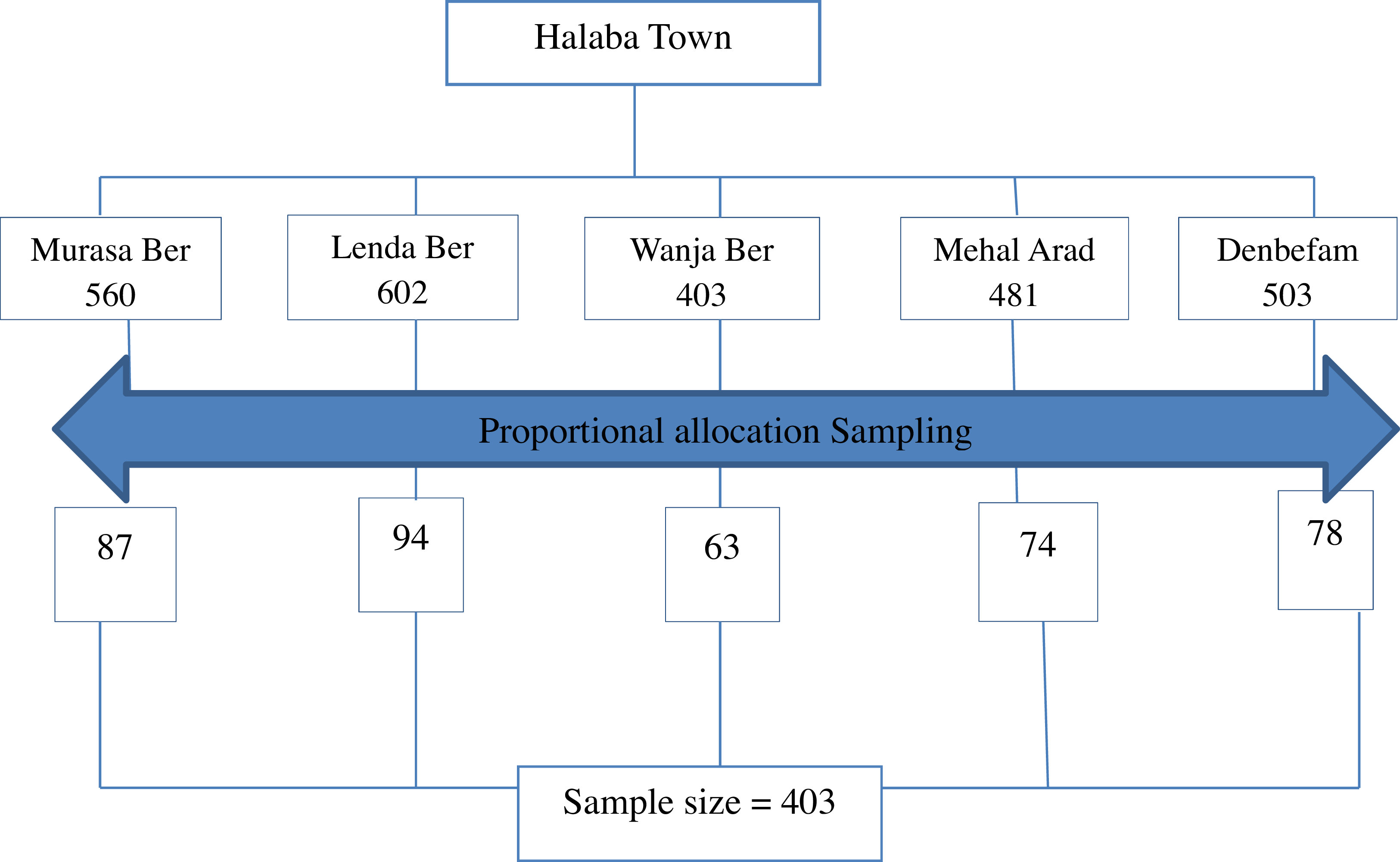
The study was conducted among pregnant women residing in Halaba town, which is administratively divided into five kebeles: Murasa Ber, Mehal Arada, Lenda Ber, Wanjia Ber, and Denbefam. According to local health records, the total number of pregnant women in each kebele was 560 in Murasa Ber, 602 in Lenda Ber, 481 in Mehal Arada, 403 in Wanjia Ber, and 503 in Denbefam. The sample size was proportionally allocated to each kebele based on the number of pregnant women, resulting in 87 participants from Murasa Ber, 94 from Lenda Ber, 75 from Mehal Arada, 63 from Wanjia Ber, and 78 pregnant women from Denbefam. Within each kebele, study participants were selected using a simple random sampling technique (Figure 1).
Sampling procedure of nutritional knowledge, dietary practices, and associated Factors among pregnant women in Halaba town, central Ethiopia.

For qualitative data, focus group discussion was conducted to explore shared cultural beliefs, social norms, and contextual factors influencing nutritional knowledge and dietary practice. FGDs were selected as they facilitate in-depth understanding of collective perception and community-level influence and complement the quantitative findings. Thirty-five pregnant women were purposively selected to participate in five focus group discussions, with one discussion conducted in each kebele. The focus group discussions were held in community meeting halls that provided a convenient and comfortable environment for pregnant women to participate freely.
Study variables
Dependent variable
Nutritional knowledge and dietary practice of pregnant women.
Independent variables
Sociodemographic variables: age, residence, educational status, marital status, occupation Maternity health-related services: antenatal care services, family planning service, the status of pregnancy (planed or unplanned), gravidity, parity, number of children’s Communication and nutrition-related factors: exposure to mass media like TV, radio, source of information, food security, food taboos and misconceptions.
Operational definition
Nutritional knowledge: Refers to an individual’s understanding of nutrition, including the intellectual capacity to memorize and recall specific food and nutrition term, information, and facts. Good knowledge: If pregnant women score above the cut point of the knowledge assessment questions, they are considered to have good knowledge. Poor knowledge: If pregnant women score below the cut point of knowledge assessment questions were considered to have poor knowledge (Yabancı et al., Reference Yabancı, Kısaç and Karakuş2014).
Food-secured women: Pregnant women who have experienced none of the food insecurity conditions or have just been worried, although rarely, during the past 4 weeks (Asgharian Dastnaei et al., Reference Asgharian dastnaei, Karami and Keshavarz2013).
Food-insecure women: Pregnant women who are unable at all times to access food sufficient to lead an active and healthy life (includes all stages of food insecurity; mild, moderate, and severe) (Keenan et al., Reference Keenan, Olson, Hersey and Parmer2001; Hussein et al., Reference Hussein, Ahmed and Muhammed2018).
Mildly food-insecure women: Pregnant women who worry about not having enough food sometimes or often and/or are unable to eat preferred foods and/or eat a more monotonous diet than desired and/or some foods considered undesirable but only rarely (Hussein et al., Reference Hussein, Ahmed and Muhammed2018).
Moderately food-insecure women: Pregnant women who eat poor quality more frequently, by eating a monotonous diet or undesirable foods sometimes or often and/or have started to cut back on quantity by lowering the size of meals or number of meals, rarely or sometimes. However, they do not experience any of the three most severe conditions (Hussein et al., Reference Hussein, Ahmed and Muhammed2018).
Severely food-insecure women: Even if it happens seldom, pregnant women who have been compelled to reduce the number of meals or the amount of their meals and/or who suffer from any of the three most serious conditions running out of food, going to bed hungry, or going an entire day and night without eating (Keenan et al., Reference Keenan, Olson, Hersey and Parmer2001; Hussein et al., Reference Hussein, Ahmed and Muhammed2018).
Dietary practice: Measured through pregnant women who consumed five and above foods items out of ten food groups have good dietary practice, while pregnant women consume less than five food groups have poor dietary practice (FAO, 2021).
Data collection and measurement
A pretested and semi-structured questionnaire was used for data collection. Then the pretested questionnaires were translated from English to Amharic and retranslated back to English to check the consistency. The data was collected through face-to-face interviews. Six BSc midwives and two master’s-level health professionals were recruited for data collection and supervision, respectively. The data collection questionnaire is grouped into four sections: socio-demographic characteristics, communication and nutrition-related characteristics, maternity health care service-related, and assessment of nutrition knowledge and dietary practice during pregnancy.
Nutritional knowledge of pregnant women was measured through multiple-choice questions. The questions aimed at assessing the knowledge of pregnant women on the aspects of nutrition required during pregnancy (Tenaw et al., Reference Tenaw, Arega and Tachbele2018). Nutrition knowledge was assessed using structured questions covering key aspects of maternal nutrition. The items evaluated respondents’ understanding of the definition of food, a balanced diet, the importance of adequate nutrition during pregnancy, differences between pregnancy diets and usual diets, and sources of essential nutrients including protein, carbohydrates, iron, iodine, and vitamin A. Additional questions assessed knowledge of the consequences of maternal malnutrition for both the mother and fetus, the influence of husbands or other household members on dietary decisions, and decision-making regarding food type and frequency of consumption during the current pregnancy. Respondents were asked to indicate whether each statement was correct or incorrect (yes/no responses). A composite nutrition knowledge score was calculated by summing the responses to the individual items, and the resulting score was used to categorize and analyze maternal nutrition knowledge (Daba et al., Reference Daba, Beyene, Fekadu and Garoma2013, Yabancı et al., Reference Yabancı, Kısaç and Karakuş2014).
The questions were adapted from previously validated tools used in maternal nutrition research, enhancing the content validity of the instrument. Moreover, the use of clear, standardized items and dichotomous response options (yes/no) helped ensure consistency and minimize measurement bias across respondents.
The household food insecurity access scale (HFIAS) was used to quantify food insecurity in households. To categorize homes as food secure or not, food and nutrition technical assistance (FANTA III) created this structured, standardized, and validated instrument (Wiesmann et al., Reference Wiesmann, Arimond and Loechl2009, Coates et al., Reference Coates, Swindale and Bilinsky2013). Household food insecurity was assessed using the nine-item HFIAS. The tool measures the occurrence and frequency of food insecurity experiences during the preceding four weeks. Responses to each item were recorded on a four-point Likert scale: 0 = never, 1 = rarely (1–2 times), 2 = sometimes (3–10 times), and 3 = often (>10 times). Pregnant women were asked to respond on behalf of all household members. The instrument was used to assess household-level access to food during the reference period. A composite HFIAS score was calculated by summing the responses to the nine items, yielding a total score ranging from 0 to 27. Higher scores indicate greater levels of household food insecurity. The internal consistency reliability of the multi-item scales was assessed using cronbach’s alpha coefficient. The cronbach’s alpha values were 0.905 for the household food security scale, 0.89 for the nutritional knowledge scale, and 0.81 for the dietary practice scale, indicating acceptable internal consistency.
Dietary practice was assessed using the updated minimum dietary diversity for women (MDD-W) tool, a structured questionnaire comprising ten food groups adapted from the food and nutrition technical assistance III (FANTA-III) project and the food and agriculture organization (FAO) guidelines for assessing minimum dietary diversity among women. Dietary intake was evaluated using a 24-hour dietary recall method, excluding atypical days such as fasting periods and holidays to better reflect usual dietary practices. Data were collected using both open-recall and list-based approaches. The MDD-W is a dichotomous indicator that classifies women according to whether they consumed foods from at least five of the ten food groups during the previous 24 hours, reflecting minimum dietary diversity (FAO, 2021).
A total of 16 food groups were assessed in this study, including cereals; white roots and tubers; vitamin A-rich vegetables and tubers; dark green leafy vegetables; other vegetables; vitamin A-rich fruits; other fruits; organ meat; flesh meat; eggs; fish and seafood; legumes; seeds and nuts; milk and milk products; oils and fats; and sweets, spices, condiments, and beverages. These food groups were subsequently categorized into the standardized 10 food groups recommended for assessing minimum dietary diversity among women: (1) grains, white roots and tubers, and plantains; (2) pulses (beans, peas, and lentils); (3) nuts and seeds; (4) dairy products (milk and milk products); (5) flesh foods (meat, poultry, and fish); (6) eggs; (7) dark green leafy vegetables; (8) other vitamin A-rich fruits and vegetables; (9) other vegetables; and (10) other fruits.
Dietary diversity practice was determined based on the number of food groups consumed by pregnant women in the previous 24 hours. Women who consumed foods from five or more of the ten food groups were classified as having adequate dietary diversity practice (meeting the recommended standard), whereas those who consumed foods from fewer than five food groups were classified as having inadequate dietary diversity practice (not meeting the recommended standard).
Qualitative data were collected using focus group discussions (FGDs) to explore community perceptions and experiences related to food taboos and beliefs, structural and economic barriers, knowledge and counseling, and social support affecting dietary diversity during pregnancy. Five FGDs were conducted, with one FGD conducted in each selected kebele. Each FGD consisted of seven purposively selected pregnant women who shared similar socio-cultural backgrounds to facilitate open discussion.
The qualitative data were collected by three trained BSc midwives who had previous experience in qualitative data collection and facilitation of FGDs. Prior to the data collection period, the data collectors received training on the objectives of the study, ethical considerations, moderation techniques, interviewing skills, probing techniques, note-taking procedures, and audio-recording methods. A semi-structured FGD guide was developed after reviewing relevant literature and the objectives of the study. The guide included open-ended questions and probing questions focusing on food taboos and beliefs, structural and economic barriers, knowledge and counseling, and social support related to dietary practices during pregnancy.
During the FGDs, one midwife moderated the discussion while another took detailed notes on participants’ responses and non-verbal expressions. With participants’ consent, all discussions were audio-recorded to ensure completeness and accuracy of the information. Each FGD lasted approximately 60–90 minutes and was conducted in a quiet and convenient setting to encourage free discussion and maintain confidentiality. Immediately after each discussion, the moderators and note-takers conducted debriefing sessions and prepared summary notes under the major thematic areas. Audio recordings were transcribed verbatim and organized according to the predefined themes and subthemes for thematic analysis.
Data quality control
The questionnaire was translated back into English by independent language experts in both languages to ensure its consistency, and comparisons were made on the consistency of the two versions. The questionnaire was pretested outside the selected kebeles before the actual data collection was conducted, and Wera woreda was selected to conduct the pretest. Twenty pregnant women participated in the pretest to ensure the validity of the tool. Then all necessary adjustments were made. The pretested and semi-structured questionnaires were translated into Amharic for data collection. The training was given for two days on theoretical and practical aspects of data collection for five midwives and two supervisors. The training was focused on the areas of interview techniques, ethical issues; and the rights of the participants, reading through all the questions and understanding them well, and ways of minimizing under-reporting or over-reporting and maintaining confidentiality. Interviews were conducted without the involvement of any person other than the respondent in the area of providing adequate confidentiality and privacy. The actual data collection was closely supervised by the principal investigator and the two supervisors. The collected data were cross-checked on each day of activity for consistency, missing data, and completeness.
To ensure the quality of qualitative data, a semi-structured FGD guide was developed based on relevant literature and study objectives. Three trained BSc midwives facilitated the FGDs after receiving training on moderation techniques, probing, note-taking, and ethical considerations. During each discussion, one moderator led the session while another recorded notes and non-verbal expressions. All FGDs were audio-recorded with participants’ consent and lasted approximately 60–90 minutes. Daily debriefing sessions were conducted, and audio recordings were transcribed verbatim and reviewed for completeness and consistency before thematic analysis. FGDs were audio-recorded and supplemented with field notes to ensure completeness. Daily supervision and debriefing sessions were conducted to review the data collection process. Transcripts were prepared verbatim and cross-checked against the audio recordings for accuracy. Coding was reviewed by the research team to ensure consistency and credibility. All data were stored securely to maintain confidentiality.
Data processing and analysis
The principal investigator visually checked all the interview questionnaires before analysis. EpiData version 4.6.0.0 was used to code, enter, and clean the data, and after the completeness was checked, it was then exported and analyzed with the statistical package for the social sciences (SPSS) Version 25 software. Descriptive statistics were performed to describe the demographic, socioeconomic, and maternal-related characteristics of the respondents. Tables and figures were used to present respondents’ information. The bivariable and multivariable analysis, along with a 95% confidence interval (CI), were used to see the association between each independent variable and the outcome variable. Independent variables with a value of p ≤ 0.25 were included in the multivariable analysis to control for confounding factors.
Multicollinearity among independent variables was assessed using variance inflation factor (VIF) and standard error (SE). Variables with SE ≥ 2 were excluded from the multivariable logistic regression analysis. In the final model, the VIF values ranged from 1.12 to 2.84, with a mean VIF of 1.76, indicating no significant multicollinearity among predictor variables. The fitness of the final logistic regression model was evaluated using the hosmer–lemeshow goodness-of-fit test, and the model showed good fit to the data (χ2 = 6.48, p = 0.593).
Qualitative data were analyzed using thematic analysis. All interviews were transcribed verbatim and, where necessary, translated into English. The transcripts were read repeatedly to ensure familiarity with the data. Initial codes were generated inductively from the data. Similar codes were grouped into categories, and broader themes were developed through iterative discussion among the research team. Coding consistency was ensured through independent coding by researchers and comparison of coding decisions. Discrepancies were resolved through discussion. Five FGDs were conducted among pregnant women to explore food taboos and beliefs and structural and economic barriers regarding nutritional knowledge and dietary practice. FGDs were conducted in the community meeting hall with 7 participants in each group (total n = 35). Discussions were held in a facilitated setting by a trained midwife assisted by a note-taker. Each session lasted 60–90 minutes; was conducted in Amharic, audio-recorded with consent, transcribed verbatim, and translated into English.
Data were analyzed using thematic analysis through independent coding by two researchers, followed by consensus-based theme development. Credibility was ensured through audio recordings, field notes, investigator triangulation, and thematic saturation. The results of the thematic analysis are presented in the form of a narrative with supporting quotes. Finally, the qualitative study’s findings were triangulated with the quantitative findings.
Ethical clearance and considerations
Ethical approval for this study was obtained from the institutional health review board of Wolkite University, college of medicine and health sciences (CHM/237/25). Participants’ privacy, confidentiality, and rights were fully protected throughout the data collection process. Written informed consent was obtained from each participant, and only those who consented were included in the study. Unique identification codes were used in place of names to maintain confidentiality. Participation was entirely voluntary, and respondents were informed of their right to decline or withdraw from the study at any time without any consequences.
Results
Socio-demographic characteristics of the participants
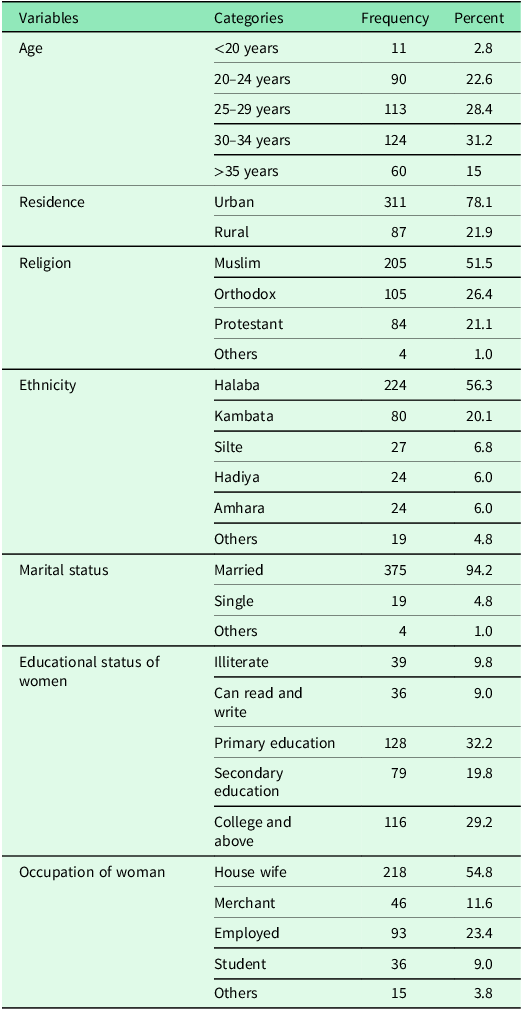
Out of the 403 selected respondents, 398 pregnant women participated in the study, resulting in a response rate of 97.7%. The majority of the participants were Muslim (53.6%). Most of the participants were married (94.5%). Regarding educational status, the largest proportion of participants had completed primary education (32.0%). The most common occupation was housewife (54.4%). The majority of the pregnant women (over 80%) were urban residents. The mean age of the pregnant women was 28.8 ± 5.4 years, and nearly one-third (31.2%) were aged between 30 and 34 years (Table 1).
Sociodemographic characteristics of pregnant women in Halaba town, central Ethiopia (n = 398)

Table 1. Long description
A table showing sociodemographic characteristics of pregnant women in Halaba town, central Ethiopia. The table has 8 rows and 4 columns. The columns are labeled Variables, Categories, Frequency, and Percent. The rows are labeled with different variables such as Age, Residence, Religion, Ethnicity, Marital status, Educational status of women, and Occupation of woman. Each variable has multiple categories with corresponding frequency and percent values. For example, under Age, the categories are <20 years, 20-24 years, 25-29 years, 30-34 years, and >35 years with frequencies 11, 90, 113, 124, and 60 respectively, and percent values 2.8, 22.6, 28.4, 31.2, and 15 respectively. Under Residence, the categories are Urban and Rural with frequencies 311 and 87 respectively, and percent values 78.1 and 21.9 respectively. Under Religion, the categories are Muslim, Orthodox, Protestant, and Others with frequencies 205, 105, 84, and 4 respectively, and percent values 51.5, 26.4, 21.1, and 1.0 respectively. Under Ethnicity, the categories are Halaba, Kambata, Silte, Hadiya, Amhara, and Others with frequencies 224, 80, 27, 24, 24, and 19 respectively, and percent values 56.3, 20.1, 6.8, 6.0, 6.0, and 4.8 respectively. Under Marital status, the categories are Married, Single, and Others with frequencies 375, 19, and 4 respectively, and percent values 94.2, 4.8, and 1.0 respectively. Under Educational status of women, the categories are Illiterate, Can read and write, Primary education, Secondary education, and College and above with frequencies 39, 36, 128, 79, and 116 respectively, and percent values 9.8, 9.0, 32.2, 19.8, and 29.2 respectively. Under Occupation of woman, the categories are House wife, Merchant, Employed, Student, and Others with frequencies 218, 46, 93, 36, and 15 respectively, and percent values 54.8, 11.6, 23.4, 9.0, and 3.8 respectively.
Others*- Daily laborer.
Maternity health-related service among pregnant women
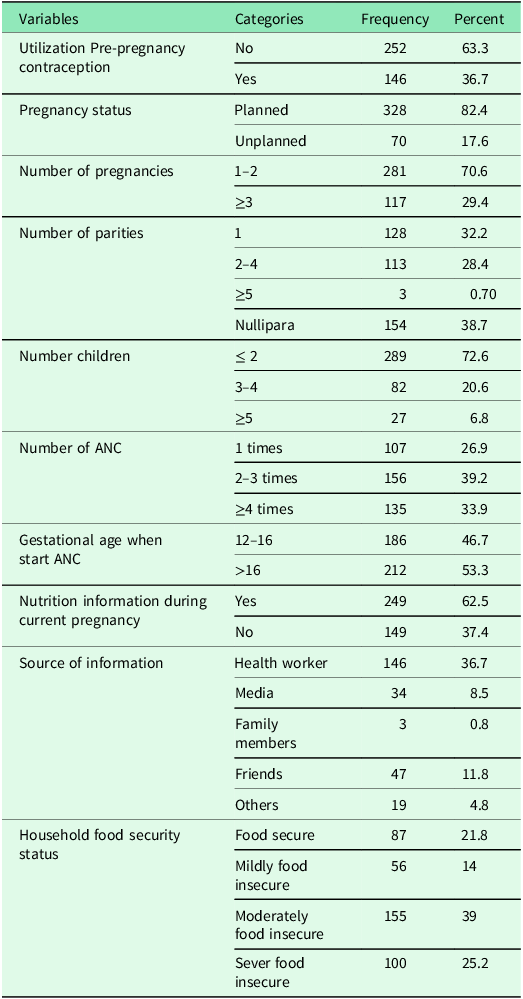
More than 63% of pregnant women did not utilize contraception, and 82.0% of pregnancies were planned. Around 71% of pregnant women have two or fewer pregnancy histories. Thirty-two percent of pregnant women had one child. Around 47% of the participants started attending ANC between 12 and 16 weeks of gestation. Sixty-three percent of the participants received nutrition information during the time of visit, and healthcare providers were the primary source of information (36.2%). Overall, 22.0% of pregnant women were from food-secure households, whereas approximately one-quarter (25.0%) experienced severe household food insecurity (Table 2).
Maternity health-related service among pregnant women in Halaba town, central Ethiopia (n = 398)

Table 2. Long description
A table summarizing maternity health-related service utilization among pregnant women in Halaba town, central Ethiopia. The table has 12 rows and 4 columns. The columns are labeled Variables, Categories, Frequency, and Percent. The rows are labeled with different variables and their respective categories, frequencies, and percentages. Row 1: Utilization Pre-pregnancy contraception, No, 252, 63.3. Row 2: Utilization Pre-pregnancy contraception, Yes, 146, 36.7. Row 3: Pregnancy status, Planned, 328, 82.4. Row 4: Pregnancy status, Unplanned, 70, 17.6. Row 5: Number of pregnancies, 1-2, 281, 70.6. Row 6: Number of pregnancies, >=3, 117, 29.4. Row 7: Number of parities, 1, 128, 32.2. Row 8: Number of parities, 2-4, 113, 28.4. Row 9: Number of parities, >=5, 3, 0.7. Row 10: Number of parities, Nullipara, 154, 38.7. Row 11: Number children, <= 2, 289, 72.6. Row 12: Number children, 3-4, 82, 20.6. Row 13: Number children, >=5, 27, 6.8. Row 14: Number of ANC, 1 times, 107, 26.9. Row 15: Number of ANC, 2-3 times, 156, 39.2. Row 16: Number of ANC, >=4 times, 135, 33.9. Row 17: Gestational age when start ANC, 12-16, 186, 46.7. Row 18: Gestational age when start ANC, >16, 212, 53.3. Row 19: Nutrition information during current pregnancy, Yes, 249, 62.5. Row 20: Nutrition information during current pregnancy, No, 149, 37.4. Row 21: Source of information, Health worker, 146, 36.7. Row 22: Source of information, Media, 34, 8.5. Row 23: Source of information, Family members, 3, 0.8. Row 24: Source of information, Friends, 47, 11.8. Row 25: Source of information, Others, 19, 4.8. Row 26: Household food security status, Food secure, 87, 21.8. Row 27: Household food security status, Mildly food insecure, 56, 14. Row 28: Household food security status, Moderately food insecure, 155, 39. Row 29: Household food security status, Sever food insecure, 100, 25.2.
*other includes religious leader, community campaign.
Nutritional knowledge of pregnant women in Halaba town
More than half of pregnant women (51%) with a 95% CI (47.9–55.3) had good nutrition knowledge in Halaba town, central Ethiopia (Figure 2).
Nutritional knowledge, dietary practices, and associated Factors of pregnant women in Halaba town, central Ethiopia.

Exploring the spectrum of foods consumed pregnant women
The majority of pregnant women (95.7%) reported consuming grains and cereals. Approximately half (50.3%) consumed white roots and tubers, while 63.9% consumed pulses and legumes. Nearly 43% of participants (42.9%) consumed nuts and seeds, and about 41% reported intake of milk and milk products. The consumption of animal-source foods was relatively low, with only 3.9% consuming organ meats, 36.4% consuming flesh meats and poultry, 20.1% consuming eggs, and 10.2% consuming fish. In terms of fruit and vegetable intake, about 56.4% consumed vitamin A–rich vegetables, and 30.8% consumed vitamin A–rich fruits. Additionally, 51.7% reported consumption of other vegetables, while 26.3% consumed other fruits (Figure 3).
Exploring the spectrum of foods consumed pregnant women in Halaba town, central Ethiopia.

Dietary practice among pregnant women in Halaba town
The overall level of adequate dietary practice among pregnant women in the study area was 42.4% (95% CI, 35.3–49.5%). This indicates that only about two-fifths of the participants consumed foods from five or more food groups within the previous 24 hours. Conversely, 57.6% of pregnant women consumed foods from fewer than five food groups during the same period, reflecting suboptimal dietary practice among the study population.
Qualitative result finding
All participants involved in FGDs are married. Concerning educational status, half of pregnant women (50.6%) completed primary education, 32.4% completed secondary education, and 17% were college and above. Among the total involved in FGDs, 49% were pregnant women who were housewives, 27% were government employees, 20% were merchants and 4% were daily laborers. Regarding gravidity, out of 35 pregnant women, 30 of them have at least one child, and 5 are primigravida. Analysis of the interview and focus group discussion data generated three major themes and six subthemes related to dietary practices during pregnancy: (1) Food taboos and beliefs, (2) Structural and economic barriers, and (3) Social support and enabling household environments.
Theme 1: Food taboos and beliefs.
Subtheme 1.1: Fear of excessive fetal growth and difficult delivery.
A prominent finding was the widespread belief that consuming certain nutrient-rich foods during pregnancy could result in excessive fetal growth, thereby increasing the risk of prolonged labor or cesarean delivery. Foods commonly avoided included organ meats and eggs, despite participants acknowledging their nutritional value. These beliefs were strongly influenced by cultural norms and community narratives regarding pregnancy and childbirth.
Participants frequently linked the consumption of organ meats and eggs with having a ‘large baby’, which was perceived as undesirable because of fears surrounding difficult labor and surgical birth. One participant explained:
“I am not preferred to eat organ meats such as liver, kidney, and tongue because I believe they may cause my baby to grow too large, which could increase the likelihood of a cesarean delivery. I am very afraid of undergoing a surgical birth.” (35-year-old pregnant woman).
Similarly, another participant stated:
“I enjoy eating eggs; however, since becoming pregnant, I have completely avoided it. I believe that consuming eggs during pregnancy may cause my baby to grow too large and prolong my labor.” (29-year-old pregnant woman).
These indicate that concerns about childbirth outcomes often outweigh nutritional knowledge. The findings suggest that cultural beliefs regarding fetal size and delivery complications continue to influence food choices during pregnancy and may contribute to reduced dietary diversity by discouraging the consumption of important sources of protein and micronutrients.
Subtheme 1.2: Persistence of cultural norms despite nutritional awareness.
Several participants demonstrated awareness of healthy dietary recommendations received during antenatal care visits. However, this knowledge did not always translate into practice because culturally shared beliefs remained influential. This finding highlights the complex relationship between knowledge and behavior, suggesting that nutrition education alone may be insufficient unless cultural misconceptions and community norms are simultaneously addressed. As one participant explained:
“The health professionals advised me to eat eggs, milk, and different fruits during pregnancy because they help the baby grow well. I understand their advice, but in our community many elders say that eating too much of these foods will make the baby too large and cause difficult delivery. Because of this belief, I still avoid some foods even though I know they are good for my health.” (28 years-old pregnant woman).
This illustrates the persistence of culturally rooted beliefs in shaping dietary practices during pregnancy, even among women who are aware of recommended nutritional guidelines. The finding suggests that nutritional knowledge alone may be insufficient to change behavior when traditional norms and advice from influential community members continue to reinforce food restrictions. Consequently, effective maternal nutrition interventions should address not only individual knowledge gaps but also the broader cultural beliefs and social influences that govern dietary decision-making.
Theme 2: Structural and economic barriers.
Subtheme 2.1: Financial constraints limiting dietary diversity.
Although participants generally understood the importance of consuming a varied and nutritious diet during pregnancy, economic hardship emerged as a major obstacle to achieving this goal. Many women reported that rising food prices and limited household income restricted their ability to purchase nutrient-rich foods such as meat, fruits, and animal-source products.
One participant explained:
“I understand the benefits of eating a variety of foods for both myself and my baby. However, I am unable to afford certain foods because their prices are too high. Most of the time, I rely on homemade cereal-based foods like injera and bread.” (31-year-old pregnant woman).
This finding demonstrates that nutritional knowledge alone does not guarantee healthy dietary practices. Participants often expressed willingness to consume more diverse foods but lacked the economic means to do so. Consequently, their diets were largely dependent on affordable staple foods, potentially increasing the risk of inadequate nutrient intake during pregnancy.
Subtheme 2.2: Dependence on available household resources.
Participants’ food choices were also influenced by the resources available within their households. Women from households with limited economic resources reported fewer opportunities to diversify their diets. This finding suggests that broader socioeconomic conditions play a critical role in shaping maternal nutrition and should be considered when designing interventions to improve dietary diversity among pregnant women.
One participant reflected:
“Sometimes I want to follow the advice given at antenatal care, but it depends on what is available at home. If there is money, we can buy fruits or animal-source foods. If not, I eat the same foods the rest of the family eats. We cannot always choose what to eat during pregnancy.” (31-years-old pregnant woman).
This finding indicates that economic limitations and restricted household food availability constrained pregnant women’s ability to adopt recommended dietary practices, resulting in reduced dietary diversity despite adequate nutritional awareness.
Theme 3: Social support and enabling household environments.
Subtheme 3.1: Spousal support and women’s decision-making autonomy.
Social support, particularly from husbands, emerged as an important facilitator of healthy dietary practices. Women who reported receiving encouragement from their spouses and participating in household decision-making described greater ability to consume diversified diets.
A participant stated:
“I understand the benefits of eating a variety of foods for both myself and my baby because I have a follow-up in Halaba hospital for this pregnancy, and the nurse told me the benefit of consuming a variety of foods. My husband also supports me in consuming a diversified diet, and I am also involved in making decisions about household purchases.” (37-year-old pregnant woman).
This finding suggests that household dynamics can significantly influence maternal nutrition. Supportive partners may facilitate access to nutritious foods through both emotional encouragement and shared decision-making regarding food purchases. Women’s involvement in household decisions also appeared to enhance their ability to implement dietary recommendations received during antenatal care.
Subtheme 3.2: Home gardening as an enabler of dietary diversity.
Home gardening was identified as another important factor promoting dietary diversity. Participants who cultivated fruits and vegetables at home reported easier access to fresh foods and greater consumption of nutrient-rich produce.
One participant explained:
“I follow my education up to grade 12, and I am not a government employee. But I know the benefit of eating diversified food for me and my baby. I consume a variety of foods, such as carrots, cabbage, tomatoes, and avocados, because these fruits and vegetables are grown in our compound.” (26-year-old pregnant woman).
The findings indicate that home food production can help overcome some of the economic barriers that limit dietary diversity. Access to homegrown produce provided a practical means of improving food variety and nutritional intake during pregnancy, even among households with limited financial resources.
Factors associated with nutritional knowledge among pregnant women
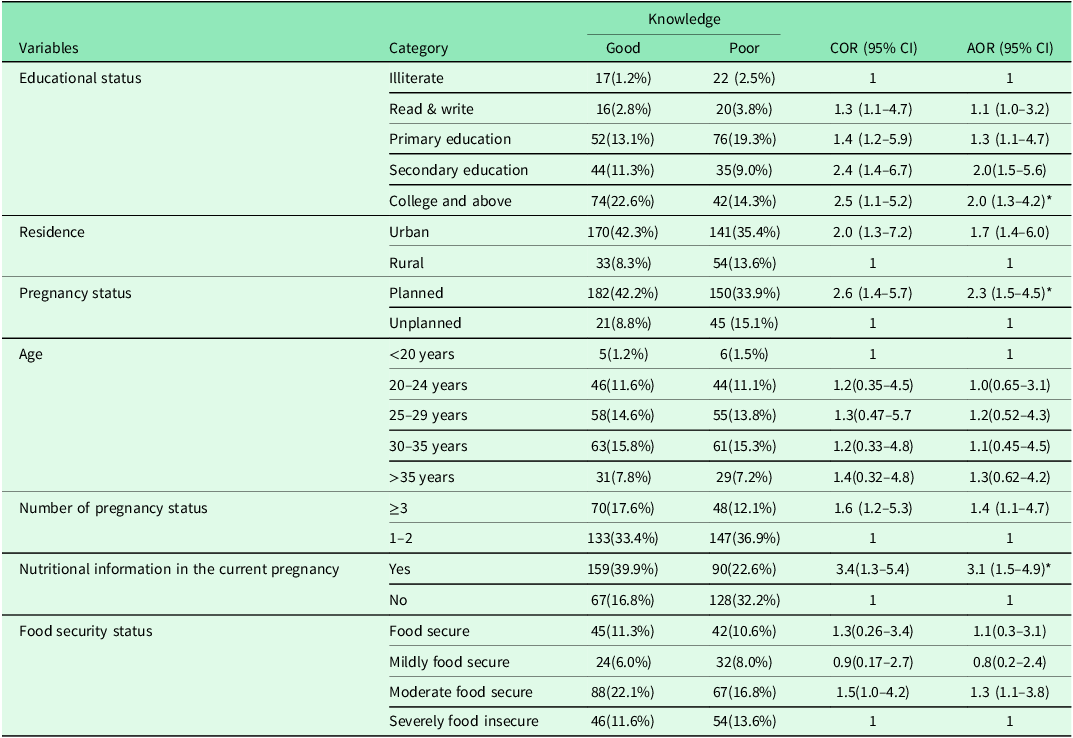
Variables with a p-value < 0.25 in the bivariable logistic regression analysis were considered candidates for multivariable logistic regression. Accordingly, women’s occupational status, educational status, gravidity, source of nutrition information, household food security status, age, and place of residence were included in the multivariable logistic regression model. Under multivariable logistic regression analysis educational status of the women, status of pregnancy, and mothers with nutritional information in the current pregnancy were significantly associated with nutritional knowledge. Pregnant women with higher education status (college & above) were two times more likely to have good nutrition knowledge as compared to illiterate pregnant women (AOR: 2.0; 95% CI: 1.3–4.2). Pregnant women who had planned pregnancies were two times more likely to have good nutritional knowledge as compared to those pregnant women who had unplanned pregnancies (AOR: 2.3; 95% CI: 1.5–4.5). The odds of nutritional knowledge were three times higher among pregnant women who have nutritional information during pregnancy than their counterparts (AOR: 3.1; 95% CI: 1.5–4.9) (Table 3).
Bivariable and multivariable logistic regression analysis of factors associated with nutritional knowledge among pregnant women in Halaba town, central Ethiopia

Table 3. Long description
A table comparing various variables with nutritional knowledge among pregnant women, including educational status, residence, pregnancy status, age, number of pregnancies, nutritional information, and food security status. The table has 10 rows and 7 columns. The columns are labeled as Variables, Category, Knowledge (Good and Poor), COR (95% CI), and AOR (95% CI). The rows are labeled as Educational status, Residence, Pregnancy status, Age, Number of pregnancy status, Nutritional information in the current pregnancy, and Food security status. Row 1: Educational status, Illiterate, Knowledge (Good 17(1.2%), Poor 22(2.5%)), COR (1), AOR (1). Row 2: Educational status, Read & write, Knowledge (Good 16(2.8%), Poor 20(3.8%)), COR (1.3(1.1-4.7)), AOR (1.1(1.0-3.2)). Row 3: Educational status, Primary education, Knowledge (Good 52(13.1%), Poor 76(19.3%)), COR (1.4(1.2-5.9)), AOR (1.3(1.1-4.7)). Row 4: Educational status, Secondary education, Knowledge (Good 44(11.3%), Poor 35(9.0%)), COR (2.4(1.4-6.7)), AOR (2.0(1.5-5.6)). Row 5: Educational status, College and above, Knowledge (Good 74(22.6%), Poor 42(14.3%)), COR (2.5(1.1-5.2)), AOR (2.0(1.3-4.2)). Row 6: Residence, Urban, Knowledge (Good 170(42.3%), Poor 141(35.4%)), COR (2.0(1.3-7.2)), AOR (1.7(1.4-6.0)). Row 7: Residence, Rural, Knowledge (Good 33(8.3%), Poor 54(13.6%)), COR (1), AOR (1). Row 8: Pregnancy status, Planned, Knowledge (Good 182(42.2%), Poor 150(33.9%)), COR (2.6(1.4-5.7)), AOR (2.3(1.5-4.5)). Row 9: Pregnancy status, Unplanned, Knowledge (Good 21(8.8%), Poor 45(15.1%)), COR (1), AOR (1). Row 10: Age, <20 years, Knowledge (Good 5(1.2%), Poor 6(1.5%)), COR (1), AOR (1). Row 11: Age, 20-24 years, Knowledge (Good 46(11.6%), Poor 44(11.1%)), COR (1.2(0.35-4.5)), AOR (1.0(0.65-3.1)). Row 12: Age, 25-29 years, Knowledge (Good 58(14.6%), Poor 55(13.8%)), COR (1.3(0.47-5.7)), AOR (1.2(0.52-4.3)). Row 13: Age, 1. Ear, Knowledge (Good 63(15.8%), Poor 61(15.3%)), COR (1.2(0.33-4.8)), AOR (1.1(0.45-4.5)). Row 14: Age, >35 years, Knowledge (Good 31(7.8%), Poor 29(7.2%)), COR (1.4(0.32-4.8)), AOR (1.3(0.62-4.2)). Row 15: Number of pregnancy status, >=3, Knowledge (Good 70(17.6%), Poor 48(12.1%)), COR (1.6(1.2-5.3)), AOR (1.4(1.1-4.7)). Row 16: Number of pregnancy status, 1-2, Knowledge (Good 133(33.4%), Poor 147(36.9%)), COR (1), AOR (1). Row 17: Nutritional information in the current pregnancy, Yes, Knowledge (Good 159(39.9%), Poor 90(22.6%)), COR (3.4(1.3-5.4)), AOR (3.1(1.5-4.9)). Row 18: Nutritional information in the current pregnancy, No, Knowledge (Good 67(16.8%), Poor 128(32.2%)), COR (1), AOR (1). Row 19: Food security status, Food secure, Knowledge (Good 45(11.3%), Poor 42(10.6%)), COR (1.3(0.26-3.4)), AOR (1.1(0.3-3.1)). Row 20: Food security status, Mildly food secure, Knowledge (Good 24(6.0%), Poor 32(8.0%)), COR (0.9(0.17-2.7)), AOR (0.8(0.2-2.4)). Row 21: Food security status, Moderate food secure, Knowledge (Good 88(22.1%), Poor 67(16.8%)), COR (1.5(1.0-4.2)), AOR (1.3(1.1-3.8)). Row 22: Food security status, Severely food insecure, Knowledge (Good 46(11.6%), Poor 54(13.6%)), COR (1), AOR (1).
Where * p-value < 0.05, ** p-value < 0.001.
Factors associated with dietary practice among pregnant women
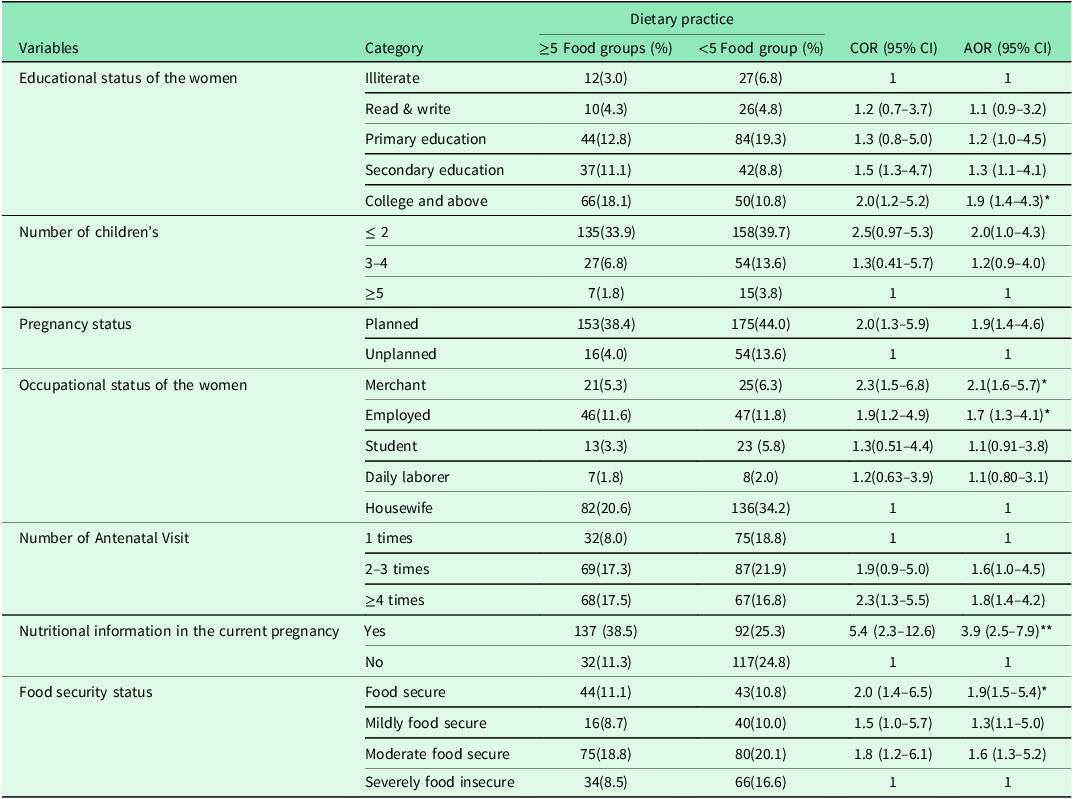
In the bivariable logistic regression analysis, the number of children, women’s educational status, household food security status, receipt of nutritional information during the current pregnancy, occupational status, and the number of antenatal care visits met the selection criterion (p < 0.25) and were subsequently included in the multivariable logistic regression model. The multivariable logistic regression analysis report shows educational status of the women, nutritional information in the current pregnancy; occupational status of the women and food security status were significantly associated with dietary practice. Pregnant women with higher education status (college & above) were nearly two times more likely to have good dietary practice as compared to illiterate pregnant women (AOR: 1.9; 95% CI: 1.4–4.3).
The odds of dietary practice were four times higher among pregnant women who have nutritional information during pregnancy than their counterparts (AOR: 3.9; 95% CI: 2.5–7.9). Pregnant women who work as employees 1.7 times more likely to have dietary practices compared none employed (AOR: 1.7; 95% CI: 1.3–4.1) and it is also higher among pregnant women who work as merchants compared with housewives (AOR: 2.1; 95% CI: 1.6–5.7). Pregnant women with food security were nearly two times more likely to have good dietary practice than pregnant women who had severe food insecurity (AOR: 1.9; 95% CI: 1.5–5.4) (Table 4).
Bivariable and multivariable logistic regression analysis of factors dietary practice of pregnant woman in Halaba town, central Ethiopia

Table 4. Long description
A table comparing dietary practices of pregnant women in Halaba town, Ethiopia. The table has 11 rows and 6 columns. The columns are labeled ‘Variables’, ‘Category’, ‘Dietary practice >=5 Food groups (%)’, ‘Dietary practice <5 Food group (%)’, ‘COR (95% CI)’, and ‘AOR (95% CI)’. The rows are labeled with different variables such as educational status, number of children, pregnancy status, occupational status, number of antenatal visits, nutritional information during pregnancy, and food security status. Each row provides percentages and odds ratios for dietary practices across different categories. Notable trends include higher dietary practice percentages among women with higher education, planned pregnancies, and those with nutritional information during pregnancy. The table also shows that employed women and those with food security have better dietary practices compared to their counterparts.
Where * p-value < 0.05, ** p-value < 0.001.
Discussion
The findings showed that 51% of pregnant women had good nutritional knowledge, whereas only 42.4% achieved adequate dietary practices. Educational status, planned pregnancy, and access to nutritional information during pregnancy were significantly associated with nutritional knowledge. Similarly, educational status, occupational status, food security, and access to nutritional information were significant predictors of dietary practice. The qualitative findings complemented these results by demonstrating that cultural food taboos, fears of excessive fetal growth and difficult delivery, persistent traditional beliefs, financial constraints, and limited household food resources negatively influenced dietary diversity. Conversely, spousal support, women’s involvement in household decision-making, and home gardening emerged as important facilitators of healthy dietary practices during pregnancy.
Half (51%) of pregnant women have good nutritional knowledge in the study area. This finding is consistent with the study conducted in Malaysia, which was 49.9% (Manaf et al., Reference Manaf, Johari, Mei, Yee, Yin and Teng2014). However, this finding was lower than the study conducted in the east Wollega zone, Ethiopia, which was 64.4% (Daba et al., Reference Daba, Beyene, Fekadu and Garoma2013). This may be related to differences in maternal educational status and access to nutritional information during pregnancy. In the current study, both educational attainment and receipt of nutritional information were significant predictors of nutritional knowledge, suggesting that variations in these factors between study populations may have contributed to the observed difference. In addition, differences in women’s employment status and household economic conditions may have influenced opportunities to access health information and nutrition-related resources.
This finding was also lower than the study conducted in India, which was 59.9% (Nagi et al., Reference Nagi, Sahu and Nagaraju2016). In Malawi, which was 70% (Mvula, Reference Mvula2010), and Swaziland, which was 67% (Masuku and Lan, Reference Masuku and Lan2014). These discrepancies may be explained by differences in women’s educational status and household income. Pregnant women in India and Swaziland tend to demonstrate somewhat higher maternal nutritional knowledge than those in Ethiopia, largely because of broader educational opportunities, extensive nutrition campaigns, and stronger health-system outreach. India and Swaziland had better household income compared to Ethiopia. Higher-income households generally have better access to education, healthcare services, nutrition information, and diverse foods, all of which contribute to greater nutritional awareness.
This finding is higher than the study conducted in the Arsi zone, west Ethiopia, which was 23.7% (Tesfaye et al., Reference Tesfaye, Adissu, Tamiru and Belachew2024), in Kenya, which was 43.6% (Perumal et al., Reference Perumal, Cole, Ouédraogo, Sindi, Loechl, Low, Levin, Kiria, Kurji and Oyunga2013). This difference may be explained by variations in factors identified in the present study, particularly inadequate nutrition counseling during antenatal care and limited access to nutrition information among pregnant women. Women who did not receive adequate dietary counseling were more likely to experience the outcome, suggesting that differences in the quality and coverage of maternal nutrition services across study settings may have contributed to the higher prevalence observed. Additionally, contextual differences in maternal educational status, household economic conditions, and dietary practices between the study populations may have further influenced the observed variation.
Nutritional dietary practice among pregnant women in Halaba town was 42.4%. This finding is consistent with the studies conducted in Dessie town, northeastern Ethiopia, which was 45.2%, Gondar, northwest Ethiopia, which was 40.1% (Alemayehu and Tesema, Reference Alemayehu and Tesema2015). While this finding was higher compared to the study conducted in west Gojjam, north west Ethiopia where only 19.9% of pregnant women have good dietary practices (Demilew et al., Reference Demilew, Alene and Belachew2020).The variation may be attributed to geographical differences, including disparities in agricultural practices and the types of crops, fruits, and vegetables cultivated, which directly influence food availability and dietary patterns. Furthermore, differences in study settings such as methodological approaches and variations in sample size may also have contributed to the inconsistency across findings.
It is also higher than the study conducted in eastern Ethiopia, which was 15.2% (Fite et al., Reference Fite, Tura, Yadeta, Oljira and Roba2022) and southwest Ethiopia, which was 22% (Shemsu et al., Reference Shemsu, Argaw and Zinab2020). The observed variation may be partly explained by differences in maternal educational status between the study populations. In the present study, a relatively higher proportion of women had formal education, which may have enhanced their access to nutrition-related information and promoted favorable health-seeking and dietary practices. Furthermore, differences in the geographic and socioeconomic contexts of the study areas may have influenced access to maternal health services, nutrition counseling, and food resources. Such contextual variations could have contributed to the higher prevalence observed in the current study.
However, this finding is lower compared to the study that was conducted in Addis Ababa, which was 63.9 % (Tesfa et al., Reference Tesfa, Aderaw, Tesfaye, Abebe and Tsehay2022), and the Kaffa zone, south Ethiopia, which was 52.3% (Gezimu et al., Reference Gezimu, Bekele and Habte2022). The observed differences may be explained by variations in maternal educational attainment, access to health services, and local food environments. Addis Ababa, as the capital city, offers greater access to education, healthcare services, nutrition information, and a wider variety of foods, all of which may promote improved maternal dietary practices. Higher utilization of maternal health services and exposure to nutrition counseling may also have contributed to the higher prevalence reported in that setting.
Similarly, contextual differences in food availability and dietary patterns may explain the variation between the present study and that conducted in the Kaffa zone. Households in Kaffa generally have access to a more diverse range of foods, including enset-based products, dairy foods, legumes, fruits, vegetables, and other locally available nutrient-rich foods, which may support better dietary practices among pregnant women. In contrast, diets in Halaba are often characterized by a greater reliance on cereal-based foods and limited consumption of diverse food groups. Moreover, recurrent drought, crop failure, and food insecurity in the area may further constrain household access to nutritionally diverse foods. These differences in educational opportunities, health service access, food availability, and environmental conditions likely contributed to the lower prevalence observed in the current study.
Factors associated with nutritional knowledge and dietary practice among pregnant women
Educational status was significantly associated with nutrition knowledge. Pregnant women with a college education or higher had nearly twofold higher odds of possessing good nutrition knowledge compared with pregnant women who were unable to read and write. This was comparable with the study conducted in west Wollega, Ethiopia (Daba et al., Reference Daba, Beyene, Fekadu and Garoma2013). The possible reason may be pregnant women who have good educational status have better nutrition knowledge because women with good education preparation have good understanding of nutrition as compared to illiterate women. Therefore, pregnant women with good educational backgrounds easily understood the importance of nutrition for her and her baby during pregnancy (Ahmed et al., Reference Ahmed, Creanga, Gillespie and Tsui2010). Similarly, the educational status of pregnant women is significantly associated with dietary practice. Pregnant women with higher education status (college & above) were two times more likely to have a good nutritional practices as compared to illiterate pregnant women (Gezimu et al., Reference Gezimu, Bekele and Habte2022).
The possible explanation might be women with secondary or higher education are more likely to understand the importance of balanced diets, micronutrients, food safety, and eating frequency during pregnancy. They may have also greater exposure to health information through books, media, and antenatal counseling. In addition, education often increases a woman’s confidence and ability to make decisions about her own diet and health. Educated women can more easily understand written or verbal health information from health workers, posters, or brochures and have a great probability of translating knowledge into practice.
The qualitative findings support these quantitative results by indicating that women with higher educational attainment demonstrated better awareness of the benefits of consuming diversified diets during pregnancy and were more likely to translate this knowledge into practice. Participants described making deliberate dietary choices to improve their own health and that of their unborn child, suggesting that education may facilitate the application of nutrition knowledge in everyday food practices.
Regarding pregnancy status, pregnant women with planned pregnancies were two times more likely to have good nutrition knowledge than women who had unplanned pregnancies. This is consistent with the study conducted in India (Nagi et al., Reference Nagi, Sahu and Nagaraju2016). Pregnant women with planned pregnancies may have better knowledge about nutrition because the women with unplanned pregnancies may not give attention to their pregnancies. When a woman becomes pregnant with a plan, she prepares her and her baby’s well-being, and then she attends any existing maternity health care service. When she got this service she gained nutritional and other important information from health care providers.
Concerning nutritional information in the current pregnancy, pregnant women with nutritional information were three times more likely to have good nutrition knowledge than their counterparts. This finding is comparable to the study conducted in Shenzhen, China (Nagi et al., Reference Nagi, Sahu and Nagaraju2016; Wang et al., Reference Wang, Zou, Ding and Fang2023). The possible explanation was pregnant women got nutritional information in from different source like health care provider, media (TV, Radio), and family may had good awareness about nutrition as compared to the pregnant women who had no nutritional information in the current pregnancy and pregnant women with information about basic nutrients and adequate well-balanced diet could result in good knowledge about nutrition during pregnancy.
Nutritional information received during the current pregnancy was also significantly associated with dietary practice. The odds of achieving dietary practice were four times higher among pregnant women who received nutritional information during pregnancy compared with those who did not receive such information (Alemayehu and Tesema, Reference Alemayehu and Tesema2015). The possible reason might be that pregnant women who receive nutritional information are more aware of which foods are beneficial, which foods to avoid, and the importance of meal frequency and dietary diversity. The qualitative evidence supports these statistical findings, indicating that nutrition counseling received during antenatal care enhanced women’s understanding of the benefits of consuming a diversified diet and encouraged healthier food choices. The findings further suggest that the translation of nutrition knowledge into practice was facilitated by supportive family environments, particularly spousal support and women’s involvement in household decision-making. Together, these findings highlight that access to nutritional information not only improves nutrition knowledge but also promotes the adoption of recommended dietary practices during pregnancy.
Household food security was significantly associated with dietary practice, with pregnant women from food-secure households exhibiting two times higher odds of good dietary practice than those experiencing severe household food insecurity (Belachew et al., Reference Belachew, Lindstrom, Gebremariam, Hogan, Lachat, Huybregts and Kolsteren2013, Kang et al., Reference Kang, Hurley, Ruel-Bergeron, Monclus, Oemcke, Wu, Mitra, Phuka, Klemm, West and Christian2019). Pregnant women living in food-secure households are more likely to have consistent access to a variety of foods: fruits, vegetables, animal-source foods, and fortified staples. This practical availability makes it easier for them to follow recommended dietary guidelines, whereas women in food-insecure households may rely on cheaper, less nutritious, and monotonous foods. Household food security also reflects better income and overall socioeconomic stability. These factors increase the ability to purchase nutritious foods, access health information, and prioritize maternal nutrition.
The qualitative findings corroborate the quantitative results, suggesting that household economic resources and food availability strongly influenced women’s ability to follow recommended dietary practices during pregnancy. Participants described that limited financial capacity and inadequate household food resources constrained their ability to access diverse and nutrient-rich foods, even when they were aware of nutritional recommendations provided during antenatal care. These findings suggest that food security is a critical enabling factor for the adoption of healthy dietary practices, as women from food-secure households are better positioned to obtain a variety of nutritious foods.
Regarding occupational status, employed pregnant women had 1.7 times higher odds of achieving adequate dietary practice compared with unemployed pregnant women. This finding is consistent with the study conducted in Maharashtra, India (Abbi et al., Reference ABBI, Christian, Gujral and Gopaldas1991). Employed pregnant women may have better dietary practices for several reasons. Employment can increase a woman’s financial independence, giving her greater ability to purchase diverse and nutrient-rich foods. Working women may also have higher levels of education, health awareness, and exposure to health information through workplace programs or social networks, which can positively influence their dietary choices. Additionally, employed women may have more structured daily routines, helping them adhere to regular meal patterns.
Implications of the findings
The findings have important public health, policy, and programmatic implications. Despite moderate levels of nutritional knowledge, adequate dietary practice remained low, suggesting that knowledge alone is insufficient to improve maternal nutrition. The significant influence of educational status, food security, employment, and access to nutritional information highlights the need for interventions that address both behavioral and socioeconomic barriers.
Strengthening nutrition counseling and behavior change communication during antenatal care, addressing cultural food taboos through community-based interventions, and integrating maternal nutrition programs with food security and women’s empowerment initiatives may improve dietary practices during pregnancy. The qualitative findings further emphasize the importance of promoting home gardening and women’s participation in household decision-making as strategies to support healthy maternal diets.
Strength and limitation of study
During data collection, interviews were not conducted on exceptional days such as holidays and fasting periods to minimize potential effects on dietary practices and to better reflect usual dietary intake. A major strength of this study is the use of the newly recommended 10-food-group minimum dietary diversity for women (MDD-W) indicator rather than the previous 9-food-group measure, providing a more comprehensive and standardized assessment of dietary diversity among pregnant women.
Another important strength is the use of a mixed-methods design, which enabled triangulation of quantitative and qualitative findings and provided a more comprehensive understanding of dietary practices and their underlying determinants. The study achieved a high response rate (97.7%), reducing the likelihood of non-response bias and enhancing the representativeness of the findings. Data were collected using standardized and validated instruments, including the HFIAS, which improved the reliability and validity of the measurements. Furthermore, proportional sampling was employed across all five kebeles of the district, ensuring adequate representation of the study population and strengthening the generalizability of the findings within the district. The community-based nature of the study also enhanced external validity by capturing dietary practices among pregnant women in their usual living environments rather than in health facility settings.
However, this study has several limitations. The cross-sectional design of the quantitative component precludes establishing temporal or causal relationships between dietary practices and the associated factors identified. Recall bias may have occurred because participants were asked to report foods consumed during the previous 24 hours and experiences from the preceding four weeks. Dietary practices may vary by season, and data collection was conducted during a single period; therefore, seasonal differences between post-harvest and pre-harvest periods may have influenced the estimated prevalence of dietary diversity.
In addition, the reliance on self-reported dietary information may have introduced social desirability bias, whereby participants could have underreported or over-reported their actual food consumption despite efforts to ensure privacy and confidentiality during interviews. Furthermore, the study was conducted in a single urban setting, which may limit the generalizability of the findings to pregnant women living in rural areas or in settings with different socioeconomic, cultural, and food environments.
Conclusion
In the study area, 51% of pregnant women demonstrated good nutritional knowledge, while 42.4% reported consuming a diversified diet. Women’s educational status and receipt of nutrition information during the current pregnancy were significantly associated with both nutritional knowledge and dietary practices. Pregnancy status was significantly associated only with nutritional knowledge, whereas household food security and occupational status were significantly associated only with dietary practices.
Recommendation
Strengthen nutrition education during antenatal care (ANC): Healthcare providers should enhance routine nutrition counseling services during antenatal care visits. Particular emphasis should be given to correcting cultural misconceptions regarding nutrient-dense foods such as eggs and organ meats. Counseling should be practical, culturally sensitive, and tailored to women with lower educational backgrounds.
Promote female education and empowerment: Since maternal educational status was strongly associated with both nutritional knowledge and dietary practice, interventions that promote girls’ education and women’s empowerment are essential. Improving women’s literacy and decision-making autonomy can facilitate better understanding and application of nutrition information. Improve access to nutrition information: health offices should strengthen information dissemination through multiple channels, including health facilities, community health workers, mass media, and family engagement. Male partner involvement should also be encouraged to support maternal dietary practices.
Address household food security: because household food security significantly influenced dietary practice, multi-sectorial strategies are needed. Collaboration between health, agriculture, and social protection sectors should focus on improving household food production, promoting home gardening, supporting drought-resilient agricultural practices, and strengthening income-generating activities for vulnerable households.
Data availability statement
The datasets analyzed during the current study will be available from the corresponding author upon reasonable request (merryfkir21@gmail.com).
Acknowledgements
We would like to thank to all the study participants, data collectors, and supervisors in each study site who gave their expensive time.
Author contributions
FE, AA, STA, DT, AB, and MA conceived the study. Analysis and interpretation of data and drafting of the manuscript were undertaken by FE, AB, and MA. FE, ET, MA, AB, and ASA supervised proposal development, data collection, data analysis, and interpretation. FE, MA, AB FTZ, HAG, STA, WW, and AW reviewed the draft manuscript for intellectual content and participated in its revision. MA, FE, FTZ, ASA, and AB critically reviewed and revised the manuscript for important intellectual content. All authors made substantial contributions to the work, critically reviewed the manuscript, approved the final version for publication, and agree to be accountable for all aspects of the work.
Funding statement
No fund was received for this study.
Competing interests
The author(s) declared that there is no conflicting of interest related to the conducting or publication of this research.
Ethical standards
Ethical approval for this study was obtained from the Ethical Review Committee of Wolkite University, College of Medicine and Health Sciences (Reference No. CHM/237/25/, July 25, 2025). The authors confirm that all procedures involving human participants were conducted in accordance with the ethical standards of the responsible institutional committee and the principles of the Declaration of Helsinki.
Written informed consent was obtained from all participants prior to data collection. Participation was voluntary, and participants were informed of their right to decline participation or withdraw from the study at any time without penalty. Confidentiality and privacy were maintained throughout the study by using unique identification codes in place of personal identifiers. No invasive procedures were performed during the study.
Consent for publication
Not needed.



 Open access

