Congenital aortic valve stenosis is the most common form of left ventricular outflow tract obstruction in children, accounting for 71–86% of paediatric left ventricular outflow tract obstruction cases. Reference Kitchiner, Jackson, Malaiya, Walsh, Peart and Arnold1,Reference Hoffman and Kaplan2 Treatment for valvar aortic stenosis is typically dictated by the degree and type of obstruction, combined with symptomatic status, irrespective of patient age. Peak-to-peak systolic gradient greater than 50 mmHg is associated with high risk for ventricular arrhythmias as well as sudden death, and therefore warrants prompt intervention even in the absence of clinical symptoms. Reference Keane, Driscoll and Gersony3
Initial treatment is directed towards achieving adequate relief of the left ventricular outflow tract obstruction without causing significant regurgitation. Balloon aortic valvuloplasty and surgical aortic valvotomy are two different treatment options with comparable gradient reduction, incidence of moderate or severe aortic regurgitation, and survival. Reference Hill, Ginde, Rios, Frommelt and Hill4 Given similar outcomes, most centres consider balloon aortic valvuloplasty as a more attractive first-line treatment approach due to its less invasive nature and shorter recovery period. However, the technique may have certain limitations when it is performed without cardiac standstill. In the absence of concurrent rapid ventricular pacing or cardiac standstill induced by other methods, cardiac contractions and pulsatile blood flow may cause balloon displacement during dilation of the aortic valve. Furthermore, cardiac contraction against an inflated balloon can increase wall stress and result in myocardial and valvular injury. Reference David, Sanchez and Yanez5–Reference Gupta, Das, Ghose, Sarkar, Goswami and Kundu12 In the long run, moderate to severe aortic regurgitation develops in approximately 15% of patients after balloon aortic valvuloplasty, even if the balloon diameter does not oversize the aortic valve annulus. Reference Alva, Sanchez and David13–Reference Brown, Dipilato, Chong, Lock and McElhinney16 To this end, several techniques have been used in the past to increase balloon stability during balloon aortic valvuloplasty and minimise subsequent aortic regurgitation rates. Extra-stiff wires, long balloons, and long sheaths have been used to provide additional support during balloon placement. Reference Harrison, How and Vallabhaneni17 Compliant balloons in the inferior and superior caval vein and compliant balloons in the main pulmonary artery have also been used. Reference Mehta, Shebani, Grech and Degiovanni18 Moreover, bolus adenosine has been used to produce transient, pharmacologic cardiac standstill. Although this approach is generally considered safe and effective, periods of asystole vary among patients and cannot be controlled or predicted. Reference De Giovanni, Edgar and Cranston19 Adenosine also does not prevent ventricular contractions, which may occur spontaneously or can be triggered by the intraventricular part of the guidewire or the balloon itself during inflation. Reference Hashimoto, Young, Aagaard, Joshi, Ostapkovich and Pile-Spellman20
Rapid ventricular pacing has been the most commonly used and accepted method to stabilise a balloon during balloon aortic valvuloplasty. Rapid right ventricular pacing was first described in 2002 Reference Ing, Boramanand, Mathewson, Maginot and Perry9 and has since been utilised worldwide. Reference David, Sanchez and Yanez5–Reference Gupta, Das, Ghose, Sarkar, Goswami and Kundu12 Left ventricular rapid pacing has also been reported but is less widely implemented. Reference Karagoz, Aypar, Erdogan, Sahin, Ozer and Celiker21,Reference Ertugrul, Karagoz, Celiker, Alehan, Ozer and Ozkutlu22 Although rapid right ventricular pacing is typically used in older children and adults undergoing balloon aortic valvuloplasty, experience in neonates and infants is globally scarce, whilst surgical bail-out procedures following balloon valvuloplasty of neonates and infants for severe aortic regurgitation are well documented. The aim of our study was to evaluate the effectiveness and safety of rapid right ventricular pacing in neonates and infants, in whom the method is not universally applied, and assess the long-term outcomes and need for further interventions in this extremely young patient population, as well as compare the results with those of older children.
Methods
Institutional practice
Retrospective case series analysis of paediatric patients with valvar aortic stenosis managed at our institution between February, 2011 and February, 2020. The study was approved by our institutional review board and participants’ parents gave written informed consent. In all patients, the approach was transfemoral and in one patient through the axillary artery. The balloon-to-annulus ratio was chosen to be close to, but no more than 1:1. A pacing catheter was placed in the right ventricle and pacing was performed in the VVI mode. Rapid right ventricular pacing was performed at a rate that resulted in drop of the systemic arterial pressure by >50%. The balloon was inflated only after the set pacing rate was reached and the blood pressure dropped. Pacing was continued until the balloon was completely deflated.
Echocardiographic assessment
The degree of aortic stenosis was assessed according to known criteria. The degree of post-interventional aortic regurgitation was assessed by using colour flow and pulsed wave Doppler criteria. Aortic regurgitation was defined by the colour jet length into the left ventricle (ending proximal or distal to the tip of the anterior mitral valve leaflet), jet width (less or more than 30% of the left ventricular outflow tract diameter), pressure half time (less or more than 600 ms), end diastolic retrograde flow in the descending thoracic aorta (<20, 20–40 or >40 cm/s), and retrograde flow in the descending thoracic aorta/flow pattern in the abdominal aorta according to already published studies. Reference Balmer, Beghetti, Fasnacht, Friedli and Arbenz23
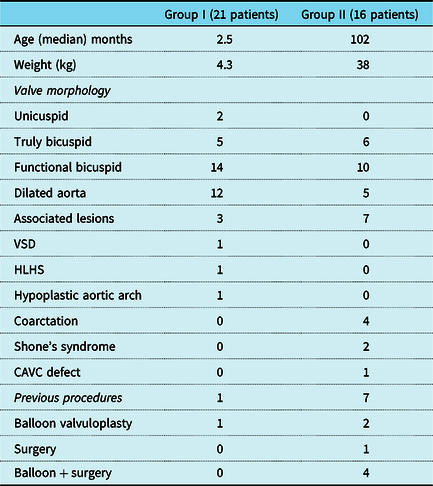
Basic demographic characteristics

CAVC: Complete Atrioventricular Canal, HLHS: Hypoplastic left heart syndrome, PDA: Patent ductus arteriosus, VSD: Ventricular septal defect
Statistical analysis
The Shapiro–Wilk test was used to determine whether data followed a normal distribution. Normally distributed continuous data were summarised as means and standard deviations. Skewed continuous distributions were summarised using medians and interquartile ranges.
One-way analysis of variance with Bonferroni correction was used to assess the impact of age group membership (neonate, infant, children over 12 months) in post-interventional gradient reduction. Univariate linear regression was used to identify variables potentially associated with higher max aortic gradient at the time of the post-balloon aortic valvuloplasty echo. Predictors found on univariate screening entered stepwise selection to build multivariate linear regression models. Paired t-test was used to perform continuous outcome comparisons when the difference between groups (before and after rapid right ventricular pacing-assisted balloon aortic valvuloplasty) followed a normal distribution. Otherwise, the Wilcoxon signed rank test was employed.
Freedom from at least moderate aortic regurgitation for neonates/infants was estimated using the Kaplan–Meier method. Cox-proportional hazard models were constructed to identify variables independently associated with survival and freedom from reintervention. Statistical significance was set at p < 0.05 for all comparisons and all p-values were two-sided. All statistical analyses were performed in STATA IC15 (StataCorp. College Station, TX: StataCorp LLC).
Results
Clinicopathologic features
A total of 37 children with congenital aortic stenosis (Group I: 21 neonates and infants <12 months and Group II: 16 children aged 1–16 years old) were treated with aortic balloon valvuloplasty (Table 1). Median age was 2.5 months (with a range from 1 day to 5.4 months) and 8.5 years (with a range from 1.5 to 16 years), and median weight 4.3 kg (with a range from 2.7 to 5.8 kg) and 38 kg (with a range from 7.7 to 61 kg) for Groups I and II, respectively. Ascending aorta dilation at presentation was noted in 17/37 (46%) patients, most of whom (n = 12/37) were either neonates or infants. Unicuspid and truly bicuspid aortic valves were noted in 2 (5%) and 11 (30%) of all children, respectively. Among the 24 (64%) patients with functionally bicuspid aortic valve, 10 had a raphe between the right and left coronary cusp, 8 between the left and the non-coronary cusps, and 6 a raphe in 2 commissural sites. Shone’s complex was diagnosed in 4 (11%) patients, all of whom had truly bicuspid valves. Of note, 8 (22%) patients (all of them but one in Group II) had history of prior surgical aortic valvotomy, balloon aortic valvuloplasty, or both before the study period. Median length of hospital stay post-intervention for Group I was 4 days (with a range from 3 to 6 days), whilst the older patients in Group II were hospitalised for 1 day.
Catheterization data
Mean balloon-to-annulus ratio was 0.94 and 0.88 in Group I and II, respectively. During catheterisation, left ventricular to aortic gradient was reduced from median of 66 mmHg (with a range from 30 to 125 mmHg) to 14 mmHg (with a range from 5 to 44 mmHg) in Group I, and from 44 mmHg (with a range from 28 to 93 mmHg) to 18 mmHg (with a range from 2 to 65 mmHg) in Group II (p < 0.001). Procedure and fluoroscopy times were similar in the two groups, with median procedure time of 65 minutes (with a range from 35 to 95 minutes) and fluoroscopy 9 minutes (with a range from 5 to 17 minutes) for Group I and 60 minutes (with a range from 35 to 95 minutes), and fluoroscopy 10 minutes (with a range from 6 to 17 minutes) for Group II. Median rapid right ventricular pacing rate was 200 bpm (with a range from 180 to 240) and 190 bpm (with a range from 180 to 250) in Groups I and II, respectively. Median left ventricular systolic pressure prior to intervention was similar in both groups and was reduced from 133 to 123 mmHg. The median aortic systolic pressure increased significantly post-intervention from 58 to 66 mmHg in Group I and from 85 to 104 mmHg in Group II. In both groups, the left ventricular end-diastolic pressure dropped by 2 mmHg post-intervention, median reduction from 17 to 15 mmHg in Group I and from 18.5 to 16.5 mmHg in Group II.
Balloon stability at the time of inflation was achieved in all cases with no balloon movement. Ventricular fibrillation occurred in three patients during rapid pacing (9.7%), all neonates, who were successfully defibrillated. Two of these neonates (one with evidence of left ventricular endocardial fibroelastosis) had very echogenic mitral valve chordae tendineae on admission echocardiography. The third neonate had evidence of right coronary artery thrombosis on the initial aortogram.
Echocardiographic data
Aortic valve maximum stenotic gradient dropped from 72 mmHg (with a range from 45 to 120 mmHg) to 36 mmHg (with a range from 17 to 55 mmHg) in Group I and from 74 mmHg (with a range from 60 to 115 mmHg) to 40 mmHg (with a range from 22 to 68 mmHg), in Group II, p < 0.001. On one-way analysis of variance with Bonferroni correction, max gradient reduction was significantly greater in infants compared to older children (difference-in-difference = 32.4 mmHg, p = 0.04). On univariate linear regression, systolic (p = 0.003) and mean (p = 0.004) ascending aortic pressure at catheterisation, procedure time (p = 0.01), fluoroscopy duration (p = 0.003), and history of prior aortic valve interventions or surgery (p = 0.003) were associated with higher max residual gradient on post-balloon aortic valvuloplasty cardiac echo. However, on multivariate regression, only longer procedure time (p = 0.01) and history of prior aortic valve procedures (p = 0.007) remained statistically significant.
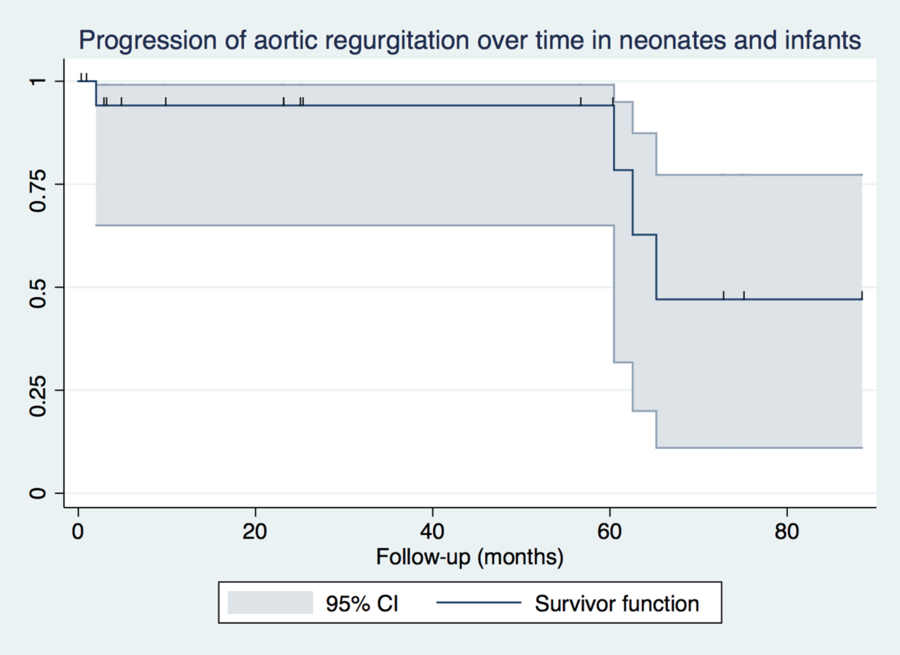
No patient was diagnosed with severe aortic regurgitation immediately after rapid right ventricular pacing-assisted balloon aortic valvuloplasty or during follow-up, hence no immediate or short-term operation was required for isolated aortic regurgitation. At their most recent echocardiogram, 45% of patients in Group I had no aortic regurgitation, 30% trace-mild, 20% mild-moderate, and 5% moderate aortic regurgitation, whereas in Group II, 50% of patients had no aortic regurgitation, 32% had mild aortic regurgitation, and 18% mild-moderate aortic regurgitation. Figure 1 depicts the Kaplan–Meier curve for Group I with respect to the progression of aortic regurgitation after balloon dilatation. Progression of aortic regurgitation over time is considered to occur due to progressive tearing, scarring, retraction, and calcification of the valve, even in the absence of major residual stenosis. Reference Balmer, Beghetti, Fasnacht, Friedli and Arbenz23 On Cox regression analysis, the presence of unicuspid valve (HR = 7.28, 95% CI: 1.15–45.82 p = 0.003) was predictive of moderate aortic regurgitation at follow-up.
Kaplan–Meier depicting the progression of aortic regurgitation over time in Group I.

Aortic valve reinterventions
Freedom from reintervention was 100% for Group I at a median time of 3.2 years (with a range from 1 month to 8 years) and 81% for Group II, at a median time of 2.7 ± 2.54 years (with a range from 4 months to 8.6 years). Reinterventions were performed in patients from Group II for mixed aortic valve disease but mainly aortic valve stenosis/small valvar annulus. The three surgical reinterventions performed were: one Ross operation, one Bentall operation, and one aortic valve replacement with aortic homograft. On Cox regression analysis, history of prior aortic valve intervention or surgery (HR = 2.85, 95% CI: 1.0–8.1, p = 0.04), presence of moderate aortic regurgitation prior to rapid right ventricular pacing-assisted balloon aortic valvuloplasty (HR = 18.3, 95% CI: 1.1–300.5, p = 0.04), and immediately after balloon aortic valvuloplasty (HR = 17.3, 95% CI: 1.5–195.7, p = 0.02) were associated with a higher risk of reinterventions.
During follow-up, only one patient (3.2%) with Shone’s complex aged 3 months died (cause of death was sepsis). At latest follow-up, only three patients (8%) were receiving pharmacologic treatment (two with moderate aortic regurgitation and one with mild-to-moderate aortic regurgitation) with single-dose medications (Valsartan 5 mg, Lisinopril 2.5 mg, Ramiprilat 2.5 mg).
Discussion
In the current era, most tertiary centres favour balloon aortic valvuloplasty as the first-line treatment for patients with severe congenital aortic stenosis because it does not require cardiopulmonary bypass, has shorter hospitalisation time, and yields similar outcomes with surgery. Nevertheless, according to a multicentre retrospective analysis of over 1000 balloon procedures, 21% of the patients had grade II aortic regurgitation, 10% had grade III, and 3% had grade IV at a median follow-up of 32 months post-balloon aortic valvuloplasty. Reference Ewert, Bertram and Breuer24
Percutaneously-treated patients may develop aortic regurgitation, which can be moderate to severe in approximately 15% of the cases Reference Alva, Sanchez and David13–Reference Brown, Dipilato, Chong, Lock and McElhinney16 and can progress over time. Reference Galal, Rao, Al-Fadley and Wilson15 Valves with lesser fusion and larger pre-balloon aortic valvuloplasty opening areas have higher rates of leaflet tears which are associated with aortic regurgitation. Reference Petit, Gao and Goldstein25 Technical challenges during balloon aortic valvuloplasty can predispose to post-interventional aortic regurgitation as well. Indeed, cardiac contraction and pulsatile blood flow can cause displacement of the balloon during inflation, leading to potential damage to the aortic valve. The most commonly used method to achieve balloon stability in older children and adults is nowadays rapid right ventricular pacing, as it decreases stroke volume, blood pressure, and transvalvular flow without causing cardiac standstill. Reference David, Sanchez and Yanez5–Reference Ing, Boramanand, Mathewson, Maginot and Perry9,Reference Gupta, Das, Ghose, Sarkar, Goswami and Kundu12 Published studies have evaluated the use of rapid pacing for transcatheter valvuloplasty in older infants and children, but not in neonates. All teams utilised rapid pacing from the outset of the procedure, except for Daehenert et al Reference Daehnert, Rotzsch, Wiener and Schneider6 who resorted to rapid right ventricular pacing only after failure of a non-paced balloon placement attempt. Among 72 reviewed patients, one developed (1.4%) ventricular fibrillation and was defibrillated successfully. Reference David, Sanchez and Yanez5–Reference Mehta, Desai, Shebani, Stickley and Giovanni7,Reference Ing, Boramanand, Mathewson, Maginot and Perry9,Reference Gupta, Das, Ghose, Sarkar, Goswami and Kundu12
Rapid right ventricular pacing onset and duration can be tailored to the needs of each procedure. Rapid right ventricular pacing is also superior to rapid atrial pacing since it is associated with asynchronous contraction of the atria, leading to a more pronounced drop in cardiac output for an equivalent pacing rate. Reference Mehta, Desai, Shebani, Stickley and Giovanni7 Maximum aortic valvular gradient after aortic dilatation with pacing decreases substantially as documented both in our study and in prior published work. Reference David, Sanchez and Yanez5–Reference Ing, Boramanand, Mathewson, Maginot and Perry9,Reference Gupta, Das, Ghose, Sarkar, Goswami and Kundu12 In older children and adults, rapid right ventricular pacing should be employed from the start of the procedure, since even a single balloon displacement event can be enough to damage the aortic valve. Reference David, Sanchez and Yanez5,Reference Mehta, Desai, Shebani, Stickley and Giovanni7,Reference Sanchez, David and Velazquez8 Overall, our institutional cohort of Group II had similar rates of aortic insufficiency at baseline and after balloon dilatation compared to published textbook outcomes on rapid right ventricular pacing. However, Group I where rapid right ventricular pacing was routinely utilised, had significant lower rates of aortic regurgitation compared to published work, Reference Luciani, Lucchese and Carotti26,Reference McElhinney, Lock, Keane, Moran and Colan27 hence no surgical bail-out procedures have been required to date. Not surprisingly, patients with unicuspid aortic valves were at an increased risk of developing more aortic regurgitation despite the use of rapid pacing during transcatheter procedures. However, it should be emphasised that no cases of severe aortic regurgitation have ever been reported where rapid pacing was utilised and the same applied to both our groups examined.
Despite its documented benefits in older patients, rapid right ventricular pacing has not been universally employed in the youngest population of neonates and infants; therefore, the outcomes of rapid right ventricular pacing in patients with congenital aortic valvar stenosis under the age of 12 months are largely unknown. The absence of a unified approach on pacing all neonates and infants during balloon aortic valvuloplasty is based on the hypothesis that the low stroke volumes (1–1.5 ml/kg), higher neonatal heart rates, and occasionally low ejection fraction, are unable to cause uncontrolled balloon movement and valvar damage. This theory, however, fails to explain why surgical bail-out procedures for post-valvuloplasty severe aortic regurgitation have been repeatedly reported for neonates and infants who were subjected to aortic valvuloplasty without rapid pacing. Achieving as little as possible, aortic regurgitation post-balloon valvuloplasty is crucial for neonates and young infants, in whom the performance of bail-out Ross procedures have been associated with very poor outcomes and increased mortality. Reference Luciani, Lucchese and Carotti26 There is no contraindication in using rapid right ventricular pacing in neonates and infants as it has already been implemented in patients as young as 1 day old (3 kg) to facilitate three-dimensional rotational angiography. Reference Peters, Krings, Koster, Molenschot, Freund and Breur28 On the contrary, not employing rapid right ventricular pacing during balloon aortic valvuloplasty may lead to low freedom from reintervention in children less than 60 days old (65% at 1 year, 48% at 5 years, and 29% at 10 years) as McElhinney et al have reported. Reference McElhinney, Lock, Keane, Moran and Colan27
We observed in our series that achieving a more-controlled aortic valve dilatation with rapid right ventricular pacing, even in neonates and infants with high heart rates, low ejection fraction, and stroke volume, can reduce aortic regurgitation significantly and delay surgical reinterventions. Indeed, none of the neonates in our series have required either short- or long-term interventions at a median of 3.2 years, ranging from 1month follow-up to 8 years. Three of the neonates (3/21, 14%) have mild-moderate or moderate aortic regurgitation and are on medication, although asymptomatic with left ventricular sizes within normal limits.
According to our analysis, catheter-measured aortic valve gradient reduction, procedure and fluoroscopy times as well as balloon:annulus ratio were very similar in the two groups. Echocardiographic gradient reduction was significant in both groups. Not surprisingly, neonates and infants had higher catheter-measured aortic valve gradients [66 mmHg (with a range from 30 to 125 mmHg) in Group I versus 44 mmHg (with a range from 28 to 93 mmHg) in Group II] and therefore maximum gradient reduction was significantly greater in neonates and infants compared to older children. Overall, freedom from reintervention across all age groups was 91% with median time to reintervention of 2.7 years for predominantly aortic stenosis in patients who did not have adequate relief of the stenosis by the valvuloplasty. The marked difference in reintervention rates in neonates and infants supports the role of rapid pacing in reducing the need for additional procedures following transcatheter aortic valvuloplasty.
Rapid right ventricular pacing has been reported to have certain drawbacks, such as prolonging operative time and potentially increasing the risk of cardiac perforation and pneumothorax (if done from the jugular/subclavian vein), Reference Mehta, Shebani, Grech and Degiovanni18 but this did not hold true in our series. Moreover, it has been suggested that rapid ventricular pacing may increase the risk of sustained ventricular arrhythmias compared to the baseline risk of cardiac catheterisation (less than 1%). Reference Slicker, Lane and Oyetayo29 In our institutional series, three neonates (8%) developed ventricular fibrillation at the onset of rapid right ventricular pacing and were successfully defibrillated. Their procedures were completed with rapid right ventricular pacing at lower pacing rates by 20 bpm. Two of them that developed dysrhythmia and required cardioversion had very echogenic mitral valve chordae tendineae on admission echocardiography indicating intrauterine ischemia and fibrosis that created a more arrhythmogenic substrate. One of these patients also had evidence of generalised endocardial fibroelastosis. The third neonate had right coronary artery thrombosis as evidenced on the initial aortogram. Reference Tzifa, Avramidis and Patris30 Therefore, we hypothesise that rapid right ventricular pacing may lead to increased risk of dysrhythmia in neonatal patients with additional risk factors of ischemia and/or endocardial fibroelastosis, although this observation will need further validation.
Balloon valvuloplasty versus aortic valvotomy
Balloon dilatation and surgical aortic valvotomy are competing management options for paediatric patients with severe aortic stenosis. A recent meta-analysis compared outcomes of 1835 patients treated with balloon aortic valvuloplasty to 533 patients who underwent surgical valvotomy by dedicated aortic valve surgeons. Reference Hill, Ginde, Rios, Frommelt and Hill4 No difference was identified in terms of post-intervention peak systolic Doppler gradient, in-hospital mortality, and 10-year survival rates. Although freedom from aortic valve replacement was similar in both groups (balloon aortic valvuloplasty: 76%; surgical aortic valvotomy: 81%), patients treated with balloon aortic valvuloplasty (46%) had significantly lower 10-year freedom from reinterventions compared to surgery (73%), irrespective of age. Timing to reintervention varies but has been reported to be nearly four times longer for patients that were initially treated with surgical aortic valvotomy (8.6 ± 4.9 years) versus balloon aortic valvuloplasty (2.5 ± 2.5 years). Reference Brown, Rodefeld, Ruzmetov, Eltayeb, Yurdakok and Turrentine31 However, it needs to be stated that comparison has been based on balloon aortic valvuloplasty patient cohorts that did not universally have balloon dilation under rapid pacing.
Post-balloon aortic valvuloplasty procedures include aortic valve replacement (17–33%, including about 15–22% Ross operation), surgical valvuloplasty (8%), and second balloon dilation (10–25%). Reference Brown, Rodefeld, Ruzmetov, Eltayeb, Yurdakok and Turrentine31–Reference Hochstrasser, Ruchat, Sekarski, Hurni and von Segesser34 Third balloon aortic valvuloplasty is rarely attempted (<4%). Reference Han, Gurofsky and Lee33 For the surgical group, typical reinterventions are aortic valve replacements (13–28%, including about 8–22% Ross aortic valve replacements), repeat valvotomies (6–8%), and balloon dilations (4–6%). Reference Brown, Rodefeld, Ruzmetov, Eltayeb, Yurdakok and Turrentine31–Reference Han, Gurofsky and Lee33 Aortic homograft is almost never used regardless of the initial repair (<1%). Reference Hochstrasser, Ruchat, Sekarski, Hurni and von Segesser34 Interestingly, no studies have formally evaluated the impact of surgical adhesions on intra-operative and post-operative outcomes of follow-up operations, especially ones that involve transfer of the coronary arteries or defining the pulmonary artery and valve if a Ross operation is planned. Also, although in the past, surgical aortic valvotomy was limited to blind transapical dilatation of the valve or simple blade commissurotomy, surgical technique has evolved and nowadays includes de-bulking aortic valve leaflets from all thickening/nodular dysplasia and resuspending with patches the incised unsupported portion of the leaflets. Reference Han, Gurofsky and Lee33,Reference Donald and Konstantinov35 Such specialised procedures, however, are performed by dedicated neonatal cardiac surgeons with relevant experience in neonatal aortic valve repair.
Strengths and limitations
Our study was performed at a European referral centre and enrolled patients in the last decade. Therefore, our data accurately mirror the benefits of using current rapid right ventricular pacing technology to perform balloon aortic valvuloplasty in congenital aortic stenosis across all ages. To our knowledge, this is the first study to describe outcomes of rapid right ventricular pacing in neonates and infants with congenital aortic valvar stenosis. Nonetheless, this was a retrospective study and further prospective data may be required. Also, although the presence of unicuspid valve was predictive of moderate aortic regurgitation at follow-up with a very high degree of significance (p = 0.003), this was obtained for an independent variable present in only 10% of 21 patients. There is an extremely wide confidence interval (HR = 7.28, 95% CI: 1.15–45.82), as the result of a low number of patients. Therefore, it should be interpreted with caution.
Conclusions
Rapid right ventricular pacing is an effective and safe procedure that helps stabilise the balloon during balloon aortic valvuloplasty and may help decrease subsequent aortic regurgitation rates. The technique can be safely extended to the neonatal and infant population and may help decrease the need for high-risk surgical bailout procedures in the first year of life. Neonates with a predisposition to ischemia and/or endocardial fibroelastosis may be at increased risk of ventricular dysrhythmias during rapid pacing.
Acknowledgements
None.
Financial support
This research did not receive any specific grant from funding agencies in the public, commercial, or not-for-profit sectors.
Conflicts of interest
None.
Ethical standards
Institutional Ethics Committee approval.